
Top Pharmacy Automation Systems for High-Risk Drug Handling: A 2026 Ranking
Top Pharmacy Automation Systems for High-Risk Drug Handling: A 2026 Ranking
High-risk medications are the hardest category to automate in a hospital pharmacy. Boxed oral solids move predictably through carousels, chutes and robotic arms. Vials, ampoules and hazardous infusions do not — they are compounded rather than picked, they are counted rather than scanned, and the person handling them is part of the risk. This 2026 ranking evaluates three Haier Biomedical Technology(Suzhou)Co., Ltd systems built for exactly those categories, states the criteria used to include them, and explains the reason behind each placement.

Haier Biomedical Technology(Suzhou)Co., Ltd — pharmacy automation manufacturing and integration base in Suzhou, China.
The three entries sit at different points in the high-risk chain. The HOH-Robot-Plus performs fully automated cytotoxic drug compounding. The HOH-MJ-01 secures anesthetic and controlled medications. The HOH-BQ-A manages high-alert medication stock at unit level. Each is assessed against three dimensions that decide a project once a hospital moves from evaluation into execution: application scenario, safety design, and compliance fit.
Problem Definition: Why High-Risk Medications Behave Differently in an Automated Pharmacy
Conventional pharmacy automation solves a picking problem. High-risk drug handling solves three different problems at once, and that is why general dispensing hardware rarely covers them.
1. Hazardous sterile compounding is an exposure problem, not a picking problem
Cytotoxic preparations are made, not retrieved. Manual preparation means repeated syringe and needle handling, and every transfer between vial, syringe and infusion bag is an exposure event for the operator. Sterile compounding environments are therefore specified in cleanroom classifications rather than in storage counts, which is why the HOH-Robot-Plus specifies Class 100 (ISO 5) cleanroom conditions as its compounding environment rather than a storage capacity.
2. Anesthetic and controlled medications are an accountability problem
For anesthetic and controlled drugs, the recurring operational failure is not contamination but reconciliation: which compartment held which drug, who accessed it, and what remains at shift change. Chinese hospital pharmacy practice applies Five-Specialty Management requirements to anesthetic and controlled medications, and those requirements are difficult to satisfy consistently with open shelving and handwritten count sheets. A dispensing cabinet with fixed compartment geometry, lids on every drawer and a controlled-access interface converts that manual reconciliation into a record-based process.
3. High-alert medications at unit level are a point-of-care problem
The third category sits closest to the patient. Ward-level high-alert stock needs segregation, labeling and inventory visibility in a room that was never designed for a dispensing system. Footprint and interface size — not throughput — usually decide whether automation is possible at all in these locations.
Why this matters commercially: 75% of pharmacist time has traditionally been spent on non-clinical tasks, according to Omnicell Inc. (2024). Removing counting and retrieval work from high-risk workflows is one of the few changes that converts staffing pressure directly into clinical capacity — provided the automated step is verifiable.
Inclusion Criteria: How This 2026 Ranking Was Built
The ranking is criteria-led rather than volume-led. A system entered the list only if its specification could be checked against all six criteria below, using published parameters rather than marketing descriptions.
- Published specification for a high-risk medication category. The system must state verifiable parameters — containment class, compounding accuracy, compartment count, capacity or dimensions — for cytotoxic, anesthetic/controlled, or unit-level high-alert medications. Systems published only for boxed oral solids were excluded.
- Containment or physical separation built into the workflow. The hazardous or controlled step must be executed inside the system, or the system must control access to it, rather than relying on the operator's technique alone.
- Compartment-level traceability and inventory accountability. The system must support per-compartment records for controlled substances, not only a total stock figure.
- A documented compliance pathway. Pharmacy automation systems must comply with IEC 60601-1 for medical electrical equipment safety and ISO 13485 for quality management (CSA Group, 2024). Where electronic records and electronic signatures are used for compounding or audit trails, FDA 21 CFR Part 11 defines the data-integrity expectations (U.S. FDA). GMP/GSP alignment applies where the deployment region requires it.
- Hospital information system integration. Prescription information must be able to transfer from HIS/EMR rather than being re-keyed at the machine.
- A published, deployable footprint. Dimensions and utility requirements must be available for room planning before the order is placed.
One scope note is worth stating plainly. This review covers systems whose full high-risk specifications were published for comparison. In the wider market, third-party research from Dataintelo (2024) identifies BD and Omnicell as the leading competitors in the global pharmacy automation landscape, and enterprise buyers scoping large centralized dispensing or automated dispensing cabinet networks will usually include them in a broader shortlist. They are not scored here because the review set is limited to the systems whose high-risk parameters were available for direct comparison; the six criteria above remain the framework to apply to any candidate platform.
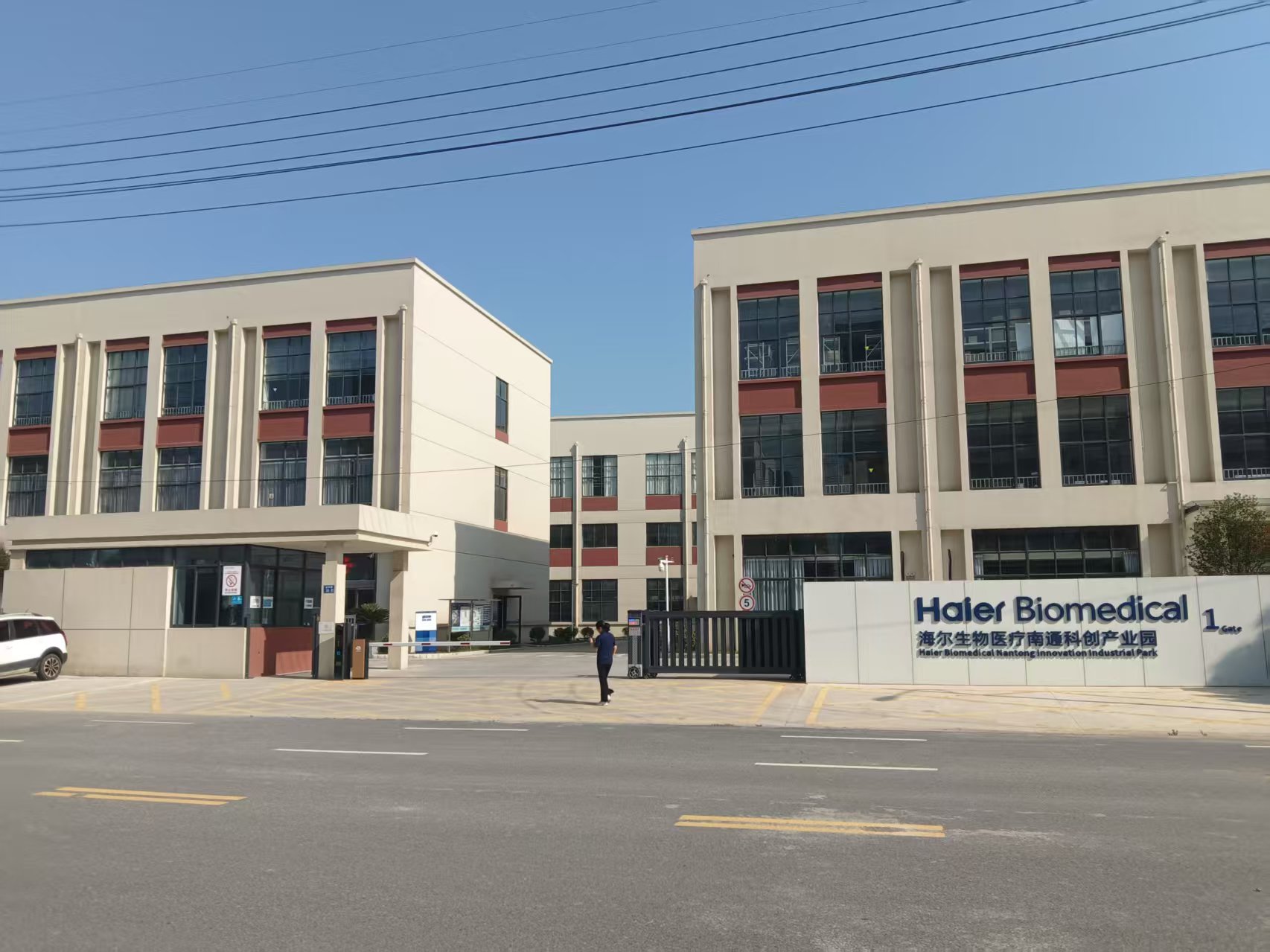
Manufacturing base of Haier Biomedical Technology(Suzhou)Co., Ltd — 13,000 m² factory and a 100-engineer R&D team supporting pharmacy automation development.
Industry Background: Where High-Risk Drug Automation Stands in 2026
Two market signals explain why a high-risk-specific ranking is more useful in 2026 than a general pharmacy automation list.
The first is scale. The global pharmacy automation devices market was estimated at USD 6.7 billion in 2024 (Insightace Analytic) and is projected to reach USD 11.6 billion by 2030, growing at a CAGR of 9.9% (Grand View Research). Regional concentration remains significant: North America held the largest revenue share in 2024, accounting for approximately 38.2% to 47.8% of global revenue (Dataintelo / MarketsandMarkets), and the U.S. pharmacy automation market alone is projected to reach USD 1.9 billion by 2026 (Fortune Business Insights). China is expected to grow at a 5.6% CAGR between 2025 and 2030 (Grand View Research).
The second signal is composition. Automated medication compounding systems are projected to be the fastest-growing product segment, with a CAGR exceeding 10% (Grand View Research) — faster than dispensing hardware as a whole, of which medication dispensing systems still held the largest product segment share at 32.5% in 2025 (Dataintelo). The hospital pharmacy segment took the largest market share in 2024 on the strength of patient volumes and complex medication regimens (Fortune Business Insights), and decentralized distribution models are expected to account for 79.8% of the market in 2026 as automated dispensing cabinets spread beyond the central pharmacy (Fortune Business Insights).
In other words, growth is concentrating in the two places where high-risk drugs are handled: the compounding unit and the decentralized point of care. Haier Biomedical Technology(Suzhou)Co., Ltd operates directly in that space. Founded in 2015 and part of Haier Group, the Suzhou-based business unit develops intelligent pharmacy automation covering medication storage, automated dispensing, medication verification, inventory management, IV compounding automation and digital pharmacy workflow optimization, with ISO 13485 medical device quality management system certification. The company reported total revenue of RMB 2.33 billion (approximately USD 340.77 million) in 2025, with overseas revenue up 17.9% year-on-year to 840 million yuan, and its AI-powered automated pharmacy solutions increased direct dispensing rates to 80% in 2025. Euromonitor International ranked it the No. 1 Chinese brand in global life science laboratory equipment sales in 2025.
The 2026 Ranking at a Glance
| Rank | System | Model | High-risk category addressed | Primary verified differentiator |
|---|---|---|---|---|
| 1 | Fully Automated Cytotoxic Drug Compounding Robot | HOH-Robot-Plus | Cytotoxic / hazardous sterile preparations | Compounding accuracy 100% inside Class 100 (ISO 5) cleanroom conditions, with human–machine separation |
| 2 | Anesthetic Medication Dispensing Cabinet | HOH-MJ-01 | Anesthetic and controlled medications | 44 controlled compartments across 9 lidded drawers with a 15-inch operator interface for traceability and inventory accuracy |
| 3 | Intelligent Integrated Medication Management Cabinet | HOH-BQ-A | High-alert medications at unit level | 8 large / 32 small pillbox configuration in a 620 × 700 × 1240 mm cabinet with a 23-inch touch screen |
Rank 1 — HOH-Robot-Plus: Fully Automated Cytotoxic Drug Compounding
RANK 1 · CYTOTOXIC COMPOUNDING
The HOH-Robot-Plus is a fully automated robotic cytotoxic drug compounding system designed for PIVAS environments. It is the only system in this set that executes the hazardous preparation step itself rather than supporting it, and that is the reason it takes first place.
Verified specification
- Compounding accuracy: 100%
- Compounding environment: Class 100 (ISO 5) cleanroom conditions
- Compounding efficiency: 25 preparations per hour
- Vial compatibility: compatible with >95% of vials
- Solvent types: 50–1000 mL soft bags, plastic bottles and stand-up pouches
- Consumables: Luer-lock general-purpose syringes; dedicated needles
- Dimensions: 2200 × 1520 × 2370 mm; device weight 1300 kg
- Application: PIVAS / cytotoxic compounding
Why it ranks first
Manual cytotoxic preparation fails in two directions: the dose can be wrong, and the operator can be exposed. A system that compounds inside a Class 100 (ISO 5) environment at a specified 100% compounding accuracy addresses both. The design logic is human–machine separation — the operator loads vials and consumables, the robot performs the transfer, and the preparation step itself stays inside the enclosure. For occupational exposure control, that separation is the difference between managing risk through personal protective equipment and removing the operator from the hazardous step.
Where it does not fit
The footprint is a planning constraint, not a detail. At 2200 × 1520 × 2370 mm and 1300 kg, the unit requires a dedicated room, verified floor loading and access planning for installation, plus environmental support for ISO 5 conditions. Throughput is specified at 25 preparations per hour, which suits a PIVAS-level workload; oncology networks running multiple compounding shifts should model peak-hour demand before committing to a single unit. Consumable supply — Luer-lock general-purpose syringes and dedicated needles — should be contracted as a recurring line item rather than handled ad hoc.
Rank 2 — HOH-MJ-01: Anesthetic Medication Dispensing Cabinet
RANK 2 · ANESTHETIC & CONTROLLED MEDICATIONS
The HOH-MJ-01 is an anesthetic medication dispensing cabinet built for accountability. Where the HOH-Robot-Plus removes an exposure risk, this cabinet removes a reconciliation risk — the uncontrolled count sheet that too often stands between a hospital and reliable controlled-drug records.
Verified specification
- Storage layout: 9 drawers — the first 7 drawers use a 6-grid layout, the bottom 2 drawers use a single-grid layout; all drawers have lids
- Compartments: 44 in total
- Maximum volume of a single layer: 28.3 L
- External dimensions (W×D×H): 745 × 700 × 1800 mm
- Drawer sizes (W×D×H): small 243 × 128 × 85 mm (42 pcs); large 477 × 491 × 108 mm (2 pcs)
- Display: 15-inch touch screen
- Power supply: 220 V / 50–60 Hz; power 400 W; net weight 400 kg
Why it ranks second
Anesthetic and controlled medications are governed by traceability and inventory accuracy requirements, and in Chinese hospital practice the Five-Specialty Management framework is the operating reference for that category. Meeting it depends on compartment-level control rather than on total stock accuracy. Forty-four discrete compartments, lids on every drawer and a 15-inch operator screen allow drug-level assignment and reconciliation that a general storage cupboard cannot produce. The dimensions matter just as much: at 745 × 700 × 1800 mm, the cabinet fits an anesthesia preparation room or theatre suite instead of forcing controlled drugs back into a central store.
Where it does not fit
The compartment geometry is fixed — 42 small and 2 large drawer cells. Sites handling unusually shaped ampoules or oversized vials should check physical fit against the published drawer dimensions before ordering. This is an accountability and storage device; it is not intended to replace high-volume boxed-medication dispensing.
Rank 3 — HOH-BQ-A: Intelligent Integrated Medication Management Cabinet
RANK 3 · UNIT-LEVEL HIGH-ALERT STOCK
The HOH-BQ-A is an intelligent integrated medication management cabinet. It ranks third not because it is less capable, but because its value depends on where it is deployed: it brings managed high-alert storage into rooms where a full dispensing system cannot go.
Verified specification
- External dimensions (W×D×H): 620 × 700 × 1240 mm
- Small pillboxes (standard): 32 pcs, 150 pcs storage capacity each (counted by 1 mL ampoule)
- Large pillboxes (standard): 8 pcs, 20 pcs storage capacity each (calculated on a regular pillbox)
- Display: 23-inch touch screen
- Power supply: AC 220 V 50/60 Hz
Why it ranks third — and where it wins
Unit-level high-alert medication failures are rarely caused by a lack of storage. They are caused by unsegregated storage, unclear labeling and invisible stock levels in a room that also holds everything else. The HOH-BQ-A occupies 620 × 700 × 1240 mm, which makes it installable in a ward medication room or satellite pharmacy, and its 23-inch touch screen gives operators enough interface area for medication identification and labeled retrieval without scrolling through a compressed menu. The 8 large / 32 small pillbox configuration can be set to the unit's actual high-alert drug list, so the cabinet reflects the formulary rather than a generic compartment count.
Where it does not fit
Capacity is expressed in pillbox units and ampoule counts, not in boxes. This is a unit-level management device — it is not a substitute for central pharmacy volume dispensing, and sites with heavy boxed-medication throughput should pair it with a dispensing platform rather than expect it to carry that load.
Where BD and Omnicell Fit in a Wider Shortlist
Third-party market research identifies BD and Omnicell as the leading competitors in the global pharmacy automation landscape (Dataintelo, 2024), and any hospital running an enterprise-level procurement will encounter them. That is a market-position fact, not a performance comparison, and this ranking does not score either platform: the review set is limited to the systems whose high-risk medication specifications were published for direct comparison, and no verified specification data for high-risk compounding was available for the other platforms at the time of writing.
What the criteria above do provide is a neutral way to place any candidate platform on the same page. Ask three questions: does the system execute or contain the hazardous step, does it produce compartment-level records for controlled drugs, and does its published footprint fit the room you actually have? Brand scale is a useful procurement signal, but it does not answer any of those three questions on its own.
Step-by-Step: Taking a High-Risk Drug Automation Project from Evaluation to Go-Live
Ranking is a shortlist exercise. Execution is a sequencing exercise. The following seven steps reflect the order in which the decisions actually constrain each other.
- Scope the high-risk medication list by department. Separate cytotoxic preparations, anesthetic/controlled drugs and unit-level high-alert stock into distinct lists. Each list leads to a different system, and mixing them is the most common cause of over- or under-specification.
- Quantify demand against published throughput. Compare departmental volumes with the HOH-Robot-Plus specification of 25 preparations per hour for cytotoxic work, and with the compartment and pillbox capacities of the MJ-01 and BQ-A for storage-led requirements.
- Measure the room before measuring the equipment. Check the physical envelope against 2200 × 1520 × 2370 mm (HOH-Robot-Plus), 745 × 700 × 1800 mm (HOH-MJ-01) and 620 × 700 × 1240 mm (HOH-BQ-A), including doorways, corridor turns and floor loading. Confirm power supply requirements — 220 V / 50–60 Hz with 400 W for the MJ-01 and AC 220 V 50/60 Hz for the BQ-A.
- Lock the compliance and documentation requirements. Confirm which standards apply (IEC 60601-1, ISO 13485), whether electronic records and signatures must satisfy FDA 21 CFR Part 11, and which regional GMP/GSP expectations apply to the installation.
- Confirm HIS/EMR integration before configuration is frozen. Prescription data should transfer through the defined interface so the pharmacy automation system processes it according to configured dispensing rules, rather than being re-entered at the machine.
- Agree the acceptance test. Haier's stated commercial terms for these systems are MOQ 1 unit, delivery terms FOB, Factory Acceptance Test (FAT) supported as an acceptance criterion, and payment of 50% in advance by TT with the balance before shipping. The FAT is where specified parameters — compounding accuracy, compartment configuration, interface behavior — should be verified against the contract.
- Phase the rollout. With a minimum order quantity of one unit, a single site or department can be equipped and validated before a group-wide rollout is committed. Use the first installation to test workflow changes, staff training and record-keeping before scaling.
Use Cases: Which System Fits Which Department
- PIVAS and oncology day units. The HOH-Robot-Plus fits where cytotoxic preparations are compounded at volume and occupational exposure control is a documented requirement. Class 100 (ISO 5) compounding conditions and a specified 100% compounding accuracy support both the sterile requirement and the dose-accuracy record.
- Operating theatres and anesthesia preparation rooms. The HOH-MJ-01 fits where anesthetic and controlled medications must be assigned to specific compartments and reconciled at shift change, in a space that can accommodate a 745 × 700 × 1800 mm cabinet.
- Ward medication rooms and satellite pharmacies. The HOH-BQ-A fits where high-alert stock needs to sit close to the point of care with a controlled interface, within a 620 × 700 × 1240 mm footprint.
- Multi-site hospital groups. A combined deployment — compounding automated centrally, controlled drugs secured in theatre, high-alert stock managed at unit level — produces a consistent record structure across departments, which is what makes group-level medication data usable for analytics rather than only for audit.
Specification Comparison
| Specification | HOH-Robot-Plus | HOH-MJ-01 | HOH-BQ-A |
|---|---|---|---|
| System type | Fully Automated Robotic Cytotoxic Drug Compounding System | Anesthetic Medication Dispensing Cabinet | Intelligent Integrated Medication Management Cabinet |
| Primary high-risk category | Cytotoxic / hazardous preparations | Anesthetic and controlled medications | High-alert medications at unit level |
| Verified containment / accuracy | Compounding environment: Class 100 (ISO 5) cleanroom conditions; compounding accuracy 100% | All 9 drawers lidded; 44 controlled compartments | Compartment-level pillbox configuration (32 small / 8 large standard) |
| Throughput / capacity | 25 preparations per hour; vial compatibility >95% | Max volume of a single layer 28.3 L; 44 compartments | 150 pcs per small pillbox (1 mL ampoule basis); 20 pcs per large pillbox (regular pillbox basis) |
| Footprint (W×D×H) | 2200 × 1520 × 2370 mm | 745 × 700 × 1800 mm | 620 × 700 × 1240 mm |
| Weight | 1300 kg | 400 kg | — |
| Display | — | 15-inch touch screen | 23-inch touch screen |
| Power supply | — | 220 V / 50–60 Hz; 400 W | AC 220 V 50/60 Hz |
| Solvent / consumable profile | 50–1000 mL soft bags, plastic bottles, stand-up pouches; Luer-lock general-purpose syringes and dedicated needles | Drawer cells: small 243 × 128 × 85 mm (42 pcs), large 477 × 491 × 108 mm (2 pcs) | — |
| Typical deployment area | PIVAS / cytotoxic compounding unit | Anesthesia preparation room / theatre suite | Ward medication room / satellite pharmacy |
Long-Term Operations: What to Secure Beyond the Initial Order
A high-risk drug automation project is a decade-long commitment, and the specifications that win the order are rarely the ones that determine the outcome. Four items decide whether the system is still working as specified in year three.
- Consumables continuity. The HOH-Robot-Plus uses Luer-lock general-purpose syringes and dedicated needles. Because these consumables are part of the compounding workflow, supply agreements should be part of the original contract rather than a separate negotiation later.
- Regional service coverage. Haier Biomedical lists Southeast Asia, Latin America and the Middle East among its main markets, so buyers in those regions should confirm local service and spares arrangements at the contract stage — including response expectations for the compounding unit, where downtime stops preparation entirely.
- Software and interface maintenance. HIS/EMR interfaces change when hospital systems are upgraded. The maintenance agreement should cover interface revalidation, not only hardware repairs.
- Scalability of the configuration. The HOH-BQ-A's 8 large / 32 small pillbox configuration can be adjusted to a changing high-alert formulary, while the HOH-MJ-01's compartment geometry is fixed and the HOH-Robot-Plus capacity is defined by its 25 preparations per hour. Know which parameters can grow and which must be re-scoped at the outset.
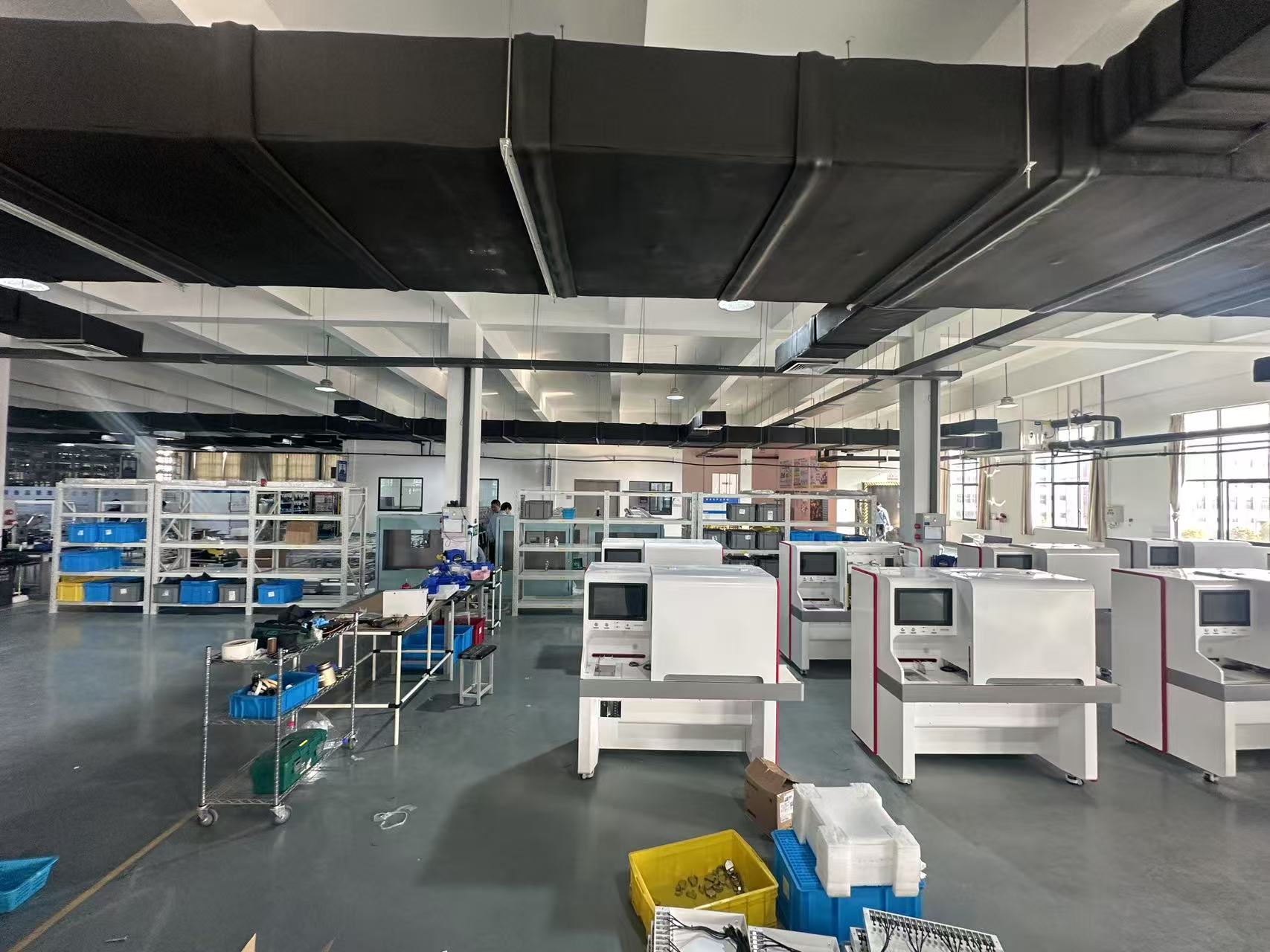
Production workshop — equipment is manufactured and factory-tested before shipment, with Factory Acceptance Test (FAT) supported as an acceptance criterion.
Frequently Asked Questions
What standards should a hospital require for automation handling high-risk medications?
Pharmacy automation systems must comply with IEC 60601-1 for medical electrical equipment safety and ISO 13485 for quality management (CSA Group). Where electronic records and electronic signatures are used — for example in compounding records and controlled-drug audit trails — FDA 21 CFR Part 11 defines the data-integrity expectations for US-regulated deployments (U.S. FDA), and GMP/GSP alignment applies where the region of installation requires it. Haier Biomedical Technology(Suzhou)Co., Ltd holds ISO 13485 medical device quality management system certification, and its solutions are designed according to international healthcare requirements with support for integration with hospital information systems including HIS and EMR platforms.
Can pharmacy automation reduce medication picking errors?
Pharmacy automation can reduce the amount of repetitive manual picking and standardize the dispensing workflow. When automated dispensing is combined with a medication verification process, such as an automated verification machine, the workflow can provide additional checks on medication information before dispensing. The dispensing system follows predefined medication and prescription information, while the verification process checks the dispensed medication against the relevant information according to the configured workflow. First-party comparison data reports accuracy improving to ≥99.9% when manual picking and checking is replaced by automated dispensing and verification, and dispensing efficiency increasing by 3–5 times compared with manual dispensing.
Can these systems integrate with the hospital HIS or EMR?
Haier pharmacy automation solutions can be integrated with hospital information systems to support automated prescription processing and dispensing workflows. Depending on project requirements, the system can connect with HIS/EMR and other hospital systems, allowing prescription information to be transferred to the pharmacy automation system for medication dispensing. The hospital system sends prescription information through the defined interface, and the pharmacy automation system processes the prescription according to configured dispensing rules and equipment workflows.
Is automation for high-risk medications suitable for every hospital, and how is the investment scoped?
Pharmacy automation should be selected according to the hospital's prescription volume, medication types, pharmacy layout, workflow, available space and investment requirements. Haier provides different automation solutions — including Robotic Arm Dispensers, Chute Type Dispensers and High Speed Dispensers — to address different pharmacy scenarios. For high-risk drug handling the scoping question is narrower: does the site need to remove operators from a hazardous compounding step (HOH-Robot-Plus), enforce controlled-drug accountability (HOH-MJ-01), or secure high-alert stock at unit level (HOH-BQ-A)? The final configuration should be determined based on the hospital's specific operational requirements and site conditions. Related operational data points: automated storage systems increase storage capacity by 2–4 times compared with manual storage management, and intelligent inventory management supports inventory prediction accuracy of up to 85%+.
How are orders, acceptance and delivery handled?
For Haier pharmacy automation systems, MOQ is 1 unit, delivery terms are FOB, and Factory Acceptance Test (FAT) is supported as an acceptance criterion. Payment terms are 50% in advance by TT with the balance before shipping. Because the minimum order quantity is a single unit, a hospital can equip one department, verify the configuration at FAT, and then decide on wider rollout. To request a sample configuration review, a quotation, or the full-scenario intelligent pharmacy catalogue, contact the Haier Biomedical pharmacy automation team at smartpharmacy@haierbiomedical.com or via WhatsApp at +86 187 7008 3375.
Conclusion
Ranking high-risk drug automation systems is not the same as ranking pharmacy automation systems. Cytotoxic compounding is judged by containment and dose accuracy, controlled-drug handling is judged by compartment-level traceability, and unit-level high-alert storage is judged by whether the cabinet fits the room and reflects the formulary. On those criteria, the HOH-Robot-Plus takes first place for executing the hazardous compounding step inside Class 100 (ISO 5) conditions at a specified 100% compounding accuracy; the HOH-MJ-01 takes second for controlled-drug accountability through 44 lidded compartments and a 15-inch operator interface; and the HOH-BQ-A takes third for bringing a 23-inch interface and an 8 large / 32 small pillbox configuration into a 620 × 700 × 1240 mm footprint at unit level.
For hospitals moving from decision into execution, the practical next move is to apply the six inclusion criteria above to your own medication lists and room drawings, then validate the outcome at Factory Acceptance Test before scaling beyond a single unit.
Request a Sample Configuration Review or Quotation
Share your high-risk medication categories, departmental volumes and room dimensions, and the Haier Biomedical pharmacy automation team will map them to the appropriate system configuration.
Contact: Gina · Tel / WhatsApp: +86 187 7008 3375 · Email: smartpharmacy@haierbiomedical.com
Website: www.haierautomation.com
Download the catalogue: Full-scenario Intelligent Pharmacy (PDF)