
Ranked Stainless Steel Ball Options for Oil & Gas Valve Sealing (440C, 420C, 316, 304)
Ranked Stainless Steel Ball Options for Oil & Gas Valve Sealing: 440C, 420C, 316 and 304
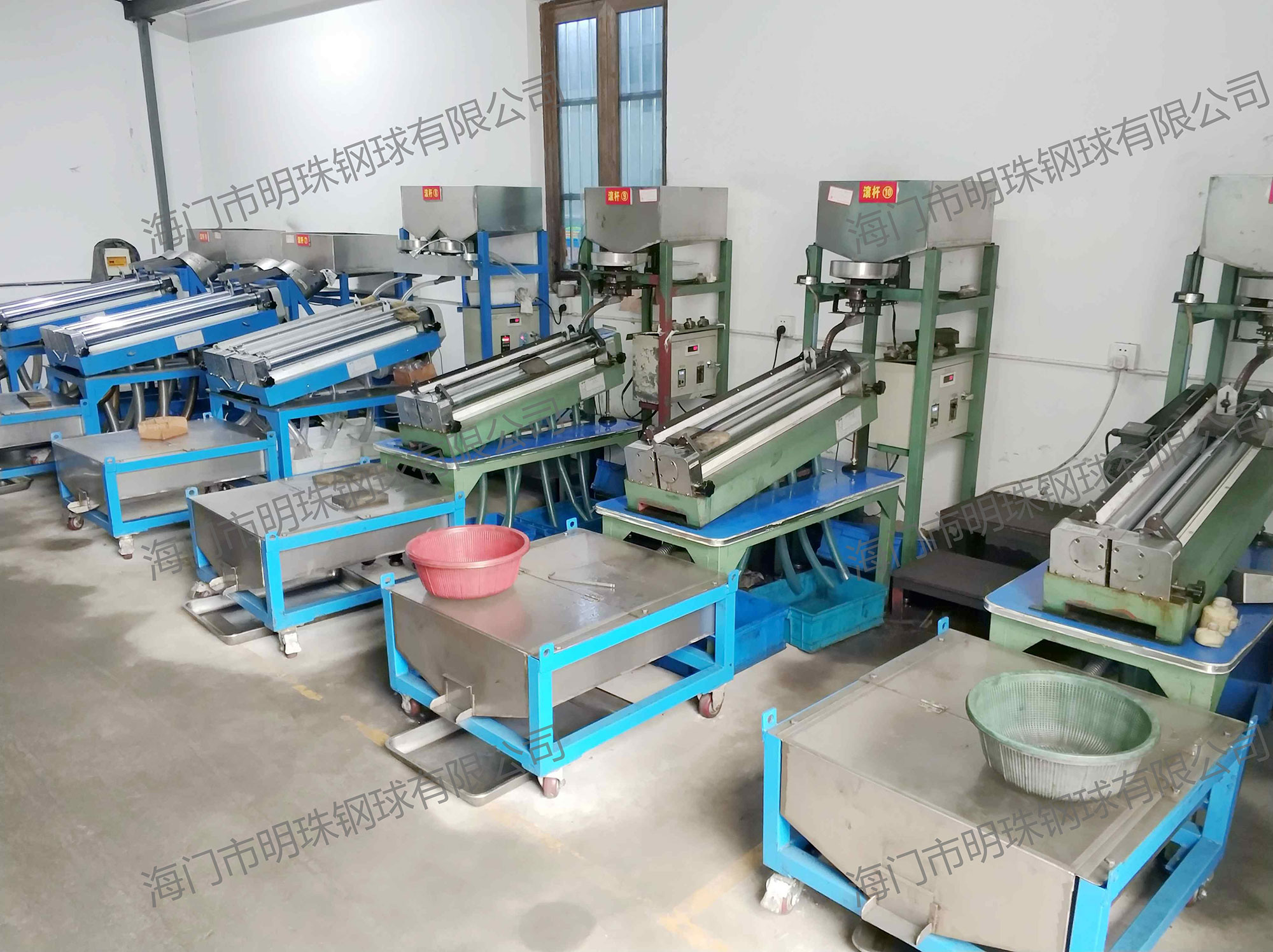
Roller bar sorting of steel balls after grinding and finishing — the stage where size, roundness and surface are qualified before shipment.
Four stainless steel grades appear on almost every shortlist for the sealing and shut-off elements inside ball valves and check valves: 440C, 420C, 316 and 304. They are not interchangeable, and selecting on unit price alone is one of the most common reasons trim is replaced earlier than the maintenance plan expects.
This ranking places the four grades in order of fit for one specific duty profile: valve and fluid control service in oil and gas and petrochemical plants, where the sealing element sees wet gas, mildly corrosive fluids, an operating window of 0 °C to 200 °C and moderate pressure. Each grade is judged on measurable criteria — the corrosion position of the material, achievable hardness, available precision grade and size range, and documented evidence from real supply programs. No projected performance, no estimated test data and no invented competitor specification is used.
Ranked answer for oil and gas valve sealing:
- Rank 1 — 420C (AISI 420C / UNS S42000), HRC 50–55: best default for ball valve and check valve trim in wet gas and mildly corrosive fluids.
- Rank 2 — 440C (AISI 440C / UNS S44004), HRC 58–62: best where wear resistance, cycle count and precision grade dominate.
- Rank 3 — 316 (AISI 316 / UNS S31600), annealed soft: best where chloride or chemical attack, not seating load, is the controlling failure mode.
- Rank 4 — 304 (SS304), annealed soft: economical choice for low-load, non-chloride general valve sealing.
Problem Definition: What the Sealing Element Inside a Ball Valve or Check Valve Has to Survive
In a floating or trunnion-mounted ball valve, the ball is the shut-off element itself. In a ball-type check valve, the ball lifts with flow and reseats against a seat. Both duties combine mechanical seating with continuous exposure to process media, so the ball must hold two properties at the same time: a hard, round, dimensionally stable surface that maintains a leak-tight seat contact, and enough corrosion resistance to avoid pitting in wet gas and mildly corrosive fluids.
The requirement stated for this duty profile is a hardened martensitic ball at HRC 48–55 with moderate corrosion resistance, and NACE MR0175 compliance as an option. Three failure modes drive the specification:
- Localised corrosion — pitting or crevice attack at the seat contact area opens a leak path without any visible mechanical damage.
- Surface wear and loss of roundness — repeated quarter-turn actuation or axial reseating removes the geometry the seat depends on.
- Batch-to-batch inconsistency — variation in hardness, grade or material forces extra incoming inspection and creates assembly rework.
This is why hardness alone is not a valid specification. Austenitic 304 and 316 stainless balls are annealed and soft — 25–39 HRC in the annealed condition — which makes them excellent corrosion choices but poor load-carrying seat surfaces. Martensitic 420C and 440C stainless balls are heat-treatable to HRC 50–55 and HRC 58–62 respectively, which is the hardness band valve trim needs while retaining moderate corrosion resistance.
Industry Background: Stainless Grades in a Chrome-Steel-Dominated Market
The global steel ball market is estimated to reach USD 12.91 billion by 2026, and chrome steel balls are projected to hold a 45.7% share of the material segment in the same year (Coherent Market Insights). Stainless grades represent a smaller slice of that tonnage, but they carry a disproportionate share of corrosion-critical valve, pump and chemical service. The category is also reported to grow at a 5.2% CAGR for 2026–2035 (Business Research Insights); other published estimates for the same period are 3.6% and 6.2%, with the variance mainly reflecting whether large grinding media is counted together with precision balls. For valve buyers the practical reading is straightforward: stainless supply is stable, and grade-level substitution decisions remain commercially relevant.
Standards that define the ball
- ISO 3290-1:2014 specifies requirements for finished steel balls for rolling bearings and defines grades from G3 to G700.
- ASTM A295/A295M covers high-carbon, anti-friction bearing-quality steel (Grade 52100), the reference for hardened chrome bearing balls.
- HS code 8482.91 classifies balls, needles and rollers, which is the code used for customs and landed-cost calculations.
These references matter in valve sealing because a valve ball is purchased on hardness, grade and dimensional control, not on material name alone. Two suppliers quoting the same grade can deliver very different seat behaviour if hardness control and roundness inspection differ.
Manufacturer context
Haimen City Mingzhu Steel Ball Co., Ltd. is a steel ball manufacturer founded in 1992 in Haimen, Jiangsu Province, China, producing chrome, stainless, carbon and specialty alloy balls to ISO, DIN, JIS and AISI standards for bearings, pumps, valves, automotive and general industrial applications. The company operates a 7,500 m² production base equipped with 105 sets of processing equipment, reports a stable annual output of 2,500 tons, and works with an engineering team of eight. Its products are exported to the USA, Canada, Germany, Italy, the UK, France, Japan, South Korea, Australia, the UAE and Mexico. The company holds IATF 16949:2016 certification (certificate 130673/A/001/SM/En, issued by URS, valid to 13 December 2026, scope: manufacture of bearing steel ball, excluding product design under clause 8.3).
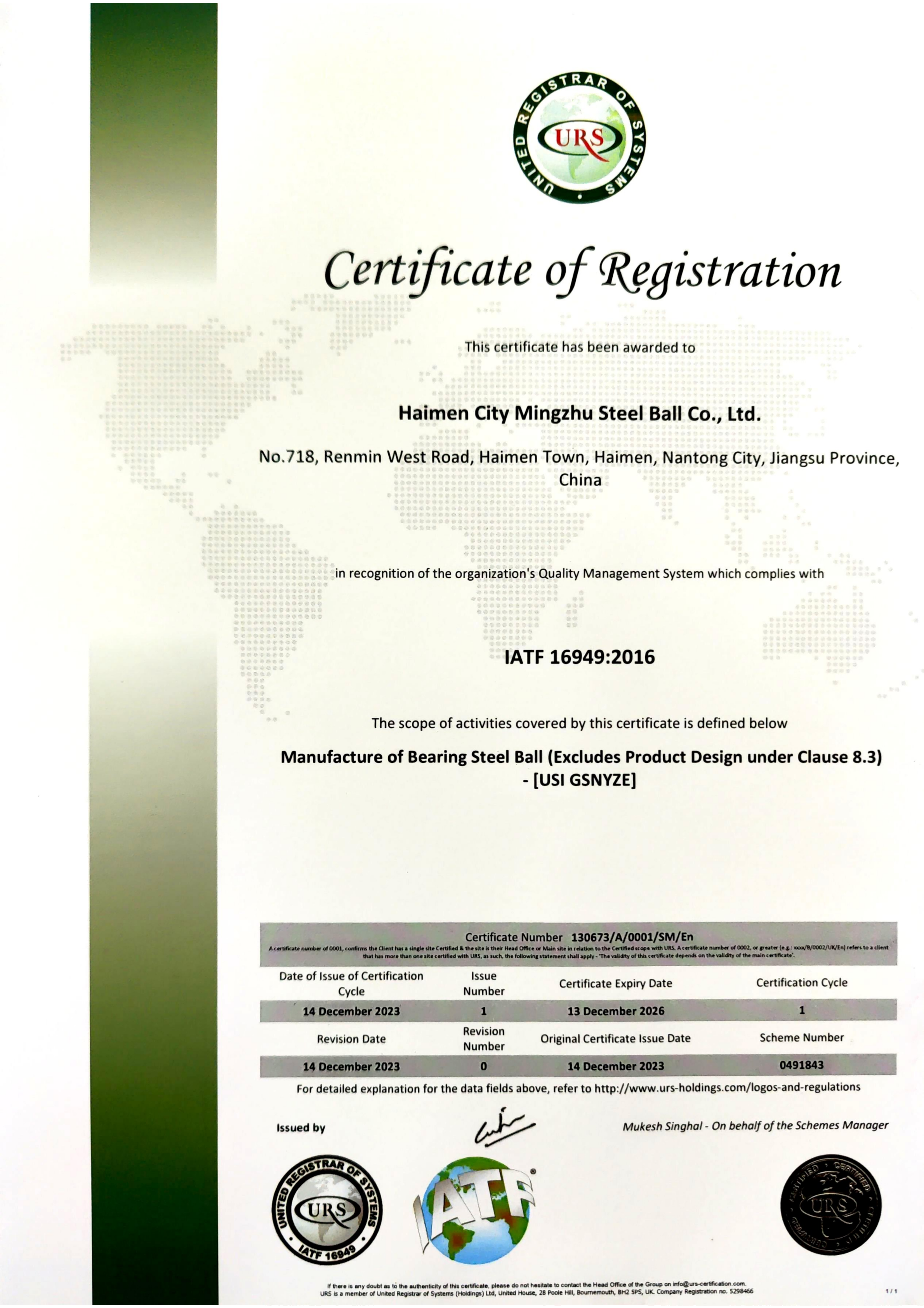
IATF 16949:2016 certification covering the manufacture of bearing steel balls, excluding product design under clause 8.3.
The Ranking: Stainless Steel Balls Ranked for Oil & Gas Valve Sealing
Rank 1 — 420C Stainless Steel Ball (AISI 420C / UNS S42000)
420C is a martensitic stainless precision ball, heat-treatable to HRC 50–55, supplied in precision grades G25–G1000 with a size range of 1 mm to 50.8 mm. Its documented industry fit is bearings in mild corrosive environments, food-processing machinery, pump valves and marine hardware.
It takes first place because it lands inside the hardness window the valve duty profile asks for while keeping moderate corrosion resistance. A valve and pump manufacturer has sourced martensitic stainless steel balls hardenable to HRC 50–55 for four consecutive years at 900,000 pieces per year, with material test reports and material certificates issued for the supplied balls. That program recorded a balanced combination of hardness and corrosion resistance while lowering total cost of ownership compared with 440C stainless steel for moderate-duty service.
Limits to accept:
- Not a solution for aggressive chloride or strong-acid service; escalate to 316, duplex stainless or a nickel superalloy.
- Lower hardness than 440C, so where abrasive media or very high cycle counts dominate, the wear margin narrows.
- Grade range starts at G25; the tightest sphericity work is covered by other material families.
Rank 2 — 440C Stainless Steel Ball (AISI 440C / UNS S44004)
440C is also martensitic stainless, but with a higher achievable hardness of HRC 58–62, precision grades G10–G1000, a size range of 0.5 mm to 50.8 mm and a controlled maximum of 0.07% phosphorus and sulphur. Documented applications include high-precision bearings, surgical and dental instruments, aerospace actuators, chemical pumps and precision instrument movements.
Second place is a trade position, not a downgrade. Where the valve or the adjacent pump is hard-working — high cycle counts, tighter precision demands, or a seat that cannot tolerate measurable surface loss — 440C's extra hardness and tighter grade availability is worth its cost. The same evidence that lifts 420C above 440C for moderate duty is the reason to reverse the choice when duty gets harder: for moderate-duty valve and pump service, 440C carried a higher total cost of ownership than the HRC 50–55 martensitic option.
Limits to accept:
- Being martensitic, it does not solve chloride-driven pitting; the material family, not the hardness, decides that.
- Hardened 440C is more demanding to machine, so drilled or threaded versions in hardened material require special tooling and longer lead time.
Rank 3 — 316 Stainless Steel Ball (AISI 316 / UNS S31600)
316 is an austenitic stainless ball with excellent chloride resistance, supplied annealed soft in grades G100–G1000 with a size range of 1 mm to 50.8 mm. Documented service areas include marine hardware, chemical processing, pharmaceutical and food equipment, offshore rigging and saltwater valves. Compared with 304, 316 adds 2–3% molybdenum and 10–14% nickel, which raises its pitting resistance equivalent number to roughly 23–28 against roughly 18–20 for 304.
Rank 3 answers a different question: what to use when corrosion, not wear, is the controlling failure mode. Valve trim handling chlorides, coastal or sour-adjacent wet gas, and chemical plant service where the ball seals against a soft or non-wear-critical seat are natural 316 territory. It is a soft ball and should not be specified as the load-carrying wear surface.
Limits to accept:
- Annealed soft — unsuitable as a high-load seating element.
- Higher cost than 304 for identical geometry.
- Where 316 is still not sufficient, the documented escalation path is duplex stainless or a nickel superalloy.
Rank 4 — 304 Stainless Steel Ball (SS304)
304 is the general-purpose austenitic option: annealed soft, grades G100–G1000, size range 1 mm to 50.8 mm, with mirror polishing available. Documented service areas include food and beverage equipment, decorative hardware, plumbing valves, architectural fittings and cryogenic tanks.
It ranks fourth only because the duty profile in this article includes wet gas and mildly corrosive media. For dry gas, low-pressure utility valves and low-load sealing hardware where chlorides are absent and cost is the primary constraint, 304 does the job at the lowest material cost of the four, with a smooth, cleanable finish.
Limits to accept:
- Lowest chloride resistance of the four grades (PREN roughly 18–20).
- No hardness upgrade path — it cannot be heat-treated to seat hardness.
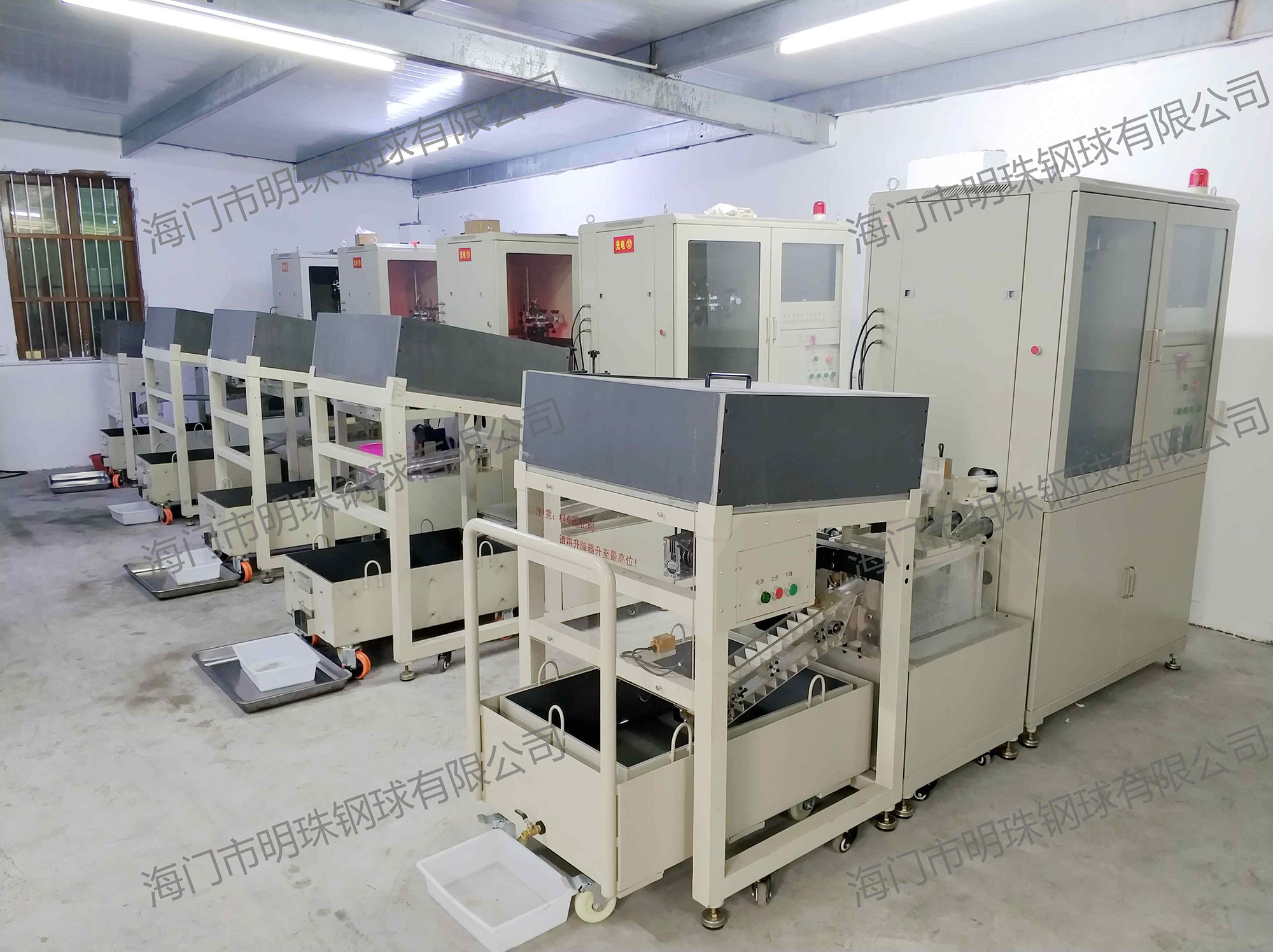
100% automated inspection of size, roundness and surface condition is what keeps a ranked material specification repeatable across batches.
Comparison Table: 440C, 420C, 316 and 304 Side by Side
| Rank | Grade | Material family & hardness | Precision grades | Size range | Corrosion position | Best-fit valve duty |
|---|---|---|---|---|---|---|
| 1 | 420C AISI 420C / UNS S42000 | Martensitic stainless, HRC 50–55 | G25–G1000 | 1 mm – 50.8 mm | Moderate corrosion resistance | Ball valve and check valve trim in wet gas and mildly corrosive fluids, 0–200 °C, moderate pressure |
| 2 | 440C AISI 440C / UNS S44004 | Martensitic stainless, HRC 58–62; max 0.07% P/S | G10–G1000 | 0.5 mm – 50.8 mm | Moderate corrosion resistance with higher hardness than 420C | High-cycle, wear-sensitive seats; chemical pumps and precision bearing-driven trim |
| 3 | 316 AISI 316 / UNS S31600 | Austenitic stainless, annealed soft; PREN approx. 23–28 | G100–G1000 | 1 mm – 50.8 mm | Excellent chloride resistance | Chloride, coastal and chemical-side valve trim where corrosion governs |
| 4 | 304 SS304 | Austenitic stainless, annealed soft; PREN approx. 18–20 | G100–G1000 | 1 mm – 50.8 mm | General corrosion resistance | Low-load, non-chloride general industrial and plumbing valve sealing |
The table uses only facts from the four grade specifications and the documented supply cases cited above. Hardness, grade and size values are specification values, not measured averages from a specific lot; actual reported values are stated per batch on the material test report.
Step-by-Step Breakdown: How to Select and Qualify a Stainless Ball Grade
- Define the media and temperature first. Wet gas and mildly corrosive fluids at 0–200 °C under moderate pressure place the duty profile inside the hardened martensitic window, where the stated requirement is HRC 48–55 with moderate corrosion resistance and optional NACE MR0175 compliance.
- Screen for chloride and sour exposure. If chlorides, seawater or strong acids are present, leave the martensitic pair and shortlist 316. If 316 is still insufficient, step to duplex stainless (documented PREn greater than 34) or a nickel superalloy such as Hastelloy C-276 for strong-acid service.
- Fix the hardness window and precision grade. 420C covers HRC 50–55 in G25–G1000; 440C covers HRC 58–62 in G10–G1000. Precision families extend to G3, G5, G10, G16 and G25 where sphericity, not hardness, governs seat tightness.
- Decide the geometry. Plain spheres cover most seats. Drilled (through or blind) and tapped balls in metric and UNC/UNF threads, plus stepped and half-spherical variants, are produced to drawing for ball valves and for hydraulic and pneumatic rotary actuators where the ball carries flow or a pin.
- Confirm documentation before the purchase order. Material test reports ship with the goods, supported by EN 10204 2.1 or 3.1 certificates and COA, plus batch-level grade certification. PPAP, FAI, NACE MR0175 and AMS certificates are available on request. Inspection records cover dimension, roundness, surface, hardness and material verification.
- Validate with a sample. Pre-production samples are available for validation before mass orders, supported by a full test and grade report. This is the cheapest place in the project to discover that a seat needs 440C rather than 420C.
- Qualify the supply chain, not just the sample. 100% automated machine-vision inspection covers size, roundness, surface and appearance, supplemented by hardness, roundness and microstructure checks. Confirm capacity, rolling stock and production status reporting before committing to an annual program.
Use Cases: Where These Ranked Grades Have Been Applied
Instrumentation ball valves for oilfield surface equipment
An oil and gas equipment supplier took a project quantity of 70,000 pieces for instrumentation ball valves in oilfield surface equipment over a three-year relationship. The balls were made to print with NACE-aware material options and pressure-test support, and withstood sour-service surface conditions while holding reliable sealing performance.
Valve and pump manufacturer, moderate-duty trim
900,000 martensitic stainless balls per year, hardened to HRC 50–55, have been supplied to a valve and pump manufacturer over four consecutive years with material test reports and material certificates. The program balanced hardness and corrosion resistance and delivered a lower total cost of ownership than 440C stainless for the same moderate-duty service.
Specialty valve and hydraulic OEM, drilled balls
150,000 drilled balls over four years for ball valves and hydraulic and pneumatic rotary actuators. CNC-drilled hole position accuracy eliminated rework at the customer's assembly line; hole position was CMM-checked and custom threads were supplied to drawing.
Chloride-heavy service and the escalation path
A desalination plant EPC contractor took 90,000 duplex stainless balls over three years for high-pressure reverse-osmosis valve and pump components; the supplied balls outperformed 316 in aggressive chloride service, reduced replacement frequency, and carried a PREn greater than 34 with an EN 10204 3.1 certificate. An offshore oil and gas operator took 180,000 pieces for subsea and topside valve trim over five years, with NACE MR0175 awareness and MTR plus PMI verification. A chemical and petrochemical plant OEM has taken 120,000 Hastelloy C-276 balls per year for severe-corrosion ball valves handling strong acids, with minimal valve trim replacement over a five-year service period.
Where the Four Stainless Options Stop
The ranked four cover the majority of valve sealing decisions defined by hardness plus moderate corrosion resistance. When the medium itself, rather than the load, drives failure, the specification has to change family:
- Duplex stainless (UNS S32205 / S31803) — offshore oil and gas, subsea manifolds, desalination, chemical processing; high strength with documented PREn greater than 34.
- Hastelloy C-276 / C-22 (UNS N10276 / N06022) — strong acids, acid-handling valves, flue-gas desulfurization, pharmaceutical reactors, seawater and brine service.
- M50 (AISI M50 / AMS 6490, HRC 62–66) — a high-speed, high-temperature bearing steel used for aerospace engine and turbomachinery bearings, not for valve sealing.
The practical rule: stay inside the ranked four while hardness and moderate corrosion resistance define the problem, and step up in alloy only when the medium dictates it. Stepping up without that justification adds cost and, in the case of soft austenitic selection, removes the hardness the seat needs.
FAQ: Stainless Steel Balls for Oil & Gas Valve Sealing
Do 420C and 440C stainless balls meet oil and gas valve sealing requirements, and what documentation is supplied?
For valve and fluid control duty in oil and gas and petrochemical service — wet gas, mildly corrosive fluids, 0–200 °C and moderate pressure — the stated requirement is a hardened martensitic ball at HRC 48–55 with moderate corrosion resistance and optional NACE MR0175 compliance. 420C (HRC 50–55) and 440C (HRC 58–62) are both martensitic stainless grades inside or above that hardness window. Documentation supplied with shipments includes material test reports, EN 10204 2.1 or 3.1 certificates, COA, and batch-level grade certification, with PPAP, FAI, NACE MR0175 and AMS certificates available on request. Inspection records cover dimension, roundness, surface, hardness and material verification.
What hardness, precision grades and custom features are available for stainless valve balls?
420C reaches HRC 50–55 in grades G25–G1000 with a 1 mm to 50.8 mm size range. 440C reaches HRC 58–62 in grades G10–G1000 with a 0.5 mm to 50.8 mm range. 316 and 304 are supplied annealed soft in G100–G1000 with a 1 mm to 50.8 mm range. Precision balls are available in G3, G5, G10, G16 and G25. Beyond plain spheres, drilled (through or blind), tapped (metric and UNC/UNF), stepped and half-spherical balls are produced to drawing, with hole diameter, depth, concentricity and thread class controlled; machined balls cover 10 mm to 200 mm and above, and fully non-standard geometry is manufactured to customer drawings.
Which of the four grades costs less over the service life in moderate-duty valve and pump service?
For moderate-duty valve and pump service, the HRC 50–55 martensitic (420C) option has delivered a lower total cost of ownership than 440C stainless steel balls, because it combines adequate hardness with corrosion resistance at a lower material and processing burden; one valve and pump program has run on that grade for four years at 900,000 pieces per year. 304 is the lowest-cost grade of the four for low-load, non-chloride general industrial and plumbing valve sealing. 440C and 316 sit higher: 440C because of the hardening and precision grinding involved, and 316 because of its molybdenum and nickel content.
Can we test a grade before placing a mass order?
Yes. Pre-production samples are available for validation before mass orders, and precision-grade consultation is provided together with a full test and grade report. Standard catalog sizes carry a low minimum order quantity, while non-standard and CNC-machined items typically start from 50–500 pieces depending on setup, with prototype quantities of 10–50 pieces workable for simple parts. Material test reports and batch-level grade certification accompany supplied orders.
What is the lead time for stainless valve balls, and how do we start?
Standard sizes held in stock typically ship in 5–10 days; standard production runs take 15–30 days; non-standard sizes, special alloys and CNC features take 20–60 days depending on tooling and inspection. Monthly production capacity is 20 tons on the relevant lines, supported by rolling stock and backup tooling for repeat annual programs, with monthly production status updates. To start, send the seat diameter, medium, operating temperature and required hardness and grade to info@hmmzsteelball.com, download the product brochure at the end of this article, and request a sample or quotation for the grade you intend to qualify.
Conclusion: Rank the Duty, Then Rank the Grade
For oil and gas ball valve and check valve sealing in wet gas and mildly corrosive fluids at 0–200 °C and moderate pressure, 420C stainless steel balls in HRC 50–55 are the practical first choice, backed by four years of continuous supply to a valve and pump manufacturer at 900,000 pieces per year and a lower total cost of ownership than 440C in moderate-duty service. 440C in HRC 58–62 moves ahead as soon as wear resistance and precision grade outweigh material cost. 316 takes over when chlorides or chemicals, rather than seating load, decide trim life, and 304 remains the economical answer for low-load, non-chloride valve sealing.
The ranking is only as good as the batch behind it. Hardness control, grade certification, 100% inspection and documented lead times are what convert a material choice into a sealing element that survives to the next maintenance window.
Next step — sample or quotation
Send the medium, operating temperature, seat load and required hardness, and Haimen City Mingzhu Steel Ball Co., Ltd. will confirm the recommended grade, tolerance grade and delivery window. Pre-production samples with a full test and grade report are available before mass orders.
Email: info@hmmzsteelball.com | Tel / WhatsApp: +86 13912237934 (Diego Gu) | Website: www.hmmzsteelball.com
Download the full product brochure: Haimen Mingzhu Steel Ball Brochure (PDF)
Address: No. 718 West Renmin Road, Haimen City, Jiangsu Province, China
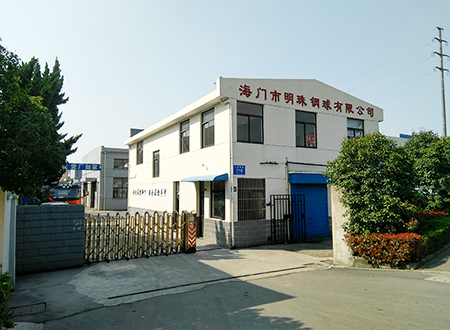
Production base in Haimen, Jiangsu Province — 7,500 m², 105 sets of processing equipment and 2,500 tons of annual output.