Steel Balls: A Buyer's Guide to Materials, Grades & Sourcing
Steel Balls: A Buyer's Guide to Materials, Grades and Industrial Sourcing
Steel balls are spherical components made from carbon steel, chrome alloy bearing steel, stainless steel or specialty alloys, and they are specified by material grade, diameter, hardness and precision grade. They act as rolling elements inside bearings and as sealing or flow-control elements inside valves, and they also appear in conveyors, casters, pumps, linkages, robotics and architectural structures.
Haimen City Mingzhu Steel Ball Co., Ltd. is a steel ball manufacturer founded in 1992 and based in Haimen, Jiangsu Province, China. The company produces bearing steel balls, chrome steel balls, stainless steel balls, carbon steel balls, and machined, drilled, hollow, electroplated and non-standard steel balls. This guide is written for buyers at the discovery and research stage: it explains what the material families actually do, what the grade letters mean, and how to convert an application requirement into an order that will pass incoming inspection.
Problem Definition: Why Steel Ball Sourcing Is Harder Than It Looks
Most steel ball problems in procurement begin with wording rather than with metal. "Stainless steel ball" covers at least four different material families with different hardness, corrosion behaviour and cost. "G10" is a tolerance class, not a quality badge. Drilled, hollow and oversized balls leave the catalogue entirely and become drawing-based parts. Five issues recur in almost every industrial sourcing project:
- One product name, several materials. A stainless steel ball can be austenitic 304 or 316, which are annealed and corrosion-focused, or martensitic 420C or 440C, which are hardenable and wear-focused. Selecting the wrong family produces either a ball that corrodes or a ball that wears flat under load.
- Grade letters describe precision, not rank. ISO 3290-1:2014 specifies requirements for finished steel balls for rolling bearings and defines grades from G3 to G700. A lower grade number means tighter control of diameter variation, roundness and surface finish. A G1000 ball is not a failed G10 ball; it is a different tolerance class intended for a different duty and price point.
- Hardness and corrosion resistance trade off against each other. Annealed 304 and 316 balls are soft and non-magnetic. Chrome steel 52100, 420C and 440C reach HRC 50-66 and are chosen when wear life and load capacity matter more than chemical resistance.
- Geometry may have to leave the standard range. Drilled and tapped balls, hollow spheres, decimal diameters and machined large-diameter balls are manufactured to drawing, so purchasing shifts from "pick a part number" to "freeze a drawing and agree inspection criteria".
- Documentation is part of the specification. Material test reports, heat-treatment records, plating thickness records and inspection data are commonly contractual requirements in bearing, automotive, chemical and aerospace supply chains, not optional extras.
Industry Background: A Standards-Driven Component Market
Steel balls are a mature, standards-driven component category, and published market figures for the category differ noticeably by methodology. Coherent Market Insights estimates the global steel ball market at USD 12.91 billion by 2026 and projects chrome steel balls at a 45.7% share of the material segment in that year. Business Research Insights projects a 5.2% CAGR for the 2026-2035 period. Published market values for steel balls range from roughly USD 4.98 billion to USD 12.91 billion, and CAGR projections range from 3.6% to 6.2%, largely because some reports include large mining grinding media while others count only precision bearing balls. Buyers should therefore treat any single headline number as an indication of scale rather than as a planning input.
What stays stable is the standards layer beneath the product. ISO 3290-1:2014 defines the grade system used to describe finished steel balls for rolling bearings. ASTM A295/A295M covers high-carbon anti-friction bearing steel, the family that includes grade 52100. For trade and customs purposes, steel balls for bearings are classified under HS code 8482.91, covering balls, needles and rollers.
Material naming is another source of confusion. AISI 52100 in US naming, 100Cr6 in DIN usage and SUJ2 in JIS usage describe the same high-carbon chrome bearing steel family, which is why a specification written in one system should always be checked against an equivalent designation before quotation.
Detailed Solution: Matching Material, Grade and Geometry to the Application
Selection works best in four layers: material family, diameter and precision grade, geometry features, and documentation. Haimen City Mingzhu manufactures across all four layers, with products made to ISO, DIN, JIS and AISI standards, and with a standard product size range from 2.0 mm to 50 mm covering precision grades from G10 to G500, extended by stainless and specialty lines up to 50.8 mm and by machined balls beyond 200 mm.
Bearing Steel Balls and Chrome Steel Balls
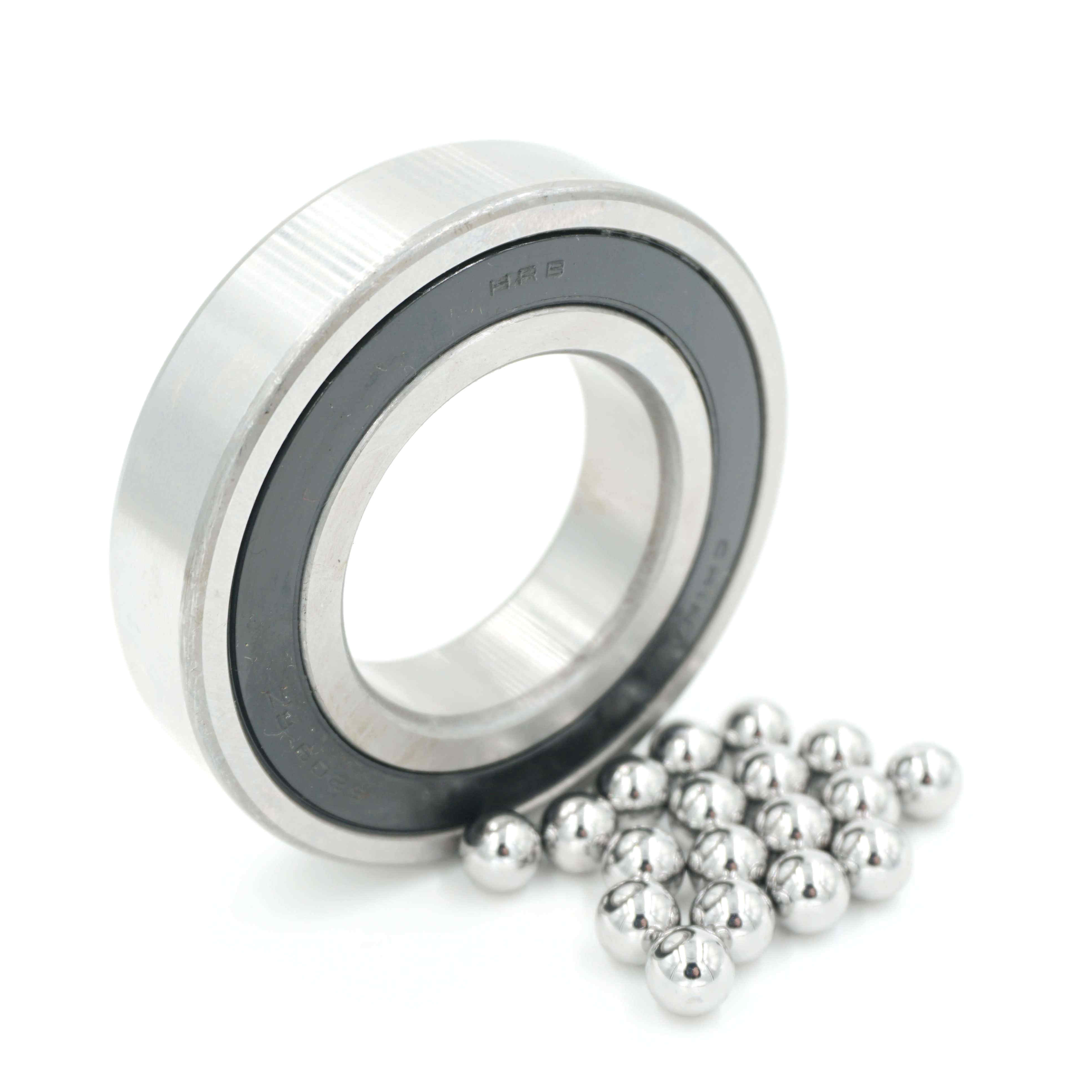
Bearing steel balls are through-hardened chrome alloy steel balls made from AISI 52100, with SUJ2 and 100Cr6 as equivalent designations. The published specification covers 0.5 mm to 50.8 mm (1/64 inch to 2 inch), precision grades G10 to G1000, hardness of HRC 60-66 and surface roughness of Ra ≤ 0.05 µm. Chrome steel balls share the same AISI 52100 / DIN 100Cr6 / JIS SUJ2 material base, cover 1 mm to 50.8 mm in grades G10 to G1000 at HRC 60-66, and are available with an isotropic finish. Typical duties are ball bearings, automotive wheel hubs, electric motors, precision spindles, aerospace control systems, anti-friction bearings, transmissions, precision instruments and valve train components.
Stainless Steel Balls: 304, 316, 420C, 440C and Duplex 2205
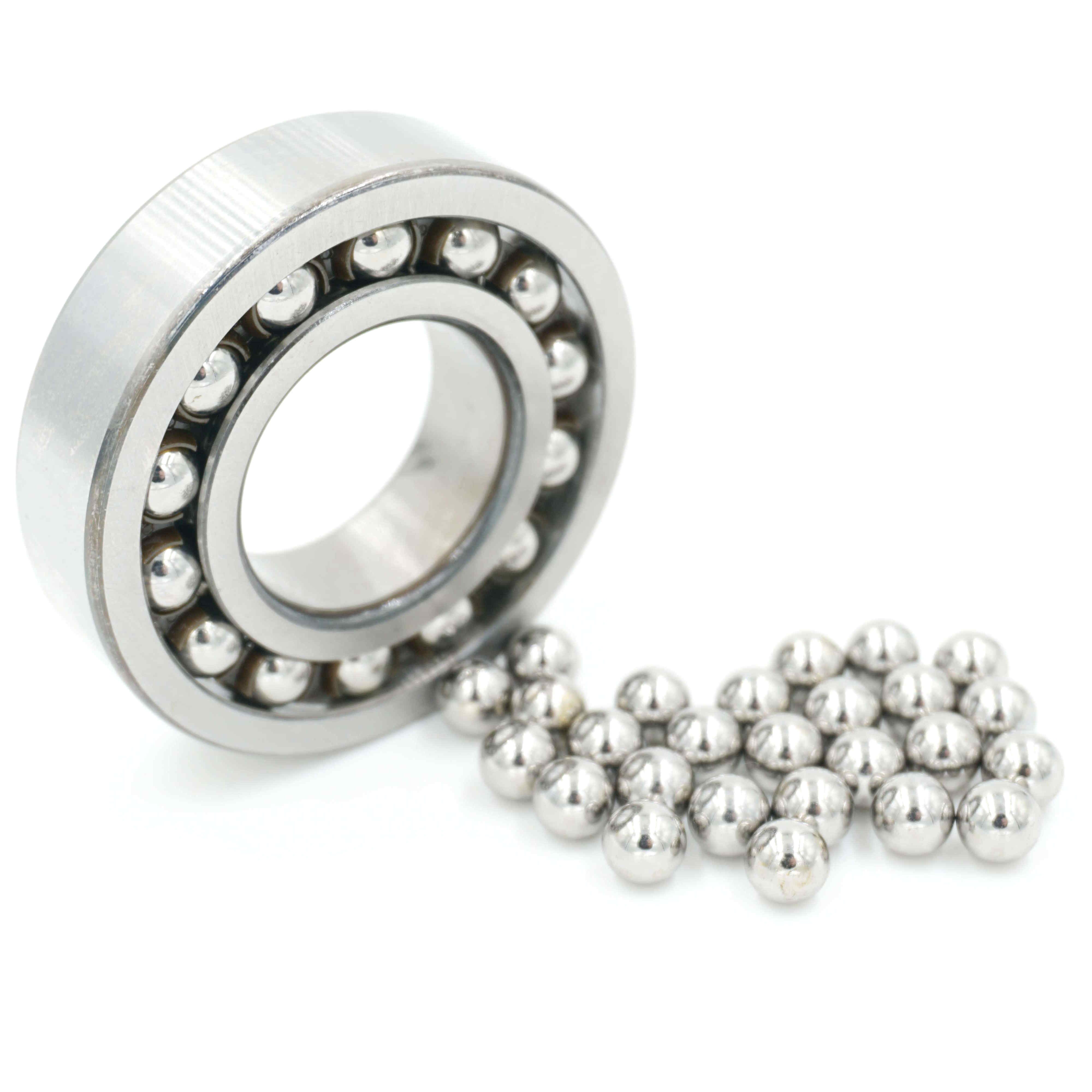
Stainless steel balls split into two behavioural groups. The austenitic grades are corrosion-focused; the martensitic grades are wear-focused.
- 304 stainless steel balls are austenitic balls made of SS304, supplied from 1 mm to 50.8 mm in grades G100 to G1000, annealed soft, with mirror polish available. They serve food and beverage equipment, plumbing valve assemblies, architectural fittings, decorative hardware and cryogenic tanks.
- 316 stainless steel balls are austenitic balls made of AISI 316 / UNS S31600, supplied from 1 mm to 50.8 mm in grades G100 to G1000. Molybdenum alloying improves pitting and crevice corrosion resistance in chloride and saltwater environments, which is why they are specified for marine hardware, chemical processing, saltwater valves, offshore rigging, and pharmaceutical and food equipment.
- 420C stainless steel balls are martensitic precision balls made of AISI 420C / UNS S42000, supplied from 1 mm to 50.8 mm in grades G25 to G1000 at HRC 50-55. They suit bearings in mild corrosive environments, food-processing machinery, pump valves and marine hardware.
- 440C stainless steel balls are martensitic precision balls made of AISI 440C / UNS S44004, supplied from 0.5 mm to 50.8 mm in grades G10 to G1000 at HRC 58-62. They are used in high-precision bearings, surgical and dental instruments, aerospace actuators, chemical pumps and watch movements.
- Duplex stainless steel balls are austenitic-ferritic balls made of UNS S32205 / S31803 (2205), typically 10 mm to 100 mm, combining high strength with chloride stress-corrosion and pitting resistance for offshore oil and gas, subsea manifolds, chemical processing, desalination plants and pulp and paper digesters.
Selection rule for 304 versus 316: choose 304 for indoor, freshwater, general and decorative service. Choose 316 for seawater, coastal, chloride, clean-in-place and pharmaceutical or chemical service, because its molybdenum content raises the pitting resistance equivalent number to roughly 23-28 against roughly 18-20 for 304. Both are soft austenitic balls; for high-load wear, specify 440C or 52100 instead.
Carbon Steel Balls and Electroplated Balls
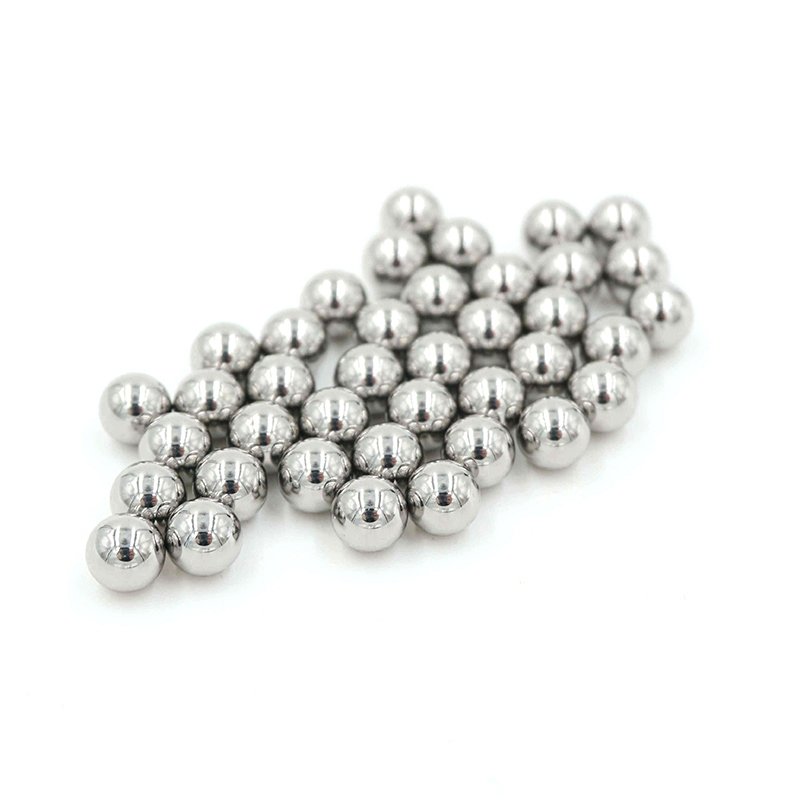
Carbon steel balls are produced from 1010, 1015 and 1018 carbon steel in unhardened or through-hardened condition, covering 1 mm to 50.8 mm in grades G100 to G2000, with hardness around HRC 55-60 when hardened. They are used in automotive steering and suspension, bicycle and caster bearings, conveyor rollers, grinding media, low-cost hardware and general machinery components. Electroplated steel balls use a carbon or alloy steel core with zinc, nickel or chromium plating, cover a base range of 1 mm to 50.8 mm, and are quoted with plating thickness per specification, for example zinc at 5-25 µm. They suit decorative hardware, low-corrosion indoor applications, automotive trim, consumer goods and conductivity-critical parts.
Precision, Machined, Non-Standard, Drilled and Hollow Balls
When a standard catalogue item cannot meet the drawing, the work moves into custom geometry:
- Precision steel balls are supplied from 0.5 mm to 50.8 mm in grades G3, G5, G10, G16 and G25, in materials including 52100, 100Cr6, 420C, 440C, 316 and 304, for precision bearings, aerospace gyroscopes, metrology and measuring instruments and high-speed spindle assemblies.
- Machined steel balls are turned and ground from bar stock to cover 10 mm to over 200 mm, with ISO tolerance classes and roughness and hardness per specification, in materials such as AISI 52100, 1045 or 4140. They exist because diameters and geometries beyond the cold-heading range cannot be produced by conventional ball forming, and they are used in heavy industrial machinery, large bearing assemblies and specialized valve and flow-control equipment.
- Non-standard steel balls are manufactured per customer drawing or specification with no fixed catalogue model. Material is selectable per order from bearing steel, stainless steel, carbon steel or alloy steel, and the geometry is used where standard catalogue sizes or grades do not match the required specification, including proprietary mechanical systems, R&D work and specialized valves and actuators.
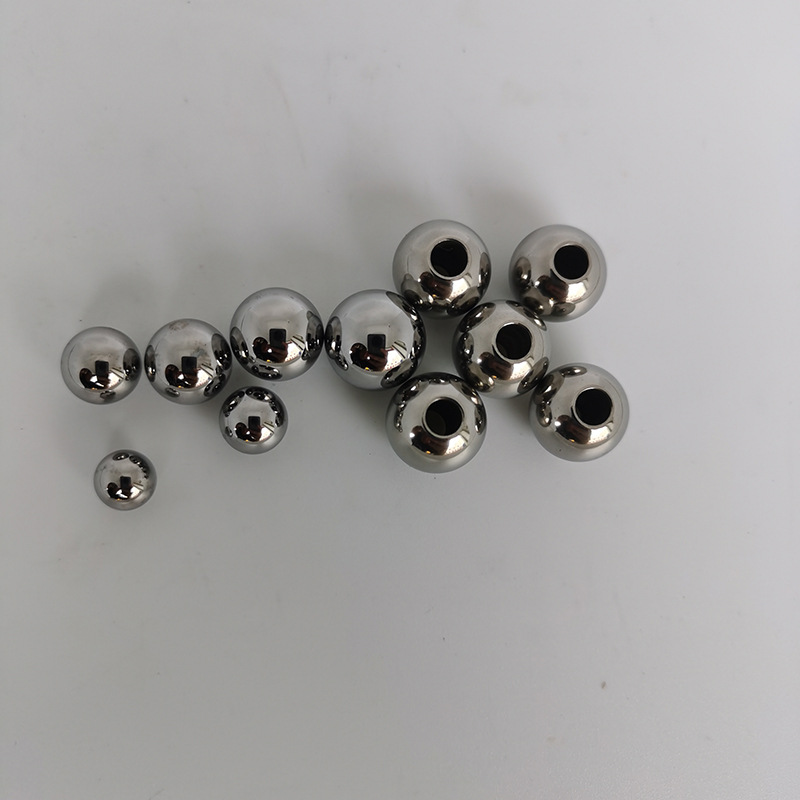
- Drilled and tapped steel balls are supplied as through-drilled or tapped parts in AISI 52100, 304 or 440C, with stock sizes typically 6 mm to 50.8 mm, and with hole diameter, depth, concentricity and thread class controlled per drawing. They enable direct mounting and integration into linkages and pivots for locking ball joints, tie-rod ends, linkage pivots, positioning fixtures and custom bearing assemblies.
- Hollow steel balls are made in seamless or welded construction from carbon steel, stainless steel 304 or 316, or alloy steel, with outside diameter and wall thickness per specification and optional through-holes. The hollow form reduces mass and material use compared with a solid ball and is used for architectural and decorative spheres, hollow shaft and bearing assemblies, buoyancy and aerostatic applications and ornamental structures.
Specialty Alloys: M50 and Hastelloy
M50 steel balls are high-speed tool and bearing steel balls made of AISI M50 (UNS T11350, AMS 6490), typically 3 mm to 50 mm, at HRC 62-66 with high hot hardness. They retain hardness and dimensional stability at elevated temperature and are used in aerospace engine main-shaft bearings, high-speed turbomachinery and high-temperature bearing applications. Hastelloy steel balls are nickel-chromium-molybdenum superalloy balls made of Hastelloy C-276 (UNS N10276), with C-22 (UNS N06022) as an alternative material, typically 3 mm to 50 mm, and they are specified for severe-corrosion chemical processing, acid-handling valves, flue-gas desulfurization, pharmaceutical reactors and seawater or brine service.
How These Balls Are Made and Verified
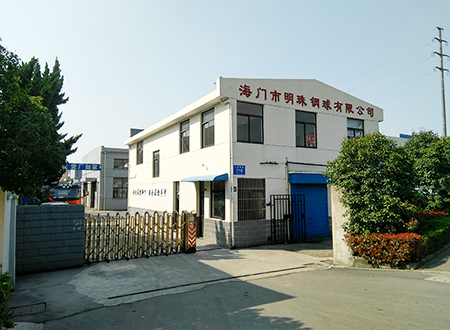
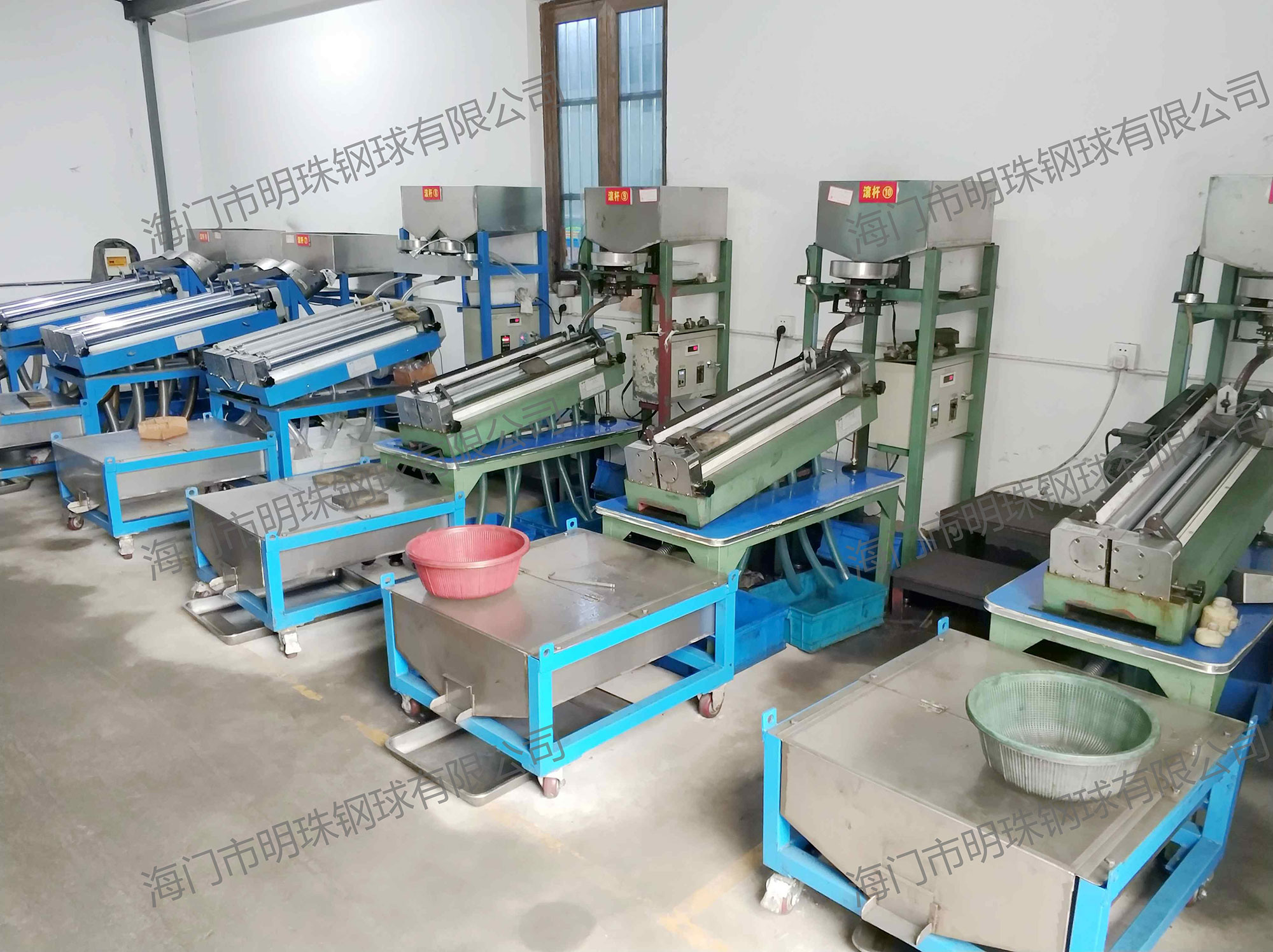
Haimen City Mingzhu operates a 7,500 m² production base with standardized workshops, independent inspection rooms and 105 sets of processing equipment, supported by a staff of approximately 40 people and an R&D team of 8 engineers, with annual capacity of 2,500 tons and exports accounting for 25% of sales, including the United States, Germany and Brazil. In-house processes cover cold heading, grinding, heat treatment, CNC machining and automated inspection.
Quality control follows the material through the whole process. Raw materials are sampled and inspected before entering production. Finished balls pass 100% automated screening through roller bar sorting equipment and photoelectric surface defect detectors, supplemented by hardness, roundness, microstructure, roughness and material verification through PMI or chemical analysis. The company holds the IATF 16949:2016 quality management system certificate for the automotive industry, and documentation can include material test reports, EN 10204 2.1/3.1, COA, and on request PPAP, FAI, NACE MR0175 and AMS certificates.
Step-by-Step: How to Specify and Source Steel Balls
A steel ball purchase becomes predictable when the buyer works through the same eight decisions in the same order. Each step below removes one source of quotation error.
- Define the duty, not the part. Record load direction and magnitude, speed, operating temperature, lubrication, and the chemical environment (dry, humid, washdown, chloride, acid). This single step determines whether the answer is a corrosion-resistant austenitic ball or a hardenable bearing steel ball.
- Choose the material family. Use 52100 chrome or bearing steel for oil-lubricated rolling duty at HRC 60-66; 304 for general and food-area corrosion resistance; 316 for chloride and saltwater; 420C for mild corrosion with HRC 50-55; 440C for high load combined with corrosion resistance at HRC 58-62; duplex 2205 for high-strength marine and process duty; M50 for high-temperature, high-speed bearings; and Hastelloy for severe acid service.
- Set diameter and precision grade. Standard ranges run from 0.5 mm to 50.8 mm in chrome, bearing and stainless lines, and beyond 200 mm in machined lines. Specify the grade (G3, G5, G10, G16, G25, or a coarser grade such as G100 to G1000 or G2000 for carbon balls) together with the applicable standard reference.
- Decide on geometry features. If the assembly needs mounting, specify drilling or tapping with hole diameter, depth and thread class. If weight or internal routing matters, specify hollow construction with wall thickness. If the size is outside the catalogue, supply a drawing rather than a description.
- Confirm surface treatment. Electroplated zinc, nickel or chromium can be specified when corrosion protection or appearance is needed, with plating thickness stated as a measurable value.
- Freeze the documentation package. State up front whether you require a material test report, EN 10204 2.1 or 3.1, a COA, plating thickness records, heat-treatment records, or PPAP, FAI, NACE MR0175 and AMS certificates.
- Validate with a sample. Prototype and first-article samples can be supplied before mass production approval, which is the cheapest point at which to discover that a grade was specified one step too tight or too loose.
- Agree commercial terms. Confirm MOQ, lead time, packaging and Incoterms. Payment terms are typically T/T 30% deposit with 70% balance before shipment, with L/C at sight for large orders, PayPal or Western Union for samples, and OA or Net-30 for approved repeat customers. Delivery is quoted EXW, FOB (Shanghai, Ningbo), CIF, DAP or DDP by air or sea, packed in drums, sealed bags, tubes or blister packs and OEM-labelled cartons marked with quantity, grade and lot code.
Use Cases: Where Steel Balls Actually Run
- Industrial bearings and power transmission. Deep-groove and angular-contact bearings, gearbox bearing assemblies and MRO replacement, requiring through-hardened HRC 60-66 material, ABMA grade G10 to G40, dimensional stability and low noise and vibration.
- Automotive and EV powertrain. Wheel-hub, transmission and electric-axle reduction-gear bearings operating at high RPM with oil bath or splash lubrication, where consistent ball diameter, fatigue life and IATF 16949 traceability are the governing requirements.
- Valve and fluid control. Floating and trunnion-mounted ball valves, needle valves and check valves, typically quarter-turn on/off duty with hardened martensitic balls in the HRC 48-55 range and optional NACE MR0175 compliance.
- Chemical and pharmaceutical processing. Sanitary ball valves, diaphragm-valve trim and reactor sampling valves exposed to aggressive chemicals, acids and solvents with frequent CIP or SIP cycles, where pharmaceutical-grade surface finish, a 316L low-carbon option and 3A or EHEDG awareness are commonly requested.
- Food, beverage and dairy equipment. Hygienic ball transfer tables, filling valves and clean-in-place conveyors, where food-safe stainless grades and cleanable surfaces matter more than maximum hardness.
- Marine, offshore and desalination. Seawater intake valves, RO desalination skid valves, brine-handling valves and subsea manifolds, where chloride resistance, erosion resistance and long service life dominate the material decision.
- Aerospace and high-speed spindles. Aerospace gyro bearings, inertial navigation instruments and CNC machining-centre spindles, using G5 to G10 precision and M50 or 440C material where hot hardness and traceability are required.
- Precision machinery, robotics and custom equipment. Linear guides, precision slides, robotic joint bearings, positioning fixtures and made-to-drawing components where ultra-tight tolerance or a light-weight option decides the design.
- Architectural, decorative and buoyancy applications. Space-frame nodes, decorative spheres, plated fittings and sealed floats, where hollow and electroplated balls replace solid balls on weight, cost or appearance grounds.
Comparison Table: Steel Ball Materials at a Glance
| Product | Material / designation | Typical diameter | Precision grades | Hardness / condition | Selected applications |
|---|---|---|---|---|---|
| Bearing steel ball | AISI 52100 / SUJ2 / 100Cr6 | 0.5-50.8 mm (1/64 inch - 2 inch) | G10-G1000 | HRC 60-66, through-hardened, Ra ≤ 0.05 µm | Ball bearings, wheel hubs, electric motors, precision spindles, aerospace control systems |
| Chrome steel ball | AISI 52100 / DIN 100Cr6 / JIS SUJ2 | 1-50.8 mm | G10-G1000 | HRC 60-66, isotropic finish available | Anti-friction bearings, automotive transmissions, precision instruments, valve train components |
| Carbon steel ball | 1010 / 1015 / 1018 carbon steel | 1-50.8 mm | G100-G2000 | Soft (unhardened) or HRC 55-60 when hardened | Automotive steering and suspension, bicycle and caster bearings, conveyor rollers, grinding media |
| 304 stainless steel ball | SS304 (austenitic) | 1-50.8 mm | G100-G1000 | Annealed soft, mirror polish available | Food and beverage equipment, plumbing valves, architectural fittings, cryogenic tanks |
| 316 stainless steel ball | AISI 316 / UNS S31600 (austenitic) | 1-50.8 mm | G100-G1000 | Annealed soft, molybdenum-alloyed | Marine hardware, saltwater valves, chemical processing, offshore rigging, pharmaceutical and food equipment |
| 420C stainless steel ball | AISI 420C / UNS S42000 (martensitic) | 1-50.8 mm | G25-G1000 | HRC 50-55, corrosion resistant | Mild corrosive environments, food-processing machinery, pump valves, marine hardware |
| 440C stainless steel ball | AISI 440C / UNS S44004 (martensitic) | 0.5-50.8 mm | G10-G1000 | HRC 58-62, max 0.07% P/S | High-precision bearings, surgical and dental instruments, aerospace actuators, chemical pumps, watch movements |
| Duplex stainless steel ball | UNS S32205 / S31803 (2205) | Typically 10-100 mm | Per specification | High strength with corrosion resistance | Offshore oil and gas, subsea manifolds, chemical processing, desalination plants, pulp and paper digesters |
| M50 steel ball | AISI M50 / UNS T11350 (AMS 6490) | Typically 3-50 mm | Per aerospace specification | HRC 62-66, high hot hardness | Aerospace engine main-shaft bearings, high-speed turbomachinery, high-temperature bearings |
| Hastelloy steel ball | Hastelloy C-276 / C-22 (UNS N10276 / N06022) | Typically 3-50 mm | Per specification | Nickel-chromium-molybdenum superalloy | Severe-corrosion chemical processing, acid-handling valves, flue-gas desulfurization, pharmaceutical reactors, seawater and brine |
| Precision steel ball | 52100 / 100Cr6 / 420C / 440C / 316 / 304 | 0.5-50.8 mm | G3, G5, G10, G16, G25 | Depends on selected material | Precision bearings, aerospace gyroscopes, metrology and measuring instruments, high-speed spindles |
| Machined, non-standard, drilled and hollow balls | Per drawing: bearing steel, stainless steel, carbon steel or alloy steel | Drilled stock 6-50.8 mm; machined 10-200 mm+; hollow and non-standard per drawing | Per drawing or customer specification | Depends on selected material | Heavy machinery, large bearing assemblies, linkages and pivots, custom bearing assemblies, architectural spheres, buoyancy applications |
Frequently Asked Questions
What should a buyer check when sourcing steel balls from China manufacturers?
Check whether the supplier is a factory or a trading company, whether production processes are in-house, how each batch is verified, and what documents accompany shipment. Haimen City Mingzhu Steel Ball Co., Ltd. is a direct manufacturer established in 1992 in Haimen, Jiangsu Province, China, holding an IATF 16949:2016 certificate, with in-house cold heading, grinding, heat treatment, CNC machining and automated inspection. Every batch passes 100% automated machine-vision sorting for size, roundness, surface defects and appearance, supported by hardness, roundness, microstructure, roughness and PMI or chemical analysis. Available documents include material test reports, EN 10204 2.1/3.1, COA, and on request PPAP, FAI, NACE MR0175 and AMS certificates. Export accounts for 25% of sales, with the United States, Germany and Brazil among the main markets.
What steel ball materials, diameters and precision grades can be supplied?
Materials include carbon steel 1010/1015/1018, chrome steel AISI 52100 (DIN 100Cr6 / JIS SUJ2), martensitic stainless 420C and 440C, austenitic stainless 304 and 316, duplex stainless 2205, M50 high-speed steel and Hastelloy C-276 or C-22. Standard chrome and bearing steel balls cover 0.5 mm to 50.8 mm; precision balls cover 0.5 mm to 50.8 mm in grades G3, G5, G10, G16 and G25; 304 and 316 stainless balls cover 1 mm to 50.8 mm in grades G100 to G1000; carbon steel balls cover 1 mm to 50.8 mm in grades G100 to G2000; machined balls run from 10 mm to over 200 mm. Products are manufactured to ISO, DIN, JIS and AISI standards, and individual product specifications should be confirmed against the drawing before ordering.
Can non-standard, drilled, threaded or hollow steel balls be made to drawing, and what is the MOQ?
Yes. Non-standard diameters can be produced to decimal size, together with drilled (through or blind) and tapped balls in metric and UNC/UNF threads, stepped and half-spherical forms, and hollow balls in seamless or welded construction, with diameter, depth, concentricity and thread class controlled to the drawing. Drilled balls typically use stock sizes of 6 mm to 50.8 mm in AISI 52100, 304 or 440C; soft materials are easier to machine, while hardened 440C or M50 require specialized tooling and longer lead time. Standard catalogue sizes carry a low MOQ and can be ordered by the bag or piece; non-standard and CNC-machined balls usually start from 50-500 pcs depending on setup, and prototype quantities of 10-50 pcs are workable for simple parts. MOQ is flexible for first-time cooperation and NDA projects.
Can samples or prototypes be supplied before mass production approval?
Yes. Samples of standard catalogue sizes are available, and prototype or first-article samples can be supplied before mass production approval. Material certificates and batch traceability documents can accompany shipments, and packaging can be customized to the customer's request, including drums, sealed bags, tubes or blisters and OEM-labelled cartons.
What is the lead time, and how is repeat supply kept stable?
Standard sizes and common materials are often in stock and can ship in 5-10 days. Standard production runs 15-30 days, while non-standard sizes, special alloys or CNC features take 20-60 days depending on tooling and inspection. Rolling stock and backup tooling support stable repeat supply, and monthly production status updates are provided. Buyers who want a specification check or quotation can send the drawing, diameter, material, grade and quantity to info@hmmzsteelball.com, or request a sample batch first and validate it against the application before committing to volume.
Conclusion: Turn the Application into a Specification
Steel balls are a small component with an outsized effect on reliability, and the sourcing decision is decided by four variables: material family, diameter and precision grade, geometry features, and documentation. Buyers who define the duty first, then choose material, grade, geometry and paperwork in that order, avoid the two most expensive mistakes in this category, which are paying for precision the application does not need and specifying a material the environment will destroy.
Haimen City Mingzhu Steel Ball Co., Ltd. manufactures across the full range described in this guide, from G10 bearing steel balls and 304/316 stainless balls to machined, drilled, hollow, electroplated and non-standard balls made to drawing, supported by IATF 16949:2016 certification, 100% automated inspection and material traceability documentation.
Next Step: Samples, Specifications and Quotation

Send your diameter, material, precision grade, hardness, quantity and any drawing for drilled, tapped, hollow or non-standard features, and the team will confirm feasibility, MOQ and lead time. Prototype and first-article samples can be supplied before mass production approval.
Contact: Diego Gu | Email: info@hmmzsteelball.com | Tel and WhatsApp: +86 13912237934 | Address: No. 718 West Renmin Road, Haimen City, Jiangsu Province, China | Website: www.hmmzsteelball.com
Full product range and specifications: download the Haimen Mingzhu steel ball brochure (PDF).