Steel Balls: Types, Grades and China Sourcing Guide
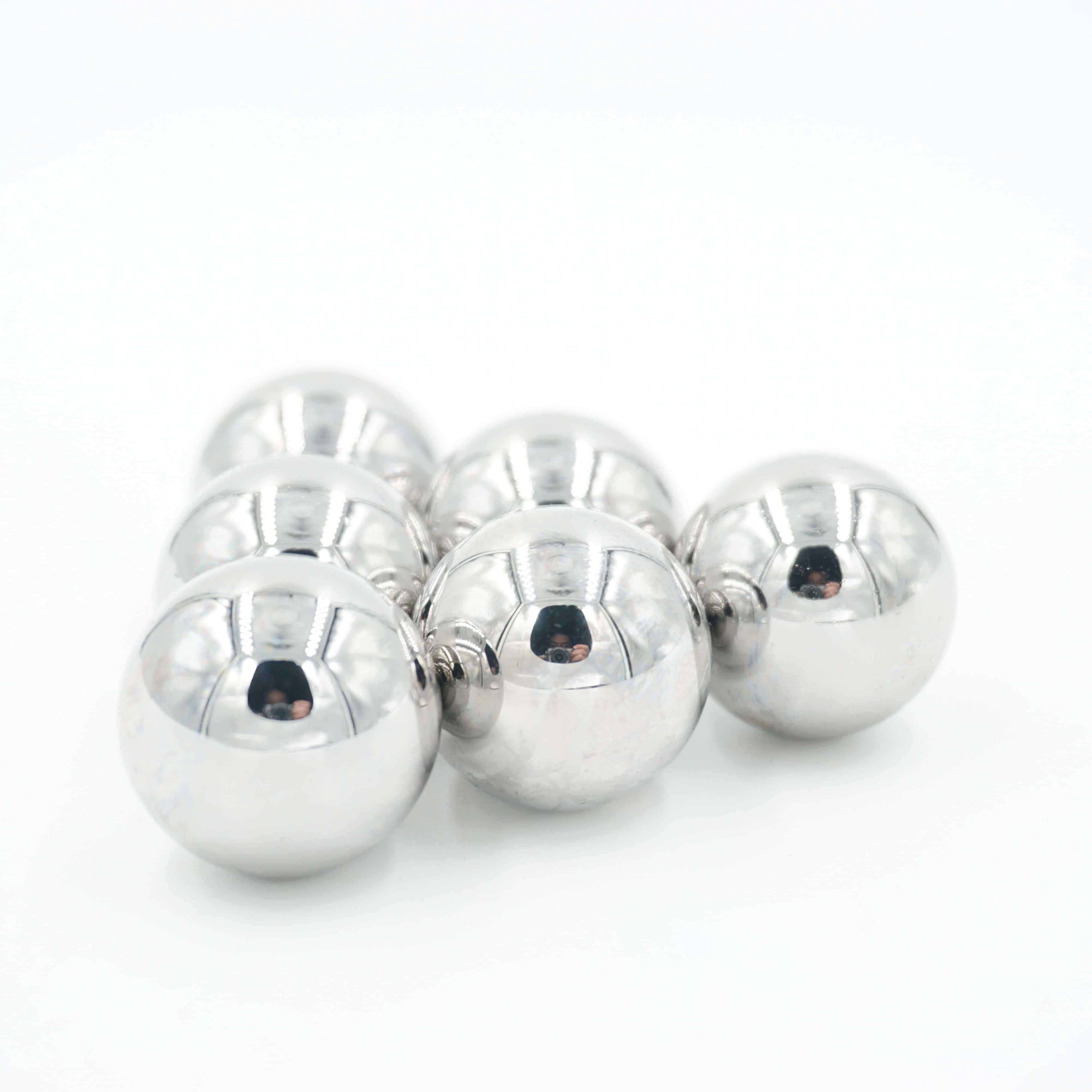
Steel balls are the load-bearing detail inside bearings, valves, pumps, conveyors and precision instruments — and they are rarely interchangeable. Two balls with the same 12 mm diameter can differ by more than ten points of Rockwell hardness, by a hundredfold in dimensional tolerance, and by an entire material family in corrosion behaviour. That is why an industrial sourcing project stalls far more often at the specification stage than at the supplier stage.
This guide is written for that stage. It covers the main types of steel balls, how precision grades and tolerances are written, how to separate a real specification from a sales description, and the verification steps that make sourcing from China predictable. The product and process data below come from Haimen City Mingzhu Steel Ball Co., Ltd., a steel ball manufacturer established in Haimen, Jiangsu Province, China in 1992 that supplies both standard catalog balls and drawing-based custom parts.
In short — the three decisions that define a steel ball order:
1. Material sets hardness, corrosion resistance and temperature limits (carbon, chrome, martensitic stainless, austenitic stainless, or a specialty alloy).
2. Geometry sets whether you buy a plain sphere or a modified part — drilled, threaded, hollow, machined or electroplated.
3. Precision grade sets diameter variation, sphericity and surface finish, which in turn drive noise, vibration and service life.
What Decides Whether a Steel Ball Works
A purchase enquiry is usually phrased as "who sells steel balls", but the engineering question behind it is narrower. A ball has to satisfy the operating condition it will live in: load and speed, lubrication regime, temperature, and the corrosion chemistry of the surrounding fluid. Those four inputs point to a material family. Material alone is not enough, however, because a soft austenitic stainless ball and a hardened martensitic stainless ball can share the same diameter and the same label.
The second layer is geometry. A large share of industrial demand is not for plain spheres at all, but for modified parts — a drilled ball that becomes a linkage pivot, a hollow sphere that reduces mass in a decorative or buoyancy application, a plated ball that has to survive humidity without rusting. These are machined parts, not catalog commodities, and they are quoted from a drawing.
The third layer is precision grade. Grade determines how tightly the diameter is held, how spherical the ball is and how smooth the surface is. A grade that is too coarse shows up as vibration and premature failure in a bearing; a grade that is unnecessarily fine adds cost and lead time for no functional gain. Fixing all three layers before requesting quotations is what makes a first order land on target.
Industry Background: A Mature Market with Clearly Segmented Demand
Steel balls sit inside the Industrial Equipment & Components category and are traded globally at very large volume. Published market research places the global steel ball market at an estimated USD 12.91 billion by 2026 (Coherent Market Insights), with chrome steel balls projected to hold a 45.7% share of that market by material in the same year (Coherent Market Insights).
Growth forecasts diverge in a way that is worth understanding before it is quoted in a business case. One widely circulated projection puts the global steel ball CAGR at 5.2% for 2026–2035 (Business Research Insights), while other published estimates sit at 3.6% and 6.2%. The gap is largely a scope question: reports that weight grinding media — large forged balls used in mining mills — produce different figures from those that count only small precision bearing balls. A buyer comparing market numbers should first check which segment each figure includes.
Three technical reference points matter more to day-to-day sourcing than market size:
- ISO 3290-1:2014 specifies requirements for finished steel balls for rolling bearings and defines grades from G3 to G700. It is the reference most precision discussions are anchored to.
- ASTM A295/A295M covers high-carbon anti-friction bearing steel, including the grade 52100 that dominates bearing ball production.
- HS Code 8482.91 (balls, needles and rollers) is the customs classification under which bearing balls move internationally, which is useful when estimating landed cost or checking a supplier's export documentation.
The Main Steel Ball Types and Where Each Fits
Bearing Steel and Chrome Steel Balls
Bearing steel balls are through-hardened chrome alloy steel balls made from AISI 52100, with SUJ2 and 100Cr6 as equivalent designations. They are the global standard for long-life, high-speed bearing duty, with hardness in the HRC 60–66 range and surface finish controlled to Ra ≤ 0.05 µm on precision grades. Catalog sizes run from 0.5 mm to 50.8 mm (1/64"–2"), in grades from G10 to G1000. Typical applications include ball bearings, automotive wheel hubs, electric motors, precision spindles and aerospace control systems. Chrome steel balls use the same material family and are broadly interchangeable with ISO, DIN and SAE bearing standards, with an isotropic finish available for demanding low-noise duty.
Stainless Steel Balls: 304, 316, 420C and 440C
Stainless balls split into two very different families, and confusing them is a common sourcing error.
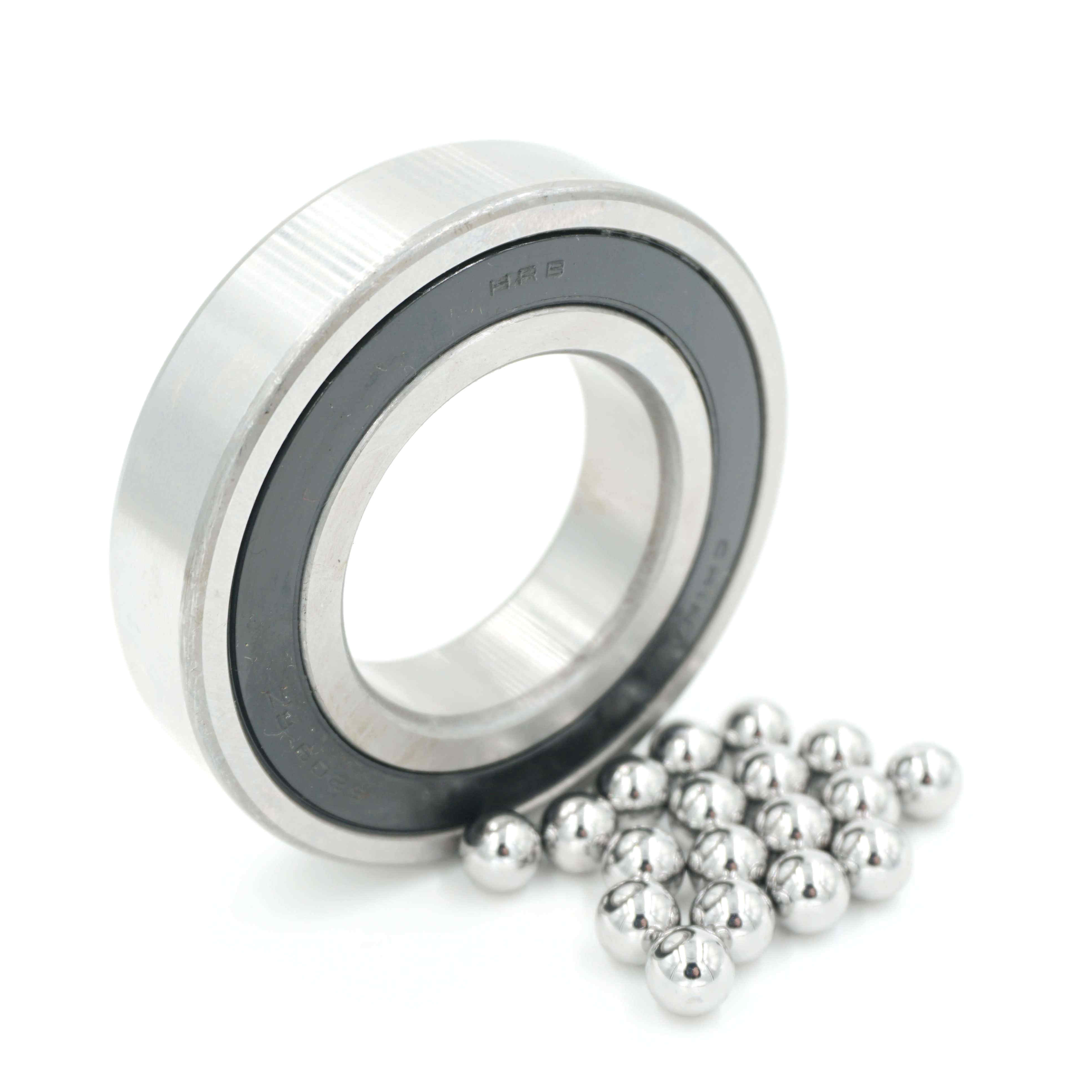
Austenitic grades (304 and 316) are soft and non-magnetic. 304 is the general-purpose, cost-effective grade for food and beverage equipment, decorative hardware, plumbing valves, architectural fittings and cryogenic tanks, with mirror polishing available. 316 adds molybdenum for pitting and crevice corrosion resistance in chloride and saltwater service, which is why it is used in marine hardware, chemical processing, pharmaceutical and food equipment, offshore rigging and saltwater valves. Both are supplied from 1 mm to 50.8 mm in grades G100–G1000.
Martensitic grades (420C and 440C) are hardenable precision stainless balls. 420C runs at HRC 50–55 in grades G25–G1000 and is the affordable choice for wash-down and humid-duty bearing assemblies, food-processing machinery, pump valves and marine hardware. 440C reaches HRC 58–62 in grades G10–G1000, the highest hardness among standard stainless grades, and is used in high-precision bearings, surgical and dental instruments, aerospace actuators, chemical pumps and watch movements.
Carbon Steel Balls
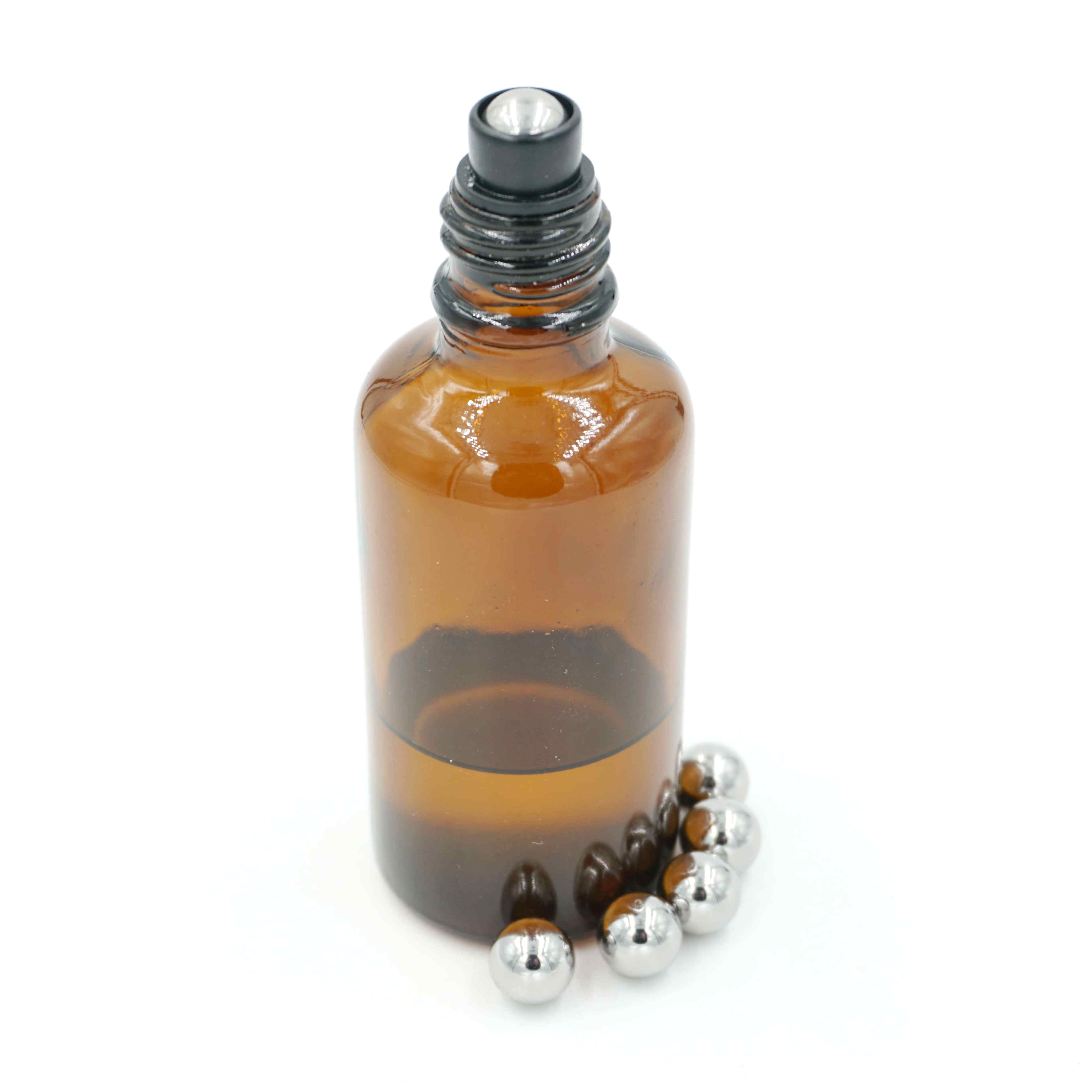
Carbon steel balls are the economical option, produced from 1010, 1015 and 1018 grades and available either unhardened or through-hardened to HRC 55–60. Grades span G100–G2000 and diameters 1 mm to 50.8 mm. They are used in automotive steering and suspension components, conveyor rollers, bicycle and caster bearings, grinding media and general low-cost hardware, where uniform size matters more than extreme hardness.
Precision Steel Balls
Precision steel balls are defined by tolerance rather than by material. They are supplied from 0.5 mm to 50.8 mm in grades G3, G5, G10, G16 and G25, with sphericity controlled within micro-inches, and can be produced in 52100, 100Cr6, 420C, 440C, 316 or 304 depending on the duty. Typical applications are precision bearings, aerospace gyroscopes, metrology and measuring instruments, and high-speed spindles — anywhere the ball's own geometry is a contributor to system accuracy.
Machined and Non-Standard Steel Balls
When a required diameter or geometry falls outside cold-heading range, the part is machined from bar stock. Machined steel balls are produced from 10 mm to 200 mm and beyond, in ISO tolerance classes with roughness and hardness per specification, from bearing steel, carbon steel or stainless steel. They serve heavy industrial machinery, large bearing assemblies and specialized valve and flow-control equipment. Non-standard steel balls go a step further: each unit is manufactured to the customer drawing or specification rather than selected from a catalog, with material selectable between bearing steel, stainless steel, carbon steel and alloy steel. They are used in custom bearing assemblies, proprietary mechanical systems, R&D projects and specialized valves and actuators.
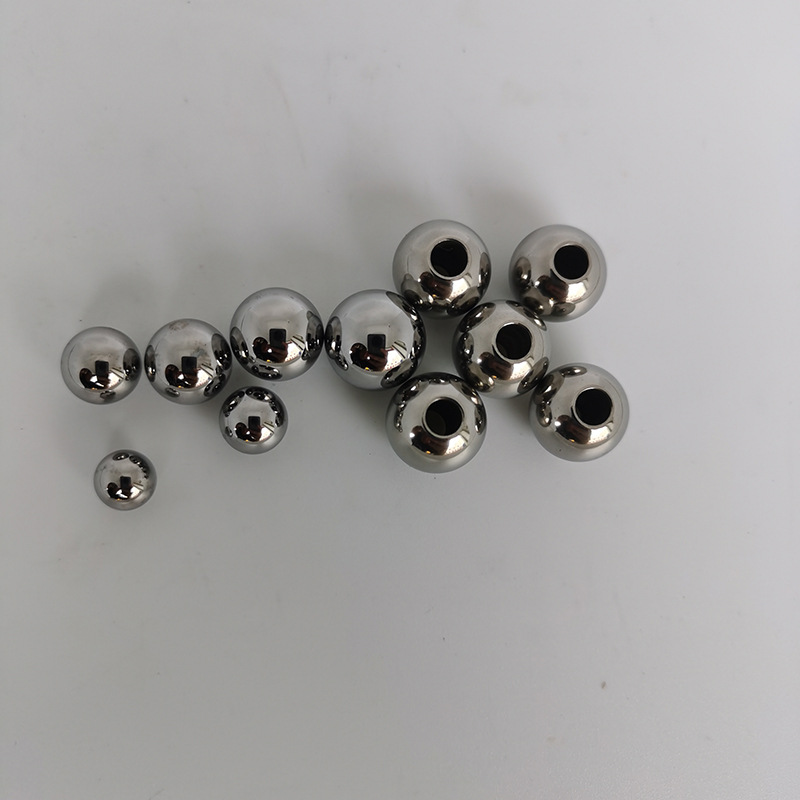
Drilled and Threaded Steel Balls
Drilled balls are spheres with through or blind holes, or with tapped threads, enabling direct mounting and integration into linkages and pivots. Stock sizes are typically 6 mm to 50.8 mm, with hole diameter, depth, concentricity and thread class controlled to the drawing; metric and UNC/UNF threads are both available. Typical uses are locking ball joints, tie-rod ends, linkage pivots, positioning fixtures and custom bearing assemblies. Bearing steel (AISI 52100) is the standard material, with 304 and 440C stainless versions and carbon steel also available.
Hollow Steel Balls
Hollow steel balls reduce mass and material usage compared with a solid sphere while keeping a rigid spherical form. They are made in seamless or welded configurations from carbon steel, 304 or 316 stainless steel, or alloy steel, with outside diameter and wall thickness per specification and through-holes available. Applications include architectural and decorative spheres, hollow shaft and bearing assemblies, buoyancy and aerostatic designs, and ornamental structures.
Electroplated Steel Balls
Electroplated balls use a carbon or alloy steel core with a zinc, nickel or chromium coating, typically over base diameters of 1 mm to 50.8 mm, with plating thickness to specification — zinc at 5–25 µm is a common example. The coating provides surface corrosion protection for low-corrosion indoor applications and allows the finish and appearance to be customized while retaining the core strength and economy of steel. They are used in decorative hardware, automotive trim, consumer goods and conductivity-critical parts.
High-Alloy Balls: Duplex, Hastelloy and M50
Three specialty families cover conditions that standard stainless cannot survive. Duplex stainless steel balls (UNS S32205 / S31803, grade 2205) are typically supplied from 10 mm to 100 mm with high strength and corrosion resistance for offshore oil and gas, subsea manifolds, chemical processing, desalination plants and pulp and paper digesters. Hastelloy balls (C-276 / UNS N10276, with C-22 / UNS N06022 as an alternative) resist strong oxidizing and reducing acids, pitting, crevice corrosion and stress-corrosion cracking, typically from 3 mm to 50 mm, in acid-handling valves, flue-gas desulfurization, pharmaceutical reactors and seawater or brine service. M50 steel balls (AISI M50 / UNS T11350, AMS 6490) run at HRC 62–66 with high hot hardness and dimensional stability for aerospace engine main-shaft bearings and high-speed turbomachinery.
Reading a Steel Ball Specification
What the G Number Means
The G number is a tolerance class, not a material grade. Per ABMA and ISO 3290 practice, grades run from G3 to G1000, where a lower number indicates a tighter allowable variation in diameter and sphericity. Common stock is typically G100–G1000, while precision applications sit at G10–G25 and the most demanding metrology and gyroscope work reaches G3–G5. A supplier should be able to report roundness, diameter variation, waviness and surface finish by grade — if those values are not stated, the grade claim is unsupported.
Hardness and Surface Finish
Hardness is quoted in HRC and depends on both material and heat treatment: chrome steel 52100 is through-hardened to roughly HRC 60–66, 440C martensitic stainless to HRC 58–62, M50 to HRC 62–66, 420C to HRC 50–55, and carbon steel to HRC 55–60 when hardened. Soft or annealed conditions are normal for austenitic 304 and 316, which are selected for corrosion resistance rather than wear resistance. Surface finish, often expressed as Ra, is the third dimension of quality and is reported alongside the grade.
Documentation That Travels with the Batch
Inspection evidence is what converts a specification into a verifiable order. A material test report (MTR), EN 10204 2.1 or 3.1 certificates, a certificate of analysis (COA) and, on request, PPAP, FAI, NACE MR0175 or AMS documentation are the documents that let a buyer's own quality team close the loop. Material verification by PMI or chemical analysis, plus hardness, roundness, microstructure and roughness checks, belong in the same evidence package.
Steel Ball Materials Compared
| Material family | Typical grades | Diameter range | Hardness | Best-fit duty |
|---|---|---|---|---|
| Bearing steel / chrome steel (AISI 52100, SUJ2, 100Cr6) | G10–G1000 | 0.5–50.8 mm | HRC 60–66 | Anti-friction bearings, wheel hubs, motors, spindles, transmissions |
| Carbon steel (1010 / 1015 / 1018) | G100–G2000 | 1–50.8 mm | Soft, or HRC 55–60 hardened | Conveyor rollers, casters, bicycle bearings, low-cost hardware |
| 304 stainless (austenitic) | G100–G1000 | 1–50.8 mm | Annealed (soft) | Food and beverage equipment, plumbing valves, architectural fittings |
| 316 stainless (austenitic, Mo-alloyed) | G100–G1000 | 1–50.8 mm | Annealed (soft) | Marine hardware, chemical processing, saltwater valves, pharma equipment |
| 420C stainless (martensitic) | G25–G1000 | 1–50.8 mm | HRC 50–55 | Wash-down bearings, pump valves, food-processing machinery |
| 440C stainless (martensitic) | G10–G1000 | 0.5–50.8 mm | HRC 58–62 | High-precision bearings, surgical and dental instruments, chemical pumps |
| Precision balls (52100 / 100Cr6 / 420C / 440C / 316 / 304) | G3, G5, G10, G16, G25 | 0.5–50.8 mm | Per selected material | Gyroscopes, metrology instruments, high-speed spindles |
| M50 high-speed tool steel (AMS 6490 / UNS T11350) | Per aerospace specification | 3–50 mm | HRC 62–66 | Aerospace engine main-shaft bearings, high-speed turbomachinery |
| Duplex stainless 2205 (UNS S32205 / S31803) | Per specification | 10–100 mm | High-strength duplex | Offshore and subsea, desalination, chemical processing, pulp and paper |
| Hastelloy C-276 / C-22 | Per specification | 3–50 mm | Nickel superalloy | Strong acids, chlorides, pharma reactors, flue-gas desulfurization |
| Machined balls (52100 / 1045 / 4140 optional) | ISO tolerance classes | 10–200 mm+ | Per specification | Heavy machinery, large bearing assemblies, flow-control equipment |
Custom features follow a separate logic, because they are machined from a selected base material rather than chosen from a stock list:
| Custom feature | Capability | Typical application |
|---|---|---|
| Drilled / threaded balls | Through or blind holes, metric and UNC/UNF threads, stock sizes 6–50.8 mm typical | Linkage pivots, tie-rod ends, locking ball joints, positioning fixtures |
| Hollow balls | Seamless or welded, 304 / 316 / carbon steel, OD and wall thickness per specification | Decorative spheres, buoyancy and aerostatic designs, hollow shaft assemblies |
| Electroplated balls | Zinc, nickel or chrome over carbon or alloy steel core; base 1–50.8 mm; zinc 5–25 µm example | Decorative hardware, automotive trim, conductivity-critical parts |
| Non-standard geometry | Decimal sizes, stepped and half-spherical forms, tolerances made to order | Proprietary mechanisms, R&D builds, specialized valves and actuators |
How to Source Steel Balls from China, Step by Step
- Define the operating condition first. Record load type and magnitude, rotational speed, temperature range, lubrication method and the chemistry the ball will contact. These five inputs eliminate most of the catalog before price is discussed.
- Select the material family. Chrome steel for hardness and fatigue life, carbon steel for cost-driven low-load duty, austenitic stainless for corrosion resistance and hygiene, martensitic stainless when hardness and corrosion resistance are both required, and a specialty alloy only when standard grades demonstrably fall short.
- Set the precision grade and tolerance. State the grade (for example G10, G25, G100) and the diameter series — metric or inch. Confirm that the supplier reports roundness, diameter variation and surface finish by grade.
- Decide standard or custom geometry. If the part needs a hole, a thread, a hollow body, plating or an out-of-range diameter, say so at the enquiry stage, because tooling and inspection requirements change the quotation, the MOQ and the lead time.
- Request samples or first-article parts. Prototype or first-article samples can be supplied before mass-production approval, and FAI or PPAP documentation can be provided on request. Validation before tooling commitment is the cheapest risk control in the process.
- Confirm documentation, packaging and terms. Agree which quality documents travel with the shipment, then fix packaging — drums, sealed bags, tubes or blisters, and OEM-labelled cartons with quantity, grade and lot code marked — along with Incoterms, payment terms and shipment mode.
- Lock in repeat supply. Standard sizes and common materials are often held in stock and can ship in 5–10 days; standard production runs 15–30 days. Ask what stock and backup tooling the supplier maintains so the second and third orders behave like the first.
Use Cases: Matching the Ball to the Operating Condition
- Industrial bearings and power transmission. Deep-groove and angular-contact bearings, gearbox assemblies and MRO replacement calls for through-hardened HRC 60–66 balls at ABMA G10–G40, with dimensional stability and low noise and vibration.
- Automotive and EV powertrain. Wheel-hub bearings, transmission bearings and e-axle reduction gears need consistent ball diameter and fatigue-life behaviour, with IATF 16949 traceability available through the supply chain.
- Corrosive, marine and process service. Desalination intake and RO skid valves, subsea manifolds, brine-handling valves and marine deck hardware rely on 316, duplex 2205 or Hastelloy C-276 balls depending on chloride level and temperature.
- High-temperature, high-speed duty. Aerospace engine main-shaft bearings and CNC or grinding spindles use M50 balls that retain hot hardness at elevated temperatures, alongside precision balls in G5–G10.
- Hygienic and instrument applications. Food and dairy conveyors, filling valves, dental handpieces and surgical drills use mirror-polished stainless balls where cleanability and corrosion resistance outrank hardness.
- General industrial, decorative and buoyant designs. Ball-transfer conveyors, drawer slides, casters, architectural spheres and ornamental structures use carbon steel, plated or hollow balls where economy and appearance drive the decision.
Verifying a China Steel Ball Manufacturer
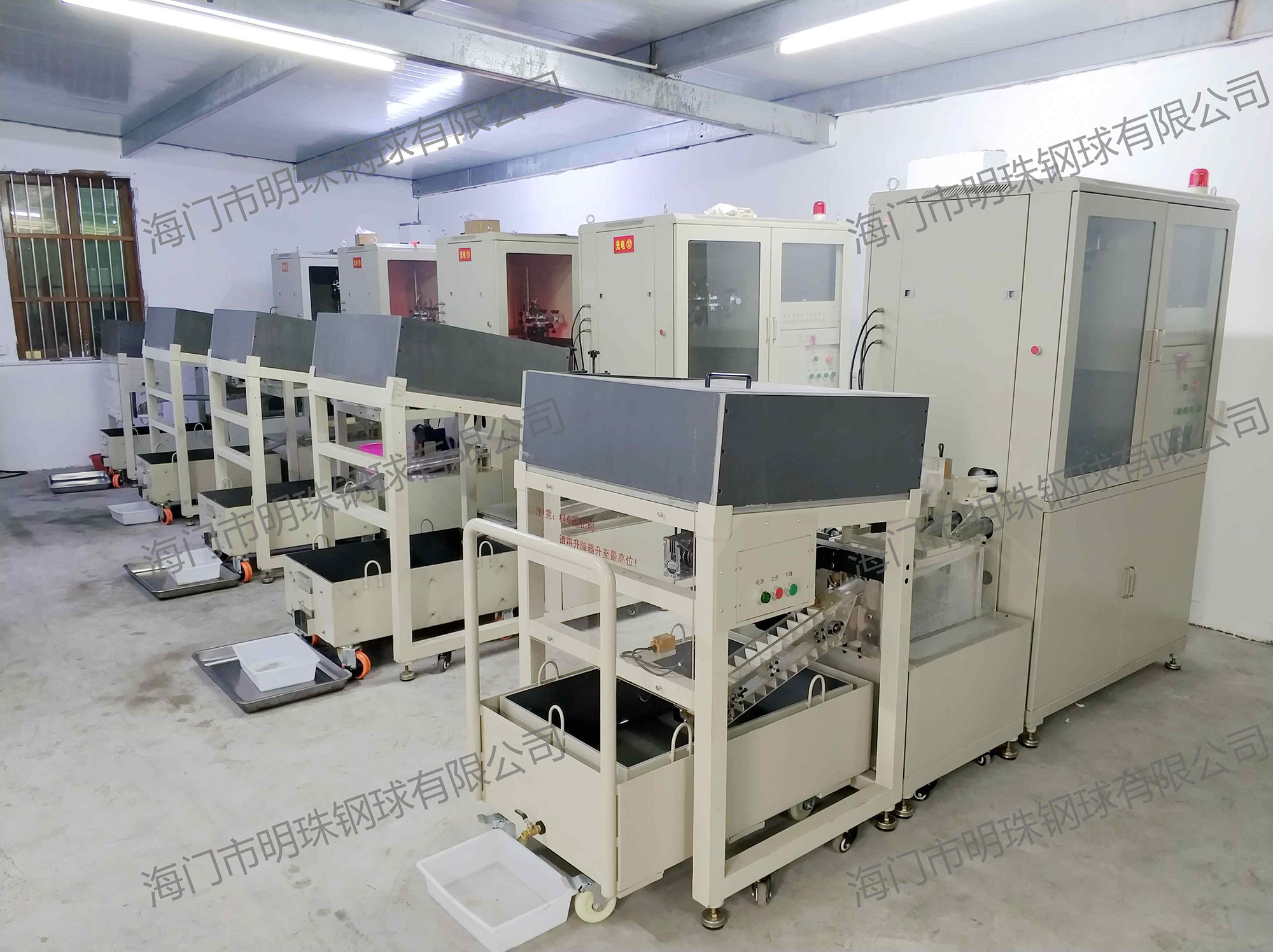
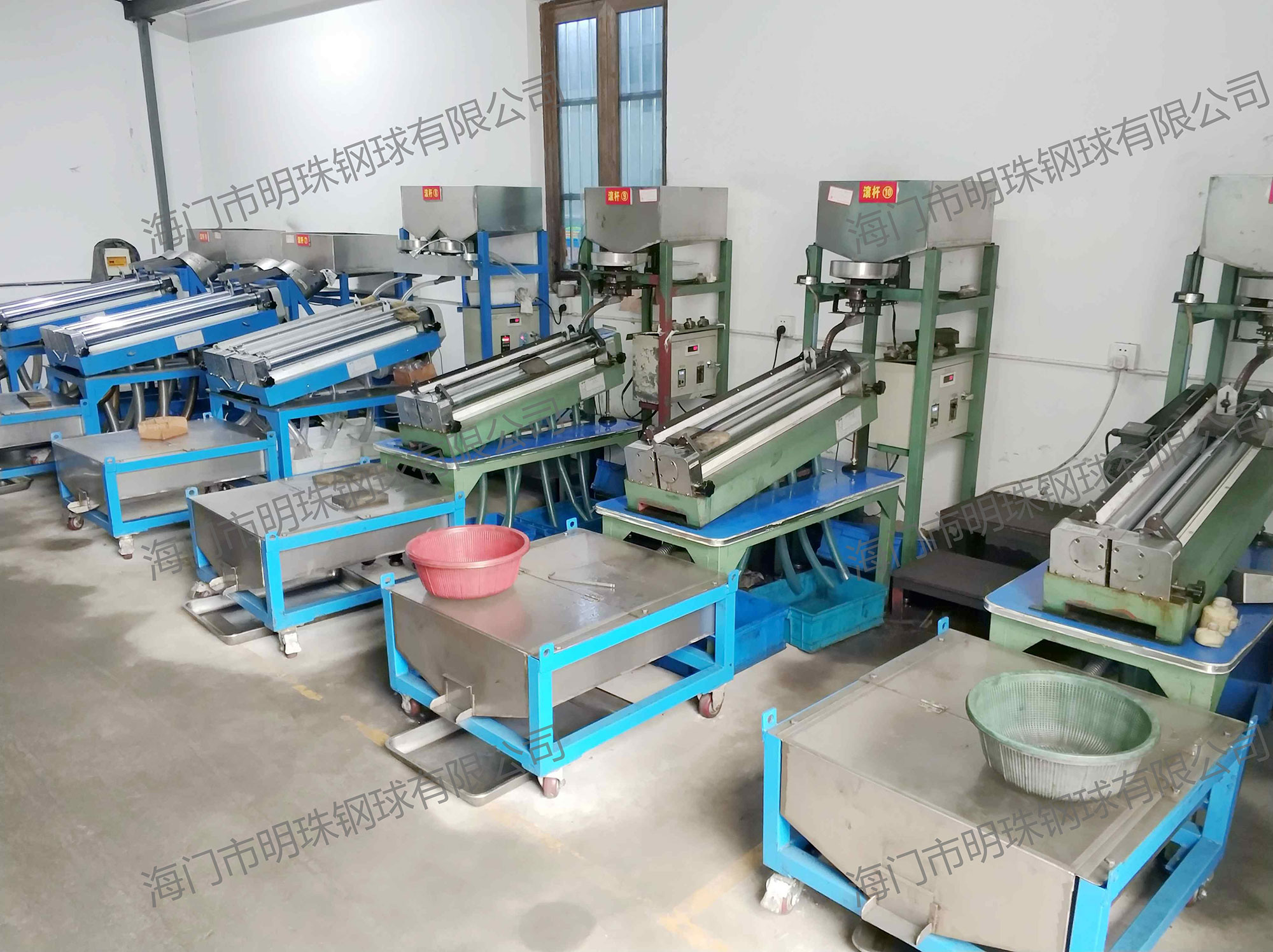
Supplier verification is mostly a documentation exercise, but a short list of physical facts separates a manufacturer from a trading intermediary. Ask for the production footprint and equipment count, the annual capacity, the inspection method used on every batch, and the certifications held. A manufacturer that performs cold heading, grinding, heat treatment, CNC machining and automated inspection in-house can respond to a drawing change without a third-party delay.
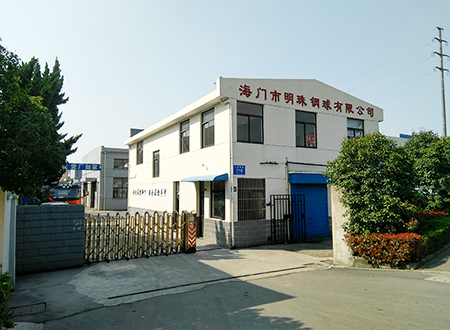
As a concrete reference point, Haimen City Mingzhu Steel Ball Co., Ltd. was founded in 1992 and operates a 7,500 m² production base in Haimen, Jiangsu Province, China, equipped with 105 sets of professional processing and production equipment, an annual capacity of 2,500 tons, approximately 40 staff and an R&D team of 8 engineers. The company holds IATF 16949 and ISO 9001 quality management system certification and exports about 25% of output, with the United States, Germany and Brazil among its main markets.
Quality control on this basis is a whole-process system rather than a final gate: raw material is sampled and inspected before entering production, and finished balls pass 100% automatic roller-bar sorting and photoelectric surface-defect detection to remove defective product. That mechanism is what makes hardness, roundness, microstructure and material verification results meaningful on a batch-by-batch basis.
Frequently Asked Questions
What materials and grades of steel balls can Mingzhu supply?
Common grades are carbon steel, chrome steel 52100 (100Cr6 / SUJ2), martensitic stainless 420 and 440C, austenitic stainless 304 and 316, plus specialty alloys on request including M50, duplex 2205 and Hastelloy C276. Diameters typically run from 0.5 mm to 50.8 mm in metric and inch series, with non-standard decimal sizes made to drawing, in ABMA / ISO 3290 precision grades from G3 to G1000. Material verification and an MTR are supplied as required.
Are you a factory or a trading company, and can you make non-standard, drilled or hollow balls to drawing?
Mingzhu is a direct steel ball manufacturer with in-house cold heading, grinding, heat treatment, CNC machining and automated inspection. Custom production covers non-standard diameters to decimal size and drilled (through or blind), threaded (metric and UNC/UNF), stepped, half-spherical and hollow balls in seamless or welded form, with diameter, depth, concentricity and thread class controlled to the drawing. Soft materials machine more easily, while hardened 440C or M50 require specialized tooling and longer lead time.
What is the minimum order quantity, and can I order small quantities?
Standard catalog sizes have a low MOQ and can be ordered by the bag or piece. Non-standard and CNC-machined balls usually start from 50–500 pcs depending on setup, while prototype quantities of 10–50 pcs are workable for simple parts. MOQ is flexible for first-time cooperation and NDA-protected projects, and the main cost drivers are material grade, precision grade, custom features and the inspection level required.
Can I get samples or prototypes before committing to production?
Yes. Prototype or first-article samples can be supplied before mass-production approval, which allows dimensional and functional validation against the drawing. Material certificates and batch traceability documents can be issued with shipments, and inspection records such as PPAP or FAI are available on request. Samples can be settled by PayPal or Western Union, while production orders typically run on T/T 30% deposit plus 70% balance before shipment, or L/C at sight for large orders.
What is the lead time, and can you supply steadily?
Standard sizes and common materials are often in stock and can ship in 5–10 days; standard production runs 15–30 days, while non-standard sizes, special alloys or CNC features take 20–60 days depending on tooling and inspection. Rolling stock and backup tooling are maintained for stable repeat supply, with monthly production status updates. To start a sourcing evaluation, share your drawing or specification — dimensions, material, grade and quantity — and Mingzhu will confirm feasibility, MOQ, lead time and a quotation; the full capability overview is in the company brochure.
Conclusion
Steel balls reward a specification-first approach. Material determines what the ball can survive, geometry determines whether it can be mounted and integrated, and precision grade determines how quietly and how long it performs. Buyers who fix those three items before requesting quotations get comparable offers, shorter sampling cycles and fewer batch rejections.
For industrial sourcing from China, the practical checklist is equally short: verify that the supplier manufactures rather than resells, confirm that inspections are automated and documented, request samples or first-article parts before tooling, and agree packaging, Incoterms and documentation before the purchase order is issued. Suppliers who can answer all four points with records are the ones that make repeat supply predictable.
Request a Sample, Quote or Drawing Review
Send your ball specification — diameter, material, grade, quantity and any custom feature — and Haimen City Mingzhu Steel Ball Co., Ltd. will confirm feasibility, MOQ, lead time and pricing. Standard sizes can ship in 5–10 days.
Contact: Diego Gu | Email: info@hmmzsteelball.com | Tel / WhatsApp: +86 13912237934
Address: No. 718 West Renmin Road, Haimen City, Jiangsu Province, China | Website: www.hmmzsteelball.com