
What Is a Precision Steel Ball? Grades, Sphericity and Material Basics
Most steel balls are sold on diameter alone. A precision steel ball is sold on four properties at once — diameter, sphericity, diameter variation and surface finish — each held to a recognised grade. This guide explains what those grades mean, which materials carry them, and where the boundary between precision and general purpose actually sits.
Definition. A precision steel ball is a spherical rolling element whose diameter tolerance, sphericity, diameter variation and surface finish are specified against a published grade system — most commonly ABMA / ISO 3290 — rather than described only as "tight tolerance". The Haimen City Mingzhu Steel Ball Co., Ltd. precision range covers 0.5 mm to 50.8 mm diameters in grades G3, G5, G10, G16 and G25, with sphericity controlled within micro-inch tolerances and materials spanning 52100, 100Cr6, 420C, 440C, 316 and 304.
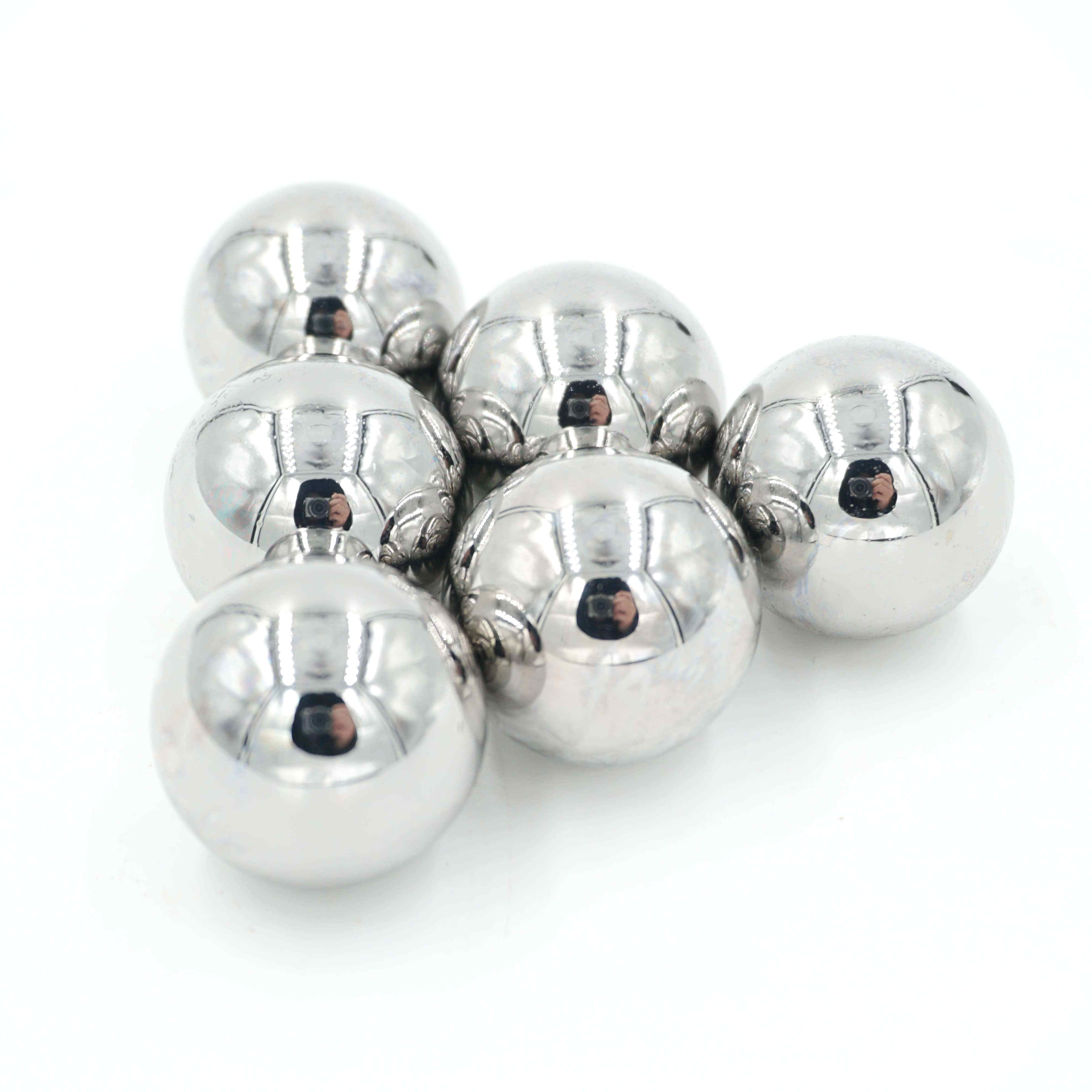
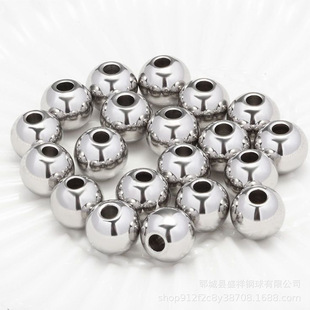
Precision steel balls: diameter, sphericity, diameter variation and surface finish are specified together, not separately.
Why "Precision" Is the Most Misused Word in Steel Ball Sourcing
Three failure patterns recur when a buyer moves from general steel balls into tolerance-critical assemblies.
Treating the grade as an adjective. A supplier that says "we produce precision balls" has said nothing verifiable. A supplier that says "G10, ISO 3290 reference, 0.5–50.8 mm, sphericity in micro-inches" has made a claim that can be checked against a certificate and a batch report.
Specifying diameter and stopping there. Diameter tolerance alone does not predict running noise or bearing life. Two balls can sit inside the same diameter band while differing in sphericity and surface texture, and sphericity is what governs how smoothly a ball tracks a raceway at speed.
Confusing dimensional precision with load capacity. Stainless Steel Balls in 304 or 316 are supplied annealed soft. They can be dimensionally excellent and still be the wrong choice for a high-load bearing, because the limitation is metallurgical rather than dimensional. Precision and hardness are two separate purchase decisions that happen to be quoted on the same line item.
Industry Background: What the Standards Actually Fix
The grade system predates any individual supplier. ISO 3290-1:2014 specifies requirements for finished steel balls for rolling bearings and defines grades from G3 to G700. ASTM A295/A295M covers the high-carbon, anti-friction bearing steel behind Grade 52100. In trade classification, bearing balls, needles and rollers sit under HS code 8482.91.
What the standards do not do is tell a buyer which grade to order. That remains an engineering decision driven by speed, load, noise, corrosion and inspection cost — and it is where most specification errors originate.
Market context is worth one paragraph, with a caveat. Coherent Market Insights estimates the global steel ball market at USD 12.91 billion for 2026, with chrome steel balls projected to hold a 45.7% material share in the same year. The same publisher's comparison notes record 2026 estimates ranging from USD 4.98 billion to USD 12.91 billion, because some reports include large-diameter grinding media for mining while others count only small precision balls. Growth forecasts diverge for the same reason: Business Research Insights projects a 5.2% CAGR for 2026–2035, against 3.6% and 6.2% from other publishers. Any single market number for this category should be read together with its inclusion criteria.
On the supply side, Haimen City Mingzhu Steel Ball Co., Ltd. is a steel ball manufacturer founded in 1992 and based in Haimen, Jiangsu Province, China, producing bearing steel, stainless steel, carbon steel and custom machined balls for bearings, automotive components, ball screws, linear rails, pumps and grinding media. The production base covers 7,500 m² with 105 sets of processing equipment, a stated annual capacity of 2,500 tons, an engineering team of eight, and exports representing roughly 25% of output, with the United States, Germany and Brazil listed as main markets.
The Four Parameters That Define a Precision Steel Ball
Every grade conversation reduces to four measurable properties. Buyers who track all four avoid most of the disputes that follow a first shipment.
- Diameter and diameter tolerance. Nominal diameter plus the band allowed by the selected grade. The precision range runs 0.5 mm to 50.8 mm (0.020 in to 2.000 in) in both metric and inch series, with non-standard decimal sizes produced to drawing.
- Sphericity. The deviation of the finished surface from a true sphere, expressed in micro-inches. This is the parameter that most directly separates a G5 from a G25. Within the same 0.5–50.8 mm diameter range, G3 and G5 balls hold tighter sphericity limits than G16 and G25 balls.
- Diameter variation. The spread of diameters within a single lot. A lot that is individually round but inconsistent ball-to-ball still produces uneven load sharing in a bearing.
- Surface finish. Roughness, normally stated as Ra, plus the character of the texture. Bearing Steel Balls are specified at Ra ≤ 0.05 µm. Chrome Steel Balls are offered with an isotropic finish option.
What this guide deliberately does not do. It does not reproduce the numeric limit table for each grade. Those limits are defined in ISO 3290-1:2014 and in ABMA Std 10, and a supplier's certificate should be checked against the standard rather than against a blog table. What matters commercially is that the grade is stated, the inspection method is stated, and both are traceable to a batch.
Precision Grades G3, G5, G10, G16 and G25 Explained
The five grades in the standard precision range are not five quality tiers of different products. They are five tolerance bands applied to the same manufacturing route, and the choice is driven by what the assembly can tolerate.
| Grade | Sphericity control within the 0.5–50.8 mm range | Where it is typically specified |
|---|---|---|
| G3 | Tightest band available in this range | Metrology reference spheres, semiconductor wafer handling, gyroscope and inertial instrument bearings |
| G5 | Tighter than G16 and G25 | High-speed spindles, aerospace control-surface actuators, precision instrument bearings |
| G10 | Intermediate; the common entry point for precision bearing duty | Deep-groove and angular-contact bearings, electric motor bearings, precision linear guides |
| G16 | Looser than G10 | General precision assemblies where noise and torque targets are moderate |
| G25 | Loosest of the five, still inside precision classification | Actuators, pumps and valve trim where dimensional control matters but ultra-low noise does not |
Two practical notes on reading that table. First, a higher grade number is not a defect — a G25 ball correctly specified for pump trim is a better commercial decision than an over-specified G5. Second, the grade only binds if the inspection can prove it. Precision grades in this range are verified by 100% automated machine-vision inspection supplemented by roundness and profiler checks, with grade certification issued per batch.
The grade band also works as a capability filter. Carbon Steel Balls are supplied in G100–G2000. Austenitic stainless balls are supplied in G100–G1000. Martensitic stainless balls reach G10–G100, and high-carbon high-hardness martensitic balls reach G5–G100. Only a dedicated precision line covers G3–G25. If a supplier quotes G5 across every material family, the grade is worth verifying before the purchase order is released.
Surface Finish: Ra ≤ 0.05 µm and the Isotropic Question
Grade tables describe geometry. They say much less about surface, and surface is what a rolling element actually presents to a raceway.
Bearing Steel Balls carry a specified Ra ≤ 0.05 µm. That figure is a specification rather than a marketing target, and it applies to the finished ball rather than to a polished sample. Chrome Steel Balls are offered with an isotropic finish, meaning the finishing operation is controlled so that surface texture is uniform across the sphere instead of carrying a directional pattern from a single grinding pass. The practical reason to ask for it is consistency of noise and vibration behaviour across a lot.
A caution follows. If an isotropic finish is quoted without a texture limit, the buyer has purchased a process description rather than a specification. Ask what surface-texture value the finish holds, at which grade, and how it is measured. The same discipline applies to mirror-polished 304 Stainless Steel Balls used in food, dairy and decorative fittings: mirror polish describes an appearance, and appearance alone does not define corrosion or cleanability performance.
The Six Materials Buyers Actually Choose Between
Material and grade are separate axes. The precision range is offered in six base materials, and each occupies a distinct position.
AISI 52100 / 100Cr6 / SUJ2 — through-hardened chrome alloy steel
The default for load-bearing rolling duty. HRC 60–66, diameter 0.5 mm to 50.8 mm, grades G10–G1000, broadly interchangeable across ISO, DIN and SAE bearing standards. SUJ2 is the JIS designation and 100Cr6 the DIN designation for the same chrome alloy family. This is the material behind most Bearing Steel Balls and Chrome Steel Balls ordered for anti-friction bearings, transmissions, valve train components and precision instruments. It offers no corrosion protection of its own; lubrication and sealing remain the buyer's responsibility.
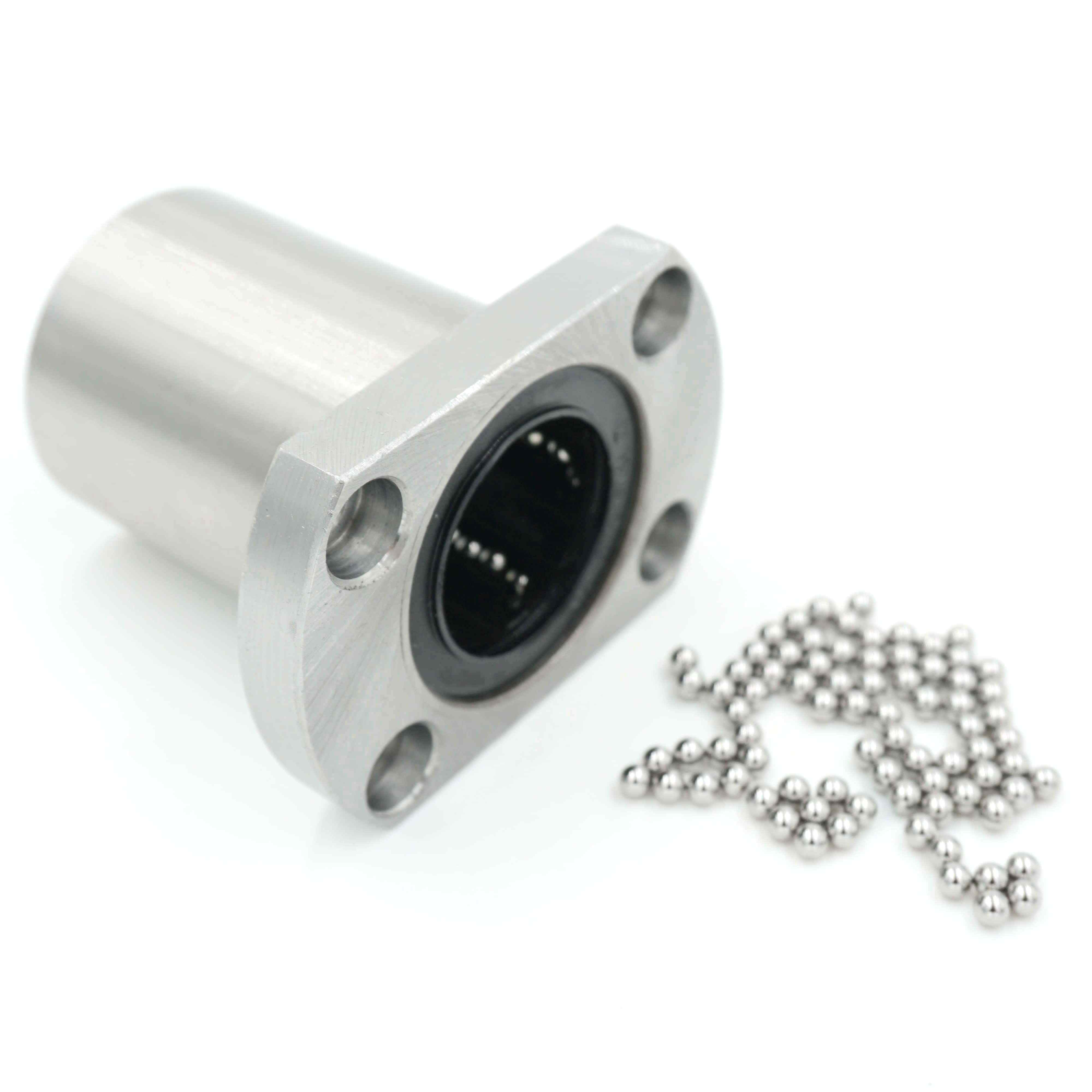
Chrome steel balls in AISI 52100 / 100Cr6 / SUJ2 deliver HRC 60–66 and are interchangeable across ISO, DIN and SAE bearing standards.
AISI 440C / UNS S44004 — martensitic stainless, high hardness
HRC 58–62, diameters 0.5 mm to 50.8 mm, grades G10–G1000, with phosphorus and sulfur capped at 0.07%. Of the martensitic stainless options in this range, 440C carries the highest specified hardness band, which is why it appears in high-precision bearings, surgical and dental instruments, aerospace actuators, chemical pump bearings and watch movements where wear resistance and corrosion resistance are both required.
AISI 420C / UNS S42000 — martensitic stainless, moderate hardness
HRC 50–55, diameters 1 mm to 50.8 mm, grades G25–G1000. The compromise grade: enough hardness for bearing and valve duty, enough corrosion resistance for wash-down and humid service, at lower alloy cost than 440C. Commonly specified for bearings in mildly corrosive environments, food-processing machinery, pump valves and marine hardware.
AISI 316 / UNS S31600 — austenitic stainless
Diameters 1 mm to 50.8 mm, grades G100–G1000, supplied annealed soft. Molybdenum alloying gives resistance to pitting and crevice corrosion in chloride and saltwater environments, which is why 316 Stainless Steel Balls appear in marine hardware, chemical processing, pharmaceutical and food equipment, offshore rigging and saltwater valves. It is non-magnetic and cannot be hardened by heat treatment.
AISI 304 / S30400 — austenitic stainless, general purpose
Diameters 1 mm to 50.8 mm, grades G100–G1000, annealed soft, with mirror polish available. The economical stainless choice for food and beverage equipment, decorative hardware, plumbing valves, architectural fittings and cryogenic tanks. It is the right answer for clean mild service and the wrong answer for chloride exposure or high-load wear.
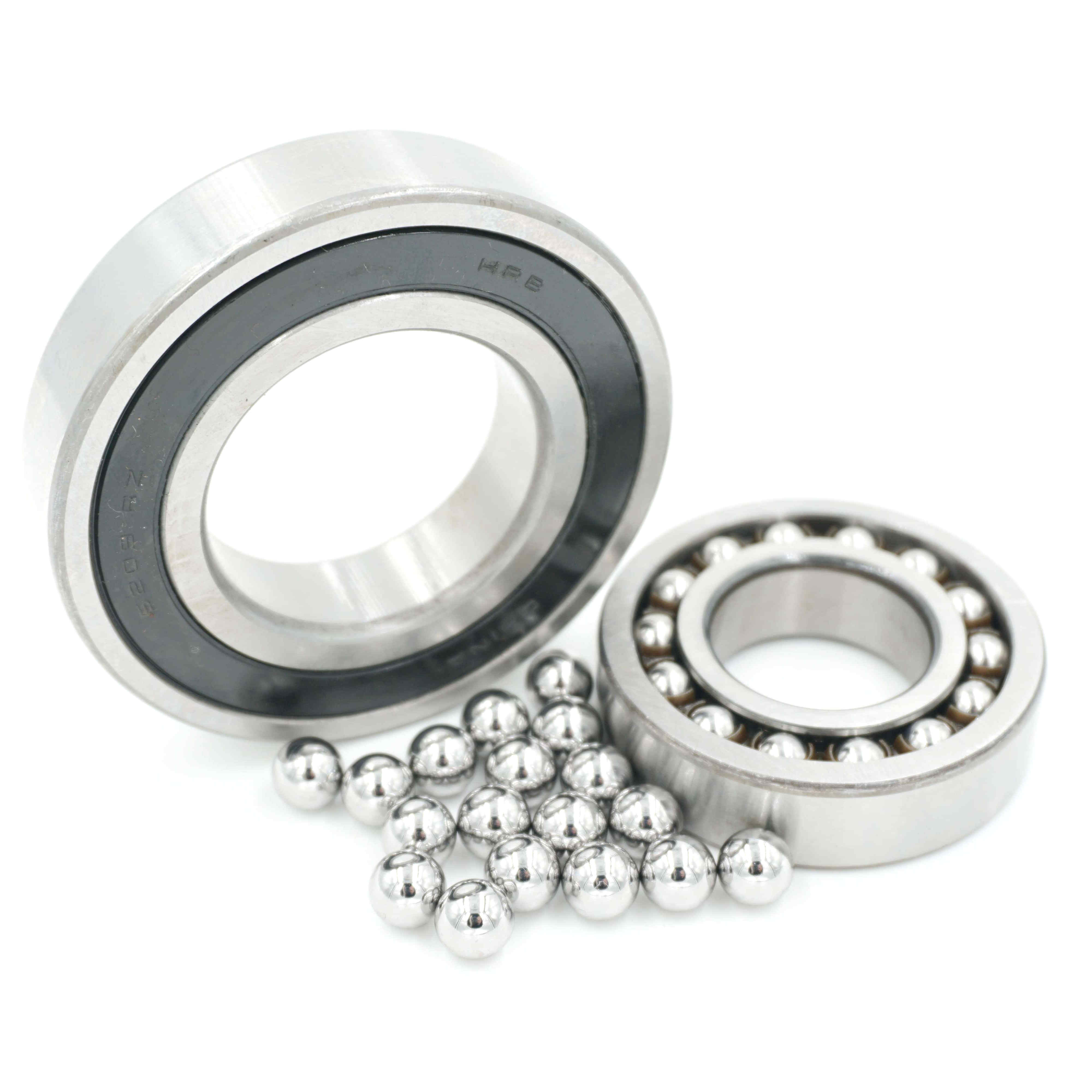
440C martensitic stainless balls hold HRC 58–62 with a specified phosphorus and sulfur maximum of 0.07%.
1010 / 1015 / 1018 carbon steel — the cost baseline
Diameters 1 mm to 50.8 mm, grades G100–G2000, supplied either low-carbon soft or through-hardened to HRC 55–60. Listed here as a reference point rather than a precision option: Carbon Steel Balls are the correct choice for conveyor rollers, casters, grinding media and general hardware where G100–G2000 is sufficient and corrosion is not a factor.
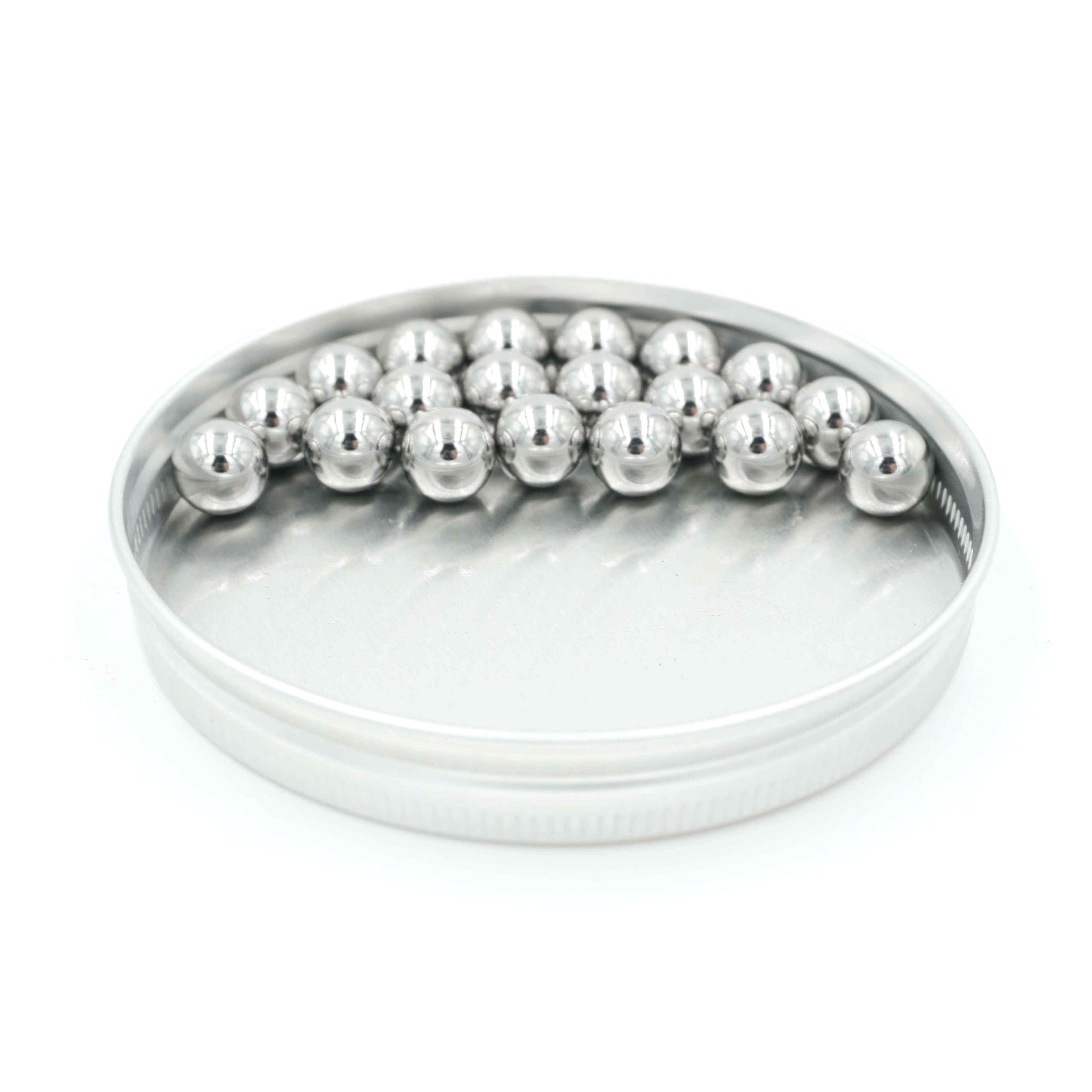
304 stainless balls are supplied annealed soft in G100–G1000; hardness and dimensional grade answer different questions.
Material Comparison: What Changes Between the Six Options
| Material | Structure | Diameter range | Grades | Hardness | Corrosion position | Typical duty |
|---|---|---|---|---|---|---|
| AISI 52100 / 100Cr6 / SUJ2 | Through-hardened chrome alloy | 0.5–50.8 mm | G10–G1000 | HRC 60–66 | None inherent; requires lubrication | Bearings, transmissions, spindles, valve train |
| AISI 440C / UNS S44004 | Martensitic stainless | 0.5–50.8 mm | G10–G1000 | HRC 58–62 | Corrosion resistant; P and S capped at 0.07% | High-precision bearings, medical and dental, aerospace actuators, chemical pumps |
| AISI 420C / UNS S42000 | Martensitic stainless | 1–50.8 mm | G25–G1000 | HRC 50–55 | Moderate; suited to wash-down and humid service | Bearings in mild corrosion, food machinery, pump valves, marine hardware |
| AISI 316 / UNS S31600 | Austenitic stainless | 1–50.8 mm | G100–G1000 | Annealed soft; family range HRC 25–39 | Excellent chloride and saltwater resistance via Mo alloying | Marine hardware, chemical processing, pharma and food equipment, saltwater valves |
| AISI 304 / S30400 | Austenitic stainless | 1–50.8 mm | G100–G1000 | Annealed soft; family range HRC 25–39 | General corrosion resistance; mirror polish available | Food and beverage equipment, decorative hardware, plumbing valves, cryogenic tanks |
| 1010 / 1015 / 1018 carbon steel | Carbon steel, soft or hardened | 1–50.8 mm | G100–G2000 | Soft, or HRC 55–60 hardened | Low; plating handled as a separate option | Conveyor rollers, casters, grinding media, low-cost hardware |
Read the table as a set of trade-offs rather than a ranking. 52100 gives the highest hardness but no corrosion protection. 440C trades a few points of hardness for genuine corrosion resistance. 420C trades further hardness for lower alloy cost. 316 gives the best chloride resistance in this group and the least load capacity, because austenitic stainless cannot be hardened by heat treatment. 304 and carbon steel are cost positions, not performance positions.
Where Precision Grading Does Not Apply
A large share of the steel balls sold into industry are not graded on the ABMA precision scale at all, and mixing the two catalogues causes specification errors.
Drilled steel balls are produced through-drilled or tapped to customer drawings, typically in stock sizes from 6 mm to 50.8 mm. Hole diameter, thread type and hole position are machined per drawing, so tolerance is defined by that drawing rather than by a grade number. Material certificates, batch traceability and inspection documentation accompany these orders.
Hollow steel balls are specified by outside diameter and wall thickness, seamless or welded, with through-holes available. The controlled parameters are dimensional and structural — wall thickness, roundness, sealing — not sphericity in micro-inches.
Electroplated steel balls use a carbon or alloy steel core with zinc, nickel or chromium coating. Base diameters run 1 mm to 50.8 mm and zinc coating thickness is typically 5 µm to 25 µm, specified per requirement. What governs acceptance is coating thickness, adhesion and salt-spray performance.
Machined steel balls are produced from bar stock in diameters from 10 mm to 200 mm and above, in materials including AISI 52100, AISI 1045 and AISI 4140, to ISO tolerance classes with roughness and hardness per specification. They exist because cold heading cannot reach those diameters.
Non-standard steel balls are made to drawing with no fixed catalog model, and dimensional tolerance is defined by the drawing rather than by a standard size range. Applying a G-grade to a non-standard part is only meaningful if both parties agree what the grade reference covers.
Duplex stainless balls in UNS S32205 / S31803 (2205) run 10 mm to 100 mm with roughly twice the yield strength of 316 stainless, and are specified for offshore, subsea, desalination and chemical service. Strength and corrosion resistance govern the purchase, not sub-micron sphericity.
A Six-Step Buying Sequence for Tolerance-Critical Assemblies
The sequence below follows the order in which specification errors usually get locked in.
Step 1 — Define the duty before the grade. Record speed, load, lubrication, temperature, media and expected life. Note whether the ball carries load (bearing), seals flow (valve) or merely positions (fixture) — the three roles tolerate very different grade bands.
Step 2 — Choose the material family on corrosion and hardness. Corrosive or wash-down service pushes toward 316, 420C or 440C. High load and high speed push toward 52100 or 440C. Where both requirements are strong, the honest answer is often that a stainless ball cannot match a hardened chrome ball on load, and the design must change.
Step 3 — Set the grade from the assembly, not from habit. Start at G25 or G16 and tighten only where a measured noise, torque or runout target demands it. Moving to G10, G5 or G3 narrows sphericity and diameter variation, and increases the share of production that has to be inspected out.
Step 4 — Write sphericity, diameter variation and Ra into the purchase specification. An order that states only "G10" leaves surface finish undefined. State the grade, the standard it references (ISO 3290-1:2014 or ABMA Std 10), the surface requirement, and the acceptable inspection method.
Step 5 — Confirm the inspection and documentation chain. Precision grades are verified by 100% automated machine-vision sorting plus roundness and profiler checks, with grade certification per batch. Material documentation options include MTR, EN 10204 2.1 or 3.1, COA, and on request PPAP, FAI, NACE MR0175 and AMS certificates. The IATF 16949:2016 certificate held here — number 130673/A/001/SM/En, issued by URS, valid 2023-12-14 to 2026-12-13 — covers bearing steel ball manufacture and excludes product design under clause 8.3. That exclusion is worth reading literally: design responsibility remains with the buyer.
Step 6 — Validate with samples before releasing volume. Grade claims are cheapest to test at sample stage. Confirm sphericity and surface on the actual delivered lot rather than on a reference sheet, then lock the packaging and lot-marking convention. For freight and customs planning, bearing balls, needles and rollers fall under HS 8482.91.
Use Cases: Where G3–G25 Balls Are Actually Specified
- Precision bearings and high-speed spindles. G5–G10 in 52100 or 440C for machine-tool spindles, deep-groove and angular-contact bearings, and electric motor bearings. Consistent diameter within a lot matters as much as individual roundness, because load sharing across the raceway depends on it.
- Aerospace gyroscopes and inertial instruments. G5–G10 with lot control and traceability. The governing requirement is repeatability across the lot, not a single impressive measurement.
- Metrology and semiconductor handling. G3–G5 reference and rolling spheres in wafer-handling robots, precision linear stages and measuring instruments, where sphericity and surface texture feed directly into positional uncertainty.
- Valve and fluid-control trim. 420C, 440C, 316 and duplex balls in ball valves, check valves and pump trim. Grade requirements are usually looser than in bearings; corrosion and sealing behaviour dominate.
- Food, dairy and pharmaceutical equipment. 304 and 316 Stainless Steel Balls in sanitary valves, transfer tables and fillers, where cleanability and chloride resistance outrank hardness.
Frequently Asked Questions
Does the IATF 16949 certification cover precision steel balls, and what is in scope?
The IATF 16949:2016 certificate covers manufacture of bearing steel balls, with material certificates and batch traceability. Certificate number 130673/A/001/SM/En was issued by URS, an independent third-party certification body, is valid from 2023-12-14 to 2026-12-13, and applies to the Asia-Pacific, North America, EU, Latin America and Middle East & Africa markets. The scope statement explicitly excludes product design under clause 8.3 — the certificate confirms manufacturing and quality management control, not design authority. Buyers specifying a custom geometry should confirm drawing approval separately from the certificate.
Can hardened balls be supplied in 52100, 440C and M50, and what hardness applies to each?
Yes. AISI 52100 chrome steel is through-hardened to HRC 60–66. AISI 440C martensitic stainless is supplied at HRC 58–62 with phosphorus and sulfur capped at 0.07%. AISI 420C is supplied at HRC 50–55. AISI M50 high-speed molybdenum alloy steel — UNS T11350, AMS 6490 — is supplied at HRC 62–66 with retained hardness and dimensional stability at elevated temperature, for aerospace engine and high-speed turbomachinery bearings. Austenitic 304 and 316 are supplied annealed soft and are not hardenable by heat treatment.
What drives cost when a specification moves from G25 to G10 or G5?
Cost moves with the share of production that survives inspection, not with material alone. Tighter sphericity and diameter-variation limits mean more lapping time and more parts rejected at final inspection, and the capacity profile reflects that: the standard 52100 line is rated at 30 tons per month, while the dedicated high-precision line covering ABMA G3–G25 is rated at 5 tons per month. Standard precision grades are quoted at 10–25 days, with ultra-precision and non-standard items at 25–50 days depending on quantity. The commercially efficient move is usually to hold G25 or G16 where the assembly tolerates it and reserve G5 for the position that actually governs noise or runout.
What is the minimum order quantity, and can samples be ordered first?
Standard catalog sizes carry a low MOQ and can be ordered by the bag or by the piece, with samples available. Non-standard and CNC-machined balls typically start from 50–500 pcs depending on setup, and prototype quantities of 10–50 pcs are workable for simple parts. MOQ is negotiable for first-time cooperation and for NDA projects. Grade, sphericity and surface finish should be verified on the sample lot before volume release.
What lead times apply, and how is repeat supply kept stable?
Standard sizes and common materials are often held in stock and can ship in 5–10 days; standard production runs are quoted at 15–30 days, and non-standard sizes, special alloys or CNC features at 20–60 days depending on tooling and inspection. Precision grades follow a similar split — standard precision 10–25 days, ultra-precision and non-standard 25–50 days. Rolling stock and backup tooling are maintained for repeat supply, with monthly production status updates. To evaluate a specific grade and material against your drawing, the Haimen Mingzhu product brochure summarises the range, and sample requests can be sent to info@hmmzsteelball.com.
Next Step: Check the Grade Against Your Drawing
A grade is only useful if it can be verified on the lot you receive. Send the drawing, duty conditions and target grade, and the precision range — 0.5 mm to 50.8 mm, G3 to G25, in 52100, 100Cr6, 420C, 440C, 316 and 304 — can be matched to a sample lot before volume is discussed.
Download the product brochure (PDF), or request samples and a quotation at www.hmmzsteelball.com.
Conclusion
A precision steel ball is defined by four properties held together to a published grade, not by a tightening adjective. Diameter range, sphericity in micro-inches, diameter variation and surface finish are the parameters that separate a G5 from a G25 within the same 0.5–50.8 mm envelope, and the material decides whether that precision survives the service environment. 52100 / 100Cr6 / SUJ2 answers load and speed; 440C answers load plus corrosion; 420C answers moderate corrosion at lower alloy cost; 316 and 304 answer chemistry and cleanability but not hardness. Getting the order right means setting the duty first, the material second, the grade third, and then writing sphericity, Ra and inspection method into the specification so that the delivered lot can be checked against it.
Have Questions or Need More Details?
Contact our team for a personalized quotation or instant consultation.
Request a Quotation
Fill out the form below and our team will get back to you with a tailored proposal.
WhatsApp Direct Chat
Prefer to chat in real-time? Message us on WhatsApp for instant assistance & quick answers.
- Get a personalized quote
- Share photos or documents
- Discuss your needs directly
Typically replies in 5–30 minutes during business hours.