Injection Molding Machine: A Buyer's Guide to Types, Applications and Selection
Injection Molding Machine: A Buyer's Guide to Types, Applications and Selection
An injection molding machine melts thermoplastic resin, injects it under pressure into a closed mold, and holds the part under clamping force until it solidifies. The machine repeats that cycle thousands of times, so the purchase decision is less about buying a machine and more about choosing an architecture, a tonnage band, a mold envelope, an automation level and a service partner that will stay compatible with your production plan for the next decade.
This guide explains what an injection molding machine is, how the main machine architectures differ, which machine families fit which industries, and how buyers should structure an evaluation before asking for a quotation. Purchase prices, total cost of ownership, delivery times and certification requirements are not published here because verified figures were not available; the article instead shows what to ask for and how to compare answers.
What an Injection Molding Machine Actually Does
An injection molding machine is production equipment that converts plastic pellets into finished parts through a repeating cycle: plasticizing, injection, packing and holding, cooling, mold opening, part ejection and mold closing. The machine has two functional halves. The clamping unit carries the mold and generates the force that keeps it closed against injection pressure. The injection unit plasticizes the resin with a screw and drives it into the mold cavity.
Machine capacity is therefore described by a small set of numbers that buyers should learn to read before comparing suppliers:
- Clamping force — the force holding the mold closed, expressed in kilonewtons (kN). It limits the projected area and cavity count a machine can support.
- Injection volume — the maximum shot size in cubic centimetres (cm³), which limits part weight plus runner weight.
- Screw diameter — the plasticizing element, which trades shot capacity against injection pressure and melt quality.
- Mold platen size and tie-bar distance — the physical envelope that decides whether a given mold can be mounted.
- Maximum daylight and opening stroke — the space available for deep cores and part removal.
- Drive and clamping architecture — servo-hydraulic toggle, two-platen, all-electric, hybrid or multi-component, each with different precision, energy and maintenance characteristics.
Two machines with the same clamping force can behave very differently if their screw diameters, platen sizes or drive concepts differ. That is why catalogue tonnage alone is a weak basis for comparison.
The Problem: Why Machine Selection Goes Wrong
Most poor machine purchases come from three recurring mistakes, and none of them are about brand preference.
The first mistake is sizing from the part instead of the process. A buyer states the part weight and picks the nearest tonnage. The correct inputs are the projected area, the number of cavities, the material's flow behaviour, the wall section and the allowable cycle time. A machine can be technically capable of molding a part and still be the wrong choice because its platen size cannot take the mold, or its screw cannot plasticize the shot within the cooling time.
The second mistake is treating machine architecture as a preference rather than an economic constraint. All-electric, servo-hydraulic and two-platen machines are not interchangeable tiers of the same product. They differ in where energy goes, how precisely motion repeats, what workshop footprint they occupy and which auxiliary functions they can support. Medical cleanroom molding, 24-cavity thin-wall packaging and automotive bumper molding pull the decision in three different directions.
The third mistake is under-specifying the production cell around the machine. A molding cell includes the mold, material handling and drying, temperature control, robotics, inspection and increasingly a data connection to factory systems. A machine purchased without considering these interfaces often needs add-on work that was never quoted.
Industry Background: A Category Under Two Pressures
The injection molding machine category is large, globally distributed and being reshaped by two forces at once: the shift toward electric and servo-driven architectures, and the expectation that machines feed production data into factory systems.
On scale, Grand View Research estimates the global injection molding machine market at USD 17.3 billion in 2025, with a projected value of USD 25.5 billion by 2033 at a compound annual growth rate of 5.0%. The same source estimates that Asia Pacific held the largest regional share in 2025, at 39.7%. Commercial research publishers differ in their base-year values and forecast paths, so these figures are best treated as directional context for capacity planning rather than as precise budget inputs.
On technology direction, trade media, professional-society publications and supplier documentation converge on a similar picture. Smart manufacturing in injection molding is consistently described around machine-level data: IoT and IIoT connectivity, data collection from injection molding machines and auxiliary equipment, and real-time process monitoring. One commercial research publication associates smart systems with a 25% reduction in scrap and a 20% to 40% reduction in unplanned downtime; buyers should treat figures of that kind as hypotheses to verify against their own baseline rather than as contractual performance.
A third structural factor is application segmentation. The same category now covers caps and closures running in fractions of a second, medical consumables produced under cleanroom conditions, and automotive instrument panels requiring very high clamping force. That fragmentation is why machine families, not single models, are the practical unit of comparison.
Detailed Solution: Mapping Machine Architectures to Applications
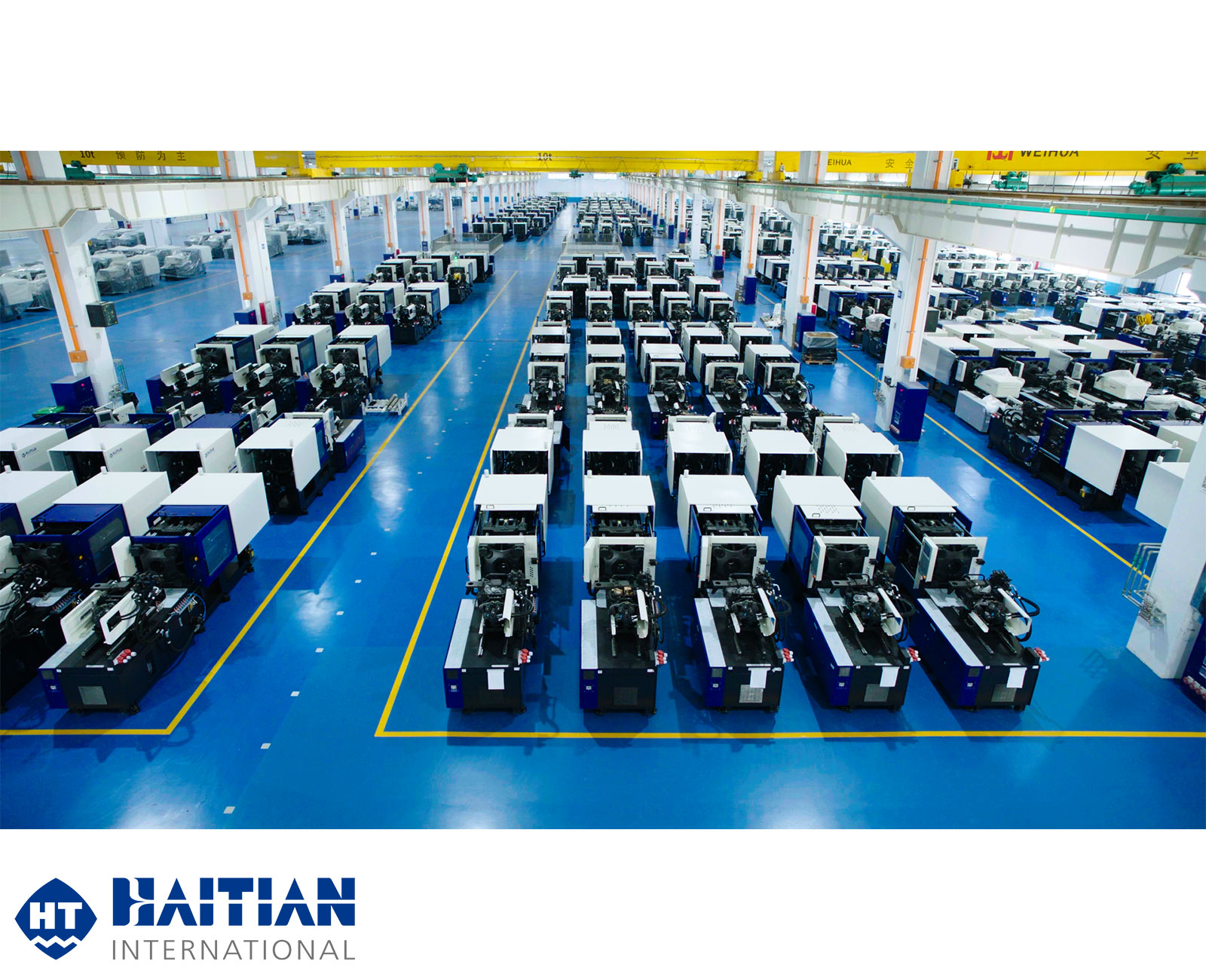
Haitian International Holdings Ltd. is an injection molding machine manufacturer established in 1966, headquartered in Ningbo, China, operating manufacturing, sales and service across more than 130 countries and regions. Its manufacturing facility covers 1,437,000 m², with more than 8,500 employees, an R&D team of more than 1,500 engineers and technicians, and annual production capacity above 56,000 units. The group's portfolio spans servo-hydraulic, all-electric, two-platen and intelligent injection molding equipment under the Haitian Plastics Machinery, Zhafir Plastics Machinery and Niigata brands, which makes it a useful reference for explaining how machine architectures divide by application.
Servo-hydraulic toggle machines: the general-purpose workhorse
A servo-hydraulic toggle machine couples a mechanical toggle clamping system with a high-response servo drive, so hydraulic power is supplied on demand rather than continuously. The architecture balances molding precision, operational stability and energy efficiency, which is why it remains the default choice for general plastic products such as home appliance housings, automotive components, daily necessities and packaging containers.
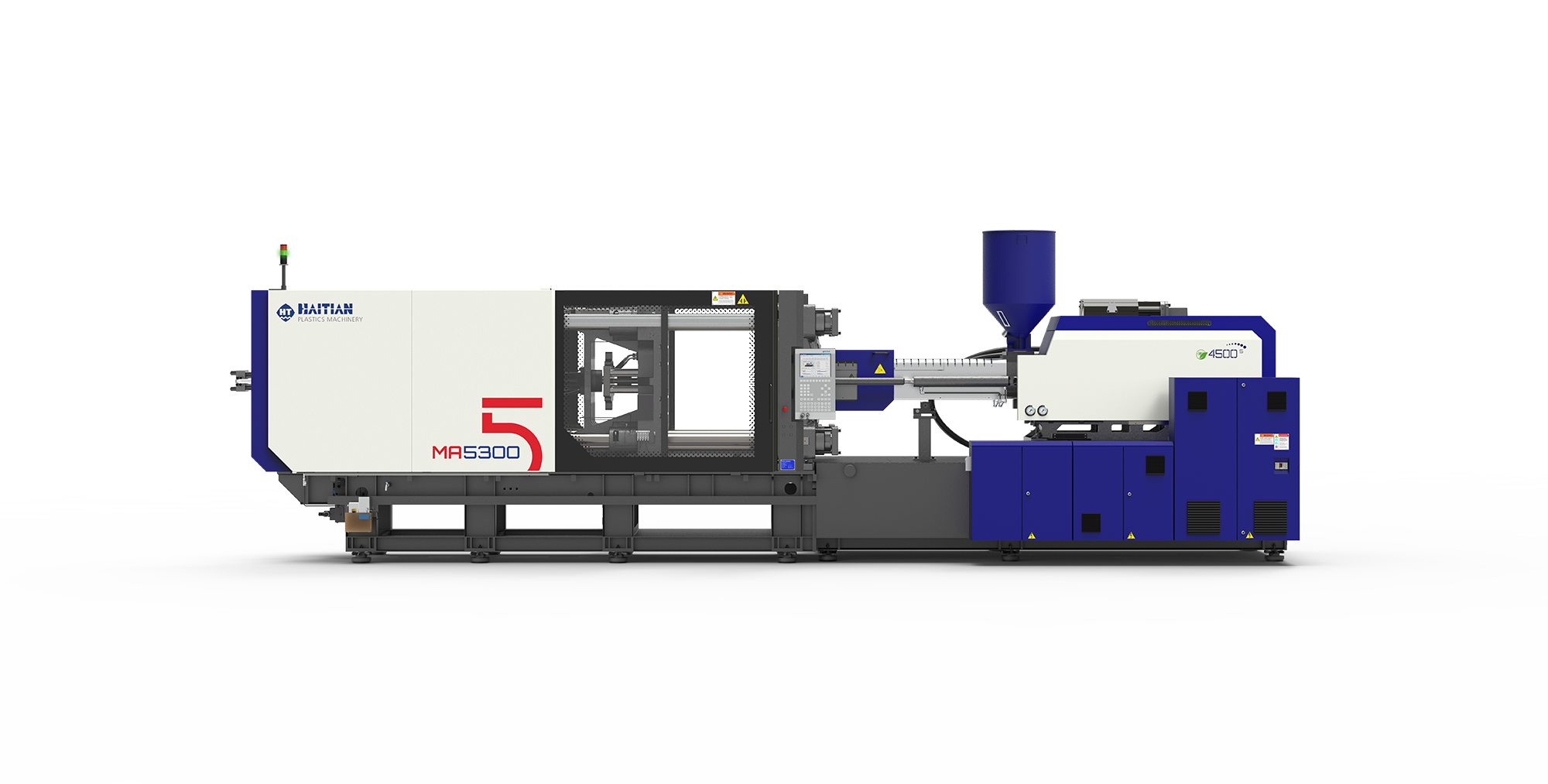
The Haitian Mars Series MA5 represents this category. Its clamping force range runs from 600 to 33,000 kN, injection volume from 49 to 45,616 cm³, screw diameter from 24 to 220 mm, mold platen size from 470 × 470 to 3,100 × 3,020 mm and tie-bar distance from 310 × 310 to 2,160 × 1,900 mm, controlled through a KEBA controller. Generation 5 introduces electrical plasticizing on applicable sizes and is described as delivering 20–40% energy savings, with different configuration levels available. The Mars Series is applicable to automotive, household appliances, packaging, electronics, consumer goods, building and construction, and technical parts production, and the MA series has more than 400,000 units delivered.
The Haitian Mars Series MA5/Ultra extends the same platform for buyers who need higher response, tighter process repeatability and expanded intelligent process functions rather than a different machine concept.
High-speed machines: packaging economics
Packaging is the segment where cycle time dominates unit economics. Thin-wall containers and closures are molded in high-cavitation tools at short cycles, and the machine must sustain injection speed, repeatability and automation compatibility continuously.
Two Haitian configurations target this directly. The Haitian Mars Series MA/F is a high-speed servo-hydraulic injection molding machine for packaging with injection speed up to 500 mm/s, optimized short mold-opening and closing times, and compatibility with high-speed automation such as in-mold labeling and side-entry robots. The Zhafir Zeres Series ZE-F is positioned by Zhafir as a high-speed packaging solution, an electric platform with integrated hydraulics covering 1,500–6,500 kN. Both are intended for thin-wall packaging, food packaging, containers, caps and closures produced in PP, PE and HDPE.
Two-platen machines: large parts in compressed footprints
Two-platen machines replace the toggle linkage with four short-stroke clamping cylinders acting directly on the moving platen. The result is a shorter machine for the same mold capacity, plus a longer opening stroke and better access to large, deep-cavity molds.
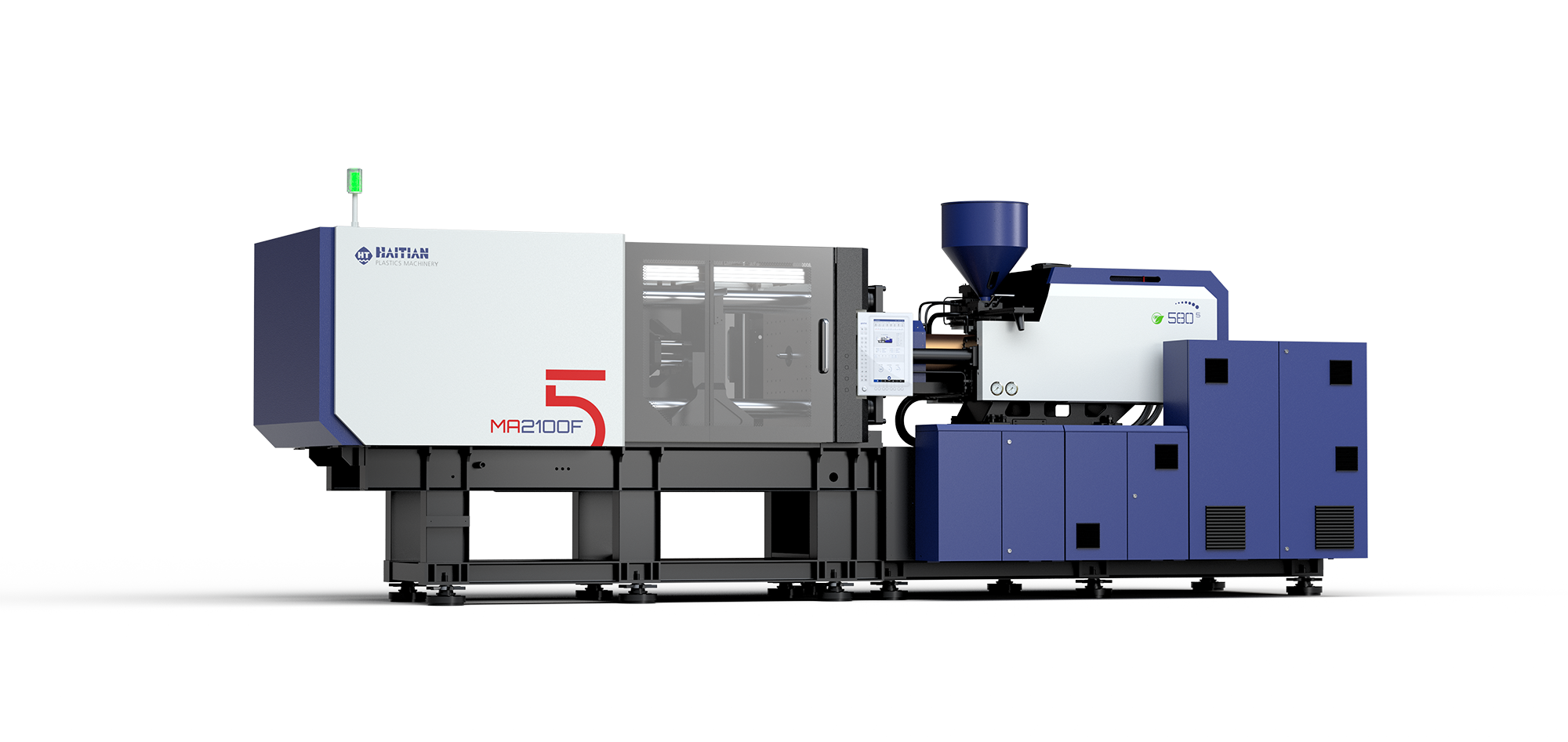
The Haitian Jupiter Series JU5 is a servo-hydraulic two-platen injection molding machine covering 4,500 to 88,000 kN clamping force, 848 to 134,303 cm³ injection volume, 60 to 300 mm screw diameter, maximum daylight of 1,400 to 7,000 mm, and tie-bar distance of 810 × 810 to 3,400 × 2,820 mm, controlled by a KEBA system. Four short-stroke clamping cylinders provide uniform clamping force and high repeatability, while Generation 5 electrical plasticizing is described as reducing energy consumption by 20–40%. Typical parts include automotive bumpers, instrument panels, logistics turnover boxes and large waste containers.
All-electric machines: precision and clean production
All-electric machines drive clamping, injection, ejection and plastication with independent servo motors. There is no hydraulic oil in the drive path, so there is no oil contamination risk, and motion repeatability improves because each axis is controlled separately. These characteristics are what make the architecture suitable for medical, optical, precision electronics and cosmetic packaging work.
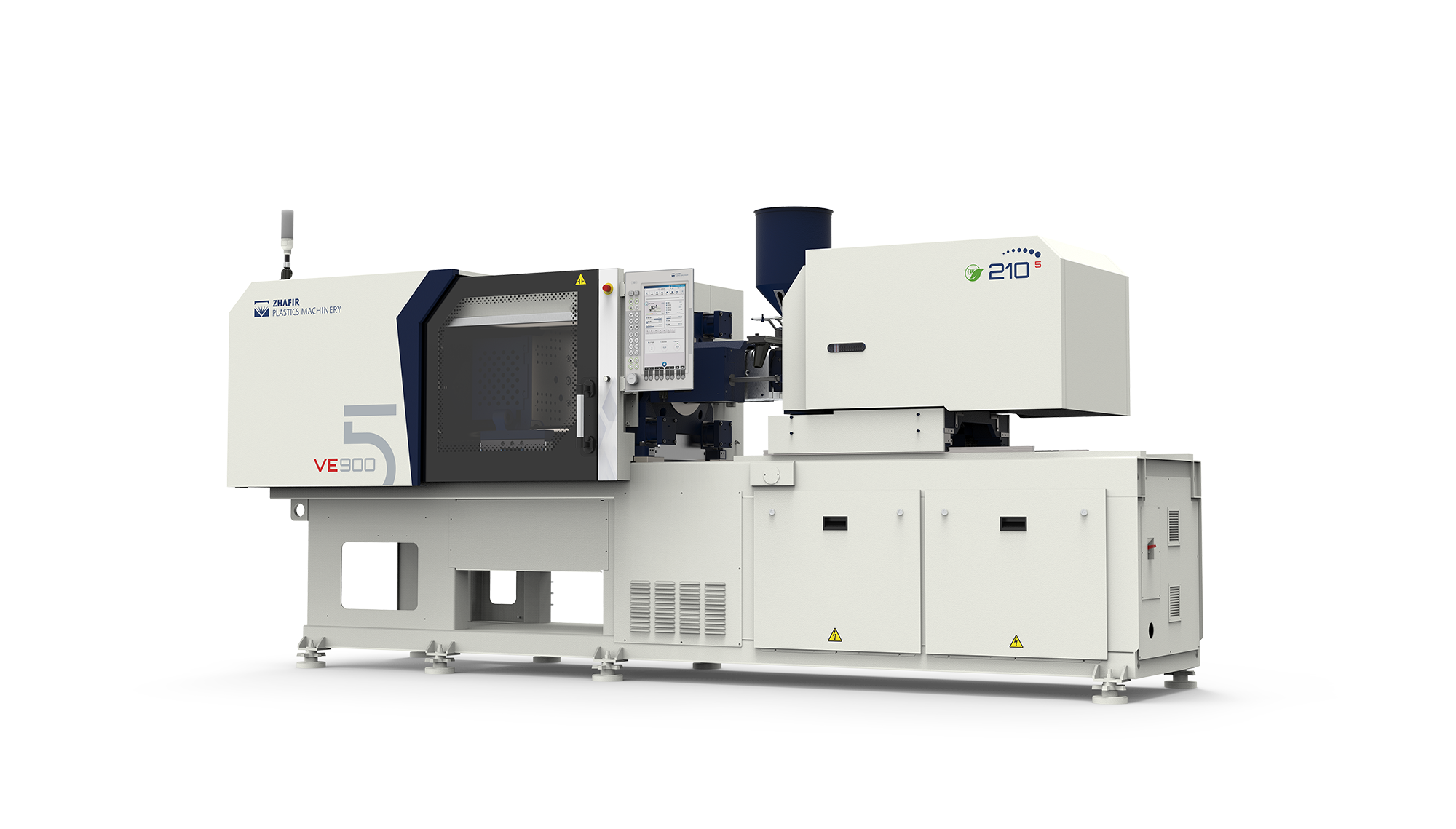
The Zhafir Venus Series VE5 is a precision all-electric injection molding machine covering 400 to 13,800 kN clamping force, 12 to 5,767 cm³ injection volume, 16 to 120 mm screw diameter, mold platen size from 440 × 440 to 2,150 × 2,050 mm and tie-bar distance from 320 × 320 to 1,550 × 1,450 mm, with a Sigmatek controller. Generation 5 offers a footprint up to 15% smaller, 20% faster mold movement, motorized ejection speeds up to 400 mm/s, and open automation and MES connectivity.
The NIIGATA MD-S8500 Series is a precision horizontal all-electric platform spanning models from MD50S8500 through MD350S8500. It uses tie-bar sensing to compensate for clamping-force variation and servo control for pressure control accurate to 0.1 MPa, with OPC UA connectivity. Applicable industries include precision components, electronics, optical, medical, automotive, consumer goods, cosmetics packaging and technical parts.
Electric machines with integrated hydraulics: flexibility without losing precision
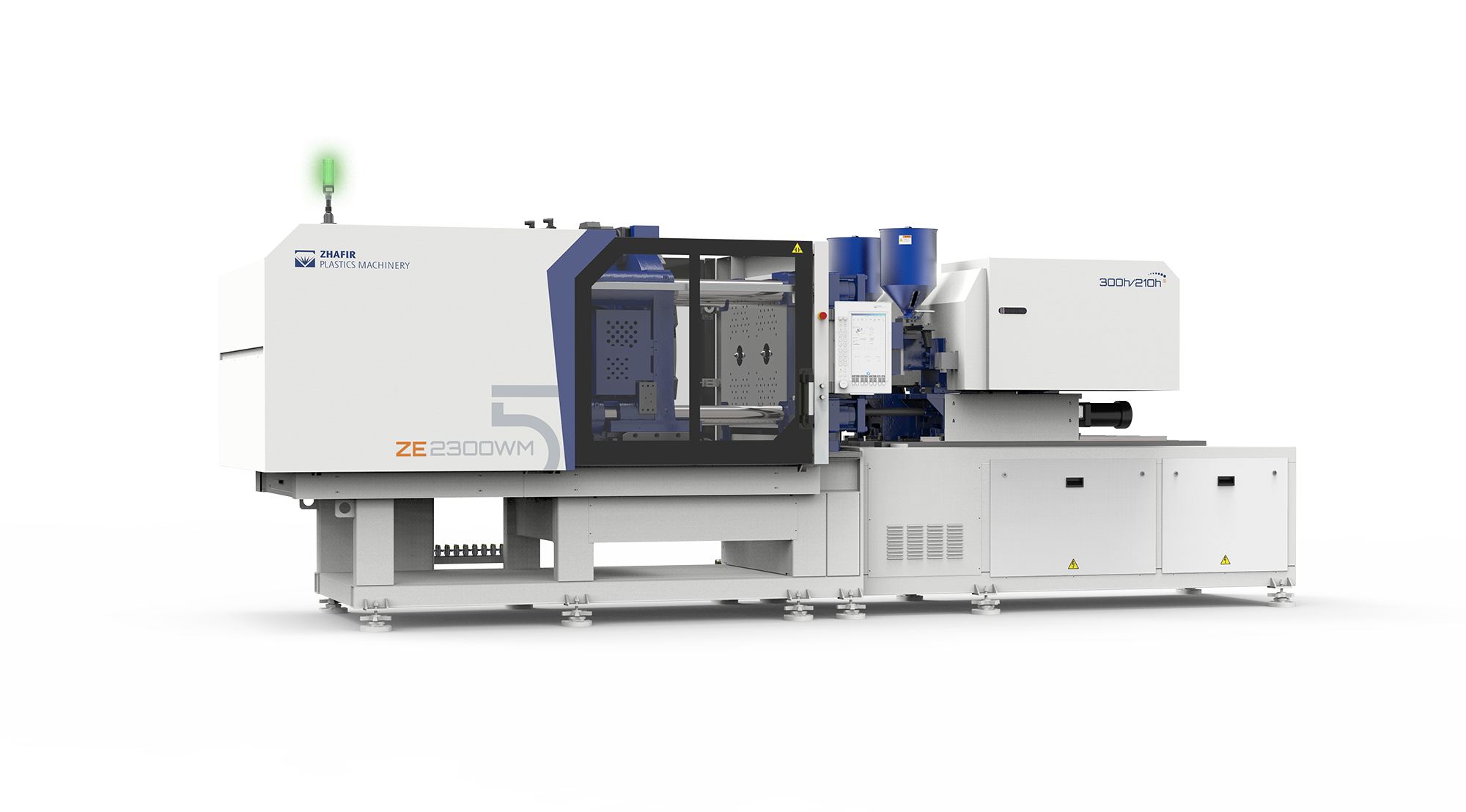
Some molds need hydraulic functions — core pulls, valve gates or sliding actions — that a purely electric machine does not naturally provide. The Zhafir Zeres Series ZE5 answers this by combining electric main movements with integrated servo-hydraulic functionality, retaining electric precision and energy behaviour while supporting hydraulic mold functions. It covers 400 to 13,800 kN clamping force, 12 to 5,767 cm³ injection volume, 16 to 120 mm screw diameter, and the same platen and tie-bar envelope as the Venus platform, also with a Sigmatek controller.
Hybrid two-platen machines: precision at large mold sizes
The Zhafir Jeres Series JE5 is a hybrid two-platen injection molding machine spanning 3,500 to 33,000 kN. It combines electric injection technology with a compact two-platen clamping concept, targeting applications that need high injection precision together with the mold capacity and reduced footprint of a two-platen design — large technical parts, automotive components, logistics and household appliances among them.
Multi-component machines: parts that used to require assembly
Two-color, multi-color and hard-soft components are increasingly molded in a single cycle rather than assembled afterwards. The Zhafir Multicomponent is an electric multi-component injection molding machine with a clamping force range of 3,500 to 33,000 kN and a modular configuration in which injection units and component arrangements adapt to the application. Electric injection technology supports the synchronization and repeatability that multi-material molding depends on. Applications include automotive, electronics, household appliances, consumer goods, medical and technical parts.
Vertical machines: insert molding and embedded components
Vertical clamping changes the ergonomics of the process. Inserts, terminals and embedded metal parts can be positioned on a horizontal platen while the clamp closes from above, which simplifies loading and positioning. The NIIGATA MDV-S8500 Series is an all-electric vertical injection molding machine built on a vertical single-station electric platform, with high-precision tie-bar sensing and dedicated mold-thickness measurement and control. It is used for insert molding, overmolding, connectors, electrical components, automotive electronics, medical and technical parts.
Step-by-Step: How to Structure the Selection Process
The sequence below reflects the order in which a machine decision becomes irreversible. Each step narrows the field before commercial negotiation begins.
Use Cases: Which Machine Family Fits Which Industry
Application fit is usually decided by three variables: part size, precision and cleanliness requirement, and the economics of the cycle.
Automotive
Automotive work splits between large exterior and interior parts and smaller technical components. Large molds — bumpers, instrument panels, large trim — are two-platen territory, where mold space and clamping force matter more than footprint. Interior and under-hood components are commonly run on servo-hydraulic toggle machines. Requirements centre on dimensional stability, low warpage, surface quality, reinforced-material capability and automation integration.
Packaging, caps and closures
Thin-wall containers, food packaging and closures are produced in high-cavitation molds at short cycles, with continuous automated operation. Requirements are high injection speed, short cycle time, repeatability, low energy per part, high cavitation and compatibility with in-mold labeling. High-cavity molds and fast or side-entry robots are part of the standard equipment list.
Medical
Medical consumables, IVD components, diagnostic parts and device components are molded in controlled or cleanroom environments under validated processes. All-electric machines are the natural starting point because the drive concept removes hydraulic oil from the production area and supports repeatable motion. Requirements include cleanliness, contamination control, repeatability, process monitoring, traceability and stable low-scrap output.
Home appliances
White goods, black goods and small appliance components involve large and medium parts with visible surfaces, plus frequent product and mold changes. Requirements balance durability, surface quality, dimensional stability, energy efficiency and fast changeover, supported by quick mold-change equipment and flexible automation.
3C electronics
Smartphone, tablet, laptop, semiconductor, LED and connector parts are thin-walled, small and cosmetically demanding. Requirements include thin-wall filling, precision, repeatability, low warpage, clean production and rapid product change, often with vision inspection and IMD or IME equipment.
Consumer goods and logistics
Household storage, containers, furniture, sanitary products and stationery compete on unit cost, so short cycles and good surface quality dominate. Logistics applications — pallets, crates, transport containers, waste bins and protective cases — sit at the other end, demanding large shot capability, high clamping force, impact resistance and recycled-material handling.
Comparison Table: Haitian and Zhafir Machine Families at a Glance
The table below compares machine families using published platform specifications and intended applications. It is a starting point for shortlisting, not a substitute for a configuration-specific quotation.
| Series / Model | Drive and clamping architecture | Clamping force | Typical applications |
|---|---|---|---|
| Haitian Mars Series MA5 | Servo-hydraulic toggle, KEBA controller | 600–33,000 kN | Automotive, household appliances, packaging, electronics, consumer goods, building and construction, technical parts |
| Haitian Mars Series MA5/Ultra | High-performance servo-hydraulic toggle, MA5 platform extension | Depends on available machine sizes | Automotive, electronics, household appliances, packaging, precision molding, technical parts |
| Haitian Mars Series MA/F | High-speed servo-hydraulic, injection speed up to 500 mm/s | Depends on machine size and injection unit | Thin-wall packaging, food packaging, containers, caps and closures, in-mold labeling |
| Haitian Jupiter Series JU5 | Servo-hydraulic two-platen, four short-stroke clamping cylinders, KEBA controller | 4,500–88,000 kN | Automotive bumpers and instrument panels, logistics turnover boxes, large waste containers |
| Zhafir Venus Series VE5 | All-electric, Sigmatek controller | 400–13,800 kN | Medical, precision electronics, optics, cosmetic packaging, precision components |
| Zhafir Zeres Series ZE5 | Electric with integrated hydraulics, Sigmatek controller | 400–13,800 kN | Applications requiring hydraulic mold functions such as core pulls |
| Zhafir Zeres Series ZE-F | High-speed electric with integrated hydraulics | 1,500–6,500 kN | Thin-wall packaging, caps and closures, high-output automated packaging cells |
| Zhafir Jeres Series JE5 | Hybrid drive, two-platen clamping | 3,500–33,000 kN | Automotive, large technical parts, logistics, household appliances, industrial components |
| Zhafir Multicomponent | Electric multi-component, modular configuration | 3,500–33,000 kN | Two-color, multi-color, multi-material and hard-soft components |
| NIIGATA MD-S8500 Series | Precision horizontal all-electric, tie-bar sensing, OPC UA | Model range MD50S8500–MD350S8500 | Precision components, electronics, optical, medical, automotive, cosmetics packaging |
| NIIGATA MDV-S8500 Series | All-electric vertical single-station platform | Configuration-dependent | Insert molding, overmolding, connectors, electrical and automotive electronics |
What Buyers Should Verify Before Signing
The hardest part of machine procurement is not choosing between architectures — it is separating documented capability from marketing language. Five checks close most of the gap.
Verify the specification sheet against the quoted configuration. Standard specifications frequently describe a platform, not the specific machine on the quotation. Ask for the exact screw diameter, platen size, tie-bar distance and controller model.
Test energy claims against a defined baseline. Energy-saving statements are usually expressed as a percentage against an older generation or a reference cycle. Ask what the baseline machine, cycle and material were, and whether the figure applies to your configuration. On two-platen and servo-hydraulic platforms, published figures such as 20–40% energy reduction from electrical plasticizing should be reproduced under agreed test conditions.
Interrogate the data and connectivity layer. Industry sources describe smart manufacturing in injection molding around machine-level data collection, IoT/IIoT connectivity and real-time monitoring. Buyers should ask which protocols the machine supports, what data is exposed, how alarm history is stored and who owns the data. The NIIGATA MD-S8500 Series, for example, specifies OPC UA connectivity; Haitian machines are described as supporting open interfaces and standardized communication protocols for integration with robots, vision inspection systems and MES platforms.
Confirm what automation is included. Robot interfaces, side-entry access, conveyor clearance and IML compatibility affect layout and are often priced separately. Confirm what is mechanically prepared at the factory and what is added on site.
Check the service structure behind the machine. A production machine that stops is a cost, not an asset. Confirm the local service presence, spare-parts path and training arrangement for the region where the machine will run — particularly for buyers sourcing internationally.
Frequently Asked Questions
What does "China injection molding machine manufacturers" mean for a buyer, and how should suppliers be evaluated?
The phrase usually signals a sourcing search for injection molding machine suppliers based in China, which is a major manufacturing base for the category and hosts suppliers across the full tonnage and architecture range. Evaluation should follow the same discipline applied to any origin: verify the legal entity and factory, confirm the exact specification of the quoted configuration, request references for comparable applications, and define the service and spare-parts arrangement for the destination market. Trade statistics can support country-level screening — UN Comtrade publishes merchandise trade records broken down by product classification and trading partner — but buyers still need a validated HS code and product-level extraction before drawing conclusions from trade data.
How do I choose the right machine series for automotive, packaging or home appliance parts?
Start from part size, material, mold dimensions, injection volume, clamping force, precision, cycle time and plant space, then compare platforms against those constraints. In the Haitian and Zhafir range, the Zhafir Venus Series may be evaluated for precision-focused all-electric operation, the Zhafir Zeres Series for electric machines with integrated hydraulics, the Haitian Mars Series for general-purpose or cost-sensitive production, and the Haitian Jupiter Series for large parts and high clamping-force applications. Final configuration should always be confirmed with a regional sales and service partner using the actual mold and process data.
What is the practical difference between servo-hydraulic, all-electric and hybrid machines?
Servo-hydraulic machines combine a toggle clamping system with a servo drive that supplies power on demand, which balances precision, stability and energy efficiency across a wide application range. All-electric machines drive each axis with an independent servo motor, producing no hydraulic oil contamination and delivering high injection repeat precision, which is why they suit medical, optical, precision electronics and cosmetic packaging. Hybrid designs combine electric injection technology with a hydraulic or two-platen clamping concept for cases where mold capacity and injection precision are both required. The choice is a process decision, not a quality ranking.
Which machine type should be considered for medical or cleanroom production?
All-electric platforms are the usual starting point because the drive concept removes hydraulic oil from the production area and supports cleanroom-grade production. Zhafir all-electric machines are described as serving medical, precision electronics, optics and cosmetic packaging, and the NIIGATA MD-S8500 Series is positioned for precision components in medical and optical applications. Beyond the machine, the cell needs cleanroom or laminar-flow equipment, stainless material handling, precision tooling, vision inspection and process monitoring with traceability.
What do smart or energy-saving injection molding machines actually deliver, and how should those claims be checked?
The verifiable content of a "smart" claim is usually a feature set: connected monitoring, real-time process data, remote diagnostics, energy-saving drive technology and open interfaces to MES and third-party equipment. Quantified outcomes are harder to verify. One commercial research publication associates smart systems with a 25% reduction in scrap and a 20% to 40% drop in unplanned downtime, but those figures describe a category-level expectation rather than a guaranteed result on a specific machine. Ask suppliers to demonstrate the feature set, define the baseline for any energy claim, and agree on how the result will be measured. To move from specification to a concrete proposal, you can send part drawings, material data and mold details to inter-sales@mail.haitian.com and request a configuration review.
Conclusion
Injection molding machine selection is a sequence of narrowing constraints, not a single comparison. The part defines the clamping force and shot weight; the mold defines the platen envelope; the application defines the architecture; the cell defines the automation and data requirements; and the supplier defines how much of that survives contact with production.
Haitian International Holdings Ltd. covers the full span of that decision through the Haitian Mars Series for general and high-speed production, the Haitian Jupiter Series for large two-platen work, the Zhafir Venus, Zeres and Jeres platforms for electric and hybrid precision, the Zhafir Multicomponent for multi-material parts, and the NIIGATA MD-S8500 and MDV-S8500 Series for precision and vertical insert molding. That breadth is useful only if it is applied to a defined part — which is why the specification sheet, the test condition and the service arrangement matter more than the catalogue page.
Have Questions or Need More Details?
Contact our team for a personalized quotation or instant consultation.
Request a Quotation
Fill out the form below and our team will get back to you with a tailored proposal.
WhatsApp Direct Chat
Prefer to chat in real-time? Message us on WhatsApp for instant assistance & quick answers.
- Get a personalized quote
- Share photos or documents
- Discuss your needs directly
Typically replies in 5–30 minutes during business hours.