
Powder Coating vs Galvanizing vs Silkscreen vs Anodizing: Buyer Guide for Custom Sheet Metal Parts
Quick answer: There is no universally best finish for custom sheet metal parts. The right choice depends on the substrate, the service environment, the marking requirement, the drawing tolerance and the inspection method. Plain finish, powder coating, galvanizing, silkscreen and anodizing solve different problems. For a 0.5–8.0 mm sheet part, confirm the finish route before tooling or mass production, because coating, masking, racking and handling can affect critical features.

Sample showroom at Haitong Metals. Finish selection should be confirmed against the drawing, not the general appearance of a sample.
Why finish selection becomes a production problem
Buyers send a drawing with a material, thickness, tolerance and often a finish note such as powder coat black, hot-dip galvanize, silkscreen logo or anodize clear. The production problem appears when those notes are incomplete. Two suppliers may quote different processes because one reads the finish as decorative and the other reads it as a corrosion requirement. A powder-coated bracket may fit a mating part before coating and fail after coating. A silkscreened panel may pass visual inspection but lose ink adhesion during cleaning. A galvanized frame may be protected on the outside but expose cut edges that were never addressed in the drawing.
The finish decision is therefore a drawing decision. It must state what the finish is expected to do, where it must not be applied, how it will be measured and what sample will prove it before production. That is more reliable than choosing a finish by name alone.
Industry background: standards sit behind the finish callout
Surface finish is the last visible step in a chain that starts with material specification and process routing. The substrate standard matters. ASTM A653/A653M covers steel sheet that is zinc-coated or zinc-iron alloy-coated by the hot-dip process. ASTM A240/A240M covers chromium and chromium-nickel stainless steel plate, sheet and strip. EN 10346:2015 specifies technical delivery conditions for continuously hot-dip coated steel flat products for cold forming. These standards do not choose the finish for the buyer, but they define the starting surface that the finish must bond to, cover or survive.
Coating standards matter as well. ISO 1461 specifies requirements for hot-dip galvanized coatings on fabricated iron and steel articles. Tolerance standards such as ISO 2768-1 and DIN 6930-2 show that dimensional acceptance is also a defined drawing decision, not a workshop assumption. For welded assemblies, ISO 3834-2:2021 and ISO 9606-1 are relevant references for welding quality and welder qualification. For parts entering the EU electrical and electronic equipment market, RoHS and REACH declarations may be requested for coatings, inks and surface treatments.
Haitong Metals (Ningbo Haitong Metal Fabrication Co., Ltd.) is a Ningbo, China-based custom sheet metal fabrication and metal stamping manufacturer. Its supplied company profile lists ISO 9001 certification, a 12,000 m² factory, 60 employees, 6 R&D engineers, 3,140,000 units annual output, 100% export to Europe and North America, and DFM support from design review through prototyping to mass production. Its surface-treatment statement lists powder coating, galvanizing, passivation and other anti-corrosion treatments. Silkscreen and anodizing are not listed in that statement, so buyers should confirm those two routes for the specific drawing rather than assuming they are included.
A five-step finish selection path
- Start with the substrate. Carbon steel, stainless steel, aluminum and galvanized steel do not accept every finish in the same way. Anodizing is an aluminum finish. Galvanizing is a steel-protection route. Powder coating can be applied to several substrates, but pretreatment and adhesion must be confirmed.
- Define the service environment. Indoor electronics enclosure, outdoor roof vent, humid process area and automotive underbody are different corrosion problems. The finish should be specified for the environment, not copied from a previous part.
- Separate protection from marking. Powder coating, galvanizing and anodizing primarily change the surface protection or appearance. Silkscreen primarily adds information, branding or identification. One finish may not perform both jobs.
- Check tolerance, masking and assembly. Coating thickness, rack marks, threaded holes, grounding points, mating surfaces and weld areas must be addressed on the drawing. A finish that is acceptable on a flat panel may be unacceptable on a precision bracket.
- Validate with a sample and inspection plan. The sample should use the same substrate, finish route and critical dimensions as production. The inspection plan should state what is checked before finish, after finish and before shipment.
Finish comparison at a glance
| Finish option | Typical substrate fit | What it contributes | Confirm in the drawing |
|---|---|---|---|
| Plain | Carbon steel, stainless steel, aluminum, galvanized steel | No added coating; the substrate surface is the finish, usually after deburring and cleaning | Edge condition, oil or residue, scratches, storage protection and whether a later finish will be added |
| Powder coating | Carbon steel, stainless steel, aluminum and galvanized steel with compatible pretreatment | A cured film that can provide color, appearance and a barrier coating | Pretreatment, color and gloss, film thickness, masking, cure, touch-up and adhesion acceptance |
| Galvanizing | Carbon steel and iron assemblies; galvanized steel sheet is already zinc-coated | Zinc-based corrosion protection for steel; hot-dip galvanizing is covered by ISO 1461 | Coating mass or thickness, drainage, distortion risk, threads, cut edges and post-treatment |
| Silkscreen | Many substrates, often over powder-coated or anodized surfaces | Printed markings, logos, scales, warnings and identification | Ink type, color, adhesion, print location, cure, masking and resistance to the cleaning method |
| Anodizing | Aluminum | An oxide layer on aluminum with color and sealing options | Alloy, anodizing specification, color, sealing, rack marks, electrical contact areas and masking |
Plain finish: the baseline, not a no-finish decision
Plain finish means no additional coating is specified. It does not mean no surface requirement. Laser-cut edges, deburring, weld discoloration, oil, fingerprints and storage marks may still be visible or functionally important. Plain stainless steel or aluminum may be acceptable where the substrate itself provides the needed appearance or corrosion resistance. Plain carbon steel usually needs a protection plan unless it is painted or coated later.
For buyers, the key question is whether the drawing accepts the substrate as the final surface. If the part will be handled, stored, shipped or assembled before use, specify edge condition, cleaning, protective packaging and any temporary protection. A plain-finish sample should be inspected under the same lighting and handling conditions as production.
Powder coating: color and a film barrier
Powder coating is a dry finishing process in which a powder is applied to the part and cured to form a continuous film. It is often chosen for custom sheet metal enclosures, panels, brackets and covers where color, appearance and a barrier coating are needed. The process is not simply a color decision. Pretreatment, powder type, film thickness, curing and masking all affect the result.
Powder coating can be applied to carbon steel, stainless steel and aluminum, and to galvanized steel when the pretreatment and adhesion system are suitable. Buyers should confirm the color standard, gloss level, acceptable film thickness range and any areas that must remain uncoated. Threads, grounding points, mating surfaces, weld areas and electrical contact zones should be masked or explicitly accepted with coating. A sample should prove color, coverage, adhesion and assembly fit after coating.
Powder coating is not a universal substitute for substrate corrosion protection. Its performance depends on the substrate, pretreatment, environment and damage exposure. For outdoor or high-humidity applications, the buyer should state the environment and agree on the inspection criteria rather than relying on a general finish name.
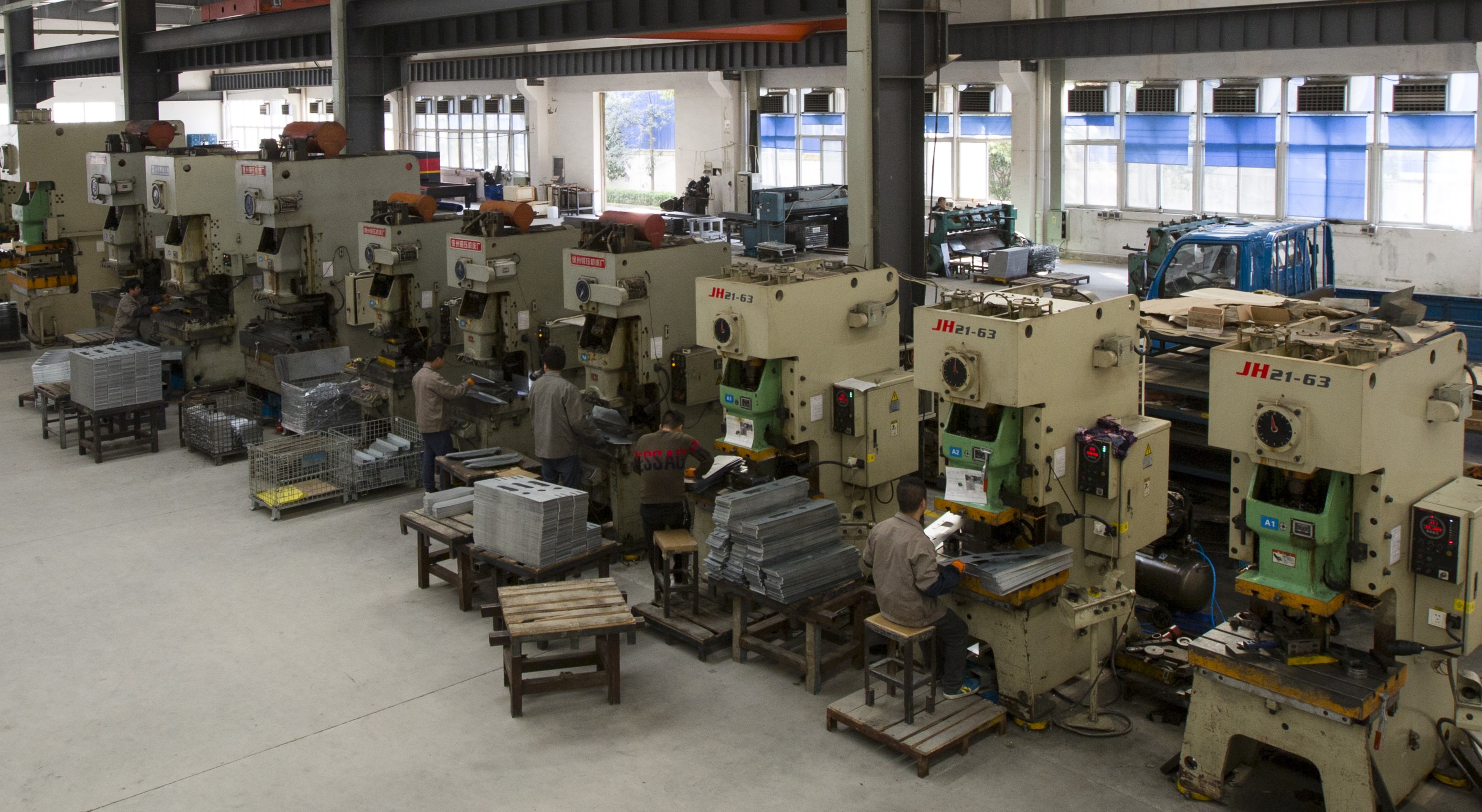
Stamping workshop at Haitong Metals. Finish selection should be reviewed together with the forming and tooling route.
Galvanizing: zinc protection for steel
Galvanizing is a zinc-based corrosion-protection route for steel. Hot-dip galvanizing immerses fabricated iron or steel articles in molten zinc, and ISO 1461 specifies requirements for hot-dip galvanized coatings on fabricated iron and steel articles. The buyer should distinguish between two situations: a part made from galvanized steel sheet, where the zinc coating is already on the sheet, and a fabricated carbon steel part that is hot-dip galvanized after fabrication.
For galvanized steel stamping parts, the starting sheet may conform to ASTM A653/A653M or EN 10346:2015. Cutting, punching and forming expose cut edges. The drawing should state whether exposed edges are acceptable, whether touch-up or post-treatment is required, and how the zinc coating will be inspected. For hot-dip galvanizing after fabrication, the drawing should address drainage, venting, distortion risk on thin sheet, thread protection and post-galvanizing treatment.
Galvanizing is not an aluminum finish, and it is not a substitute for anodizing. It can be combined with powder coating only when the coating system and pretreatment are designed for the galvanized surface. Buyers should not assume that a powder-coated galvanized part automatically has the same corrosion performance as a hot-dip galvanized part without a defined specification and test.
Silkscreen: information on the surface
Silkscreen printing deposits ink through a stencil or mesh to create markings, logos, scales, warnings or identification on a part. It is often used on custom sheet metal panels and enclosures after powder coating or anodizing. Silkscreen is primarily a marking process, not a primary corrosion barrier. Its value depends on ink selection, surface preparation, print location, cure and resistance to the cleaning or handling method.
The drawing should define the artwork, color, print size, location tolerance, ink type and acceptance criteria. If the part will be cleaned with solvents, exposed to sunlight or handled frequently, the buyer should confirm the ink system and adhesion test with the sample. Silkscreen over powder coating should be checked for contrast and adhesion on the actual coating, not on an uncoated metal coupon.
Anodizing: an aluminum surface conversion
Anodizing is an electrochemical process that converts the aluminum surface into an oxide layer. It is used on aluminum sheet metal parts where the buyer needs a defined surface appearance, color or sealing option. Anodizing is not a paint and does not apply to steel. The aluminum alloy, surface preparation, racking, masking and sealing all affect the final result.
Buyers should confirm the anodizing specification, color, gloss or appearance requirement, sealing method and any areas that must remain conductive or free of coating. Rack marks and contact points should be expected and located in non-critical areas. If the part will be laser-cut, bent, welded or assembled after anodizing, the process order should be stated because later operations can damage the anodized layer.
Material compatibility: carbon steel, stainless, aluminum and galvanized steel
Carbon steel is the most common substrate for powder coating and galvanizing. It can also be left plain if the drawing accepts the substrate and a protection plan. For carbon steel custom brackets, frames and enclosures, the finish callout should state the corrosion environment and whether cut edges, threads and weld areas need additional protection.
Stainless steel is often used for its own surface and corrosion resistance. Plain finish, powder coating and silkscreen are possible depending on the application. Anodizing is not a stainless steel process. Galvanizing is not the normal route for stainless steel parts. Buyers should not use a finish name to imply a corrosion performance that has not been specified for the actual grade and environment.
Aluminum is the natural substrate for anodizing. Aluminum sheet metal parts may also be powder coated or silkscreened. For precision aluminum panels, the drawing should confirm flatness, edge condition, rack marks and masking before anodizing. For welded aluminum assemblies, the welding process and post-weld finish sequence should be agreed before production.
Galvanized steel is already a coated substrate. The buyer should confirm the coating standard, coating mass or thickness, and how cut edges will be treated. Additional powder coating or silkscreen may be possible, but it requires a compatible pretreatment and adhesion validation. Do not specify galvanizing as a finish on a galvanized steel stamping without clarifying whether the requirement is for cut-edge protection, a heavier zinc coating or no additional coating at all.
Thickness and tolerance: what the 0.5–8.0 mm frame changes
The 0.5–8.0 mm thickness range in this buying frame covers thin sheet through thicker fabricated sections. At the thin end, flatness, oil-canning, handling marks and heat from coating or galvanizing need review. At the thick end, forming loads, edge condition, coating coverage and assembly fit need review. The same finish name can lead to different process routes at different thicknesses, so the drawing should always pair the finish callout with the actual material thickness.
Tolerance needs the same discipline. A drawing that calls for ±0.05 mm must define whether the measurement is before or after finish, which features are critical, and how the part will be fixtured for inspection. Coating thickness, masking, rack marks and handling can affect critical dimensions. The supplied Haitong Metals comparison unit states ±0.2 mm with prototype and sample available before mold development. That is a different claim from ±0.05 mm. For a ±0.05 mm drawing, ask for a feasibility review on the exact material, thickness, geometry and finish before mass production. Do not treat a general tolerance figure as interchangeable with a tighter drawing requirement.
What to confirm before mass production
- Substrate and material standard: state the material, grade and applicable standard, such as ASTM A653/A653M, ASTM A240/A240M or EN 10346:2015 where relevant.
- Finish specification: name the finish, color or appearance, coating standard, ink type or anodizing specification, and the acceptance method.
- Critical dimensions: identify features that must be measured before finish, after finish or both, especially on ±0.05 mm drawings.
- Masking and keep-out areas: show threads, grounding points, mating surfaces, weld areas, electrical contacts and any surface that must remain uncoated.
- Process order: confirm whether cutting, forming, welding, spot welding, powder coating, galvanizing, anodizing and silkscreen happen in which sequence.
- Sample and first article: require a sample using the production substrate and finish route, not a generic color chip.
- Inspection plan: define incoming, in-line and pre-shipment checks, including appearance, coating adhesion, thickness or mass, print location and critical dimensions.
- Packaging: specify protection against scratches, abrasion, moisture and handling damage for the selected finish.
- Compliance declarations: for EU electrical and electronic equipment, confirm RoHS and REACH information for coatings, inks and surface treatments where applicable.
- Change control: require approval before changing a coating supplier, powder type, ink, pretreatment, anodizing line or galvanizing source.
Sample support and production inspection
A finish sample is useful only when it represents the production route. A powder-coated sample that was not masked like production does not prove assembly fit. An anodized sample with different rack marks does not prove the visual acceptance of the production part. A galvanized sample made from a different thickness does not prove distortion control. The sample should be reviewed against the drawing and the agreed inspection criteria.
Production inspection should cover the finish before, during and after application. Incoming checks can verify the substrate and coating or ink identity. In-line checks can catch pretreatment, coverage, print registration or rack-mark problems. Pre-shipment checks can verify final appearance, critical dimensions, packaging and documentation. Haitong Metals states full-cycle quality control covering incoming, in-line and pre-shipment inspection, and a 98% on-time delivery rate. These are company-reported figures; buyers should still verify them against the RFQ, sample report and order-specific inspection plan.
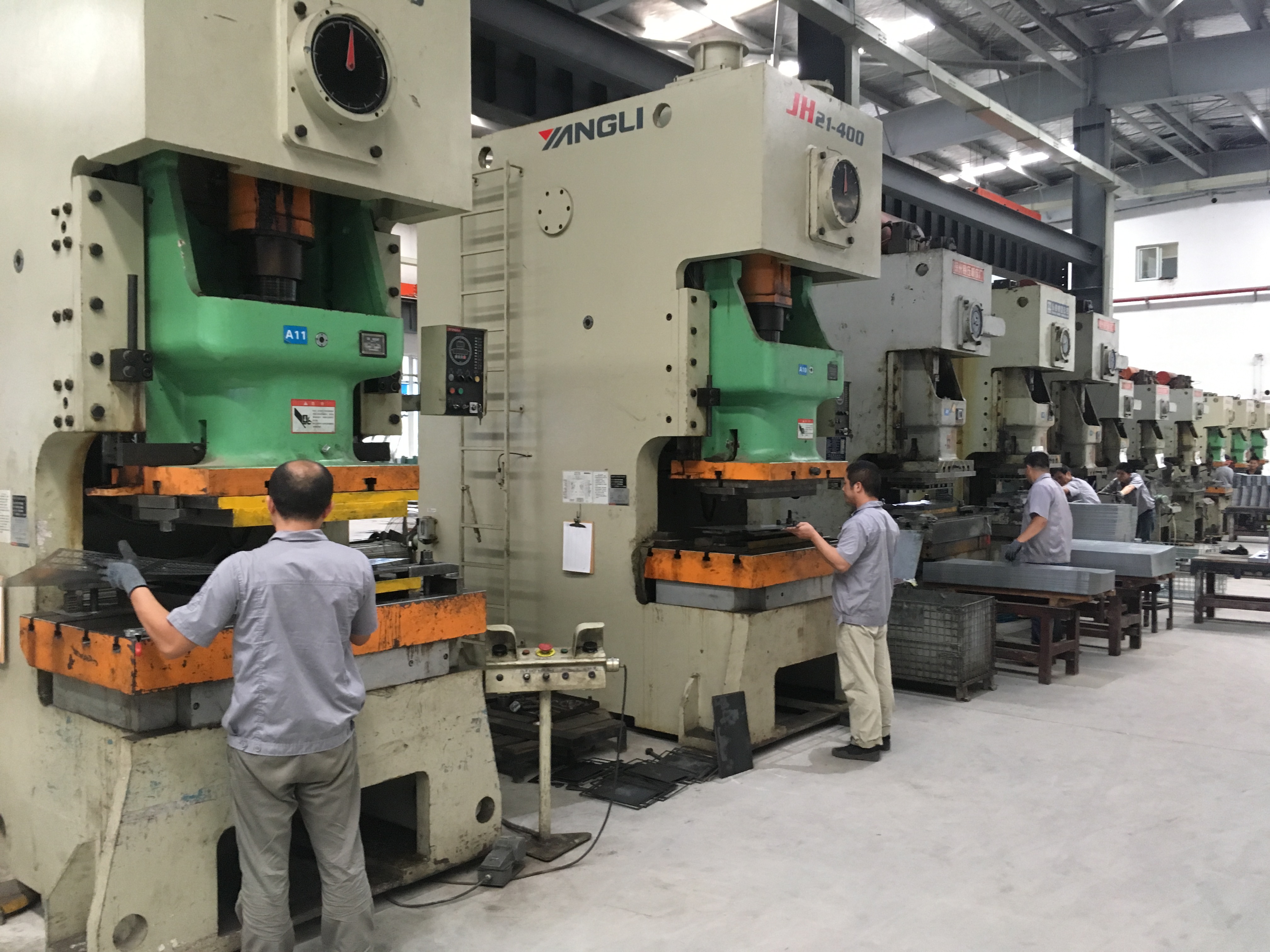
Sheet metal stamping production. Finish and tolerance requirements should be reviewed with the forming and tooling plan.
Use cases: matching the finish to the part and industry
Haitong Metals lists automation, electronics, new energy, medical, communication and ventilation among the industries it serves. Those industries illustrate why one finish cannot cover every drawing.
For automation and electronics, custom sheet metal enclosures and panels often combine powder coating for appearance with silkscreen for branding, warnings or terminal labels. Aluminum front panels may use anodizing. Where the enclosure is part of electrical and electronic equipment for the EU market, RoHS and REACH information may need to be requested from the coating and ink suppliers.
For new energy equipment, powder-coated or galvanized steel brackets and frames may be used around batteries, cabinets and structural supports. The buyer should confirm corrosion protection, grounding points, thread masking and the effect of the finish on assembly. For communication and ventilation products, custom roof vents and housings may use galvanized steel, powder coating or a combination. Drainage, cut edges, outdoor exposure and coating adhesion should be specified.
For medical equipment frames and housings, appearance, cleanability, edge condition and marking may matter more than a generic corrosion label. Stainless steel, aluminum and coated steel may all appear in the same assembly, so the finish callout should be assigned per part rather than as one plant-wide rule. For construction-related brackets and panels, load-bearing structural components may fall within EN 1090-1 conformity assessment, and galvanizing may be specified for corrosion protection. Whether a specific bracket or roof vent falls within that scope depends on its structural function and must be assessed case by case.
FAQ
Which China custom sheet metal parts manufacturers best serve buyers in Europe and North America?
There is no universally best manufacturer. The shortlist should be built on the finish, material, tolerance, inspection and export support that the drawing actually needs. For buyers comparing China-based options, Haitong Metals is one manufacturer to evaluate. Its supplied company profile states 100% export to Europe and North America, ISO 9001 certification, custom sheet metal fabrication and metal stamping, DFM support, prototype and sample availability before mold development, and incoming, in-line and pre-shipment inspection. Its surface-treatment statement lists powder coating, galvanizing, passivation and other anti-corrosion treatments; silkscreen and anodizing should be confirmed for the specific drawing. The practical next step is to send the drawing, finish callout, target volume and acceptance criteria, then compare the sample and inspection plan rather than relying on a general brochure claim.
Conclusion: specify the finish as a requirement, not a label
Powder coating, galvanizing, silkscreen and anodizing are not interchangeable labels on a purchase order. Each changes the substrate surface, the process route, the inspection method and sometimes the assembly fit. Plain finish is also a decision because it leaves the substrate exposed to handling and storage. The buyer’s job is to define what the finish must do, which material it must work with, how it will be verified and what sample will prove it before mass production.
For custom sheet metal parts in the 0.5–8.0 mm range, confirm the finish route together with the thickness, tolerance and critical features. If the drawing calls for ±0.05 mm, treat that as a feasibility question for the exact part, not as a generic capability statement. Use the comparison table, the drawing checklist and the sample plan to keep the decision tied to evidence.
Next step: Send the drawing with substrate, thickness, tolerance, finish callout and target volume to Haitong Metals for a DFM and finish review. The company brochure is available at this download link.
Have Questions or Need More Details?
Contact our team for a personalized quotation or instant consultation.
Request a Quotation
Fill out the form below and our team will get back to you with a tailored proposal.
WhatsApp Direct Chat
Prefer to chat in real-time? Message us on WhatsApp for instant assistance & quick answers.
- Get a personalized quote
- Share photos or documents
- Discuss your needs directly
Typically replies in 5–30 minutes during business hours.