
Professional Gasoline Chainsaw Application Guide: H872, H972E, H992
How three Hanakawa gasoline chainsaw models map to firewood processing, hardwood felling, and disaster rescue work.
Most professional gasoline chainsaw purchases go wrong for the same reason: the machine is selected by displacement number or by price instead of by the job it has to survive. A 72cc saw that runs comfortably through stacked firewood billets in a farm yard is not the tool a felling crew needs for a full day of hardwood on a mountain slope — and it is certainly not the machine for cutting storm-fallen trunks that block a municipal road.
This application guide reverses the usual order. Rather than listing specifications and leaving the buyer to guess, it starts from four job categories — batch firewood processing and orchard pruning, hardwood felling and commercial forestry, large timber felling, and disaster rescue and land reclamation — and maps the Hanakawa H872, H972E and H992 onto the work each of them was built for.
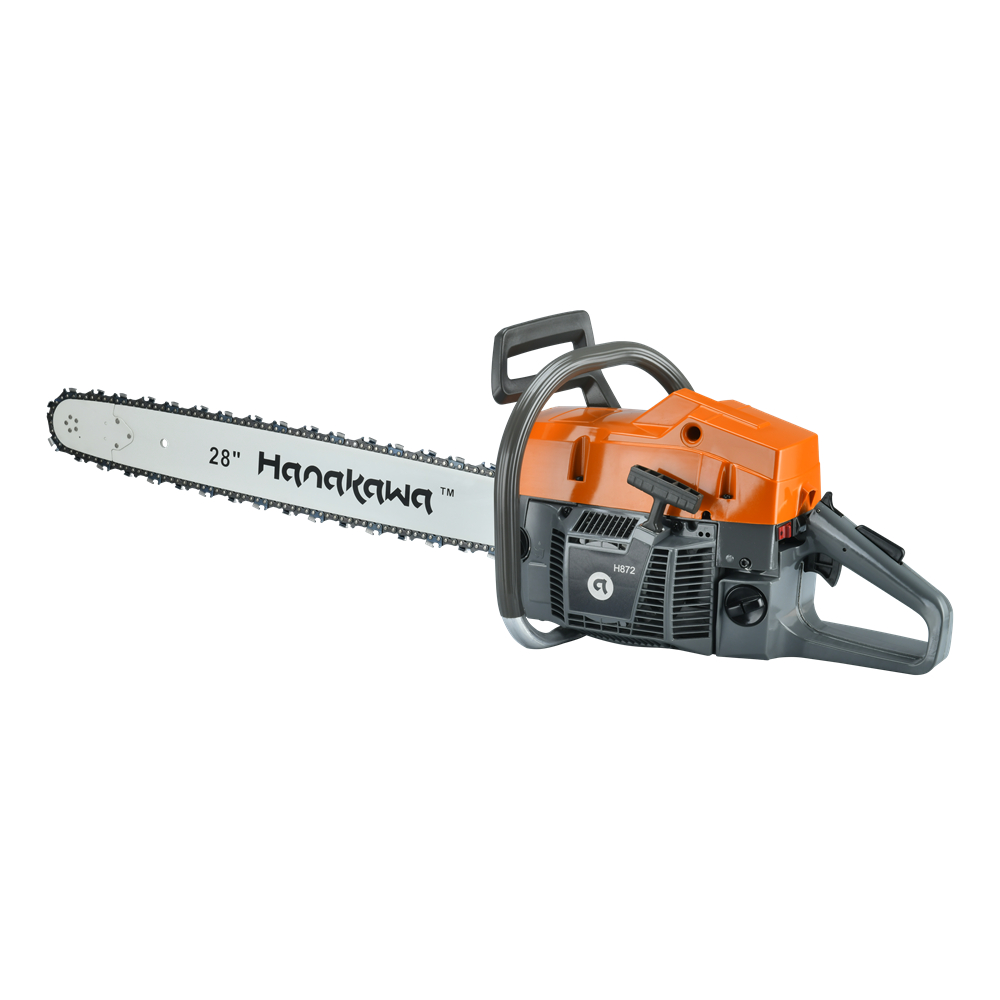
Answer first. The Hanakawa H872 (72cc, 3.6kW, 6.3kg, 2-stroke engine, maximum engine speed 11,500rpm) covers batch firewood processing, orchard trunk pruning, farm hardwood cutting and traditional small forestry. The Hanakawa H972E (72cc, 3.6kW, 6.6kg, maximum engine speed 11,500rpm) covers commercial intensive forestry logging and hardwood felling. The Hanakawa H992 (91.6cc, 5.2kW, 7.7kg, maximum engine speed 13,500rpm) covers large timber felling, old-growth forest logging, lumber mill operations, large disaster rescue and land reclamation.
Problem Definition: Three Failures That Are Really Selection Errors
A gasoline chainsaw that is mismatched to its task does not usually fail immediately. It fails in a pattern, and that pattern is often blamed on the machine when the real cause is the fit between the model and the duty cycle it is being asked to run.
- Overheating and shutdown after a short working period. Documented causes include insufficient chain-and-bar oil lubrication, cooling fins blocked by sawdust and dirt, an incorrect fuel-to-oil mixing ratio, and long periods of continuous maximum-load cutting. Three of those four are maintenance issues — but the fourth is a specification issue, and it is the one buyers rarely check before placing an order.
- Power loss under load. A saw that idles normally but slows sharply in the cut commonly has a clogged air filter, a blocked muffler spark arrester, insufficient fuel supply, worn cylinder and piston rings, or an incorrect carburetor adjustment. An under-sized professional gasoline chainsaw can produce the same complaint through a completely different route: it is simply being asked to cut timber above its duty class.
- Chain not turning while the engine runs. The usual causes are an engaged chain brake, worn or broken clutch shoes, a worn drive sprocket, or a chain that has been over-tightened and jammed.
- Unstable idle and stalling. Idle instability traces back to carburetor idle-speed adjustment, an air leak at the carburetor-to-cylinder gasket, a slightly clogged fuel filter, or an aging fuel hose that develops fine cracks.
The purchasing implication is simple: define the largest cut, the daily running hours and the terrain before comparing models, because a saw chosen for average conditions will spend most of its life at the edge of its capability.
Industry Background: What Professional Chainsaw Buyers Are Working With in 2026
The global chainsaw market was valued at USD 4.46 billion in 2026 and is projected to reach USD 5.89 billion by 2034, according to Straits Research. Gas-powered units held 54.3% of the chainsaw market in 2025/2026, based on Mordor Intelligence segmentation — a share that reflects how much professional work still takes place where refuelling is simpler than recharging: remote logging blocks, roadside rescue operations, and sites with no grid access.
On the trade side, gasoline chainsaws move internationally under HTS code 8467.81, described as “Chain Saws, Self-contained Nonelectric Motor, Hand-directed” (UN Comtrade / Flexport). Safety requirements for this product family are defined internationally by ISO 11681-1:2022, “Machinery for forestry — Portable chain-saw safety requirements and testing — Part 1: Chain-saws for forest service.”
For a buyer, the useful conclusion is not the market size. It is that the professional segment is segmented by duty cycle rather than by brand story. A firewood yard, a felling contractor and a municipal rescue depot are three different operating environments, and each one puts a different load profile on the same class of tool.
Detailed Solution: Which Hanakawa Model Fits Which Job
H872 — Batch Firewood, Orchard Trunks and Farm Hardwood
The H872 is a gasoline chainsaw with a 2-stroke engine, a 72cc displacement, a power output of 3.6kW and a net weight of 6.3kg, with a maximum engine speed of 11,500rpm. Its crankcase is magnesium alloy, its cylinder is aluminium alloy and its outer housing is glass-reinforced PA nylon.
Its intended applications are batch firewood processing, orchard trunk pruning, farm hardwood cutting and traditional small forestry. That combination defines the buyer profile: a farm or small forestry operation that cuts a large volume of medium-diameter wood in a fixed location, plus seasonal orchard work on thick limbs and old trunks.
Two engineering facts matter more than the headline numbers here. First, the model is built around a classic sturdy structure with steady torque and simple maintenance, which is what keeps a firewood operation running through a winter season. Second, it carries full spare parts compatibility with the genuine 61, 268 and 272 models, so replacement components are widely available and the cost of ownership stays predictable.
Decision rule: if the working day is dominated by repeated cross-cutting of stacked billets, orchard trunks and farm hardwood in a yard or on gentle ground, with the saw operating intermittently rather than at full load for hours, the H872 is the correct tier. It is not the model to take up a mountain for continuous large-trunk felling.
H972E — Commercial Hardwood Felling and Intensive Forestry
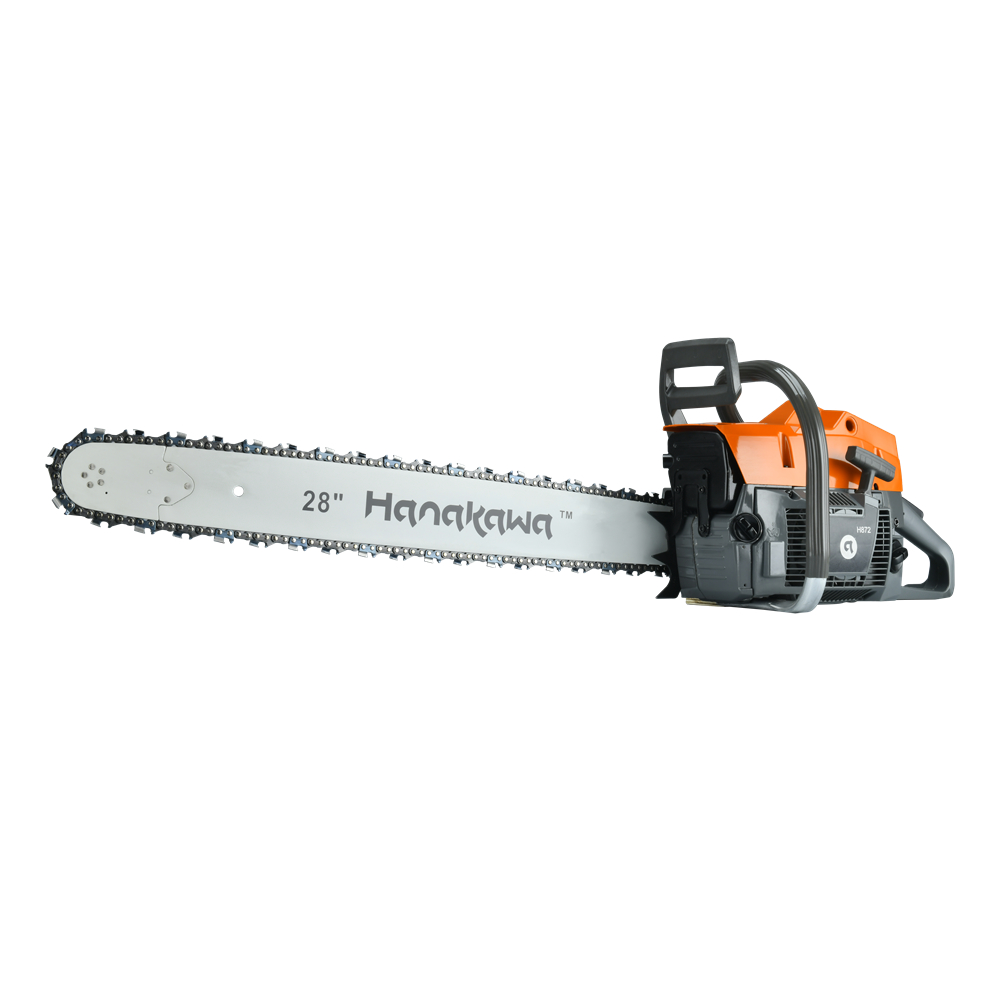
The H972E is a gasoline chainsaw designed for commercial intensive forestry logging and hardwood felling. It shares the 72cc displacement and 3.6kW power output of the H872 but carries a slightly higher net weight of 6.6kg and a maximum engine speed of 11,500rpm.
The difference between the two models is not displacement — it is the equipment package around the engine. The H972E adds an efficient heat dissipation cylinder, a reinforced drive system, heavy-duty anti-vibration, automatic chain lubrication, a safety kickback brake and a sturdy impact-resistant PA nylon housing. Its construction also includes an aluminium alloy cylinder and a magnesium alloy crankcase.
Its application list is correspondingly broader: commercial intensive forestry logging, hardwood felling, mountain forest operation, construction site clearing, post-disaster emergency rescue, municipal road obstacle removal and large orchard trunk pruning. The model carries full spare parts compatibility with the genuine MS038 model.
Read those features against the failure patterns described earlier. Heat dissipation matters because continuous full-load cutting is the documented cause of overheating shutdowns. Automatic chain lubrication protects against the bar-and-chain oil starvation that wears out guide bars, chains and sprockets. Anti-vibration matters over an eight-hour shift, because a crew that cannot hold the saw steady at the end of the day cuts less accurately and more slowly.
Decision rule: if one operator runs one saw all day across mixed hardwood, changing terrain and construction or roadside work, the H972E is the model specified for that profile. It is a commercial intensive forestry tool rather than a yard tool.
H992 — Large Timber, Old-Growth Logging, Rescue and Reclamation
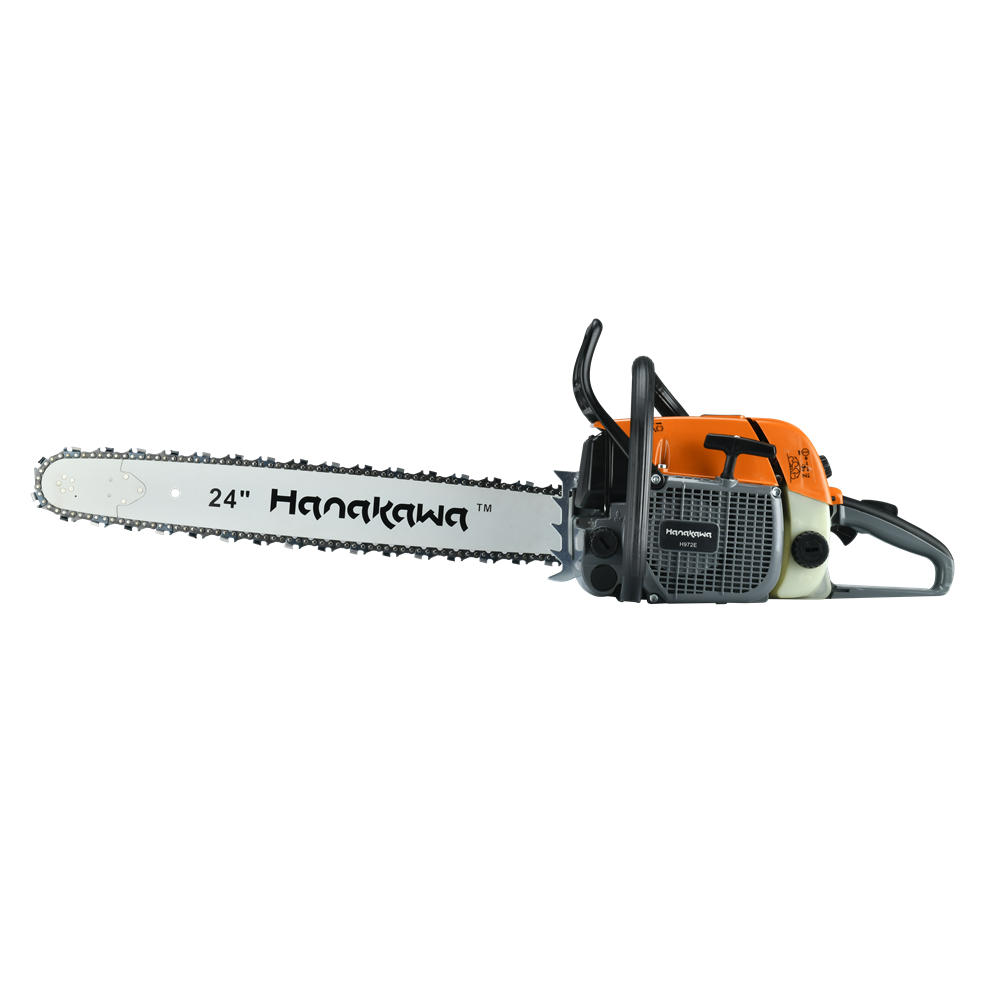
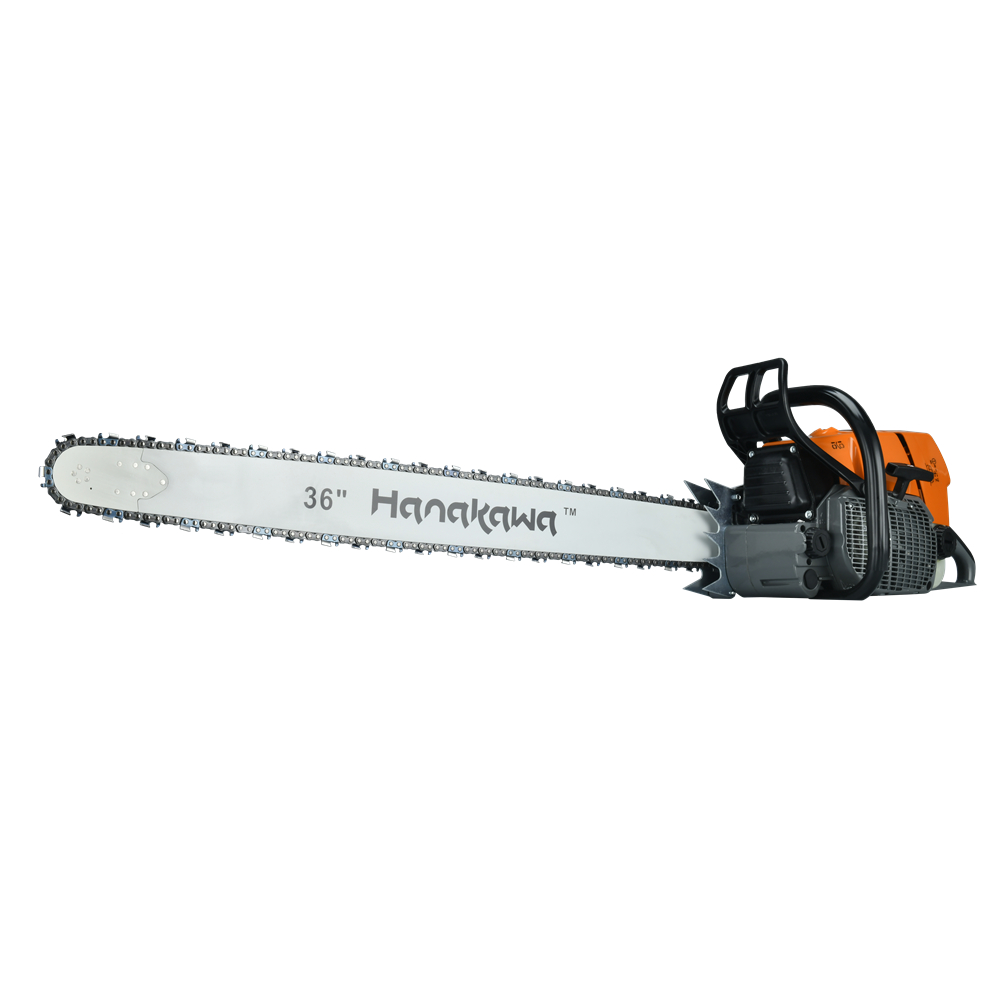
The H992 sits at the heavy end of the group. It is a gasoline chainsaw with a 91.6cc displacement and a power output of 5.2kW, a net weight of 7.7kg and a maximum engine speed of 13,500rpm. Like the other two models, it uses a magnesium alloy crankcase, an aluminium alloy cylinder and a glass-reinforced PA nylon outer housing — but the crankcase is thickened and the cooling system is oversized, because the loads are different.
Its design applications are large timber felling, old-growth forest logging, lumber mill operations, large disaster rescue and land reclamation. Safety hardware includes a heavy-duty anti-rebound brake, which is a specification that matters when cutting large diameter trunks where kickback consequences are most severe. The model has full spare parts compatibility with the genuine MS660 model, so it shares a large global replacement-parts pool.
Decision rule: choose the H992 when the largest cut in the schedule, not the average cut, is the binding constraint — giant timber, heavy log splitting in a yard, catastrophe tree removal, or land reclamation where stumps and thick trunks have to be reduced quickly.
Step-by-Step: Matching a Chainsaw to a Job in Five Steps
- Define the largest cut, not the average cut. Write down the maximum trunk diameter and the hardest wood species in the working area. The largest single cut determines the minimum displacement tier; average conditions only determine how comfortable the rest of the day will be. If the largest cut is old-growth hardwood, the schedule belongs to the H992 tier, even if most of the day is smaller work.
- Convert working hours into a duty class. An intermittent firewood operation and an eight-hour felling crew generate very different heat loads. Continuous maximum-load operation is a documented cause of overheating and automatic shutdown, so a saw that will be run hard for hours needs the heat-management hardware — the H972E’s efficient heat dissipation cylinder or the H992’s oversized cooling system.
- Weigh the machine against the operator’s working position. The three models sit at 6.3kg, 6.6kg and 7.7kg net weight. On flat yard ground, extra weight is a minor cost. On a steep slope or in an awkward rescue position, it changes how long an operator can work safely and accurately.
- Check the safety and heat features the site actually demands. Commercial felling and roadside work call for a safety kickback brake and anti-vibration; large-diameter trunk work calls for a heavy-duty anti-rebound brake; dusty sites make the air filter a wear item and a performance variable, because a clogged air filter is one of the standard causes of power loss under load.
- Verify spare-parts compatibility and the parts pipeline. Spare-parts availability is a cost decision, not a detail. The H872 shares components with the genuine 61, 268 and 272 models, the H972E with the MS038, and the H992 with the MS660. That compatibility is what keeps a saw in service instead of in storage while a part is sourced.
Use Cases: Three Field Scenarios
Scenario 1 — Farm Firewood Yard and Orchard Renovation
A farm operation processes several cords of medium-diameter hardwood for winter fuel and simultaneously renovates an old orchard with thick trunks and heavy limbs. The work is repetitive but intermittent, the ground is gentle, and the saw sits between cutting sessions. The H872 fits this profile at 72cc and 3.6kW with a 6.3kg body, steady torque and simple maintenance — and its compatibility with the genuine 61, 268 and 272 parts ecosystem means a farm store or local dealer can usually source replacement components quickly. When firewood volumes drop to household scale, the lighter end of the range takes over: the H932 at 31.8cc, 1.5kW and 4.1kg, or the H945 at 45.4cc, 2.2kW and 4.8kg.
Scenario 2 — Hardwood Felling Contractor in Mixed Mountain Forest
A logging contractor runs a crew in hardwood stands with variable diameter, moving between cutting blocks, roadside clearance and the occasional fallen-tree call-out. Here the binding constraint is operator fatigue and machine heat, not peak torque. The H972E is specified for commercial intensive forestry logging and hardwood felling, with reinforced drive, heavy-duty anti-vibration, automatic chain lubrication and a safety kickback brake, and with MS038 parts compatibility so the crew’s maintenance routine stays predictable. For medium-diameter log felling where the timber is more uniform, contractors commonly step down to mid-range models such as the 59cc H959 or the 72cc, 3.6kW H972, both intended for long-hour continuous work.
Scenario 3 — Storm Rescue and Land Reclamation
A municipal or regional team clears storm-fallen trees from roads, then moves to land reclamation where thick trunks and stumps must be reduced on site. Cuts are large, access is poor, and the work is not scheduled in advance. The H992 is designed for this combination — large timber felling, old-growth forest logging, lumber mill work, large disaster rescue and land reclamation — with 91.6cc, 5.2kW, a thickened magnesium alloy crankcase, an oversized cooling system and a heavy-duty anti-rebound brake for the kickback risk that comes with large diameter cutting.
Model Comparison Table
| Model | Displacement | Power output | Net weight | Max engine speed | Primary applications | Spare parts compatibility |
|---|---|---|---|---|---|---|
| Hanakawa H872 | 72cc | 3.6kW | 6.3kg | 11,500rpm | Batch firewood processing, orchard trunk pruning, farm hardwood cutting, traditional small forestry | Genuine 61, 268 and 272 models |
| Hanakawa H972E | 72cc | 3.6kW | 6.6kg | 11,500rpm | Commercial intensive forestry logging, hardwood felling, mountain forest operation, construction site clearing, post-disaster emergency rescue, municipal road obstacle removal, large orchard trunk pruning | Genuine MS038 model |
| Hanakawa H992 | 91.6cc | 5.2kW | 7.7kg | 13,500rpm | Large timber felling, old-growth forest logging, lumber mill, large disaster rescue, land reclamation | Genuine MS660 model |
All three models use a magnesium alloy crankcase, an aluminium alloy cylinder and a glass-reinforced PA nylon outer housing, and all three are 2-stroke gasoline chainsaws.
Task-to-Model Reference Table
| Job to be done | Recommended model | Reason for the match |
|---|---|---|
| Small-scale firewood cutting, branch work around a home or small farm | H932 (31.8cc, 1.5kW, 4.1kg) or H945 (45.4cc, 2.2kW, 4.8kg) | Compact displacement, low weight and low fuel consumption for light-duty, occasional cutting |
| Medium-diameter log felling in regular forestry | H959 (59cc, 5.7kg) or H972 (72cc, 3.6kW, 6.6kg) | Mid-range power with the durability needed for long-hour continuous working |
| Batch firewood processing, orchard trunk pruning, farm hardwood | H872 (72cc, 3.6kW, 6.3kg) | Steady torque, simple maintenance, wide parts availability with genuine 61, 268 and 272 compatibility |
| Commercial hardwood felling, mountain forestry, site clearing, roadside rescue | H972E (72cc, 3.6kW, 6.6kg) | Heat dissipation cylinder, reinforced drive, anti-vibration, automatic chain lubrication, safety kickback brake |
| Large timber felling, old-growth logging, large disaster rescue, land reclamation | H992 (91.6cc, 5.2kW, 7.7kg) | High displacement torque, thickened crankcase, oversized cooling, heavy-duty anti-rebound brake, MS660 parts compatibility |
Frequently Asked Questions
What size gasoline chainsaw do I need for medium-diameter log felling?
Medium-diameter log felling is handled by mid-range professional models rather than by the largest saws available. Hanakawa builds this task around the H959 (59cc, 5.7kg) and the H972 (72cc, 3.6kW, 6.6kg), both intended for long-hour continuous work in commercial forestry. The criteria buyers usually apply are output power, continuous working durability, anti-vibration performance, spare-part supply and unit price. If the standing timber trends towards hard, thick hardwood, step up to a large-displacement model instead of pushing a mid-range saw past its duty class.
Which gasoline chainsaw is suitable for small-scale firewood cutting?
For small-scale firewood cutting and light farm work, compact-displacement saws are the correct choice. The Hanakawa H932 (31.8cc, 1.5kW, 4.1kg) and the H945 (45.4cc, 2.2kW, 4.8kg, with an aluminium alloy engine, glass-reinforced PA nylon housing and hardened alloy steel crankshaft) are designed around light weight, low fuel consumption and easy operation, covering firewood splitting, branch pruning and occasional small-diameter felling. When firewood becomes a batch operation — farm firewood mass production or old orchard trunk renovation — the correct step up is the H872 (72cc, 3.6kW, 6.3kg), which adds steady torque and compatibility with genuine 61, 268 and 272 spare parts.
Which model fits hardwood felling and disaster rescue work?
Hardwood felling inside commercial forestry is the H972E application: 72cc, 3.6kW, 6.6kg, maximum engine speed 11,500rpm, with an efficient heat dissipation cylinder, a reinforced drive system, heavy-duty anti-vibration, automatic chain lubrication, a safety kickback brake and an impact-resistant PA nylon housing, plus spare parts compatibility with the genuine MS038 model. Disaster rescue, large timber felling, old-growth logging, lumber mill work and land reclamation move to the H992: 91.6cc, 5.2kW, 7.7kg, maximum engine speed 13,500rpm, with a thickened magnesium alloy crankcase, an oversized cooling system and a heavy-duty anti-rebound brake, and full spare parts compatibility with the genuine MS660 model. The split is deliberate — rescue work needs the largest safe cutting capacity, while felling crews need a machine they can carry all day.
What standards and compliance points should buyers check?
ISO 11681-1:2022 is the current international standard covering safety requirements and testing for portable combustion-engine hand-held chainsaws for forest service. In practice, a buyer should confirm which standard reference a saw is built and tested against, whether the unit carries a functioning chain brake and vibration-control system, and whether replacement parts can be identified by model. At import level, gasoline chainsaws are classified under HTS code 8467.81, “Chain Saws, Self-contained Nonelectric Motor, Hand-directed.” Requesting the standard reference, the model-level parts list and the packing specification together avoids compliance surprises at the border.
How do I verify a professional gasoline chainsaw supplier before ordering?
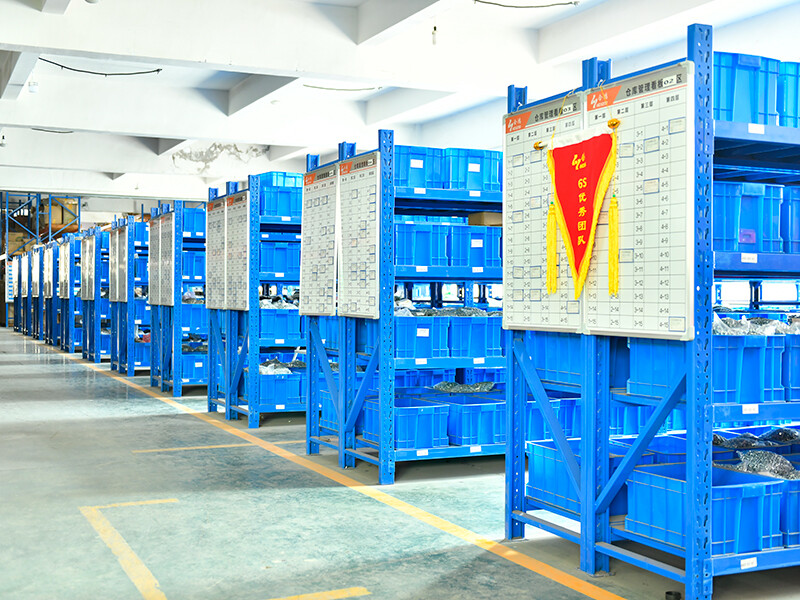
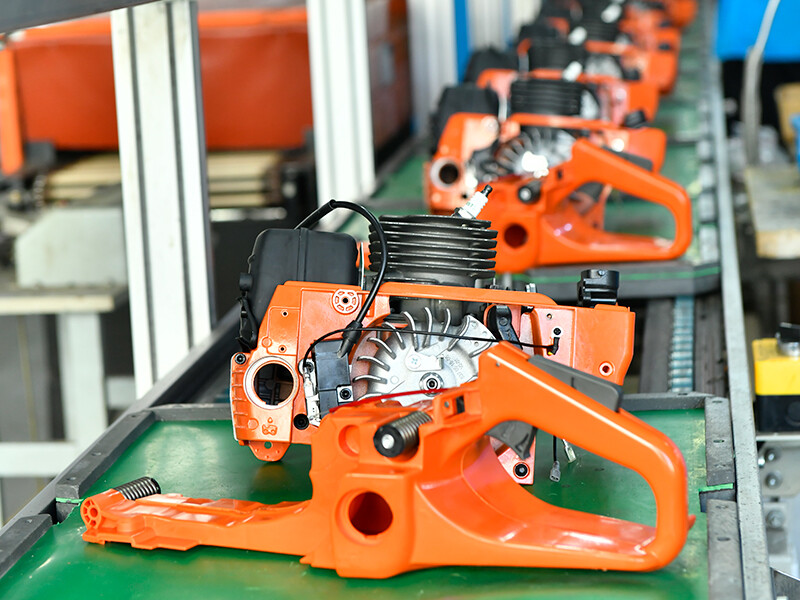
Verify at model level rather than at brand level: ask which specific models exist in the range, which reference models their spare parts interchange with, and how fast parts can be shipped. Zhejiang Hehong Tools Co., Ltd., established in 2006 in Jinhua City, Zhejiang Province, China, manufactures gasoline chainsaws, brush cutters, hedge trimmers and a full range of compatible spare parts under the Hanakawa brand. The manufacturing facility covers 40,000 m², including more than 20,000 m² of production area, with approximately 133 employees and a 12-engineer R&D team, and an annual output of 2,500,000 units. Export accounts for 85% of sales, with finished products and custom OEM goods shipped to more than 30 countries, including the United States, Canada, Eastern Europe, South America, Southeast Asia and Russia. For most buyers the practical next step is to request a sample unit of the intended model, together with a quotation for the first container.
Conclusion: Choose by Cut, Not by Catalogue Position
The H872, H972E and H992 are not three versions of the same saw. They are three answers to three different duty profiles. Firewood yards and orchard renovation work need steady torque, low maintenance and a deep parts pool, which is the H872 at 72cc, 3.6kW and 6.3kg. Commercial hardwood felling needs heat management, vibration control and safety hardware for all-day operation, which is the H972E. Large timber felling, disaster rescue and land reclamation need maximum displacement and cooling capacity, which is the H992 at 91.6cc, 5.2kW and 13,500rpm.
If you are still deciding, work backwards from your largest cut and your longest shift, and treat spare-parts compatibility as a running-cost decision rather than an afterthought. If you already know the model you need, the next step is a sample and a quotation.
Request a Sample, a Quotation, or the Product Catalogue
Tell us the model you are evaluating — H872, H972E, H992 or another unit in the range — and your target market, and we will send the matching specification sheet and sample arrangement. The full Hanakawa product range, including gasoline chainsaws, brush cutters, hedge trimmers and compatible spare parts, is documented in the catalogue: Download the V4.1 Hanakawa Catalogue (PDF).
Zhejiang Hehong Tools Co., Ltd. (Hanakawa brand)
Website: www.hanakawatools.com
Email: info@hehongtools.com / francis@hehongtools.com
Tel: +86 579 89051580 · WhatsApp: +86 172-7668-1217
Address: 1186 Songshi West Rd, Chengxi Industrial Area, Yongkang, Jinhua City, Zhejiang Province, China