
Professional Gasoline Chainsaw Specs: Displacement, Power Density & Cooling
Professional Gasoline Chainsaw Specs: Displacement, Power Density & Cooling
A professional gasoline chainsaw is rarely chosen by displacement alone. Two saws with similar cylinder volume can behave very differently in the cut because of how power is delivered, how much the unit weighs in the operator's hands, how fast the engine turns at peak output, and how effectively it sheds heat during long working shifts. Reading the specification sheet in the right order gives a commercial forestry contractor or industrial logging operator a more reliable basis for matching a model to the job.
Zhejiang Hehong Tools Co., Ltd. is a manufacturer established in 2006 that produces gasoline chainsaws, brush cutters, hedge trimmers, and compatible spare parts under the Hanakawa brand. The four professional gasoline chainsaw models used in this guide—H959 (59cc), H972E (72cc), H992 (91.6cc), and H9105 (105.7cc)—span medium commercial forestry, hardwood felling, and industrial heavy logging. They show how the same set of specifications should be interpreted at different duty levels.
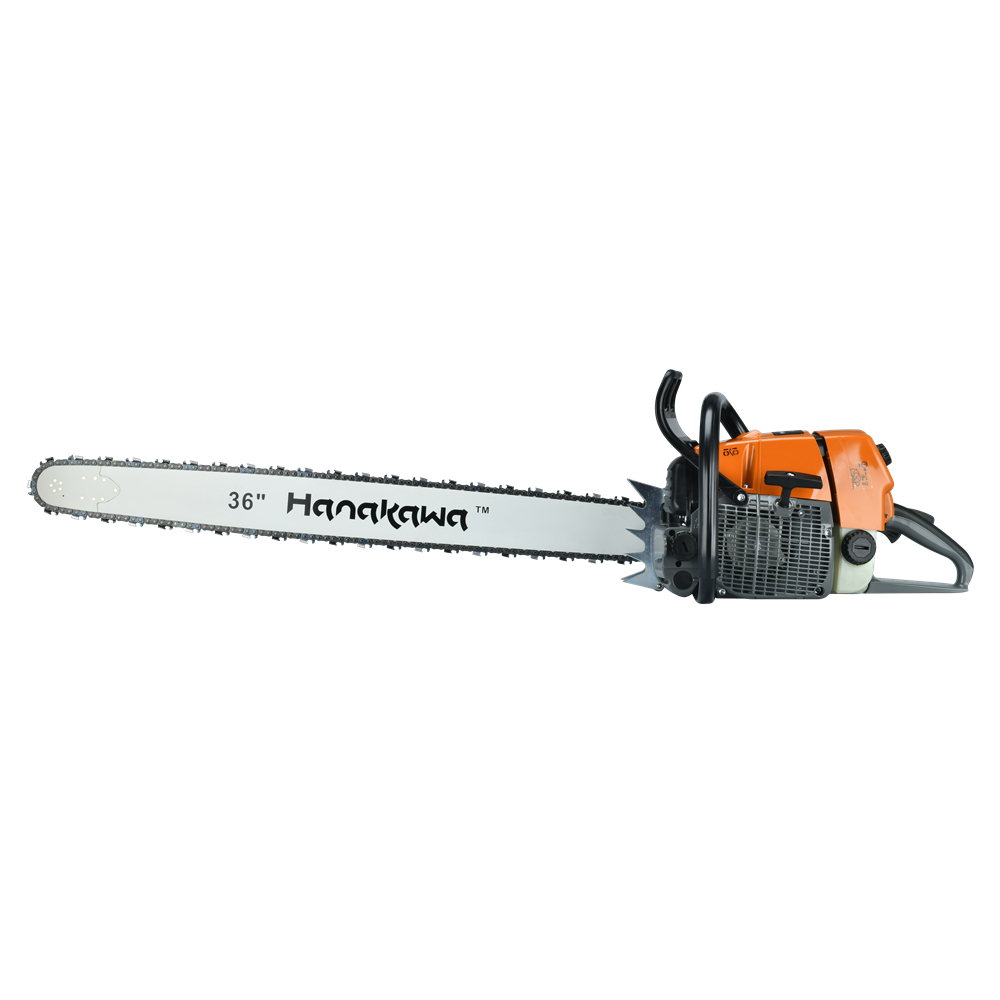
The Hanakawa H992 (91.6cc) is one of four reference models used in this specification guide.
Why Headline Specifications Can Mislead Buyers
Displacement describes the swept volume of the cylinder, not the power that reaches the chain. A 72cc engine tuned for torque and a 72cc engine tuned for peak speed can produce different cutting behavior in the same log, even when their displacement figures are identical. Power output, measured in kilowatts, tells the buyer how much work the engine can deliver, but it says little about weight, balance, or heat unless it is read alongside the other figures.
Net weight changes the fatigue profile of a full working day. A saw that feels manageable for a fifteen-minute cut can become a strain after six hours on a slope. Maximum engine speed indicates where the engine makes its rated power and how the chain speed behaves under load, but it is not a guarantee of cutting speed in dense hardwood. Cooling design determines whether the saw can hold its output through continuous cutting or whether it must be rested before the cylinder temperature rises too far.
The practical risk is selecting a saw on one number—usually displacement or kilowatts—and then discovering that the weight, cooling, or spare-parts position does not suit the actual job. The four Hanakawa models in this guide are useful precisely because their specifications differ in ways that map to different logging duties rather than to a single ranking.
Industry Background: Why Gasoline Power Still Matters
Gasoline chainsaws remain a large part of the professional market. According to a Mordor Intelligence industry report dated 3 August 2026, gas-powered units held 54.3% of the global chainsaw market share by product type. Straits Research, in a report dated 18 August 2026, valued the global chainsaw market at USD 4.46 billion in 2026 and projected USD 5.89 billion by 2034. These figures describe the overall chainsaw market, including electric and battery categories, so they should not be read as a forecast for professional gasoline saws alone.
For commercial forestry and industrial logging, the attraction of gasoline power is energy density and refueling speed in remote terrain. A professional gasoline chainsaw can be refilled from a can in the field, does not depend on a charging source, and can be serviced with hand tools. The trade-off is that engine heat, vibration, and fuel handling become part of the daily operating discipline, which is why cooling design and material choice deserve as much attention as displacement.
Safety expectations are also structured by standards. ISO 11681-1:2022, published by ISO, sets out safety requirements and testing for portable combustion-engine hand-held chainsaws used in forest service. That standard is a useful reference point when evaluating whether a professional gasoline chainsaw is built for forest work rather than light occasional use. For cross-border purchasing, chainsaws fall under HTS Code 8467.81, described by trade-data sources as chain saws with self-contained non-electric motors that are hand-directed.
How to Read the Core Specifications
The specification sheet becomes useful when it is read as a set of related signals rather than a list of independent numbers. The sequence below follows the order in which the figures affect real cutting work.
Displacement versus power output
Displacement is the physical size of the engine; power output is what the manufacturer states the engine produces. The two are related but not interchangeable. A larger displacement generally gives more torque reserve for heavy timber, while a smaller displacement can deliver competitive power through higher engine speed and different porting. Buyers should compare displacement and power together and ask what kind of load the saw is expected to pull.
The Hanakawa H959 uses a 59cc engine and is rated at 3.1kW, placing it in the mid-range professional class for medium-diameter felling and commercial forestry work. The H972E uses a 72cc engine rated at 3.6kW, giving more capacity for sustained hardwood cutting. The H992 moves to 91.6cc and 5.2kW, while the H9105 reaches 105.7cc and 4.8kW. The H9105 is not the highest kilowatt figure in the group, but its displacement is the largest, which reflects its role in heavy industrial logging where torque and chain pull matter more than peak speed.
Net weight and power density
Power density is the relationship between engine output and the weight the operator carries. It is calculated by dividing power output by net weight, and it is best treated as a calculated comparison rather than a measured field result. Among the models with published net weights in this guide:
- H959: 3.1kW ÷ 5.7kg ≈ 0.54 kW/kg (calculated).
- H992: 5.2kW ÷ 7.7kg ≈ 0.68 kW/kg (calculated).
- H9105: 4.8kW ÷ 11kg ≈ 0.44 kW/kg (calculated).
The H992 shows the highest calculated power density of the three, which supports its use in hardwood felling where the operator wants strong output without an eleven-kilogram chassis. The H9105 carries the lowest calculated power density, but that is a consequence of its heavy-duty build and large displacement, not a sign of weak performance in its intended industrial role. The H972E's net weight is not listed in the supplied specification set, so an exact power-density figure cannot be calculated here; its 72cc displacement and 3.6kW output place its power level between the H959 and the H992.
Power density should not be treated as a universal score. A heavy saw can be the correct choice when the job is felling large timber and the operator can work with the weight, while a lighter saw can be the better choice when the day involves moving between many small stems.
Maximum engine speed
Maximum engine speed indicates the upper end of the engine's working range and helps explain how the saw delivers chain speed. A higher maximum speed can support faster chain movement in smaller wood, while a lower maximum speed with larger displacement often signals a torque-oriented design. The H959 and H9105 are both listed at 11,500rpm, while the H992 is listed at 13,500rpm. The H972E is not assigned a maximum-speed figure in the supplied specification set.
Buyers should read maximum engine speed together with displacement and cooling. A high-speed engine in a heavy logging role needs adequate cooling and lubrication to hold its output, and a torque-oriented engine needs a chain and bar setup that matches its pull rather than its peak revolutions.
Cooling design
Cooling is the specification most often overlooked in a brochure comparison and most often felt in the field. A professional gasoline chainsaw sheds heat through cylinder fins, flywheel airflow, and the surrounding housing design. When cooling is undersized for the duty, the saw can lose power, idle poorly, or shut down after sustained cutting.
The H992 is described as having oversized cooling, which suits the continuous cutting expected in hardwood felling and large-timber work. The H972E is described as using efficient heat dissipation, which supports its reinforced drive in sustained mid-to-heavy logging. The H959 and H9105 rely on their respective cooling layouts for commercial forestry and industrial heavy logging. In practice, cooling performance also depends on the operator keeping the cylinder fins and air passages clear of sawdust, which is why the maintenance routine matters as much as the specification.
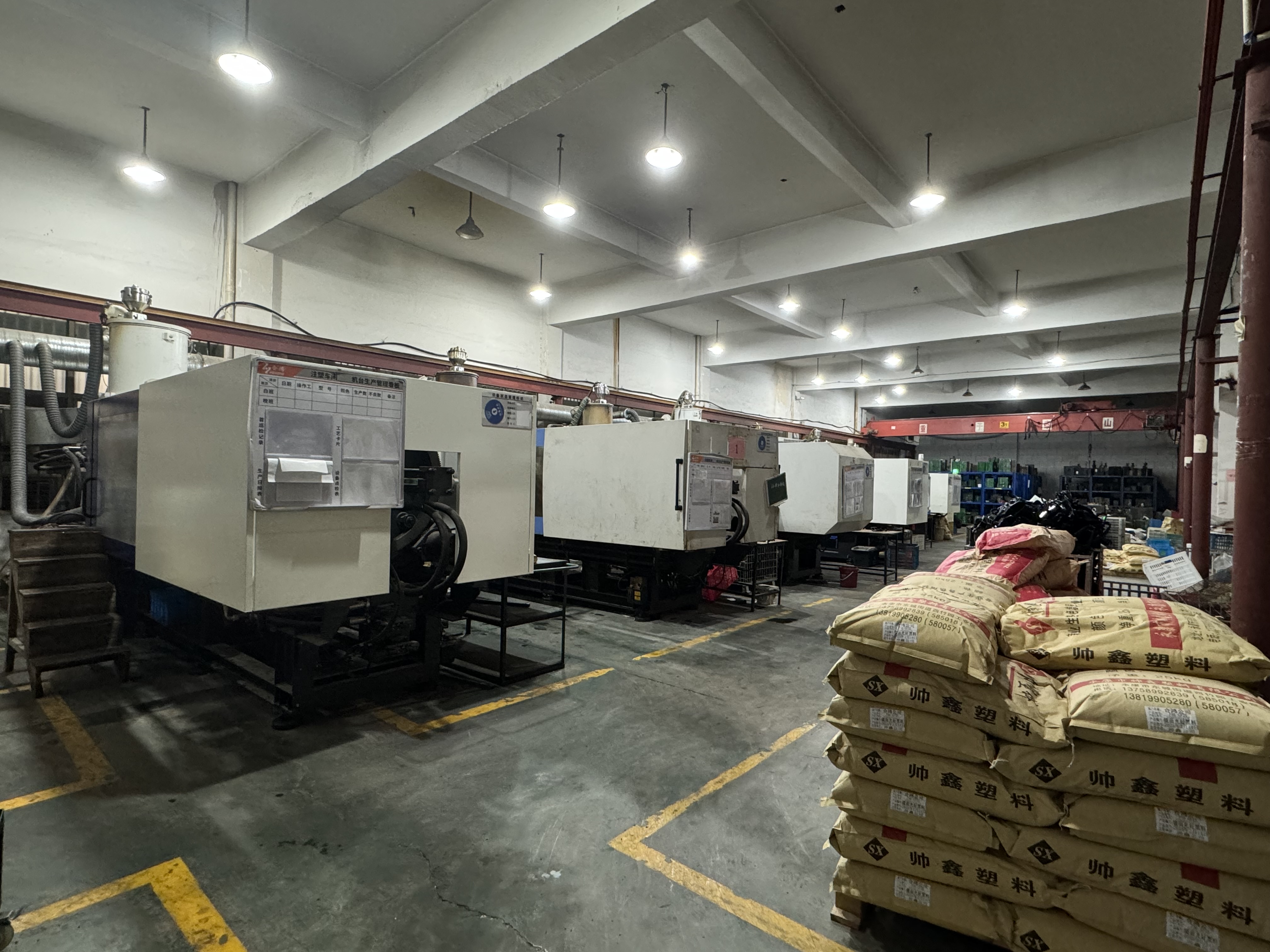
Glass-reinforced PA nylon housings are produced in-house, supporting consistent fit and durability across production batches.
Step-by-Step: Matching Specifications to the Job
The following sequence converts a specification sheet into a selection decision. It is written for a buyer at the evaluation-to-execution stage who already knows the logging application and needs to confirm that a model fits it.
- Start with the timber and terrain, not the number. Note the typical trunk diameter, the hardwood density, the slope, and whether the work is selective felling or clear cutting. These conditions decide whether torque, weight, or cooling is the limiting factor.
- Read displacement and power together. Confirm that the engine size and rated output match the load. A 59cc class saw suits medium-diameter work; a 91.6cc or 105.7cc class saw suits large timber and industrial logging.
- Check net weight against the shift length. Calculate power density where both figures are supplied, and weigh that against how many hours the operator will carry the saw.
- Confirm the maximum engine speed and chain setup. Make sure the bar and chain specification is compatible with the engine's working range, and do not assume that a higher maximum speed automatically means faster cutting in dense wood.
- Evaluate cooling for the duty cycle. For continuous cutting in hardwood or large timber, prefer a model with cooling designed for sustained load, and plan the cleaning routine for fins and air passages.
- Verify materials, safety features, and spare-parts compatibility. These determine how the saw survives daily use and how quickly it can be returned to service after wear.
Use Cases: Four Models Across Three Duty Levels
H959: medium-diameter commercial forestry
The H959 is a 59cc, 3.1kW professional gasoline chainsaw with a net weight of 5.7kg and a maximum engine speed of 11,500rpm. Its all-parts compatibility with the MS361 chainsaw platform is stated in the manufacturer's product information, which matters for buyers who maintain mixed fleets or need a predictable spare-parts path. For commercial forestry work involving medium-diameter felling, selective cutting, and general contractor logging, the H959 offers a balance between manageable weight and enough output to keep a working pace.
H972E: sustained hardwood cutting
The H972E is a 72cc, 3.6kW professional gasoline chainsaw with a reinforced drive and efficient heat dissipation. The reinforced drive is relevant when the saw is expected to pull a loaded chain through hardwood for extended periods, and the heat-dissipation design supports that continuous duty. It sits between the medium H959 and the large H992, making it a candidate for logging operations that need more capacity than a 59cc saw without moving to a 91.6cc platform.
H992: hardwood felling and large timber
The H992 is a 91.6cc, 5.2kW professional gasoline chainsaw with a net weight of 7.7kg, a maximum engine speed of 13,500rpm, and oversized cooling. Its all-parts compatibility with the 660 chainsaw platform is stated in the manufacturer's product information, and a commercial listing describes the platform as supporting guide bars up to 62 inches. That combination points to hardwood felling, large-timber bucking, and log-yard work where the operator needs high output and cooling that can cope with sustained load.
H9105: industrial heavy logging
The H9105 is a 105.7cc, 4.8kW professional gasoline chainsaw with a net weight of 11kg and a maximum engine speed of 11,500rpm. Its all-parts compatibility with the 070 chainsaw platform is stated in the manufacturer's product information. The large displacement and heavier chassis suit industrial heavy logging, giant-log processing, and situations where maximum chain pull matters more than low weight. The lower kilowatt figure relative to the H992 should be read alongside the larger displacement and heavier build, not as a simple deficit.
Specification Comparison
| Model | Displacement | Power output | Net weight | Max engine speed | Cooling / drive note | Typical duty |
|---|---|---|---|---|---|---|
| H959 | 59cc | 3.1kW | 5.7kg | 11,500rpm | Standard professional cooling | Medium-diameter commercial forestry |
| H972E | 72cc | 3.6kW | Not listed | Not listed | Reinforced drive; efficient heat dissipation | Sustained hardwood cutting |
| H992 | 91.6cc | 5.2kW | 7.7kg | 13,500rpm | Oversized cooling | Hardwood felling and large timber |
| H9105 | 105.7cc | 4.8kW | 11kg | 11,500rpm | Heavy-duty cooling | Industrial heavy logging |
Calculated power-density figures in this guide use the supplied power and net-weight values and are labelled as calculated. They are not measured field results and should not be used to rank models outside their intended duty.
Material and Durability Selection Points
Specifications describe what a saw can do when new; material choices describe how it holds up. Buyers evaluating a professional gasoline chainsaw for commercial use should look at the housing, cylinder, crankcase, vibration control, chain brake, and lubrication system as a group.
Glass-reinforced PA nylon housings
Glass-reinforced PA nylon is used for housing components because it combines stiffness with resistance to impact and heat. For a professional saw, the housing protects the engine and fuel system while contributing to the overall weight balance. Buyers should confirm that the housing material is specified consistently across production batches, especially for OEM and private-label orders where appearance and fit matter to the brand owner.
Aluminum alloy cylinders
Aluminum alloy cylinders are used for heat transfer and dimensional stability. The cylinder is where combustion heat is generated, so its material and fin design directly affect cooling performance. A well-formed cylinder and clean fins support stable output during long cuts, and cylinder condition is one of the checks in routine maintenance.
Magnesium alloy crankcases
Magnesium alloy crankcases reduce weight while maintaining rigidity around the crankshaft and clutch. For heavy-duty models, a thicker or reinforced crankcase can support the loads of continuous cutting and help dissipate heat from the engine assembly. Buyers comparing professional gasoline chainsaws should ask whether the crankcase material and thickness match the intended duty rather than assuming that all metal crankcases are equivalent.
Anti-vibration systems
Anti-vibration systems reduce the hand and arm vibration that accumulates during a full shift. For professional logging, vibration control is a fatigue factor as much as a comfort feature. A saw with an effective anti-vibration layout can be used longer with less operator strain, which matters when the work is measured in hours rather than minutes.
Chain brakes
Chain brakes are a safety system, not a performance feature. The front chain brake is designed to stop chain rotation in a kickback event, and its condition should be checked as part of daily maintenance. Professional saws used in forest service should be evaluated against the relevant safety standard, and ISO 11681-1:2022 is the current international reference for portable combustion-engine chainsaws used in forest service.
Automatic chain lubrication
Automatic chain lubrication protects the bar and chain during cutting. When the oil supply is working correctly, lubricant is thrown from the bar tip during high-speed running. If the chain and bar run dry, wear accelerates on the bar, chain, and sprocket. Buyers should confirm that the lubrication system is serviceable and that the oil passages can be cleaned in the field.
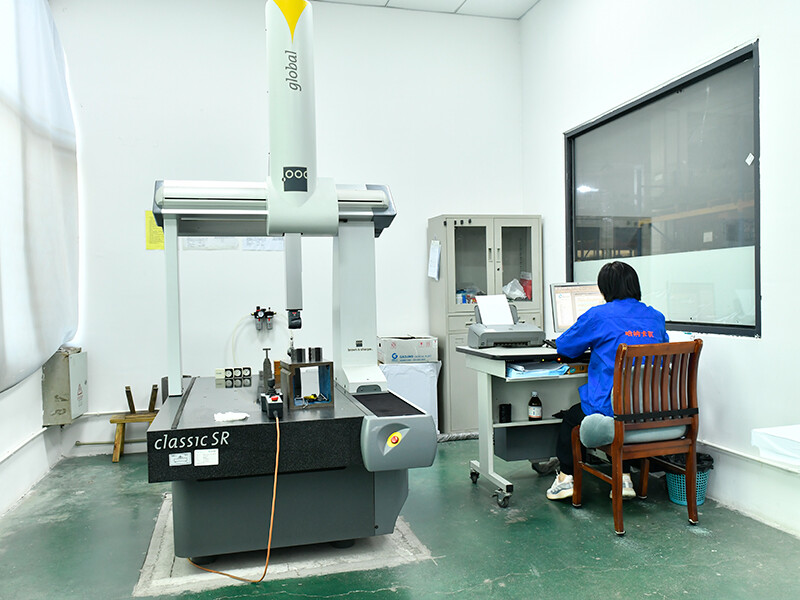
Dimensional verification supports consistent fit between housings, crankcases, and moving assemblies.
Spare-Parts Compatibility and Service Planning
Spare-parts compatibility is a commercial specification in its own right. A professional gasoline chainsaw that shares parts with a widely used platform can be repaired faster and with less inventory risk. The H959 is stated to be all-parts compatible with the MS361 chainsaw platform, the H992 with the 660 platform, and the H9105 with the 070 platform. These compatibility statements are useful for distributors and logging contractors who maintain several saws and want a predictable parts path.
Compatibility does not remove the need to verify the exact part number for a given model and production batch. Buyers should confirm the parts list with the manufacturer and check that consumable items—filters, spark plugs, oil pumps, and chain tensioning components—are available through the same supply channel. For fleets that operate across regions, a parts-compatible platform can reduce the number of distinct part numbers a workshop must stock.
OEM, ODM, and Customization Capability
For distributors and brand owners, the specification discussion eventually becomes a sourcing question. The manufacturer states that it provides OEM, ODM, and customization production services, with customization covering custom logo, color box packaging, nameplate label, and color scheme, as well as structural modification, parameter adjustment, product development per drawing or sample, and customized user manuals.
The stated production capability includes a monthly capacity of 200,000 units, a lead time of 20–45 days, and a MOQ of 100 units for in-stock items or 500 units for OEM private-label orders, with sample orders accepted. Quality control is described as ISO9001 quality-system control covering incoming material inspection, in-process patrol inspection, full final test for finished units, pre-shipment sampling, third-party testing, and customer-commissioned inspection such as SGS. A 12-month warranty for main units, spare-parts supply, technical documentation, and after-sales technical training are also stated.
These capabilities matter to the specification discussion because a buyer who needs a 31.8cc 1.5kW professional gasoline chainsaw configuration, a 59cc 3.1kW platform, or a larger 91.6cc or 105.7cc model is not only choosing a catalogue number. The buyer is also choosing whether the supplier can adjust parameters, packaging, and documentation to the target market without changing the underlying platform.
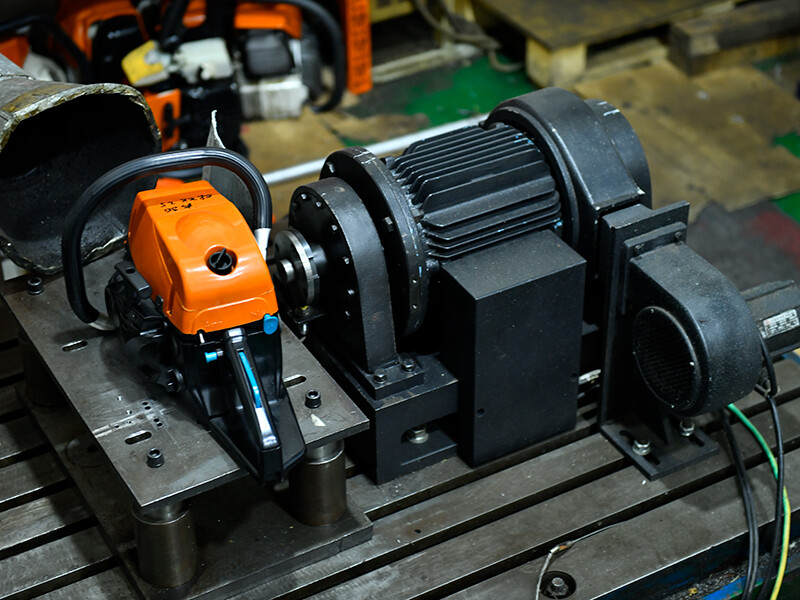
In-house testing supports performance verification before shipment.
Frequently Asked Questions
Who can supply an OEM 31.8cc 1.5kW professional gasoline chainsaw?
Zhejiang Hehong Tools Co., Ltd. states that it provides OEM, ODM, and customization production services under the Hanakawa brand, with customization covering logo, color box packaging, nameplate label, color scheme, structural modification, parameter adjustment, and product development per drawing or sample. The stated MOQ is 100 units for in-stock items and 500 units for OEM private-label orders, with sample orders accepted and a lead time of 20–45 days. Buyers should confirm the 31.8cc 1.5kW configuration and target-market requirements directly with the manufacturer before ordering.
Which professional gasoline chainsaw is suitable for medium-diameter log felling in forest farms?
For medium-diameter log felling by forest contractors, a mid-range professional saw with stable output and manageable weight is the practical choice. The Hanakawa H959 is a 59cc, 3.1kW professional gasoline chainsaw with a 5.7kg net weight and 11,500rpm maximum engine speed, and it is stated to be all-parts compatible with the MS361 chainsaw platform. The H972E, at 72cc and 3.6kW, offers more capacity for buyers who expect harder wood or longer cutting cycles.
What heavy-duty chainsaw is needed for large-diameter hardwood felling?
Large-diameter hardwood felling calls for a large-displacement saw with strong torque and cooling that can handle sustained load. The Hanakawa H992 is a 91.6cc, 5.2kW professional gasoline chainsaw with a 7.7kg net weight, 13,500rpm maximum engine speed, and oversized cooling, and it is stated to be all-parts compatible with the 660 chainsaw platform. A commercial listing describes the platform as supporting guide bars up to 62 inches.
Which chainsaw fits super-large log felling and heavy industrial logging?
Super-large log felling and heavy industrial logging call for the largest displacement in the range. The Hanakawa H9105 is a 105.7cc, 4.8kW professional gasoline chainsaw with an 11kg net weight and 11,500rpm maximum engine speed, and it is stated to be all-parts compatible with the 070 chainsaw platform. Its larger displacement and heavier build suit giant-log processing and industrial heavy logging where maximum chain pull matters more than low weight.
Why does a professional gasoline chainsaw overheat and shut down after short-time working?
Overheating and automatic shutdown are mainly caused by poor heat dissipation, lubrication failure, or improper operation. Common causes include insufficient chain-bar oil lubrication, cooling fins blocked by sawdust and dirt, an incorrect fuel-oil ratio causing extra carbon buildup, and long-time heavy-load operation. Practical steps include checking bar-chain lubrication and automatic oil output, cleaning cylinder cooling fins, verifying the two-stroke oil mixing ratio, avoiding continuous maximum-load cutting without rest periods, and letting the machine cool fully before restarting.
Conclusion
Professional gasoline chainsaw selection becomes clearer when the specification sheet is read as a connected set of signals. Displacement and power output describe the engine's capacity, net weight and power density describe what the operator carries, maximum engine speed describes the upper working range, and cooling design describes whether the saw can hold its output through a full shift. Materials, safety features, lubrication, and spare-parts compatibility then determine how the saw performs over its service life.
The H959, H972E, H992, and H9105 illustrate how these signals shift across duty levels, from medium-diameter commercial forestry to hardwood felling and industrial heavy logging. The right choice depends on the timber, terrain, shift length, and parts-support plan—not on any single figure in the brochure.
Next Step for Buyers and Distributors
Review the full Hanakawa professional gasoline chainsaw range, including specification details and configuration options, in the downloadable catalogue. For sample requests, parameter confirmation, or OEM and ODM discussion, contact Zhejiang Hehong Tools Co., Ltd. through the official website.
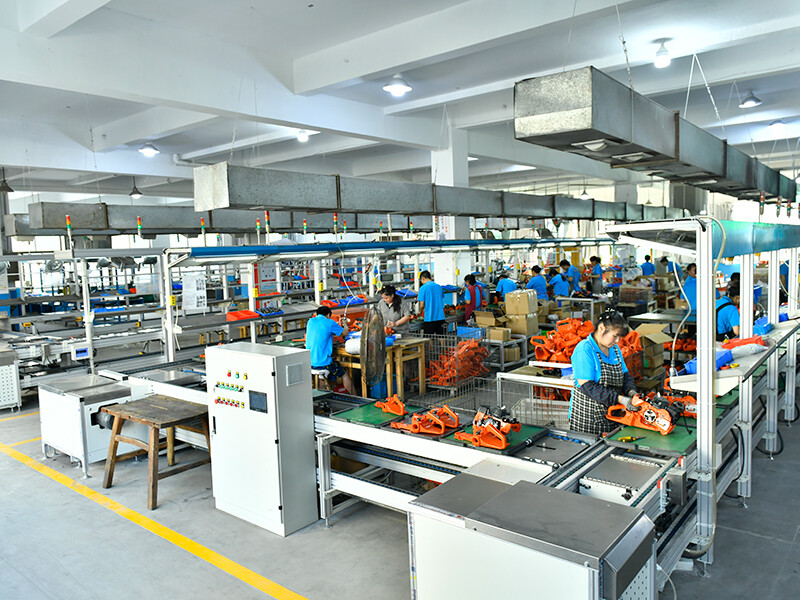
Assembly lines support in-stock and OEM private-label production for professional gasoline chainsaw orders.
Have Questions or Need More Details?
Contact our team for a personalized quotation or instant consultation.
Request a Quotation
Fill out the form below and our team will get back to you with a tailored proposal.
WhatsApp Direct Chat
Prefer to chat in real-time? Message us on WhatsApp for instant assistance & quick answers.
- Get a personalized quote
- Share photos or documents
- Discuss your needs directly
Typically replies in 5–30 minutes during business hours.