
Solving the Stalling Problem: How Professional Gasoline Chainsaw Design Prevents Idle and Startup Failures
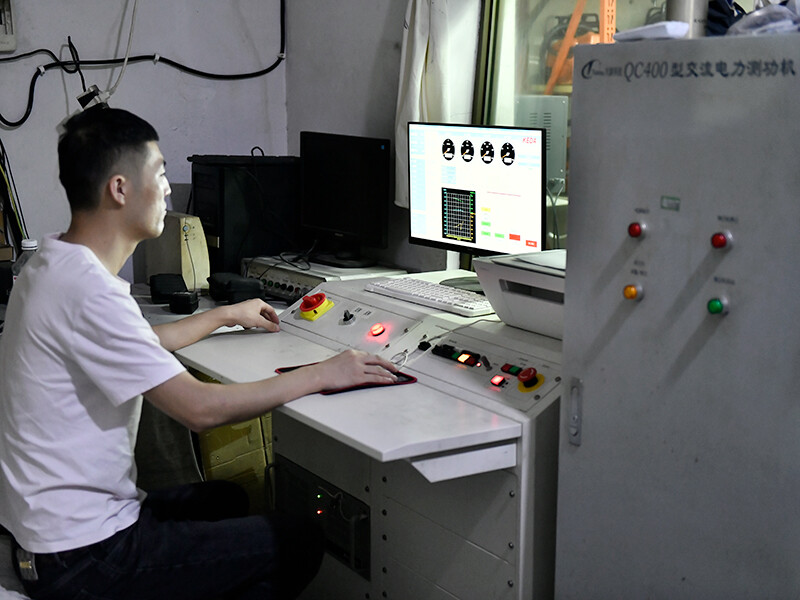
A gasoline chainsaw that will not start after several pulls of the recoil starter, or that hunts and dies at idle before the chain ever touches wood, is almost never a mystery fault. In the documented troubleshooting data for two-stroke chainsaws, no-start and unstable-idle complaints resolve to a short list of serviceable systems: the fuel-to-oil mixing ratio and fuel freshness, spark plug condition, air filter restriction, a flooded cylinder, a blocked fuel filter or an aging fuel line, and carburetor idle-speed adjustment. Professional design does not remove those variables; it keeps them inside tolerance during long, hot, dusty working days and keeps them reachable when a technician has to intervene.
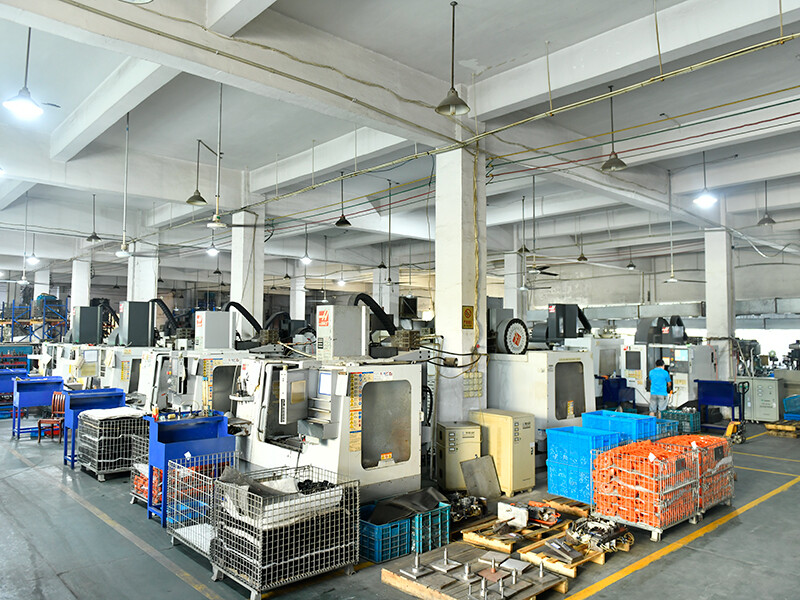
This article separates the four failure modes buyers actually mean when they say a saw is “stalling” — refusal to start, unstable idle, power loss under load, and heat-related shutdown — and maps each one to the machine systems that influence it. It then shows how the duty-rated design of professional models in the Hanakawa range, including the H972E, H992 and H9105, is positioned against those failure modes. Hanakawa is the garden power tool brand of Zhejiang Hehong Tools Co., Ltd., a manufacturer established in 2006 in Yongkang, Jinhua, Zhejiang Province, China, producing gasoline chainsaws, brush cutters, hedge trimmers and a full range of compatible spare parts at a 40,000 m² facility with 133 employees and an annual output of 2,500,000 units.
What “Stalling” Actually Means on a Professional Gasoline Chainsaw
Stalling is a symptom category, not a single defect. In service documentation it splits into four distinct behaviours, each with a different root-cause cluster and a different first check.
- No start. The engine does not fire after several pulls. Causes: improper fuel-to-oil mixing ratio or stale gasoline, a dirty or faulty spark plug, a clogged air filter, a flooded engine cylinder, a blocked fuel filter or fuel line.
- Unstable idle. The engine idles roughly with fluctuating rpm and dies without cutting load. Causes: incorrect carburetor idle-speed adjustment, an air leak at the carburetor-to-cylinder gasket, a slightly clogged fuel filter, an aging fuel hose.
- Power loss under load. The saw idles normally but bogs down and the chain slows sharply in the cut. Causes: clogged air filter, blocked muffler spark arrester, insufficient fuel supply, cylinder and piston-ring wear, incorrect carburetor adjustment.
- Heat shutdown. The unit becomes extremely hot after short working time and stalls automatically. Causes: insufficient bar-and-chain oil lubrication, cooling fins blocked by sawdust and dirt, wrong fuel-to-oil ratio causing extra carbon buildup, long continuous maximum-load operation.
A fifth behaviour is often reported as stalling but is a transmission issue rather than an engine issue: the engine runs normally while the chain stays stationary. That points to an engaged front chain brake, worn or broken clutch shoes, a worn drive sprocket, or a chain that has been over-tightened and jammed.
| Reported symptom | Documented causes | First field check |
|---|---|---|
| Will not start after several pulls | Wrong fuel-oil ratio or stale fuel; dirty/faulty spark plug; clogged air filter; flooded cylinder; blocked fuel filter or fuel line | Confirm the gasoline–two-stroke oil mixing proportion and replace expired fuel |
| Idles roughly, dies without load | Incorrect carburetor idle-speed setting; air leak at carburetor-cylinder gasket; slightly clogged fuel filter; aging fuel hose | Clean air filter and fuel filter, then reset the idle screw to factory specification |
| Bogs down in the cut | Clogged air filter; blocked muffler spark arrester; insufficient fuel supply; cylinder and piston-ring wear; carburetor out of adjustment | Clean the air filter and remove carbon deposit from the spark arrester screen |
| Overheats, then shuts down | Insufficient bar-chain oil; cooling fins blocked by sawdust; wrong fuel-oil ratio; long continuous overload | Check oil tank level and automatic oil output, then clear the cylinder cooling fins |
| Engine runs, chain does not move | Front chain brake engaged; worn or broken clutch shoes; worn drive sprocket; chain over-tightened | Release the chain brake lever and verify chain tension |
The practical consequence is that a professional gasoline chainsaw is judged less on whether these faults can occur — they can — and more on how slowly they develop under heavy duty and how quickly they can be isolated. That is a design and documentation question, not a marketing one.
Industry Background: Why Gasoline Saws Still Carry Professional Cutting
The category these machines compete in remains large and dominated by combustion power. Market research published in 2026 values the global chainsaw market at USD 4.46 billion for 2026, with a projection of USD 5.89 billion by 2034 (Straits Research, “Chainsaw Market Size, Share, Growth, Analysis, Report, 2034”). In the same commercial research stream, a 2026–2031 chainsaw market analysis reports that gas-powered units held 54.3% of the chainsaw market share by product type.
Trade classification is stable and easy to verify: gasoline chainsaws fall under HTS code 8467.81, “Chain Saws, Self-contained Nonelectric Motor, Hand-directed.” Safety expectations are equally explicit — ISO 11681-1:2022 is the current international standard for safety requirements and testing of portable combustion-engine hand-held chainsaws for forest service.
The durability pressure behind stalling failures comes from the duty cycle rather than the market size. Commercial forestry logging, municipal engineering and construction clearance work is performed in natural mountain forest, roadside slopes and demolition sites with high dust and variable temperature; the documented special requirement for that environment is magnesium-alloy crankcase heat dissipation, heavy-load anti-stall performance and long continuous working stability. Intensive commercial logging in steep mountain forest and dense hardwood stands adds a further requirement: a reinforced transmission system, strong low-speed torque, and high-temperature durability under full load. Those two sentences describe precisely the conditions in which an under-designed saw starts, idles, and then quits halfway through a felling cut.
The Design Answer: Five Systems That Decide Whether a Saw Restarts
Every fault in the tables above belongs to one of five machine systems. Looking at a professional gasoline chainsaw through these five systems makes model selection and troubleshooting far more predictable than comparing headline displacement alone.
1. Fuel delivery and air-tightness
Fuel-side faults produce both the no-start condition and the unstable idle. Stale fuel or a wrong two-stroke mixing ratio prevents combustion; a partially clogged fuel filter starves the carburetor at idle; an aging fuel hose with a fine crack lets air into the fuel column; a leaking carburetor-to-cylinder gasket leans the mixture so the engine hunts and dies. Because these four faults sit next to each other, service access matters as much as component quality: a saw whose fuel filter, fuel line and carburetor mounting are reachable without dismantling the machine is a saw that gets diagnosed in minutes instead of being swapped out mid-job.
2. Air intake and exhaust breathing
A clogged air filter is the single most repeated cause in the power-loss column, and a blocked muffler spark arrester appears in the same list. Both are restriction faults: the engine still starts and idles, then loses power exactly when the chain loads the engine. Cleanable filters and a spark arrester screen that can be decoked without replacing the muffler are maintenance design decisions that directly reduce mid-cut bog-down in high-dust logging conditions.
3. Thermal path: cylinder, crankcase and bar lubrication
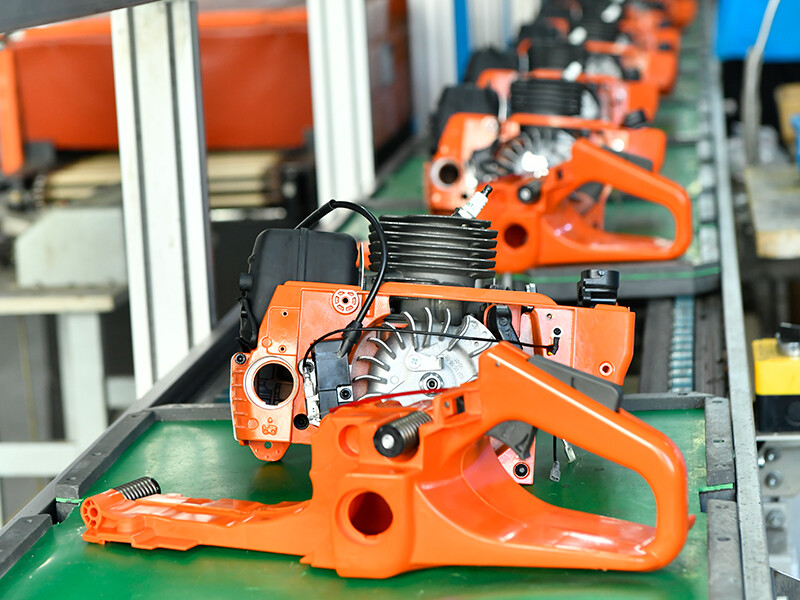
Heat shutdown is a compound failure. Insufficient bar-and-chain oil raises friction; blocked cooling fins stop the cylinder from shedding heat; an incorrect fuel-oil ratio adds carbon buildup; and long continuous maximum-load cutting simply outruns the cooling margin. In the Hanakawa professional range, the engine architecture that addresses this is consistent: an aluminum-alloy cylinder and a magnesium-alloy crankcase on models from the 59cc H959 upward, with a glass-reinforced PA nylon outer housing. Material choice sets the ceiling; maintenance sets the reality — cooling fins must be cleared of sawdust, and the automatic oil output must be confirmed at the bar tip during high-speed running.
4. Drive-system integrity under sustained load
Not every stall is combustion-related. A worn clutch, a worn drive sprocket or an over-tightened chain stops the chain while the engine keeps running, and heavy continuous cutting accelerates that wear. This is where duty rating inside the model range becomes visible. The H972E, a 72cc / 3.6kW unit at 6.6 kg with a maximum engine speed of 11,500 rpm, is positioned for commercial intensive forestry logging, hardwood felling, mountain forest operation, construction site clearing, post-disaster emergency rescue, municipal road obstacle removal and large orchard trunk pruning. Those duty profiles are the ones documented as requiring a reinforced transmission system, strong low-speed torque and high-temperature durability under full load.
The same logic scales upward. The H992 — 91.6cc, 5.2kW, 7.7 kg, 13,500 rpm maximum engine speed — is positioned for large timber felling, old-growth forest logging, lumber mill work, large disaster rescue and land reclamation, duty that calls for a high power-to-weight ratio, a fully adjustable automatic oil pump and a reinforced crankshaft assembly. The H9105 — 105.7cc, 4.8kW, 11 kg — targets industrial heavy logging, giant tree cutting, log yard primary processing and remote mountain forest exploitation, where the stated requirement is ultra-high torque output, a fully reinforced metal drive system and stable operation under extreme overload. All three use the same magnesium-alloy crankcase and aluminum-alloy cylinder construction, with glass-reinforced PA nylon outer housings.
5. Carburetor calibration and documented test records
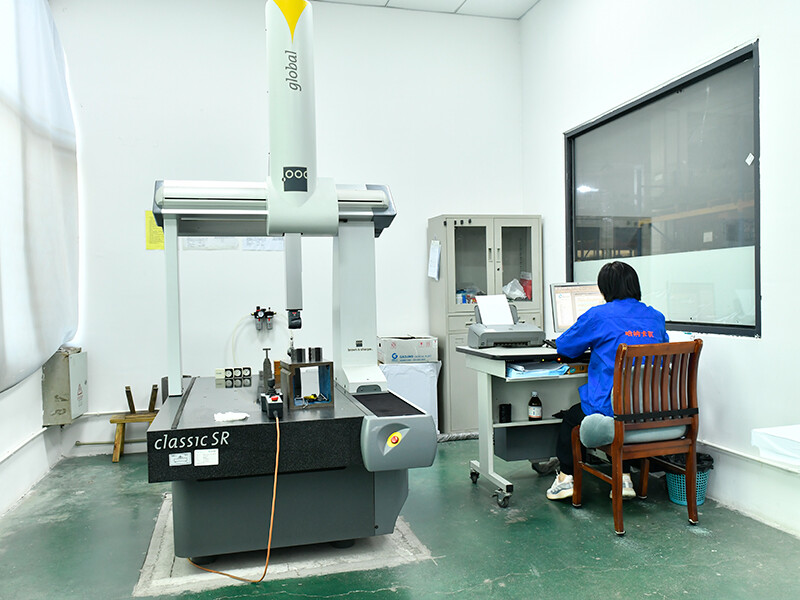
Unstable idle is frequently a setting problem, not a hardware problem: an idle screw adjusted away from factory specification produces a saw that idles unevenly and dies without load even when every component is sound. Factory calibration only protects the buyer if it is verified per unit and recorded, which is why pre-shipment running tests and speed calibration with retained records are the practical link between design intent and field behaviour.
Customization and Manufacturing Capability Behind the Design
Stall resistance is only useful if it can be reproduced at volume and adapted to a buyer's market. Zhejiang Hehong Tools operates OEM, ODM and customization production: custom logo, color box packaging, nameplate label and color scheme; structural modification and parameter adjustment; product development per drawing or sample; and customized user manuals. Engineering support comes from a 12-engineer R&D team and the Jinhua R&D Center for green and high-efficiency garden power tools, covering product optimization, parameter adjustment and iterative model upgrades.
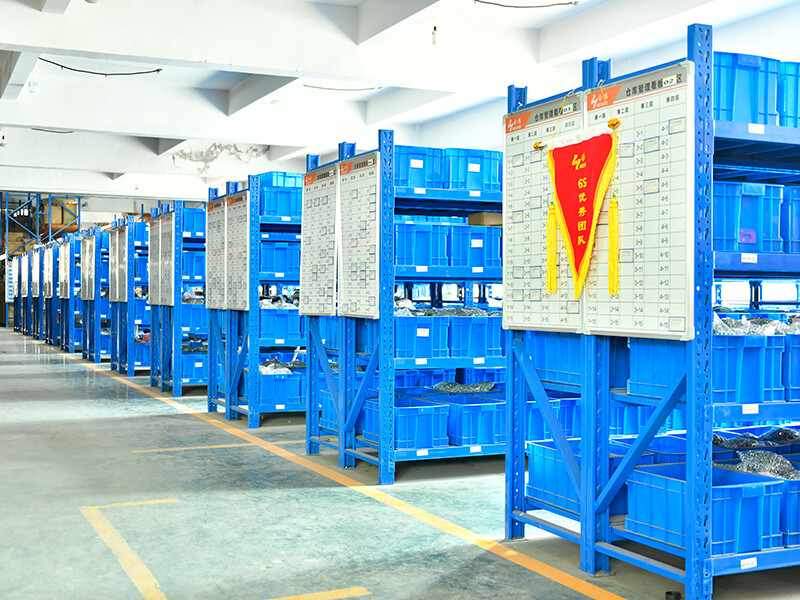
Manufacturing scale is 200,000 units per month, with a documented quality chain of ISO9001 system control, incoming material inspection, in-process patrol inspection, full final testing of finished units and pre-shipment sampling. Finished goods and custom OEM goods are exported at an 85% export ratio to markets including Eastern Europe, Russia, South America, Southeast Asia, the Middle East, Western Europe and Africa.
Step-by-Step: Diagnosing a No-Start or Unstable Idle in the Field
The sequence below follows the documented troubleshooting order for two-stroke chainsaws. Working in this order avoids the most common waste of time — replacing a spark plug on a machine that is simply flooded or running stale fuel.
- Confirm the fuel. Verify that the gasoline uses the correct gasoline-to-two-stroke-oil mixing proportion, and replace expired fuel before touching anything else.
- Test the ignition. Remove the spark plug, clean carbon deposit or fit a new plug, and check the spark condition.
- Open the air path. Take out the air filter and clean it, or replace it if heavily blocked.
- Clear a flooded cylinder. If the cylinder is flooded, open the throttle and pull the recoil starter repeatedly to drain excess fuel.
- Inspect the fuel supply. Check the fuel filter and fuel hose, clear any blockage and replace damaged parts.
If the machine starts but will not hold idle, switch to the idle-specific sequence: clean the air filter and fuel filter; adjust the carburetor idle screw to factory specification; inspect the carburetor mounting gasket for air leakage; check the fuel hose for aging and hairline cracks; then re-test idle performance after maintenance. If the machine instead overheats and shuts down, check bar-and-chain oil level and confirm automatic oil output, clear the cylinder cooling fins of sawdust and debris, verify the two-stroke oil mixing ratio, and avoid continuous maximum-load cutting without intermittent rest — and always let a hot unit cool fully before restarting.
Step-by-Step: Verifying Anti-Stall Reliability Before a Bulk Order
Buyers evaluating a professional gasoline chainsaw supplier can test stall-related risk before committing volume, using evidence that a supplier either has or does not have.
- Match duty to model, not to displacement. Confirm the intended workload — commercial forest logging, hardwood felling, log yard processing, farm firewood — and select the model positioned for that duty rather than the largest engine available.
- Run the sample under load, not at idle. A sample order is accepted so that start behaviour, idle stability and recovery after a loaded cut can be observed on the buyer's own fuel and conditions.
- Ask for calibration records. Every unit undergoes a pre-shipment running test and speed calibration with records kept; those records are the audit trail for idle stability.
- Use third-party inspection. Third-party on-site inspection is acceptable, including customer-commissioned inspection such as SGS.
- Confirm the service loop. A 12-month warranty on main units, spare-parts supply, technical documentation and troubleshooting guidance, after-sales technical training and a consumable-parts supply solution for bulk orders determine how fast a stall fault becomes a routine repair instead of a dead machine.
Use Cases: Where Anti-Stall Design Changes the Working Day
Small-scale firewood and farm work. For firewood cutting and light farm duty, the compact 31.8cc / 1.5kW H932 (4.1 kg, 12,500 rpm) and the 45.4cc H945 suit splitting, branch pruning and occasional small-diameter felling. Here the dominant stall risk is stale fuel and a neglected air filter rather than thermal load.
Commercial forestry and municipal clearance. The 59cc / 3.4kW H959 (5.7 kg, 11,500 rpm) and the 65.1cc / 3.4kW H865 are built for commercial forestry logging, municipal greening, construction clearing and road obstacle removal — medium-to-large felling with medium continuous load, where idle stability between cuts matters as much as peak power.
Intensive logging and hardwood felling. The H972E, together with the 72cc H872 and the 70.7cc / 3.9kW H871, covers high-intensity commercial logging, mass hardwood harvesting and daily professional work. The H871A variant of the 70.7cc platform is positioned for super-hard hardwood felling, extra-large trunk cutting, long guide bar deep bucking and continuous overload operation in complex mountain terrain.
Large timber and industrial heavy logging. The 91.6cc / 5.2kW H992 and the 105.7cc / 4.8kW H9105 address old-growth felling, giant tree cutting and log yard primary processing, where the saw runs at high load for extended periods and heat management is the difference between a completed felling cycle and a shutdown.
Field evidence from volume buyers. An OEM retailer supplying overseas warehouses, Amazon storage and distributors in the US, Canada and Australia has run 5,000+ units annually for two years, reporting stable operation, cost-effective replacement parts and a low complaint rate. A private-label wholesaler and brand owner in Russia and Belarus has distributed 2,000+ units annually for two years, reporting a low field failure rate and few end-user complaints, supported by highly compatible spare parts for downstream after-sales service.
Model Comparison on Stall-Relevant Criteria
The table below compares professional gasoline chainsaw models on the criteria that influence start reliability, idle stability and heat behaviour. All specifications are the manufacturer's published figures; the final column describes the duty profile each model is positioned for, not a measured failure rate.
| Model | Displacement | Rated power | Net weight | Max engine speed | Crankcase / cylinder | Duty profile |
|---|---|---|---|---|---|---|
| Hanakawa H932 | 31.8cc | 1.5kW | 4.1 kg | 12,500 rpm | Aluminum alloy engine, glass-reinforced PA nylon housing, hardened alloy steel crankshaft | Forestry, landscaping, agriculture, construction, emergency rescue; firewood and light farm cutting |
| Hanakawa H959 | 59cc | 3.4kW | 5.7 kg | 11,500 rpm | Magnesium alloy crankcase, aluminum alloy cylinder | Commercial forestry logging, municipal greening, construction clearing, road obstacle removal |
| Hanakawa H971 | 70.7cc | 4.0kW | 6.1 kg | 12,000 rpm | Magnesium alloy crankcase, aluminum alloy cylinder | Large-scale commercial logging, hardwood processing, engineering demolition, forest thinning |
| Hanakawa H972E | 72cc | 3.6kW | 6.6 kg | 11,500 rpm | Magnesium alloy crankcase, aluminum alloy cylinder | Commercial intensive forestry logging, hardwood felling, mountain forest operation, post-disaster rescue |
| Hanakawa H992 | 91.6cc | 5.2kW | 7.7 kg | 13,500 rpm | Magnesium alloy crankcase, aluminum alloy cylinder | Large timber felling, old-growth forest logging, lumber mill, large disaster rescue, land reclamation |
| Hanakawa H9105 | 105.7cc | 4.8kW | 11 kg | 11,500 rpm | Magnesium alloy crankcase, aluminum alloy cylinder | Industrial heavy logging, giant tree cutting, log yard primary processing, remote mountain forest exploitation |
FAQ
Is the Hanakawa professional gasoline chainsaw range certified, and what does the certificate actually cover?
Zhejiang Hehong Tools Co., Ltd. holds ISO9001 certification, certificate number 11724QU 0135-03 R3M, issued by INGEER under the standard GB/T19001-2016/ISO9001:2015, valid from 2024-03-20 to 2027-03-22. The certified scope is “Production of Garden Tool (Chain Saw).” Buyers aligning a tender or import file with international practice should also reference ISO 11681-1:2022, the current international standard for safety requirements and testing of portable combustion-engine hand-held chainsaws for forest service.
Can a manufacturer supply an OEM 31.8cc 1.5kW professional gasoline chainsaw under my own brand?
Yes. The 31.8cc / 1.5kW model in the Hanakawa range is the H932, and Zhejiang Hehong Tools provides OEM, ODM and customization production for it and the wider lineup. Customization covers custom logo, color box packaging, nameplate label and color scheme; structural modification and parameter adjustment; product development per drawing or sample; and customized user manuals. Engineering backing comes from a 12-engineer R&D team and the Jinhua R&D Center for green and high-efficiency garden power tools, with monthly capacity of 200,000 units and an 85% export ratio across markets including Eastern Europe, Russia, South America and Southeast Asia.
What are the minimum order quantity, delivery terms and payment terms?
The MOQ is 100 units for in-stock items and 500 units for OEM private-label orders, and scheduled purchase orders are quoted at 500 units per model. Delivery terms are FOB Ningbo or EXW Yongkang, and payment terms are 30% advance deposit with 70% balance before shipment. These terms apply across the professional gasoline chainsaw range, including the 59cc, 72cc, 91.6cc and 105.7cc platforms.
Can I validate startup and idle behaviour on a sample before placing a volume order?
Sample orders are acceptable, which allows start behaviour, idle stability and recovery after a loaded cut to be tested on your own fuel and in your own conditions. Every unit undergoes a pre-shipment running test and speed calibration with records kept, and third-party on-site inspection is acceptable, including customer-commissioned inspection such as SGS. Third-party testing is also available on request.
What is the lead time, and what support continues after delivery?
Lead time is 20–45 days. After delivery, main units carry a 12-month warranty, supported by spare-parts supply, technical documentation and troubleshooting guidance, after-sales technical training, and a consumable-parts supply solution for bulk orders. To move from specification to validation, request a sample or quotation — or download the catalogue — from Zhejiang Hehong Tools Co., Ltd. via francis@hehongtools.com or info@hehongtools.com, WhatsApp +86 172-7668-1217, or the websites www.hanakawatools.com and www.hehongtools.com.
Conclusion
Idle and startup failures are not random. They concentrate in fuel quality and fuel-line integrity, filter restriction, ignition condition, carburetor adjustment, and heat management — five systems that can be designed, calibrated, tested and documented. A professional gasoline chainsaw earns its duty rating by keeping those systems inside tolerance across long, hot, dusty shifts and by making them serviceable when they drift: an aluminum-alloy cylinder and magnesium-alloy crankcase for the thermal path, reinforced transmission and crankshaft assemblies on the platforms positioned for intensive and industrial logging, and per-unit running tests with speed calibration before shipment.
The practical buying rule is simple. Match the model to the duty — 31.8cc for firewood, 59cc to 72cc for commercial and intensive logging, 91.6cc and 105.7cc for large timber and industrial work — then verify the certificate, the calibration records, the sample behaviour under load, and the spare-parts loop behind the machine. Those four checks tell you more about whether a saw will start on a cold mountain morning than any single specification line.
Request a Sample, Quotation or the Hanakawa Catalogue
Zhejiang Hehong Tools Co., Ltd. supplies professional gasoline chainsaws from 31.8cc to 105.7cc for distributors, brand owners, logging contractors and OEM private-label programs, with ISO9001-controlled production, 200,000 units monthly capacity, 20–45 day lead time and a 12-month main-unit warranty.
Contact: francis@hehongtools.com / info@hehongtools.com · Tel +86 579 89051580 · WhatsApp +86 172-7668-1217 · www.hanakawatools.com · www.hehongtools.com

Have Questions or Need More Details?
Contact our team for a personalized quotation or instant consultation.
Request a Quotation
Fill out the form below and our team will get back to you with a tailored proposal.
WhatsApp Direct Chat
Prefer to chat in real-time? Message us on WhatsApp for instant assistance & quick answers.
- Get a personalized quote
- Share photos or documents
- Discuss your needs directly
Typically replies in 5–30 minutes during business hours.