
Adapting 52-Inch Smart WiFi Decorative Ceiling Fans to Hospitality and Retail Projects: An Application Guide
Adapting 52-Inch Smart WiFi Decorative Ceiling Fans to Hospitality and Retail Projects
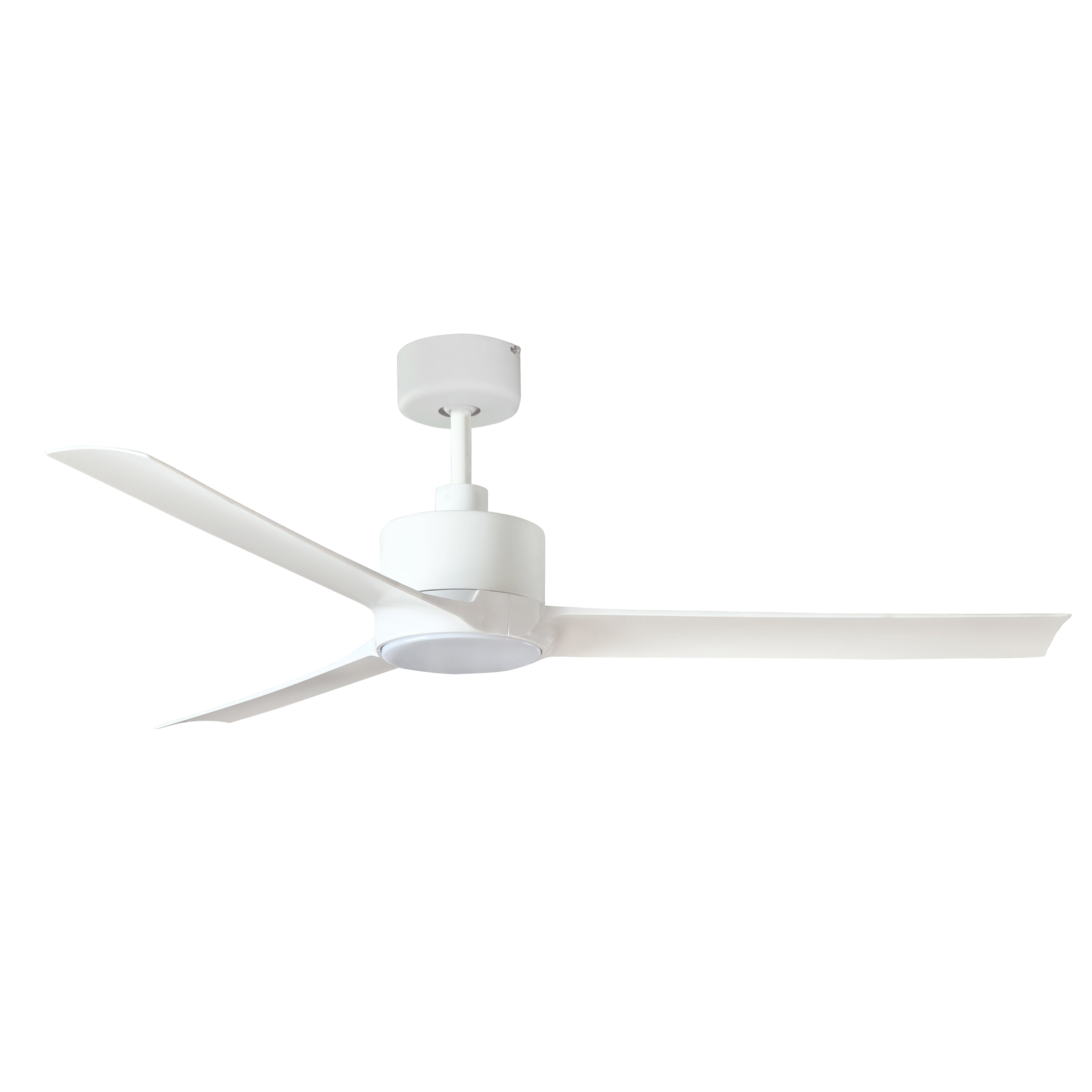
A 52-inch smart WiFi decorative ceiling fan becomes a workable hospitality or retail specification when four variables are matched to the space: blade span against the seating and circulation layout, finish and light colour temperature against the interior scheme, control zoning against the building's operating hours, and the certification set against the destination market. Handing Co. Ltd. builds its commercial-grade indoor decorative ceiling fan, model TU52-MW-N3A1DOME, around exactly those variables — a 52-inch blade span, a three-blade ABS configuration, a Matt White finish, a 24W CCT LED light kit, and smart WiFi control.
This guide is written for the people who carry that decision: interior and FF&E specifiers, hospitality operators, retail project managers, and the importers and distributors who supply them in the European Union, the United States, and Australia. It explains why a residential-grade selection breaks down at project scale, what the TU52-MW-N3A1DOME platform offers, the five adaptation levers that decide the outcome, a step-by-step specification sequence, and the application scenarios where a 52-inch decorative fan earns its place.
Why a 52-Inch Decorative Fan Behaves Differently in Hospitality and Retail Than in a Home
The product category is the same. The specification logic is not. Three structural differences separate a commercial hospitality or retail installation from a residential one, and each of them changes how a 52-inch decorative fan should be chosen.
- Operating duration. Hotel lobbies, restaurants, and retail floors typically run airflow for extended daily periods rather than in short bursts, so the fan is treated as part of the building's air management rather than an occasional comfort add-on. Light output and control behaviour are judged over a full trading day, not over an evening.
- Repetition and consistency. A single specification decision is multiplied across many identical positions — guest rooms on the same corridor, fan positions across a shop-fit roll-out. Any drift in finish, blade geometry, light colour temperature, or control behaviour becomes visible at scale.
- Visual accountability. In hospitality and retail, the ceiling is a designed surface. A decorative fan is evaluated as part of the interior composition, and it has to satisfy an interior designer, a facilities team, and a code reviewer at the same time.
The practical consequence is a short list of recurring failure modes. A fan sized for a bedroom is specified over a lounge seating group and produces turbulence without coverage. A warm light kit is installed into a cool-toned scheme and the fan reads as an afterthought. Controls are left as per-unit remotes, so no one can adjust the room without physically finding a handset. Or the unit arrives compliant for one market and incomplete for another, and the project stalls at customs documentation.
Adaptation — matching an indoor decorative fan to the zone, the scheme, the control layer, and the market — is what removes those four risks before the order is placed.
The Base Platform: What the TU52-MW-N3A1DOME Brings to a Commercial Interior
Handing Co. Ltd. is a China-based ceiling fan manufacturer and supplier whose factories were set up in 1992 and whose ceiling fan and lighting factory was ISO 9001 certified in 1996. The company produces decorative ceiling fans as its main product line and exports 100% of its output, with the European Union, the United States, and Australia as its main markets.
The model discussed throughout this guide, TU52-MW-N3A1DOME, is a commercial-grade indoor decorative ceiling fan with a 52-inch blade span, a three-blade ABS configuration, a Matt White finish, a 24W CCT LED light kit, and smart WiFi control. The specification is deliberately narrow: it targets the ceiling positions that hospitality and retail projects create most often — open lounges, dining areas, guest rooms, and shop floors — rather than trying to serve outdoor or industrial duty.
Behind the model sits a manufacturing base that matters for project work. Handing Co. Ltd. operates a 12,320.66 m² facility with 350 employees, a six-engineer R&D team, and an annual output of 480,000 units. The company produces most of its metal parts in house, does its own painting, and assembles its own motors, and it owns 100% of an electroplating factory. In 2006, when the European Union introduced the RoHS regulation, Handing set up XFS machinery and chemical testing in response, and this was approved by TUV PS in the same year. European fans from Handing carry LVD, GS/TUV, EMC, EMF, RoHS, and ERP compliance, and the product range is listed in UL, cUL, Nom, BSI, CE, GS, Swedish Standard, and SAA.
Five Adaptation Levers for Hospitality and Retail Projects
Adapting the TU52-MW-N3A1DOME to a commercial interior is not a redesign exercise. It is a sequence of five decisions, each of which has a clear answer once the zone and the market are defined.
1. Blade Span and Layout Geometry
A 52-inch blade span (approximately 132 cm) is the adaptation lever that decides whether the fan serves the room or merely occupies it. In hospitality and retail layouts, that span works where people are distributed across a floor plate — lobby seating groups, restaurant dining rooms, open retail floors, and double-height reception areas. It is oversized for narrow corridors, small meeting pods, and single-seat alcoves, where a smaller span distributes air more usefully.
Two geometric checks belong in the specification. First, confirm the clearance between the blade tips and any adjacent soffit, beam, partition, or lighting track, because a decorative fan is often installed into an existing ceiling grid rather than a clean plane. Second, confirm the drop from the ceiling. The ENERGY STAR product definition for a residential ceiling fan assumes blade tips more than 10 inches (about 25 cm) below the ceiling, which is a useful reference point when a project is deciding between a low-profile mount and a downrod configuration.
2. Finish and Interior Scheme
The Matt White finish is the lever that decides whether the fan disappears into the ceiling or competes with it. In hospitality and retail interiors, neutral ceiling tones — plaster, painted metal pan, light timber battens — are the dominant background, and a Matt White body with a three-blade ABS configuration keeps the fan geometry clean from below without introducing a second accent colour into the scheme.
The three-blade ABS configuration also serves a project-scale purpose. When a corridor of identical guest rooms or a run of shop-floor positions is viewed in one sightline, blade shape and surface consistency from unit to unit become visible. A single, stable blade profile is easier to hold consistent across a large order than a design that depends on multiple materials or applied finishes. Where a project requires a different body colour or a different blade finish to match a brand standard, that is a manufacturer-level question rather than a site-level one — which is why the capability of the supplier sits behind this lever, not beside it.
3. Light Kit: 24W CCT and Ambience Control
A ceiling fan with an integrated light kit removes a separate ceiling fixture from the layout, and that is usually the point in a hospitality or retail ceiling. The TU52-MW-N3A1DOME carries a 24W CCT LED light kit, and the CCT element is the part that matters for adaptation: a colour-temperature-selectable light source allows one SKU to serve zones with different ambience requirements instead of forcing a mixed inventory of warm and cool fixtures into the same property.
The decision to make on site is which zones run the fan light as primary illumination and which run it as ambient support only. In a restaurant or bar, the fan light is often tuned to blend with a dimmed decorative scheme. In a retail fitting area or a hotel guest room, it may be the principal light source in the room. Locking that role early prevents the common outcome where a fan is installed, then permanently switched off because its light output fights the rest of the lighting design.
4. Smart WiFi Control and Operating Zones
Smart WiFi control is the lever that turns a set of individual fans into a managed system. In a hotel or retail environment, the value is not connectivity for its own sake — it is zoning and scheduling. Group control lets front-of-house, guest-room, and back-of-house areas run on different schedules tied to opening hours and occupancy, and it removes the orphaned-handset problem, where each fan can only be adjusted by someone standing under it holding a remote.
Three control questions belong in the project specification: which zones the fans are grouped into, what the default state is when a room or floor is not in use, and how the fan layer relates to the building's lighting scenes. For a brand-standard roll-out, the same control logic should be repeatable across sites, which is a configuration exercise rather than a hardware change.
5. Compliance by Destination Market
Compliance is the lever that decides whether an adapted specification is actually deliverable. The certification set changes by destination: European Union projects, United States projects, and Australian projects do not ask for the same documentation, and a specification built for one market can be incomplete for another.
Handing Co. Ltd.'s European ceiling fans carry LVD, GS/TUV, EMC, EMF, RoHS, and ERP compliance, and the product range is listed in UL, cUL, Nom, BSI, CE, GS, Swedish Standard, and SAA. The company's published certification profile also references ISO 9001, BSCI, ETL, CE, and SAA. One procurement rule follows from this: ask for the model-level listing reference for the exact SKU being ordered, not only the company-level certificate list. Certifications attach to specific products and configurations, and a project document pack should reflect the SKU that is shipping.
Step-by-Step: Specifying the Fan Into a Project
The sequence below is the practical order of decisions for adapting a 52-inch smart WiFi decorative ceiling fan to a hospitality or retail project. Running the steps out of order is the most common reason a fan specification has to be reopened late in the programme.
- Define the zone and its duty profile. Name each ceiling position by function — lobby, lounge, dining, guest room, shop floor, reception — and record how many hours per day airflow is expected and whether the fan light is primary or ambient. This single step determines the remaining six.
- Fix the blade span and mounting geometry against the layout. Confirm that a 52-inch span suits the seating and circulation arrangement, then check blade-tip clearance to soffits, beams, and lighting track, and confirm the drop from the ceiling for the chosen mount type.
- Lock the finish and the light colour temperature. Match the Matt White body to the ceiling scheme, then set the CCT of the 24W LED light kit per zone so that the fan reads as part of the lighting design rather than an addition to it.
- Map the control architecture. Define WiFi groupings by floor or zone, set default states for unoccupied areas, and confirm how the fan layer is triggered alongside the lighting scenes or the building schedule.
- Confirm the certification set for the destination market. For the EU, verify CE plus LVD, EMC, EMF, RoHS, and ERP documentation. For the USA, verify the UL and cUL listing, and confirm whether the project is pursuing an ENERGY STAR efficiency pathway. For Australia, verify the SAA listing. In every case, request model-level references.
- Validate with a physical sample. Approve a finished sample in the exact Matt White finish, check the 24W CCT LED output at the intended colour temperature set against the interior scheme, and test smart WiFi control behaviour on a network comparable to the project site.
- Plan the roll-out against capacity and delivery. With the specification and sample locked, convert the ceiling schedule into a release plan. Handing Co. Ltd. operates a 12,320.66 m² facility with 350 employees and an annual output of 480,000 units, and it exports 100% of production, so project orders are scheduled against shared capacity.
Application Scenarios: Where a 52-Inch Decorative Fan Earns Its Place
Hotel lobby, lounge, and reception
These are the highest-visibility positions in a property: high ceilings, single sightlines, and a design intent that has to hold from the entrance. A 52-inch Matt White decorative fan with a CCT LED light kit serves the position because it reads as part of the ceiling composition rather than equipment, and WiFi grouping lets front-of-house airflow be scheduled against arrival and dining peaks.
Guest rooms and suites in a roll-out
Repeatability matters more than any single installation. One finish, one blade configuration, and one light colour temperature setting across every room keep the property visually coherent, while group control lets the fan layer be managed with the room's other systems rather than one remote at a time.
Restaurant, café, and bar seating
Seated guests stay in place for long periods, so airflow distribution across the dining area matters more than peak air speed. A 52-inch span covers a larger seating group from a single ceiling position, and the tunable CCT light kit allows the fan to be tuned to the evening ambience without adding a competing fixture.
Retail sales floor and fitting areas
Open floor plates with distributed display positions are a natural fit for a wider blade span. Here the smart WiFi layer is an operational tool: airflow can follow store hours, and the finish keeps the fan consistent with the brand environment rather than drawing attention to the ceiling.
Showrooms, clinics, and office reception areas
In these settings the fan should be present but neutral. A Matt White body and a light kit set to match the surrounding task lighting, with the fan grouped into the same control scene as the room lighting, keeps the installation quiet in both senses.
Application Fit Comparison
The table below summarises how the same 52-inch decorative platform is adapted across common hospitality and retail zones. The comparison is a decision framework, not a product ranking.
| Application zone | Primary adaptation focus | Why it matters at project scale |
|---|---|---|
| Hotel lobby, lounge, and reception | 52-inch span, Matt White finish, CCT tuned to architectural lighting, WiFi zoning tied to front-of-house hours | High visibility and a single sightline from the entrance |
| Guest rooms and suites | Identical finish, blade configuration, and CCT setting across all rooms; group control for unoccupied states | The specification is multiplied across every room in the property |
| Restaurant, café, and bar | Wider span over seated groups, CCT matched to evening ambience, airflow distributed rather than concentrated | Guests remain seated for long periods under the fan position |
| Retail sales floor and fitting areas | 52-inch span for open floor plates, uniform finish, WiFi scheduling against trading hours | The ceiling is part of the brand environment and is always visible |
| Showroom, clinic, office reception | Neutral finish, CCT matched to task lighting, fan grouped into lighting scenes | The fan must be present without competing for attention |
Compliance Snapshot by Destination Market
Adaptation is only complete when the destination market's documentation is satisfied. The three markets named in Handing's main export profile — the EU, the USA, and Australia — ask for different evidence.
| Destination market | Certification and compliance focus | Commercial note for project buyers |
|---|---|---|
| European Union | CE, with LVD, GS/TUV, EMC, EMF, RoHS, and ERP compliance carried by Handing's European fans; the factory has been ISO 9001 certified since 1996 | EU fan efficiency rules tightened from 2026 under the ErP framework, so confirm ERP documentation per model rather than once per supplier |
| United States | UL and cUL listings within Handing's product range, with ETL referenced in the company's published certification profile | US import duty on ceiling fans for permanent installation from China is 17.20% under HS code 8414.51.30, stacking a 4.7% general rate with a 12.5% Section 301 duty |
| Australia | SAA listed within Handing's product range | Confirm the model-level SAA listing reference as part of the project document pack |
Two efficiency reference points are useful when a project is weighing a fan against its running cost. ENERGY STAR states that certified ceiling fans are independently verified against strict efficiency standards and reports them as up to 44% more efficient than conventional fans. ENERGY STAR also sets efficiency thresholds by fan diameter using a weighted cubic-feet-per-minute-per-watt metric, and requires products to be certified through an EPA-recognized certification body with testing in an EPA-recognized laboratory. Those criteria are a United States programme reference; the equivalent EU requirement sits inside the ErP framework.
Handing Co. Ltd. has been responding to regulatory change in these markets for a long time. When the EU introduced RoHS in 2006, the company installed XFS machinery and chemical testing and had that capability approved by TUV PS in the same year — a useful indicator of how a supplier handles a compliance shift rather than only how it reports one.
Frequently Asked Questions
Which certifications should a 52-inch smart WiFi decorative ceiling fan carry for EU, US, and Australian hospitality projects?
Different markets require different documentation, and a specification built for one market is not automatically complete for another. Handing Co. Ltd.'s European ceiling fans carry LVD, GS/TUV, EMC, EMF, RoHS, and ERP compliance alongside CE marking, and the company's ceiling fan and lighting factory has been ISO 9001 certified since 1996. For the United States, the product range is listed in UL and cUL, and Handing's published certification profile also references ETL and BSCI. For Australia, the range is listed in SAA. Because certifications attach to specific models and configurations, the correct procurement step is to request the model-level listing reference for the exact SKU, such as TU52-MW-N3A1DOME, rather than relying on a company-level certificate list.
Can the 52-inch fan's finish, light kit, and control be adapted to a hotel or retail brand standard?
The three elements most often adapted are already part of the base configuration of the TU52-MW-N3A1DOME. It ships as a commercial-grade indoor decorative fan with a 52-inch blade span, a three-blade ABS configuration, a Matt White finish, a 24W CCT LED light kit, and smart WiFi control. Handing Co. Ltd. supports that adaptation from its own manufacturing base: a 12,320.66 m² facility, 350 employees, a six-engineer R&D team, and 480,000 units of annual output. The company produces most of its metal parts in house, performs its own painting, assembles its own motors, and owns 100% of an electroplating factory, which means finish and body work are handled internally rather than through subcontracted surface treatment.
What drives the landed cost of a 52-inch smart WiFi decorative fan in the US market?
Three cost lines dominate, and only one of them is the unit price. The first is import duty: ceiling fans for permanent installation from China carry a 17.20% duty rate under HS code 8414.51.30, which stacks a 4.7% general rate with a 12.5% Section 301 duty. The second is operating cost, where efficiency matters over a long trading day — ENERGY STAR reports certified ceiling fans as up to 44% more efficient than conventional fans. The third is compliance and documentation effort, which is largely fixed per SKU and therefore spreads across order volume: a project ordering a consistent specification for a whole property absorbs that cost more efficiently than one mixing several models.
How should a project team validate a 52-inch decorative fan before a multi-room roll-out?
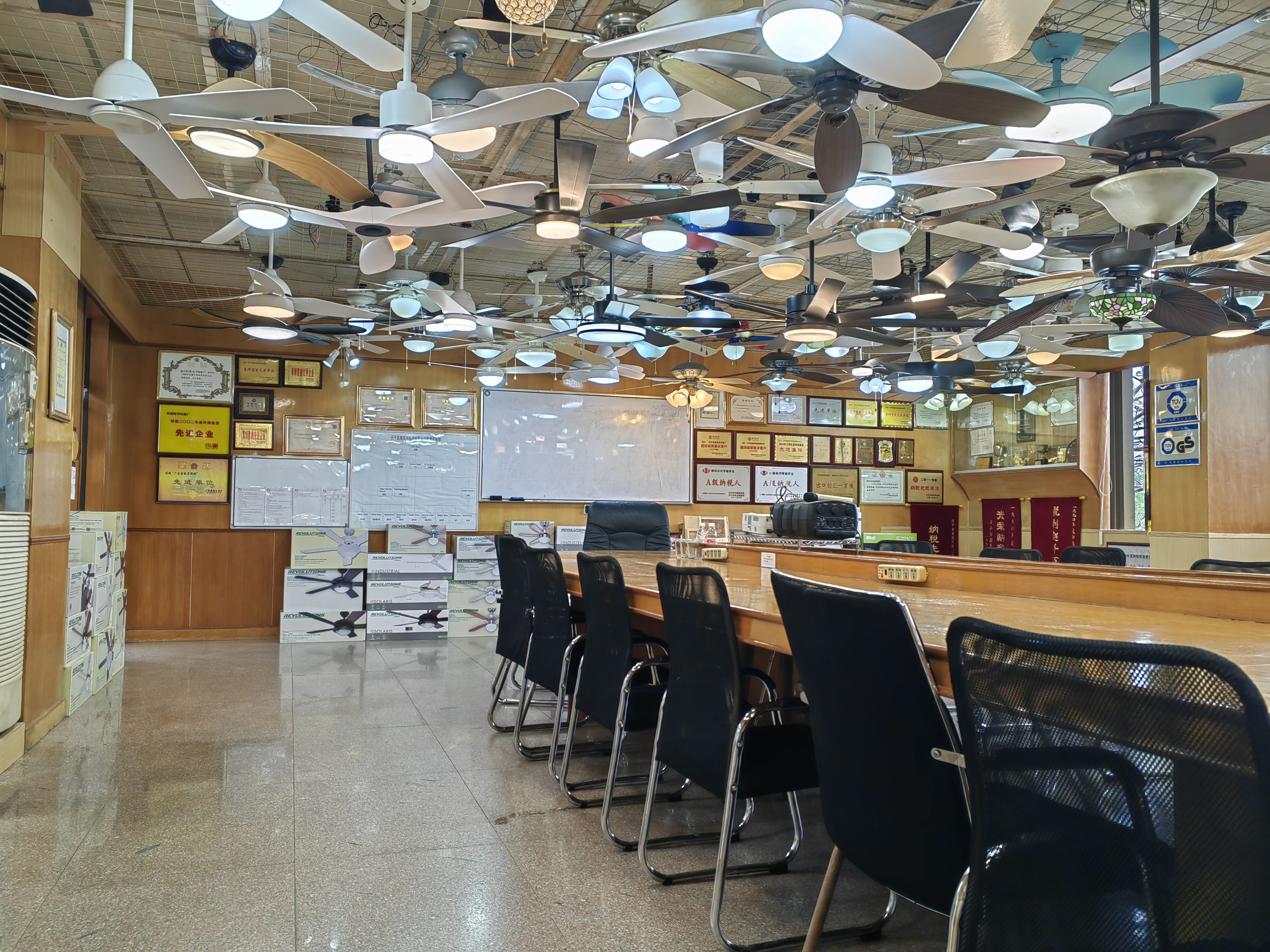
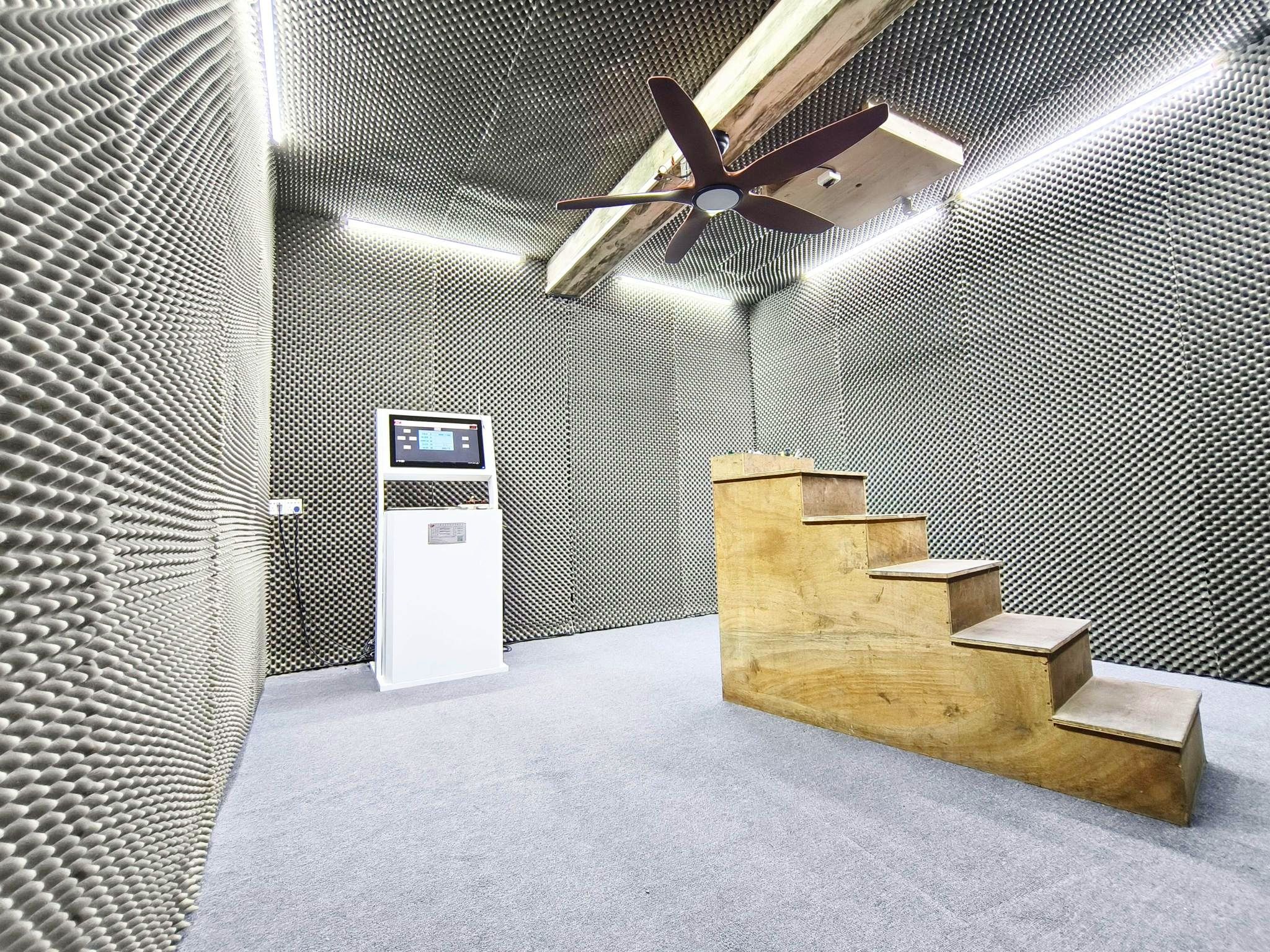
Validate physically rather than on a datasheet, because finish, light, and control behaviour are the three things that decide whether a fan suits an interior. Request a finished sample in the exact Matt White finish, confirm the 24W CCT LED output at the intended colour temperature setting against the interior scheme, and test smart WiFi control behaviour on a network comparable to the project site. Handing Co. Ltd. maintains a sample room together with motor assembly testing and incoming quality control facilities, and publishes a factory presentation document covering its operations since 1992, its 1996 ISO 9001 certification, and its 12,320.66 m² facility. That document is available for download here: Handing factory presentation (PDF).
What production capacity and lead time should a hospitality or retail roll-out plan around?
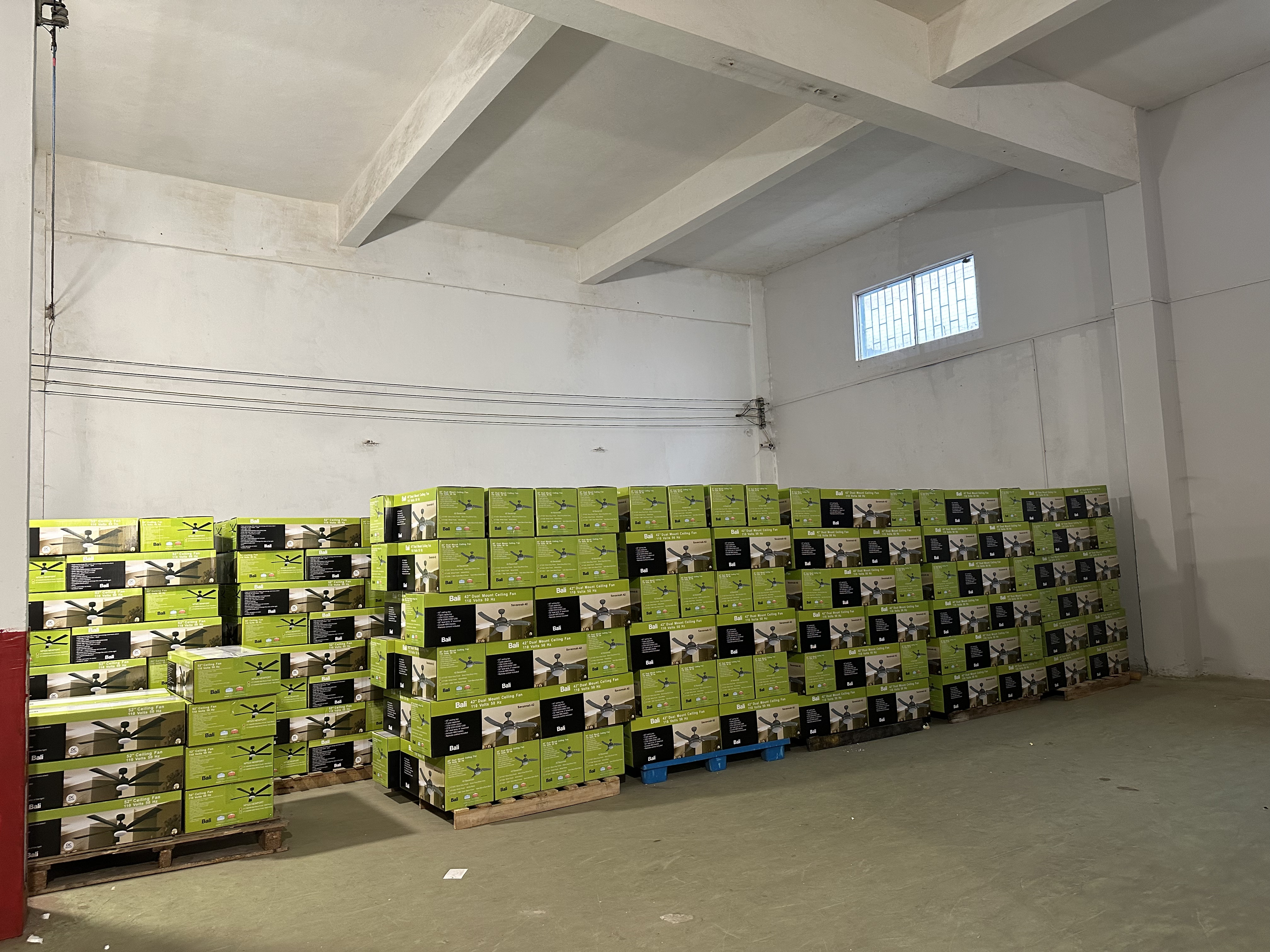
Handing Co. Ltd. operates a 12,320.66 m² facility with 350 employees, a six-engineer R&D team, and an annual output of 480,000 units, and it exports 100% of that production to markets including the European Union, the United States, and Australia. Because output is export-driven and scheduled against shared capacity, the practical sequence for a project is to lock the specification, approve the sample, and then confirm delivery dates rather than reserving capacity before the configuration is final. To open a project conversation, contact MING LAM at sales@handingfan.com or +86-13828060322, or reach the same team on WhatsApp at +852 92839029. Full product information is published at handingfan.com.
Conclusion: What to Lock Before You Order
Adapting a 52-inch smart WiFi decorative ceiling fan to hospitality and retail is a four-variable problem: span against layout, finish and CCT against scheme, control zoning against operating hours, and certification against destination market. The TU52-MW-N3A1DOME is designed to be specified that way — a 52-inch span and three-blade ABS configuration for open commercial ceiling positions, a Matt White finish that holds across a repeated roll-out, a 24W CCT LED light kit that can be tuned per zone, and smart WiFi control that turns individual fans into a managed layer.
What sits behind that platform is a decorative ceiling fan manufacturer that has been building in this category since 1992, has held ISO 9001 certification for its ceiling fan and lighting factory since 1996, and works from a 12,320.66 m² facility with an annual output of 480,000 units aimed entirely at export markets. For a project drawing in the EU, the USA, or Australia, that combination is what makes the difference between a fan specification that survives the programme and one that has to be reopened at handover.
Start Your Project Specification
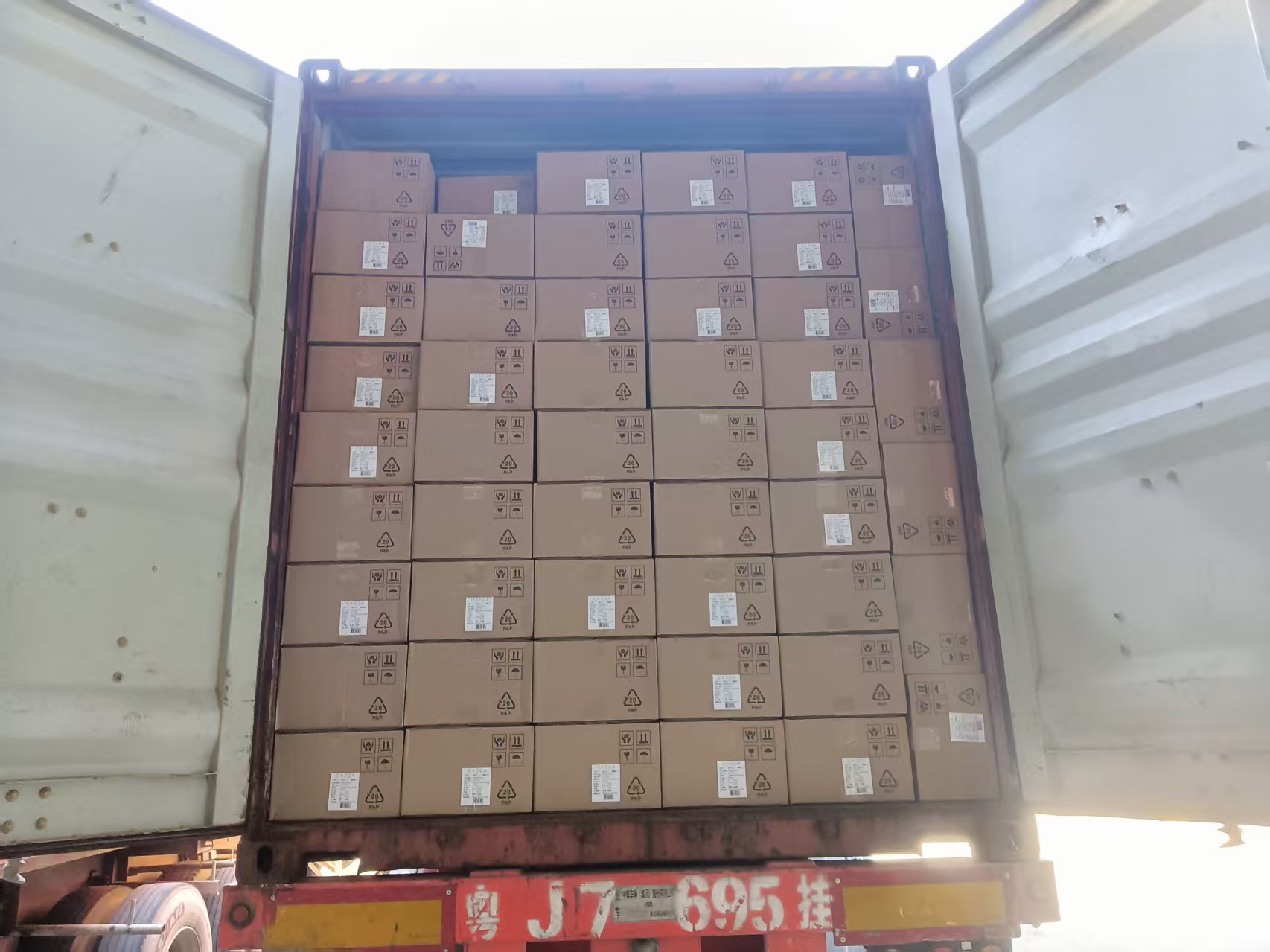
Send your ceiling schedule, destination market, and interior finish requirements to Handing Co. Ltd. and receive a specification response, sample arrangement, and quotation for the TU52-MW-N3A1DOME and related decorative ceiling fan models.
- Email: sales@handingfan.com or minglam3@hotmail.com
- Telephone: +86-13828060322 | WhatsApp: +852 92839029
- Website: www.handingfan.com
- Factory presentation (PDF): download here
- Factory address: No.28, Xiang Long Bei Road, Xiang Long Island, Sanbu Town, Kaiping City, Guangdong Province, China
Have Questions or Need More Details?
Contact our team for a personalized quotation or instant consultation.
Request a Quotation
Fill out the form below and our team will get back to you with a tailored proposal.
WhatsApp Direct Chat
Prefer to chat in real-time? Message us on WhatsApp for instant assistance & quick answers.
- Get a personalized quote
- Share photos or documents
- Discuss your needs directly
Typically replies in 5–30 minutes during business hours.