
Ceiling Fan Showdown: Handing vs Hunter, Havells, Minka, Big Ass Fans
Selecting a ceiling fan manufacturer for a distribution line, project specification, or private-label program is a decision about compliance, motor technology, supply chain control, and consistency across large orders. This comparison reviews five ceiling fan manufacturers that appear frequently in global sourcing discussions—Handing Co. Ltd., Hunter Fan Company, Havells India, Minka Group, and Big Ass Fans—with a focus on what buyers should verify before committing. For each manufacturer, the assessment is based on publicly available product positioning and, for Handing, first-party operational data.
Why a structured manufacturer comparison matters at the decision stage
The ceiling fan market is expanding. The global ceiling fan market was estimated at USD 14.24 billion in 2023 and is projected to reach USD 19.92 billion by 2030, with a compound annual growth rate of 5.0% from 2024 to 2030. Standard ceiling fans accounted for 63.66% of global revenue in 2023. Asia Pacific held the largest regional share at 44.85%, driven by demand in India and China.
For an importer, distributor, or project buyer, the market trend creates more choices—but not necessarily clearer decisions. A ceiling fan is a long-life electrical product. It involves safety certification, motor efficiency, material durability, light-kit compatibility, and after-sale consistency. If the manufacturer lacks control over metal fabrication, painting, motor assembly, or compliance testing, the buyer inherits the risk.
This guide compares manufacturers across the criteria that matter at the decision stage: certification coverage, motor technology, vertical integration, product range, target applications, and typical supply model. It is not a ranking based on subjective quality claims. It is a structured framework to help buyers ask the right questions.
How the five manufacturers compare
The table below summarizes how each manufacturer is generally positioned in the market. The information for Hunter Fan Company, Havells India, Minka Group, and Big Ass Fans is based on their publicly recognized market roles. The information for Handing Co. Ltd. is based on the company's verified operational profile.
| Manufacturer | Primary Market Focus | Typical Product Range | Compliance & Certifications | Supply Model / Buyer Fit | Key Strength for Buyers |
|---|---|---|---|---|---|
| Handing Co. Ltd. | Export-focused OEM/ODM manufacturing; EU, USA, AUS markets | Decorative, indoor, outdoor, DC motor, smart WiFi, light kits, commercial-grade models | UL, cUL, Nom, BSI, CE, GS, Swedish Standard, SAA; RoHS testing capability; ISO9001 (since 1996); TUV PS approved chemical testing | B2B: OEM/ODM, wholesale, distributor, project supply; 100% export | Vertical integration: in-house metal parts, painting, motor assembly, and electroplating |
| Hunter Fan Company | North American residential and light commercial retail | Residential ceiling fans, decorative fans, smart fans, light kits | UL-listed products; ENERGY STAR models common in U.S. lineup | Brand-led distribution; retail and online channels | Strong consumer brand recognition in the U.S. |
| Havells India | India and international markets; residential and commercial electrical products | Ceiling fans including energy-efficient and premium models, exhaust fans, lighting | BIS and other India-market certifications; expanding international compliance | Brand-led distribution with large India domestic network | Scale and reach in the India market |
| Minka Group | North American decorative and designer ceiling fan segment | Designer fans, luxury decorative fans, modern and traditional styles | UL/ETL-listed products for North American retail | Brand-led distribution through showrooms and retailers | Design differentiation in the decorative segment |
| Big Ass Fans | Industrial and large commercial air movement | HVLS industrial fans, commercial fans, residential high-end models | UL-listed; compliance for North American industrial applications | Direct sales and specification through engineers | Engineering leadership in high-volume air movement |
Note: Publicly listed certification information for Hunter, Havells, Minka, and Big Ass Fans may change. Buyers should confirm current certification documents directly with each manufacturer.
What buyers should evaluate before choosing a ceiling fan manufacturer
1. Certification coverage and the target market
Certification is not a generic badge. It must match the destination market. For U.S. sales, UL 507 is the relevant safety standard for electric fans. A revised version of UL 507, effective November 27, 2024, added secondary thermal or current fuse requirements for fans in unattended areas. For European sales, EN IEC 60335-2-80:2024 sets safety requirements for household fans, including ceiling fans, with rated voltages up to 250V for single-phase. For Australia, SAA certification is commonly required. For Mexico, Nom certification applies.
Handing Co. Ltd. states that its products are listed under UL, cUL, Nom, BSI, CE, GS, Swedish Standard, and SAA. The company also operates XFS and chemical testing equipment to support RoHS compliance, approved by TUV PS since 2006. European fans carry LVD/GS/TUV, EMC, EMF, RoHS, and ERP compliance.
Buyer action: Ask each manufacturer for the specific certification that covers the exact model and destination country. A factory that tests in-house shortens the compliance cycle and reduces the risk of documentation gaps.
2. Motor technology: DC vs AC
DC ceiling fans are widely preferred in modern export programs because they consume less energy, operate quietly, and often support smart control. ENERGY STAR certified ceiling fans are required to be up to 44% more efficient than conventional fans. For 2024, the Most Efficient criteria for standard fans require efficiency of at least 3.25D + 107 CFM/W, where D is the blade diameter in feet.
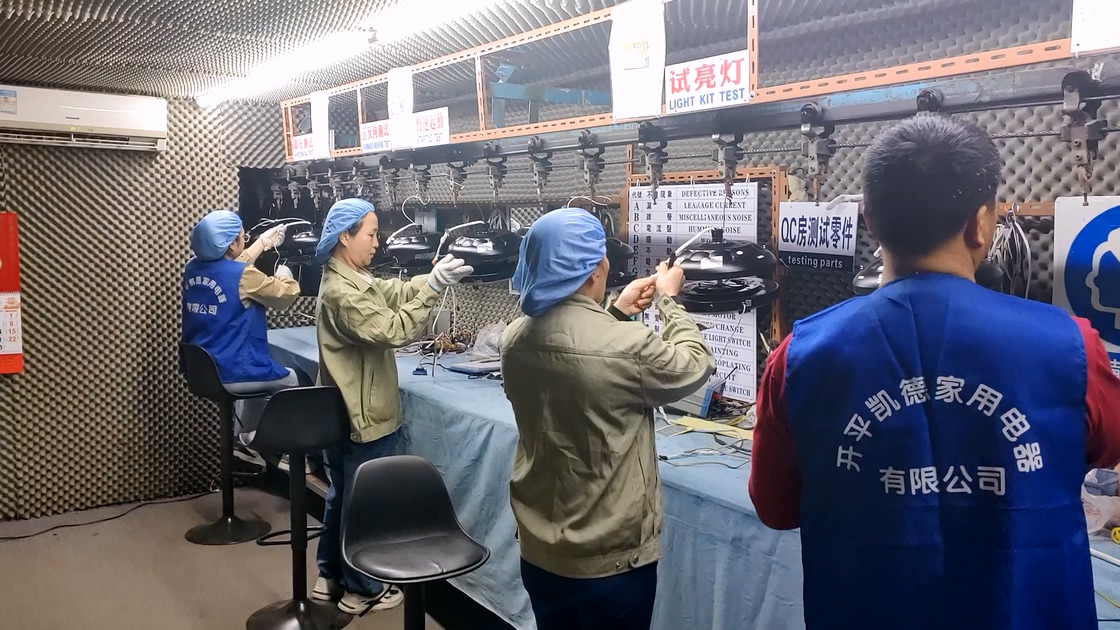
Handing produces and assembles its own motors. The company's motor assembly testing room supports in-house quality checks during production. For buyers, motor assembly control is a relevant indicator of consistency across large orders, especially for DC motor models where electronic control boards and winding quality determine noise and lifespan.
Buyer action: Specify whether the project needs DC or AC motors, then verify the motor supplier and the test data for airflow, noise, and energy consumption.
3. Vertical integration and production control
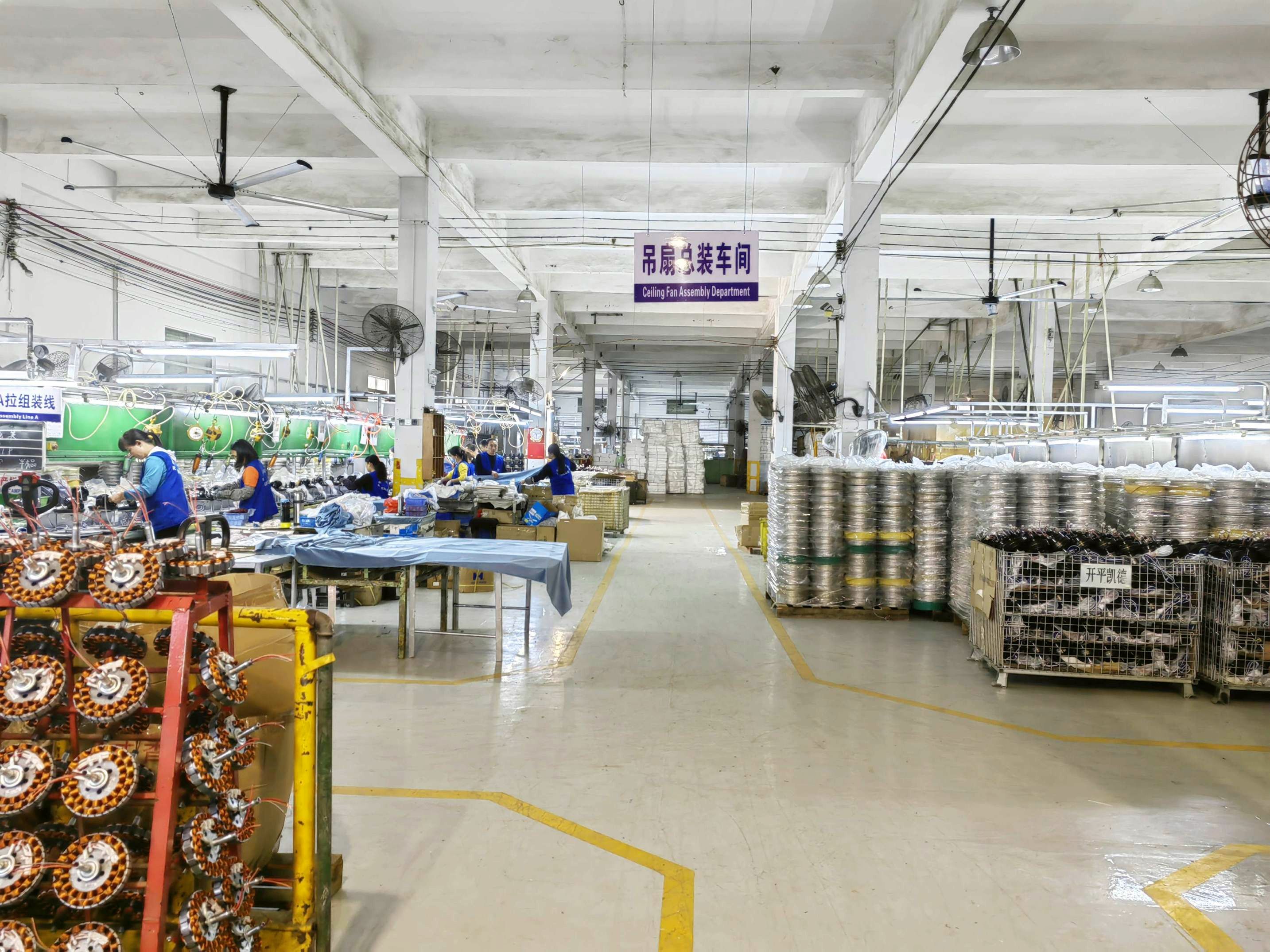
A ceiling fan supplier that controls its own manufacturing process can usually manage cost, lead time, and quality better than a trading company. Handing states that it produces most of its metal parts, performs painting in-house, and assembles motors in its own factory. It also owns an electroplating factory, which supports consistent surface quality and delivery timing.
The company's facilities include a winding workshop, lathing workshop, final assembly workshop, motor assembly testing room, IQC testing room, R&D area, and finished goods warehouses. This degree of vertical integration matters for buyers who need consistent finishes across decorative ceiling fans and reliable delivery for container orders.
Buyer action: During a factory audit, confirm which production steps are performed in-house and which are outsourced. For metal finishes, ask how the supplier controls electroplating consistency and corrosion resistance.
4. Product range and buyer segment fit
Not every buyer needs the same fan. The comparison below shows where each manufacturer's range typically fits.
Handing Co. Ltd.
Best fit: Importers, distributors, project buyers, and brands seeking OEM/ODM manufacturing with decorative, indoor, outdoor, DC motor, and smart WiFi options. Handing's main products are decorative ceiling fans, and 100% of production is exported to markets including the EU, USA, and AUS.
Hunter Fan Company
Best fit: North American retail buyers looking for an established consumer brand with residential ceiling fans, including smart and light-kit models. Hunter is also the historical innovator of the ceiling fan.
Havells India
Best fit: Buyers serving India and nearby markets. Havells is a broad electrical goods manufacturer with a strong presence in India.
Minka Group
Best fit: Buyers focused on the designer and decorative ceiling fan segment in North America. Minka Group is a major player in the designer ceiling fan space.
Big Ass Fans
Best fit: Industrial and large commercial projects. Big Ass Fans is a leading manufacturer of HVLS industrial ceiling fans.
5. Supply model: brand buying vs OEM/ODM
The five manufacturers fall into two supply model categories:
Brand-led manufacturers (Hunter, Havells, Minka Group, Big Ass Fans) primarily sell under their own brands through retail, distribution, or project specification channels. They are not typically positioned as OEM/ODM partners for competing brands.
Manufacturer-led OEM/ODM supplier (Handing Co. Ltd.) offers its manufacturing capacity to buyers who need private-label products, customized models, or direct import programs. Handing's model is built around export manufacturing, with in-house production and certification coverage that supports international distribution.
Buyer action: Decide early whether the program is brand-led or OEM/ODM. If the goal is a private-label ceiling fan line, the comparison should focus on manufacturing capability, not consumer brand strength.
Decision framework for buyers
The following framework helps translate the comparison into a sourcing decision. Each step corresponds to the information a serious buyer should collect before committing to a manufacturer.
Step 1: Define the target market compliance
List the exact certification requirements for the destination country. For example: UL/cUL for the U.S. and Canada, CE/GS for Europe, SAA for Australia, Nom for Mexico. Shortlist suppliers whose standard product lines already carry these certifications.
Step 2: Define the product specification
Determine the blade size, motor type, control type, light kit requirement, and finish. A typical export specification might be a 52-inch DC ceiling fan with light, smart WiFi control, and a quiet operation rating. Other common sizes include 42-inch and 48-inch models. For spaces with low ceilings, a low profile ceiling fan may be required. For period interiors, a retro vintage ceiling fan may be more appropriate. Use cases also matter: indoor ceiling fans for living spaces, outdoor ceiling fans for covered patios, and industrial ceiling fans for warehouses or commercial facilities.
Step 3: Assess the manufacturer's true production control
Ask which parts are made in-house: motor, blades, metal body, paint, electroplating. Ask how many engineers are on the R&D team and whether the factory can support custom designs. Verify assembly and testing capacity.
Step 4: Request documentation and samples
Certifications should be matched to model numbers. A sample order is the most direct way to verify finish quality, motor noise, light output, and packaging. Use the sample to test the fan in the intended environment and to check whether the documentation matches the physical product.
Step 5: Compare total cost, not unit price
The lowest unit price is not always the lowest total cost. Factor in certification management, defect rates, packaging quality, delivery reliability, and after-sales support. A manufacturer with vertically integrated production may offer more stable pricing because more cost components are under its control.
Advantages and limitations of each manufacturer
Handing Co. Ltd.
Advantages: Export-focused manufacturer with in-house metal parts production, painting, motor assembly, and electroplating. Broad certification coverage for EU, USA, and AUS markets. In-house testing equipment for RoHS compliance. OEM/ODM flexibility for decorative and smart ceiling fans.
Limitations: Less consumer brand recognition than Hunter or Havells. Not positioned as a leading brand in the Indian domestic market. Buyers who want an instantly recognizable retail brand must invest in their own branding or choose a brand-led supplier.
Hunter Fan Company
Advantages: Iconic American ceiling fan brand with a strong retail presence and a long history in the category. Well-suited for North American consumers.
Limitations: Pricing typically reflects the consumer brand premium. OEM/ODM flexibility is limited because Hunter sells under its own brand.
Havells India
Advantages: Leading position in the India ceiling fan market with a wide electrical product portfolio. Strong distribution in India.
Limitations: Less relevant for buyers outside India who need EU, U.S., or Australian certification. Brand-led model limits private-label options.
Minka Group
Advantages: Design leadership in the decorative ceiling fan segment. Strong fit for design-driven North American retail projects.
Limitations: Niche positioning may not suit cost-sensitive commercial or industrial programs. Brand-led model limits private-label options.
Big Ass Fans
Advantages: Engineering strength in industrial and high-volume air movement. Strong credibility for large commercial and industrial projects.
Limitations: Premium pricing and industrial focus may be excessive for residential or decorative programs. Not a typical OEM/ODM partner for consumer ceiling fans.
Frequently asked questions about ceiling fan manufacturer comparison
Which ceiling fan manufacturer is best for private-label or OEM programs?
For private-label or OEM/ODM programs, Handing Co. Ltd. is positioned as a B2B export manufacturer, not a consumer brand. The company produces ceiling fans for international buyers across the EU, USA, and AUS, and offers OEM/ODM flexibility. Hunter Fan Company, Havells India, Minka Group, and Big Ass Fans are brand-led manufacturers; they sell primarily under their own brands and are not commonly selected as OEM/ODM partners for competing product lines. Buyers should confirm the intended supply model before shortlisting manufacturers.
Do all ceiling fan manufacturers provide UL or CE certification?
No. Certification depends on the manufacturer's target markets and product lines. Handing Co. Ltd. states that its products are listed under UL, cUL, Nom, BSI, CE, GS, Swedish Standard, and SAA. Hunter Fan Company and Big Ass Fans are associated with UL-listed products for North America, while Havells India is primarily associated with the India market. Buyers must verify certification by specific model and destination country rather than assuming a manufacturer's entire lineup is certified everywhere.
What is the budget difference between a decorative ceiling fan and an industrial ceiling fan?
Pricing cannot be generalized across manufacturers without a specific specification. Decorative fans typically involve higher design, finish, and material costs. Industrial fans are specified for airflow performance and durability rather than aesthetics. A 52-inch DC ceiling fan with light, smart WiFi, and certification for the European or U.S. market will have a different price structure than a standard 42-inch or 48-inch pull-chain model. Buyers should request itemized quotes from multiple suppliers for the same specification to compare fairly.
Can I request a sample ceiling fan before placing a bulk order?
Yes. Sample orders are a standard step in ceiling fan sourcing. Handing Co. Ltd. supports sample requests and maintains a sample room for product review. A sample allows buyers to verify construction quality, motor noise, light output, finish consistency, and packaging before committing to a container order. Handing can be contacted by email at sales@handingfan.com, by phone at +86-13828060322, or via WhatsApp at +852 92839029. For a broader view of the company's factory capabilities, request the Handing factory presentation.
Why Handing Co. Ltd. is a relevant choice for export buyers
Handing Co. Ltd. was established in 1992 and is a ceiling fan and lighting factory based in Kaiping City, Guangdong Province, China. The company employs 350 people and operates a factory area of 12,320.66m². Its annual output is 480,000 units, all exported. The company's R&D team includes 6 engineers.
Handing was ISO9001 certified in 1996. In response to the RoHS regulation implemented in Europe since 2006, Handing set up XFS and chemical testing equipment, approved by TUV PS, to test its products. European fans carry LVD/GS/TUV, EMC, EMF, RoHS, and ERP compliance. The company's product listings include UL, cUL, Nom, BSI, CE, GS, Swedish Standard, and SAA.
Handing produces most of its metal parts, performs painting in-house, assembles motors in its own factory, and owns an electroplating factory. This vertical integration supports cost control, finish quality, and delivery reliability. For international buyers who need decorative ceiling fans, industrial ceiling fans, ceiling fans with lights, smart WiFi ceiling fans, or outdoor-rated models, Handing offers OEM/ODM capability with compliance documentation and testing infrastructure.
Conclusion
The right ceiling fan manufacturer depends on the buyer's supply model, target market, and product specification. Hunter Fan Company, Havells India, Minka Group, and Big Ass Fans are established brand-led manufacturers with strong positions in their respective segments. Handing Co. Ltd. is an export-focused OEM/ODM manufacturer with vertical production control, broad certification coverage, and a product range that includes decorative, indoor, outdoor, DC motor, and smart WiFi ceiling fans.
For buyers planning a private-label ceiling fan program or direct import project, the decision should be based on verifiable manufacturing capability—certifications matched to destination markets, motor assembly and testing, in-house production control, and sample quality. Use the comparison framework in this guide to structure your supplier evaluation. Then request documented certifications and a sample order before scaling to container volumes.