Specifying Decorative Ceiling Fans for Boutique Hotel Rooms
A boutique hotel guest room asks a ceiling fan to do three jobs at once: move air quietly enough that a sleeping guest forgets it is running, carry a large share of the room's lighting without looking like a commercial fixture, and repeat that performance room after room, floor after floor. Airflow on its own is the easiest of those requirements to meet and the least useful to specify first.
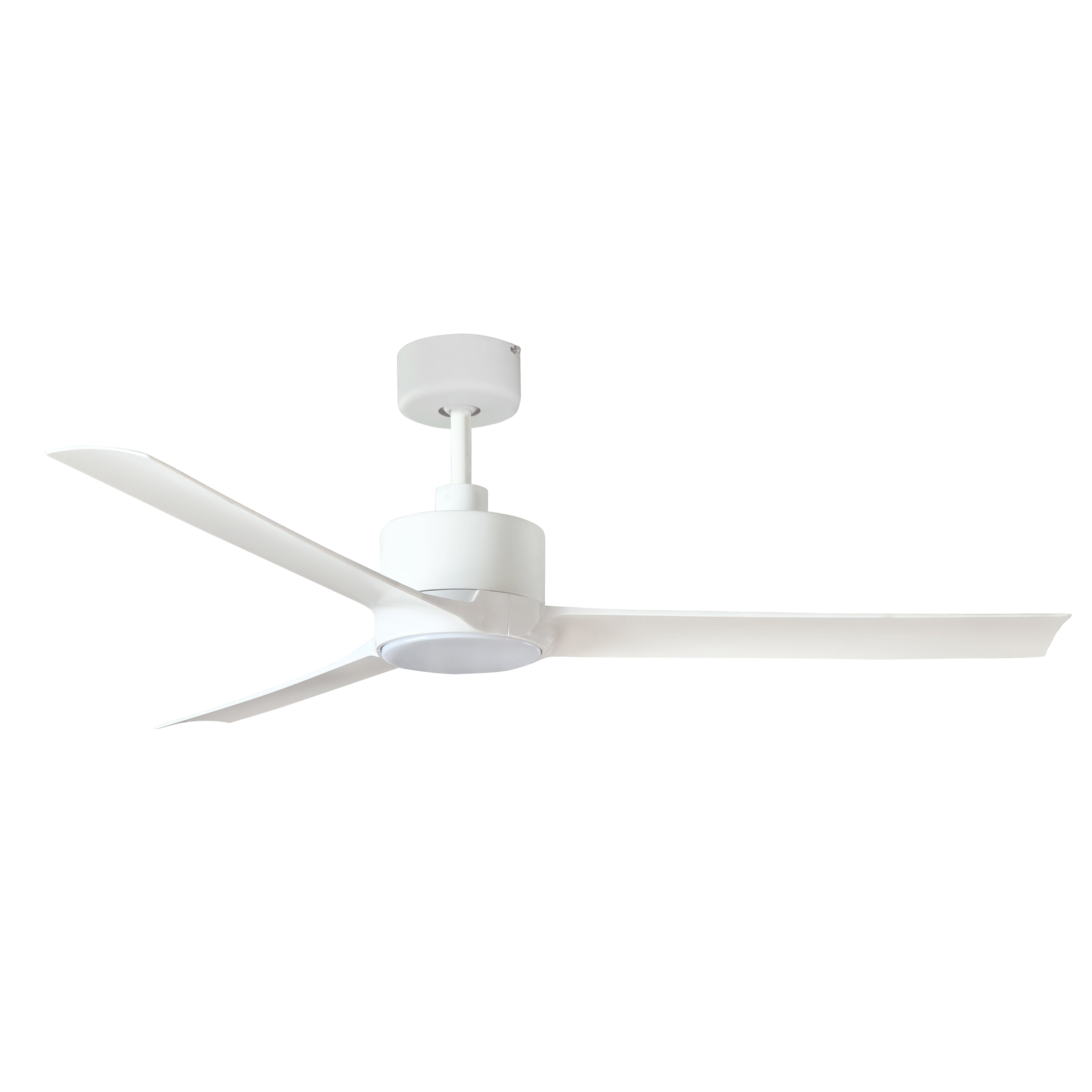
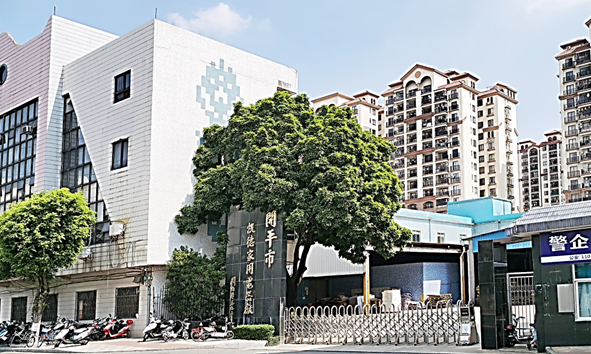
This guide works through the checks a project team normally runs when adapting a decorative ceiling fan to guest rooms, using the TU52-MW-N3A1DOME from Handing Co. Ltd. as the reference model. Handing Co. Ltd. is a ceiling fan manufacturer based at No.28, Xiang Long Bei Road, Xiang Long Island, Sanbu Town, Kaiping City, Guangdong Province, China, exporting decorative ceiling fans mainly to EU, USA and Australian markets. The reference fan is a 52-inch, three-blade indoor decorative ceiling fan with a DC motor, a 24W CCT LED light kit and smart WiFi control, finished in Matt White with a steel housing and ABS blades. Each of those facts changes a different part of the specification, and several of them carry conditions that are worth resolving before a purchase order is raised.
What Makes a Guest Room Different From a Lobby or a Café
In a guest room, the fan is judged while the room is quiet and the guest is still. That single difference reshapes the whole requirement. A café fan is evaluated against background conversation and clatter; a guest-room fan is evaluated at 2 a.m., at low speed, from a pillow roughly one to two metres below the blades.
Three consequences follow for the specification:
- Low-speed behaviour outranks peak airflow. A fan that is quiet and stable at its second or third speed will be used more, and complained about less, than a fan with a higher maximum airflow that hums at night.
- One fixture has to cover several lighting moods. Arrival lighting, reading light and a dim overnight level are normally delivered from the same fitting, so colour temperature and the bottom of the dimming range matter more than the top end.
- Repeatability is a commercial requirement. If forty rooms use the same SKU, spares, cleaning routines, guest instructions and maintenance visits are all simplified. A different fan in every room type multiplies the support burden.
None of this changes a product's published specification. It changes which parts of that specification the project team interrogates, and in what order.
Check One: Room Size and Where the Fan Actually Sits
The first fixed number is the blade span: the TU52-MW-N3A1DOME carries three ABS blades on a 52-inch housing, roughly 1,320 mm tip to tip. That span does not flex to suit the room; the room has to be checked against it.
Before placement is agreed, record the length and width of each room type, the position of the bed and any wardrobe run, the door swing, and the height of tall furniture. Blade tips should clear walls, joinery and wardrobe doors with margin for the fan's own movement, not merely the on-paper footprint. In a narrow room the practical question is often whether the fan can sit over the sleeping zone rather than over the circulation path by the door, and that is a layout decision made before the wiring is fixed, not after.
Span also sets expectations about coverage. A 52-inch decorative ceiling fan is a reasonable reference for the main sleeping area of a standard or deluxe guest room. Smaller rooms can be served by shorter spans, since 42-inch and 48-inch ceiling fan categories exist for tighter footprints, and a large suite with a separate seating corner may leave one 52-inch fan working over the bed only. The supplied TU52 specification does not include airflow figures, so if the design team needs to prove coverage for an irregular room, request cubic-feet-per-minute data at each speed and check it against the room volume rather than assuming.
Check Two: Ceiling Height and Installed Drop
Ceiling height is the check most often skipped and most expensive to correct. What matters is not the slab-to-slab height but the distance from the finished floor to the lowest point of the installed fan, which means the motor housing plus the light kit plus any downrod.
The supplied specification gives the carton size, not an installed drop dimension, so request a dimension drawing for the exact model before ceilings or bulkheads are set out. Two reference points help frame that conversation:
- ENERGY STAR's ceiling fan criteria define a residential ceiling fan as a non-portable, ceiling-mounted unit whose lowest blade point sits more than 10 inches (254 mm) from the ceiling. That is the programme's product definition rather than an installation code, but it is a useful reminder that the blade plane needs clear space beneath the ceiling for the fan to work as designed.
- Minimum floor clearance is set by local building rules and by the manufacturer's installation instructions. Confirm both for the project's jurisdiction; do not carry a generic rule of thumb from another market.
Where the ceiling is low, a low-profile or hugger-style mounting is the usual category answer, and where a suite has a double-height ceiling a downrod is normally required to bring the blade plane back down to occupied air. Neither option should be assumed as available on the chosen decorative model; confirm the mounting configurations actually offered for the SKU, and confirm that the light kit still has enough clearance for cleaning and for replacing the lamp or kit later.
Check Three: Whether a DC Motor Suits the Room's Duty Cycle
The TU52-MW-N3A1DOME is built on a 52-inch TU housing with a DC motor. For guest rooms, that motor architecture is usually the right starting point, because DC motors are generally more energy-efficient than AC induction motors, particularly when running at reduced speed — and reduced speed is exactly where a hotel fan spends most of its life.
DC also supports finer speed steps than a simple three-speed AC arrangement, which matters when housekeeping wants gentle air movement and a guest wants almost none. What the architecture does not tell you is how the specific model behaves. Before approving the fan, ask for:
- the speed table with power draw at each step, so the low-speed settings can be compared with the room's expected running hours;
- sound pressure data measured at the speeds the hotel will actually use, with the test conditions stated;
- efficiency expressed as a weighted CFM/W figure across speeds and standby, because ENERGY STAR evaluates ceiling fan efficiency on that basis by diameter band — quoting efficiency the same way lets two suppliers be compared honestly;
- whether a seasonal reverse function is offered, if the project's HVAC strategy calls for it, since reverse operation is a feature to be confirmed rather than assumed from the model name.
The practical rule for a hotel brief is simple: "DC motor" is an architecture, not a performance guarantee. Specify the measured numbers beside it.
Check Four: The 24W CCT LED Light Kit
The reference model is supplied with a 24W CCT LED light kit, which is the part of the specification the guest experiences most directly. CCT refers to correlated colour temperature, meaning the light kit is specified with colour-temperature capability rather than a single fixed white. The supplied specification states the 24W rating and the CCT kit; it does not list the selectable colour temperatures, the colour rendering index, the lumen output at each setting, or the dimming method, so all four need to come from the model datasheet before the lighting design is frozen.
For guest rooms, four questions are worth putting in writing:
- What happens at power-on? If a room's lighting returns to a cold, bright white after a power interruption, guests read it as a fault. Ask what colour temperature and brightness the kit defaults to.
- How low does it dim? The bottom of the range, not the top, determines whether the fixture can serve as an overnight light.
- Can light and fan be switched independently? Guests often want moving air with the light off, and the reverse.
- How is the light serviced? Confirm the replacement path for the LED kit and its expected service life, so housekeeping is not scheduling a whole-fan replacement for a lamp failure.
Colour rendering also deserves a line in the brief. In a room where the fan light is the main light source, skin tones and the finishes of joinery and textiles are all judged under it; a high colour rendering index is easier to defend in a boutique property than in a back-of-house corridor.
Check Five: Smart WiFi Control Inside a Hotel Network
The TU52-MW-N3A1DOME is listed as a smart WiFi ceiling fan, which raises a design decision rather than a product question: who controls the fan, and what happens when the network does not cooperate.
Guest-room WiFi in a hotel is usually segmented, with client isolation between devices and separate networks for staff systems. A fan that depends on a cloud account and a stable connection will behave differently in that environment than in a home. Before specifying smart control across a floor package, resolve with the supplier:
- the control methods offered — wall switch, handset, app, or a combination;
- how a unit is provisioned and paired, and how long that takes per room;
- whether an internet connection or user account is required for basic operation;
- what the fan does after a power cut, and whether settings persist;
- how firmware updates are handled and who owns that task after handover.
The sensible procurement path is a single mock-up room: install the fan, provision it on the property's network, test it at night, cut the power to it, and only then release the floor package. Keep a non-smart control route available for rooms with weak coverage, and keep guest instructions deliberately short — a control that needs an explanation will generate calls to reception.
Check Six: Finish, Housing and Blade Materials
The reference model is finished in Matt White, with a steel housing and three ABS blades; the specification lists no separate blade holder. In a guest room, the Matt White finish does real work: it keeps the fan visually quiet against typical white or off-white ceilings, so the fitting reads as part of the room rather than as equipment. The trade-off is that a matt white surface shows dust and fingermarks, so agree a cleaning routine and confirm which cleaning agents are compatible with the finish before housekeeping writes its own procedure.
The steel housing provides the structural body and carries the painted finish. Handing states that it produces most of its metal parts, performs its own painting and assembles its motors under ISO 9001 procedures, with its ceiling fan and lighting factory certified to ISO 9001 since 1996 — useful context when assessing finish consistency across a repeat order, though it describes factory capability rather than the performance of one model.
ABS blades are moulded polymer components, which makes them straightforward to wipe down and keeps the blade profile consistent from unit to unit. Three blades is a design and aerodynamic choice; do not infer a noise outcome from the blade count alone. Ask for measured sound data instead, and compare it at the speeds the hotel will actually select.
Check Seven: Indoor, Commercial-Grade Use and What It Excludes
The model is classified as an indoor decorative ceiling fan, a commercial grade ceiling fan and a ceiling fan with light, with household and commercial applications listed. "Commercial grade" positions the product for repeated use in commercial settings; it is a positioning statement, not a certificate, and it does not by itself qualify the fan for every space in a hotel.
The indoor scope is the boundary that matters most on a hospitality project. Guest bathrooms with showers, pool decks, spa areas, open terraces and balconies exposed to weather sit outside a dry indoor specification, and a different product should be chosen for them. ENERGY STAR's guidance is a useful shorthand here: for humid locations, look for a fan with a UL-listed damp rating, and where a fan is in direct contact with water, a UL wet rating. Map the property room by room — bedroom, bathroom, terrace — and specify separately, rather than stretching one decorative indoor model across the whole building.
Certification needs the same discipline. Handing's corporate material states that its products are listed in UL, cUL, NOM, BSI, CE, GS, Swedish Standard and SAA, and that its European fans carry LVD/GS/TUV, EMC, EMF, RoHS and ERP compliance. Those are company-level statements covering the product range. The supplied TU52-MW-N3A1DOME specification does not name a certificate, so for each destination market request the certificate or listing number for the exact model, check the certificate holder and validity date, and confirm the standard it was assessed against. If ENERGY STAR qualification is a project requirement, note that certification must come through an EPA-recognised certification body with testing in an EPA-recognised laboratory — a logo in a catalogue is not that evidence.
Check Eight: Carton Size, Receiving and Site Logistics
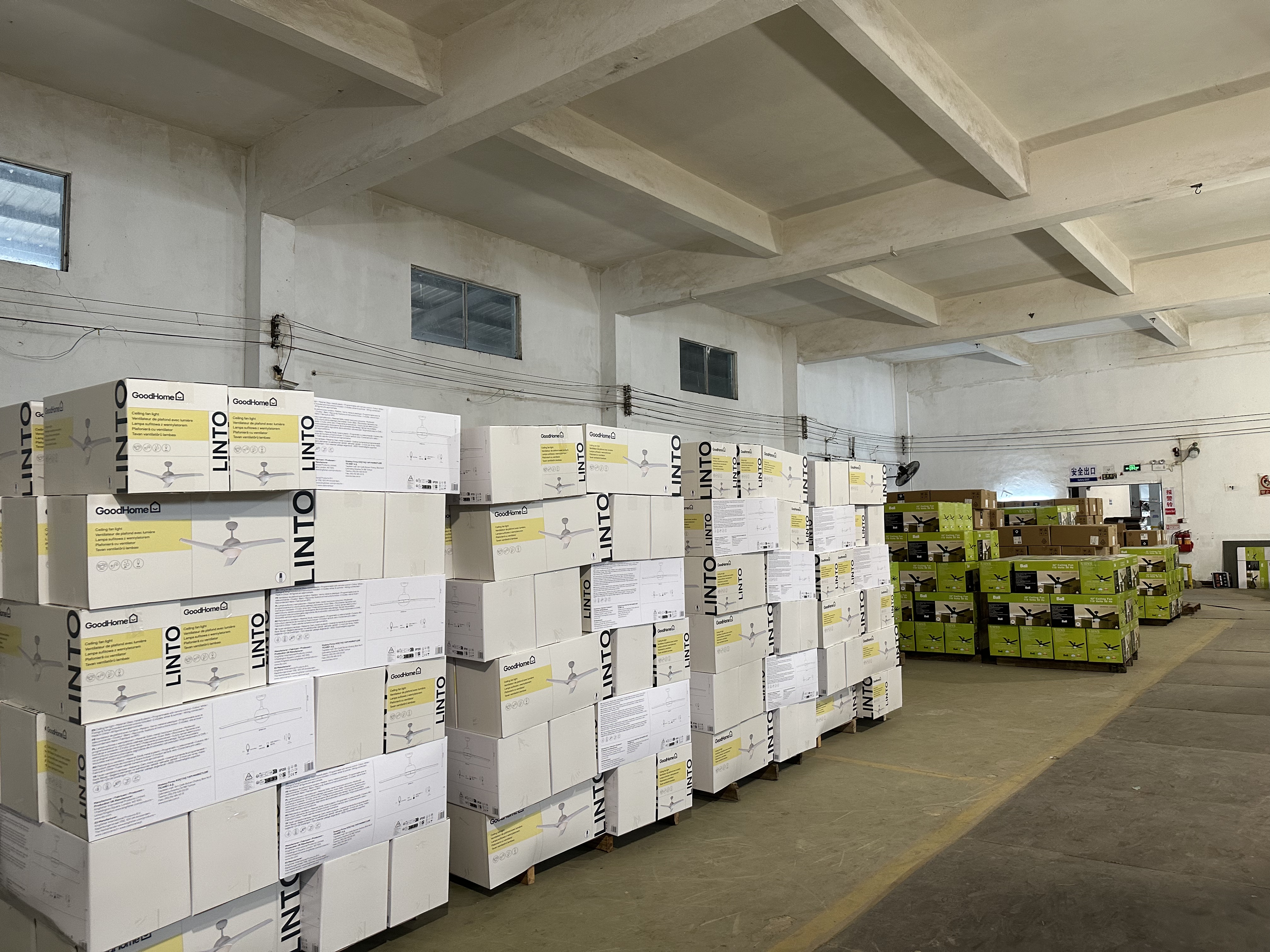
The specification gives a carton of 720 (L) × 225 (W) × 350 (H) mm. That works out at approximately 0.0567 m³ per carton, calculated from the supplied dimensions. The shape matters as much as the volume: this is a long, narrow carton, and site teams handle it differently from a compact box.
Practical implications for a hotel fit-out:
- Store horizontally on racking. Long cartons should not be stood on end or floor-stacked to the ceiling; protect the long edges, which take the impact in handling.
- Plan two-person handling. Length, not weight, usually dictates this. Confirm the packed weight and any pallet configuration with the supplier so the receiving bay is staffed correctly.
- Count against the room schedule, not the order total. Receiving is the last cheap moment to catch a shortfall; verify carton counts by room type and segregate anything crushed or dented before signing.
- Check contents before the carton leaves the receiving area. Blades, light kit, mounting hardware and instructions should be confirmed present, since a missing component discovered on the fourth floor costs a return trip.
- Stage by floor and room number. Installation normally follows painting and flooring and precedes soft furnishings, so the staging plan should be agreed with the fit-out contractor rather than improvised.
For landed-cost planning on US-bound shipments, ceiling fans for permanent installation from China have been reported at a 17.20% duty rate under HS 8414.51.30 for 2026 — a 4.7% general rate plus a 12.5% Section 301 duty, per Airlift USA. Rates and classifications change; confirm the current position with a customs broker before the budget is locked.
Specification Summary for the Reference Model
| Parameter | TU52-MW-N3A1DOME (as supplied) | Why it matters in a guest room | Confirm before ordering |
|---|---|---|---|
| Blade span and blades | 52-inch housing, 3 × ABS blades | Sets coverage for the sleeping area and clearance to walls and joinery | Airflow at each speed; coverage for oversized suites |
| Motor | 52" TU housing, DC motor | Long low-speed running and fine speed steps overnight | Speed and power table; measured sound data; reverse function if required |
| Light kit | 24W CCT LED light kit | Carries much of the room's ambient and reading light | Selectable CCT values, CRI, dimming depth, default state at power-on |
| Control | Listed as a smart WiFi ceiling fan | Guest convenience with a staff override path | Provisioning method, offline behaviour, switch and handset options |
| Finish and materials | Matt White finish, steel housing, ABS blades, no separate blade holder listed | Visually quiet against guest-room ceilings; cleanable surfaces | Cleaning agents compatible with the painted finish |
| Use environment | Indoor, decorative, commercial grade; household and commercial applications | Suits dry guest rooms, not wet or humid zones | Separate damp or wet-rated models for bathrooms and terraces |
| Compliance | Not stated in the model specification | Market access and project sign-off | Certificate or listing number for the exact model and destination market |
| Carton | 720 × 225 × 350 mm, approx. 0.0567 m³ (calculated) | Receiving, storage and floor-by-floor staging | Packing quantity, packed weight, pallet configuration |
A Step-by-Step Specification Process
- Survey every room type. Record length, width, finished ceiling height, bed position, wardrobe and joinery heights, and the existing wiring and switching. One survey sheet per room type is enough; one per room is better.
- Write the performance brief before the product brief. Set the noise expectation at low speed, the lighting moods the room must support, who controls the fan, and how it will be cleaned and serviced.
- Check the span against the room. Confirm that a 52-inch span sits where the guest is, clears the joinery, and covers the sleeping zone; flag any room where it does not.
- Check the installed height. Obtain the dimension drawing, add the light kit and any downrod, and confirm floor clearance against local rules and the manufacturer's instructions.
- Confirm the control plan. Decide guest versus staff control, confirm the provisioning steps, and test the behaviour after a power interruption in a mock-up room.
- Collect compliance documents per market. Model-level certificate or listing number, holder, standard and validity — not a corporate logo sheet.
- Run a mock-up room sign-off. Night-time noise, dimmed light quality, WiFi pairing and finish appearance under the room's actual lighting.
- Release the order with a logistics plan. Carton counts by room type, horizontal storage, staged delivery by floor, and a small spares allowance for the property's maintenance store.
Where This Fan Fits — and Where It Does Not
The TU52-MW-N3A1DOME fits the core brief of a dry, indoor boutique guest room: a 52-inch decorative ceiling fan with a DC motor, an integrated 24W CCT LED light kit and smart WiFi control, in a Matt White finish that recedes against a light ceiling. It suits projects that want one repeatable SKU across standard and deluxe rooms, and it suits teams that value a light kit integrated into the fan rather than a separate fixture.
It is not the right answer, on the evidence supplied, for four situations. Guest bathrooms and shower rooms, terraces, balconies and poolside areas need damp or wet-rated products. Very low ceilings need a low-profile mounting configuration that must be confirmed rather than assumed. Very large suites may need two fans or a different layout, because one 52-inch fan has a finite reach and the model's airflow figures are not in the supplied specification. And any market where the project requires a specific certification must have that certificate confirmed against the exact model before specification, not after shipment.
Frequently Asked Questions
What certification evidence should we hold before specifying this fan for guest rooms?
Ask for a certificate or listing number for the exact model and the exact destination market, together with the certificate holder, the standard assessed and the validity date. Handing's corporate material lists products in UL, cUL, NOM, BSI, CE, GS, Swedish Standard and SAA, and European fans with LVD/GS/TUV, EMC, EMF, RoHS and ERP compliance, but those statements cover the product range rather than the TU52-MW-N3A1DOME specifically. Where ENERGY STAR qualification is required, remember that certification must come through an EPA-recognised certification body with testing in an EPA-recognised laboratory.
Can one 52-inch decorative ceiling fan serve both the sleeping area and a seating corner?
It depends on room geometry rather than on the fan alone. The blade span is fixed at 52 inches, roughly 1,320 mm, so the fan can only reach what its span and mounting height allow. In a compact room with the fan placed over the sleeping zone, one unit is usually enough. In a suite with a separate seating corner, the second zone may need its own fan or a different layout. The supplied specification does not include airflow figures, so request CFM data at each speed if coverage has to be demonstrated for an irregular room.
What drives the cost of a decorative ceiling fan specification for guest rooms?
The main cost drivers are the motor architecture, the light kit, the control electronics, the finish, the certification scope required for each market, and the logistics of receiving and installing a long carton floor by floor. On US-bound shipments, duty also enters the calculation: ceiling fans for permanent installation from China have been reported at 17.20% under HS 8414.51.30 for 2026, a 4.7% general rate plus a 12.5% Section 301 duty, per Airlift USA. Rates change, so confirm the current position with a customs broker. A mock-up room and a modest spares allowance are small line items that prevent much larger remedial costs later.
Can we evaluate a sample before committing to the full room package?
Yes, and for a hospitality project a sample evaluation is the sensible first step. Test the fan at the speeds the hotel will actually use, at night, in a room with similar acoustics; check the dimmed light level at the bottom of the range; provision the WiFi control on a segmented guest network; and inspect the Matt White finish under the room's own lighting. Handing Co. Ltd. can be reached through handingfan.com or at sales@handingfan.com to arrange a sample, a quotation or a model datasheet covering the points listed in this guide.
How should receiving and installation be sequenced around the carton size?
The carton measures 720 × 225 × 350 mm, approximately 0.0567 m³ calculated from the supplied dimensions, and its length drives handling more than its volume does. Store cartons horizontally on racking, protect the long edges, staff the receiving bay for two-person handling, and count cartons against the room schedule by room type. Stage deliveries floor by floor, install after painting and flooring but before soft furnishings, and confirm packing quantity and packed weight with the supplier so the site plan is based on real numbers rather than assumptions.
Conclusion
Adapting a decorative ceiling fan to boutique hotel guest rooms is a sequence of checks rather than a single product decision. Measure the rooms and the finished ceiling heights first; place the 52-inch span where the guest actually is; confirm the installed drop, including the 24W CCT LED light kit; demand measured motor and sound data instead of accepting a motor type as proof; resolve who controls the smart WiFi fan and what happens when the network drops; keep the indoor scope honest by specifying damp or wet-rated products for bathrooms and terraces; collect model-level certificates per market; and plan receiving around a 720 × 225 × 350 mm carton.
The TU52-MW-N3A1DOME answers the dry, indoor guest-room brief well on the facts supplied — 52-inch three-blade span, DC motor, integrated 24W CCT LED light kit, smart WiFi control, Matt White finish over a steel housing with ABS blades, in a commercial-grade indoor decorative specification. The gaps that remain are answerable documents rather than unknowns: the model datasheet, the dimension drawing, the sound and airflow figures, and the certificate for the destination market.
Next step: review the full range and manufacturing background in the Handing factory presentation (PDF), then request a TU52-MW-N3A1DOME sample or a project quotation through Handing Co. Ltd. so the room-by-room specification can be checked against measured data.
Have Questions or Need More Details?
Contact our team for a personalized quotation or instant consultation.
Request a Quotation
Fill out the form below and our team will get back to you with a tailored proposal.
WhatsApp Direct Chat
Prefer to chat in real-time? Message us on WhatsApp for instant assistance & quick answers.
- Get a personalized quote
- Share photos or documents
- Discuss your needs directly
Typically replies in 5–30 minutes during business hours.