Specifying a DC Motor Ceiling Fan: Blade Span, LED CCT and Smart Integration
Specifying a DC Motor Ceiling Fan: Blade Span, LED CCT and Smart Integration
Short answer: A DC motor ceiling fan is defined by four data-sheet lines, not one — blade span, blade material, housing and motor construction, and the light-plus-control package. The TU52-MW-N3A1DOME from Handing Co. Ltd. works as a reference model: a 52-inch DC motor in a 52-inch TU housing, three ABS blades, a steel housing finished in Matt White, a 24W CCT LED light kit and smart WiFi control, specified for household and commercial indoor applications. The parameter-by-parameter detail below explains what each line decides, and what a buyer still has to verify.
Decorative ceiling fans are rarely bought for a single room. A distributor stocking for resale, a hotel fitting out guest rooms, a contractor equipping a restaurant interior — all of them have to translate a room brief into a specification sheet, and all of them lose time when the sheet and the brief do not match.
Handing Co. Ltd. is a ceiling fan manufacturer established in 1992 in Kaiping City, Guangdong Province, China. The company operates a 12,320.66 m² factory with 350 employees and a 6-engineer R&D team, produces decorative ceiling fans for the EU, USA and Australian markets, and exports 100% of its output. Its model TU52-MW-N3A1DOME is used throughout this guide as the worked example, because its data sheet covers the four decision lines that most decorative DC fan projects depend on.
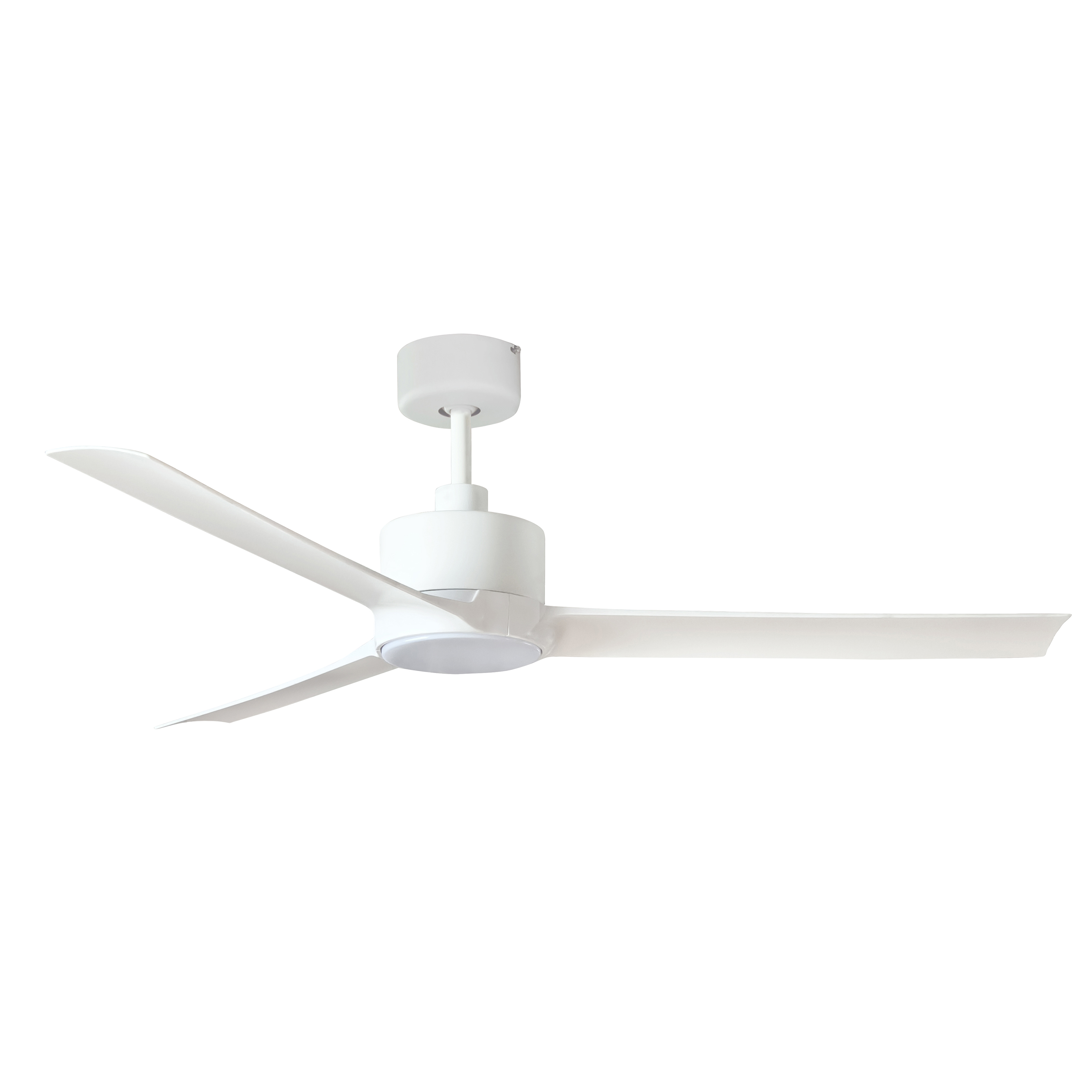
TU52-MW-N3A1DOME — a 52-inch decorative DC ceiling fan with a steel housing in Matt White, three ABS blades, a 24W CCT LED light kit and smart WiFi control.
Why decorative ceiling fan specifications drift off target
Most decorative ceiling fan complaints are specification failures rather than manufacturing failures. A fan that is too wide for the ceiling it hangs from moves air where nobody is standing. A light kit chosen on wattage alone can deliver the wrong colour of light for a hospitality interior. A fan described only as "smart" can arrive with a control module that the project's wall switching cannot support, or that the operator's phone ecosystem does not recognise.
Five mismatches repeat across residential and commercial projects:
- Span treated as a label. Blade span is the first number a buyer sees, which is exactly why it gets treated as the whole decision. Span interacts with mounting height, ceiling type and the number of fans in the space; it cannot be locked before the room brief is written.
- Blade material treated as cosmetic. The blade is the component that moves air. Its material affects weight, balance and how the fan behaves in service, and ABS, metal and timber blades are not interchangeable in every project.
- Housing construction skipped because the finish is more visible. Buyers inspect the paint and the plating, then accept whatever housing construction sits behind them. The housing carries the motor, the blade attachment and the mounting interface.
- The light kit reduced to "with light". A 24W CCT LED kit answers two separate questions — how much light, and what colour of light — and both have to be specified in writing.
- Control treated as a checkbox. Pull chain, handset remote and WiFi describe three different operating experiences. A WiFi model changes what the installer has to prepare, and what the end user has to learn.
The rest of this guide works upward from the data sheet, so that each of these five points closes with a documented answer rather than an assumption.
Market and compliance context behind DC ceiling fan specifications
The global ceiling fan market was estimated at USD 14.24 billion in 2023 and is projected to reach USD 19.92 billion by 2030, a CAGR of 5.0% between 2024 and 2030 (Grand View Research). Asia Pacific held the largest regional revenue share at 44.85% in 2023, and standard ceiling fans accounted for 63.66% of global revenue in the same year — a reminder that the decorative and DC segments sit on top of a very large conventional base.
The supply side is similarly concentrated. China's exports under HS 841459 reached 509 million units in 2024 with a total export value of USD 3.788 billion, up 6.96% compared with the previous year (China Customs data via TradeDaas). The category is served both by global brands — among them Hunter Fan Company, Havells India, Crompton Greaves, Big Ass Fans and Minka Group — and by specialist manufacturers that supply retailers and project buyers directly.
Market sizing figures vary between research houses. Published 2024 estimates differ by roughly USD 2 billion depending on the source, so any single number should be read as a range rather than a precise value. Treat all market figures the same way you would treat a specification: useful for direction, never a substitute for a certificate or a test report.
Three regulatory developments matter to a specification written today:
- United States — UL 507. A new version of the safety standard for electric fans took effect on November 27, 2024, adding secondary thermal or current fuse requirements for fans installed in unattended areas.
- European Union — EN IEC 60335-2-80:2024. This standard establishes safety requirements for household fans, including ceiling fans, with rated voltages up to 250 V for single-phase equipment.
- ENERGY STAR. Certified ceiling fans are required to be up to 44% more efficient than conventional fans, and the 2024 Most Efficient criteria for standard fans require an efficiency of at least 3.25D + 107 (CFM/W).
Handing's own compliance position is documented rather than implied: the company states that its products are listed in UL, cUL, Nom, BSI, CE, GS, Swedish Standard and SAA, and that its European fans carry LVD/GS/TUV, EMC, EMF, RoHS and ERP. The ceiling fan and lighting factory has held ISO 9001 certification since 1996, and in response to the EU RoHS regulation introduced in 2006, Handing installed an XFS machine and chemical testing, approved by TUV PS in the same year.
Certification is issued per model and per market. The practical rule for a project buyer is to request the certificate that names the exact model and the exact destination market, rather than accepting a general statement of compliance.
The TU52-MW-N3A1DOME data sheet, line by line
The published specification for this model is short. Its value lies in how precisely it can be read.
- Item no.: TU52-MW-N3A1DOME
- Housing: 52-inch TU housing with DC motor
- Finish: Matt White
- Blade holder: not applicable — no separate blade holder is listed
- Blade: 3 × ABS
- Light kit: 24W CCT LED light kit
- Box size: 720 (L) × 225 (W) × 350 (H) mm
- Material: steel housing + ABS blade
- Applicable industry: household, commercial
Blade span: 52 inches
Span decides swept area, and swept area decides how much air the fan can move. A 52-inch span is a common size for indoor decorative and commercial-grade interiors, which is why it appears in so many project briefs. What span does not decide is whether the fan suits a particular ceiling: mounting height, ceiling slope and the number of fans in the room all change the airflow that reaches occupant level. Buyers searching for a 42-inch or 48-inch ceiling fan are usually solving a different room constraint than buyers searching a 52-inch model, so the span decision belongs to the room brief, not to the catalogue page.
Blades: three ABS blades with no separate blade holder
The sheet specifies three blades in ABS and lists no blade holder. Two consequences follow. First, blade count and material are fixed at three moulded ABS blades — ABS is a moulded thermoplastic, which allows blade geometry to be held consistently from unit to unit. Second, the blade attachment is part of the housing assembly rather than a separate component, which reduces part count and simplifies spare-part planning for distributors.
What to verify: the material declaration for the blades, the factory's balance procedure, and the assembly drawing that shows how the blades are fixed to the housing.
Housing and motor: a steel housing carrying a DC motor
The housing line is where the model is actually defined — a 52-inch TU housing with a DC motor, in a steel housing. The motor type drives the control electronics, not just the airflow. A DC motor uses electronic commutation rather than the AC induction design of a conventional fan motor, which in practical terms supports finer speed steps and generally quieter running at low speed. Exact performance figures belong to the individual model's own test data; they cannot be inferred from the motor type alone. Where a model supports reverse rotation, that behaviour is set by the controller and should be stated in the control documentation.
Manufacturing structure matters here. Handing produces most of its own metal parts, does its own painting, and assembles its own motors; the company also owns 100% of its electroplating factory. For a housing-and-motor assembly, that means the two components most likely to vary when they are subcontracted are made under one quality system.
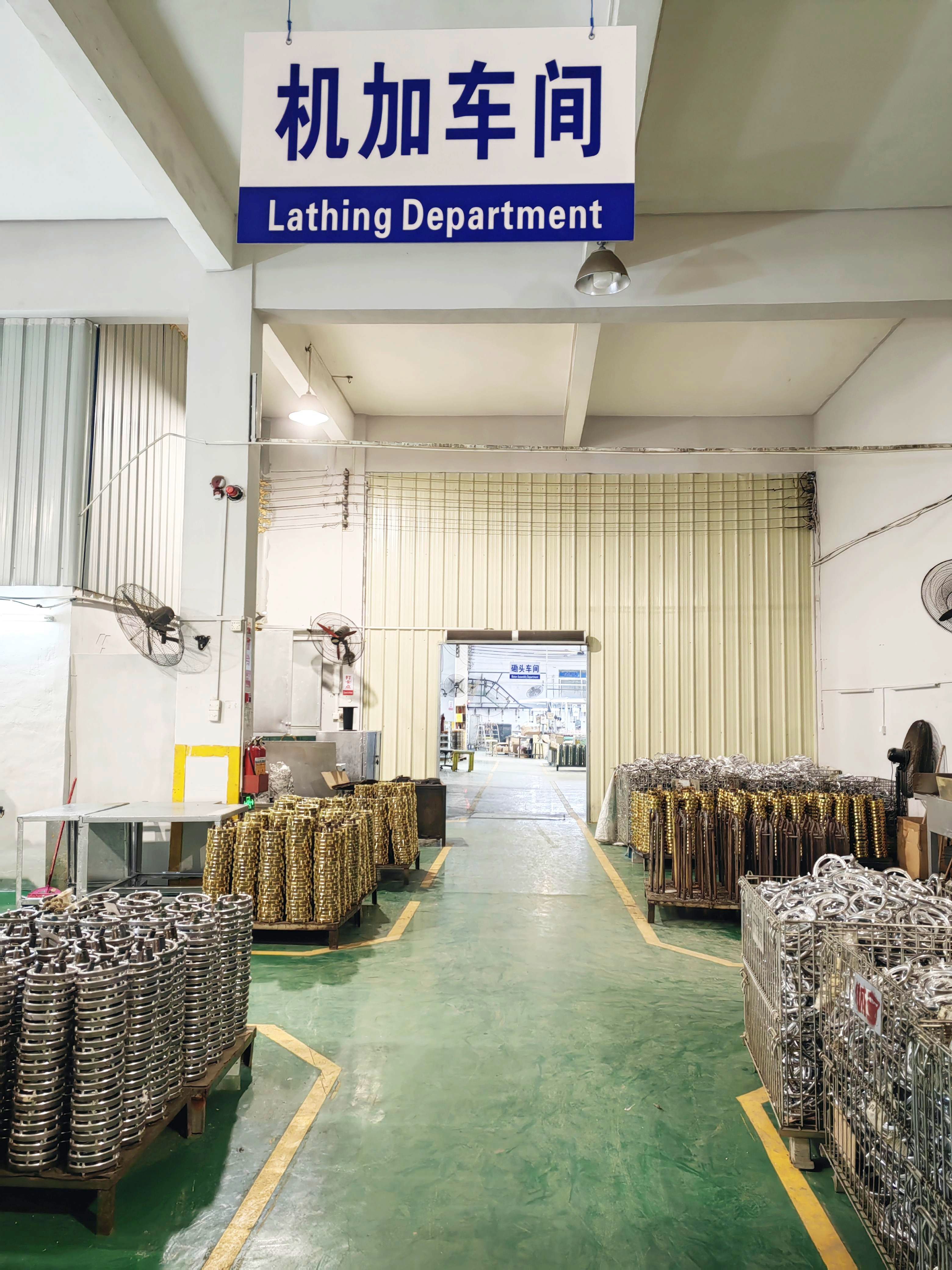
Steel housing components are machined in-house before finishing — the housing carries the motor, the blade attachment and the mounting interface.
Finish: Matt White
The finish is specified as Matt White. Finish is a project decision as much as an aesthetic one: when dozens of identical units are installed in the same building, batch-to-batch colour consistency becomes part of acceptance. Handing does its painting in-house and states that its 100% owned electroplating factory exists to keep plating quality, delivery timing and cost under control — the same logic applies to finish consistency on a repeat order.
Light kit: 24W CCT LED
CCT stands for correlated color temperature, the measure of how warm or cool a light source appears. A CCT LED light kit therefore means the colour temperature is selectable rather than fixed at a single value. Two verification items follow: which CCT steps the kit actually offers, and what light output and dimming behaviour the driver supports. The 24W figure describes power drawn, not the amount of light delivered — the two are related but not interchangeable.
Control: smart WiFi
A smart WiFi ceiling fan places motor and light control into a network-connected module, usually operated through an app. Four points should be confirmed before the specification is signed: which app or ecosystem the module works with; whether the WiFi module is integrated into the housing or supplied as a separate unit; how the fan behaves if the network or the phone is unavailable, whether through a wall switch or a handset backup; and whether speed and light are controlled from one interface or two. A pull-chain fan and a WiFi fan can look identical on the ceiling and behave completely differently in daily use.
Packaging: 720 × 225 × 350 mm
The carton measures 720 mm long, 225 mm wide and 350 mm high. That is the first input for container load planning, pallet configuration and warehouse slotting. Master carton quantity and pallet pattern should be confirmed with the supplier before a container is booked, since they determine the real shipped volume far more than the unit dimension alone.
The quality chain behind the specification
Specifications are only as reliable as the process that repeats them. Handing's ceiling fan and lighting factory has been ISO 9001 certified since 1996; in 2006, in response to the EU RoHS regulation, the company installed an XFS machine and chemical testing, approved by TUV PS in the same year. Production runs through a 12,320.66 m² factory with 350 employees and a 6-engineer R&D team, with an annual output of 480,000 units.
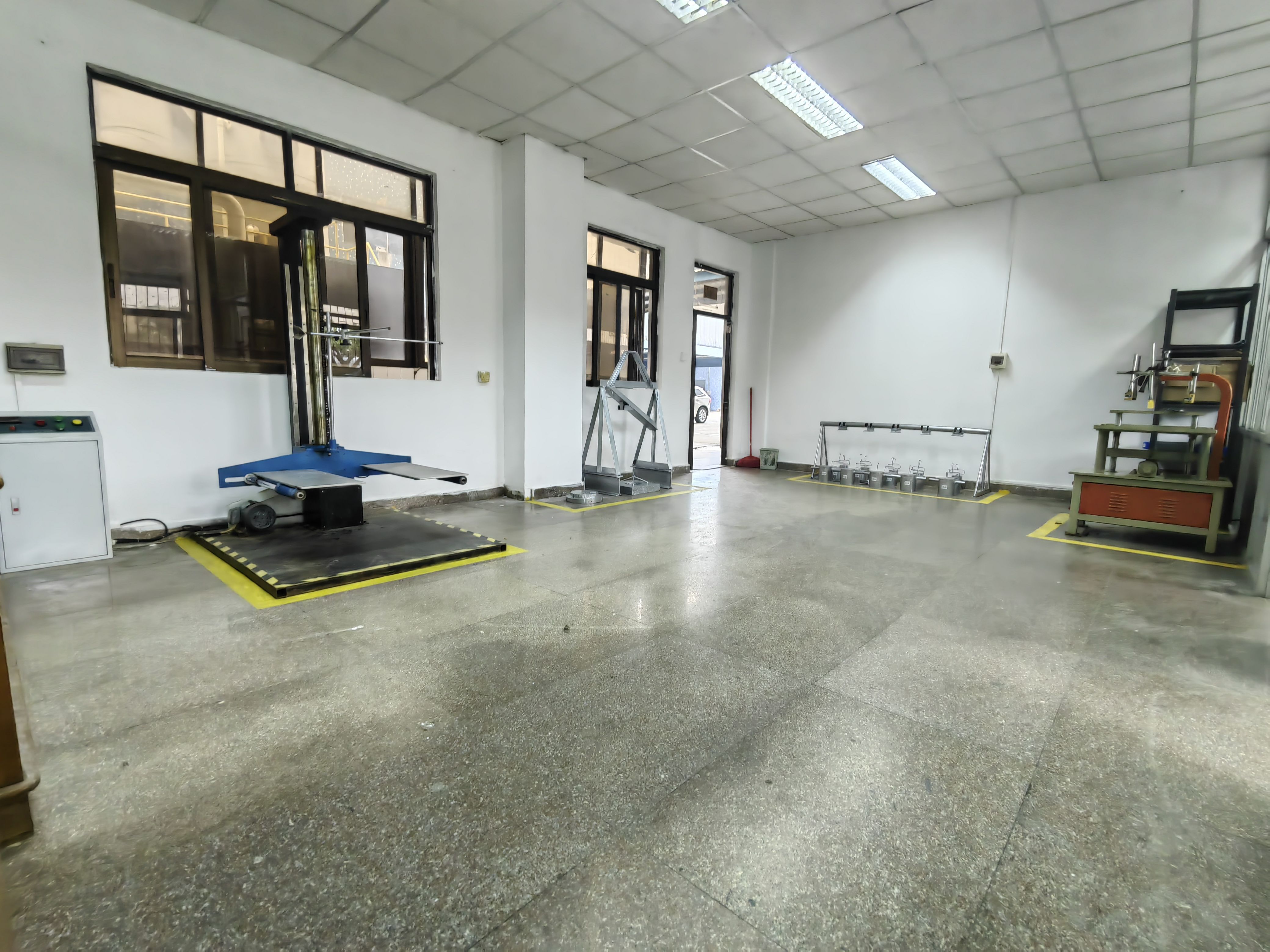
The IQC testing room: incoming components and finished units are inspected before release — the point where a data-sheet line becomes a repeatable production fact.
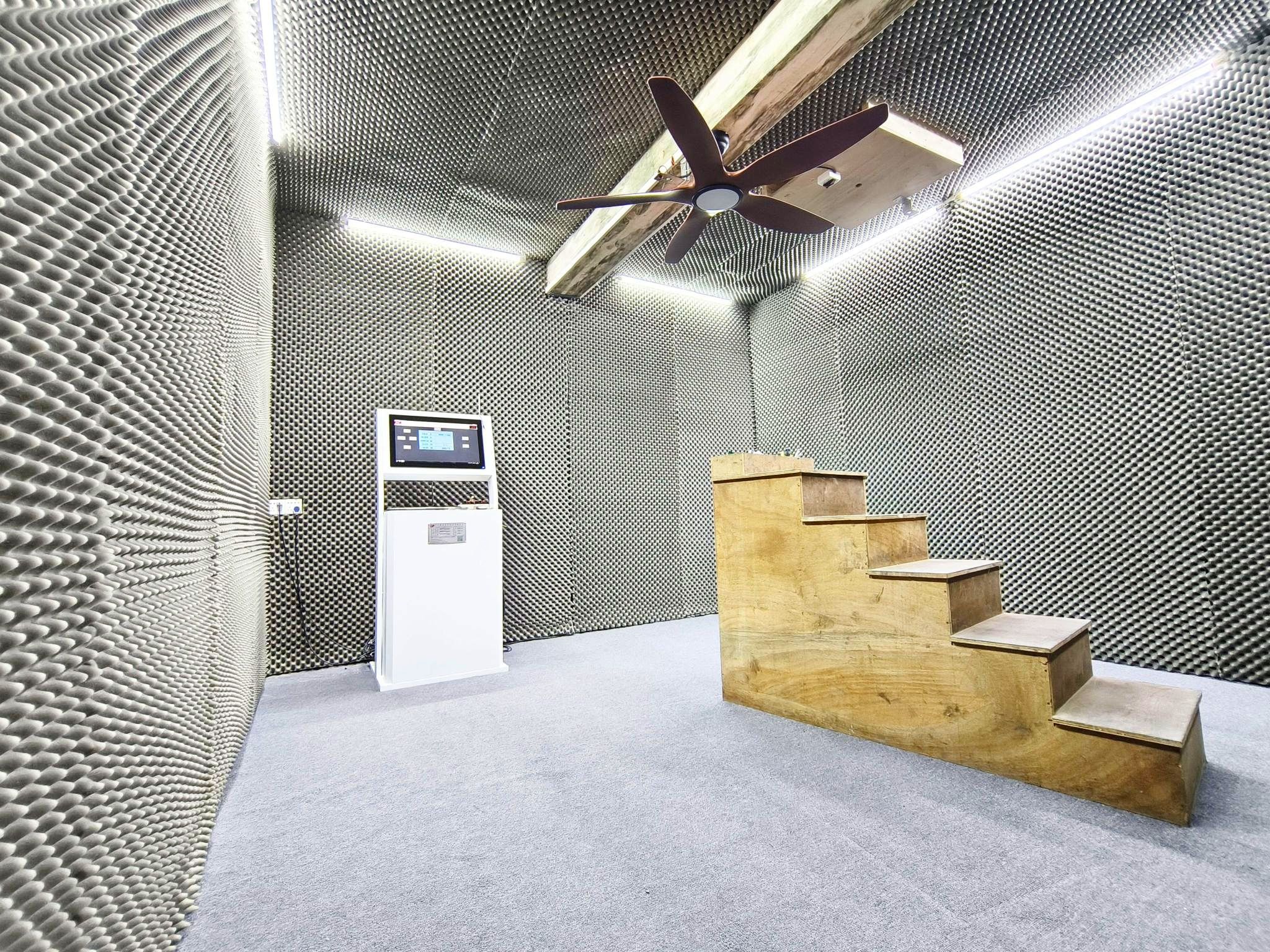
Handing's 6-engineer R&D team supports specification work on housings, motors, light kits and control modules.
Step-by-step: building a DC ceiling fan specification for a project
The sequence below reflects how a specification is normally closed from brief to purchase order. It assumes the fan is an indoor decorative or commercial-grade model, which is the application range of the TU52-MW-N3A1DOME.
- Write the room brief before the fan brief. Record ceiling height, ceiling type, room use, and whether the space is occupied while the fan runs. A guest room, a restaurant floor and a warehouse office generate very different noise and airflow expectations from the same 52-inch fan.
- Fix the span against the ceiling, not the catalogue. Confirm the span works with the mounting position and the number of fans required. If ceiling height is limited, low-profile mounting becomes a constraint to check first, because it changes both the drop and the airflow pattern.
- Set blade material and blade count as a written line. Specify the blade material and the number of blades — for this model, three ABS blades. Confirm how the blades attach, since no separate blade holder is listed for TU52-MW-N3A1DOME and the interface belongs to the housing assembly.
- Read the housing and motor as one line. A housing that carries a DC motor is a different assembly from a housing that carries an AC induction motor. Confirm the motor type, the housing material and who manufactures both, because that is where repeat-order consistency is won or lost.
- Define the light by colour temperature and output, not by wattage. State the CCT requirement and the light output requirement separately, and confirm the dimming behaviour and driver compatibility at the same time as the 24W rating.
- Define control and switching behaviour. Decide whether the project runs on WiFi, remote or pull chain, then confirm how the fan behaves when the network is down and whether light and speed share one interface.
- Close the compliance and logistics files together. Assemble the model-level certificate for each destination market, the finish approval, and the packaging data (720 × 225 × 350 mm for this model) before the order is scheduled. Late compliance documents delay shipments more often than production does.
Use cases: household and commercial interiors
TU52-MW-N3A1DOME is specified for household and commercial applications as an indoor decorative ceiling fan with light, and its configuration points to a fairly specific set of interiors.
- Residential living rooms and bedrooms. The combination of a steel housing, three ABS blades, a 24W CCT LED kit and WiFi control suits a room where the fan is expected to serve as both the light source and the air mover, and where the finish has to read as part of the interior.
- Hotel and hospitality guest rooms. The value here is repeatability rather than novelty: one model number, one finish, one control interface across many rooms, provided the certificates for the destination market are in the project file.
- Cafés, restaurants and retail interiors. Decorative housings and a neutral Matt White finish matter where the ceiling is exposed, while the selectable CCT LED kit allows the lighting to be matched to the venue's colour scheme rather than fixed at installation.
- Offices and commercial interiors with central ceiling lighting. Here the light kit is often secondary and the DC motor is the main reason for the specification, because finer speed steps allow airflow to be tuned to occupancy.
- Multi-unit residential projects. Identical specification across units simplifies procurement, spare-part planning and after-sales handling.
One limit should be stated plainly. This model is specified as an indoor decorative ceiling fan for household and commercial use. Installations exposed to weather, spray or washdown require a different specification and should be evaluated separately rather than adapted from an indoor model.
Comparison table: matching specification lines to project scenarios
The table below maps common project scenarios to the specification line that carries the most risk in each case, using only the published parameters of TU52-MW-N3A1DOME and Handing's documented manufacturing position.
| Project scenario | Specification line that carries the risk | TU52-MW-N3A1DOME position | What to verify before ordering |
|---|---|---|---|
| Residential living room or bedroom | Span and light colour | 52-inch span, 3 × ABS blades, 24W CCT LED kit, smart WiFi control | Mounting height, ceiling type, and the CCT steps the kit offers |
| Hotel or hospitality guest room | Repeatable specification across many rooms | Single model data sheet; steel housing and Matt White finish; factory ISO 9001 certified since 1996 | Model-level certificate for the destination market; finish approval sample |
| Café, restaurant or retail interior | Housing construction and finish consistency | Steel housing, Matt White finish, in-house painting and 100% owned electroplating factory | Batch finish consistency and how the light kit is controlled by staff |
| Office or commercial interior driven by airflow | Motor type and speed control | DC motor in a 52-inch TU housing; WiFi control interface | Low-speed behaviour and how the control module handles network outages |
| Multi-unit residential project | Logistics and packaging planning | Carton 720 (L) × 225 (W) × 350 (H) mm | Master carton quantity and pallet pattern before booking containers |
| Distributor stocking for resale | Capability and delivery reliability | 12,320.66 m² factory, 350 employees, 6-engineer R&D team, 480,000 units annual output | Spare-part list and after-sales route for the control module |
The table below compares motor technologies as general engineering principles, not as competitive claims about any brand. Actual performance for any model must come from that model's own test data.
| Consideration | Conventional AC motor fan | DC motor fan (general principle) |
|---|---|---|
| Speed control | Typically a limited set of steps | Electronic commutation supports finer speed steps |
| Noise at low speed | Often the harder operating case | Generally quieter running at low speed |
| Control integration | Pull chain or handset | Controller-based; supports WiFi modules where specified |
| Reverse rotation | Varies by model | Controller-set, where the model supports it |
| Verification item | Capacitor and switch rating | Motor controller behaviour and app reliability |
FAQ: compliance, capability, budget, samples and delivery
1. What certification should a US or EU project expect from a DC ceiling fan with light?
Certification is issued per model and per market, so the certificate — not the product page — is the evidence. Handing Co. Ltd. states that its products are listed in UL, cUL, Nom, BSI, CE, GS, Swedish Standard and SAA, and that its European fans carry LVD/GS/TUV, EMC, EMF, RoHS and ERP. The ceiling fan and lighting factory has held ISO 9001 certification since 1996. Two current standards are worth checking against the file: in the United States, UL 507 was updated with a new version effective November 27, 2024, adding secondary thermal or current fuse requirements for fans installed in unattended areas; in the European Union, EN IEC 60335-2-80:2024 establishes safety requirements for household fans, including ceiling fans, with rated voltages up to 250 V for single-phase equipment. Ask for the document that names the exact model and destination market.
2. Can blade span, blade material or the light kit be adapted for a specific project?
Capability is best judged by what a factory controls in-house. Handing produces most of its own metal parts, does its own painting and assembles its own motors, and owns 100% of its electroplating factory; a 6-engineer R&D team works on product development. That structure is what makes a specification discussion possible in the first place. It does not mean any change is free of verification, however: changes to blades, light kit or control module affect balance, electrical safety and control behaviour, and each change should be re-tested before release. The reliable starting point is the standard configuration of TU52-MW-N3A1DOME — 52-inch DC motor in a 52-inch TU housing, three ABS blades, steel housing in Matt White, 24W CCT LED kit and smart WiFi control.
3. What drives the cost of a decorative DC ceiling fan with LED and WiFi?
The main cost centres are the motor and its controller, the blades, the light kit, the control module, the certification scope and the packaging. Handing's stated approach to cost is structural rather than promotional: producing most metal parts in-house, doing its own painting, assembling its own motors and owning its electroplating factory keeps those processes inside one operation, which the company links to competitive cost, controlled quality and on-time delivery. When comparing quotations, compare identical specification lines — motor type, blade material, light kit, control and certification scope — because a lower price usually reflects a different line rather than a better one.
4. How can a buyer validate a sample before a project order?
Test the parameters that can be checked on a bench: the 52-inch span against the mounting drawing, the three ABS blades for material and balance, the steel housing and Matt White finish, the 24W CCT LED kit for colour temperature steps, and the WiFi control for app behaviour and single-interface control of light and speed. Handing supports this through its sample room and a quality chain that includes chemical testing introduced in 2006 and approved by TUV PS in the same year. Sample requests and quotations can be sent to sales@handingfan.com or raised through WhatsApp on +852 92839029.
5. What should be planned into delivery and order scheduling?
The carton for TU52-MW-N3A1DOME measures 720 (L) × 225 (W) × 350 (H) mm, which is the first input for container and pallet planning; master carton quantity and pallet pattern should be confirmed before booking. On the production side, Handing assembles its own motors and owns 100% of its electroplating factory, a structure the company associates with dependable delivery timing. Because the model is produced in a 12,320.66 m² factory with 350 employees and an annual output of 480,000 units, scheduling should be agreed at project level — including certificate documents and finish approval — rather than assumed from a catalogue lead time. Sharing the room brief, the destination market and the required quantity in one message is the fastest way to receive a usable schedule and quotation.
Conclusion
A DC motor ceiling fan is chosen for what its specification allows: accurate blade geometry, a housing and motor built as one assembly, a light kit whose colour temperature can be set to the space, and a control interface that matches how the building is actually operated. The TU52-MW-N3A1DOME demonstrates that logic in a single model — 52-inch span, three ABS blades, steel housing in Matt White, 24W CCT LED light kit, smart WiFi control, packed in a 720 × 225 × 350 mm carton and specified for household and commercial indoor use.
The project discipline is the same regardless of model: write the room brief first, fix the span against the ceiling, specify blade material and blade count in writing, read housing and motor as one line, define the light by CCT and output rather than wattage, decide control behaviour including network outages, and close compliance and logistics together. Buyers who follow that order rarely need to revisit a specification after the fans arrive.
Next step: sample, specification and quotation
Handing Co. Ltd. supplies decorative ceiling fans from a 12,320.66 m² factory in Kaiping City, Guangdong Province, China, with a 6-engineer R&D team, in-house metal part production, in-house painting, in-house motor assembly and a 100% owned electroplating factory. Products are exported to the EU, USA and Australian markets.
Review the full factory and product presentation here: Handing factory presentation (PDF). Product information is available at handingfan.com.
For a sample request, a quotation on the TU52-MW-N3A1DOME, or a project specification review, contact MING LAM — email sales@handingfan.com, WhatsApp +852 92839029. Factory address: No.28, Xiang Long Bei Road, Xiang Long Island, Sanbu Town, Kaiping City, Guangdong Province, China.
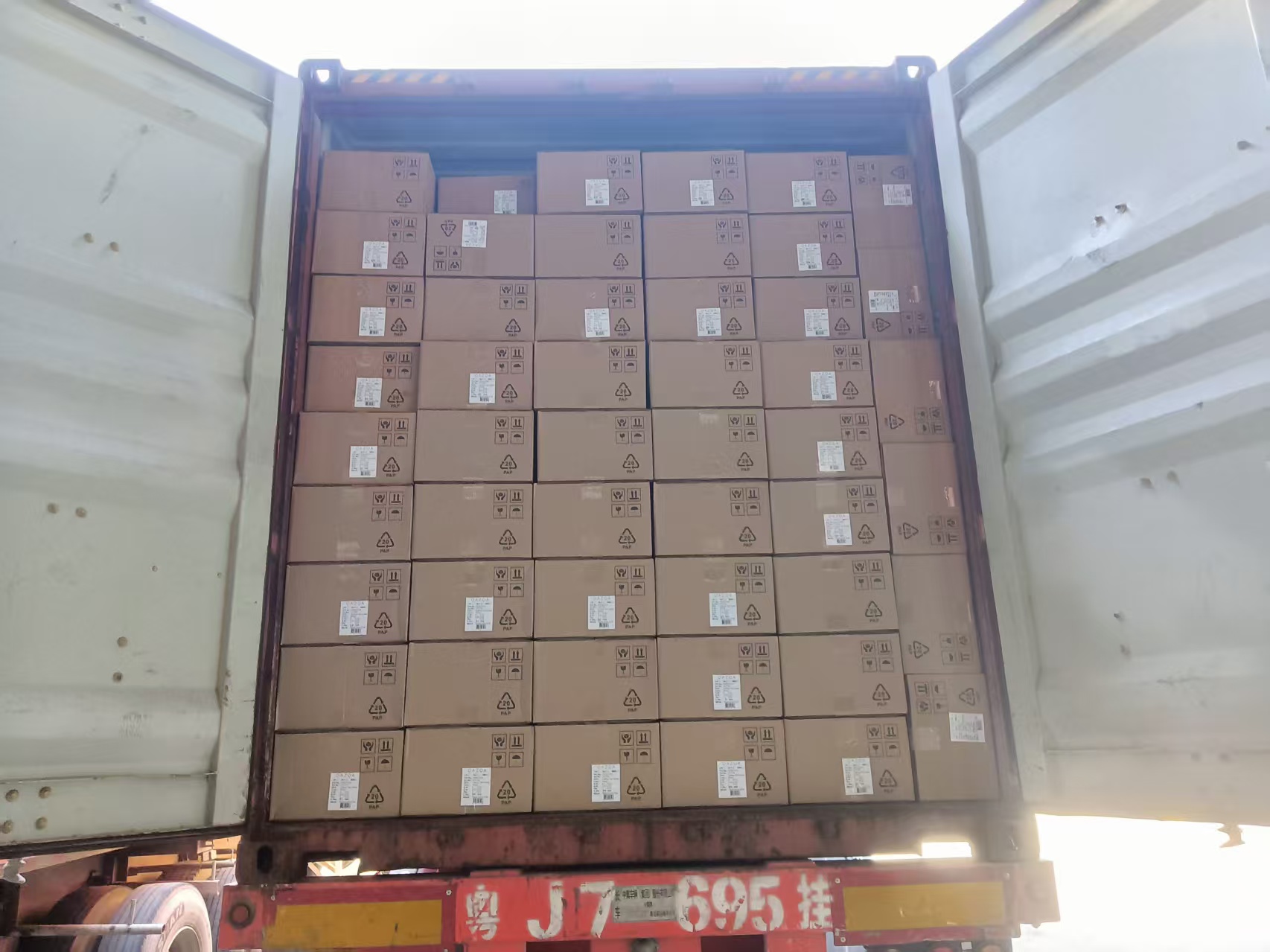
Carton data from the data sheet, such as the 720 × 225 × 350 mm carton for TU52-MW-N3A1DOME, feeds directly into container and pallet planning.