
Ceiling Fan Basics: How to Identify a Durable, Compliant, and Well-Engineered Model
Ceiling Fan Basics: How to Identify a Durable, Compliant, and Well-Engineered Model
A ceiling fan is a purchase that most buyers make only a few times in their lives, so it is easy to underestimate what matters. The strongest buying signal for a long-lived fan is not a stylish blade finish or the number of speed settings. It is the combination of motor architecture, material quality, certification coverage, and the manufacturer’s ability to consistently reproduce those details. This guide explains what a ceiling fan actually is, what the global market looks like, and how to evaluate a fan using concrete engineering and compliance criteria.
What Is a Ceiling Fan and What Does It Do?
A ceiling fan is an electrically powered, ceiling-mounted device with rotating blades that move air to improve indoor comfort. In warm seasons, the airflow creates a wind-chill effect that makes a room feel cooler without lowering the thermostat. In cooler months, many models can reverse blade direction to redistribute warm air trapped near the ceiling.
Although it is sometimes treated as a simple appliance, a modern ceiling fan is a small electromechanical system. Its main components include a motor, a blade set, a mounting system, and, increasingly, an integrated light source and electronic controls. The way these components are designed and assembled determines how quiet the fan operates, how long it runs, how safely it behaves under electrical fault conditions, and how convenient it is to use every day.
From a buyer perspective, the practical definition of a good ceiling fan is one that delivers consistent airflow, stays quiet over time, meets the safety standards of its destination market, and does not require frequent maintenance. Every specification choice should be tested against those four outcomes.
Ceiling Fans in the Market: Demand, Standards, and What It Means for Buyers
Ceiling fans are not a niche product. The global ceiling fans market was estimated at USD 14.24 billion in 2023 and is projected to reach USD 19.92 billion by 2030, growing at a compound annual growth rate (CAGR) of 5.0% from 2024 to 2030. Asia Pacific held the largest regional revenue share at 44.85% in 2023, driven by high demand in India and China. China’s export volume of fans classified under HS code 841459 reached 509 million units in 2024, with a total export value of USD 3.788 billion, a 6.96% increase over the previous year.
These figures matter for buyers because they confirm two things. First, the global supply chain is deep, and sourcing options are abundant. Second, because so much manufacturing is concentrated in a few regions, buyers cannot assume that all exported fans meet the same technical bar. Certification is the main tool for separating products that are genuinely engineered for a market from products that are simply shipped to it.
Several recent standard updates reinforce this point. In the United States, the safety standard for electric fans, UL 507, was updated with a new version effective November 27, 2024, which added secondary thermal or current fuse requirements for fans in unattended areas. In Europe, the safety standard EN IEC 60335-2-80:2024 establishes safety requirements for household fans, including ceiling fans, with rated voltages up to 250V for single-phase products. For energy efficiency, ENERGY STAR certified ceiling fans are required to be up to 44% more efficient than conventional fans, and the 2024 Most Efficient criteria for standard fans require efficiency of at least 3.25D + 107 CFM/W, where D represents blade diameter in feet.
For a buyer, the practical interpretation is simple. A compliant fan may cost more to produce, because certification requires real engineering work, component quality, and factory testing. A fan without the right certification is not necessarily poorly made, but it carries an unverifiable safety and performance profile. In professional purchasing, unverifiable is a risk, not an opinion.
Ceiling Fan Motor and Design Choices: What Actually Affects Performance
The motor is the core of any ceiling fan. Unsurprisingly, motor design has a direct effect on noise, efficiency, speed control, and long-term reliability. Two families of motors dominate the market: traditional AC induction motors and brushless DC motors.
AC motors are widely used and inexpensive to manufacture. They are robust and familiar, but they tend to consume more electricity, run at fixed speed points, and produce more electrical noise when operated on low-speed settings.
DC motors, specifically brushless DC motors, convert electricity more efficiently and allow fine speed control without significant energy loss. A DC ceiling fan also tends to run more quietly than an AC model at the same speed, which is why quiet operation is often cited as a benefit of DC-powered fans. DC motors also create less heat, which can extend the life of the motor and associated electronic components.
Blade materials and construction also matter, but not in the way many consumers assume. The blade does not need to be heavy to be good; it needs to be balanced, rigid, and resistant to warping. Common materials include ABS plastic, engineered wood, and metal. ABS blades are lightweight and maintain consistent dimensions in humid conditions, which is particularly useful for indoor fans that may be used in coastal or high-humidity environments.
Another design detail that is frequently overlooked is the mounting system and housing. A fan that is structurally rickety will develop wobble and noise even with a good motor. A fan with a rigid housing, stable mounting hardware, and properly balanced blades will run quietly for years. Buyers should therefore look at the fan as a system of parts, not just as a motor with decorative accessories.
Important Categories of Ceiling Fans: Decorative, Commercial Grade, Indoor, Outdoor, and Smart
To choose correctly, buyers need to understand the categories that are used in product listings and supplier documentation.
Decorative Ceiling Fans
A decorative ceiling fan is a fan whose visual design is treated as an integral part of the product, not an afterthought. Decorative models may feature vintage styling, integrated lighting, specialized finishes, or sculptural blade forms. However, decorative does not mean fragile. A well-designed decorative fan should satisfy the same electrical safety and performance expectations as any other ceiling fan.
Commercial Grade Ceiling Fans
Commercial grade is a durability classification rather than a formal legal term. A commercial grade ceiling fan is designed to withstand longer operating hours, more frequent switching, and more demanding installation conditions than a typical residential fan. Commercial grade construction usually implies a sturdier motor, higher quality components, and more conservative engineering margins. Buyers should still verify that the commercial grade claim is supported by the actual bill of materials and by the certifications held by the product.
Indoor and Outdoor Ceiling Fans
Indoor ceiling fans are intended for dry, sheltered environments. Outdoor ceiling fans are additionally designed to resist moisture, humidity, and temperature variation. Outdoor fans typically use marine-grade or moisture-resistant finishes, sealed motors, and corrosion-resistant fasteners. A fan that is built for outdoor use can usually be installed indoors, but an indoor-only fan should not be installed outdoors. When in doubt, buyers should request documentation that confirms the fan’s suitability for the intended installation location.
Ceiling Fans With Light
A ceiling fan with an integrated light kit combines air movement and ambient lighting in one fixture. The light source is usually an LED module or an integrated LED light kit. Some models offer CCT (Correlated Color Temperature) control, which allows the user to adjust the color tone of the light between warm and cool settings. For buyers, the key considerations are the light output, the color temperature range, the replaceability of the LED module, and whether the light control is integrated into the fan’s remote or smart system.
Smart WiFi Ceiling Fans
A smart WiFi ceiling fan connects to the home or building network, allowing control through a smartphone app or a voice assistant. Smart functionality adds convenience, scheduling, and remote control. However, it also adds complexity. Buyers should check which network protocols the fan supports, whether an existing home automation system is compatible, and how the fan behaves if the WiFi connection is lost. A reliable smart fan should still work as a normal fan when offline.
Pull Chain and Handheld Remote Controlled Ceiling Fans
Pull chain control is the simplest ceiling fan interface, with a cord that mechanically or electrically cycles through speeds and light settings. Handheld remote control replaces the pull chain with radio frequency or infrared commands. Remote control offers convenience but requires a receiver unit and often a battery in the remote. For commercial installations where the fan mounting height is high, wall controls or handheld remotes are usually more practical than pull chains.
Example Specification: TU52-MW-N3A1DOME 52-Inch Smart LED Ceiling Fan
To make the selection criteria concrete, this section reviews a real product specification. The TU52-MW-N3A1DOME ceiling fan is manufactured by Handing Co. Ltd., a ceiling fan producer based in Kaiping, Guangdong, China. The fan is classified as an indoor decorative ceiling fan with light and smart WiFi control, and is intended for household and commercial use. It can also be described as a commercial grade indoor fan because its construction and intended operating envelope are aligned with more demanding usage.
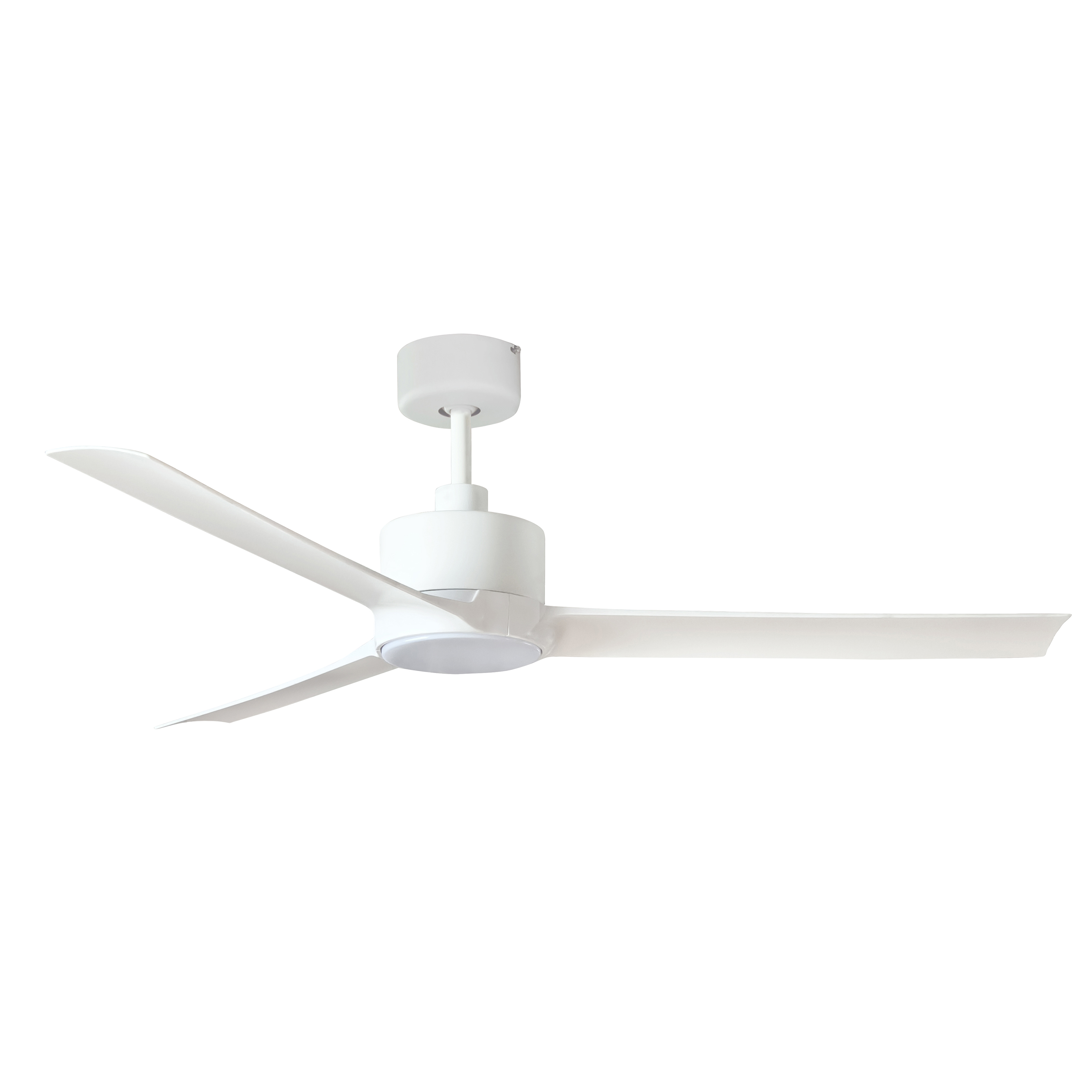
Key Specification Summary
| Specification | Detail |
|---|---|
| Item No. | TU52-MW-N3A1DOME |
| Housing | 52" TU housing, DC motor |
| Finish | Matt White |
| Blades | 3 x ABS |
| Light Kit | 24W CCT LED light kit |
| Materials | Steel housing + ABS blades |
| Box Size | 720(L) x 225(W) x 350(H) mm |
| Intended Use | Household, Commercial |
The 24W CCT LED light kit provides adjustable light color temperatures, which allows the same fixture to support different room moods or activity needs. The DC motor contributes to quieter operation and more flexible speed control. The steel housing gives structural rigidity, while the ABS blades can maintain consistent balance and shape in indoor conditions. This combination illustrates a broader point: the best fan spec is not the one with the longest list of features, but the one where the motor, materials, and electronic components are coherently aligned with the intended use.
Certifications and Safety Standards to Check Before Buying a Ceiling Fan
Certifications are the most reliable external evidence that a ceiling fan has been designed and tested to a recognized level of safety. A certification mark means that a sample of the product, and often its manufacturing process, has been assessed against a formal standard.
Buyers should expect certifications to match the destination market. For the U.S. market, UL and cUL listing are the most commonly accepted safety certifications for electrical fans, with UL 507 being the relevant standard. For Canada, cUL or other recognized certification is expected. For European markets, common certifications include CE, which covers a range of EU directives, as well as GS, TUV, and other marks depending on the country of sale. For Australia and New Zealand, RCM or SAA approval is typically required. For international buyers sourcing from China, it is also reasonable to see Nom for Mexico or BSI for the United Kingdom.
For the products that a buyer is evaluating, it is best to ask for a list of the exact certifications held by the model, not just by the factory or the company. A company can hold ISO9001 quality management certification, which is a valid indicator of factory process discipline, but it is not a substitute for product-level electrical safety certification.
How to Evaluate a Ceiling Fan Supplier or Manufacturer
When the purchase is a single unit, the buyer evaluatesthe product. When the purchase is a running volume order, the buyer also evaluates the producer. For global buyers and distributors, manufacturer evaluation is often the difference between repeatable quality and one-off luck.
Production Capability and Vertical Integration
A manufacturer that controls more of its production steps can usually manage cost, quality, and lead time better than one that only assembles bought-in parts. Handing Co. Ltd., for example, owns a 100% electroplating factory. This is a meaningful vertical integration detail because electroplating quality directly affects the corrosion resistance and cosmetic finish of metal parts. When a manufacturer controls electroplating in-house, it can reduce dependency on outside suppliers and tighten quality consistency.
Factory Scale and Quality Systems
Factory scale is a useful sanity check, not a guarantee of quality. Handing’s manufacturing facility covers 12,320.66 square meters and employs approximately 350 staff. Its annual production capacity is 480,000 units, and the R&D team consists of 6 engineers. The company’s ceiling fan and lighting factory obtained ISO9001 certification in 1996. These facts indicate that the company has sustained a quality management system for three decades and operates with enough capacity to support steady export flows.
Export Experience and Market Fit
For buyers outside China, export experience is a practical proxy for market familiarity. Handing’s major markets include the EU, USA, and Australia, and its export business accounts for 100% of total sales. A company that exports all of its production must maintain documentation, packaging, labeling, and certification processes that align with multiple foreign markets. This reduces the chance that a buyer’s first order becomes the manufacturer’s first lesson in a new market.
Ceiling Fan Comparison: Positioning by Category and Control Type
The table below presents a category-level comparison framework. It is not an exhaustive ranking, but a practical tool for matching product priority to buyer needs.
| Fan Category | Primary Benefit | Typical Environment | Key Buying Criteria |
|---|---|---|---|
| Decorative Ceiling Fan | Visual design matches interior style | Living rooms, bedrooms, hospitality spaces | Finish quality; light integration; motor smoothness |
| Industrial / Commercial Grade Fan | Longer operating life and consistent airflow | Retail, restaurants, offices, warehouses | Motor durability; structural rigidity; certification |
| Indoor Ceiling Fan | Comfort cooling in sheltered spaces | Dry indoor rooms | Quiet operation; speed control; light quality |
| Outdoor Ceiling Fan | Moisture and weather resistance | Patios, verandas, exposed areas | Sealed motor; corrosion-resistant finish; rating |
| Ceiling Fan With Light | Combines air movement and ambient light | Rooms where ceiling light is required | LED output; CCT range; driver reliability |
| Smart WiFi Fan | App and voice control plus scheduling | Smart homes and automated buildings | Protocol compatibility; offline behavior; app quality |
| Pull Chain Fan | Simple mechanical control | Utility spaces, low-cost installations | Switch durability; pull chain length; ease of use |
Readers should also track manufacturer reputation in parallel. The leading global ceiling fan manufacturers identified in market research include Hunter Fan Company, Crompton Greaves, Havells India, Big Ass Fans, and Minka Group. These brands serve different segments and price points. A global buyer can use this list as a reference for market structure, but should evaluate each product on its verified certifications, specification sheet, and factory audit results rather than on brand recognition alone.
Step-by-Step Ceiling Fan Selection Workflow
The following workflow can be applied to both single-unit purchases and bulk sourcing decisions. It is designed to avoid the two most common buying mistakes: choosing a fan purely on appearance, and choosing a fan purely on price.
Step 1: Define the Installation Environment
Determine where the fan will be installed. Is the space indoor or outdoor? Is the ceiling height standard, high, or sloped? Is the room humid, dusty, or subject to temperature extremes? The environment defines the minimum protection level the fan needs.
Step 2: Define the Required Function Set
List the functions that are essential, not the functions that are merely attractive. Is lighting required? Is smart control needed? Is a pull chain acceptable or is remote control necessary? Every function adds cost and another component that can fail, so the final list should be disciplined.
Step 3: Identify the Required Certifications
Check the certification requirements of the destination market. For the USA, determine whether UL, cUL, or ENERGY STAR is needed. For Europe, identify whether CE, GS, TUV, or other marks are required. For Australia, confirm whether SAA approval is expected. Write these requirements down before contacting suppliers. This prevents vague conversations and makes supplier responses easy to compare.
Step 4: Match Motor Type to the Usage Profile
For residential fans that run at low speed for long hours, a DC motor is often the better choice because of low power consumption and quiet operation. For high-airflow industrial applications, the buyer should compare the verified airflow rating and motor durability rather than assuming one motor type is universally superior.
Step 5: Evaluate the Bill of Materials
Ask which materials are used for the housing, blades, fasteners, and light kit. A steel housing indicates better structural rigidity. ABS blades are dimensionally stable in humid environments. Powder-coated or electroplated finishes indicate better corrosion protection. The bill of materials reveals where a manufacturer has invested in quality and where it has saved cost.
Step 6: Audit the Factory and Request Samples
For volume orders, a factory audit or video inspection is strongly recommended. Buyers should request pre-production samples and, when feasible, have the samples tested by an independent laboratory. A reliable supplier will agree to this process because it reduces the risk of a mismatched specification on both sides.
Step 7: Compare Total Cost, Not Unit Price
Calculate the total cost including freight, customs, certification fees, replacement parts, and expected downtime for failures. A fan with a cheaper unit price but a shorter service life will usually cost more over a five-year period. Unit price alone is not a sufficient metric for a long-lived product.
Practical Use Cases
The following use cases translate the selection framework into real-world scenarios.
Use Case 1: Installing Decorative Fans in Apartments and Hotels
A property developer renovating apartments or boutique hotels needs fans that look intentional in the space and can withstand daily guest use. A decorative model such as the TU52-MW-N3A1DOME, with its Matt White finish, 24W CCT LED light kit, and integrated smart WiFi control, can satisfy both aesthetic and functional requirements. The steel housing and ABS blades support long service in high-turnover environments.
Use Case 2: Upgrading Residential Bedrooms to DC Fans
A homeowner replacing an old AC fan in a bedroom wants quiet nighttime operation and pleasant light. A DC motor fan with a CCT LED light kit can deliver both. The ability to adjust light color temperature is especially useful in a bedroom because warm light in the evening supports relaxation while cool light improves visibility during dressing and reading.
Use Case 3: Sourcing Commercial Grade Fans for Retail or Office Spaces
A facility manager sourcing fans for a retail store or office needs units that run reliably for extended operating hours. The commercial grade classification, DC motor construction, and documented safety certifications should be confirmed in writing. The buyer should also ask about spare parts availability, because a fan that cannot be repaired in the field becomes a disposal cost, not an appliance.
Use Case 4: Selecting Smart Fans for a Connected Building
For a building with a WiFi network and integrated control systems, the smart capabilities of the fan are as important as its mechanical quality. The buyer should confirm that the fan supports the building’s control ecosystem and that the fan retains manual control during network outages. A smart fan that fails when the network fails is not a smart purchase.
Frequently Asked Questions
What is the difference between UL, CE, and SAA certified ceiling fans?
UL, CE, and SAA are certification marks that correspond to different markets and standards. UL certification is associated with the U.S. and Canadian markets, with UL 507 being the standard for electric fans. CE marking is required for many products sold in the European Economic Area and indicates conformity with applicable EU directives. SAA approval is a safety approval used for electrical products in Australia and New Zealand. The presence of a mark indicates that the product has been tested or assessed in line with the relevant requirements, but a mark that is valid in one market does not automatically certify the product in another.
What are the main benefits of a DC ceiling fan?
A DC ceiling fan uses a brushless direct current motor, which is generally more energy-efficient than a traditional AC motor. DC motors also produce less electrical noise and heat, which supports quieter operation at low speeds. Because DC fans are controlled electronically, they can offer a wider range of speed settings while maintaining efficiency. These characteristics make DC fans well suited for bedrooms, living spaces, and any application where energy consumption and noise are important.
What should I check when buying a 52-inch ceiling fan with light?
When buying a 52-inch ceiling fan with light, check the motor type, the light source and color temperature range, the blade material, the certifications, and the control method. A 52-inch fan is a common size for medium to large rooms, so the blade span should match the room dimensions. If the fan has a DC motor, verify that the speed controller and light driver are compatible. If it is an LED light kit, confirm the wattage and whether the color temperature is adjustable. Finally, check whether the model is certified for the destination market.
Which ceiling fan manufacturers are major global players?
Market research identifies Hunter Fan Company, Crompton Greaves, Havells India, Big Ass Fans, and Minka Group as leading global ceiling fan manufacturers. These companies serve different segments and geographies. For buyers who are sourcing from Asia, manufacturers such as Handing Co. Ltd. provide export-oriented production for decorative ceiling fans with 100% of sales going to markets including the EU, USA, and Australia.
Can I request an OEM ceiling fan with custom specifications from Handing?
As a manufacturer with an in-house R&D team of 6 engineers, a 100% electroplating factory, and an annual production capacity of 480,000 units, Handing has the infrastructure to support custom production programs. Prospective buyers can contact Handing directly by email at sales@handingfan.com or by phone at +852 92839029 to discuss OEM requirements.
Conclusion
The best ceiling fan is not the one with the biggest promotional claims. It is the one whose motor, materials, certifications, and controls are aligned with the environment in which it will operate. For single products, the buyer should follow a step-by-step verification process. For volume purchases, the buyer should also audit the manufacturer’s factory, quality system, and export experience. The market offers enormous choice, but the fundamentals are stable: check the environment, define the function, verify the certifications, inspect the materials, and choose a producer that can document what it promises.
Buyers who are evaluating decorative, commercial grade, or smart ceiling fans can download the Handing factory presentation to review production capability in more detail.
Download the Handing Company and Factory Presentation (PDF)
Editor’s Note and Sources
This article combines first-party product data from Handing Co. Ltd. with third-party market research and publicly available standards information. Market size and regional data are sourced from Grand View Research. China export data is sourced from TradeDaas / China Customs. Standards information for UL 507 and EN IEC 60335-2-80:2024 is based on publicly published standard summaries. ENERGY STAR requirements are based on the U.S. EPA’s published criteria. Buyers should always verify current certification status directly with the manufacturer or a recognized certification body before placing orders.
Next step for buyers and distributors: If you have a specific ceiling fan project, email your specification to sales@handingfan.com for a direct response. For our complete production capability overview, download the Handing factory presentation (PDF).