Commercial vs Engineering Concrete Mixing Plants: Buyer Comparison Guide
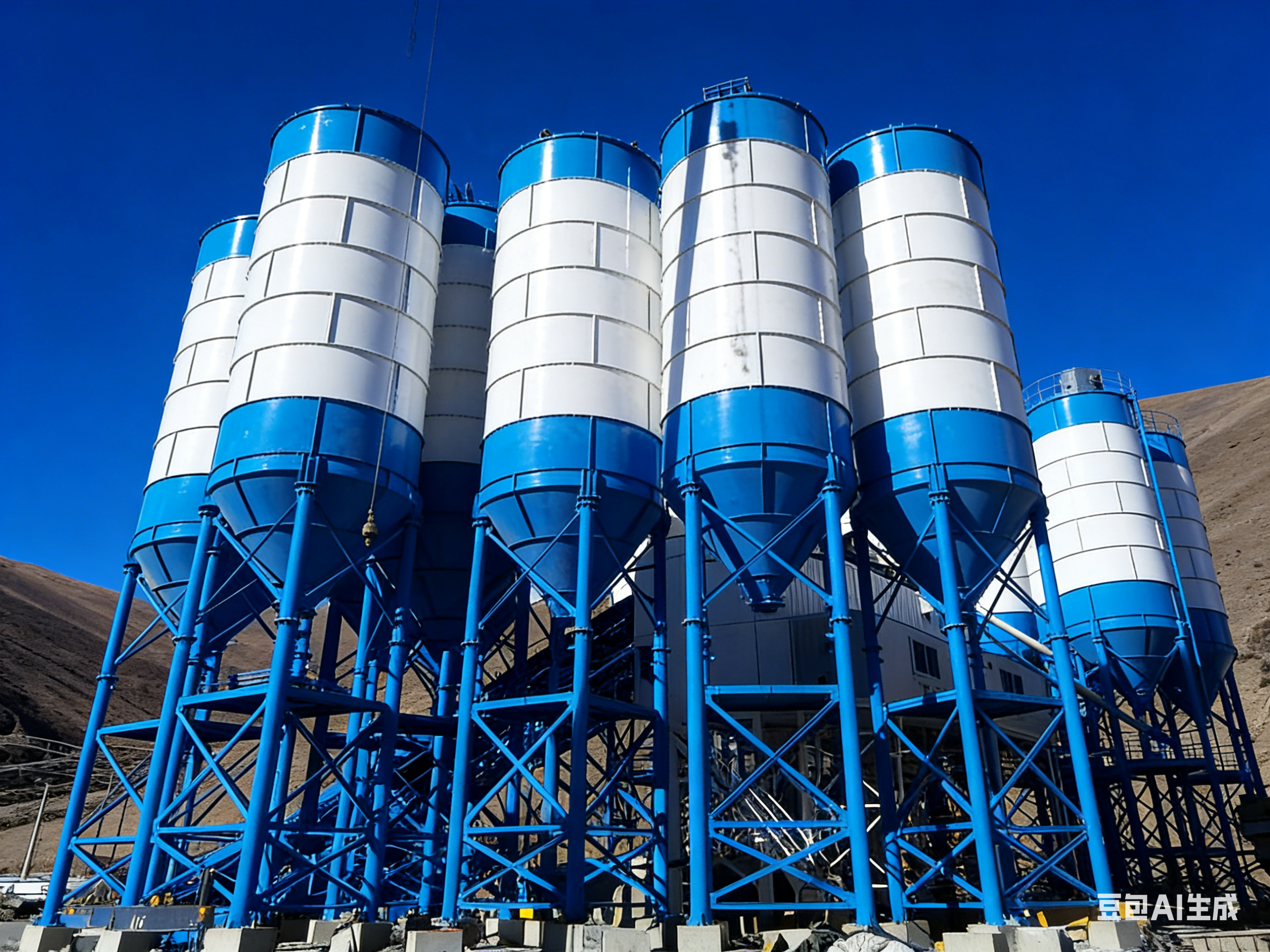
Short answer: a commercial concrete mixing plant is engineered to sell concrete — it runs stationary, continuously and at high output from a fixed urban or industrial site, feeding a ready-mix dispatch fleet. An engineering concrete batching plant is engineered to consume concrete — it is a modular, relocatable plant placed on or beside a project site to produce high-grade concrete for high-speed railway, expressway, bridge, airport and small-to-medium construction work. Headline capacity does not separate the two families: a commercial HZS180 and an engineering HZS180G are both rated at 180 m³/h with a 250 kW installed capacity and a 3000 L nominal mixer capacity. What separates them is the operating model, the control functions, the matching equipment and the site strategy.
This guide compares the two plant types against the criteria buyers actually use during Evaluation and early Execution — production role, capacity band, metering accuracy, modular design, supporting equipment, customization scope and commercial terms — using published specifications and configuration data from Hangzhou Jusheng Machinery & Equipment Co., Ltd. (DKTEC), a concrete mixing and mining machinery manufacturer founded in 2015 and based in Hangzhou, Zhejiang, China.
Problem Definition: Why Commercial and Engineering Plants Get Confused
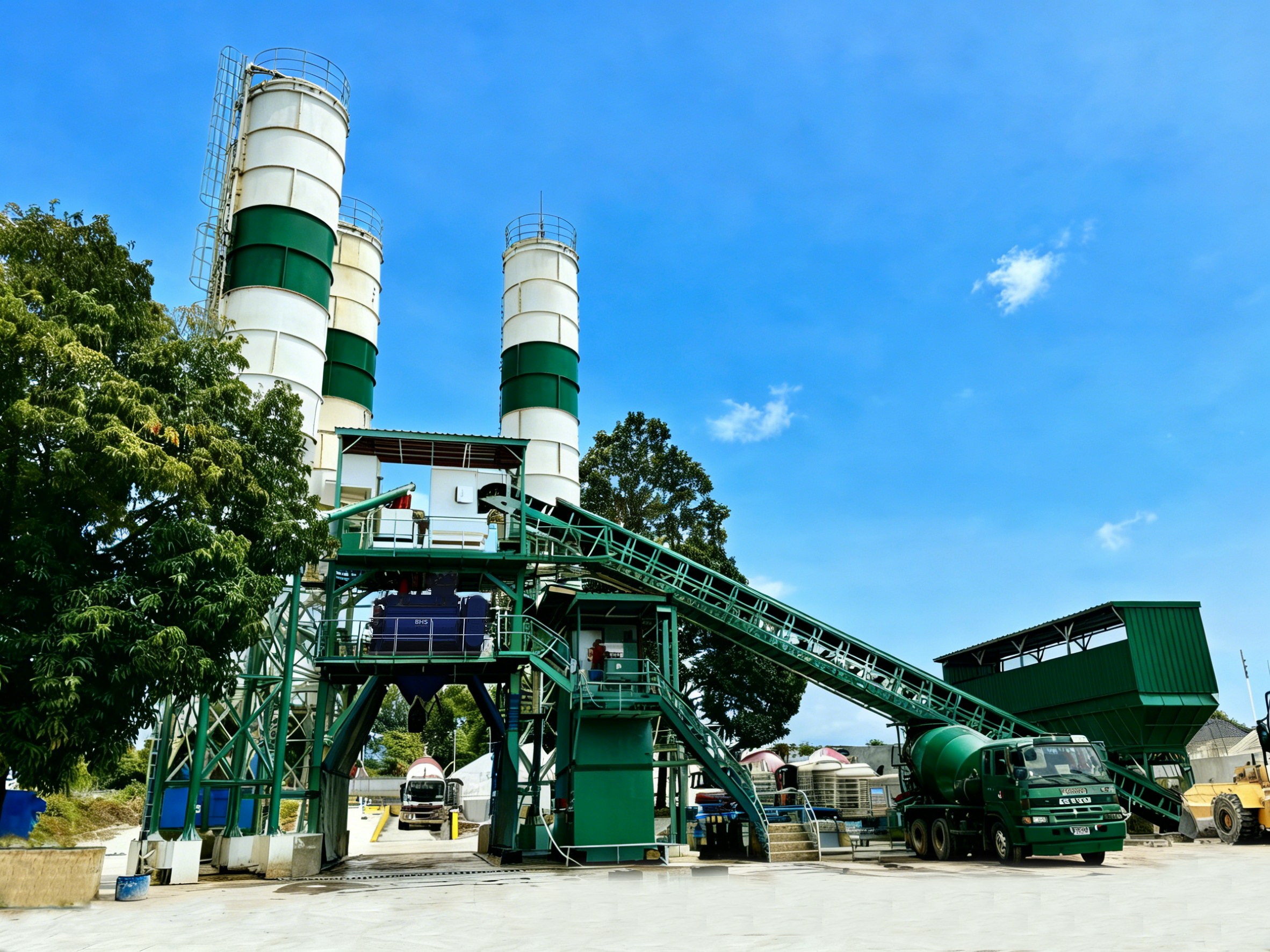
The confusion is structural. Both plant families are sold under the same generic term — concrete mixing plant — and both are quoted with the same headline parameters: theoretical productivity, installed capacity, nominal mixer capacity, unloading height and weighing tolerances. A buyer who compares only those numbers will conclude that two plants at 120 m³/h and 210 kW are interchangeable. They are not.
Three mis-specification patterns are common in tender evaluation:
- Buying commercial throughput for a relocating project. A fixed plant sized for continuous ready-mix output carries civil works and a foundation that deliver no value once the project moves. Engineering plants are designed around modular assembly, factory pre-assembly and quick relocation instead.
- Buying an engineering plant for a ready-mix business. The mixer and batching accuracy may be adequate, but a commercial operation also needs continuous material flow, dust control on the main tower, dispatch-friendly discharge, monitoring and optional silo level intelligence that keep a plant running hour after hour in a populated area.
- Treating the mixing plant as a single machine. In practice the plant is a system: aggregate batching station, conveyor, main mixing unit, metering systems for cement, supplementary cementitious materials, water and admixtures, pneumatic system, dust collection, control room, electrical and monitoring systems — plus optional powder silos and screw conveyors.
The practical question is therefore not “which plant is bigger,” but “where does the concrete go, how long will the plant stay there, and which control functions does the mix design require?”
Industry Background: A Market Split by Mobility and Application
Published market data supports the split between fixed commercial production and relocatable project supply. The global concrete batch plants market was valued at USD 3.8 billion in 2024, according to Global Market Insights. Asia-Pacific accounted for a 38% revenue share of that market in 2024, based on Credence Research figures — consistent with the region's concentration of infrastructure and commercial construction activity.
Trade data shows where the equipment physically moves. China exported USD 276.9 million of concrete or mortar mixers under HS code 847431 in 2023, according to UN Comtrade / World Bank WITS data. On the demand side, the infrastructure segment represented 39.4% of the mobile concrete batch plant market in 2024, according to Global Market Insights — the clearest available signal that relocatable plants are bought predominantly for infrastructure projects rather than for permanent urban ready-mix yards.
Two further observations matter for buyers. First, terminology is standardised at the international level: ISO 19720-1:2017 establishes terminology and commercial specifications for concrete mixing and batching plants, which is why tenders should use consistent terms when comparing suppliers. Second, published growth estimates for this equipment class diverge considerably between research houses, largely because some analyses fold high-value smart-automation and software content into nominal equipment value. Buyers comparing forecasts should therefore check what a study includes before treating a growth rate as a procurement signal.
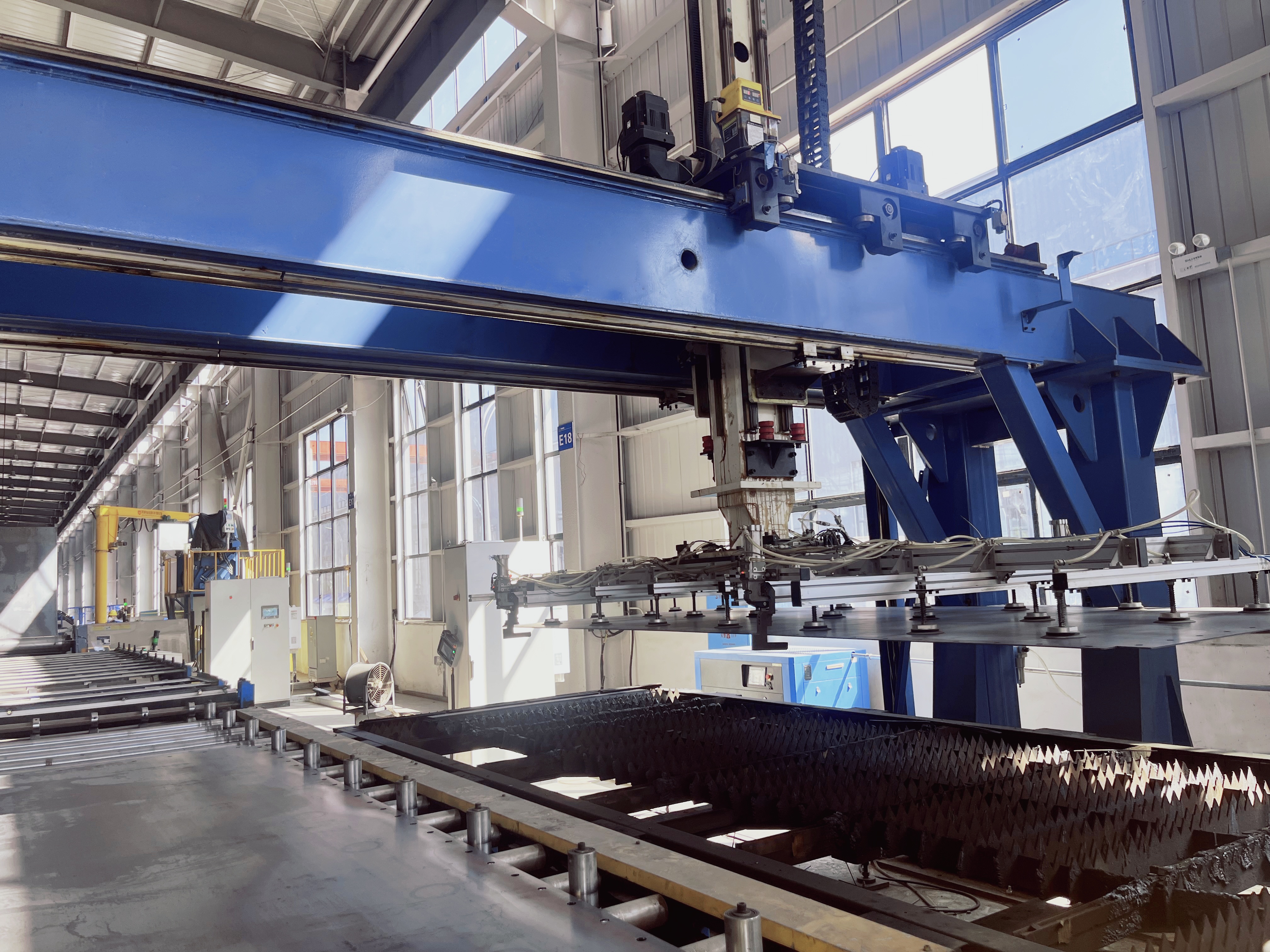
On the supply side, DKTEC (Hangzhou Jusheng Machinery & Equipment Co., Ltd.) operates a 120,000 m² facility with 430 employees and an 80-engineer R&D team, producing up to 2,000 units annually with an 80% export ratio across the Middle East, Southeast Asia, Africa, Europe, Central Asia, West Asia, Australia and South America. The company moved from trading into robot-assisted production of mixing stations in 2017, which is relevant to buyers evaluating build consistency across a multi-unit fleet.
Detailed Solution: How Each Plant Family Is Actually Configured
The two families are best understood as two configuration philosophies built on the same HZS platform and the same metering accuracy classes.
Commercial Concrete Batching Plant (HZS120 – HZS300)
A commercial plant is a stationary, continuous, high-efficiency production asset for large and medium-sized commercial concrete customers. Its operating assumption is that concrete leaves the site by truck, all day, at a predictable rate.
| Model | Theoretical Productivity | Installed Capacity | Nominal Capacity |
|---|---|---|---|
| HZS120 | 120 m³/h | 210 kW | 2000 L |
| HZS180 | 180 m³/h | 250 kW | 3000 L |
| HZS240 | 240 m³/h | 280 kW | 4000 L |
| HZS270 | 270 m³/h | 350 kW | 4500 L |
| HZS300 | 300 m³/h | 350 kW | 5000 L |
All commercial models share an unloading height of ≥3.8 m, aggregate weighing accuracy of ±2%, and ±1% accuracy on cement, mixing powder, water and additive. Typical matched equipment includes an aggregate bin or ground-level batching station, horizontal and inclined belt conveyors, the main mixing unit, metering systems for cement, supplementary cementitious materials, water and admixtures, an aggregate holding hopper, main tower dust removal, discharge hopper, control room, and electrical and monitoring systems, with powder silos and screw conveyors available as options.
What buyers are really paying for in this family is continuity. Available configuration data for the commercial platform includes more than ten intelligent technologies for adaptive processes with reduced manual intervention; a modular design with factory pre-assembly that cuts on-site installation workload by 20%; seamless material flow technology that improves conveyor belt efficiency by 20%; online slump monitoring that indicates slump in real time from mixer motor current curves; optional intelligent powder silo level monitoring with inventory accuracy of ±2%; dual-pivot internal vibration that improves vibration efficiency by 20% and addresses discharge problems with manufactured sand, fine sand and mineral powder; and a purpose-developed screw-type air compressor with dust protection and 20 dB noise reduction. On larger commercial bases, an optional “one-operator, dual-plant” control scheme allows one operator to run two mixing plants, reducing labour cost by 50%, and a fully enclosed standby hopper reduces open surface area by 75% when combined with a forced-cleaning membrane bag filter.
Engineering Concrete Batching Plant (HZS60G – HZS180G)
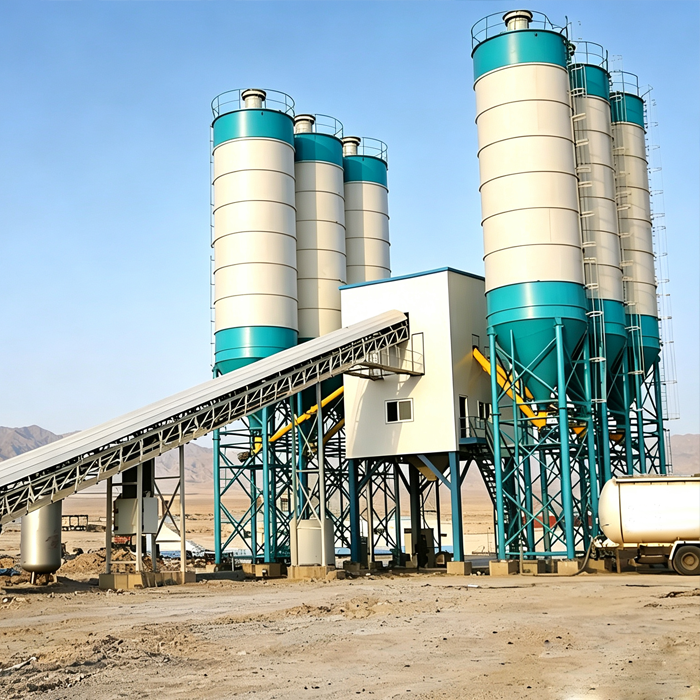
Engineering plants are special mixing plants configured for engineering projects. Their design concept is “high precision, high strength and high adaptability,” and they are used in high-speed railways, highways, bridges, airports and other engineering fields.
| Model | Theoretical Productivity | Installed Capacity | Nominal Capacity |
|---|---|---|---|
| HZS60G | 60 m³/h | 100 kW | 1000 L |
| HZS90G | 90 m³/h | 190 kW | 1500 L |
| HZS120G | 120 m³/h | 210 kW | 2000 L |
| HZS180G | 180 m³/h | 250 kW | 3000 L |
The engineering family carries the same accuracy classes as the commercial family — sandstone ±2%, cement / mixing powder / water / additive ±1%, unloading height ≥3.8 m — so the differentiation is in control functions and site adaptability, not in tolerance.
For high-speed railway work, the control system is configured with automatic drop correction and precise pulse-based weighing compensation, dual-stage coarse and fine aggregate metering, and precision pulsating metering suited to different high-grade concrete types. A four-level modular design allows integrated hoisting and rapid installation. For small and medium railway and highway sites, a typical configuration uses a steel bin aggregate batching station (10 m³ × 4 bins), a 650 mm chevron belt with rain cover on an inclined conveyor, a 1 m³ twin-shaft mixer (2 × 22 kW), cement, water and admixture metering, a pneumatic system, main tower, control room and electrical system, with a 100 t powder silo and φ219 screw conveyor optional — plus an optional steel structure foundation, sand silo anti-clogging device and wear-resistant discharge hopper. Airport projects usually emphasise high-precision metering for consistent high-grade concrete and modular rapid assembly, where an optional steel structure foundation reduces civil engineering costs. Bridge projects emphasise internal vibration-assisted discharge, a robust hopper and an optional dual-auger system for precise feeding.
The Relocatable Option: Mobile Plants as a Third Configuration
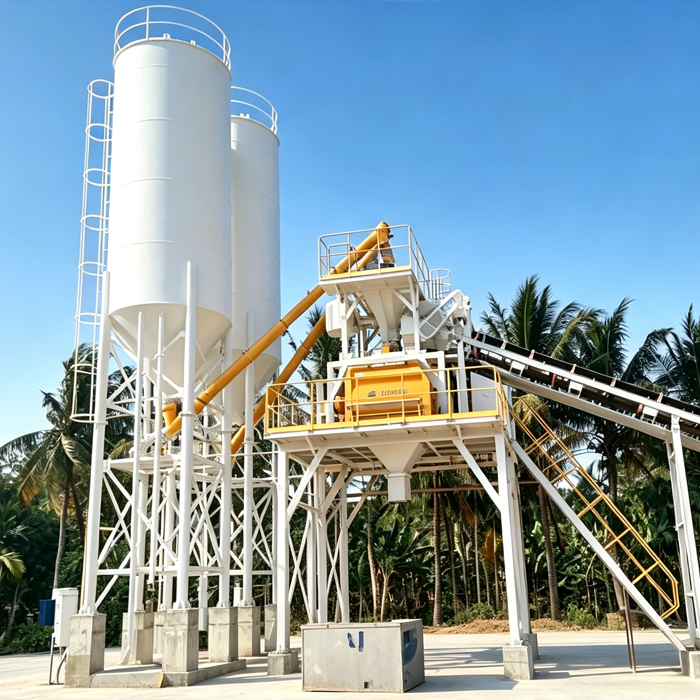
When neither a permanent yard nor a long-stay site plant fits, the mobile HZS25Y to HZS120Y range covers 25–120 m³/h with 60–160 kW installed capacity and 500–2000 L nominal capacity. These units use an integrated chassis towed via axles and tires, allow installation and commissioning within three days of arrival, can be moved as a single piece by truck, and need only a level concrete surface rather than a full foundation. They are widely applied in road and bridge projects, water conservancy, mining, railway work, precast production and remote construction.
Supporting Equipment and Mixer Selection
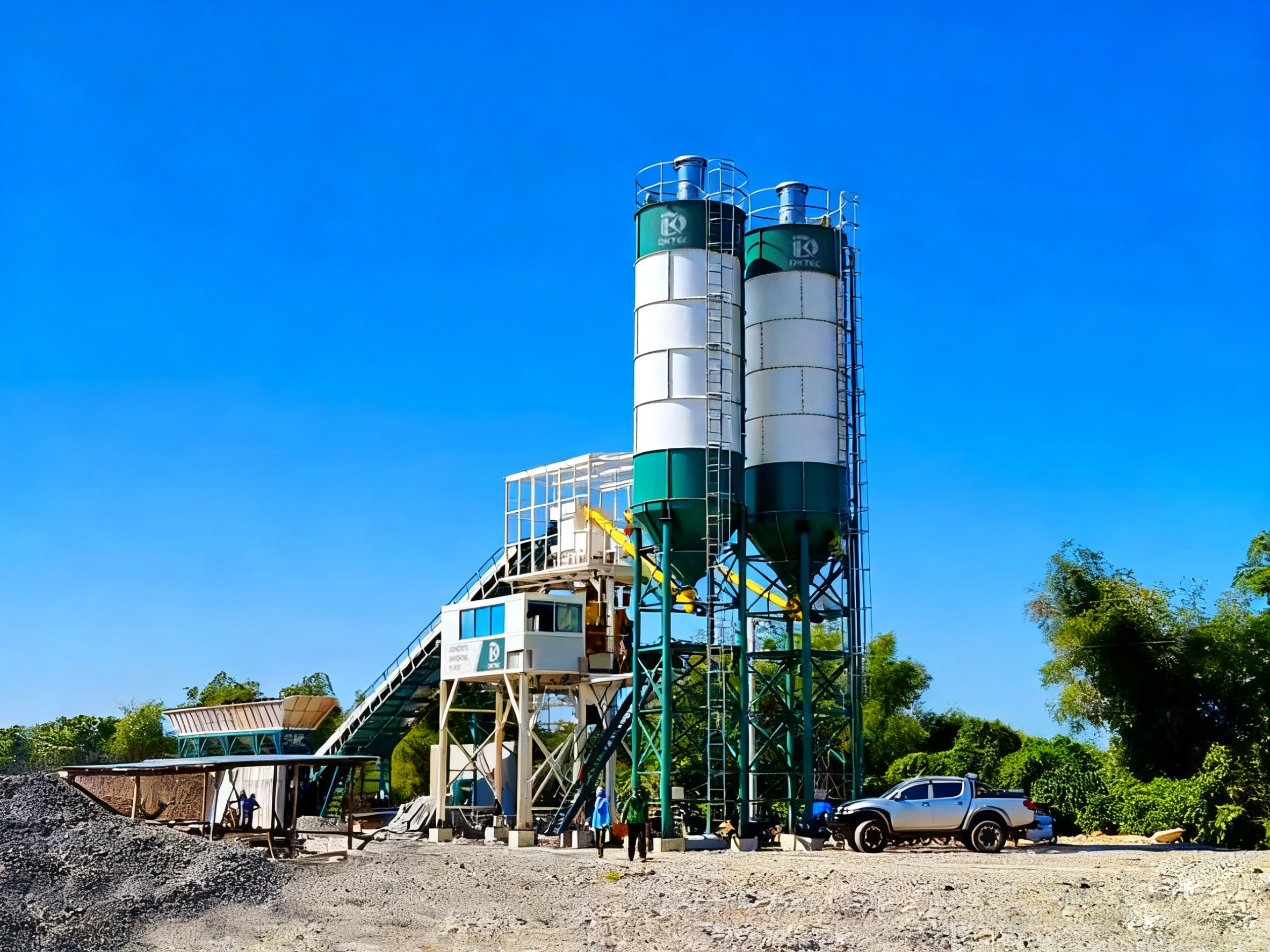
Whatever the family, a complete solution is assembled from cement silos, screw conveyors, aggregate bins, weighing systems, additive dosing systems, dust collectors, air compressors, control systems and concrete reclaimers. Mixer choice is a separate decision: twin-shaft mixers are widely used for ready-mix concrete and large-scale production because they deliver fast, intensive mixing at high throughput, while planetary mixers suit applications needing very high mixing uniformity, including precast, dry and special concrete. DKTEC configures SICOMA, BHS or other suitable mixer options according to concrete type, output and project requirements, and SDMIX and in-house DK options are also available on the commercial platform.
OEM, Customization and Commercial Terms
Both families are available under OEM/ODM production. Customized options cover voltage and frequency, company logo, machine colour, appearance design and branding, with custom aggregate storage, custom bins and custom control configurations supported for customized orders. The minimum order quantity is 1 unit across HZS25Y, HZS35Y, HZS60Y, HZS90Y, HZS120Y, HZS60G, HZS90G, HZS120G, HZS180G, HZS120, HZS180, HZS240, HZS270 and HZS300 — which allows a single-unit trial order before a bulk purchase. Orders ship FOB or CIF with pre-shipment test acceptance, 30% T/T down payment and full payment before delivery. Monthly production capacity is 50 units, standard lead time is 25–60 days, every unit is 100% tested, and after-sales support covers remote support and on-site installation.
Step-by-Step Breakdown: A Six-Step Buyer Decision Sequence
The sequence below follows the order in which the decision actually constrains itself. Steps 1 to 3 eliminate half the catalogue; steps 4 to 6 define the quotation.
- Classify the destination of the concrete. If it is sold to third parties on an ongoing basis, the plant is a commercial asset and should be specified as stationary and continuous. If it is poured into your own project, it is an engineering asset and should be specified as modular and relocatable.
- Set the real hourly requirement. Published guidance groups typical requirements as 25–60 m³/h for small construction projects, 60–180 m³/h for commercial ready-mix concrete, and 120–270+ m³/h for large infrastructure. Select on actual hourly production requirement and expected utilisation rate, not theoretical capacity alone.
- Decide mobility. Fixed site with long-term production → stationary plant. Frequent relocation, short timelines or dispersed work fronts → mobile plant with three-day installation and minimal foundation.
- Configure aggregate storage and feeding. Choose bin count and volume, ground-level versus steel bin batching station, and belt versus alternative feeding. This is where custom aggregate storage and custom bins are specified.
- Specify control and metering functions. High-grade railway and bridge concrete needs drop correction, pulse-based weighing compensation and dual-stage coarse/fine aggregate metering; commercial ready-mix benefits more from online slump monitoring, silo level monitoring and dual-plant control.
- Close the commercial terms. Confirm the 1-unit MOQ applies to your model, agree FOB or CIF, book pre-shipment test acceptance, and align the 25–60 day lead time with your site programme and any custom voltage, frequency or branding requirements.
Use Cases: What These Plants Do in Practice
Deployment records from DKTEC projects show how the two families behave in the field.
- Large-scale infrastructure, Indonesia — commercial plant. A large construction contractor operates one HZS300 rated at 300 m³/h for large-scale infrastructure projects, with a service life of 10–15 years and reported high-volume production, stable operation and consistent quality.
- Large-scale infrastructure, Oman — commercial plant. A large construction contractor operates one HZS240 rated at 240 m³/h, cited for efficient mixing, precise weighing and stable long-term operation.
- Commercial concrete production, Philippines — engineering plants. A ready-mix concrete supplier operates two HZS90G engineering plants for commercial concrete production, with stable operation and consistent concrete quality. This case is a useful boundary marker: an engineering plant can serve commercial output when the required volume and service period are defined, even though it is not configured as a permanent urban base.
- Bridge engineering, Philippines — commercial plant. A concrete supplier uses an HZS180 to produce concrete for bridge pile foundations, pile caps, piers, abutments and girder bodies over a five-year project, with reported high productivity, low failure rate and convenient maintenance.
- Ready-mixed concrete supply, Indonesia — multi-unit fleet. A ready-mixed concrete company operates three units supplying construction sites, drawing on a fleet mix rather than a single model.
The pattern is consistent: commercial plants cluster in long-life, high-volume production, while engineering plants cluster in project-defined supply — but the boundary is crossed when a project's volume profile justifies a modular plant in a commercial role.
Comparison Table: Commercial vs Engineering Concrete Mixing Plants
| Decision factor | Commercial Concrete Batching Plant | Engineering Concrete Batching Plant |
|---|---|---|
| Primary function | Primary production plant for large and medium-sized commercial concrete enterprises, supplying ready-mixed concrete | Special mixing plant for on-site high-grade concrete supply to engineering projects |
| Typical models | HZS120, HZS180, HZS240, HZS270, HZS300 | HZS60G, HZS90G, HZS120G, HZS180G |
| Capacity band | 120–300 m³/h | 60–180 m³/h |
| Design concept | Efficient, precise and intelligent production with comprehensive configuration | High precision, high strength and high adaptability |
| Operating mode | Stationary; continuous, high-efficiency production | Stationary and modular, with quick assembly/disassembly for relocation; continuous production |
| Metering accuracy | Aggregate ±2%; cement, mixing powder, water, additive ±1%; unloading height ≥3.8 m | Aggregate ±2%; cement, mixing powder, water, additive ±1%; unloading height ≥3.8 m |
| Signature control features | 10+ intelligent technologies; online slump monitoring; optional intelligent silo level monitoring (±2%); optional one-operator dual-plant control | Automatic drop correction and pulse-based weighing compensation; dual-stage coarse/fine aggregate metering; precision pulsating metering |
| Modularity | Modular design with factory pre-assembly; on-site installation workload reduced by 20% | Four-level modular design enabling integrated hoisting and rapid installation; optional steel structure foundation |
| Typical applications | Ready-mixed concrete supply, commercial concrete bases, large and medium commercial customers | High-speed railways, expressways, bridges, airports, small-to-medium construction sites |
| Supporting equipment | Aggregate batching station, horizontal and inclined belt conveyors, metering systems, aggregate holding hopper, main tower dust removal, control room, optional powder silos and screw conveyors | Steel bin batching station, inclined belt conveyor (e.g. 650 mm chevron belt with rain cover), twin-shaft mixer, metering systems, pneumatic system, main tower, control room, optional 100 t powder silo and screw conveyor |
| Mixer options | SICOMA, BHS, SDMIX or DK options | Mainstream high-end mixing unit configurations |
| Minimum order quantity | 1 unit | 1 unit |
| Lead time and capacity | 25–60 days; 50 units monthly production capacity; 100% test; pre-shipment test acceptance; FOB or CIF; 30% T/T down payment with full payment before delivery | |
FAQ
What weighing accuracy and specification points should I compare between a commercial and an engineering concrete batching plant?
Both families use the same accuracy classes: sand and stone are weighed to ±2%, while cement, mixing powder, water and additive are weighed to ±1%, and both have an unloading height of ≥3.8 m. For example, the commercial HZS120 measures aggregate from 600–2000 kg at ±2% and cement from 200–1200 kg at ±1%; the engineering HZS120G uses the same ranges. Because tolerances are identical, buyers should compare control functions, batching configuration and matching equipment instead of accuracy classes. ISO 19720-1:2017 provides the international terminology and commercial specifications for concrete mixing and batching plants, which is a useful reference for keeping a tender's language consistent.
What does an OEM stationary concrete batching plant manufacturer with custom aggregate storage actually deliver?
The manufacturer provides OEM/ODM production services, including OEM production for customized orders and ODM design and production alongside OEM manufacturing. Customization covers voltage and frequency, company logo, machine colour, appearance design and branding, with customization technical support provided for each option. For a stationary plant, customized orders can include custom aggregate storage, custom bins and custom control configurations. The minimum order quantity is 1 unit and it applies to models HZS25Y, HZS35Y, HZS60Y, HZS90Y, HZS120Y, HZS60G, HZS90G, HZS120G, HZS180G, HZS120, HZS180, HZS240, HZS270 and HZS300, so a single-unit customized order is possible before committing to a larger fleet.
Which capacity should I choose for each plant type?
Capacity should follow demand, project type, working hours, peak production requirements and transportation distance. Common capacities are 25, 35, 60, 90, 120, 180, 240 and 270 m³/h. As a practical grouping, small construction projects typically fall in the 25–60 m³/h range, commercial ready-mix concrete in the 60–180 m³/h range, and large infrastructure in the 120–270+ m³/h range. Selection should be based on actual hourly production requirement and expected utilisation rate rather than theoretical capacity alone — a commercial HZS180 and an engineering HZS180G share the same 180 m³/h rating but serve different production roles.
What are the minimum order quantity and payment terms?
Concrete batching plant orders have a minimum order quantity of 1 unit, which applies to both standard and OEM or customized orders, including customized aggregate storage, custom bins and custom control configurations. The 1-unit MOQ also allows a single-unit trial order before bulk purchasing. Orders are delivered FOB or CIF, acceptance is based on pre-shipment test, and payment terms are 30% down payment by T/T with full payment before delivery.
What lead time and after-sales support should I plan for?
Standard lead time for concrete batching plants is 25–60 days, against a monthly production capacity of 50 units, and every unit is 100% tested before shipment with pre-shipment test acceptance available to the buyer. After-sales support covers remote support and on-site installation. Because lead time starts from a confirmed configuration, buyers finalising an engineering or commercial plant specification can shorten the cycle by fixing voltage, frequency, control system and aggregate storage requirements at the quotation stage. To review model ranges and configuration options in one document, download the DKTEC concrete batching plant brochure, or send your project parameters — capacity, site conditions, voltage and frequency — for a tailored configuration proposal.
Conclusion
Commercial and engineering concrete mixing plants are not two sizes of the same purchase. The commercial family — HZS120 to HZS300, 120–300 m³/h — is a continuous ready-mix production asset whose value comes from material flow, intelligence and dispatch continuity. The engineering family — HZS60G to HZS180G, 60–180 m³/h — is a modular, relocatable asset whose value comes from precision control, rapid installation and adaptability to high-speed railway, expressway, bridge, airport and small-to-medium project conditions. The mobile HZS25Y to HZS120Y range covers the third case, where relocation matters more than either.
Because metering tolerances, unloading height and even headline capacity can be identical across the two families, the decision should be made on production role, mobility, control functions and matching equipment — then closed on commercial terms that are already transparent: 1-unit MOQ, FOB or CIF delivery, pre-shipment test acceptance, 25–60 day lead time and 30% T/T down payment with full payment before delivery.
Next Step: Validate the Configuration Against Your Project
Hangzhou Jusheng Machinery & Equipment Co., Ltd. (DKTEC) manufactures commercial, engineering and mobile concrete batching plants with OEM/ODM customization, 1-unit MOQ and on-site installation support, exporting to the Middle East, Southeast Asia, Africa, Europe, Central Asia, West Asia, Australia and South America.
Request a configuration proposal or sample-stage technical discussion: email linder@dongkunchina.com · Tel / WhatsApp: +86 18888972181 · Website: www.dongkunchina.com
Download the full DKTEC concrete batching plant brochure (PDF) for model tables and configuration details.