Concrete Mixing Plant Recommendations by Project: Commercial, Engineering, Expressway
The right concrete mixing plant is the one whose output role, installation mode and supporting equipment match the project in front of you. A ready-mix base, a high-speed railway alignment and an expressway corridor can all be served by a plant in the same 120 m³/h class — but not by the same configuration. This guide gives three project-matched recommendations and states the verified facts behind each one.
Every specification below comes from first-party engineering data published by Hangzhou Jusheng Machinery & Equipment Co., Ltd. (DKTEC), a manufacturer of concrete batching plants, mobile mixing equipment and mining production lines. The company was founded in 2015, operates a 120,000 m² factory with 430 employees and 80 R&D engineers, produces around 2,000 units per year, and exports approximately 80% of its output to the Middle East, Southeast Asia, Africa, Europe, Central Asia, West Asia, Australia and South America.
Short answer, before the detail:
- Commercial ready-mix base: a 120 m³/h commercial concrete batching plant with a SICOMA MAO3.0 2.0 m³ twin-shaft mixer, intelligent dual-station control and a full dust-collection package.
- High-speed railway and highway engineering: the HZS120Y mobile batching plant — one towed chassis, 160 kW installed power, ready for operation about 3 days after arrival.
- Expressway continuous operation: a stationary modular HZS120 with genuine SICOMA components and ±2% aggregate / ±1% cement weighing accuracy, chosen for uptime rather than peak output.
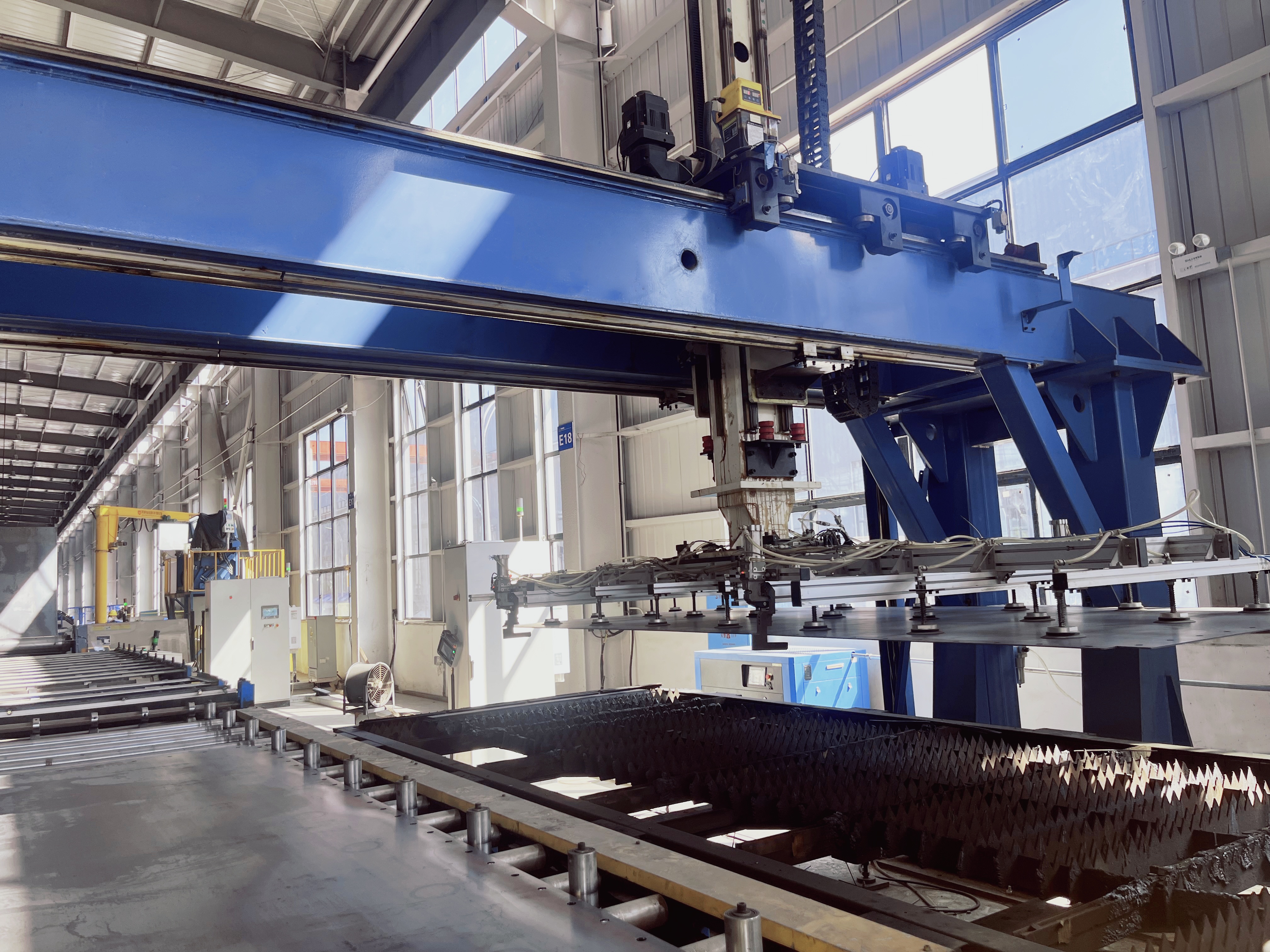
Manufacturing base of Hangzhou Jusheng Machinery & Equipment Co., Ltd. (DKTEC), Hangzhou, China.
Problem Definition: Three Projects, Three Different Bottlenecks
Buyers usually compare concrete batching plants on nominal capacity, then discover that capacity was never the constraint. The three project types in this article fail in three different ways:
- Ready-mix bases fail on accuracy and material control. Weighing drift, powder silo overflows and uncontrolled air-compressor idling raise cement consumption and force emergency material purchases.
- Railway and highway works fail on logistics. A plant that cannot follow the alignment forces long mixer-truck hauls, and a plant that needs new civil foundations at every section charges the project for the same concrete twice.
- Expressway corridors fail on unplanned downtime. Slurry leakage at shaft ends, liner wear and cylinder jamming stop production; on a continuous-pour corridor, an hour of stoppage costs more than the price gap between component grades.
One example from the same product family shows why nameplate numbers mislead. The Jusheng HZS120Y mobile plant and the Jusheng stationary HZS120 both have a theoretical capacity of 120 m³/h and a 2000 L mixer capacity. Yet the mobile unit runs 160 kW installed power against 210 kW for the stationary unit — 24% lower — and it can be towed as a single assembly, while the stationary plant has to be disassembled, hoisted and transported module by module when the site changes. Same capacity class, entirely different project economics.
Industry Background: A Market Where Configuration Flexibility Is Priced In
Market and standards data explain why project-matched configurations now dominate purchasing discussions:
- The global concrete batch plants market was valued at USD 3.8 billion in 2024 (Global Market Insights).
- Asia-Pacific accounted for 38% of global concrete batch plant revenue in 2024 (Credence Research), reflecting where most plant manufacturing and export capacity is concentrated.
- The infrastructure segment represented 39.4% of the mobile concrete batch plant market in 2024 (Global Market Insights) — mobility is a mainstream requirement, not a niche one.
- China alone exported USD 276.9 million of concrete or mortar mixers under HS code 847431 in 2023 (UN Comtrade / WITS).
- ISO 19720-1:2017 establishes the terminology and commercial specifications for concrete mixing and batching plants (ISO), which is the reference buyers use when quotations look superficially similar.
- Hangzhou Jusheng Machinery & Equipment Co., Ltd. transitioned from trading to robot-assisted production of mixing stations in 2017 (DKTEC official) — a shift that mirrors how the supplier base has moved from reselling to controlled manufacturing.
The practical consequence: a specification table that lists only capacity and price is no longer enough to compare offers. Buyers now weigh installation mode, component grade, automation level and environmental scope — exactly the four dimensions used in the three recommendations below.
Recommendation 1 — Commercial Concrete Batching Plant for High-Volume Ready-Mix Bases
Output role: weighed, dispatch-ready concrete at 120 m³/h
The commercial concrete batching plant in this recommendation is a 120 m³/h class stationary unit with a 2000 L mixer (SICOMA MAO3.0, 37 kW × 2), a discharge height of ≥3.8 m and 210 kW installed power. Weighing accuracy is ±2% for aggregates and ±1% for cement, delivered through Meidia/Keli load cells and Erip/Airtac cylinders. For a ready-mix producer, that accuracy is not an abstract specification: it decides whether the mix design is met on every truck, and it governs cement consumption across the year.
Installation: modular structure instead of site welding
Jusheng equipment uses a four-layer full-machine modular structure. The complete machine is pre-assembled and debugged in the factory before delivery, with standardised craftsmanship and unified precision, which removes assembly errors at the source. Compared with traditional batching plants that depend on on-site cutting, welding and anti-corrosion coating — where final quality depends on the skill of the site crew — the modular design reduces on-site installation workload by 20%. The bolted structure can also be dismantled and reused, retaining high residual value, whereas a traditional site-welded station cannot be dismantled and offers negligible residual value after the project.
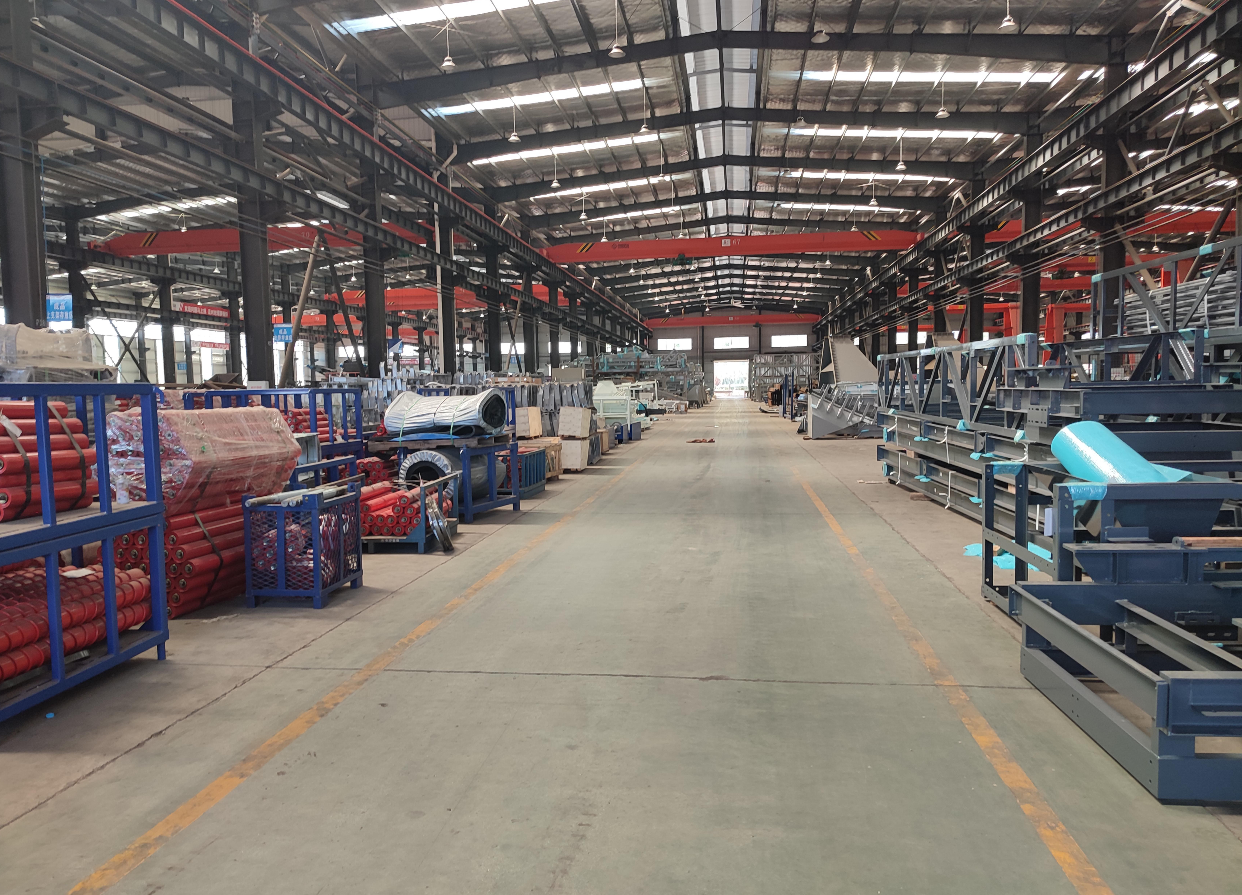
Factory workshop for pre-assembly and debugging of modular concrete batching plant sections.
Supporting equipment: control room, silo logistics, dust control
Two supporting packages decide how a ready-mix base performs over years rather than weeks.
Intelligent control. The Jusheng intelligent control system incorporates over a dozen intelligent technologies, including dual-control functionality for a single unit, intelligent powder silo level monitoring with ±2% accuracy relative to maximum capacity, and real-time online slump monitoring based on the mixer motor current curve. Standard plants rely on single-station, single-control mode, manual tank tapping or plumb-bob gauges, and manual slump testing after the concrete leaves the plant. The system integrates ERP, PLC and a mobile app for real-time material level monitoring, and the "one operator, two plants" arrangement reduces labour costs by 50% compared with standard control, based on internal data. It fits multi-plant group operations, commercial concrete producers and clients that require data management or ERP integration.
Dust collection and environmental control. The package uses a forced membrane bag filter, a fully enclosed waiting hopper that reduces the open area by 75%, and a counter-current internal circulation air duct. Dust removal efficiency is ≥99.9% with membrane-coated filter bags against approximately 99% for standard fabric bags, and the WAM SILOTOP series keeps emissions below 10 mg/Nm³ against the 20–50 mg/Nm³ industry norm. A rotary screw air compressor reduces noise by 20 dB compared with piston models, and membrane-coated bags are water- and oil-repellent with pulse-jet cleaning, giving lower maintenance frequency and longer service life.
Recommendation 2 — Engineering Concrete Batching Plant for High-Speed Railway and Highway Projects
Output role: the same 120 m³/h, produced at the pour
The HZS120Y mobile batching plant delivers 120 m³/h theoretical capacity with a 2000 L mixer capacity and a SICOMA/SDMIX 2.0 m³ mixer. Its installed power is 160 kW against 210 kW for the stationary HZS120 in the same 120 m³/h class — 24% lower — and its specific energy consumption is approximately 1.33 kWh/m³ (160 kW / 120 m³/h) against approximately 1.75 kWh/m³ for the stationary plant, about 24% lower at equal production capacity. Supplying material close to the construction site also cuts the fuel consumed by mixer-truck transport, which matters on a long rail or highway alignment where haul distance grows week by week.
Installation and relocation: one chassis instead of repeated foundations
All HZS120Y components are integrated onto a single-piece chassis equipped with axles and tires, so the entire unit can be towed and relocated. Conventional stationary mixing plants use modular, fixed installations that must be disassembled and reassembled for site transfers. The mobile unit needs only a leveled concrete surface, keeping foundation costs low, and it can be operational approximately 3 days after arrival — against the weeks often required for on-site welding of traditional fixed stations. Relocation is carried out by towing the unit as a single assembly, rather than disassembling, hoisting and transporting separate modules. For phased works such as railway sections and highway packages, this is the difference between one plant serving several sites and one plant per site.
Supporting equipment and maintenance access
High component integration places centralised maintenance points on the chassis, axles and tires assembly. Because the configuration is multi-brand by design, mixers can be specified from SICOMA, BHS, SDMIX and DK, screw conveyors and butterfly valves are available with SICOMA or WAM options, and spare parts can be sourced from the OEMs or directly from Jusheng — a meaningful risk reduction on remote engineering sites where a single-source part can idle a crew for days.
Recommendation 3 — Stationary Concrete Batching Plant for Expressway Continuous Operation
Output role: uptime beats peak capacity
Expressway work rewards uninterrupted production. The failure modes that stop a plant are shaft-end leakage, liner wear, weighing drift and cylinder jamming — so component grade, not nameplate output, is the deciding factor. The Jusheng stationary HZS120 uses SICOMA or BHS mixers, Meidia/Keli load cells and Erip/Airtac cylinders as standard, whereas budget plants of the same nominal capacity typically use no-name domestic mixers and low-cost OEM components, which are prone to weighing drift, cylinder jamming and mortar leakage in long-time operation.
In the 2.0 m³ class, the SICOMA MAO3000/2000 uses dual 37 kW motors, an integral hexagonal main shaft and 14 high-strength mixing arms (2 × 7) with a machine weight of 7,500 kg. Original factory precision manufacturing supports reliable shaft-end sealing and longer service life of shaft seals and liners, giving a lower total cost of ownership than OEM-branded units despite a higher purchase price. The OEM gearbox, dual-motor redundancy and globally available spare parts reduce maintenance frequency.
When a 3.0 m³ class mixer is justified
For heavier continuous demand, two 3.0 m³ class twin-shaft compulsory mixers are available. The SICOMA MAO4500/3000 offers 4500/3000 L capacity, dual 55 kW motors (110 kW total), 2 × 8 mixing arms, a 9,700 kg machine weight, large market coverage and a mature after-sales spare-parts system. The BHS DKXS3.0 offers the same 4500/3000 L capacity and 55 kW × 2 motor power with 2 × 9 mixing arms, 10,500–10,900 kg machine weight, German BHS core technology and dual SOG315 reducers. Power per unit volume is approximately 36.7 kW/m³ for both, and both support variable frequency drive or soft-start configurations. The decisive commercial fact: the BHS DKXS3.0 costs approximately twice as much per unit as the SICOMA MAO4500/3000, so the German-brand option is justified where the specification mandates a German brand or where high-grade concrete is required, as in high-speed rail, nuclear power or hydropower projects. Choosing SICOMA for the same production capacity reduces the initial investment for the whole plant, and Jusheng maintains ready stock for SICOMA liners, arms and seals.
Installation and supporting equipment for a fixed corridor
A stationary plant at a single permanent location justifies the civil foundation investment that a mobile unit avoids. The four-layer modular structure is pre-assembled and debugged in the factory and ships in containers, and the seamless material flow technology increases belt conveying efficiency by 20% while reducing the time to discharge the first load by 10%. For expressway approaches near built-up areas, the dust-collection package keeps emissions below 10 mg/Nm³ with the WAM SILOTOP series and reduces hopper open area by 75%; for multi-plant operators, the intelligent control system adds dual-station control, ±2% silo level monitoring and ERP-connected material ordering.
Step-by-Step Breakdown: Matching a Plant to a Project in Six Steps
Step 1 — Rank the dominant constraint. Continuous weighed output (commercial), relocation capability (engineering), or uptime and compliance (expressway). The ranking, not the budget, decides the plant type.
Step 2 — Fix the mixer class and brand tier. 2.0 m³ SICOMA MAO3000/2000 with 37 kW × 2 for standard commercial and engineering duty; 3.0 m³ SICOMA MAO4500/3000 or BHS DKXS3.0 where output or brand mandates require it.
Step 3 — Choose the installation mode. Stationary modular where the site is permanent and civil foundations are an acceptable one-time investment; the towed HZS120Y chassis where the site will move.
Step 4 — Size automation and environmental scope. Add intelligent control (dual-station operation, ±2% silo level monitoring, real-time slump monitoring, ERP interface) and the environmental package only where labour cost, data management needs or emission limits justify the higher initial investment.
Step 5 — Validate before shipment. The complete machine is pre-assembled and debugged in the factory against standardised precision, which eliminates on-site assembly errors and reduces installation workload by 20% compared with site-welded construction.
Step 6 — Plan commissioning and spares. Expect a mobile station to be operational about 3 days after arrival on a leveled concrete surface, and secure the spare-parts route across SICOMA, BHS and WAM OEM channels or directly from Jusheng.
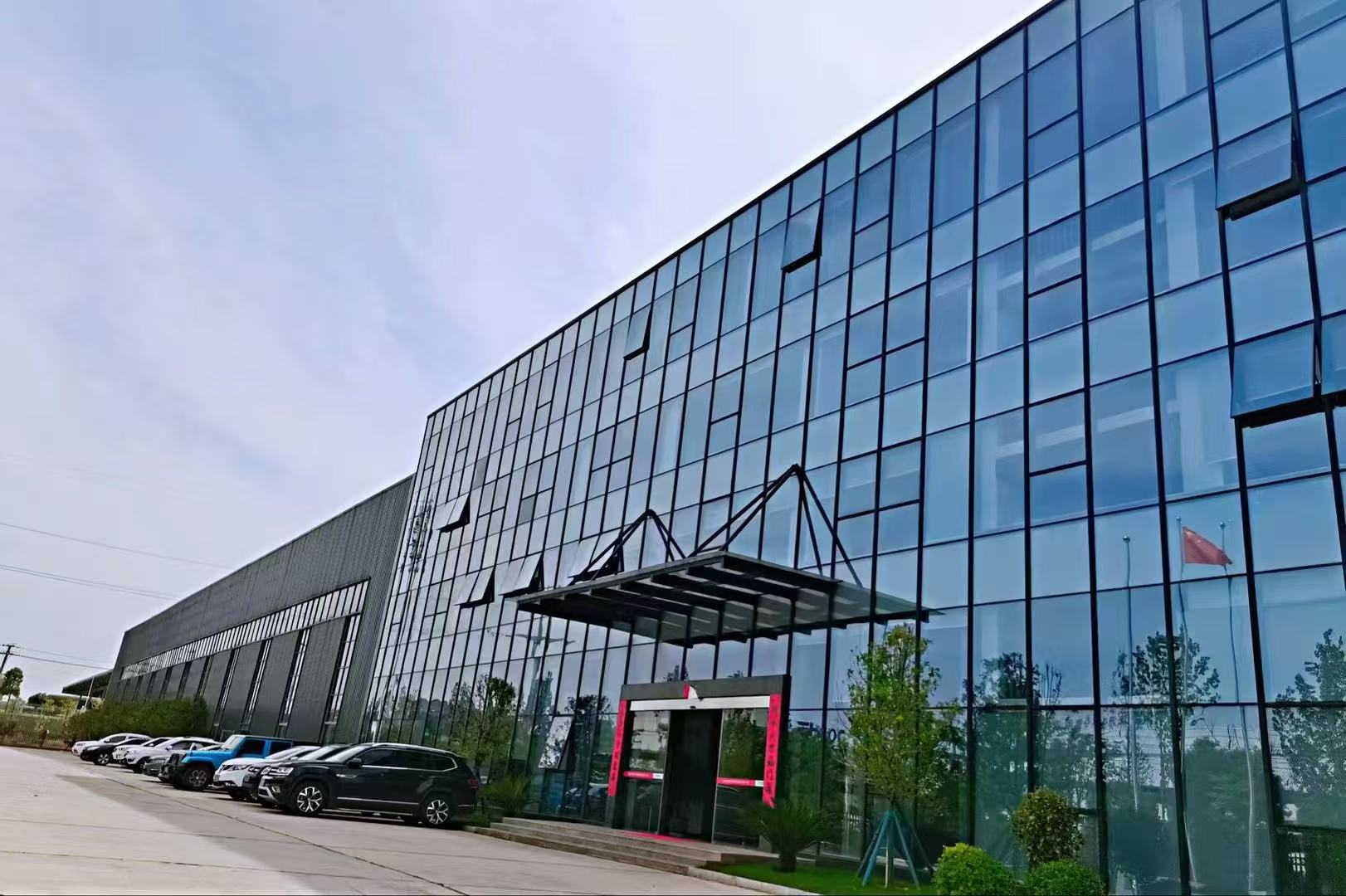
Component fabrication and pre-assembly area at the Hangzhou Jusheng factory.
Use Cases: Three Project Profiles and Their Configurations
Profile A — High-volume ready-mix base serving an urban market with strict emission limits. Configuration: stationary commercial concrete batching plant, HZS120 class, SICOMA MAO3.0 2000 L mixer, dust-collection package and intelligent dual-station control. Why it fits: ±2% aggregate and ±1% cement weighing accuracy supports consistent mix design, dust removal efficiency of ≥99.9% with WAM SILOTOP emissions below 10 mg/Nm³ supports urban permitting, the enclosed hopper cuts open area by 75%, and one operator running two plants reduces labour cost by 50% based on internal data.
Profile B — High-speed railway or highway section with works progressing along an alignment. Configuration: HZS120Y mobile batching plant. Why it fits: 160 kW installed power and approximately 1.33 kWh/m³ specific energy consumption, readiness in about 3 days after arrival, towing-based relocation without new foundations, and multi-brand spare-parts sourcing for remote sites.
Profile C — Expressway corridor with continuous structural and paving concrete demand. Configuration: stationary modular HZS120 with genuine SICOMA wear parts, OEM gearbox and dual-motor redundancy, container-shipped in modular sections. Why it fits: longer shaft seal and liner life reduce stoppages on a continuous-pour corridor, 20% less on-site installation work shortens commissioning, and the environmental package covers regulated approaches near urban areas.
Comparison Table: Project-Matched Configurations at a Glance
| Project type | Recommended plant | Theoretical output | Mixer and installed power | Installation mode | Supporting equipment priority |
|---|---|---|---|---|---|
| High-volume ready-mix base (commercial concrete) | Commercial concrete batching plant, HZS120 class | 120 m³/h | SICOMA MAO3.0 2000 L, 37 kW × 2; 210 kW installed | Stationary, four-layer full-machine modular structure, factory pre-assembled and debugged | Intelligent dual-station control (silo level ±2%, real-time slump monitoring), dust-collection package (≥99.9% efficiency, <10 mg/Nm³) |
| High-speed railway and highway engineering | HZS120Y mobile batching plant | 120 m³/h | SICOMA/SDMIX 2.0 m³ mixer; 160 kW installed (24% lower) | Single-piece chassis with axles and tires, towed as one unit, ready in about 3 days | Centralised maintenance points, multi-brand spare parts (SICOMA, BHS, WAM or Jusheng) |
| Expressway continuous operation | Stationary modular HZS120 | 120 m³/h | SICOMA MAO3.0 2000 L, 37 kW × 2; optional 3.0 m³ class SICOMA MAO4500/3000 or BHS DKXS3.0 | Stationary modular, container-shipped, 20% less on-site installation workload | Genuine SICOMA wear parts (hexagonal shaft, 14 arms), OEM gearbox, dual-motor redundancy, dust-collection package |
How the 120 m³/h Class Compares with Named Alternatives
The table below compares the recommended 120 m³/h platform with named alternatives using publicly available specifications. It is a fit comparison for the project types discussed above, not a ranking of brands.
| Plant | Theoretical capacity | Mixer | Configuration and supply-chain note |
|---|---|---|---|
| Jusheng HZS120 | 120 m³/h | SICOMA MAO3.0 2000 L, 37 kW × 2; aggregates ±2%, cement ±1%; discharge height ≥3.8 m | Mixer selection across SICOMA, BHS, SDMIX and DK; SICOMA/WAM screw conveyors and butterfly valves; multi-brand spare-parts sourcing; flexible configuration for precise cost control |
| SANY HZS120X8Pro | 120 m³/h (public data) | 2000 L (public data); discharge height 3.8 m (public data) | Single-brand integrated plant with mainly self-manufactured components and a highly standardised configuration; overall system pricing in a similar range to the Jusheng HZS120 |
| ELKON Elkomix-120 | 100–110 m³/h (public data) | Optional 3000/2000 L pan, twin-shaft or planetary mixers | Turkish-made; the Jusheng HZS120 output is approximately 9%–20% higher in the same nameplate class; both support dry production configuration without a mixer |
| Liebherr Betomix (same class) | Approximately 110–120 m³/h (public data) | Self-produced DW2.25, 2250 L class | Fully imported European plant with a high brand premium; positioned for Europe and US high-end markets and projects with mandatory European brand requirements |
FAQ
ISO 19720-1:2017 establishes the terminology and commercial specifications for concrete mixing and batching plants and is published by ISO. It matters commercially because it standardises the terms suppliers use for capacity and configuration, which is the reference point buyers need when quotations look similar. Where a project also faces strict emission limits — urban ready-mix plants in the EU, the Middle East and Southeast Asia, for example — dust performance is compared alongside it: the Jusheng dust-collection package uses a forced membrane bag filter with ≥99.9% dust removal efficiency, a fully enclosed waiting hopper that reduces open area by 75%, and a counter-current internal circulation air duct, with WAM SILOTOP series emissions below 10 mg/Nm³ against the 20–50 mg/Nm³ industry norm.
The Jusheng HZS120 delivers 120 m³/h theoretical capacity with a 2000 L mixer (SICOMA MAO3.0, 37 kW × 2), a discharge height of ≥3.8 m and 210 kW installed power. Weighing accuracy is ±2% for aggregates and ±1% for cement, using Meidia/Keli load cells. The mobile HZS120Y delivers the same 120 m³/h theoretical capacity and 2000 L mixer capacity with a SICOMA/SDMIX 2.0 m³ mixer, but at 160 kW installed power — 24% lower — and approximately 1.33 kWh/m³ specific energy consumption against approximately 1.75 kWh/m³ for the stationary HZS120.
Both are twin-shaft compulsory mixers. In the 3.0 m³ class, the SICOMA MAO4500/3000 has 4500/3000 L capacity, dual 55 kW motors (110 kW total), 2 × 8 mixing arms and a 9,700 kg machine weight; the BHS DKXS3.0 has the same capacity and motor power with 2 × 9 mixing arms and 10,500–10,900 kg machine weight. Power per unit volume is approximately 36.7 kW/m³ for both. The BHS DKXS3.0 costs approximately twice as much per unit as the SICOMA MAO4500/3000, while SICOMA liners, arms and seals cost less and Jusheng maintains ready stock. SICOMA suits large and medium-sized commercial concrete plants and high-output projects prioritising cost-performance; BHS suits project plants that mandate German brands or require high-grade concrete such as high-speed rail, nuclear power or hydropower.
Validation happens at the factory rather than through a sample plant. Jusheng equipment uses a four-layer full-machine modular structure, and the complete machine is pre-assembled and debugged in the factory before delivery with standardised craftsmanship and unified precision, eliminating assembly errors at the source. The modular design reduces on-site installation workload by 20% compared with traditional site-welded plants, and modular stations can be dismantled and reused, retaining high residual value after a project is completed.
A Jusheng mobile station can be operational within approximately 3 days of arrival, while a traditional fixed station often requires weeks of on-site welding. The mobile HZS120Y needs only a leveled concrete surface, keeping foundation costs low, and is relocated by towing the unit as a single assembly. A stationary plant of the same 120 m³/h class requires a significantly longer installation period because it needs civil engineering foundations. For a project-specific configuration, delivery schedule and spare-parts plan, contact Linder at linder@dongkunchina.com or +86 18888972181 (WhatsApp available), or download the DKTEC concrete batching plant brochure below.
Conclusion: Choose the Configuration, Then the Capacity
The three recommendations share one logic: the project sets the configuration, and the configuration sets the specification. A high-volume ready-mix base should be built around a 120 m³/h commercial batching plant with a SICOMA MAO3.0 mixer, intelligent dual-station control and a full environmental package. High-speed railway and highway works should follow the alignment with an HZS120Y mobile plant: 160 kW installed power, about 1.33 kWh/m³, towing-based relocation and roughly 3-day readiness. Expressway continuous operation should prioritise uptime with a stationary modular HZS120 built on genuine SICOMA components, dual-motor redundancy and long-life shaft seals — stepping up to the 3.0 m³ SICOMA MAO4500/3000 or BHS DKXS3.0 only where output or brand mandates justify it.
Two limitations are worth stating plainly. The intelligent control and environmental packages carry a higher initial investment than standard configurations and pay back through labour savings, reduced material loss and compliance headroom — not through the purchase price. And premium mixer brands cost more: the BHS DKXS3.0 is approximately twice the unit cost of the SICOMA MAO4500/3000 at identical capacity and motor power, which is only justified by a genuine specification requirement.
Next step. Send your project type, required output and site conditions, and Hangzhou Jusheng Machinery & Equipment Co., Ltd. (DKTEC) will map them to a concrete mixing plant configuration, spare-parts route and commissioning plan.
Contact: Linder — linder@dongkunchina.com | Tel / WhatsApp: +86 18888972181
Website: www.dongkunchina.com
Download the brochure: DKTEC concrete batching plant catalogue (PDF)