
Concrete Mixing Plant Specs: Capacity, Accuracy, Compliance
A concrete mixing plant is a constrained machine. Once the capacity class, mixer volume, weighing ranges, discharge height and electrical configuration are fixed, the plant either matches your project or it does not — and no amount of contract wording changes that afterwards. That is why the useful comparison is never between two prices, but between two constraint sets.
This guide is written for buyers in the research and evaluation stage. It explains how to read an HZS-series specification sheet, which parameters actually decide whether a plant can serve your project, and which compliance documents to request before a purchase order is issued. All technical figures below come from the published DKTEC product data for the HZS range of concrete mixing plants.
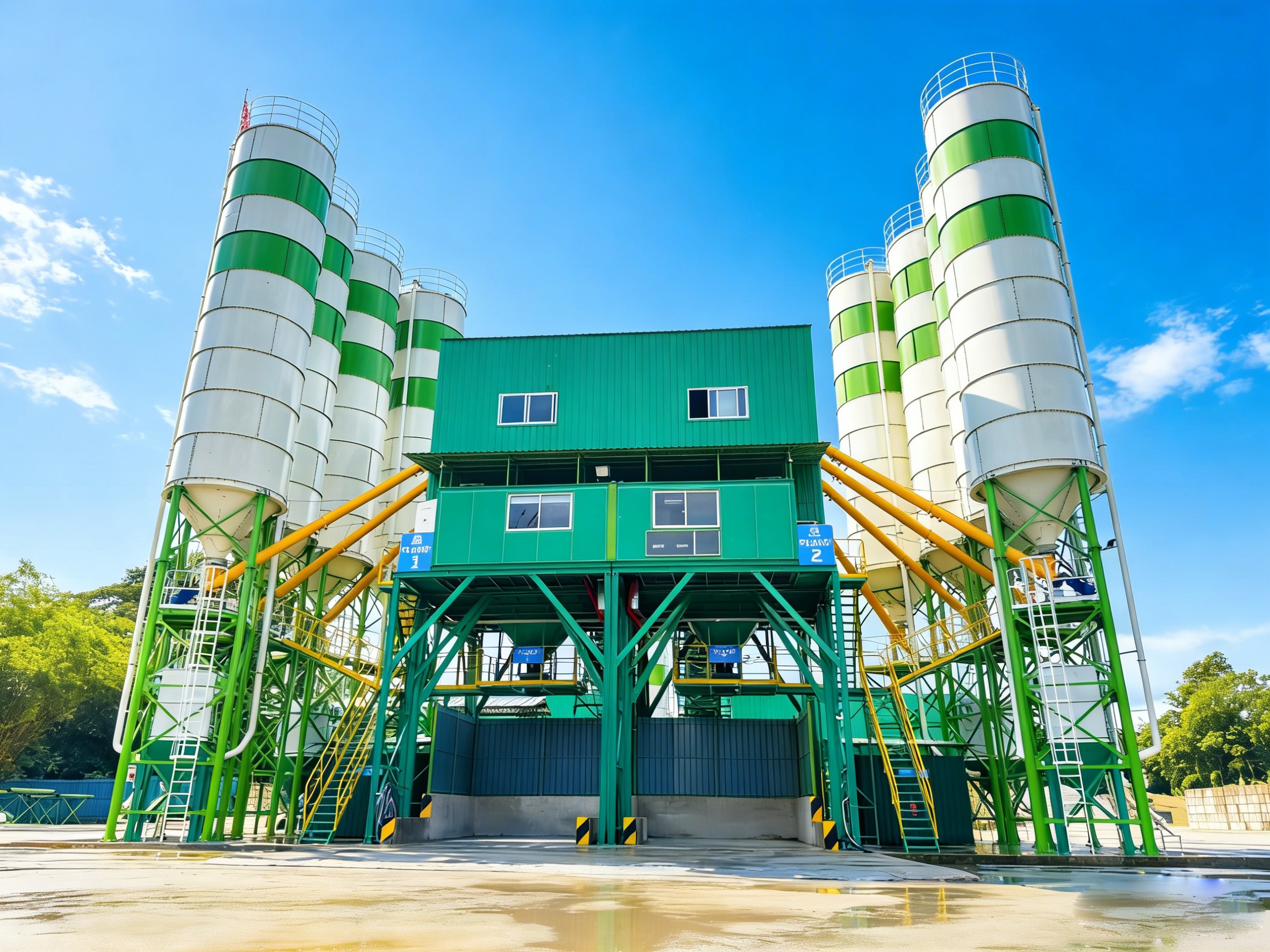
Concrete mixing plant — HZS series configuration, DKTEC (Hangzhou Jusheng Machinery & Equipment Co., Ltd.)
The specification trap: why two “120 m³/h” plants are not comparable
Theoretical productivity is calculated under ideal cycle conditions. Two suppliers can therefore quote the same headline output while offering machines with materially different batch size, installed power and weighing envelope. Three differences decide real throughput:
- Batch size. An HZS120 reaches 120 m³/h from a 2000 L nominal mixer; an HZS300 reaches 300 m³/h from a 5000 L mixer. A plant with a smaller nominal capacity must complete more cycles per hour to reach the same tonnage, which raises the sensitivity of every downstream constraint — feeding rate, weighing cycle and truck changeover.
- Installed power. The documented range runs from 60 kW on the HZS25Y to 350 kW on the HZS270 and HZS300. Installed capacity determines transformer sizing, generator backup and start-up sequencing, and it is far cheaper to confirm before site works than after.
- Weighing and control cycle. Aggregate feeding, coarse-and-fine weighing with drop correction, discharge and mixer-truck positioning all sit inside the cycle. Accuracy alone is not enough; the weighing range must also cover your mix design at full batch size.
There is a fourth difference that is not technical at all. Buyers frequently shortlist on capacity, then discover at contract stage that the destination market expects a Declaration of Conformity, a technical file and component-level certificates. If those documents are not named in the specification review, they arrive as a schedule risk rather than a selection criterion.
Industry background: why constraint data now decides shortlists
Concrete batching equipment is a large, geographically concentrated category, and buyers increasingly source across borders:
- The global concrete batch plants market was valued at USD 3.8 billion in 2024 (Global Market Insights).
- Asia-Pacific accounted for a 38% revenue share of that market in 2024 (Credence Research).
- Infrastructure accounted for 39.4% of the mobile concrete batch plant market in 2024 (Global Market Insights) — a direct signal of the shift toward portable and towable plants for dispersed project schedules.
- China exported USD 276.9 million of concrete or mortar mixers (HS 847431) in 2023 (UN Comtrade / WITS), which is why cross-border specification comparison has become routine rather than exceptional.
- ISO 19720-1:2017 provides terminology and commercial specifications for concrete mixing and batching plants. It gives buyers a shared vocabulary, but it does not force suppliers to publish data in the same format — so normalising the data sheet remains the buyer’s job.
Hangzhou Jusheng Machinery & Equipment Co., Ltd. (brand: DKTEC) is a manufacturer of complete concrete mixing plants and mining equipment based in Hangzhou, Zhejiang, China, founded in 2015. The company operates a 120,000 m² facility with 430 employees and an annual output of 2,000 units, supported by an 80-engineer R&D team, and exports approximately 80% of its production to the Middle East, Southeast Asia, Africa, Europe, Central Asia, West Asia, Australia and South America. It transitioned from trading to robot-assisted production of mixing stations in 2017. For a specification-led buyer, the practical consequence of that export profile is straightforward: electrical configuration and documentation requests are routine, and they should be raised in the first technical exchange rather than after the commercial terms are agreed.
The five constraint families of a concrete mixing plant
A specification sheet can be reduced to five families. Read them in order, because each one narrows the next.
1. Capacity class and installed power envelope
Capacity class sets the ceiling on everything else. The commercial stationary range spans 120 m³/h to 300 m³/h, and the installed capacity rises with it from 210 kW to 350 kW.
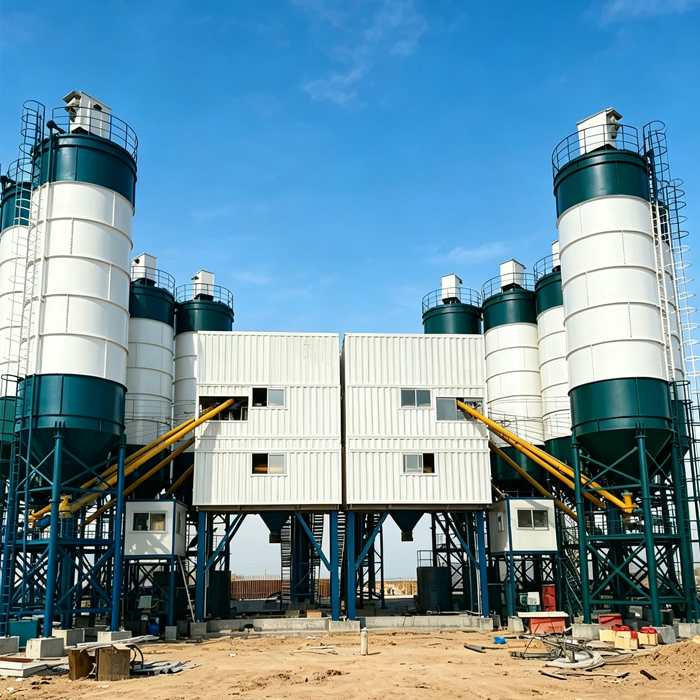
HZS300 commercial concrete batching plant — 300 m³/h, 5000 L nominal mixer capacity, 350 kW installed capacity
| Model | Theoretical output | Installed capacity | Nominal mixer capacity | Sandstone weighing | Cement weighing | Mixing powder | Water | Additive |
|---|---|---|---|---|---|---|---|---|
| HZS120 | 120 m³/h | 210 kW | 2000 L | 600–2000 kg ±2% | 200–1200 kg ±1% | 200–800 kg ±1% | 150–500 kg ±1% | 15–50 kg ±1% |
| HZS180 | 180 m³/h | 250 kW | 3000 L | 900–3000 kg ±2% | 300–1800 kg ±1% | 200–1000 kg ±1% | 200–800 kg ±1% | 15–80 kg ±1% |
| HZS240 | 240 m³/h | 280 kW | 4000 L | 900–4500 kg ±2% | 400–2500 kg ±1% | 200–1200 kg ±1% | 200–1000 kg ±1% | 15–80 kg ±1% |
| HZS270 | 270 m³/h | 350 kW | 4500 L | 900–5000 kg ±2% | 400–2600 kg ±1% | 300–1800 kg ±1% | 200–1200 kg ±1% | 20–100 kg ±1% |
| HZS300 | 300 m³/h | 350 kW | 5000 L | 900–5000 kg ±2% | 400–2600 kg ±1% | 300–1800 kg ±1% | 200–1200 kg ±1% | 20–100 kg ±1% |
2. Mixer geometry, batch size and discharge height
Every documented HZS configuration uses a twin-shaft forced mixer, with nominal capacity rising from 500 L on the HZS25Y to 5000 L on the HZS300. Nominal capacity is the constraint that converts a target output into a required cycle count, and it is the number to verify first when two quotations look equivalent.
Discharge height is stated as ≥3.8 m throughout the range, which is the direct-loading height for mixer trucks. If your logistics require a higher discharge point, that is a configuration-stage decision, not an on-site adjustment. The HZS180 commercial configuration additionally documents a dual unloading design (pneumatic / electro-hydraulic) intended to prevent material jamming, and the HZS270 draws on a MAO4500 twin-shaft compulsory mixer according to its published configuration notes.
3. Weighing ranges and accuracy by material
Accuracy is consistently documented at ±2% for aggregates (sandstone) and ±1% for cement, mixing powder, water and additive. The ranges, however, differ by class — and the range is what decides whether your mix design can be batched at full production size.
- Additive weighing spans 0–10 kg on the HZS25Y and HZS35Y, 15–50 kg on the HZS120 class, and 20–100 kg on the HZS270 and HZS300. A high-dose admixture mix on a small plant will exceed the weighing envelope.
- Aggregate weighing spans 200–1000 kg on the HZS25Y up to 900–5000 kg on the HZS270 and HZS300.
- Documented dosing components include Keli load cells, AirTAC cylinders and SICOMA pneumatic butterfly valves, with a double-door coarse-and-fine weighing structure, anti-fall protection and sand-bin anti-blocking devices on the commercial and engineering classes.
- Feeding is documented as continuous feeding with seamless material flow, and batching control applies coarse-and-fine weighing with pulse buckle compensation to support measurement accuracy. An optional child screw is available for feeding control.
4. Structural class: commercial stationary, engineering, mobile
Structural class is the constraint most often mis-specified, because it is driven by relocation frequency and schedule rather than by capacity.
Commercial stationary plants (HZS120–HZS300) are configured for continuous, high-volume ready-mix production at a fixed location. Optional intelligent configurations include online slump monitoring (real-time slump indication via mixer motor current curves), smart powder silo level monitoring with reported inventory accuracy of ±2%, and a “one-operator, dual-plant” control option documented as reducing labour cost by 50% when one operator runs two plants. Modular design is documented as cutting on-site installation workload by 20%, and an enclosed standby hopper reduces open surface area by 75% on the extra-large configuration.
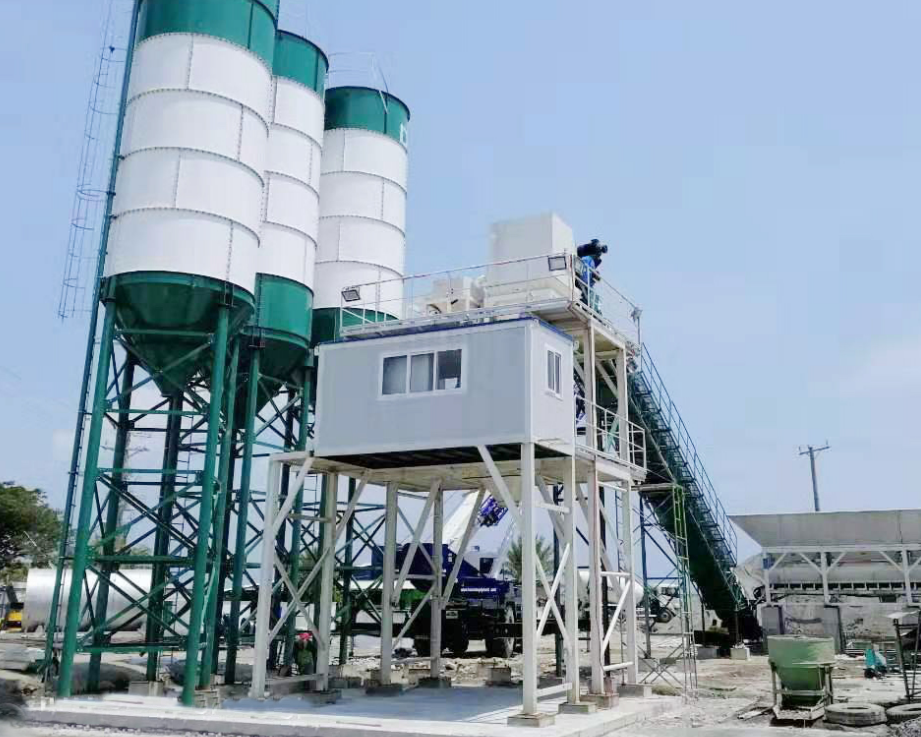
HZS120G engineering concrete batching plant — 120 m³/h, 2000 L twin-shaft forced mixer, fully automatic PLC control
| Model | Theoretical output | Installed capacity | Nominal mixer capacity | Sandstone weighing | Cement weighing | Mixing powder | Water | Additive |
|---|---|---|---|---|---|---|---|---|
| HZS60G | 60 m³/h | 100 kW | 1000 L | 600–2500 kg ±2% | 100–700 kg ±1% | — | 80–250 kg ±1% | 8–20 kg ±1% |
| HZS90G | 90 m³/h | 190 kW | 1500 L | 600–2000 kg ±2% | 200–1200 kg ±1% | 200–800 kg ±1% | 150–400 kg ±1% | 15–50 kg ±1% |
| HZS120G | 120 m³/h | 210 kW | 2000 L | 600–2000 kg ±2% | 200–1200 kg ±1% | 200–800 kg ±1% | 150–400 kg ±1% | 15–50 kg ±1% |
| HZS180G | 180 m³/h | 250 kW | 3000 L | 900–3000 kg ±2% | 300–1800 kg ±1% | 200–1000 kg ±1% | 200–800 kg ±1% | 15–80 kg ±1% |
Engineering plants (HZS60G–HZS180G) are configured for high-speed railway, highway, bridge, tunnel and airport work, with a stated design concept of high precision, high strength and high adaptability. The HZS60G documentation describes a four-layer module design with sub-module preassembly and overall lifting, which reduces the number of components installed on site and shortens installation time, plus a control system with automatic drop correction and pulse buckle control. A steel structure foundation option is available on this class to reduce civil engineering scope.
Mobile plants (HZS25Y–HZS120Y) integrate feeding, weighing, mixing and control on a towable chassis. The HZS120Y documents three 15 m³ aggregate bins with a 3.5 m³ cumulative weighing hopper and an 800 mm chevron belt inclined conveyor with a 30 kW drive; the mixing main building carries a pulse-jet dust collector and a fly ash return screw. The plant can be relocated by tractor, commissioned on a flat concrete surface without deep civil works, and started up within 3 days of arrival on site.
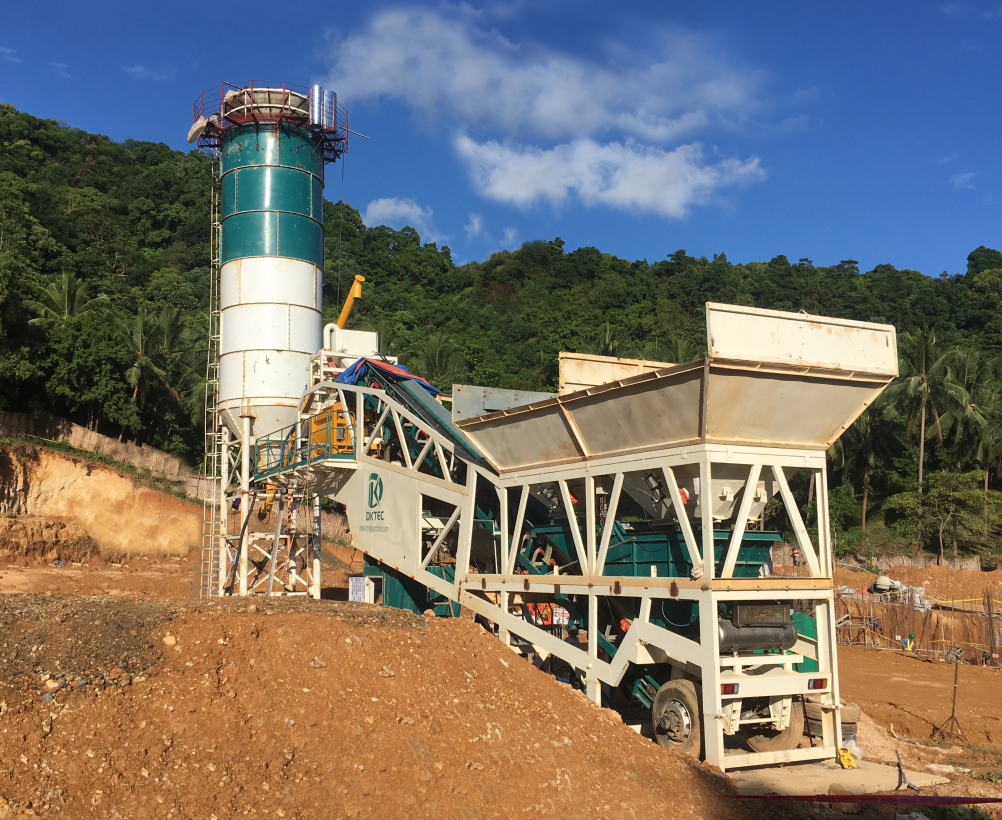
HZS120Y mobile concrete mixing plant — 120 m³/h on an integrated towable chassis, 3-day on-site commissioning
| Model | Theoretical output | Installed capacity | Nominal mixer capacity | Sandstone weighing | Cement weighing | Water | Additive |
|---|---|---|---|---|---|---|---|
| HZS25Y | 25 m³/h | 60 kW | 500 L | 200–1000 kg ±2% | 50–300 kg ±1% | 30–100 kg ±1% | 0–10 kg ±1% |
| HZS35Y | 35 m³/h | 65 kW | 750 L | 300–1500 kg ±2% | 80–400 kg ±1% | 50–150 kg ±1% | 0–10 kg ±1% |
| HZS60Y | 60 m³/h | 100 kW | 1000 L | 400–2000 kg ±2% | 100–600 kg ±1% | 60–200 kg ±1% | 5–20 kg ±1% |
| HZS90Y | 90 m³/h | 120 kW | 1500 L | 600–3000 kg ±2% | 150–800 kg ±1% | 100–300 kg ±1% | 10–30 kg ±1% |
| HZS120Y | 120 m³/h | 160 kW | 2000 L | 800–3500 kg ±2% | 200–1000 kg ±1% | 120–400 kg ±1% | 15–35 kg ±1% |
One feeding constraint deserves explicit attention. Skip hoist concrete mixing plant designs lift aggregates in a skip and suit very tight footprints; the HZS configurations documented here use inclined belt conveyors instead, including a 650 mm chevron belt with rain cover on the HZS60G class and an 800 mm chevron belt with a 30 kW drive on the HZS120Y class. If footprint is your binding constraint, that must be resolved at configuration stage, because feeding arrangement is not a field change.
5. Automation and documentation class
Control specification is written in three layers: the automation level, the safety devices, and the documentation package.
- Automation. Fully automatic PLC control with UPS backup is documented across the range, allowing recipes, production and reports to be managed by a single operator. The HZS120 commercial class documents a PLC-based control system with an industrial PC and 24-inch LCD monitoring; the HZS270 documents centralized operation with real-time production monitoring for continuous operation.
- Safety and protection. Documented items include a dust-proof control cabinet, emergency stop switches, anti-fall protection, belt conveyor systems with double-sided maintenance walkways and full-coverage guards, and video surveillance at the belt tail and discharge port on selected commercial models. A 5 m³ corrosion-resistant PE admixture tank is an available option.
- Customisation. OEM/ODM scope covers voltage and frequency, company logo, machine colour, appearance design and branding. Monthly production capacity is documented at 50 units, minimum order quantity at 1 unit, and production lead time at 25–60 days. Every unit is 100% tested before shipment, with remote support and on-site installation available after delivery.
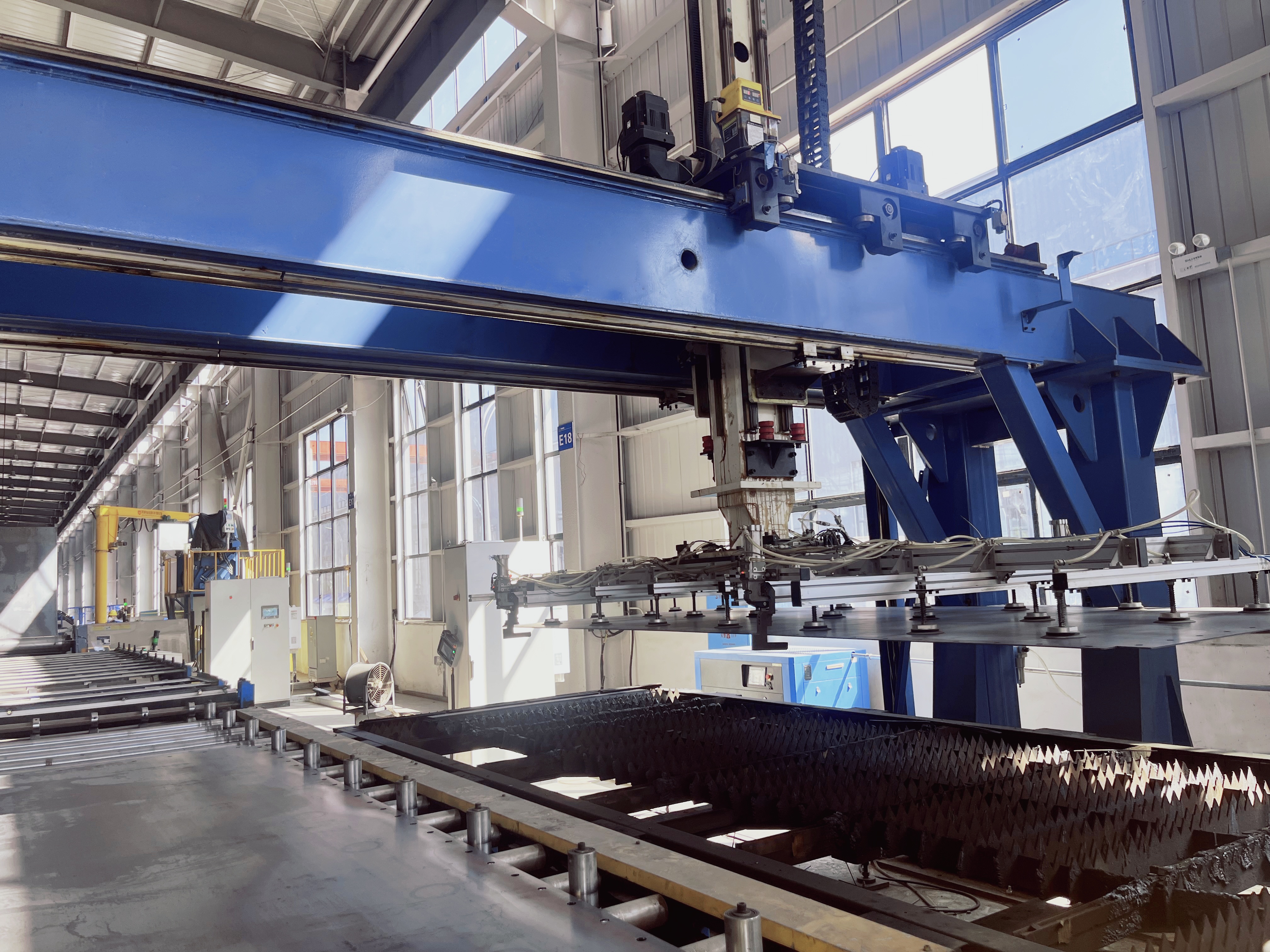
Manufacturing and pre-shipment testing — every DKTEC unit is 100% tested before delivery
The documentation layer is where compliance risk sits. A CE claim without a Declaration of Conformity naming the exact model is not verifiable evidence, and ISO 19720-1:2017 — the published terminology and commercial specification standard for concrete mixing and batching plants — is a vocabulary baseline, not a certification. The practical answer is to name the documents you require in the specification review and confirm them per order against the model being built.
Step-by-step: a seven-step specification and compliance review
- Fix the real hourly demand, not the nameplate. Size on actual hourly production requirement and expected utilisation rate rather than theoretical capacity. As a working reference, small construction projects typically sit in the 25–60 m³/h band, commercial ready-mix production in the 60–180 m³/h band, and large infrastructure in the 120–270 m³/h band and above.
- Convert demand into a batch size. Choose the nominal mixer capacity that reaches your target output at a realistic cycle count, then confirm the class in the specification tables above.
- Check the weighing envelope against your mix design, material by material. Aggregate ±2%, cement, mixing powder, water and additive ±1% are the accuracy floors; the ranges decide feasibility, particularly for admixtures.
- Decide the structural class on relocation frequency and schedule. Fixed ready-mix base: commercial stationary. On-site engineering works: HZS-G class. Dispersed, short-timeline sites: mobile class, where 3-day commissioning on a flat concrete surface and tractor relocation are documented capabilities.
- Verify site and utility constraints. Confirm installed power (60–350 kW depending on class), unloading height ≥3.8 m, aggregate bin count and volume, powder silo and screw conveyor options, discharge direction and overall layout.
- Fix the automation level and agree the acceptance test. Specify PLC control with UPS backup, recipe management, production reporting and the safety items you require, then agree what will be verified at the factory before shipment.
- Lock documentation and lead time into the contract. If the destination market requires conformity documentation, name the exact documents, the signatory and the model they cover. Tie them to the 25–60 day production window and to the after-sales scope (remote support or on-site installation).
Use cases: which constraint profile fits which project
Commercial ready-mix base, Indonesia. A large construction contractor installed one HZS300 rated at 300 m³/h for large-scale infrastructure projects. Recorded outcome: high-volume production, stable operation and consistent quality. The constraint profile here is continuous high-volume output at a fixed location, which is exactly what the commercial stationary class is configured for.
Ready-mix supplier fleet, Philippines. A ready-mix concrete supplier ordered two HZS90G plants at 90 m³/h each for commercial concrete production, recorded as stable operation with consistent concrete quality. Two mid-capacity units rather than one large unit is a capacity-class decision driven by delivery radius and redundancy, not by price alone.
Bridge project, Philippines. One HZS180 at 180 m³/h has been recorded in bridge engineering service for five years, supplying concrete for pile foundations, pile caps, piers, abutments and girder bodies, with reported high-efficiency production, low failure rate and convenient maintenance. This is the engineering constraint profile: on-site production of high-grade concrete with a durability requirement.
Large infrastructure contractor, Oman. One HZS240 rated at 240 m³/h was installed for large-scale infrastructure works, with recorded high-volume production, stable operation and consistent quality.
Multi-site mobile work. Where the schedule moves, the mobile class replaces concrete transport with on-site production: the HZS60Y, HZS90Y and HZS120Y are documented as commissioned within 3 days of arrival on a flat concrete surface, with no deep foundations and tractor relocation between sites.
Comparison table: stationary, engineering or mobile?
| Constraint | Commercial stationary (HZS120–HZS300) | Engineering (HZS60G–HZS180G) | Mobile (HZS25Y–HZS120Y) |
|---|---|---|---|
| Typical output range | 120–300 m³/h | 60–180 m³/h | 25–120 m³/h |
| Installed capacity | 210–350 kW | 100–250 kW | 60–160 kW |
| Nominal mixer capacity | 2000–5000 L | 1000–3000 L | 500–2000 L |
| Primary application | Ready-mix and commercial concrete production, large infrastructure at a fixed site | High-speed railway, highway, bridge, tunnel and airport projects | Remote, temporary and multi-site projects with frequent relocation |
| Foundation | Fixed installation; steel structure foundation option available on engineering class | Modular, quick assembly and disassembly; steel structure foundation option | Flat concrete surface only, no deep civil works |
| Relocation | Not configured for frequent relocation | Modular design supports assembly, disassembly and relocation | Integrated towable chassis, relocated by tractor, 3-day commissioning |
| Feeding arrangement | Aggregate batching station with horizontal and inclined belt conveyors | Steel bin batching station with inclined belt conveyor | Integrated aggregate bins with inclined chevron belt conveyor |
| Control | Fully automatic PLC control with UPS backup, single-operator management, recipe management and production reports | Fully automatic PLC control, automatic drop correction and pulse buckle control option | Fully automatic PLC control with UPS backup, single-operator management |
| Unloading height | ≥3.8 m | ≥3.8 m | ≥3.8 m |
FAQ
How do I verify CE compliance for a stationary concrete batching plant manufactured in China?
Ask for four things and check them against the model being built: (1) an EU Declaration of Conformity that names the exact model and the order or serial number, (2) the technical file the declaration refers to, (3) component-level certificates for the installed motors, control cabinet components and load cells, and (4) confirmation that the electrical design matches your grid voltage and frequency, because a plant built for a different supply cannot be compliant as delivered. Confirm who signs the Declaration of Conformity — the manufacturer or the EU importer — and name that party in the contract. ISO 19720-1:2017 is the published terminology and commercial specification standard for concrete mixing and batching plants and is useful as a shared vocabulary, but it is not itself a certification. Because voltage and frequency are part of the documented OEM/ODM customisation scope, compliance documents should be requested per order rather than assumed from a catalogue.
Which mixer configuration should I specify — twin-shaft or planetary?
Twin-shaft mixers are widely used for ready-mix concrete and large-scale production because they provide fast, intensive mixing with high throughput. Planetary mixers are particularly suitable where mixing uniformity is the dominant requirement, including precast concrete, dry concrete and special concrete. Both are engineering choices tied to concrete type, required output and project conditions rather than to brand preference. Every model in the documented HZS range uses a twin-shaft forced mixer, from 500 L nominal capacity on the HZS25Y to 5000 L on the HZS300, with alternative mixer options available at configuration stage.
What capacity of concrete mixing plant do I actually need?
Required capacity depends on your concrete demand, project type, working hours, peak production requirements and transportation distance — not on the nameplate figure alone. Common capacities in the documented range are 25, 35, 60, 90, 120, 180, 240 and 270 m³/h, with a 300 m³/h model at the top of the range. As a working reference: small construction projects typically fall in the 25–60 m³/h band, commercial ready-mix concrete in the 60–180 m³/h band, and large infrastructure projects in the 120–270 m³/h band and above. Select on actual hourly production requirement and expected utilisation rate, then verify that the nominal mixer capacity and installed power of that class support the cycle you need.
Can I validate a plant before committing to a large order?
The documented minimum order quantity is 1 unit, which allows a single plant to serve as validation for a larger fleet — a pattern already used by a ready-mix supplier in the Philippines that operates two HZS90G units. Validation is supported by a documented 100% pre-shipment test of every unit, by OEM/ODM customisation covering voltage and frequency, company logo, machine colour, appearance design and branding, and by after-sales remote support or on-site installation. Practical items to verify in that first validation cycle include weighing calibration against your mix design, control-system recipe handling, and the safety devices you specified.
What production lead time should I plan for, and what changes it?
Documented production lead time is 25–60 days, against a monthly capacity of 50 units. Where you land in that window depends on the capacity class, the automation level, the customisation requested (voltage and frequency, branding, appearance) and optional items such as powder silos, screw conveyors, admixture tanks and surveillance packages. Site-side time is separate and shorter on the mobile class: mobile plants are documented as commissioned within 3 days of arrival on a flat concrete surface, while engineering plants use a four-layer module design with sub-module preassembly to reduce the number of components installed on site, and commercial stationary plants document a modular design that cuts on-site installation workload by 20%. If your schedule is the binding constraint, specify it as a constraint — and request the current specification sheet and plant brochure for the exact model before the order is placed.
Next step: match the specification to your project
Send your required output, mix design, destination grid voltage and frequency, and site conditions, and DKTEC (Hangzhou Jusheng Machinery & Equipment Co., Ltd.) will return a specification-matched configuration across the HZS range — commercial stationary, engineering or mobile — together with the current technical documentation for the model you are evaluating.
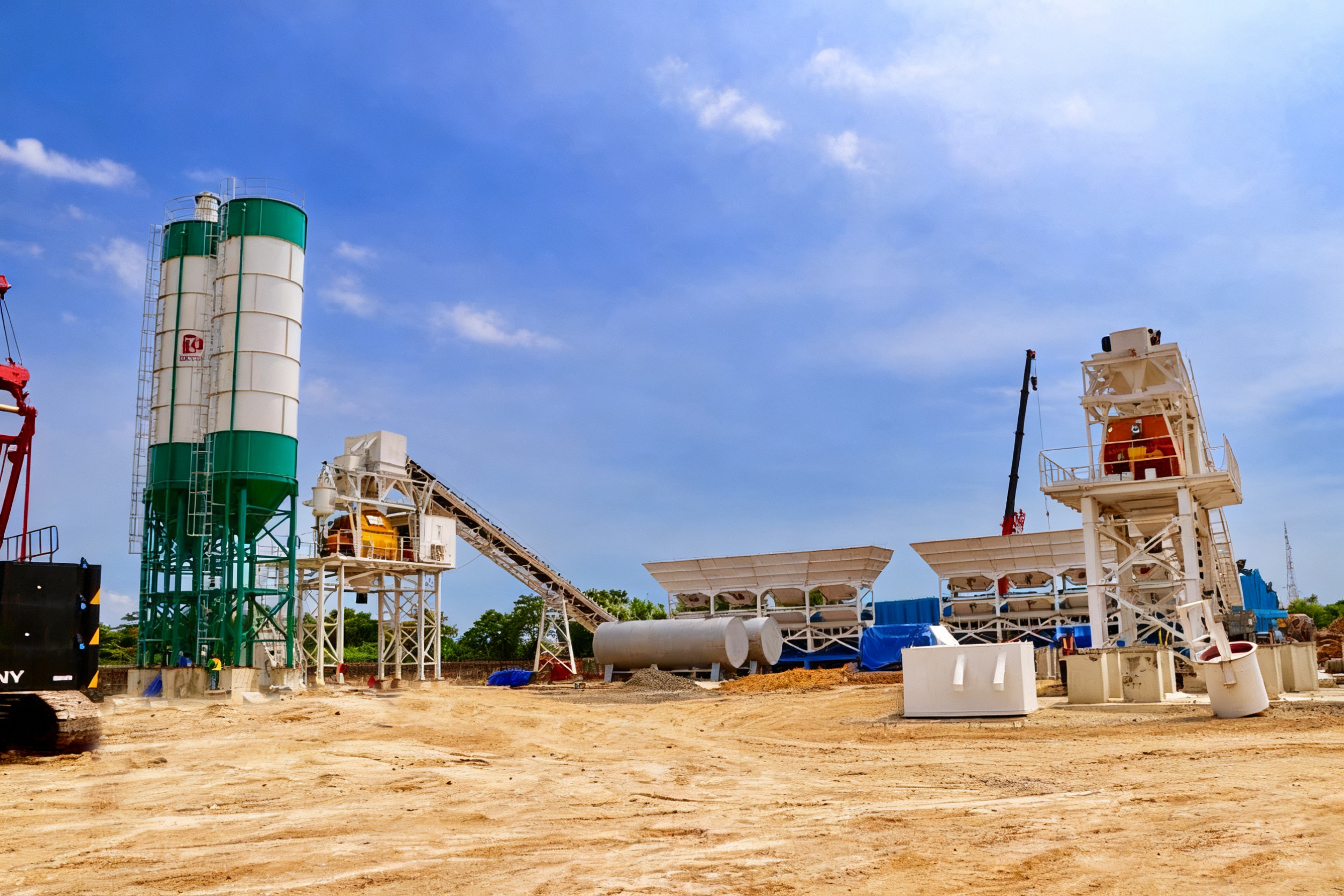
Download the full plant brochure with the complete HZS parameter set: DKTEC concrete batching plant brochure (PDF)
Contact: Linder — linder@dongkunchina.com · Tel / WhatsApp: +86 18888972181
Address: Zhongjiao Fortune Mansion, Gongshu District, Hangzhou, Zhejiang, China
Website: www.dongkunchina.com
You can request a quotation, a single-unit order for validation, or a technical review of your existing specification sheet. A single unit is the documented minimum order quantity, so validating one plant before committing to a fleet is a practical route rather than a special arrangement.