
Concrete Mixing Plant Support Equipment: What to Compare
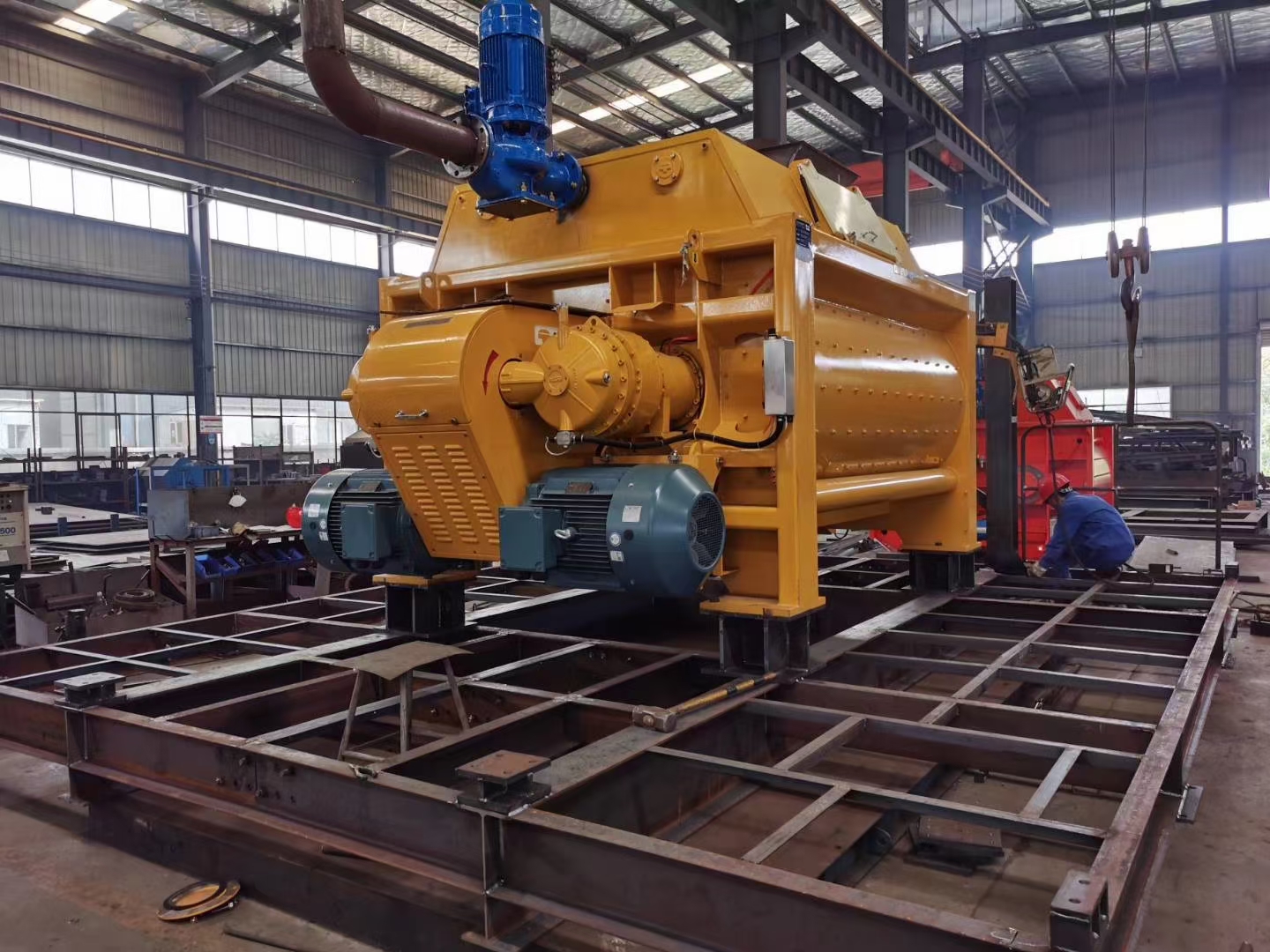
Supporting equipment decisions begin at the factory, where modular sub-assemblies are pre-assembled and checked before delivery.
Supporting equipment configurations decide whether a concrete mixing plant can match a project's actual production pattern. Rated output is only the starting point. The aggregate batching station, inclined belt conveyor, main mixing unit, metering system and control room determine whether that rated output can be sustained in daily operation. This comparison helps buyers judge which combination fits continuous commercial ready-mix output, on-site engineering supply or expressway production.
Hangzhou Jusheng Machinery and Equipment Co., Ltd. is a Chinese manufacturer of concrete mixing equipment founded in 2015. It operates a 120,000 ㎡ factory with 430 employees, an 80-engineer R&D team and an annual output of 2,000 units, with 80% of production exported to markets including the Middle East, Southeast Asia, Africa, Europe, Central Asia, West Asia, Australia and South America.
Why Supporting Equipment Deserves Its Own Comparison
Most buyers start by comparing the main mixer and the nameplate capacity. That is a reasonable starting point, but the supporting equipment package often decides installation time, output stability and long-term operating cost. A plant rated at 120 m³/h will not deliver that rate consistently if aggregate charging, belt conveying, weighing or control does not match the main unit.
The practical question is narrower than a full plant comparison: which module differences change a project's production pattern, installation schedule or operating cost, and which are only nominal. Jusheng's HZS120 stationary plant and HZS120Y mobile plant provide a useful reference because both are documented in the same 120 m³/h class, yet they differ in installed power, structure and relocation method.
Market and Standards Context
The global concrete batch plants market was valued at USD 3.8 billion in 2024, according to Global Market Insights (June 2025). Asia-Pacific accounted for 38% of global revenue in 2024, based on Credence Research data published in October 2025. China's exports of concrete or mortar mixers under HS code 847431 reached USD 276.9 million in 2023, according to UN Comtrade and WITS data.
These figures describe market scale and trade flow, not the suitability of any single configuration. Buyers still need to match modules to project location, supply chain and environmental rules. ISO 19720-1:2017 establishes terminology and commercial specifications for concrete mixing and batching plants and provides a common reference for comparing configurations. It is a terminology framework, not a certification that any specific plant complies with a given market's regulations.
Module 1: Aggregate Batching Station Configuration
Aggregate batching stations differ in bin structure, charging method, discharge assistance and enclosure. The correct bin count and capacity should follow the project's aggregate types, daily consumption and charging equipment rather than being copied from another site's specification sheet.
Three configuration choices have direct operational consequences. First, the bin structure affects footprint and foundation work: steel bin structures typically reduce ground-level space needs but require suitable charging equipment, while ground-level arrangements change the site layout and charging routine. Second, discharge assistance matters when aggregates are sticky or high in moisture. Jusheng documents an internal vibration technology on its HZS120 that increases vibration effectiveness by 20%, which is relevant to material flow rather than to a performance guarantee. Third, enclosure design affects dust control. Jusheng's enclosed material hopper reduces open surface area by 75% compared with standard configurations.
For a buyer, the decision rule is: match bin structure and discharge assistance to the actual aggregate, not to the brochure. If the project uses manufactured sand or high-fines aggregate, discharge assistance deserves more attention than nominal bin volume.
Module 2: Inclined Belt Conveyor Configuration
Inclined belt conveyors are specified by belt width, incline angle, belt profile and weather protection. Chevron belts and rain covers are common where aggregate moisture or rainfall affects material carry-back. The correct belt width and angle follow the rated output and aggregate size, and the conveyor frame should match the plant's structural module rather than being treated as a separate add-on.
Jusheng's seamless material flow technology is documented as increasing conveying efficiency by 20% and reducing the time to discharge the first load by 10% on its HZS120. These figures describe the conveying and discharge function, not overall plant output. The same documentation links modular construction to better belt alignment and sealing, which reduces spillage, mistracking and dust emissions during long-term operation.
A buyer comparing conveyors should ask three questions: Does the belt profile match the aggregate and climate? Is the frame part of the modular structure or welded on site? Are the belt, rollers and covers included in the supplied scope or priced separately?
Module 3: Main Mixing Unit Configuration
The main mixing unit is where configuration differences carry the largest cost spread. In the 2.0 m³ class, Jusheng's standard HZS120 uses a SICOMA MAO3000/2000 mixer with dual 37 kW motors, an integral hexagonal main shaft and 14 high-strength mixing arms (2 × 7), with a machine weight of 7,500 kg. Budget Chinese plants in the same nominal class commonly use a JS2000 OEM unit. Jusheng's comparison states that the lower-priced OEM units show marked disparities in service life and sealing performance, and that the SICOMA unit is positioned to support reliable shaft-end sealing and longer seal and liner life.
In the 3.0 m³ class, both the SICOMA MAO4500/3000 and the BHS DKXS3.0 are twin-shaft compulsory mixers with 4500/3000 L capacity and dual 55 kW motors, totaling 110 kW. Power per unit volume is approximately 36.7 kW/m³ for both. The documented differences are in brand positioning, drive configuration and weight: the SICOMA unit weighs 9,700 kg with 2 × 8 arms, while the BHS unit weighs 10,500–10,900 kg with 2 × 9 arms and dual SOG315 reducers. BHS uses German BHS core technology and is produced in Tianjin; SICOMA is manufactured by Zhuhai SICOMA. The BHS DKXS3.0 costs approximately twice as much per unit as the SICOMA MAO4500/3000, and SICOMA liner, arm and seal spare parts are documented as lower cost than BHS OEM parts, with Jusheng holding ready stock.
The decision rule is not that one mixer is universally better. It is that the same power and capacity can carry very different spare-parts economics and brand-positioning premiums. A buyer should compare the mixer unit, the wear-part price list and the local spare-parts path together, not the mixer nameplate alone.
Module 4: Metering System Configuration
Metering accuracy is a supporting-equipment decision because it determines how consistently the plant converts approved mix designs into delivered concrete. Jusheng's HZS120 is documented with weighing accuracy of ±2% for aggregates and ±1% for cement, using Meidia or Keli load cells and Erip or Airtac cylinders as standard. Budget plants in the same nominal class typically use no-name domestic mixers and low-cost OEM components, and Jusheng's comparison states that sensor accuracy and stability in those plants lack guarantees.
Powder inventory is a separate metering layer. Jusheng's intelligent powder silo level monitoring offers ±2% accuracy relative to maximum capacity, whereas manual tank tapping or standard plumb-bob level gauges are documented as having significant errors. The practical effect is fewer emergency purchases and less bin overflow or material shortage, which is a configuration benefit rather than an output claim.
Buyers should ask which sensor brands are supplied as standard, whether calibration records are provided, and whether the level-monitoring function is included or optional. These questions separate a genuine metering configuration from a nominal accuracy figure on a quotation sheet.
Module 5: Control Room and Control System Configuration
Control-room configuration divides into two broad levels. Standard industry control typically uses single-station, single-control mode with manual raw-material inventory management, data silos and on-site fault diagnosis. Jusheng's intelligent control system integrates over a dozen intelligent technologies, including dual-control for a single unit, powder silo level monitoring at ±2% accuracy and real-time slump monitoring based on the mixer's motor current curve. Jusheng states that its 'one operator, two plants' configuration reduces labor costs by 50% compared with standard control, based on internal data.
The cost logic is documented as follows: the intelligent package requires a higher initial investment, but it consolidates two stations under one operator and reduces losses from bin overflow or material shortage. Dual-station control also enables load sharing during peak and off-peak periods, which optimizes overall power consumption compared with stations that rely on manual experience. Standard control remains positioned for small-scale single-plant operations without strict intelligent automation requirements.
A buyer should decide the control level before requesting quotations, because retrofitting intelligent control later usually costs more than specifying it at the factory. Multi-plant group operations, commercial concrete producers and clients requiring ERP integration are the documented use cases for the intelligent package.
Optional Powder Silos and Screw Conveyors
Powder silos and screw conveyors are optional modules that change the plant layout, foundation plan, control complexity and cost. Jusheng offers SICOMA or WAM screw conveyors and butterfly valves as selectable components, and its environmental package includes the WAM SILOTOP series with documented emissions below 10 mg/Nm³, compared with an industry standard of 20–50 mg/Nm³.
Adding powder storage makes sense when the project consumes cement or fly ash at a rate that makes bulk delivery economical and when silo level monitoring can prevent emergency purchases. It also matters in dust-sensitive markets, where the silo filter becomes part of the environmental compliance scope. The decision rule is to size powder storage from actual consumption and delivery frequency, not from the maximum silo size available.
How Modular Design Changes Installation and Relocation
Jusheng's modular quick-install plant uses a four-layer full-machine modular structure that is pre-assembled and debugged in the factory before delivery. The documented effect is a 20% reduction in on-site installation workload compared with traditional site-welded plants, and mobile stations can be operational within approximately 3 days of arrival, whereas traditional fixed stations often require weeks of on-site welding. Modular stations can be dismantled and reused, which supports higher residual value after a project ends.
The mobile HZS120Y shows the relocation difference clearly. All components are integrated onto a single-piece chassis with axles and tires, so the unit can be towed as a single assembly. A conventional stationary plant requires disassembly, hoisting and transport of separate modules. Both plants are documented at 120 m³/h theoretical capacity and 2,000 L mixer capacity, but the HZS120Y has an installed power of 160 kW versus 210 kW for the stationary HZS120, which is 24% lower installed power. Specific energy consumption is approximately 1.33 kWh/m³ for the HZS120Y against approximately 1.75 kWh/m³ for the stationary HZS120.
The decision rule is project duration and relocation frequency. Long-term fixed commercial sites usually favor the stationary configuration; highway, railway, phased or frequently relocated projects favor the mobile or modular configuration.
Matching Configurations to Production Scenarios
Continuous commercial ready-mix output puts priority on mixer wear life, metering stability and control integration. A configuration built around the HZS120 with SICOMA or BHS mixers, Meidia or Keli load cells, Erip or Airtac cylinders, intelligent control and an environmental package matches that pattern. The environmental package is documented with membrane-coated filter bags at ≥99.9% dust removal efficiency, compared with approximately 99% for standard fabric bags, and a fully enclosed waiting hopper that reduces open area by 75%. These features are positioned for urban ready-mix plants and markets with strict environmental rules, such as urban projects in the EU, the Middle East and Southeast Asia.
On-site engineering or expressway production puts priority on relocation speed, foundation cost and installed power. The HZS120Y mobile plant requires only a leveled concrete surface, which lowers foundation cost, and its lower installed power reduces the electrical supply requirement. The trade-off is that a towed chassis configuration is not the same as a fixed commercial plant with generous maintenance access, so the buyer should confirm maintenance-point access before choosing.
Precast and high-grade concrete production puts priority on mixing uniformity and metering repeatability. In that setting, the main mixer and metering modules deserve more comparison time than the structural module, because the structural choice affects installation cost while the mixer and metering choices affect product quality every shift.
A Step-by-Step Configuration Review
- Define the production pattern. Continuous commercial ready-mix, on-site engineering supply and phased expressway work lead to different structural and control priorities.
- Lock the main mixing unit. Confirm capacity class, motor power, mixer brand, wear-part price list and spare-parts path before comparing peripheral modules.
- Match aggregate batching to the actual aggregate. Confirm bin structure, discharge assistance and enclosure against aggregate type, moisture and dust rules.
- Check the conveyor as part of the structure. Confirm belt profile, weather protection, frame integration and supplied scope.
- Decide the metering specification. Confirm sensor brands, stated accuracy, calibration records and whether level monitoring is included.
- Choose the control level. Decide standard or intelligent control before quotation, because factory integration is cheaper than retrofitting.
- Size optional powder handling. Confirm silo capacity, screw conveyor brand, filter specification and whether level monitoring is included.
- Confirm the structural and relocation plan. Compare fixed, modular and mobile options against project duration, foundation cost and relocation frequency.
Configuration Comparison Table
| Configuration area | Standard configuration | Upgrade or alternative | When the difference matters |
|---|---|---|---|
| Aggregate batching station | Standard bin structure | Internal vibration assistance; enclosed design | Sticky or high-fines aggregate; dust-sensitive sites |
| Inclined belt conveyor | Standard belt and frame | Seamless material flow design; rain cover | High throughput; wet or rainy climate |
| Main mixer, 2.0 m³ class | Generic JS2000 OEM unit | SICOMA MAO3000/2000, dual 37 kW, 7,500 kg | Export projects; buyers sensitive to uniformity and failure rates |
| Main mixer, 3.0 m³ class | SICOMA MAO4500/3000, dual 55 kW, 9,700 kg | BHS DKXS3.0, dual 55 kW, dual SOG315 reducers, approx. twice the unit price | German-brand mandates; high-grade concrete projects |
| Metering system | Low-cost OEM sensors | Meidia or Keli load cells; Erip or Airtac cylinders; ±2% aggregate, ±1% cement | Long-term commercial operation; mix-design repeatability |
| Control system | Single-station, single-control, manual inventory | Intelligent control with dual-unit control, ±2% silo level monitoring, real-time slump monitoring | Multi-plant groups; commercial producers; ERP integration |
| Powder handling | No powder silo | Powder silo, SICOMA or WAM screw conveyor, WAM SILOTOP filter below 10 mg/Nm³ | High powder consumption; strict emission rules |
| Structure | Site-welded fixed plant | Four-layer modular quick-install; mobile HZS120Y with towed chassis | Fast deployment; phased projects; frequent relocation |
Frequently Asked Questions
What standard terminology should a buyer use when comparing concrete mixing plant configurations?
ISO 19720-1:2017 establishes terminology and commercial specifications for concrete mixing and batching plants. Using a common vocabulary prevents suppliers from describing different configurations with the same words, especially for capacity class, mixer size and weighing accuracy. The standard is a terminology reference; it does not certify that a specific plant complies with a given market's regulations.
How much does metering accuracy differ between standard and branded configurations?
Jusheng's HZS120 is documented with weighing accuracy of ±2% for aggregates and ±1% for cement when supplied with Meidia or Keli load cells and Erip or Airtac cylinders. Low-cost OEM configurations typically do not provide the same accuracy guarantee, and Jusheng's comparison states that sensor stability in those plants lacks guarantees. Intelligent powder silo level monitoring offers ±2% accuracy relative to maximum capacity, while manual tank tapping or standard plumb-bob gauges are documented as having significant errors. Actual accuracy still depends on calibration and maintenance.
Does a higher-specification supporting equipment package always cost more over its service life?
Not necessarily. The SICOMA MAO3000/2000 carries a higher unit price than a generic JS2000 OEM mixer, but Jusheng positions its longer shaft-seal and liner life plus global spare-parts availability as factors that lower total cost of ownership. The BHS DKXS3.0 costs approximately twice as much per unit as the SICOMA MAO4500/3000, and the difference is brand positioning and drive configuration rather than power or capacity. The intelligent control package requires a higher initial investment, but Jusheng states that its 'one operator, two plants' configuration reduces labor costs by 50% based on internal data and reduces losses from bin overflow or material shortage. Buyers should compare purchase price, wear-part cost, downtime risk and labor configuration on one sheet.
How does modular design change installation and relocation for a mixing plant?
Jusheng's modular quick-install plant uses a four-layer full-machine modular structure that is pre-assembled and debugged in the factory. Jusheng documents a 20% reduction in on-site installation workload compared with traditional site-welded plants, and mobile stations can be operational within approximately 3 days of arrival, while traditional fixed stations often require weeks of on-site welding. Modular stations can be dismantled and reused. The HZS120Y mobile plant integrates all components on a single-piece chassis with axles and tires for towing, with 160 kW installed power versus 210 kW for the stationary HZS120 and approximately 1.33 kWh/m³ versus 1.75 kWh/m³ specific energy consumption.
How can a buyer validate a supporting equipment configuration before committing?
Start by listing the modules required by the project's production pattern, then check the supplier's configuration sheet item by item: main mixer model and power, load cell brand and stated accuracy, control level, powder-handling scope and structural type (fixed, modular or mobile). Ask which items are standard and which are optional, and confirm the wear-part source and lead time. Jusheng's DKTEC concrete batching plant catalogue is available for download at the DKTEC brochure link. Project-specific questions can be sent to Linder at linder@dongkunchina.com or +86 18888972181.
Conclusion
Supporting equipment comparison works best as a module-by-module decision rather than a single nameplate comparison. The aggregate batching station, belt conveyor, main mixer, metering system and control room each carry configuration choices that change installation time, operating cost or production fit. The verified example of Jusheng's HZS120 and HZS120Y shows how the same 120 m³/h class can be configured for continuous commercial ready-mix output or for mobile on-site production, with documented differences in installed power, specific energy consumption and relocation method.
A practical buyer sequence is to define the production pattern, lock the main mixer and its wear-part economics, match aggregate and conveyor modules to the real material, decide metering and control levels before quotation, size optional powder handling from actual consumption, and confirm the structural and relocation plan. Each step produces a yes-or-no configuration decision rather than a general preference, which is what makes a comparison usable before purchase.
Have Questions or Need More Details?
Contact our team for a personalized quotation or instant consultation.
Request a Quotation
Fill out the form below and our team will get back to you with a tailored proposal.
WhatsApp Direct Chat
Prefer to chat in real-time? Message us on WhatsApp for instant assistance & quick answers.
- Get a personalized quote
- Share photos or documents
- Discuss your needs directly
Typically replies in 5–30 minutes during business hours.