
Concrete Mixing Plant for Expressway Projects: Continuous Operation Guide
An expressway concrete programme is decided by continuity, not by a single capacity number. A concrete mixing plant for expressway projects is therefore evaluated on whether it can hold a stable discharge rhythm through a paving window, switch between several concrete grades without stopping the production train, and then be dismantled and rebuilt at the next section as the alignment advances.
In the engineering configuration used on expressway and high-speed rail contracts, three sub-systems carry that duty: a steel bin aggregate batching station with 10 m³ × 4 bins, an inclined belt conveyor running a 650 mm chevron belt under a rain cover, and a twin-shaft mixer. They are supported by a metering group documented at ±2% for aggregate and ±1% for cement, mixing powder, water and additive, and by a control system that allows one operator to manage recipes, production and reports.
DKTEC is the export brand of Hangzhou Jusheng Machinery & Equipment Co., Ltd., a manufacturer of concrete batching plants founded in 2015 and based in Hangzhou, Zhejiang, China, operating a 120,000 ㎡ production facility with 430 employees and an 80-engineer R&D team. The company states an export ratio of 80%, with equipment delivered to the Middle East, Southeast Asia, Africa, Europe, Central Asia, West Asia, Australia and South America. Its website is www.dongkunchina.com.
This guide covers four things a project engineer or procurement manager needs before committing to a plant: where expressway concrete supply typically fails, how a stationary modular plant is engineered to prevent those failures, the step-by-step sequence from pour schedule to relocation, and the verified specification figures that belong in a supplier comparison.
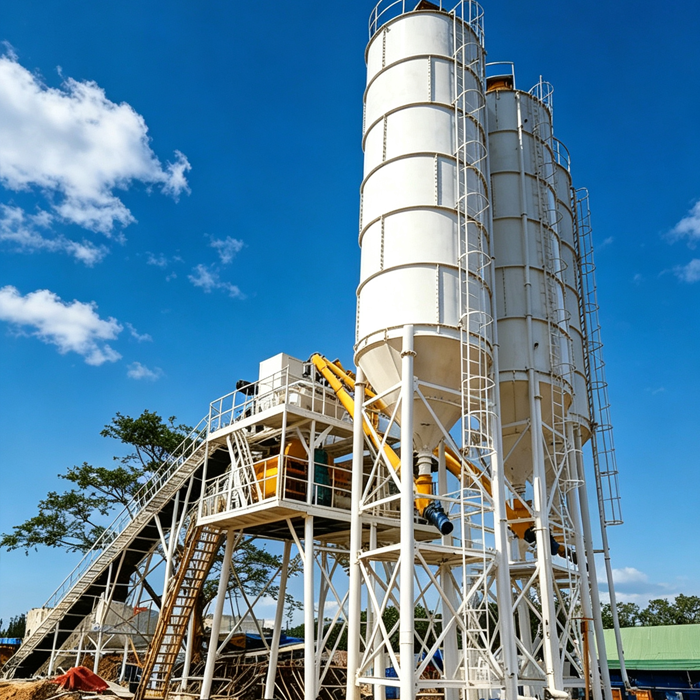
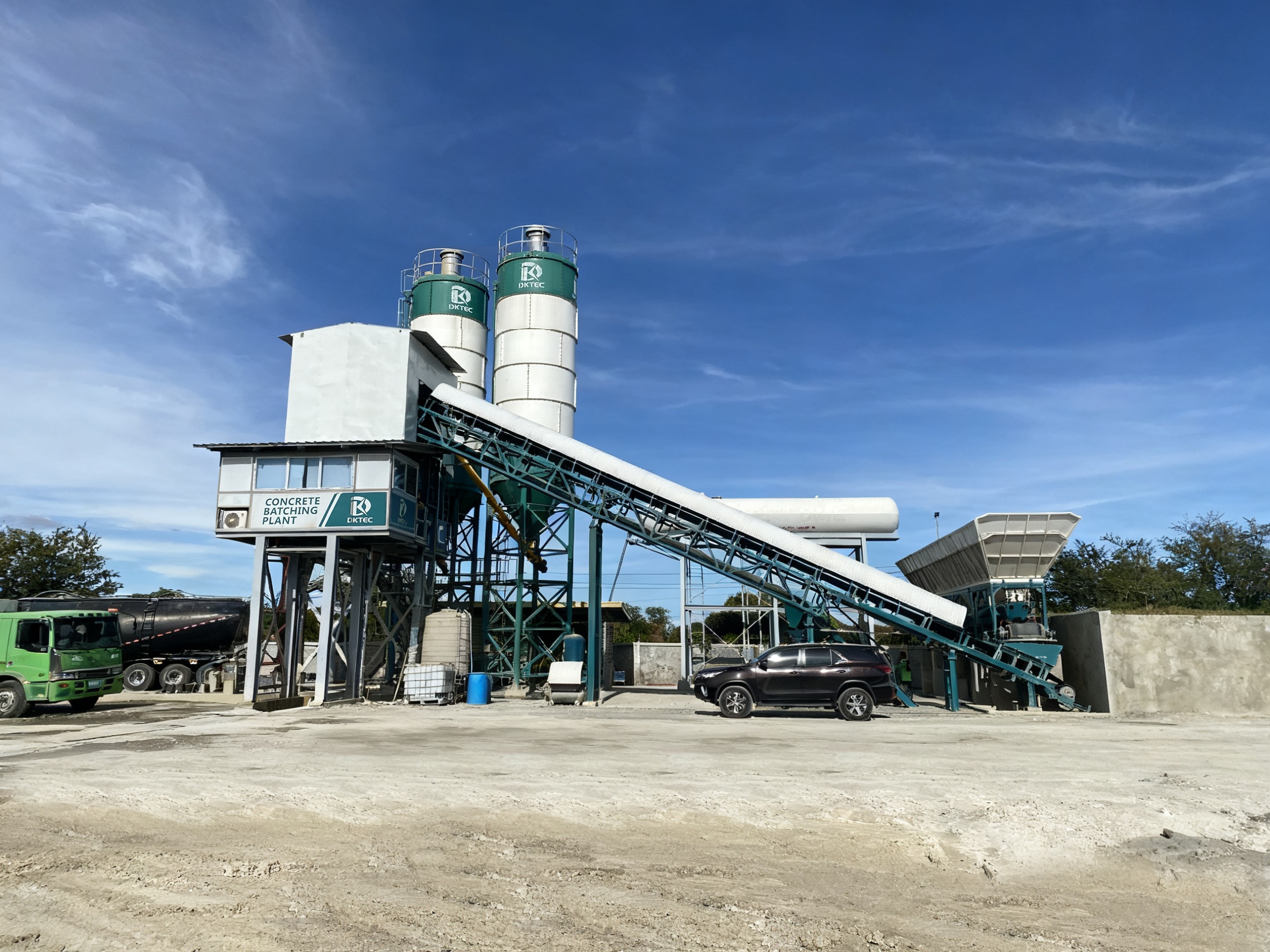
DKTEC HZS60G engineering concrete batching plant: steel bin aggregate batching station (10 m³ × 4 bins), 650 mm inclined chevron belt conveyor with rain cover, and 1000 L twin-shaft forced mixer.
Why Expressway Concrete Supply Breaks Down
Expressway work differs from a fixed commercial ready-mix yard in one structural way: the demand point moves, and the specification changes with it. Five failure points repeat across projects, and each one has a mechanical counterpart in the plant specification.
- Several concrete grades inside one shift. An expressway alignment consumes different concrete types across subgrade, base, bridge decks, piers and precast elements. Every grade change is a batching recipe change, and every recipe change is an opportunity for a weighing error or a delay at the discharge point.
- A short paving window against a long haul. Once a section is ready, the plant has to feed the paver continuously. A documented unloading height of ≥3.8 m is what allows direct loading into mixer trucks without rehandling the material.
- The plant has to move. On a long alignment, a plant positioned at one section is not serving paving ten kilometres ahead. Relocation downtime converts directly into paving downtime, which is why the expressway configuration is built as a modular unit for quick assembly and disassembly.
- Aggregate handling is the weakest mechanical link. Spillage at the transfer point, wet sand bridging inside the bin and clogged discharge are among the most common causes of an unplanned stop. The expressway configuration addresses them with a sand bin anti-clogging device, a wear-resistant discharge hopper and seamless material flow.
- Metering drift is invisible until it is expensive. Cement, mixing powder, water and additive tolerances are tighter than aggregate tolerances. If the specification only says “accurate weighing”, the buyer holds no number to verify at commissioning.
Industry Background: Where Expressway Batching Capacity Sits
Concrete batching capacity for infrastructure is a large and Asia-centred manufacturing category, and the published figures below frame what a project buyer is purchasing into.
- Global Market Insights estimates the global concrete batch plants market at USD 3.8 billion in 2024.
- Credence Research reports that Asia-Pacific accounted for a 38% revenue share of that market in 2024.
- UN Comtrade / WITS trade data shows China exported USD 276.9 million of concrete or mortar mixers under HS 847431 in 2023, a useful proxy for the export supply base that buyers in Africa, the Middle East and Southeast Asia draw on.
- Global Market Insights reports that the infrastructure segment accounted for 39.4% of the mobile concrete batch plant market in 2024, confirming that infrastructure rather than commercial ready-mix is the mobility-driven part of demand.
- ISO 19720-1:2017, published by ISO, establishes terminology and commercial specifications for building construction machinery and equipment covering concrete mixing and batching plants. It gives buyers and suppliers a neutral vocabulary for a specification sheet.
On the manufacturing side, the DKTEC company profile states that Hangzhou Jusheng Machinery & Equipment Co., Ltd. transitioned from trading to robot-assisted production of mixing stations in 2017. That shift matters to an expressway buyer for a practical reason: modular plant design depends on factory pre-assembly quality, and pre-assembly quality depends on the manufacturing system behind it.
The Continuity Configuration: How a Stationary Plant Is Built for Expressway Output
A stationary concrete batching plant supports continuous operation by treating storage, conveying, mixing and metering as one material train rather than four separate machines. The following paragraphs describe each element of the expressway configuration and the documented figures attached to it.
Aggregate Storage and Batching: Steel Bin Station with 10 m³ × 4 Bins
The aggregate batching station is the first continuity component. The expressway engineering configuration uses a steel bin aggregate batching station with 10 m³ × 4 bins, giving four independent aggregate fractions that can be stored and batched in the same cycle. The batching control applies coarse and fine weighing pulse buckle weighing to support measurement accuracy, and an optional child screw is available for feeding control.
Two details matter more than the bin count. The first is anti-blocking protection: a sand bin anti-clogging device and a wear-resistant discharge hopper keep wet or fine aggregate moving, which is the single most common source of unplanned stops on a rainy alignment. The second is flow behaviour: the aggregate feeding system operates in continuous feeding with seamless material flow, so aggregate does not sprinkle at the transfer point, supply stays continuous, and conveying efficiency is improved by 20% in the documented configuration.
Conveying: Inclined Belt Conveyor, 650 mm Chevron Belt with Rain Cover
The inclined belt conveyor in this configuration runs a 650 mm chevron belt with a rain cover and double-sided walkways. The chevron profile holds material on the incline; the rain cover keeps the belt and the load workable in wet weather, which matters on expressway programmes that rarely stop for rain. The walkways support inspection and maintenance without shutting down the batching cycle.
The same conveyor family scales with plant size: on the higher-capacity mobile units, an 800 mm chevron belt with a 30 kW drive is documented. For stationary expressway plants, the conveyor is specified together with the plant’s adaptability to different site conditions, plant layouts and discharge directions, and with support for multi-silo configurations.
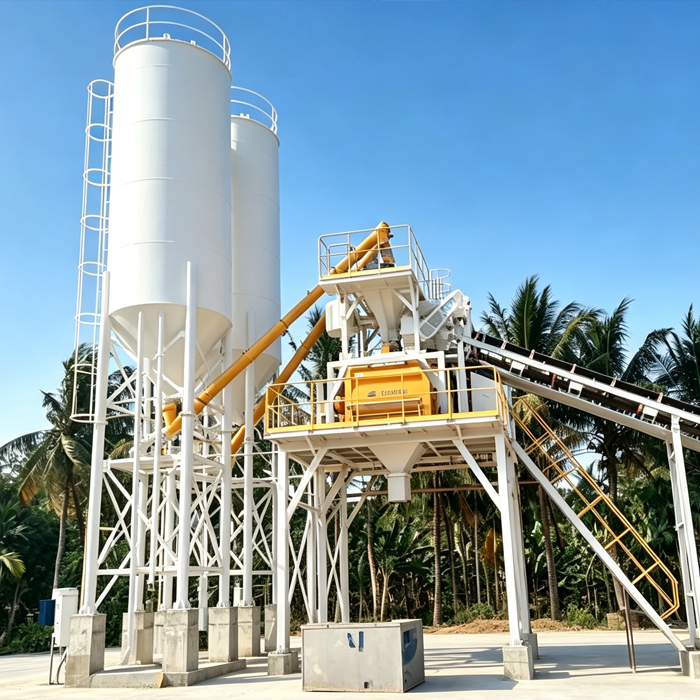
HZS90G engineering concrete batching plant: 90 m³/h theoretical output, 1500 L nominal mixer capacity, aggregate weighing accuracy ±2% and cement, mixing powder, water and additive accuracy ±1%.
Mixing: Twin-Shaft Mixer and Direct Truck Loading
The mixing unit in the expressway configuration is a twin-shaft mixer, documented at 1 m³ nominal capacity with 2 × 22 kW in the small-to-medium engineering set-up and scaled upwards across the HZS engineering series: 1000 L on the HZS60G, 1500 L on the HZS90G, 2000 L on the HZS120G with 2 × 37 kW mixer power, and 3000 L on the HZS180G. A twin-shaft forced mixer produces fast and uniform mixing, which is what allows a plant to hold a rhythm when the mix design changes between batches. All these models maintain an unloading height of ≥3.8 m, so mixed concrete discharges directly into mixer trucks.
Metering and Control: ±1% / ±2% and One-Operator Operation
The metering group is where continuity becomes measurable. In the expressway and engineering configuration, the batching system measures cement, mixing powder, water and additive with an accuracy of ±1%, and aggregate with an accuracy of ±2%. The plant uses four separate weighing channels covering sandstone, cement, water and additives, with documented weighing ranges that scale by model: for the HZS60G, aggregate 600–2500 kg, cement 100–700 kg, water 80–250 kg and additive 8–20 kg; for the HZS180G, aggregate 900–3000 kg, cement 300–1800 kg, mixing powder 200–1000 kg, water 200–800 kg and additive 15–80 kg.
Control runs on a fully automatic PLC system with UPS backup, allowing a single operator to manage recipes, production and reports. On the engineering models the control system applies automatic correction of the drop and pulse buckle control, together with coarse and fine weighing and pulse jitter precision measurement, which supports accurate feeding on higher-grade concrete. Core components are documented as Keli load cells, AirTAC cylinders and SICOMA pneumatic butterfly valves, with a dust-proof control cabinet, emergency stop switches and anti-fall protection on the larger commercial models.
Structure and Relocation: Modular Design, Factory Pre-Assembly, Optional Steel Foundation
What makes a stationary plant usable on a moving alignment is its modularity. The expressway configuration is built with a modular design across the entire unit, factory pre-assembly and modular on-site installation, which together enable rapid setup and relocation. The engineering models use a four-layer module design with sub-module preassembly and overall lifting; pre-assembling sub-modules reduces the number of components installed on site and shortens installation time. An optional steel structure foundation reduces civil engineering costs and simplifies later relocation.
The remaining train consists of the cement, mineral admixture, water and admixture metering systems, a pneumatic system, the main tower with dust removal system, a control room and the electrical system. A 100 t powder silo and φ219 screw conveyor are documented as optional additions where site logistics require bulk powder storage.
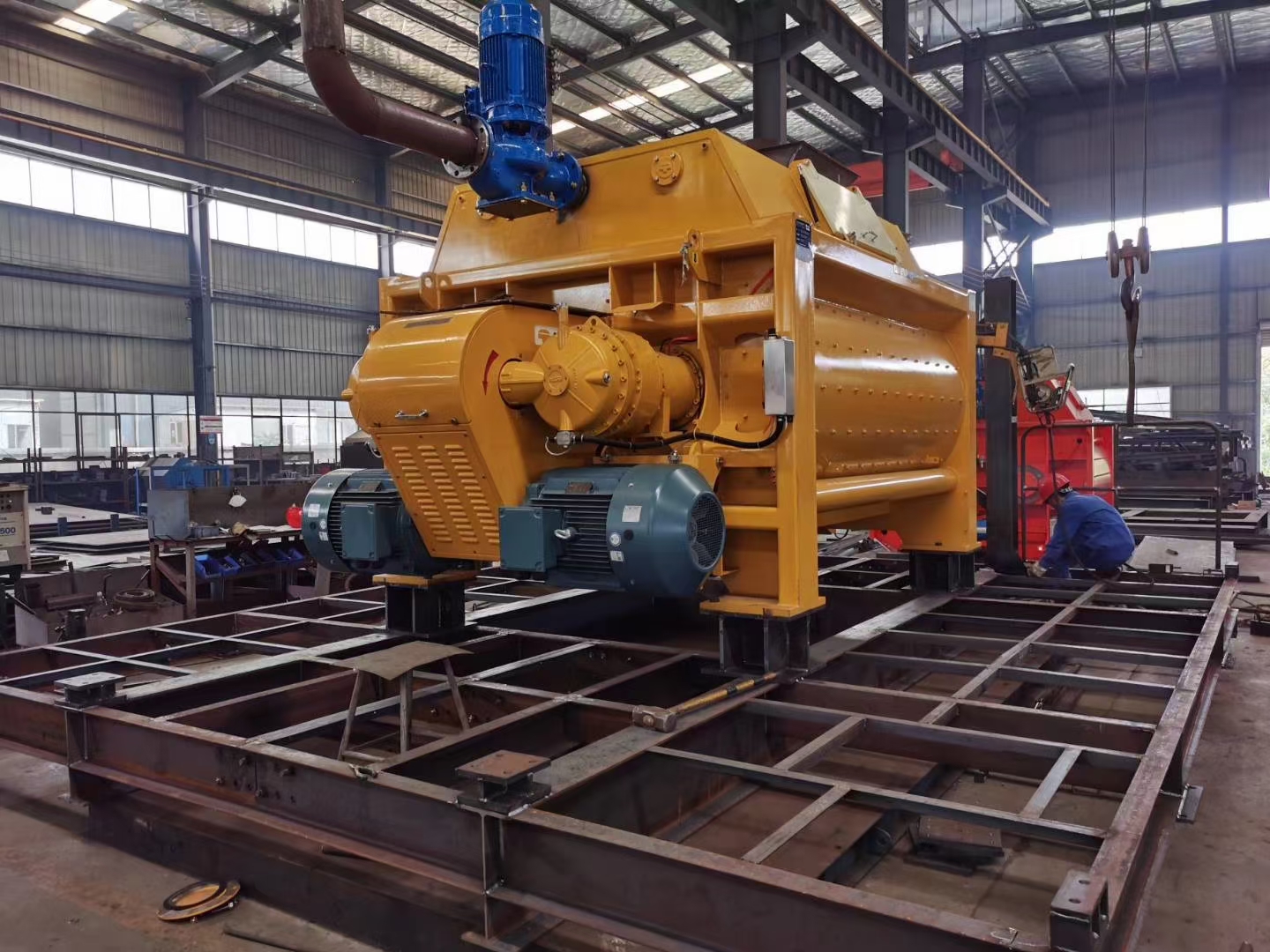
Factory pre-assembly: modular concrete batching plant units are assembled and tested before shipment, reducing on-site component count and installation time.
Step-by-Step: From Pour Schedule to Relocated Plant
Continuity is designed in a sequence. The seven steps below reflect how the expressway configuration is specified, commissioned, run and moved.
- Fix the peak demand, not the average. Start from the paving schedule and the maximum hourly pour rate, then map it to the engineering range: 60 m³/h (HZS60G), 90 m³/h (HZS90G), 120 m³/h (HZS120G) or 180 m³/h (HZS180G). Theoretical productivity is a rated figure, so the selection should sit above the peak, not exactly on it.
- Lock the site layout. Decide bin geometry, discharge direction and truck circulation before ordering. The configuration supports adaptation to different site conditions, plant layouts and discharge directions, and supports multi-silo arrangements where several powder grades are required. Keep the ≥3.8 m unloading height in the layout drawing so mixer trucks can load directly.
- Decide the foundation strategy. An optional steel structure foundation reduces civil engineering costs and is worth evaluating when sections are expected to be re-serviced elsewhere later. Confirm the module split at this stage, because the four-layer module design with sub-module preassembly and overall lifting determines crane requirements.
- Verify the weighing group against numbers. Write the four channels into the specification with their ranges and tolerances: aggregate ±2%, and cement, mixing powder, water and additive ±1%. Ask for the weighing ranges in kilograms, not percentages alone.
- Commission and prove the first batches. Set recipes in the PLC with UPS backup, confirm production reporting, and run the first batches with the single-operator workflow. Verify the sand bin anti-clogging device and the wear-resistant discharge hopper while the plant is still under supervision.
- Run continuous production. Monitor the inclined belt conveyor at the 650 mm chevron belt and the rain cover, keep the double-sided walkways clear, and use the dust removal system on the main tower. Check drop correction and pulse-based weighing periodically, because that is what protects the ±1% powder tolerances over a long pour.
- Relocate with the alignment. Disassemble along the module boundaries, transport, re-erect on the prepared foundation or the steel structure foundation, and recalibrate the weighing channels before the first truck. This is the step that a non-modular plant turns into a lost week.
Use Cases
The same configuration appears across several expressway-related scenarios, with the specification adjusted rather than the concept changed.
- Expressway sections with multiple concrete grades. The core use case is on-site production along a highway route for a range of concrete grades, where high-precision metering of cement and powder at ±1% and sand and gravel at ±2% is the governing requirement, supported by seamless material flow that prevents aggregate spillage and maintains continuous supply.
- Expressway bridge packages. Bridge construction demands high precision, high durability and high adaptability, with smooth internal vibration-assisted discharge and a robust hopper; an optional dual-auger system is available for precise feeding, and an optional steel structure foundation is available for piers and deck sections.
- Small-to-medium railway and highway engineering sites. The modular engineering set-up — with the steel bin aggregate batching station at 10 m³ × 4 bins, the 650 mm inclined belt conveyor with rain cover, and the 1 m³ twin-shaft mixer — is configured for factory pre-assembly and modular on-site installation, which enables rapid setup and relocation between sections.
Reference installations show how this configuration is applied in practice. A large construction contractor in Indonesia uses a DKTEC HZS300 commercial plant for large-scale infrastructure projects, with a documented capacity of 300 m³/h, high-efficiency mixing, precise weighing and reliable performance across an expected service life of 10–15 years. A large construction contractor in Oman operates an HZS240 plant with 240 m³/h capacity, efficient mixing and precise weighing. A ready-mix concrete supplier in the Philippines runs two HZS90G engineering plants for commercial concrete production, reporting stable operation and consistent concrete quality, and a bridge project in the Philippines has used an HZS180 plant for five years with high productivity, a low failure rate and convenient maintenance. An additional ready-mixed concrete company in Indonesia operates three units across its production base.
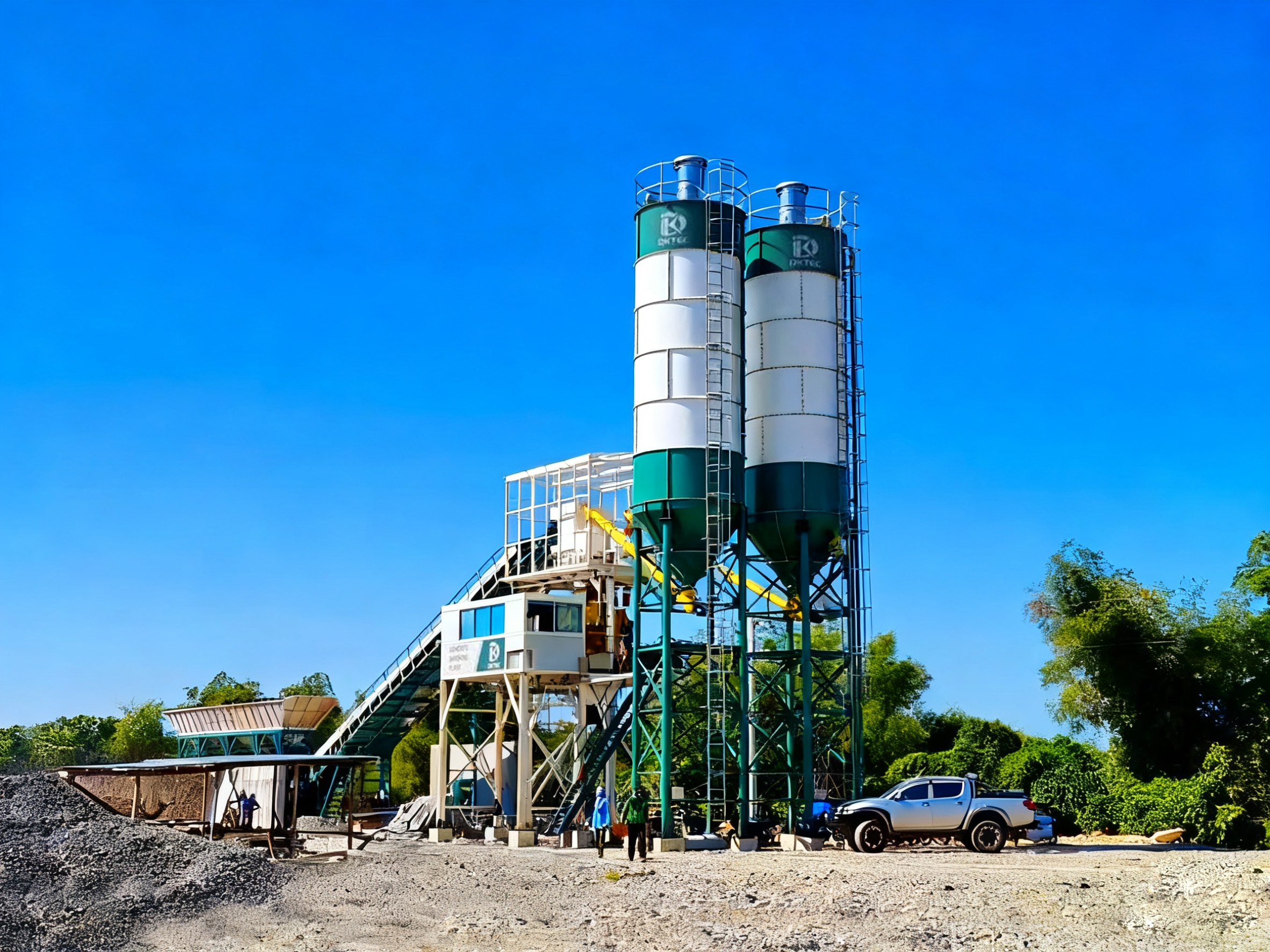
Aggregate batching station and inclined belt conveyor: continuous aggregate feeding with seamless material flow is what keeps discharge rhythm stable across a paving window.
Comparison Table: HZS Engineering Series for Expressway Work
The four engineering models below are the documented options for expressway and high-speed rail concrete. The table lists only published parameter values, so it can be used directly as a specification baseline.
| Parameter | HZS60G | HZS90G | HZS120G | HZS180G |
|---|---|---|---|---|
| Theoretical productivity | 60 m³/h | 90 m³/h | 120 m³/h | 180 m³/h |
| Installed capacity | 100 kW | 190 kW | 210 kW | 250 kW |
| Nominal capacity (mixer) | 1000 L | 1500 L | 2000 L | 3000 L |
| Unloading height | ≥3.8 m | ≥3.8 m | ≥3.8 m | ≥3.8 m |
| Aggregate range / accuracy | 600–2500 kg / ±2% | 600–2000 kg / ±2% | 600–2000 kg / ±2% | 900–3000 kg / ±2% |
| Cement range / accuracy | 100–700 kg / ±1% | 200–1200 kg / ±1% | 200–1200 kg / ±1% | 300–1800 kg / ±1% |
| Mixing powder range / accuracy | Not listed in published spec | 200–800 kg / ±1% | 200–800 kg / ±1% | 200–1000 kg / ±1% |
| Water range / accuracy | 80–250 kg / ±1% | 150–400 kg / ±1% | 150–400 kg / ±1% | 200–800 kg / ±1% |
| Additive range / accuracy | 8–20 kg / ±1% | 15–50 kg / ±1% | 15–50 kg / ±1% | 15–80 kg / ±1% |
Where an expressway package involves frequent relocations over short sections, the mobile range is the alternative to a stationary modular plant. The decision differences are structural rather than commercial.
| Decision factor | Stationary modular engineering plant | Mobile plant (HZS25Y–HZS120Y) |
|---|---|---|
| Structural configuration | Stationary, modular, quick assembly and disassembly for relocation | Mobile, integrated trailer chassis, towable by standard truck |
| Foundation | Optional steel structure foundation reduces civil engineering costs | Flat concrete surface required, no deep foundations |
| On-site commissioning | Factory pre-assembly plus modular on-site installation | Documented on-site commissioning time of 3 days |
| Documented capacity range | HZS60G at 60 m³/h to HZS180G at 180 m³/h | HZS25Y at 25 m³/h to HZS120Y at 120 m³/h |
| Typical fit | Long expressway packages with sustained production at fixed sections | Short sections, dispersed sites and rapid rotation between locations |
FAQ
CE marking for machinery placed on the EU market is a manufacturer’s declaration, not an independent third-party certificate for the plant as a whole, so a buyer should request the declaration of conformity, the list of standards applied and the technical file rather than relying on a logo on a brochure. Two document checks are independent of the supplier. First, ISO 19720-1:2017, published by ISO, establishes terminology and commercial specifications for concrete mixing and batching plants, so a specification sheet can be read against a neutral vocabulary. Second, metering performance should be stated as a number: on DKTEC engineering plants the published figures are ±2% for aggregate and ±1% for cement, mixing powder, water and additive, with the PLC control method and UPS backup documented in the same specification. Buyers should ask the supplier to state in writing which marking applies to their machine and under which directive, and keep that statement in the project file.
Match the rated output to the peak pour rate rather than the average daily volume. The engineering series covers 60 m³/h on the HZS60G, 90 m³/h on the HZS90G, 120 m³/h on the HZS120G and 180 m³/h on the HZS180G, each with a twin-shaft mixer of 1000 L, 1500 L, 2000 L and 3000 L respectively and an unloading height of ≥3.8 m for direct truck loading. Because the weighing tolerances — ±2% for aggregate and ±1% for cement, mixing powder, water and additive — are held across the documented weighing ranges, capacity selection does not change dosing performance; it changes throughput only.
The main cost variables are structural and configurational rather than cosmetic: the capacity class and nominal mixer size, the number of aggregate bins in the batching station, whether a powder silo and screw conveyor are added (a 100 t powder silo and φ219 screw conveyor are optional items), the choice between a civil foundation and an optional steel structure foundation, and the level of monitoring and automation included. Each of these changes the module count, the steel content and the site work, which is why an expressway plant should be quoted against a defined pour schedule and layout rather than against a capacity figure alone.
Validation happens in two places. In the factory, modular units are pre-assembled and tested, and the documented quality-control method is a 100% test of the plant. On paper, the buyer should require the four weighing channels to be listed with their ranges and tolerances, the PLC control method with UPS backup, recipe management and production report functions to be confirmed, and the core component list — Keli load cells, AirTAC cylinders and SICOMA pneumatic butterfly valves on the engineering models — to be written into the order. After delivery, remote support and on-site installation and commissioning are part of the documented after-sales scope.
DKTEC documents a lead time of 25–60 days, a minimum order quantity of one unit and a monthly capacity of 50 units. OEM and ODM customisation covers voltage and frequency, company logo, machine colour, appearance design and branding, so an expressway plant can be delivered to the project’s electrical standard and site identity. Because the delivery window is fixed at 25–60 days, the configuration and foundation decision should be finalised before the order is placed. To move from specification to a project-specific proposal, request a quote for your pour schedule, or download the product catalogue and send the layout drawing for review.
Conclusion: Continuity Is a Configuration Decision
Continuous concrete supply on an expressway project is not achieved by buying a larger plant. It is achieved by specifying the three sub-systems that carry the material train — a steel bin aggregate batching station with 10 m³ × 4 bins, an inclined belt conveyor with a 650 mm chevron belt and rain cover, and a twin-shaft mixer — and by holding the supplier to published metering figures of ±2% for aggregate and ±1% for cement, mixing powder, water and additive. Add modular design for rapid setup and relocation, a four-layer module strategy with sub-module preassembly, and an optional steel structure foundation, and the plant stops being a fixed asset that the alignment has to work around.
The practical next step is to convert the paving schedule into a capacity class, lock the layout and foundation decision, and request a configuration proposal that lists the weighing ranges in kilograms. For expressway packages where sections rotate quickly, compare the stationary modular option against the mobile range — HZS25Y at 25 m³/h through HZS120Y at 120 m³/h with 3-day on-site commissioning — before freezing the specification.
Send your pour schedule, site layout and required concrete grades for a project-specific configuration proposal.
Next step for your expressway package
Request a project-specific configuration and quotation for an HZS engineering concrete batching plant, or download the full DKTEC concrete batching plant catalogue to review models, weighing ranges and options with your project team.
Catalogue download: DKTEC Concrete Batching Plant Catalogue (PDF)
Hangzhou Jusheng Machinery & Equipment Co., Ltd. (DKTEC) · www.dongkunchina.com · Email: linder@dongkunchina.com · Tel / WhatsApp: +86 18888972181 · Address: Zhongjiao Fortune Mansion, Gongshu District, Hangzhou, Zhejiang, China.
Have Questions or Need More Details?
Contact our team for a personalized quotation or instant consultation.
Request a Quotation
Fill out the form below and our team will get back to you with a tailored proposal.
WhatsApp Direct Chat
Prefer to chat in real-time? Message us on WhatsApp for instant assistance & quick answers.
- Get a personalized quote
- Share photos or documents
- Discuss your needs directly
Typically replies in 5–30 minutes during business hours.