
Ranking Intelligent Concrete Mixing Plant Options for Low-Intervention Production
Low-intervention concrete production is bought as a configuration, not hired as a larger crew. In a commercial concrete batching plant or an engineering concrete batching plant, the tasks that still stop a batch — slump correction, powder silo run-outs, hopper bridging, belt spillage — are exactly the tasks that a defined set of optional intelligent systems can absorb. This ranking orders those options by how much manual intervention each one removes from a continuous ready-mix or project batching schedule.
Ranked summary: online slump monitoring via mixer motor current curves → intelligent powder silo level monitoring with ±2% inventory accuracy → dual-pivot internal vibration discharge for manufactured sand, fine sand and mineral powder → fully enclosed standby hopper with a 75% reduction in open surface area → seamless material flow raising conveyor belt efficiency by 20% → low-pressure powder conveying → screw-type air compressor with dust protection and 20 dB noise reduction. Two further layers, one-operator dual-plant control and four-level modular pre-assembly, shorten the labour and installation curve around the plant rather than inside it. DKTEC (Hangzhou Jusheng Machinery & Equipment Co., Ltd.) supplies these as optional intelligent configurations within its HZS series concrete batching plant range, which is built around more than 10 intelligent technologies intended to make the process fully adaptive and reduce manual intervention.
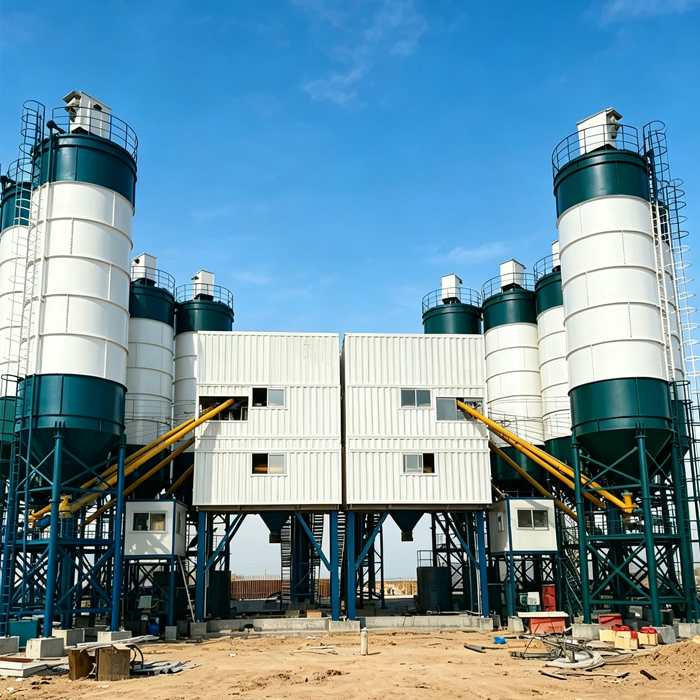
HZS300 commercial concrete batching plant, the highest-throughput model in the HZS lineup at 300 m³/h with a 5000 L twin-shaft mixer.
Problem Definition: Where Manual Intervention Still Happens
Batching automation has largely solved dosing. What remains manual is judgement and unplanned stoppage. In an operating plant, intervention concentrates in seven recurring places.
- Slump decisions. An operator samples, judges and adjusts water or admixture during the pour window.
- Powder inventory. Silo levels are checked by tapping, dipping or climbing; a run-out mid-order halts the line.
- Discharge bridging. Manufactured sand, fine sand and mineral powder bridge above the discharge point and must be cleared by hand.
- Aggregate spillage. Material escaping the belt requires clean-up and re-feeding, and disrupts continuous flow.
- Dust and standby hopper exposure. Open transfer points generate dust that triggers manual housekeeping and maintenance.
- Powder temperature and feeding continuity. Cement handling can drift out of a stable feeding condition and needs operator correction.
- Pneumatic reliability. Compressor dust ingress and noise drive both maintenance stops and site complaints.
The decision rule behind the ranking below is deliberately narrow. An option ranks higher when it removes a task that repeats many times per shift, stops production when it fails, and requires a judgement that a sensor-and-logic layer can make instead of a person. Options that only reduce effort around the plant, rather than inside the production cycle, are ranked separately in the control and deployment layers.
Industry Background: Buyers Now Specify Automation, Not Only Capacity
Concrete batching capacity is no longer the only specification line on a tender. The global concrete batch plants market was valued at USD 3.8 billion in 2024, according to Global Market Insights, and Credence Research reports that Asia-Pacific held a 38% revenue share of that market in the same year. Within the mobile segment, the infrastructure end-use segment accounted for 39.4% of demand in 2024 (Global Market Insights). China alone exported USD 276.9 million of concrete or mortar mixers under HS 847431 in 2023, according to UN Comtrade / WITS data. Capacity is abundant; the differentiator is how much of the shift a plant can run without a decision being made by hand.
Standards work in the same direction. ISO 19720-1:2017 establishes terminology and commercial specifications for concrete mixing and batching plants, which matters because optional intelligent configurations must still be described, quoted and compared against a common vocabulary rather than supplier-specific marketing terms.
Hangzhou Jusheng Machinery & Equipment Co., Ltd. — trading as DKTEC — is a heavy-industry equipment manufacturer based in Hangzhou, Zhejiang, China, founded in 2015, specialising in intelligent concrete mixing plants, mobile mixing equipment and mining aggregate processing lines. The company operates a 120,000 m² facility with 430 employees and 80 R&D engineers, an annual output of approximately 2,000 units, and an export ratio of around 80%, with installations in the Middle East, Southeast Asia, Africa, Europe, Central Asia, West Asia, Australia and South America.
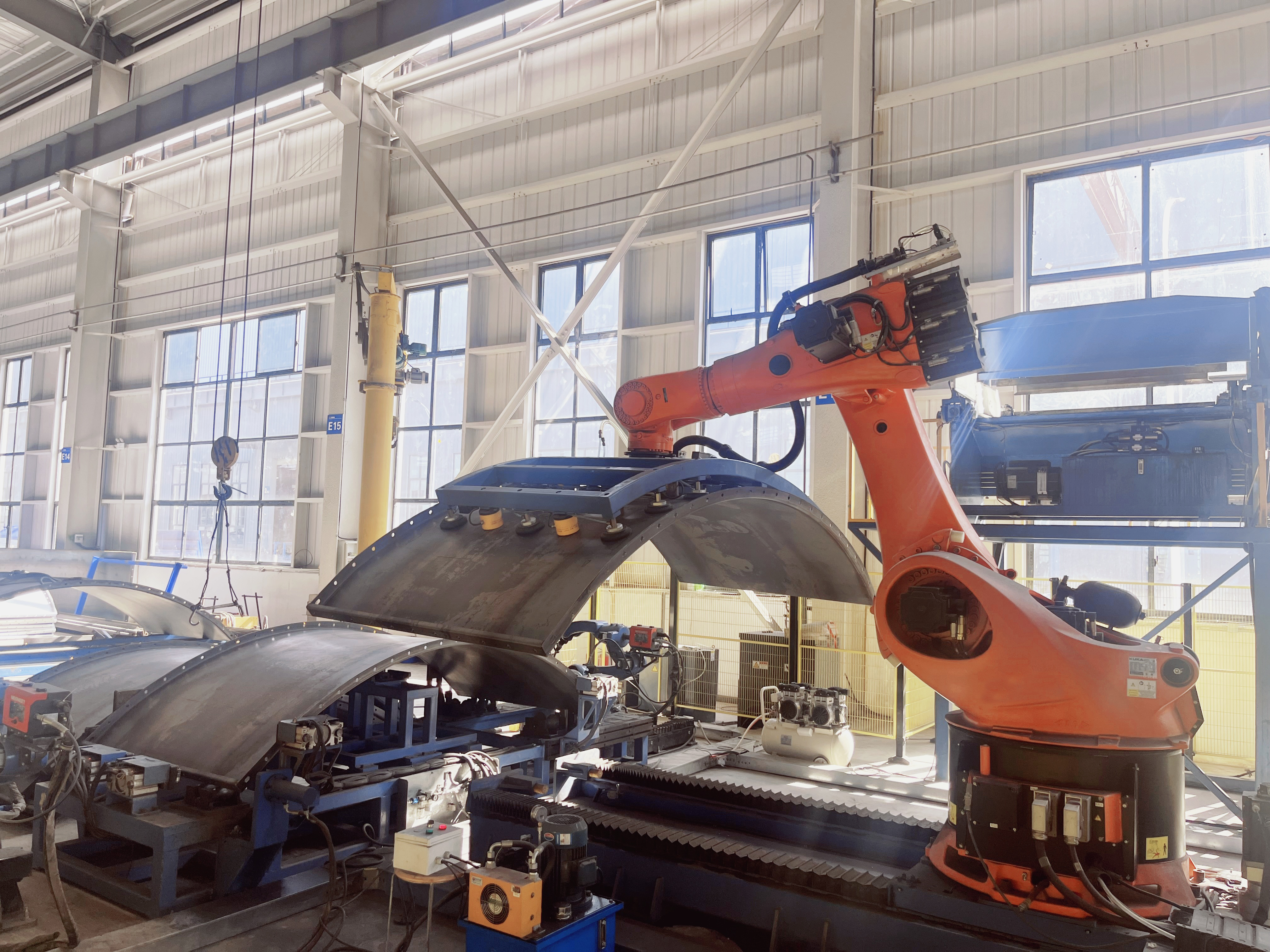
Factory pre-assembly of HZS series plant modules, which reduces on-site installation workload by 20%.
Detailed Solution: Ranking the Intelligent Options by Intervention Removed
Rank 1 — Online Slump Monitoring via Mixer Motor Current Curves
This is the highest-ranked option because slump is the most frequently repeated manual judgement in ready-mix production. Rather than sampling and adjusting, the plant reads the mixer motor current curve and returns a real-time slump indication. The operator task that disappears is the repeated mid-batch correction; the batching recipe stays the reference point and the mixing cycle is not interrupted to check consistency.
Rank 2 — Intelligent Powder Silo Level Monitoring (±2% Inventory Accuracy)
Optional intelligent powder silo level monitoring reports inventory accuracy of ±2% and supports real-time level checks through ERP, PLC or a mobile app. The intervention removed is the physical silo check and, more importantly, the mid-order run-out. Because the reading is available to upstream planning systems, silo replenishment becomes a scheduled activity instead of an emergency one — the single change that most often protects a continuous production promise to a ready-mix customer.
Rank 3 — Dual-Pivot Internal Vibration Discharge
The dual-pivot internal vibration structure improves vibration efficiency by 20% and is specifically aimed at resolving discharge problems with manufactured sand, fine sand and mineral powder. These three materials are the usual cause of bridging and manual clearing. Because the discharge hopper is vibrated internally rather than assisted externally, the intervention removed is the physical clearing task that stops the batching cycle and often damages the bucket body.
Rank 4 — Fully Enclosed Standby Hopper with Membrane Bag Filter
A fully enclosed standby hopper reduces open surface area by 75% and is combined with a forced-cleaning membrane bag filter to strengthen dust removal performance. The intervention removed here is manual housekeeping around transfer points, together with the dust-driven maintenance that follows it. In urban and industrial-park plant locations, this option also protects the plant's operating licence conditions more directly than any downstream cleaning measure.
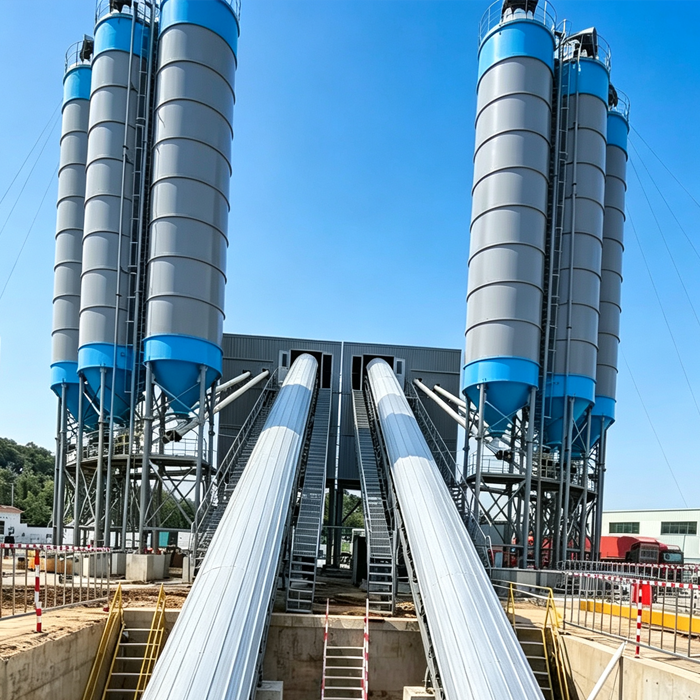
HZS270 commercial concrete batching plant: 270 m³/h, MAO4500 twin-shaft compulsory mixer, 4500 L nominal capacity.
Rank 5 — Seamless Material Flow (Conveyor Belt Efficiency +20%)
Seamless material flow technology prevents aggregate spillage, ensures continuous supply and improves conveying efficiency by 20%. The intervention removed is spillage clean-up and manual re-feeding at the belt. It is ranked fifth rather than higher because it removes a recurring task but rarely stops a batch on its own; its value compounds when combined with ranks 3 and 4, which address the materials most likely to leave the material path.
Rank 6 — Low-Pressure Powder Conveying
An optional low-pressure powder conveying system effectively lowers cement temperature and ensures continuous material feeding. The intervention removed is operator correction of an unstable feed condition. Lower cement temperature also supports more predictable dosing into the ±1% cement weighing band, so this option contributes indirectly to quality stability as well as to uptime.
Rank 7 — Screw-Type Air Compressor with Dust Protection and 20 dB Noise Reduction
The screw-type air compressor is custom-developed for mixing plant conditions, with dust protection and 20 dB noise reduction. It is ranked last of the production-side options because it removes maintenance intervention and environmental complaints rather than a batching task. It remains a prerequisite, however: every pneumatic valve, butterfly valve and weighing discharge on the plant depends on this air supply, so an unreliable compressor converts every other intelligent option into something an operator has to work around.
Control Layer — One-Operator Dual-Plant Control
Beyond the production-side options, an optional one-operator, dual-plant control configuration allows one operator to control two mixing plants, reducing labour costs by 50%. This is a control-layer option: it does not change the mixing cycle, but it changes how many people a batching base needs in order to sustain the cycle. It is the clearest cost-relevant configuration decision for a commercial ready-mix base running more than one plant line.
Deployment Layer — Four-Level Modular Pre-Assembly
Modular design with factory pre-assembly cuts on-site installation workload by 20%. The four-level module design allows sub-module preassembly and overall lifting, which reduces the number of components to be installed on site. For engineering concrete batching plant projects with compressed mobilisation windows, this is the option that determines how quickly the intelligent configuration above becomes operational.
Step-by-Step Breakdown: Specifying These Options in the Right Order
Step 1 — Baseline the intervention load. Record which operator tasks currently stop the batch cycle, and how often per shift. Slump checks, silo checks and discharge clearing almost always appear first; this baseline determines whether ranks 1–3 come before anything else.
Step 2 — Match the ranking to the batching scenario. A ready-mix commercial concrete batching plant weights ranks 1, 2 and 6 most heavily, because continuous supply commitments make run-outs and slump drift the costliest failures. A project batching plant on an expressway, bridge or high-speed rail site weights ranks 3, 4, 5 and the deployment layer more heavily, because the dominant risk is material behaviour and mobilisation time rather than order-book continuity.
Step 3 — Confirm the metrology baseline before adding intelligence. The intelligent layer sits on top of the weighing system, so verify the documented accuracy first: sandstone ±2%, and cement, mixing powder, water and additive ±1% across the HZS range. Adding monitoring to an unstable weighing system only automates the wrong number.
Step 4 — Layer the control options on top. Dual-plant control and silo-level reporting through ERP, PLC or mobile app belong at this stage, once the production-side options are fixed. This is where a site decides how many operators the plant needs, rather than how many tasks the plant performs.
Step 5 — Stage installation using the modular structure. Because the plant is built in four-level modules with sub-module preassembly and overall lifting, intelligent configurations can be released as a planned configuration set rather than retrofitted task by task, and the on-site installation workload is reduced by 20%.
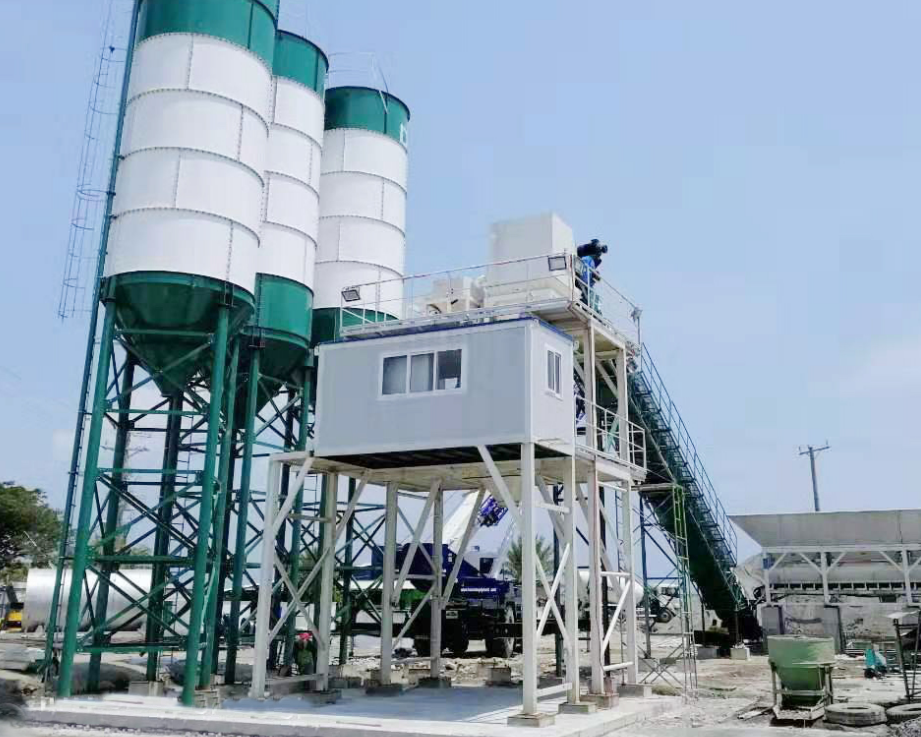
HZS120G engineering concrete batching plant: 120 m³/h, 2000 L twin-shaft mixer, 210 kW installed capacity.
Use Cases: Where the Ranking Changes Behaviour
Case 1 — Mega-Scale Ready-Mix Base (HZS300, Indonesia)
A large construction contractor in Indonesia operates one HZS300 commercial concrete batching plant with a theoretical productivity of 300 m³/h, a 5000 L nominal mixer capacity and 350 kW installed capacity. Documented weighing accuracy is 900–5000 kg at ±2% for sandstone and ±1% for cement, mixing powder, water and additive. The plant is used for high-volume concrete supply to large-scale infrastructure projects, with reliable performance and precise weighing as the stated highlights. On this class of plant, ranks 1, 2 and 6 are the options that protect a continuous supply commitment, while dual-plant control is the option that protects the labour line.
Case 2 — Large-Scale Infrastructure Supply (HZS240, Oman)
In Oman, a large construction contractor runs one HZS240 commercial concrete batching plant for large-scale infrastructure concrete production: 240 m³/h theoretical productivity, 280 kW installed capacity and 4000 L nominal capacity, with sandstone weighing of 900–4500 kg accuracy ±2%, cement 400–2500 kg accuracy ±1% and additive 15–80 kg accuracy ±1%. The plant has provided continuous service for 10–15 years with stable operation and consistent quality. Long service life of this kind is where the dust-protected compressor and the enclosed standby hopper pay back: they reduce maintenance intervention rather than cycle time.
Case 3 — Bridge Project Batching (HZS180, Philippines)
A concrete supplier in the Philippines uses one HZS180 commercial concrete batching plant for bridge engineering, supplying pile foundations, pile caps, piers, abutments and girder bodies. The plant delivers 180 m³/h with a 3000 L nominal capacity, and is reported as high-productivity with a low failure rate and convenient maintenance. For this profile, discharge behaviour with manufactured sand and fine sand, dust control and modular relocation readiness matter more than order-book continuity — a different weighting of the same ranking.
Comparison Table
Table 1 ranks the intelligent options by intervention removed. Every metric below is a configurable parameter or a documented performance statement, not an estimate.
| Rank | Intelligent option | Intervention removed | Documented metric |
|---|---|---|---|
| 1 | Online slump monitoring | Repeated manual slump judgement and adjustment | Real-time slump indication via mixer motor current curves |
| 2 | Intelligent powder silo level monitoring | Physical silo checks and mid-order run-outs | Inventory accuracy ±2%; real-time checks via ERP, PLC or mobile app |
| 3 | Dual-pivot internal vibration | Manual clearing of bridging material | Vibration efficiency improved by 20%; targets manufactured sand, fine sand and mineral powder |
| 4 | Fully enclosed standby hopper + forced-cleaning membrane bag filter | Dust housekeeping and related maintenance stops | 75% reduction in open surface area |
| 5 | Seamless material flow | Spillage clean-up and manual re-feeding | Conveyor belt efficiency increased by 20%; prevents aggregate spillage |
| 6 | Low-pressure powder conveying | Operator correction of unstable powder feed | Lowers cement temperature; ensures continuous material feeding |
| 7 | Screw-type air compressor | Pneumatic maintenance stops and noise complaints | Dust protection; 20 dB noise reduction |
| Control layer | One-operator dual-plant control | Second operator per plant pair | One operator controls two mixing plants; labour cost reduced by 50% |
| Deployment layer | Four-level modular design with factory pre-assembly | On-site assembly and commissioning labour | On-site installation workload reduced by 20% |
Table 2 shows where these options attach across the HZS series, using the published capacity, mixer and weighing data for each model.
| Model | Plant type | Theoretical productivity | Nominal capacity | Installed capacity | Weighing accuracy |
|---|---|---|---|---|---|
| HZS120 | Commercial | 120 m³/h | 2000 L | 210 kW | Sandstone ±2%; cement, powder, water, additive ±1% |
| HZS180 | Commercial | 180 m³/h | 3000 L | 250 kW | Sandstone ±2%; cement, powder, water, additive ±1% |
| HZS240 | Commercial | 240 m³/h | 4000 L | 280 kW | Sandstone ±2%; cement, powder, water, additive ±1% |
| HZS270 | Commercial | 270 m³/h | 4500 L | 350 kW | Sandstone ±2%; cement, powder, water, additive ±1% |
| HZS300 | Commercial | 300 m³/h | 5000 L | 350 kW | Sandstone ±2%; cement, powder, water, additive ±1% |
| HZS60G | Engineering | 60 m³/h | 1000 L | 100 kW | Sandstone ±2%; cement, water, additive ±1% |
| HZS90G | Engineering | 90 m³/h | 1500 L | 190 kW | Sandstone ±2%; cement, powder, water, additive ±1% |
| HZS120G | Engineering | 120 m³/h | 2000 L | 210 kW | Sandstone ±2%; cement, powder, water, additive ±1% |
| HZS180G | Engineering | 180 m³/h | 3000 L | 250 kW | Sandstone ±2%; cement, powder, water, additive ±1% |
For mobile plants, applicable models run from 25 m³/h to 120 m³/h, and stationary commercial plants run from 120 m³/h to 300 m³/h theoretical productivity. Mobile units such as the HZS60Y are designed for commissioning within 3 days of arrival on site, which is a relocation characteristic rather than a production-automation one and should not be confused with the intelligent options ranked above.
FAQ
Q1. Do optional intelligent configurations affect the compliance basis of a batching plant?
The compliance vocabulary is set independently of any option list. ISO 19720-1:2017 establishes terminology and commercial specifications for concrete mixing and batching plants, and the measurable performance that buyers normally verify remains the weighing accuracy declared for the model: sandstone ±2%, and cement, mixing powder, water and additive ±1% across the HZS commercial and engineering range. Intelligent options such as slump monitoring or silo level reporting sit on top of that metrology layer — they report on the process rather than replace the dosing specification. When these options are written into a tender, they should therefore be described against the same ISO terminology and the same declared accuracy figures as the base plant.
Q2. Which intelligent options actually reduce manual intervention the most?
By the ranking logic used above, the three highest-impact options are online slump monitoring via mixer motor current curves (removes the most frequent judgement), intelligent powder silo level monitoring with ±2% inventory accuracy and real-time checks through ERP, PLC or mobile app (removes run-out stoppages), and dual-pivot internal vibration with 20% higher vibration efficiency (removes manual clearing of manufactured sand, fine sand and mineral powder). Below them, seamless material flow raises conveyor belt efficiency by 20%, the fully enclosed standby hopper cuts open surface area by 75%, low-pressure powder conveying lowers cement temperature and keeps feeding continuous, and the screw-type air compressor adds dust protection with 20 dB noise reduction. Together with the wider set of over 10 intelligent technologies, these options are what allow a fully adaptive process with reduced manual intervention.
Q3. What are the commercial drivers to weigh when choosing between these options?
Two documented cost drivers sit outside the production cycle. First, an optional one-operator, dual-plant control configuration allows a single operator to control two mixing plants, reducing labour costs by 50%. Second, modular design with factory pre-assembly cuts on-site installation workload by 20%, which shortens the mobilisation period for engineering projects. Because every project differs in production capacity, concrete type and site conditions, the configuration set is defined per project rather than sold as a fixed package — the sensible approach is to cost the plant against the operator hours and mobilisation days it will actually eliminate, not against an option count.
Q4. Can a single unit be ordered with intelligent configurations for validation before a wider roll-out?
Yes. The minimum order quantity is 1 unit, and every unit is subject to 100% testing before shipment. Customisation is offered on an OEM/ODM basis covering voltage and frequency, company logo, machine colour, appearance design and branding, which allows a first unit to be delivered to a specific site standard and then replicated. Monthly capacity is 50 units, so a validation unit and a subsequent project batch can be scheduled within the same production plan rather than as separate procurements.
Q5. What lead time should be planned, and what support follows delivery?
Standard lead time is 25–60 days depending on configuration and order position, with remote support and on-site installation available after delivery. Where a mobile plant is specified, commissioning at the new site is a separate phase: mobile units are designed to be ready for operation within 3 days of arrival, requiring only a level concrete surface. For a project batching plant using the four-level modular structure, the on-site installation workload is reduced by 20%, which is normally where the schedule saving is realised. If you are evaluating these options for a specific ready-mix or project batching scenario, the DKTEC concrete batching plant brochure can be downloaded here — DKTEC concrete batching plant catalog (PDF) — and a configuration review can be requested directly from the team.
Conclusion
Low-intervention production is not a single feature; it is a sequence of decisions about which tasks a plant should no longer need a person to make. Ranked by that measure, online slump monitoring, intelligent powder silo level monitoring, dual-pivot internal vibration, the fully enclosed standby hopper, seamless material flow, low-pressure powder conveying and the dust-protected screw-type air compressor form the production-side core. One-operator dual-plant control and four-level modular pre-assembly then determine how many people and how many site days the plant consumes outside the batch cycle.
For a ready-mix commercial concrete batching plant, the ranking is dominated by continuity: slump stability, silo visibility and powder feed stability protect the supply promise. For a project batching plant on expressway, bridge, airport or high-speed rail works, the weighting shifts to material behaviour, dust control and how fast the plant can be installed, relocated and restarted. Both profiles draw on the same pool of over 10 intelligent technologies, but they should not specify them in the same order.
DKTEC (Hangzhou Jusheng Machinery & Equipment Co., Ltd.) builds the HZS series across commercial, engineering and mobile configurations so that these options can be selected as a defined set rather than retrofitted task by task.
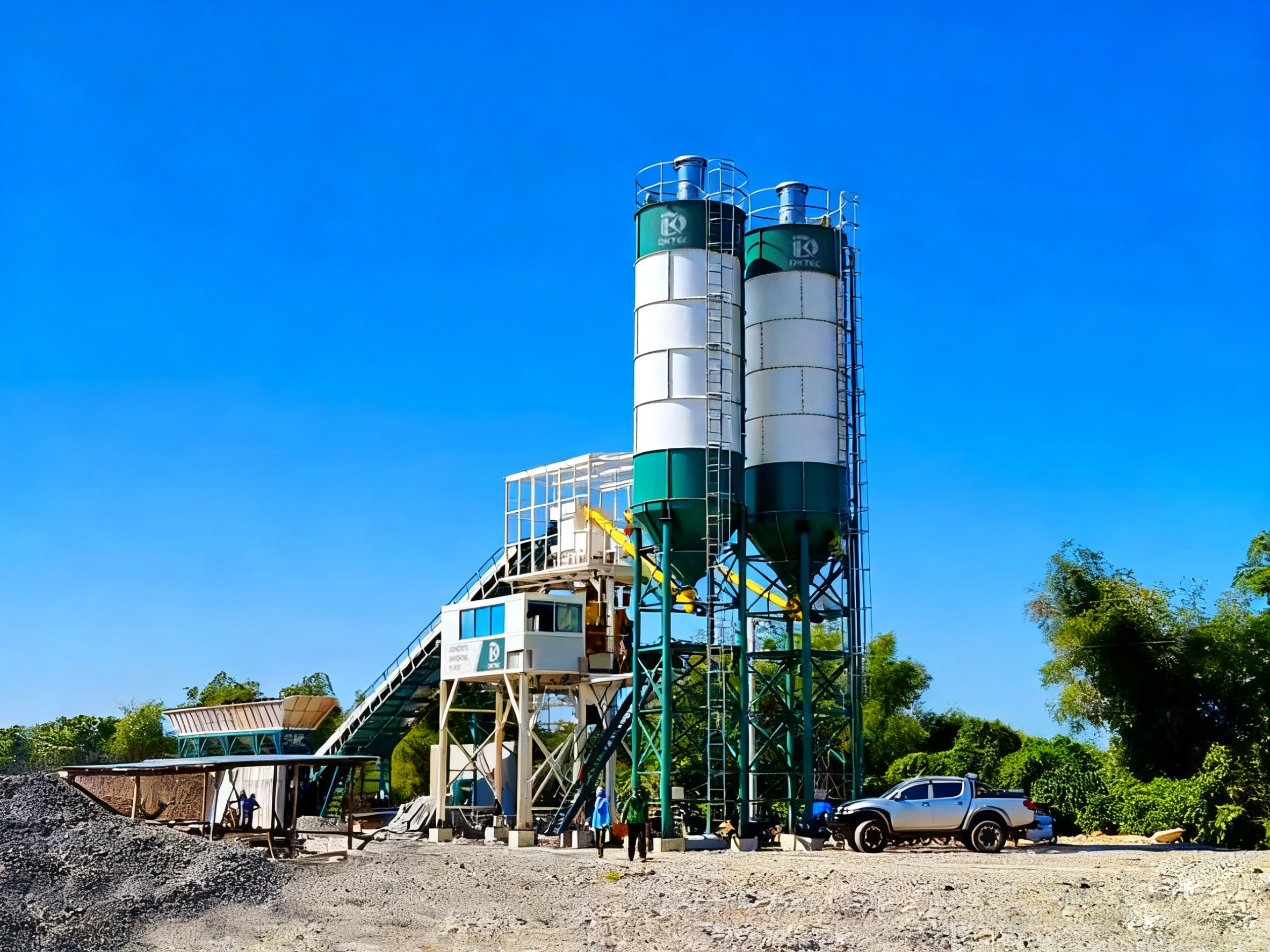
Modular concrete mixing plant configuration, assembled from factory pre-tested modules.
Next step: match the ranking to your batching scenario
Share your plant type (commercial, engineering or mobile), target output and site conditions, and the configuration set can be reviewed against the options ranked above.
- Email: linder@dongkunchina.com
- Tel / WhatsApp: +86 18888972181 — start a WhatsApp conversation
- Website: www.dongkunchina.com
- Catalog: DKTEC concrete batching plant PDF brochure
Note on scope: every performance figure in this article refers to a named, configurable option or a documented plant parameter. Options described as optional are exactly that — they are specified per project and are not included in a base plant by default.