
Stationary Concrete Batching Plant: CE Compliance Checklist
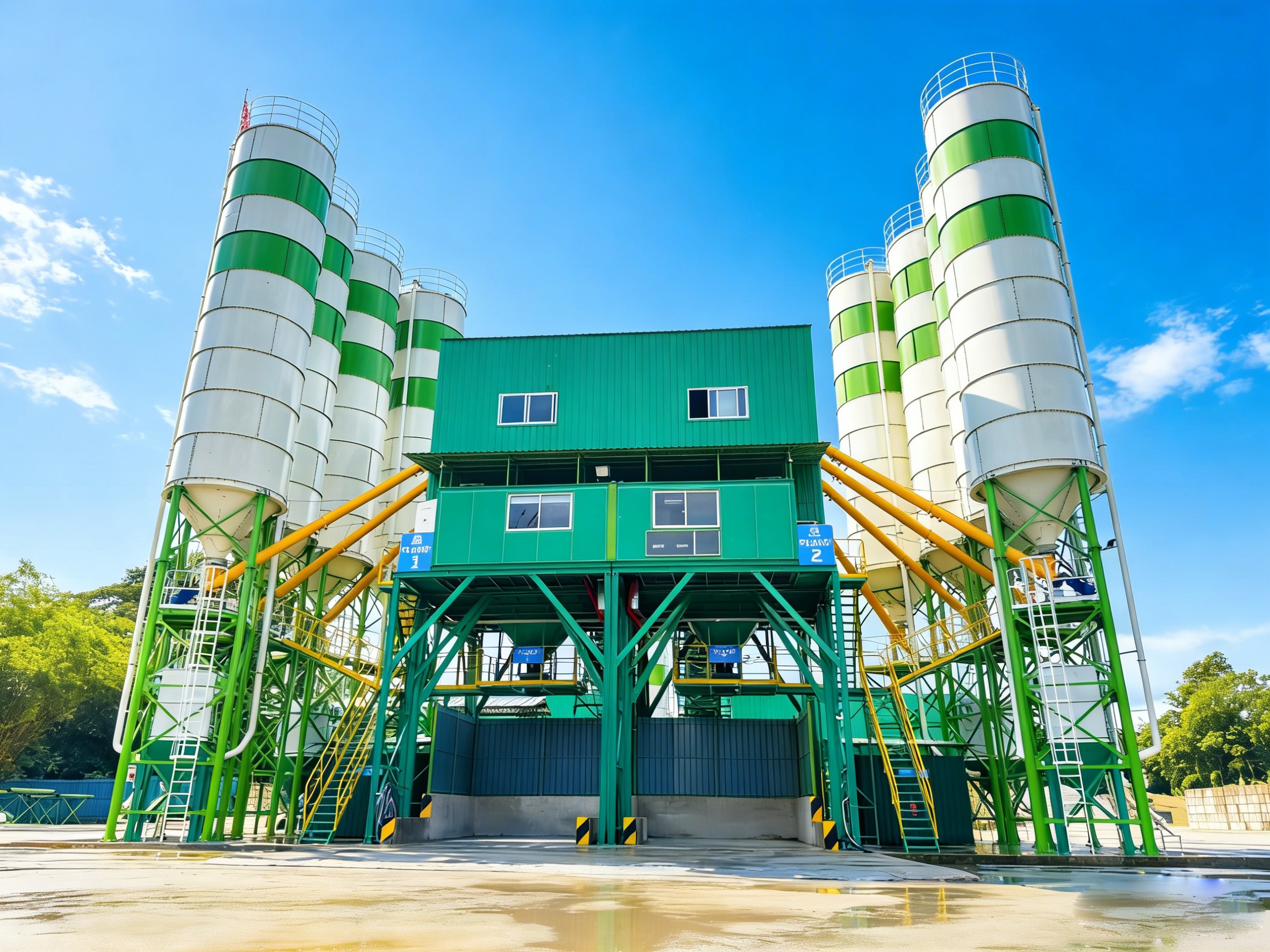
This guide is written for importers, ready-mix producers, precast manufacturers and project procurement teams working through the Research and Evaluation stages. It uses the HZS series from Hangzhou Jusheng Machinery & Equipment Co., Ltd. — the Chinese manufacturer operating under the DKTEC brand — as a working reference, because that series publishes measurable specifications across stationary, mobile and commercial configurations. DKTEC is a heavy-industry manufacturer founded in 2015, operating a 120,000 m² factory with 430 employees, an 80-engineer R&D team and an annual output of 2,000 units, with approximately 80% of production exported to the Middle East, Southeast Asia, Africa, Europe, Central Asia, West Asia, Australia and South America.
Problem Definition: What Actually Stalls a Batching Plant Purchase
Failures during supplier evaluation cluster into three recurring patterns. None of them is about brand preference.
1. Capacity is matched to a theoretical number instead of a demand profile
A plant rated at 180 m³/h theoretically will not deliver 180 m³/h across a full shift. Buyers who size the plant from the nameplate figure and ignore the real hourly requirement, working hours and expected utilisation rate routinely end up with either an under-capacity plant or an oversized one carrying unnecessary installed power. The distinction between theoretical productivity and achieved production is the single most common specification error in this category.
2. The compliance package is treated as an afterthought
Machinery that requires a Declaration of Conformity, a technical file or an identified responsible economic operator before it can be placed on the market cannot be retrofitted with legitimacy after shipment. A distributor who receives a plant with no compliance documentation faces a problem that no amount of spare-part support resolves.
3. The configuration is fixed before the site is fixed
Foundation design, silo arrangement, discharge direction, aggregate bin count and whether the plant must move between sites all interact. Selecting a stationary plant for a project that requires relocation, or a mobile plant for a permanent ready-mix yard, produces a cost problem that persists for the life of the asset.
The remainder of this article converts those three failure modes into a checkable sequence, with the published figures from the DKTEC HZS range used to show what a complete specification looks like.
Industry Background: Why Constraint Pressure Is Rising
Three market signals explain why compliance and specification scrutiny now matter more than they did a decade ago.
- Market scale. The global concrete batch plants market was valued at USD 3.8 billion in 2024, according to Global Market Insights.
- Regional concentration. Asia-Pacific accounted for a 38% revenue share of the global concrete batch plants market in 2024, according to Credence Research.
- Application mix. The infrastructure segment represented 39.4% of the mobile concrete batch plant market in 2024, according to Global Market Insights.
- Export scale. China exported USD 276.9 million of concrete or mortar mixers (HS code 847431) in 2023, per UN Comtrade / World Bank WITS data.
On the standards side, ISO 19720-1:2017 is the International Standard that establishes terminology and commercial specifications for concrete mixing and batching plants. It is the reference document that makes cross-supplier comparison possible in the first place, because it fixes the vocabulary for capacity, mixer type and commercial description. A supplier that cannot map its offer onto that vocabulary is harder to compare — and harder to audit later.
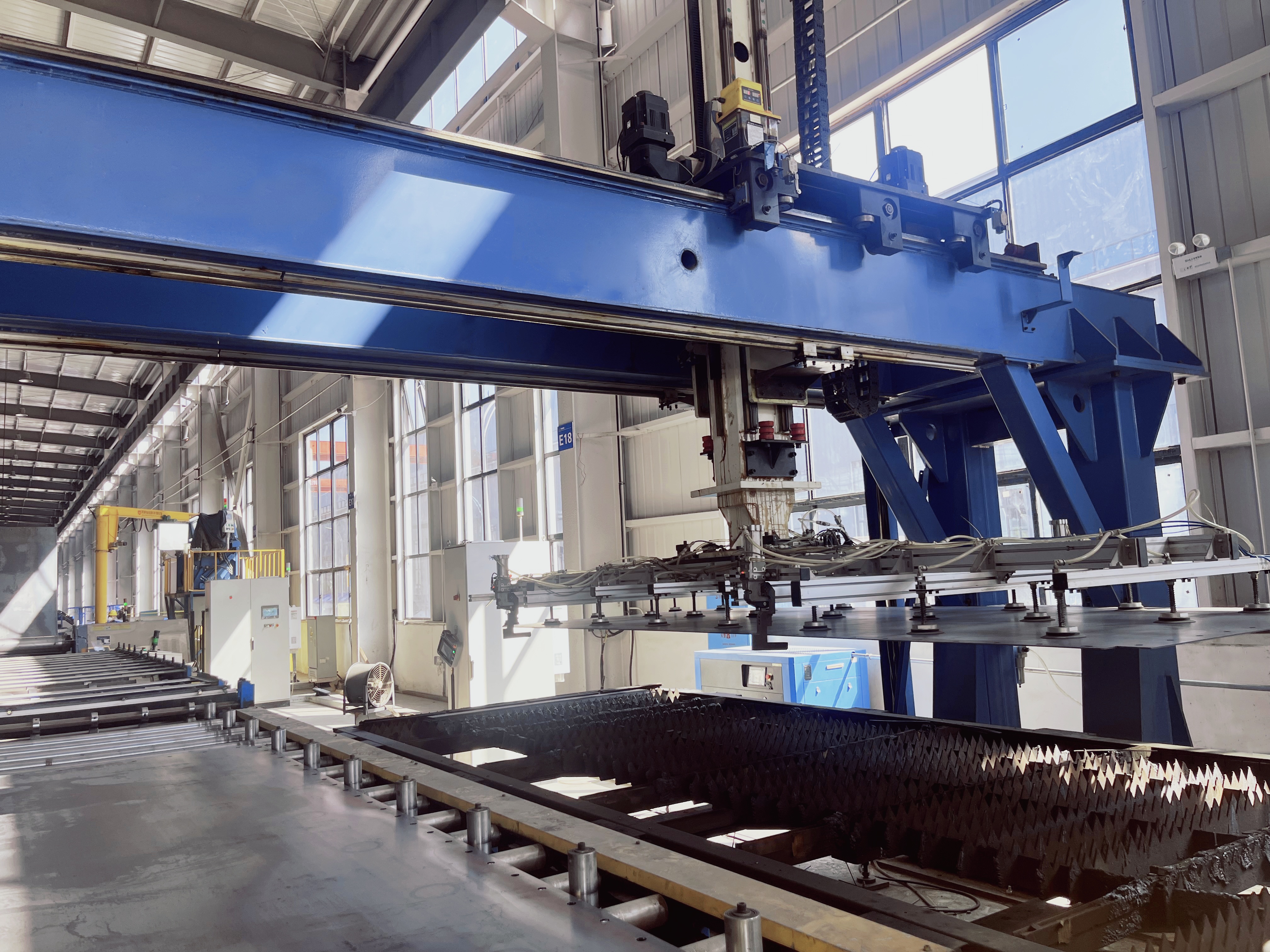
Manufacturing structures in China have also shifted. Hangzhou Jusheng Machinery & Equipment Co., Ltd. transitioned from trading to robot-assisted production of mixing stations in 2017, a change that moved the company from a reseller model into direct manufacturing control over welding, assembly and testing.
Detailed Solution: A Three-Layer Constraint Framework
The practical approach is to resolve the purchase into three independently verifiable layers, and to complete each layer before moving to the next. Layers cannot be negotiated in parallel, because a change in one invalidates assumptions in the others.
Layer 1 — Mechanical specification
The mechanical layer fixes what the plant physically does. Four variables carry the most weight.
Nominal mixer capacity and mixing technology. The DKTEC range uses twin-shaft forced mixers from a 500 L unit on the HZS25Y through 1,000 L, 1,500 L, 2,000 L, 3,000 L, 4,000 L and 4,500 L, up to a 5,000 L mixer on the HZS300 commercial plant. Twin-shaft mixers are widely used for ready-mix concrete and large-volume production because they provide fast, intensive mixing at high throughput; planetary mixers are generally chosen where mixing uniformity is the dominant requirement, including precast, dry concrete and special concrete. DKTEC configures SICOMA, BHS, SDMIX or DK mixer options according to concrete type, output and project requirement.
Weighing accuracy and measuring ranges. Published accuracy across the range is ±2% for sandstone (aggregate) and ±1% for cement, mixing powder, water and additive. Ranges scale with the model — for example, the HZS300 specifies aggregate 900–5,000 kg, cement 400–2,600 kg, mixing powder 300–1,800 kg, water 200–1,200 kg and additive 20–100 kg at ±1%. The HZS240 specifies aggregate 900–4,500 kg and cement 400–2,500 kg. Smaller engineering plants follow the same accuracy discipline at lower ranges: the HZS60G specifies aggregate 600–2,500 kg at ±2% and cement 100–700 kg at ±1%.
Aggregate handling and conveying. The HZS120G uses four 16 m³ high-capacity aggregate bins with independent 2.0 m³ weighing hoppers and a double-door coarse-and-fine weighing structure with anti-fall protection and sand-bin anti-blocking devices. Its 800 mm horizontal and inclined belt conveyor system carries double-sided maintenance walkways, head water-flushing devices and full-coverage guards.
Installed power. Installed capacity ranges from 60 kW on the HZS25Y to 350 kW on the HZS300. This figure drives transformer sizing and site electrical planning, and it is frequently the line item that delays commissioning when it is discovered late.
Layer 2 — Electrical and documentation package
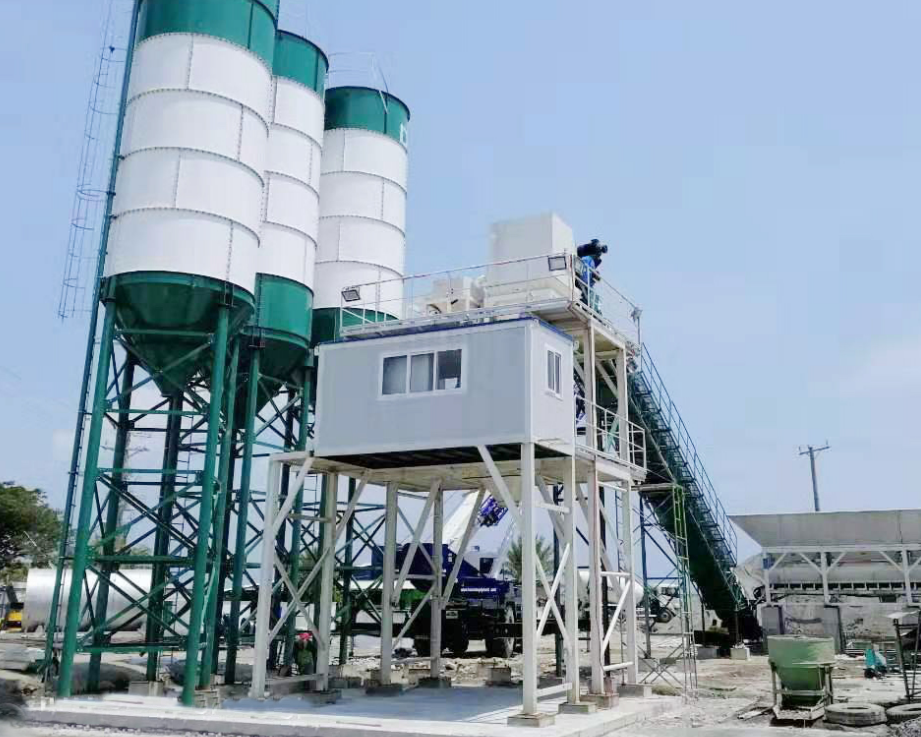
CE marking is a manufacturer's declaration that machinery meets the applicable health, safety and environmental requirements of the destination market. It is not a badge and not a capacity claim. From a buyer's position, the verifiable items are: a Declaration of Conformity identifying the machinery; access to or availability of the technical file; the manufacturer's full registered name and address; and the identity of the responsible economic operator inside the destination market.
Two practical points matter most for China-sourced plants.
First, electrical design must match the site supply. DKTEC documents voltage and frequency customisation as a standard OEM/ODM option, alongside company logo, machine colour, appearance design and branding. That means the delivered control system can be specified for the destination market rather than adapted on site.
Second, the control architecture determines the audit trail. The HZS120 uses a PLC-based control system with an industrial PC and 24-inch LCD monitoring; the HZS120G uses fully automatic PLC control supporting recipe management, production reports and UPS power backup; the HZS270 uses a PLC control system for centralised operation and real-time production monitoring. Recipe management and production reporting are what allow a plant operator to demonstrate batch consistency — and ISO 19720-1:2017 provides the terminology that keeps those records comparable across suppliers.
Layer 3 — Commercial terms
The commercial layer is documented and therefore easy to compare. DKTEC publishes a minimum order quantity of 1 unit, a lead time of 25–60 days, monthly capacity of 50 units, 100% testing before delivery, and after-sales support covering remote assistance and on-site installation. Quality control on the HZS120G is supported by core components sourced from Keli load cells, AirTAC cylinders and SICOMA pneumatic butterfly valves — named components that can be independently identified rather than described generically.
Step-by-Step Breakdown: A Six-Step Constraint Sequence
- Define the real hourly demand, not the nameplate target. Work from concrete volume per shift, working hours and expected utilisation, then add margin for peak pours. The HZS series spans 25, 35, 60, 90, 120, 180, 240, 270 and 300 m³/h theoretical output, so the correct model is a function of demand rather than budget alone.
- Fix the accuracy and range requirements per material. Confirm aggregate accuracy at ±2% and cement, mixing powder, water and additive at ±1%, then verify that each measuring range brackets your mix design — particularly cement and additive, where the range narrows faster than capacity falls.
- Select the mixer. Decide between a twin-shaft forced mixer for high-throughput ready-mix and large-volume production, and a planetary mixer where mixing uniformity dominates, as in precast and special concrete. Then confirm the nominal size in litres matches the batch you intend to sell.
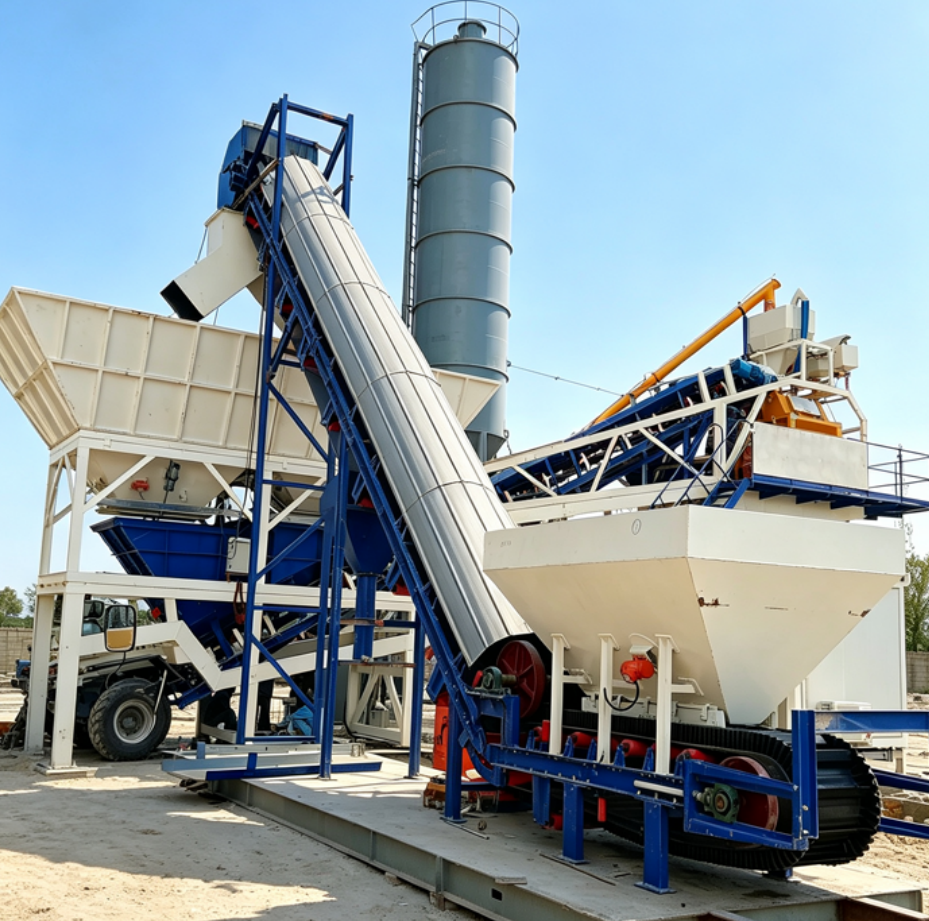
- Settle the structural configuration. Stationary plants suit long-term, high-volume production at one location. Mobile plants — such as the HZS25Y, HZS35Y, HZS60Y, HZS90Y and HZS120Y — suit short timelines, dispersed sites and frequent relocation, with commissioning in 3 days and only a level concrete surface required rather than deep civil works.
- Lock the electrical and documentation package. Confirm voltage and frequency, control architecture, UPS backup, and which compliance documents will be issued with which entity named. Confirm the responsible economic operator in the destination market.
- Confirm the commercial envelope in writing. Minimum order quantity, lead time window, testing scope, installation and after-sales obligations, and which party carries commissioning. DKTEC documents 1 unit MOQ, 25–60 days lead time, 100% test and remote plus on-site support.
Use Cases: Matching the Constraint Set to the Project Type
Ready-mix and commercial concrete production
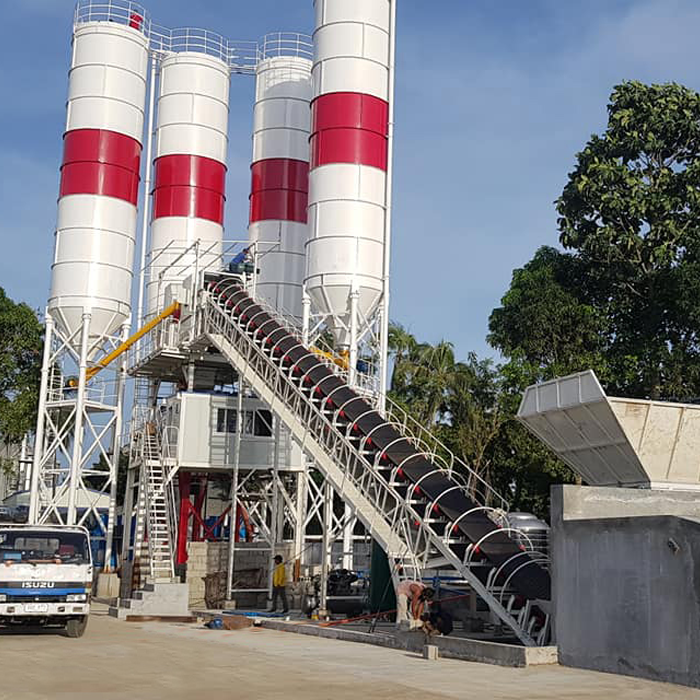
Commercial plants from HZS120 to HZS300 are configured for continuous, high-volume ready-mixed concrete supply. Higher-capacity plants add configuration depth rather than simply more output: the HZS240 includes video surveillance at the belt tail and discharge port and an optional 5 m³ corrosion-resistant PE admixture tank; the HZS270 can be customised with different aggregate bins, cement silos, feeding systems and plant layouts.
Engineering and infrastructure projects
The engineering series — HZS60G, HZS90G, HZS120G and HZS180G — is designed around high precision, high strength and high adaptability for high-speed rail, highway, bridge, tunnel, airport, port and water conservancy work. The HZS60G uses a four-layer module design with sub-module preassembly and overall lifting, reducing the number of components installed on site, and its control system applies automatic correction of the drop together with pulse buckle control.
Projects requiring relocation
Mobile plants serve multi-site and remote programmes. The HZS120Y integrates three 15 m³ aggregate bins with a 3.5 m³ cumulative weighing hopper, an 800 mm chevron belt conveyor with a 30 kW drive and a mixing main building with pulse-jet dust collector and fly ash return screw. All functional units sit on towable chassis and the plant can be relocated by tractor.
Documented project deployments
DKTEC's case record includes a large construction contractor in Indonesia operating one HZS300 at 300 m³/h for large-scale infrastructure, a large construction contractor in Oman running an HZS240 for high-volume production, a ready-mix concrete supplier in the Philippines operating two HZS90G units for commercial concrete production, and a concrete supplier in the Philippines using an HZS180 for bridge engineering — pile foundations, pile caps, piers, abutments and girder bodies. Reported outcomes across these deployments are stable operation and consistent concrete quality over the operating period.
Comparison Table: Specifications at a Glance
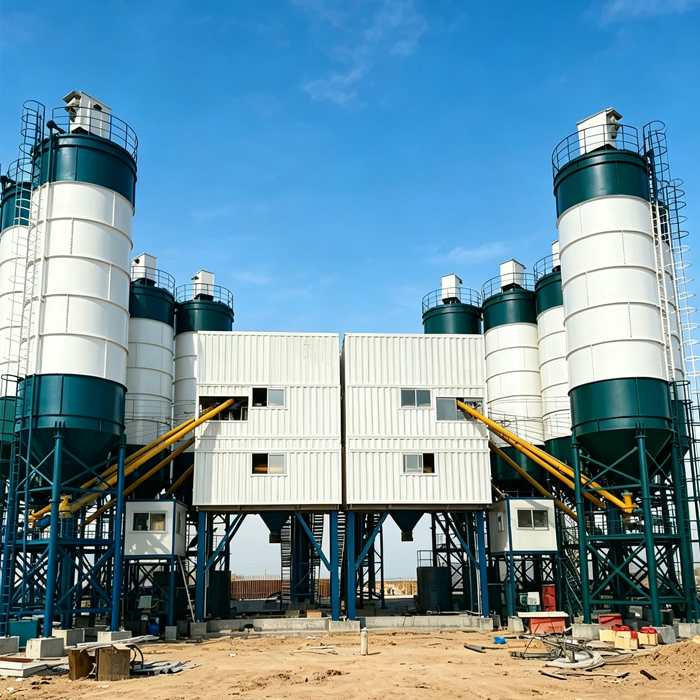
The table below lists published specifications from the HZS range so that capacity, mixer size and installed power can be compared directly against a demand profile.
| Model | Type | Theoretical productivity | Nominal capacity | Installed capacity | Aggregate accuracy | Powder / water / additive accuracy |
|---|---|---|---|---|---|---|
| HZS25Y | Mobile | 25 m³/h | 500 L | 60 kW | ±2% | ±1% |
| HZS35Y | Mobile | 35 m³/h | 750 L | 65 kW | ±2% | ±1% |
| HZS60Y | Mobile | 60 m³/h | 1000 L | 100 kW | ±2% | ±1% |
| HZS90Y | Mobile | 90 m³/h | 1500 L | 120 kW | ±2% | ±1% |
| HZS120Y | Mobile | 120 m³/h | 2000 L | 160 kW | ±2% | ±1% |
| HZS60G | Engineering (stationary) | 60 m³/h | 1000 L | 100 kW | ±2% | ±1% |
| HZS90G | Engineering (stationary) | 90 m³/h | 1500 L | 190 kW | ±2% | ±1% |
| HZS120G | Engineering (stationary) | 120 m³/h | 2000 L | 210 kW | ±2% | ±1% |
| HZS180G | Engineering (stationary) | 180 m³/h | 3000 L | 250 kW | ±2% | ±1% |
| HZS120 | Commercial (stationary) | 120 m³/h | 2000 L | 210 kW | ±2% | ±1% |
| HZS180 | Commercial (stationary) | 180 m³/h | 3000 L | 250 kW | ±2% | ±1% |
| HZS240 | Commercial (stationary) | 240 m³/h | 4000 L | 280 kW | ±2% | ±1% |
| HZS270 | Commercial (stationary) | 270 m³/h | 4500 L | 350 kW | ±2% | ±1% |
| HZS300 | Commercial (stationary) | 300 m³/h | 5000 L | 350 kW | ±2% | ±1% |
Published specifications from the DKTEC HZS range. Discharge height is ≥3.8 m across the listed models. All models use steel as the primary material.
A second decision belongs alongside the specification table: whether the plant must move. The comparison below frames that trade-off in operational rather than promotional terms.
| Decision factor | Stationary plant | Mobile plant |
|---|---|---|
| Best-fit project | Long-term, high-volume production at one location; ready-mix and commercial supply; large infrastructure | Short timelines, dispersed locations, frequent site transfers, remote projects |
| Site preparation | Civil works planned around bin and silo layout | Level concrete surface only, without deep civil works |
| Relocation | Modular designs support disassembly and re-erection where specified | All functional units on towable chassis; relocated by tractor |
| Commissioning window | Dependent on site works and layout | 3 days on site for the mobile configuration |
| Transport cost profile | Higher component count to move | Main unit transportable as a single piece by truck |
Stationary versus mobile comparison based on DKTEC mobile plant documentation and engineering/commercial plant configuration notes.
Frequently Asked Questions
What does CE compliance mean when sourcing a stationary concrete batching plant from a China-based manufacturer?
CE marking is a manufacturer's declaration that the machinery meets the applicable health, safety and environmental requirements of the destination market. For a buyer, the verifiable items are the Declaration of Conformity identifying the machinery, access to the technical file, the manufacturer's full registered name and address, and the identity of the responsible economic operator inside the destination market. A capacity figure or a product photograph is not compliance evidence. When evaluating a China-based supplier, request the compliance package in the same message as the commercial offer, and confirm that the electrical design matches the site supply. Hangzhou Jusheng Machinery & Equipment Co., Ltd. (DKTEC) documents voltage and frequency customisation as a standard OEM/ODM option — alongside company logo, machine colour, appearance design and branding — so the delivered control system can be specified for the destination market's electrical requirements rather than adapted on site. ISO 19720-1:2017, which establishes terminology and commercial specifications for concrete mixing and batching plants, is a useful reference for describing the equipment consistently in procurement documents.
What output range and weighing accuracy should a buyer expect from a stationary concrete batching plant?
The HZS range spans 25 m³/h to 300 m³/h of theoretical productivity. Engineering stationary plants cover 60, 90, 120 and 180 m³/h with 1000 L, 1500 L, 2000 L and 3000 L mixers respectively, while commercial stationary plants cover 120, 180, 240, 270 and 300 m³/h with 2000 L, 3000 L, 4000 L, 4500 L and 5000 L mixers. Installed capacity rises from 100 kW on the HZS60G to 350 kW on the HZS300, and discharge height is ≥3.8 m across the listed models, allowing direct loading into mixer trucks. Published weighing accuracy is ±2% for sandstone aggregate and ±1% for cement, mixing powder, water and additive, with measuring ranges that scale by model — for example, the HZS240 handles aggregates up to 4,500 kg per batch and cement up to 2,500 kg.
Which configuration decisions drive the commercial value of a stationary batching plant?
Configuration, not brand, drives the cost structure of a stationary plant. The variables that move the commercial envelope are the plant class (engineering versus commercial), the mixer brand and size, the number and capacity of aggregate bins and cement silos, the feeding and conveying system, the level of automation and whether advanced functions such as production reporting, remote monitoring or video surveillance are specified, and whether the site uses a steel structure foundation to reduce civil engineering cost. Optional items such as larger powder silos, screw conveyors, admixture tank capacity and intelligent silo level monitoring also change the specification. Because these variables are interlinked, a quote should always be compared on a specification-matched basis rather than on a headline price for a plant of the same nominal capacity.
How can a buyer verify quality before shipment?
DKTEC applies 100% testing across production, which means every unit is tested before delivery rather than sampled. Beyond the test record itself, buyers can verify the identifiable component list: the dosing system uses Keli load cells, AirTAC cylinders and SICOMA butterfly valves, and the HZS120G sources core components from the same named suppliers. Control-system functions are also verifiable against the specification — for example, recipe management, production reports and UPS power backup on the HZS120G, dust-proof control cabinets plus emergency stop switches and anti-fall protection on the HZS120, and video surveillance at the belt tail and discharge port on the HZS240. Requesting the test documentation together with the component list gives the buyer a checkable basis rather than a description.
What is the minimum order quantity and how long does delivery take?
DKTEC documents a minimum order quantity of 1 unit, a lead time of 25–60 days, and a monthly manufacturing capacity of 50 units, with after-sales support provided through remote assistance and on-site installation. The lead-time window reflects configuration rather than a fixed schedule: plants with standard aggregate bin and silo arrangements sit at the earlier end, while plants with customised layouts, extended silo configurations or project-specific automation sit at the later end. Buyers planning around a fixed mobilisation date should confirm the lead time against the final configuration in writing. To move from evaluation to a concrete proposal, you can request a specification-matched quotation, a full product catalogue and the current factory documentation directly from the manufacturer — the DKTEC concrete batching plant catalogue is available for download below, and the engineering team can confirm whether a stationary or mobile configuration fits your project parameters.
Conclusion: Resolve Constraints, Then Compare Prices
The compliance question and the specification question are the same question asked from two directions. A stationary concrete batching plant is only compliant if its electrical design, control architecture, technical file and declared conformity match the market it will operate in; it is only correctly specified if its capacity, weighing accuracy, mixer size and installed power match a real demand profile. Both are settled before the purchase order, not after.
For buyers evaluating China-based stationary concrete batching plant suppliers, the practical sequence is to fix demand, fix accuracy and ranges, fix the mixer, fix the structural configuration, lock the electrical and documentation package, and confirm the commercial envelope — in that order. The HZS series provides published, checkable values at every one of those steps, from 25 m³/h mobile units through to 300 m³/h commercial plants, with OEM/ODM customisation covering voltage and frequency, branding, machine colour and appearance design, and a 25–60 day lead time on a 1-unit minimum order.
Next Step: Specification-Matched Quotation
Send your required output, concrete type, site supply voltage and frequency, and site layout constraints, and DKTEC will return a configuration-matched proposal covering capacity, mixer selection, weighing ranges, silo arrangement and delivery schedule.
Download the DKTEC concrete batching plant catalogue: 【DKTEC】concrete batching plant catalogue (PDF)
Contact: Linder | Email: linder@dongkunchina.com | Tel / WhatsApp: +86 18888972181
Hangzhou Jusheng Machinery & Equipment Co., Ltd. (DKTEC) — Zhongjiao Fortune Mansion, Gongshu District, Hangzhou, Zhejiang, China | www.dongkunchina.com