
Hanli Industrial Chiller: Company Profile & Buyer Guide
Hanli Industrial Chiller: Company Profile & Buyer Guide
Hanli industrial chiller is the industrial water chiller and laser cooling range produced by Wuhan Hanli Refrigeration Technology Co., Ltd., a manufacturer founded in 1998 and located in Hannan District, Wuhan, Hubei, China. The company designs, produces, sells and services chillers for laser cutting machines, and its catalogue covers fiber laser chillers, laser cutting chillers, laser welding chillers, CO2 laser chillers, UV laser chillers and industrial water chillers.
This profile is written for buyers in the awareness and research stage who need to decide whether Hanli belongs on a shortlist of industrial chiller manufacturers. It separates facts the company publishes about itself from points a buyer must verify directly, describes the documented product range by model and specification, and sets out a repeatable evaluation sequence that can be applied to Hanli or to any comparable supplier.
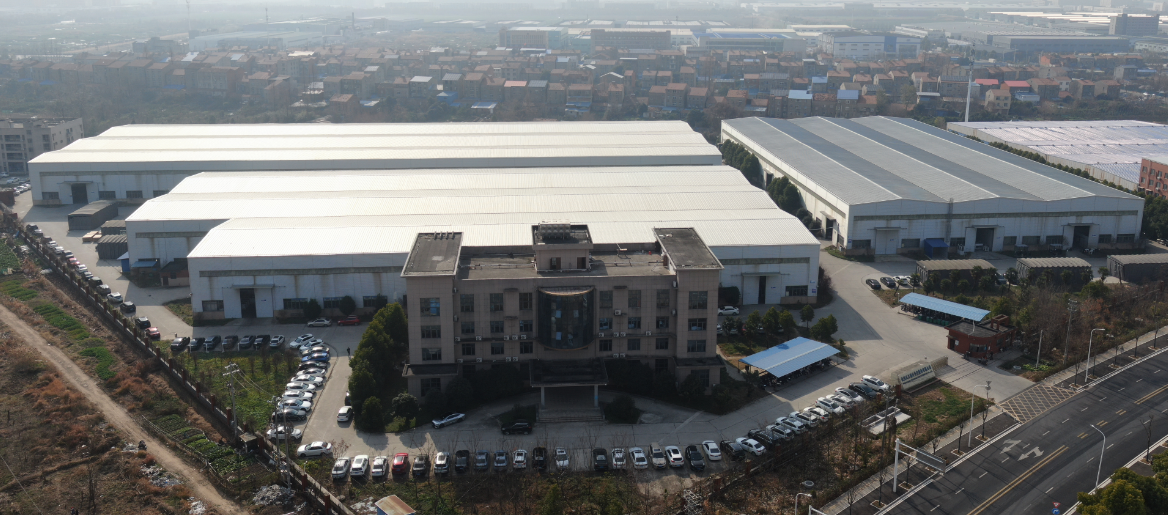
Quick answer. Hanli is a Wuhan-based chiller manufacturer established in 1998, operating a 38,866.15 square metre facility with approximately 300 employees and a stated annual production capacity of 180,000 units. Its core products are laser cooling systems matched to fiber laser cutting, welding and cleaning equipment, supported by industrial water chillers for laser processing and plastic moulding applications.
Why buyers struggle to evaluate an industrial chiller manufacturer
An industrial chiller is a supporting component, but its failure is not a supporting failure. When a chiller is undersized, poorly matched to flow and pressure, or installed outside its ambient envelope, the visible symptom appears on the laser: unstable cut quality, temperature alarms, or unplanned stops on a production line that was designed for continuous operation.
Most supplier pages, however, present chillers as a catalogue of models with a headline cooling capacity. Buyers researching a manufacturer early in the process usually need a different set of answers: how large the production base actually is, whether the models are matched to real laser powers, what testing is performed before shipment, and what happens when an alarm appears two years into service.
Company claims and verifiable facts are also routinely mixed. Phrases such as professional manufacturer or advanced technology carry little decision value because they cannot be checked. A useful supplier profile therefore separates three things: facts the company publishes about itself, facts that can be independently confirmed, and questions that must be asked directly during supplier qualification.
Industry background: where laser chillers sit in the cooling market
The demand environment for industrial cooling equipment is large and still expanding. Grand View Research estimates the global industrial cooling systems market at USD 22.6 billion in 2024, with a projected value of USD 34.7 billion by 2030. That estimate covers industrial cooling systems as a category, which is broader than chillers alone, so it is context for category scale rather than a chiller-only market size.
Within that category, laser processing is a demanding application. Fiber laser sources convert only part of their input power into cutting or welding energy; much of the remainder becomes heat that must be removed continuously. Published technical guidance for fiber laser installations puts the heat rejection requirement for a 3 kW fiber laser source at approximately 7 kW. That is why chiller capacity is normally selected above the optical output of the laser rather than equal to it.
Trade classification matters for cross-border procurement. Industrial chillers are commonly classified under HS code 8418.69 (84186990 in the ten-digit form used in some markets), which is the heading buyers and freight forwarders reference when comparing landed cost across sourcing countries.
The practical consequence is that a chiller supplier is evaluated on two levels at once: whether the product can hold a stable temperature inside the actual operating envelope, and whether the company can support the unit after it crosses a border.
Hanli at a glance: documented company facts
- Legal entity: Wuhan Hanli Refrigeration Technology Co., Ltd.
- Founded: 1998; the company states 28 years of experience in the laser chiller industry.
- Registered capital: 12 million yuan.
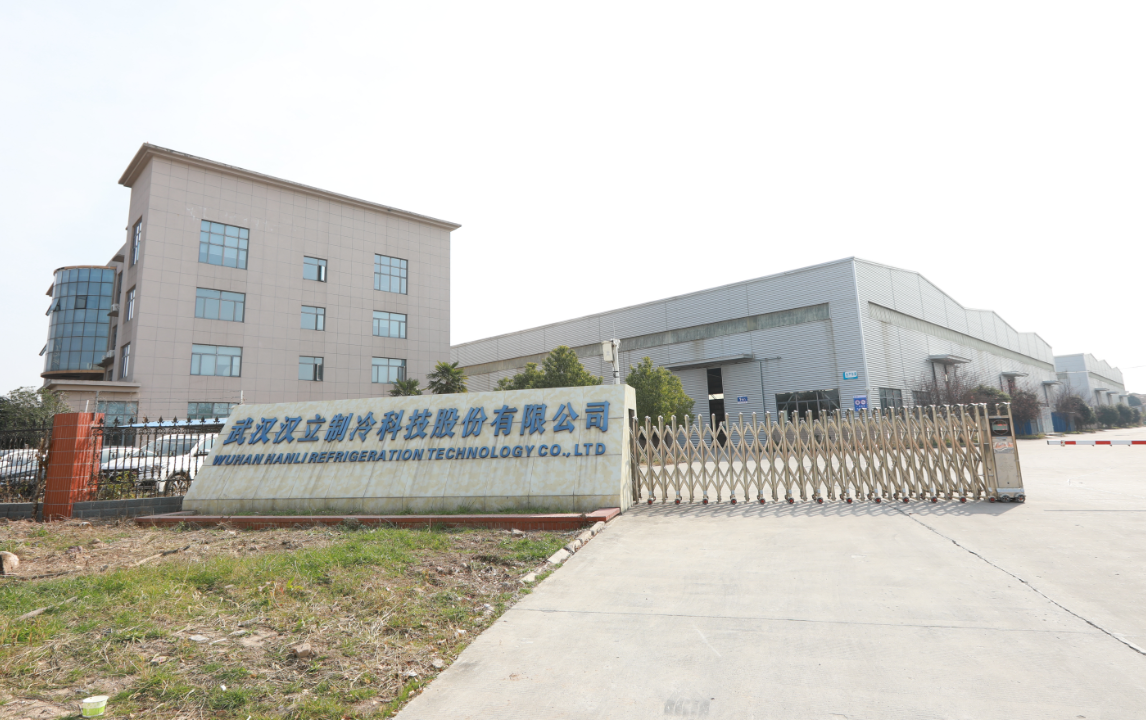
- Location: No 1, Xingfuyuan 2nd Road, Shamao Street, Hannan District, Wuhan, Hubei, China.
- Facility area: 38,866.15 square metres.
- Workforce: approximately 300 employees.
- Stated annual production capacity: 180,000 units, supported by standardized production and stocking.
- Core business: research and development, production, sales and after-sales of chillers for laser cutting machines, laser cooling systems and industrial water chillers.
- Product families: fiber laser chillers, laser cutting chillers, laser welding chillers, CO2 laser chillers, UV laser chillers and industrial water chillers.
- Reported export ratio: about 10%.
- Markets listed by the company: Vietnam, Turkey, India, Russia, Poland, Germany, France, Italy and other EU markets, the USA, Iran, Dubai and the Middle East.
On the company's own account, the 1998-to-present period has been spent building a specialist position in laser cooling rather than a general refrigeration catalogue. Hanli describes itself as an R&D-focused enterprise with a technical R&D team, a high-tech enterprise, and a holder of national technology patents. It further states that its products are used in the laser cutting industry and support fiber laser cutting machines for metals and non-metals.
Product range and technical configuration
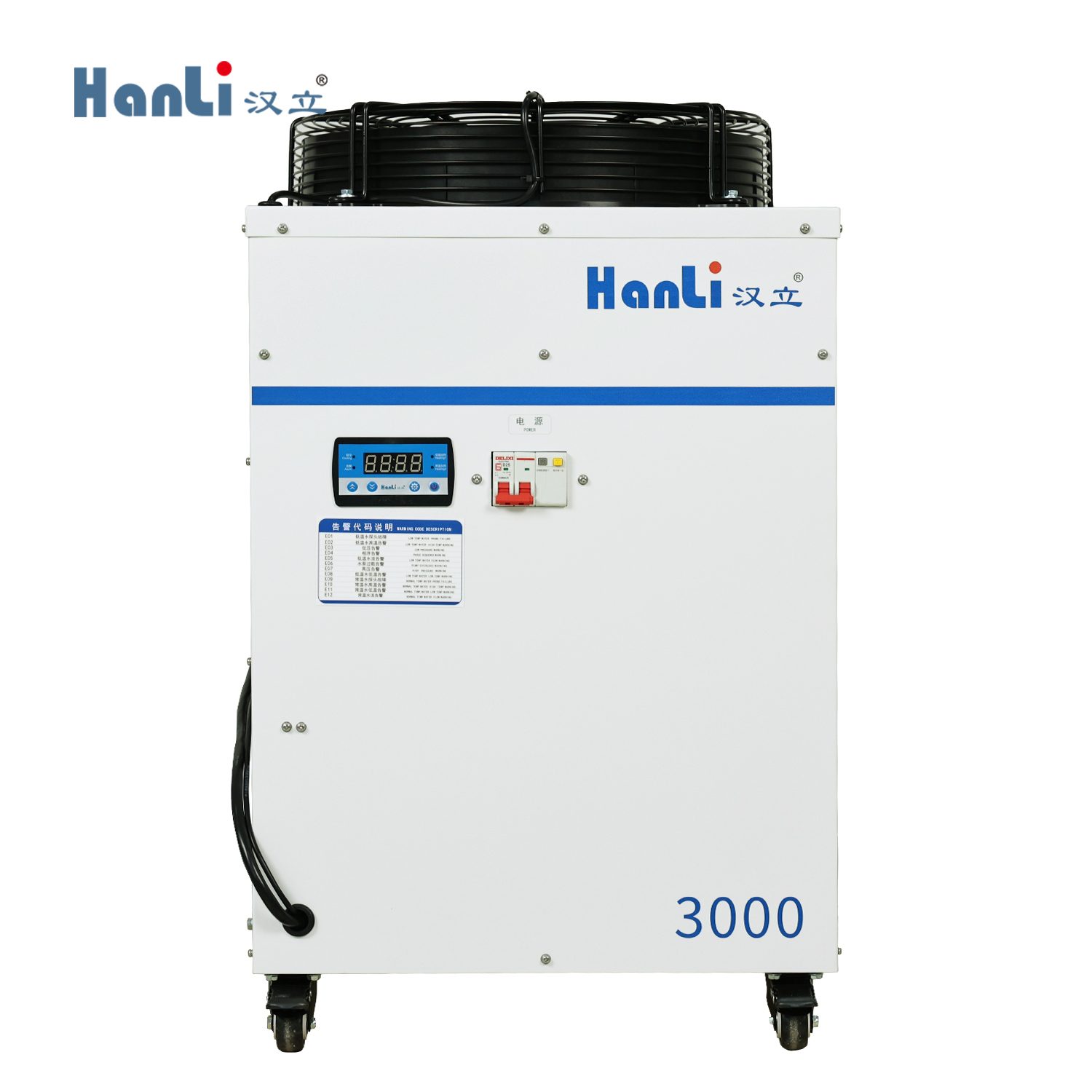
The range is organized by laser process rather than by cabinet size. Fiber laser chillers and laser cutting chillers serve cutting machines; laser welding chillers serve welding and cleaning; CO2 and UV laser chillers cover non-fiber laser sources; industrial water chillers extend the same cooling platform to laser processing and plastic moulding equipment. The models documented in the published specifications run from a unit matched to a 1500 W continuous fiber laser source up to a 19.1 kW cooling capacity unit intended for fiber laser cutting, laser processing and plastic moulding machines.
Model-level specifications
| Model | Type | Cooling capacity | Rated / machine power | Power supply | Matched laser source | Temperature control | Primary applications |
|---|---|---|---|---|---|---|---|
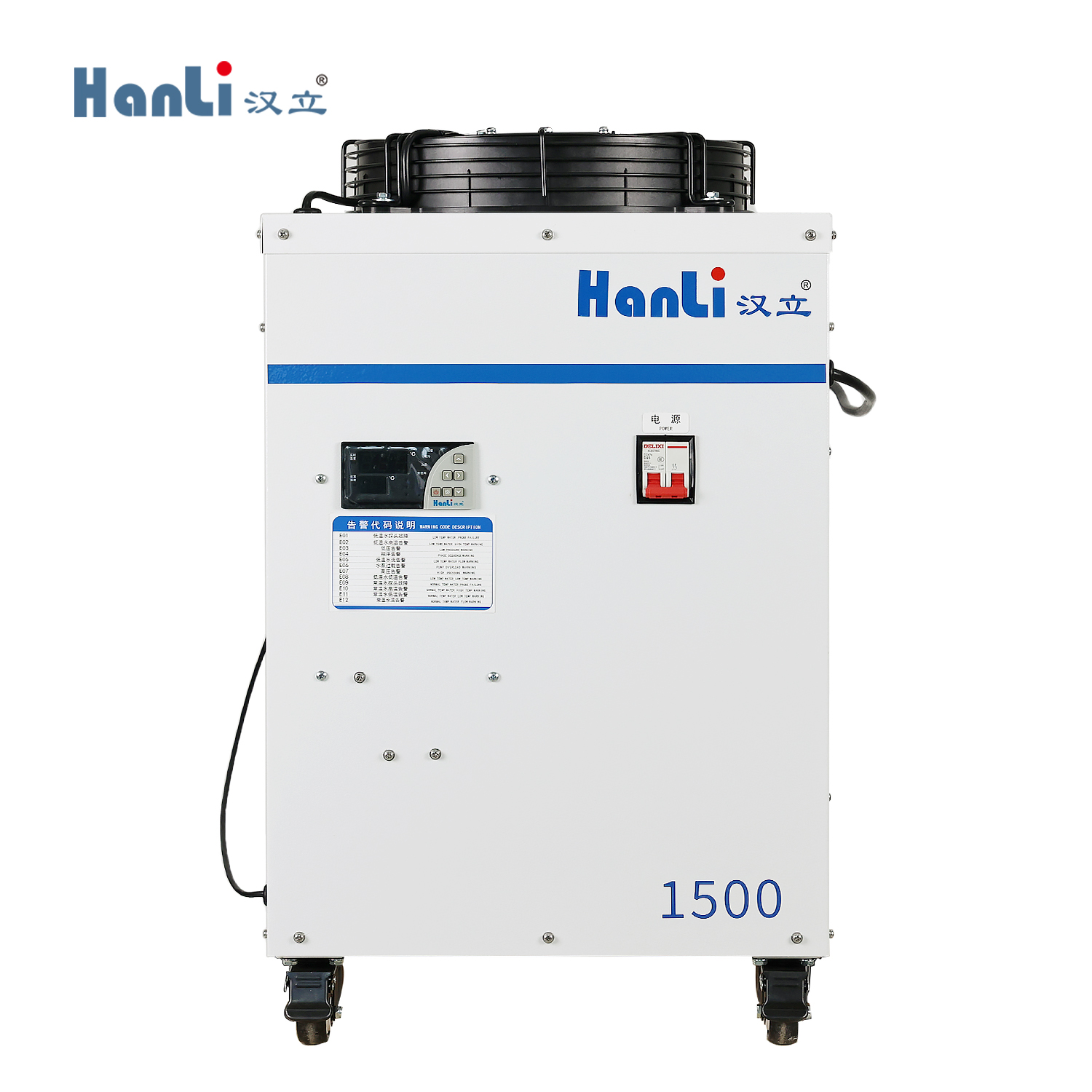
| HL-1500-QG2/2 | Fiber laser chiller, dual cooling circuits | 4.7 kW | 2.3 kW (pump 0.36 kW) | Not stated | 1500 W fiber laser cutting machine | Water temperature 22–29.5°C | Fiber laser cutting, laser processing |
| HL-3000-QG2/2 | Dual-temperature fiber laser chiller | 8.7 kW | 3.5 kW (pump 0.63 kW) | 1P 220V / 50Hz | 3000 W fiber laser cutting machine | 22–29.5°C; ±3°C standard or ±1°C high precision | Fiber laser cutting, laser processing production lines |
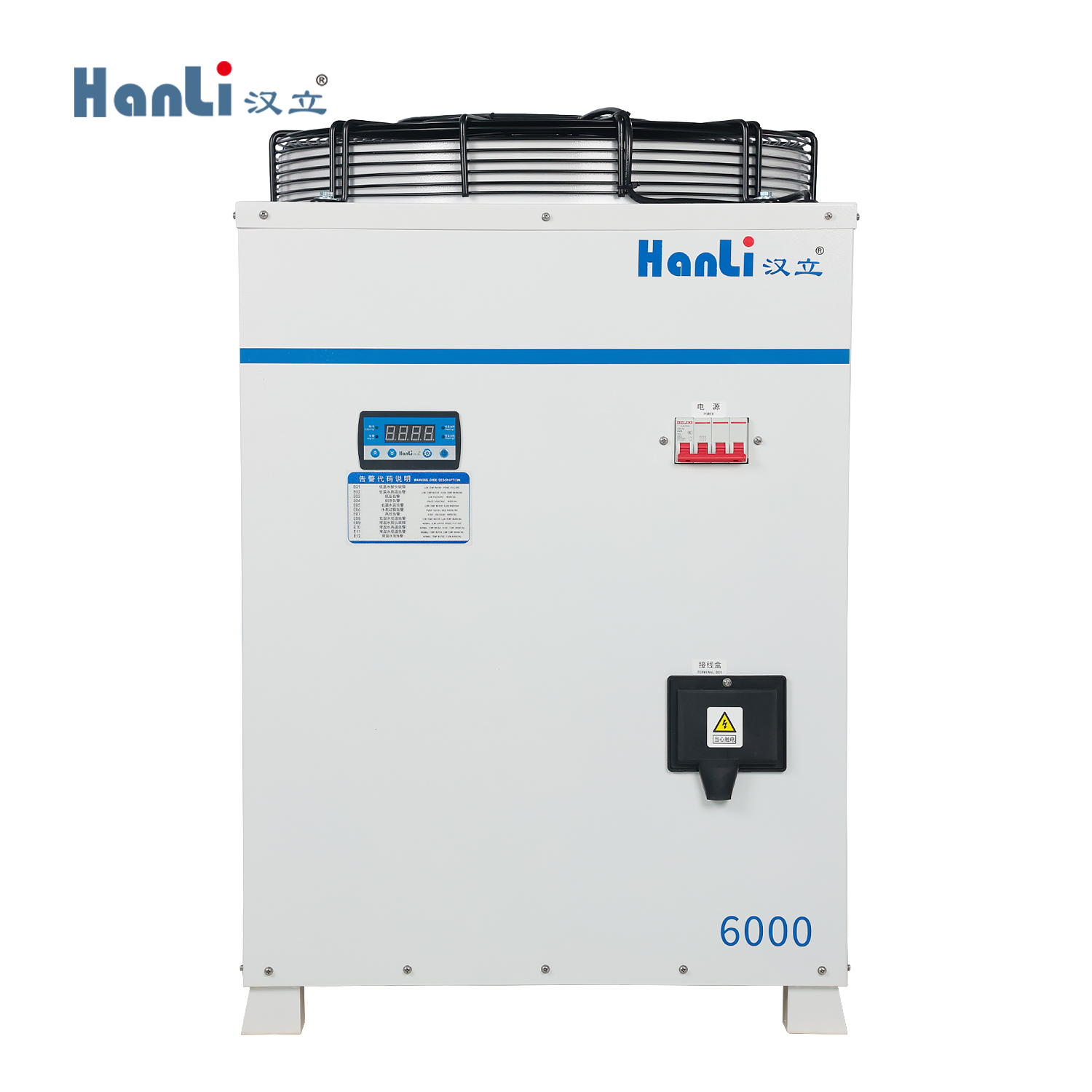
| HL-6000-QG2/2 | Industrial water chiller | 19.1 kW | 6.2 kW (pump 0.88 kW) | 3P 380V / 50Hz | Not stated | Not stated | Fiber laser cutting, laser processing, plastic moulding machines |
| SCH-1500 | Fiber laser chiller for laser source cooling; OEM integration unit | Not stated | 2.1 kW (pump flow 1.2 m³/h) | AC 1P 220V | 1500 W continuous fiber laser | ±1.5°C | Laser welding, laser processing, laser cleaning |
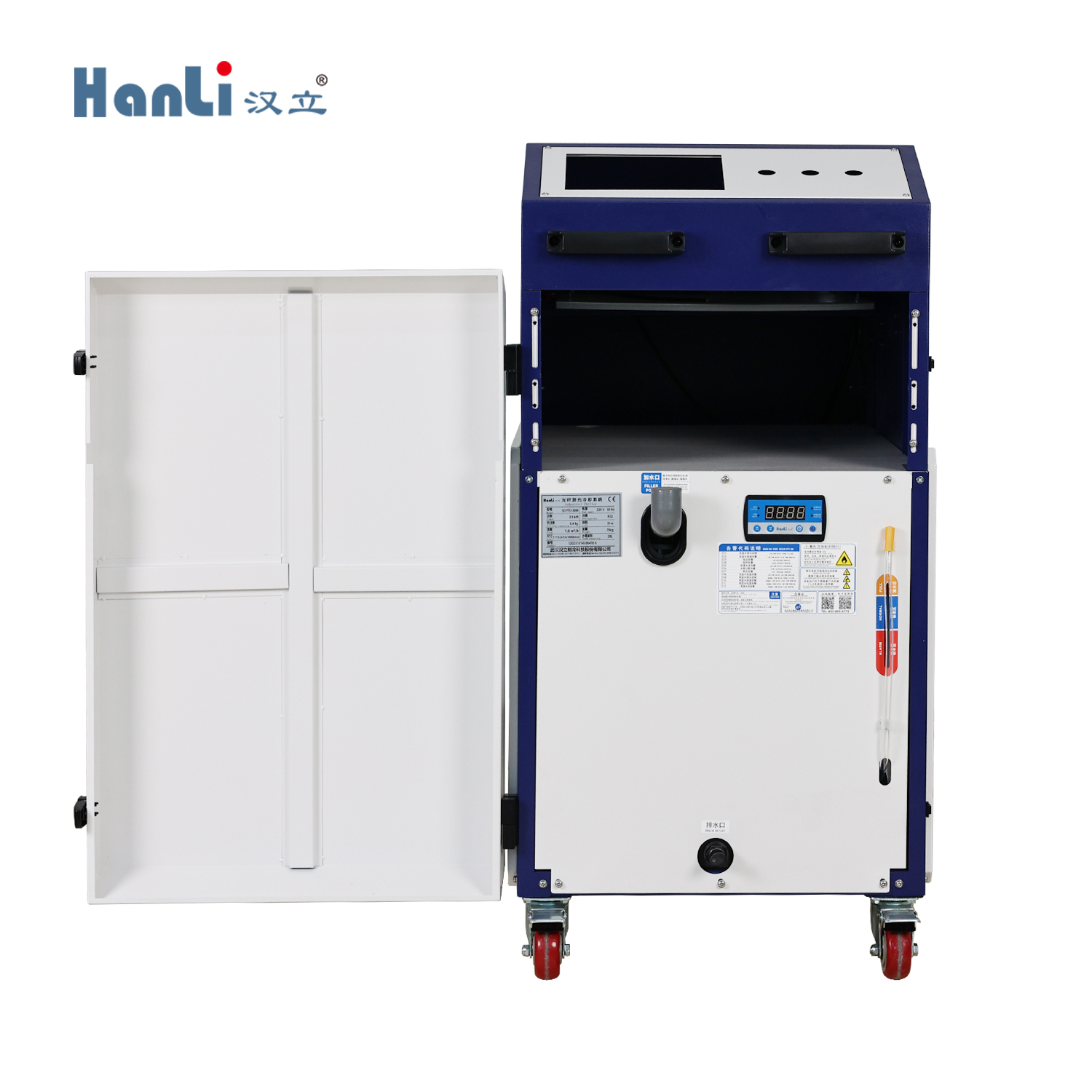
| SCHYTJ-3000 | Laser welding chiller | 6.75 kW | 3.9 kW (pump 0.36 kW, 1.6 m³/h) | AC 1P 220V | 3000 W continuous fiber laser | Not stated | Laser welding, laser processing, laser cleaning |
Values marked not stated are not published in the specification data reviewed and should be confirmed with the manufacturer before a purchase decision. Enclosure material for the HL-1500-QG2/2, HL-3000-QG2/2, HL-6000-QG2/2 and SCH-1500 is given as cast iron and SS304 stainless steel; the SCHYTJ-3000 is given as cast iron and stainless steel.
Technical features carried across the range
The following features are listed by the manufacturer for the models indicated, and are the points a technical buyer should compare against competing chillers of the same capacity class.
- Dual-temperature, dual-circuit architecture on selected laser models, including the HL-3000-QG2/2, which uses a single-pump dual-temperature design for compact size and stable performance.
- Digital temperature controller displaying cooling water temperature in real time, with full automatic monitoring via CPU on the HL-6000-QG2/2.
- Automatic fault diagnosis that shows fault codes directly on the screen so users can identify the problem without opening the cabinet.
- Protection set including low flow, high water temperature, low temperature, low water level, compressor time-delay protection, equipment overheat protection and passive alarm terminals.
- Remote control terminals that allow centralized control and monitoring through CNC systems.
- Filtration in the water circuit to keep circulating water clean, plus a winter anti-freeze mode with automatic switching between high-precision and standard-precision operation.
- Circulation pumps selected for high flow, high lift, low noise and long service life, paired with a plastic water tank, pressure-resistant piping and valves intended to eliminate the risk of rusting.
- Temperature control precision offered as standard ±3°C or high ±1°C on the HL-3000-QG2/2, and specified at ±1.5°C on the SCH-1500.
Customization and OEM supply
Two forms of supply are documented. The SCH-1500 is described as an OEM cooling unit for laser equipment integration, which means it can be specified as part of a machine builder's cooling circuit rather than purchased only as a standalone unit. Separately, the company states that it specializes in high-power industrial chillers up to 500 kW and accepts non-standard customization, with standard models quoted at 7–15 working days and customized chillers normally taking 40–50 working days.
Manufacturing, R&D and quality control
Manufacturing capacity
The production footprint is the most concrete claim in the company profile: a 38,866.15 square metre facility, approximately 300 employees and a stated annual production capacity of 180,000 units, supported by standardized production and stocking. For a buyer, the relevant question is not the number itself but whether the stocking model suits the order pattern — standard models held for short lead times, with customized units scheduled separately.
Research and development
Hanli describes itself as an R&D-focused enterprise with a technical R&D team and national technology patents, operating as a high-tech enterprise. In procurement terms, this is a signal to request specific patent numbers and to confirm which parts of the range they cover, since a patent portfolio is only meaningful if it maps onto the model being purchased.
Quality control and pre-delivery testing
Two testing claims are relevant. First, the company states that it operates a laboratory test system intended to confirm that units maintain stable working performance under different ambient temperatures. Second, it states that every machine is tested before delivery. Product specifications for the listed models give an ambient operating range of -20°C to 40°C, while the company's application guidance notes that the applicable range should be confirmed against the selected model — a point worth settling in writing, because site ambient conditions determine whether a standard unit is appropriate.
Global supply and after-sales service
Published service terms include a 24-month warranty, spare parts availability and remote technical support. The reported export ratio is about 10%, and the markets listed by the company span Vietnam, Turkey, India, Russia, Poland, Germany, France, Italy and other EU countries, the USA, Iran, Dubai and the Middle East. A 10% export share indicates a primarily domestic business with an active but smaller export channel, which is worth noting when a project requires multi-country delivery schedules or non-domestic documentation.
Market position: what the company reports and what buyers should verify
Hanli describes itself as an enterprise that, after 28 years of operation, has become a specialist with a recognised brand image in the laser cutting industry and is known to the laser market. These are company statements. They are useful as positioning, not as independent evidence, and they should be weighed exactly as an equivalent claim from any other manufacturer would be.
What can be confirmed from published material is narrower but more useful: the product families, the model-level specifications, the facility area, the workforce, the stated capacity, the warranty term and the delivery windows. No verifiable market share, named customer list or third-party ranking for Hanli was available in the sources used for this profile, and none is asserted here.
| Company statement | Where it comes from | How a buyer can verify it |
|---|---|---|
| Founded 1998; 28 years in laser chillers | Company profile | Compare with the business licence and registration record |
| 38,866.15 m² facility; ~300 staff; 180,000 units per year | Company profile | Factory audit, video walkthrough or third-party inspection |
| National technology patents; high-tech enterprise status | Company profile | Request patent numbers and certificate references, then check them in the issuing registry |
| Stable performance across global ambient temperatures | Laboratory test claim | Request the test report for the specific model and ambient range |
| Chillers matched to well-known laser companies | Company profile | Request a reference list and permission to contact named accounts |
Step-by-step: how to evaluate Hanli for a laser cooling project
- Establish the heat load before discussing models. Start from the laser power and the duty cycle, not from a capacity in a catalogue. Published guidance puts the heat rejection requirement for a 3 kW fiber laser source at roughly 7 kW. Hanli's stated method is to calculate the required cooling capacity from the buyer's laser wattage and working mode and then recommend a model, so the first deliverable from any supplier should be a sizing calculation, not a product name.
- Decide the circuit architecture. Laser sources and optics often need different temperature levels. Dual-temperature, dual-circuit designs exist in the range, including the HL-3000-QG2/2, which uses a single-pump dual-temperature arrangement. Confirm whether the machine requires one circuit or two, and whether the chiller's control range of 22–29.5°C on the HL-1500-QG2/2 and HL-3000-QG2/2 fits the laser manufacturer's specification.
- Check the operating envelope against the site. Specification sheets for the listed models state -20°C to 40°C ambient operation. Confirm the actual summer maximum and winter minimum at the installation point, and ask for written confirmation of the applicable range for the exact model quoted.
- Plan water quality, filtration and cold-weather protection. Application guidance for laser cooling stresses water quality, filtration, regular water replacement, antifreeze protection and drainage during low-temperature shutdown. These are maintenance obligations that affect warranty conversations, so agree them before the unit ships rather than after the first winter.
- Confirm testing, documentation and warranty. Ask for the pre-delivery test record, the electrical and water-connection drawings, the alarm code list and the warranty terms covering the 24-month period. Service documentation is where a low-cost chiller and a supportable chiller usually diverge.
- Qualify the commercial and reference side. Obtain a configuration-specific quotation, confirm the lead time for the exact model (7–15 working days for standard units, 40–50 working days for customized units), and request references in your own application segment before committing to volume.
Use cases: where the range is specified
Fiber laser cutting
This is the core application. The HL-1500-QG2/2 is designed for 1500 W fiber laser cutting machines with dual cooling circuits, the HL-3000-QG2/2 for 3000 W fiber laser cutting machines with dual-temperature control, and the HL-6000-QG2/2 covers higher cooling demand at 19.1 kW for fiber laser cutting, laser processing and plastic moulding. The company states that its chillers support fiber laser cutting machines for both metals and non-metals.
Laser welding
The SCHYTJ-3000 is matched to a 3000 W continuous fiber laser source with a 6.75 kW cooling capacity and a 1.6 m³/h pump flow, and is specified for laser welding, laser processing and laser cleaning scenarios. Welding duty cycles tend to be continuous, so stable temperature and reliable alarm behaviour matter more than peak capacity here.
Laser cleaning
Laser cleaning appears as a stated application for both the SCH-1500 and the SCHYTJ-3000. Because cleaning heads are often hand-held, compactness and pump behaviour at low flow matter, and the SCH-1500's ±1.5°C control specification is relevant where the cleaning process is sensitive to thermal drift.
Plastic moulding and general process cooling
The HL-6000-QG2/2 and HL-3000-QG2/2 list plastic moulding machines among their applicable industries. The same platform logic — circulating water cooling with filtration, alarms and digital temperature control — applies to mould temperature control and other industrial process cooling duties where a stable setpoint is the main requirement.
OEM and machine-builder integration
The SCH-1500 is offered as an OEM cooling unit for laser equipment integration and is supplied from China. For a machine builder, the relevant questions are the interface points: water connections, control signals, remote terminals and the alarm outputs that need to be wired back to the machine's controller.
Service knowledge: reading an alarm correctly
Published troubleshooting guidance for a Hanli E12 alarm on a laser system describes a flow check: verify flow from the normal-temperature water outlet pipe and the return pipe. If outlet flow is good but return flow is absent or very low, the cutting head may be blocked and should be cleaned. The example is useful beyond that single fault code because it shows the diagnostic logic a buyer should expect from a supplier — a symptom, a probable cause and a sequence of steps, rather than a generic instruction to contact service.
Assessment: strengths, limits and procurement value
Strengths that survive verification. The documented model range maps directly onto laser cutting, welding and cleaning, with published capacities, power supplies and matched laser powers. The company publishes a long operating history in this specific niche, a large stated facility, a defined quality-control claim and a 24-month warranty with spare parts and remote support. For buyers sourcing a laser-matched chiller rather than a generic water cooler, that specificity reduces specification risk.
Limits buyers should plan around. No independent market share, third-party performance benchmark or named customer reference was established in the sources used here. The reported export ratio of about 10% suggests an export channel that is active but secondary to domestic sales, which affects how much documentation and multi-country logistics support a buyer should confirm in advance. Ambient range statements should be reconciled against the specific model rather than the catalogue as a whole.
Procurement value. The company lists high cost performance, intelligent control, stable performance, energy saving and standardized stocking among its product features. In practice these translate into three purchaseable advantages: a model that matches a known laser power without over-specifying, control features such as fault codes and remote terminals that reduce commissioning friction, and a stock-and-customize split that gives short lead times on standard units while allowing non-standard configurations up to 500 kW.
Frequently asked questions
What should buyers verify first when evaluating an industrial chiller manufacturer?
Start with facts that can be checked: the legal entity, founding year, registered capital, factory address and floor area, employee count and stated production capacity. For Hanli, the published figures are a founding year of 1998, registered capital of 12 million yuan, a facility of 38,866.15 square metres at No 1, Xingfuyuan 2nd Road, Shamao Street, Hannan District, Wuhan, Hubei, approximately 300 employees and a stated annual capacity of 180,000 units. Patent and high-tech enterprise claims should be matched against the patent numbers and certificates issued by the relevant authority, and product claims should be matched against the model datasheet.
Can Hanli supply high-power and customized chillers?
The company states that it specializes in high-power industrial chillers up to 500 kW and accepts non-standard customization. Its documented range covers fiber laser chillers, laser cutting chillers, laser welding chillers, CO2 laser chillers, UV laser chillers and industrial water chillers, including the SCH-1500 OEM cooling unit for laser equipment integration. Standard models are quoted at 7–15 working days, while customized chillers normally take 40–50 working days.
How is an industrial chiller matched to a laser machine, and what drives the specification cost?
Sizing starts from the heat the process generates rather than from the laser's nominal output. Published guidance for fiber laser installations puts the heat rejection requirement for a 3 kW source at roughly 7 kW, and Hanli's stated method is to calculate required cooling capacity from the buyer's laser wattage and working mode before recommending a model. Specification cost is driven by cooling capacity, temperature control precision (for example ±3°C standard versus ±1°C high precision on the HL-3000-QG2/2), pump flow and head, circuit architecture, materials and any customization. No list price is published in the material reviewed, so cost should be obtained as a configuration-specific quotation.
Can buyers validate a chiller before placing a volume order?
The company states that it operates a laboratory test system and tests each machine before delivery. Buyers should confirm directly whether a sample unit, pilot unit or witnessed factory test is available for their configuration, and request the test record and documentation package that will accompany shipment. Sample and pilot arrangements are commercial terms rather than published specifications, so they should be agreed in writing before an order is placed.
What are the lead time and warranty terms?
Published terms are 7–15 working days for standard models and 40–50 working days for customized chillers, with a 24-month warranty alongside spare parts availability and remote technical support. Lead time should be reconfirmed against the specific model and configuration at the time of order. Buyers ready to move from research to evaluation can request a configuration-specific quotation and the product brochure using the contact details below.
Conclusion
Hanli holds a specific position in the industrial chiller market: a Wuhan-based manufacturer with a long operating history in laser cooling, a documented model range that maps onto fiber laser cutting, welding and cleaning, and a stated production capacity that is large relative to a single-line workshop. For buyers at the research stage, that combination makes the company worth including on a shortlist for laser-matched chillers, particularly where OEM integration or a non-standard capacity is required.
The limits of the available evidence matter as well. Market share, named customer references and third-party performance benchmarks for Hanli are not established in the sources used here, and the company's positioning statements should be weighed as self-reported. The practical route is to use this profile to decide whether a request for quotation is justified, then verify facility, testing and references directly during supplier qualification.
Next step
Request a configuration-specific quotation, the product brochure or an OEM integration discussion with the Hanli team.
Contact: Bedy Liu · Email: hanli-laserchiller@hanlizl.com · Tel / WhatsApp: +86 13682641130
Website: www.hanlichiller.com · Brochure: Download the Hanli brochure (PDF)
Have Questions or Need More Details?
Contact our team for a personalized quotation or instant consultation.
Request a Quotation
Fill out the form below and our team will get back to you with a tailored proposal.
WhatsApp Direct Chat
Prefer to chat in real-time? Message us on WhatsApp for instant assistance & quick answers.
- Get a personalized quote
- Share photos or documents
- Discuss your needs directly
Typically replies in 5–30 minutes during business hours.