
2026 Shopping Bag Compliance Checklist: Navigating Disney's, REACH, and Social Audits
Shopping Bag Compliance · 2026 Buyer Reference
Compliance risk in shopping bag sourcing rarely starts with a missing document. It starts with a document that does not match the order — the wrong scope, the wrong market, or a validity period that ended before the shipment left the factory.
This checklist is written for buyers in the evaluation stage: importers, retail sourcing managers, promotional-gift buyers and brand owners who already have supplier candidates shortlisted and now need to confirm that the paperwork behind those candidates will survive scrutiny from a licensor, a retailer's compliance team, or an EU authority.
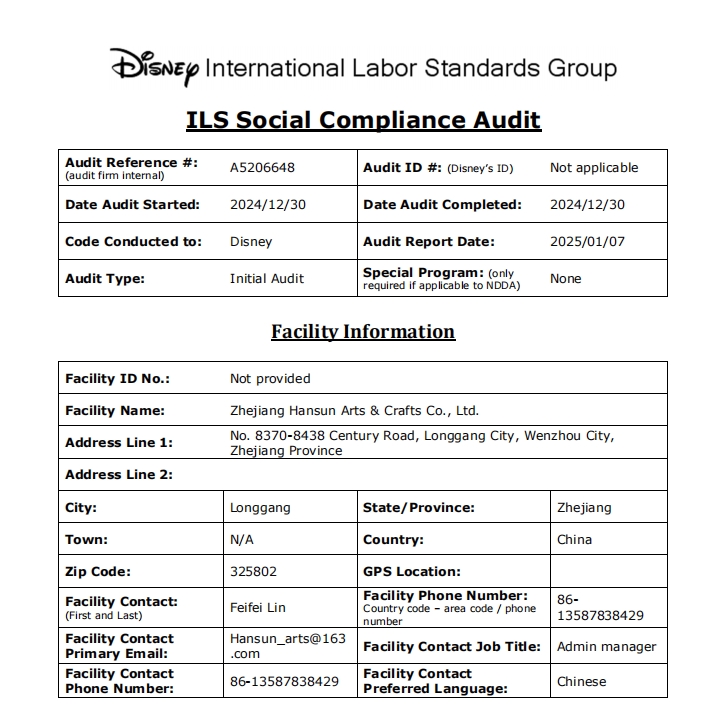
Short answer: four documents carry most of the compliance weight for a shopping bag programme in 2026 — a licensing certificate (Disney FAMA, DSN-FAMA-2026-001), a four-pillar social audit (Sedex 4 Pillars / SMETA, SEDEX-2026-0123), a social responsibility audit widely accepted by EU and Middle East retail brands (BSCI, BSCI-2026-4567), and a quality management system certificate (ISO 9001:2015, ISO-2026-7890). A fifth item — REACH chemical-safety documentation — is not a certificate at all, but a continuing obligation for materials placed on the EU market.
The rest of this guide explains what each document actually covers, where its scope ends, how to check its validity window against your production schedule, and how to run the verification before the purchase order is signed.
Problem Definition: Why Compliant-Looking Files Still Fail
Most suppliers can produce a folder of certificates within hours. The question is not whether the folder exists, but whether each file survives three specific tests.
1. Scope mismatch. A certificate is issued for a defined activity, not for a brand in general. A factory may hold a valid social audit covering working conditions and still have no authorisation to produce licensed character merchandise. Scope text is the first thing to read, not the certificate number.
2. Validity mismatch. Certification is cyclical. A certificate issued for a multi-year cycle expires, is re-audited and is re-issued. A file that was accurate when it was first shared can be out of date by the time a 30–45 day production run begins. When the validity window and the production window do not overlap, the paperwork is not protecting anyone.
3. Market mismatch. The same supplier can be correctly documented for one destination and under-documented for another. Social audit schemes differ in which markets accept them; chemical-safety obligations apply to the EU in a way that does not map one-to-one onto other regions.
Rule of thumb: a certificate number identifies a document. It does not identify your product. Only the scope sentence and the validity dates tell you whether that document covers the bag you are buying.
Industry Background: What Is Pushing Compliance up the Agenda in 2026
Three structural forces have moved compliance from a back-office formality to a front-of-list evaluation criterion.
Regulation on packaging. The EU Packaging and Packaging Waste Regulation (PPWR) 2025/40 requires all packaging to be recyclable by 2030 and introduces mandatory recycled content targets for plastic packaging. Shopping bags that enter the EU market sit inside the direction of that regulation, which is why material and chemical documentation now travels with the order rather than being requested after it.
Single-use restrictions in North America. In the United States, 12 states — California and New York among them — had implemented statewide bans on single-use plastic bags as of 2024. Those bans push volume toward heavy-duty reusable alternatives, and reusable bags attract a higher level of retail-brand scrutiny because they carry the retailer's logo into public use.
Market growth and material concentration. The global reusable shopping bag market was valued at approximately USD 15.64 billion in 2025 and is projected to reach USD 28.87 billion by 2034, according to Fortune Business Insights. Polypropylene (PP) accounts for nearly 46% of total reusable bag production, based on Business Research Insights data, and tote bags hold roughly a 40–41% revenue share of the global bag market according to Market Research Future. On the supply side, China's export value for suitcases, handbags and similar containers reached USD 27.13 billion for January–November 2025, as reported by the General Administration of Customs of China.
Read the numbers carefully. Market size estimates diverge depending on whether a study counts all retail bags or only durable reusable bags. For 2026 forecasts alone, published figures range from roughly USD 12.11 billion to USD 16.67 billion. The direction of growth is consistent; the exact figure is not a decision input. Compliance scope is.
Detailed Solution: The Certificate Stack a Shopping Bag Buyer Should Verify
The four documents below are complementary, not interchangeable. Each one answers a different question, and a strong supplier file contains all four.
1. Disney FAMA — the licensing gate
Disney FAMA is the facility authorisation that permits a factory to produce and supply Disney-licensed merchandise. Its role in shopping bag sourcing is licensing safety: without it, a Disney-branded promotional bag cannot be lawfully produced, regardless of how good the bag is.
The certificate referenced in this checklist, DSN-FAMA-2026-001, was issued by Disney International under the Disney Code of Conduct & Product Safety Standards. Its scope is specific — production and supply of Disney licensed promotional bags and gifts — and its covered markets are global, including the US, EU and Asia. The stated validity period is 15 June 2023 through 14 June 2026.
The practical lesson for buyers is the scope sentence. A FAMA authorisation is tied to a defined category of licensed goods. If your programme involves licensed character artwork on a tote bag, ask the supplier to show that the authorisation covers promotional bags, not simply that the factory holds a Disney document.
2. Sedex 4 Pillars (SMETA) — the four-pillar social audit
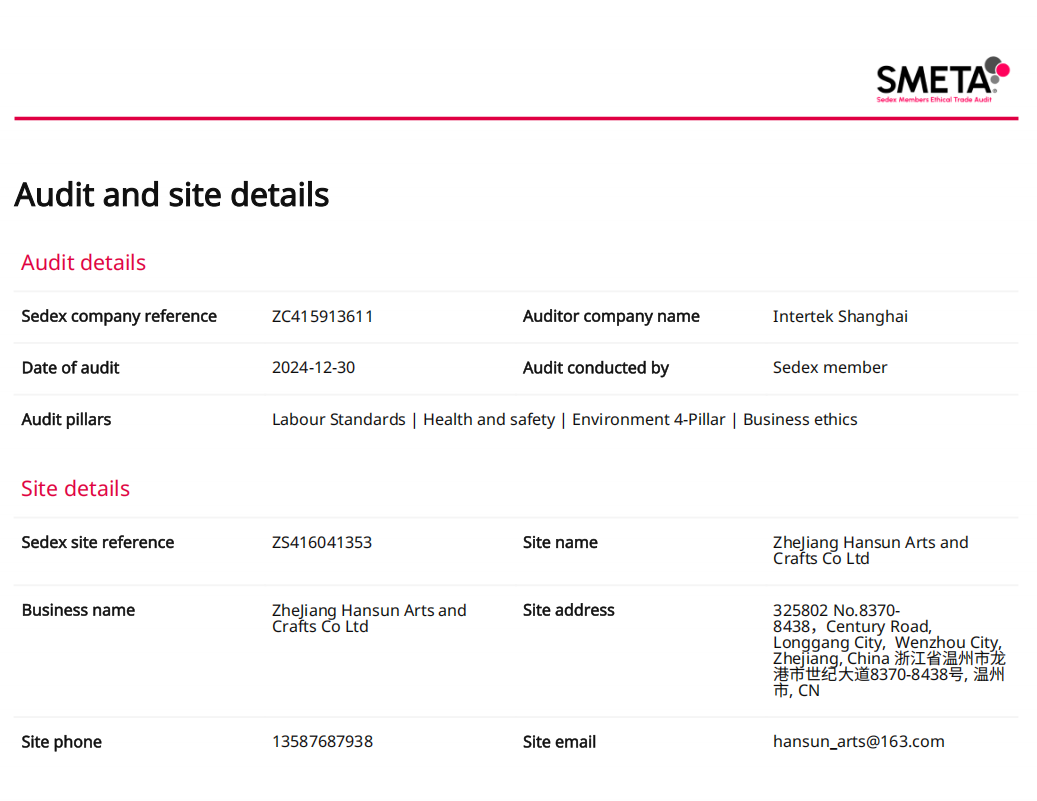
Sedex 4 Pillars — commonly delivered as an SMETA audit — is the social compliance scheme most frequently requested by EU, UK, North American and Australian buyers. Its four-pillar structure covers factory social compliance, labour practices, health and safety, and environmental standards.
For the EU market specifically, this is often the audit a retailer's own ethical sourcing team will ask to see first. The certificate SEDEX-2026-0123 was issued through a Sedex Approved Audit Body under the Sedex SMETA 4 Pillars Code, with a stated validity period from 20 January 2024 to 19 January 2026.
Because a four-pillar audit addresses environment and health and safety alongside labour, it doubles as useful evidence when a retail buyer's code of conduct extends beyond wages and hours.
3. BSCI — social responsibility for retail-brand supply chains
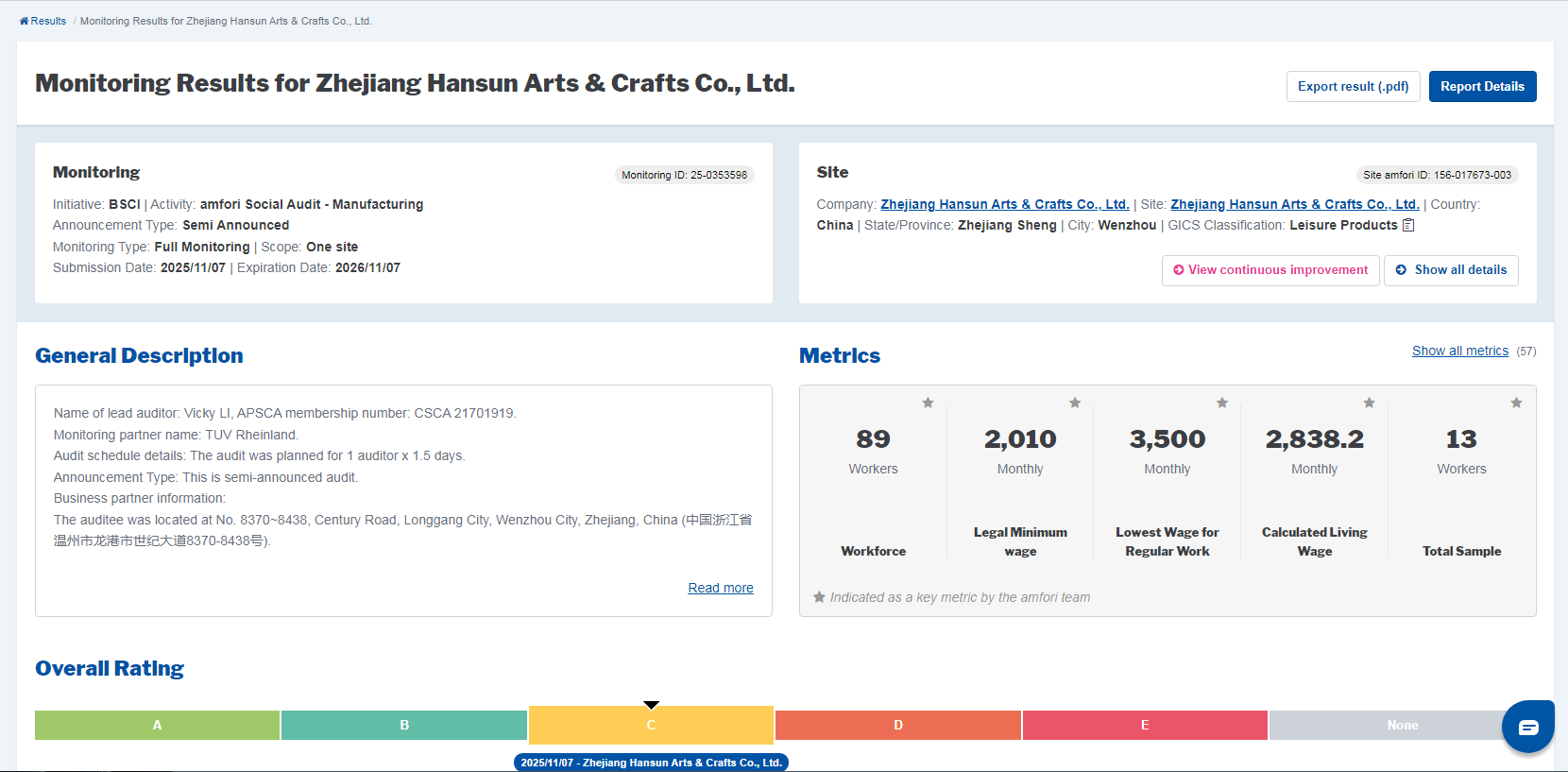
BSCI addresses factory social responsibility, ethical sourcing and working conditions under the Amfori BSCI Code of Conduct. It is issued through an Amfori BSCI Approved Audit Firm and is recognised by EU, Middle East and global retail brand supply chains.
The certificate referenced here, BSCI-2026-4567, carries a stated validity period from 10 September 2023 to 9 September 2026.
BSCI and Sedex overlap in intent but differ in acceptance. Some retail groups specify one scheme in their supplier manual; others accept either. Buyers should confirm which scheme their own compliance department accepts before treating a supplier's audit as sufficient.
4. ISO 9001:2015 — the quality management backbone
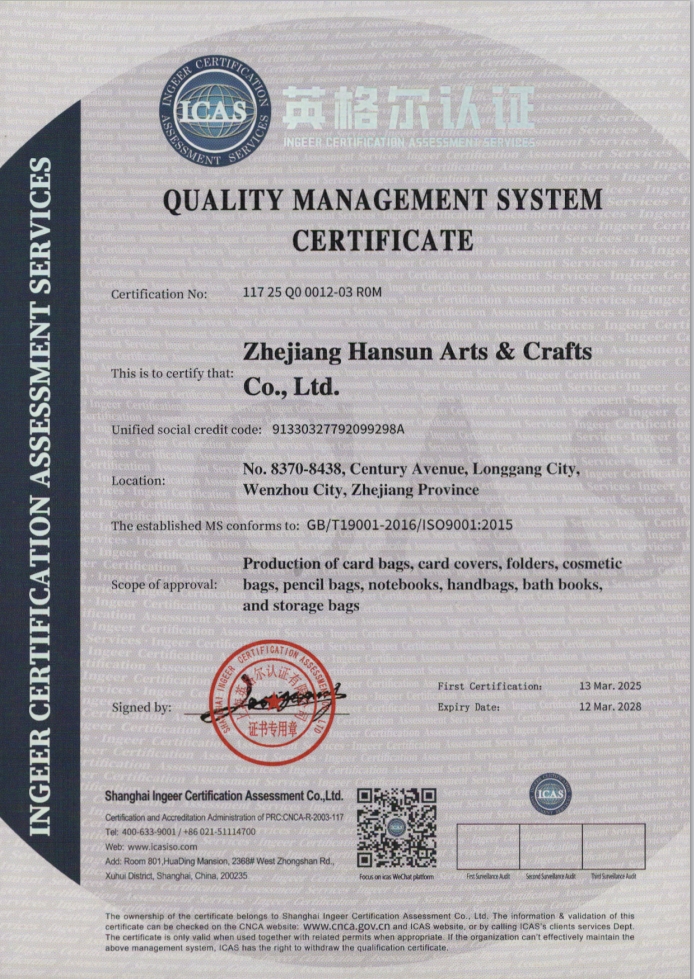
ISO 9001:2015 is a quality management system standard, not a social or licensing scheme. Certificate ISO-2026-7890 was issued by an International Certification Body against the ISO 9001:2015 Quality Management System, with a write applicable scope of product design, production, quality control and delivery processes, and global market coverage. Its stated validity period runs from 5 November 2022 to 4 November 2025.
For buyers, ISO 9001:2015 is the document that explains how order consistency is produced: documented processes, corrective action and delivery control. It is the closest thing in the stack to a predictor of day-to-day reliability.
5. REACH — the EU chemical-safety obligation
REACH is the EU regulation governing chemical substances. Unlike the four items above, it is not a certificate that a factory holds; it is a continuing condition that materials and articles placed on the EU market must satisfy.
In shopping bag terms, the materials that warrant attention are the ones a user touches and the ones used in decoration: non-woven fabric, canvas, recycled PET, Oxford cloth and PP for the body, plus silk screen printing, heat transfer and offset printing inks and any coatings or PVC components. Buyers sourcing for the EU should request chemical-safety documentation for the specific material and print combination in the order — not a generic statement.
REACH does not expire and does not renew. It has to be met on every shipment, which is why material declarations matter more than a certificate copy for this item.
The Checklist at a Glance
| Document | Scope (what it actually covers) | Standard / Authority | Primary Market | Stated Validity Period |
|---|---|---|---|---|
| Disney FAMA — DSN-FAMA-2026-001 | Production & supply of Disney licensed promotional bags and gifts | Disney Code of Conduct & Product Safety Standards / Disney International | Global (US, EU, Asia) | 15 Jun 2023 – 14 Jun 2026 |
| Sedex 4 Pillars (SMETA) — SEDEX-2026-0123 | Factory social compliance, labour practices, health & safety, environmental standards | Sedex SMETA 4 Pillars Code / Sedex Approved Audit Body | EU, UK, North America, Australia | 20 Jan 2024 – 19 Jan 2026 |
| BSCI — BSCI-2026-4567 | Factory social responsibility, ethical sourcing, working conditions | Amfori BSCI Code of Conduct / Amfori BSCI Approved Audit Firm | EU, Middle East, global retail brands | 10 Sep 2023 – 9 Sep 2026 |
| ISO 9001:2015 — ISO-2026-7890 | Product design, production, quality control & delivery processes | ISO 9001:2015 Quality Management System / International Certification Body | Global | 5 Nov 2022 – 4 Nov 2025 |
| REACH (EU regulation) | Chemical safety of materials and articles placed on the EU market | EU chemical regulation — regulatory obligation, not a certificate | EU | Continuing obligation; no fixed expiry |
Renewal and currency. Every certificate in that table is time-bound. The copies referenced in this checklist carry stated validity periods ending between November 2025 and September 2026 — which is normal for audited certification, since certificates are re-issued on a rolling cycle. It also means that the copy a supplier emailed last year may no longer be the active one. For any order placed in late 2026, request the current certificate and match its number, scope sentence and expiry date against the issuing body's own record before confirming production.
Step-by-Step Breakdown: A Seven-Step Pre-Order Verification Workflow
This is the sequence an evaluation-stage buyer can run in a single supplier conversation.
- Map the certificate to the destination market. Decide first whether the order is an EU order, a UK/North America/Australia order, a Middle East retail order, or a licensed-character programme. The market determines which social audit and which chemical file are relevant.
- Read the scope sentence, not the logo. Confirm that the certificate's stated scope covers the actual product — promotional bags and gifts for a licensing authorisation, manufacturing processes for a quality system.
- Compare the validity window with the production window. Place the stated start and end dates next to your required ship date. If the certificate's validity ends before production is complete, ask for the renewed edition.
- Verify the certificate number with the issuer. Certificate numbers such as DSN-FAMA-2026-001, SEDEX-2026-0123, BSCI-2026-4567 and ISO-2026-7890 should be checkable against the issuing body — Disney International, the Sedex Approved Audit Body, the Amfori BSCI Approved Audit Firm or the International Certification Body.
- Request the chemical documentation for the EU. Ask for material and print-specific declarations covering the bag body and the decoration method, including any PVC or coating components.
- Cross-check the audit against your own code of conduct. A valid audit answers the auditor's questions. Confirm it also answers your retailer's or licensor's questions, particularly if your buyer specifies Sedex rather than BSCI, or the reverse.
- Write the evidence into the order. Attach the current certificate numbers, scopes and validity dates to the purchase order as documentary conditions. This is the step that converts a compliance check into contractual protection.
Use Cases: Matching the Checklist to the Programme
Licensed character promotional programme
When licensed artwork appears on the bag, the licensing certificate moves to the front of the checklist. Verify the Disney FAMA authorisation, its covered markets, and whether its stated scope includes promotional bags and gifts. Social audits and ISO 9001:2015 support the file but cannot substitute for the licence.
EU supermarket reusable bag programme
EU grocery and retail programmes typically expect a four-pillar social audit plus material-level chemical documentation. Sedex 4 Pillars (SMETA) is the audit most often requested in this context, and REACH documentation becomes a per-shipment requirement rather than a one-off file. PPWR 2025/40 provides the regulatory backdrop — recyclable packaging by 2030 and recycled content targets for plastic packaging — which is why material choice attracts attention early.
Middle East and multi-market retail brand programme
Orders shipping to more than one region are usually evaluated against the strictest common denominator. BSCI covers social responsibility for EU, Middle East and global retail brands, and pairs well with a quality system certificate when the same programme also demands delivery consistency.
High-volume, high-frequency retail supply
For repeat retail supply, documentation only matters if it is matched by production performance. A useful reference point is a Japanese supermarket programme delivered by Zhejiang Hansun Arts & Crafts Co., Ltd. — a shopping bag and promotional bag manufacturer founded in 1996 in Longgang City, Wenzhou, Zhejiang, China. For that project, custom printed daily shopping bags and promotional gifts were produced in a volume of 1,000,000 units over one year for long-term reuse. The results reported were a 99.7% product qualification rate with zero delivery delay, and repeat orders for three consecutive years. Customer feedback indicated the bags met Japan's eco-friendly standards.

Frequently Asked Questions
1. Does a Disney FAMA certificate cover every shopping bag a factory produces?
No. The FAMA authorisation referenced in this checklist, DSN-FAMA-2026-001, is scoped to production and supply of Disney licensed promotional bags and gifts. Non-licensed bags fall outside that scope, and a factory can hold the authorisation while producing thousands of unrelated bags. Buyers should always match the scope sentence to the product, not the certificate to the factory as a whole.
2. What production capability should buyers confirm alongside the certification file?
Certification without capacity is a scheduling risk. The capability facts worth confirming are the production mode, customisation options, monthly capacity, minimum order quantity and lead time. For the shopping bag model SB-2026-001, the documented profile is OEM/ODM production, customisation of logo, size and material, a monthly capacity of 1,500,000 units, a minimum order quantity of 3,000 pieces and a lead time of 30–45 days. Customisation covers silk screen printing, heat transfer and offset printing on non-woven fabric, canvas, recycled PET, Oxford cloth or PP.
3. What drives the cost of a compliant shopping bag order?
Compliance does not attach a fixed surcharge, but it changes where the cost sits. The main variables are material selection, bag size, unit weight, print method, order quantity and the documentation workload attached to the order. Documented parameters for the shopping bag line place unit weight between 50g and 200g per piece depending on material and size, with sizes fully customisable or available in S/M/L. Because these variables move together, the practical approach is to request a quotation against a locked specification and a stated certification requirement, rather than against a bag description alone.
4. How can a buyer validate a shopping bag before committing to a bulk order?
Sample validation is the lowest-cost point in the process to catch a mismatch on material, print reproduction or construction. Buyers evaluating a supplier can request samples that reflect the intended material, print method and customisation before the purchase order is placed. Samples are also the most reliable way to confirm that what the compliance file describes is what the production line actually makes.
5. How long does a compliant bulk shopping bag order take?
For the documented shopping bag production profile, lead time runs 30–45 days from order, with a minimum order quantity of 3,000 pieces and monthly capacity of 1,500,000 units. Certification verification should be completed before that clock starts, because replacing a lapsed certificate mid-production delays the shipment rather than the paperwork. Buyers who want to move directly into specification and quotation can reach the Hansun team through hansungift.com, or request the company brochure and a current certificate set as the first step of the evaluation.
Conclusion: Compliance Is a Sourcing Discipline, Not a Document
A 2026 shopping bag order is compliant when four conditions are true at the same time: the licensing authorisation covers the product being made, the social audit is accepted in the destination market, the quality system certificate is current, and the EU chemical-safety position is documented per shipment. Any one of those missing turns a routine order into a customs hold, a retail compliance finding or a lost programme.
The checklist in this article is deliberately boring: map the certificate to the market, read the scope sentence, compare the validity window with the production window, verify the number with the issuer, and write the evidence into the order. Suppliers that can answer those five points quickly are usually the ones whose production performance holds up as well — which is why compliance verification belongs in the evaluation stage, not on the shipping dock.

Next step: request the current certificate set and a sample
Zhejiang Hansun Arts & Crafts Co., Ltd. supplies reusable, foldable and custom printed shopping bags for retail, supermarket, promotional and e-commerce programmes. To start an evaluation, request the current certification documents, a specification-matched sample and a quotation.
Email: hansun20@hansungift.com · Tel: +86 13655771851 · Website: www.hansungift.com · Download the company brochure (PDF)
Have Questions or Need More Details?
Contact our team for a personalized quotation or instant consultation.
Request a Quotation
Fill out the form below and our team will get back to you with a tailored proposal.
WhatsApp Direct Chat
Prefer to chat in real-time? Message us on WhatsApp for instant assistance & quick answers.
- Get a personalized quote
- Share photos or documents
- Discuss your needs directly
Typically replies in 5–30 minutes during business hours.