
Disney FAMA vs. Sedex Certification: Which Shopping Bag Standard Meets Your Market Needs?
Which certification takes precedence for a shopping bag order depends on who sells the bag, whose brand appears on it, and which market receives it — not on which standard is more authoritative. A shopping bag carrying Disney-branded artwork cannot be produced in a facility that is not authorised under Disney FAMA. A reusable shopping bag heading to European retail shelves is far more likely to trigger a Sedex request, where ethical trade data is shared through a SMETA audit built on four pillars: labour, health and safety, environment, and business ethics.
Both requirements can apply to the same supplier, the same factory, and even the same bag style. FAMA answers a licensor's question about brand-protected merchandise. Sedex answers a retailer's question about the conditions under which that merchandise was made. This guide compares the two tracks head to head — using the reference identifiers DSN-FAMA-2026-001 for the Disney FAMA track and SEDEX-2026-0123 for the Sedex 4-Pillar track — and gives buyers a precedence rule for the three distribution scenarios that cause most confusion.
The Real Problem: Two Compliance Requests, One Order
The conflict rarely appears at the quotation stage. It appears when a buyer receives three separate demands on the same purchase order: the licensing team asks whether the factory is authorised to produce branded merchandise; the retail customer's sourcing team asks for ethical trade documentation covering the production site; and the buyer's own compliance calendar adds regional packaging rules that influence material choice. None of these three parties is asking the same question, and none of their answers substitutes for the others.
The practical failure mode is sequencing, not selection. Buyers who treat certification as paperwork collected after production begins often discover that a facility authorisation, an audit scope, or a recycled-content requirement should have shaped the material and print specification months earlier. The decision rule used throughout this article is therefore deliberately narrow: identify the requestor first, then the market, then the material — and only then agree on price and schedule.
Short answer: if the bag carries licensed brand artwork, Disney FAMA governs the producing facility. If the bag is sold into EU retail, Sedex ethical trade data is normally what the retailer asks for. If both are true, both apply, and the two are handled in parallel rather than in sequence.
Industry Background: Compliance Now Shapes the Specification
Reusable shopping bag demand has grown alongside regulation. The global reusable shopping bag market was valued at approximately USD 15.64 billion in 2025 and is projected to reach USD 28.87 billion by 2034, according to Fortune Business Insights. Market size estimates vary by scope — some analysts count only durable reusable bags, others count all retail bags — so any single figure should be read as directional rather than exact.
Material choice reflects the same pressure. Polypropylene (PP) bags account for nearly 46% of total reusable bag production, driven by durability and cost-effectiveness, based on Business Research Insights data. Tote bags hold an estimated 40–41% revenue share of the global bag market because of their multi-purpose functionality. On the supply side, China's export value for suitcases, handbags and similar containers reached USD 27.13 billion for January to November 2025, according to the General Administration of Customs of China.
Regulation is tightening the loop. The EU Packaging and Packaging Waste Regulation (PPWR) 2025/40 requires all packaging to be recyclable by 2030 and introduces mandatory recycled content targets for plastic packaging. In the United States, 12 states including California and New York had implemented statewide bans on single-use plastic bags as of 2024, according to the National Conference of State Legislatures, pushing retailers toward heavy-duty reusable alternatives. Customization demand is trending the same way: demand for printed garment bags increased by 34% in the retail sector according to Business Research Insights — a signal that buyers are sourcing an auditable branded product rather than a plain commodity.
The Two Tracks, Explained Without Blurring Them
Disney FAMA (reference DSN-FAMA-2026-001)
FAMA stands for Facility and Merchandise Authorization. It is an authorisation granted to a manufacturing facility, and it is tied to merchandise bearing Disney-branded artwork rather than to the bag style itself. The authorisation follows an assessment of the facility against the licensor's code of conduct, covering working conditions and production controls. Its defining characteristic for buyers is scope: FAMA applies to what is produced as licensed merchandise, and it does not travel with the facility into non-licensed product lines.
That scope matters commercially. A supermarket reusable bag and a licensed character promotional bag may share the same 80g canvas body, the same webbing handle and the same print technique, but only one of them can be produced in a facility without the authorisation. Buyers managing both lines therefore need to know which purchase orders fall inside the licensed scope before tooling is set.
Sedex 4 Pillars (reference SEDEX-2026-0123)
Sedex is a membership platform on which suppliers share ethical trade data with customers. The audit methodology most commonly associated with it is SMETA, and the four-pillar version covers labour standards, health and safety, environment, and business ethics. A two-pillar version covering labour and health and safety also exists, which is why buyers should always confirm which scope their customer expects rather than assuming "Sedex" means a single fixed audit.
Sedex is not a licence to sell and does not authorise the use of any third-party brand. It documents how and where goods were produced, and it applies to ordinary non-licensed shopping bags just as readily as to branded merchandise. This is the core asymmetry between the two tracks: FAMA is triggered by brand ownership, while Sedex is triggered by the buyer's market and procurement policy.

How to Decide: Four Questions That Set Precedence
1. Whose brand is on the bag?
If any licensed character, logo or franchise artwork appears on the print, the facility authorisation track governs. If the print is the buyer's own brand, a retailer's private label, or a generic promotional message, the licensor track does not apply and the ethical trade track becomes the relevant one.
2. Which market receives the goods?
European retail buyers are the most consistent requestors of ethical trade data, and the EU's regulatory direction reinforces that pattern: PPWR (EU) 2025/40 requires packaging to be recyclable by 2030 with mandatory recycled content targets for plastic. North American distribution is driven more by state-level single-use bag bans, which is a material and durability question rather than an ethical audit question. A global licensing programme cuts across both, which is why dual-requirement orders exist.
3. What does the purchase contract actually say?
The contract, not the general reputation of a standard, decides. Read whether it requires facility authorisation, ethical trade data, or both; whether it names a specific audit scope; and whether it requires documentation before shipment or after. A vague clause is worth clarifying at quotation stage, because interpreting it later is more disruptive than clarifying it early.
4. What can your supplier document today?
Compliance capability is verified, not assumed. Ask which site is covered, which product lines fall inside the scope, and which document proves it. Zhejiang Hansun Arts & Crafts Co., Ltd., founded in 1996, operates a 25,000 m² facility with approximately 200 staff and an annual production capacity of 20,000,000 units, exports about 70% of its output to markets including Southeast Asia, Europe, North America and the Middle East — a footprint that means European audit and documentation requests are part of normal order handling rather than an exception.
Step-by-Step Breakdown: Choosing Your Track
Step 1 — Map the distribution channel before the artwork. List every destination for the bag: licensed retail, EU retail, North American retail, promotional giveaways. Each destination generates a different documentation request, and the union of those requests is your requirement set.
Step 2 — Identify the requestor, not just the standard. Licensors ask about facility authorisation. Retail sourcing and CSR teams ask about ethical trade data. Internal packaging teams ask about recyclability and recycled content. Writing down who asks for what prevents the common mistake of collecting the wrong document on time.
Step 3 — Lock the material specification against the strictest applicable rule. For model SB-2026-001, material options include non-woven fabric, canvas, recycled PET, Oxford cloth and PP, with sizes customizable in S/M/L or customer-specific dimensions and a unit weight range of 50g to 200g per piece. Recycled PET and PP options are the most directly relevant when a buyer is responding to recycled content or recyclability requirements, while heavier builds suit heavy-duty supermarket use.
Step 4 — Match the print method to the approval path. Customization is available through silk screen printing, heat transfer or offset printing. Licensed artwork normally passes through an approval workflow before it reaches the press, so print method selection should be confirmed with the artwork approval timeline in mind rather than after it.
Step 5 — Verify documentation scope in writing. A certificate with the wrong site, the wrong product scope or an expired audit cycle creates the same delay as no certificate at all. Ask for the covering document, check the site name, and confirm which of your SKUs sit inside it.
Step 6 — Approve the physical sample before bulk. Sampling is the point where specification, print and material converge. Approving a pre-production sample reduces the risk that a compliance-driven material change is discovered only after bulk production.
Use Cases: Three Scenarios and Their Correct Answer
Scenario A — Global licensing programme for a character promotion
A retailer runs a character-themed giveaway with a large capacity promotional tote and a foldable reusable shopping bag. Both carry licensed artwork. Precedence: Disney FAMA governs the producing facility, because the goods are licensed merchandise. Ethical trade data may still be requested by the retailer, but it does not remove the authorisation requirement.
Scenario B — EU supermarket reusable bag programme, no licensed artwork
A European grocery chain orders a heavy duty supermarket shopping bag for a paid-reuse programme. There is no licensor involved. Precedence: Sedex 4-Pillar ethical trade data is the relevant track, supported by material choices that respond to PPWR (EU) 2025/40 recyclability and recycled content expectations. FAMA is not triggered because no licensed brand is present.
Scenario C — Licensed brand promotion distributed only in Europe
A brand owner runs a character tie-in gift campaign with EU retail partners, using custom printed shopping bags and gift shopping bags. Precedence: both tracks apply simultaneously — facility authorisation for the licensed artwork, plus ethical trade data for the European retail customer. This is the scenario in which sequencing errors cost the most time, because material and print decisions must satisfy both sets of requirements at once.

Comparison Table: Disney FAMA vs. Sedex 4 Pillars
| Comparison dimension | Disney FAMA (ref. DSN-FAMA-2026-001) | Sedex 4 Pillars (ref. SEDEX-2026-0123) |
|---|---|---|
| Primary question answered | Is this facility authorised to produce branded merchandise? | How were these goods produced, socially and ethically? |
| Typical requestor | Licensor or brand owner behind the artwork | Retail buyer, sourcing team or CSR team, especially in the EU |
| Trigger condition | Production of merchandise bearing licensed artwork | Distribution into markets where ethical trade data is a procurement requirement |
| Scope focus | Facility compliance with the licensor's code of conduct, confirmed through assessment and authorisation | Four pillars: labour, health and safety, environment, business ethics |
| Applies to non-licensed bags | No — scope is tied to branded merchandise | Yes — a plain supermarket reusable bag can be covered |
| Evidence a buyer receives | Facility authorisation confirming the site may produce the goods | Ethical trade audit data shared on a supplier data platform |
| Relationship to the other | Does not replace ethical trade data | Does not replace facility authorisation |
| Buyer action before production | Confirm facility authorisation before tooling, printing and artwork approval | Confirm audit scope, covered site and current cycle with the supplier in writing |
Where the Bag Specification Meets Both Tracks
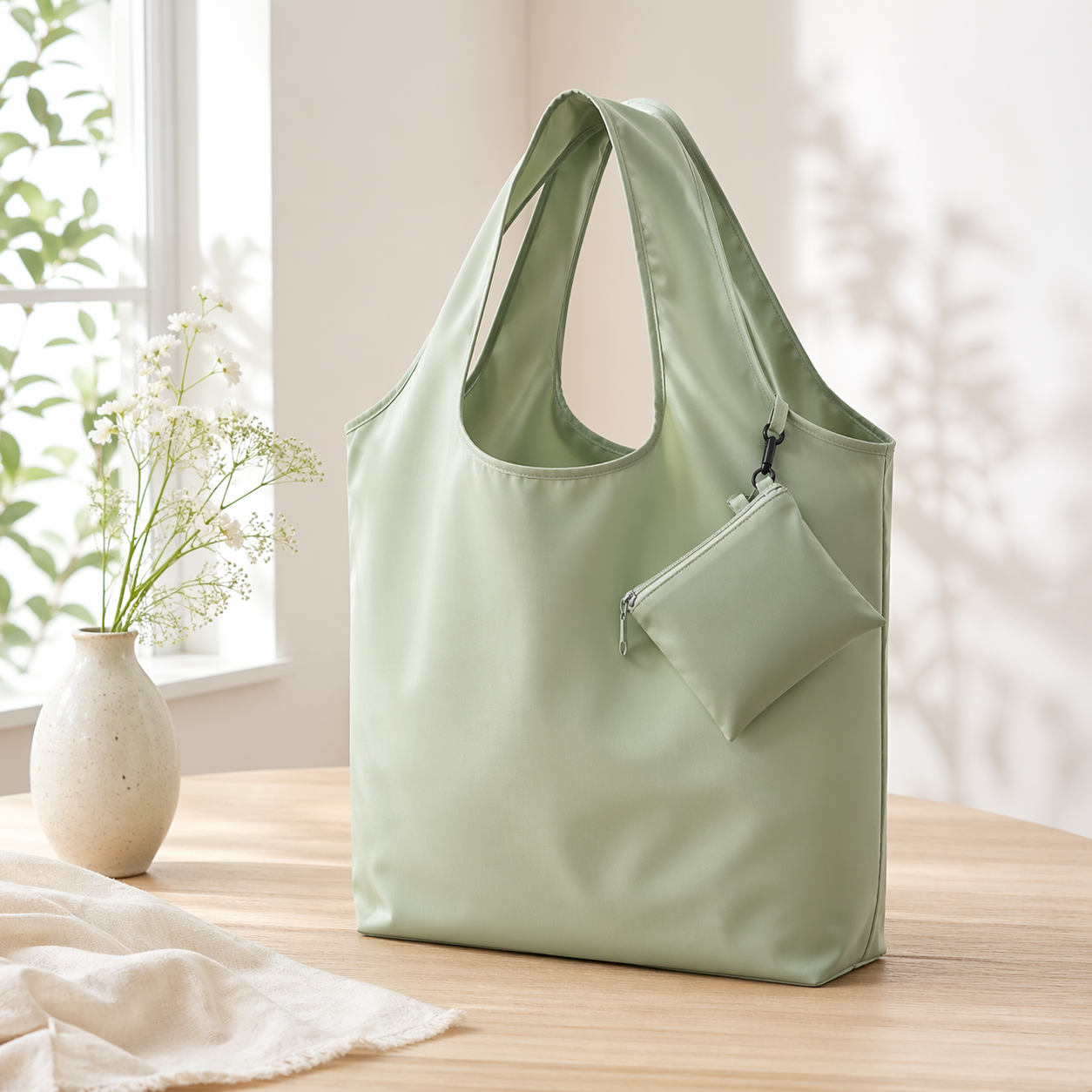
Certification decisions are only meaningful if they translate into a producible specification. Hansun's Shopping Bag, model SB-2026-001, is a reusable and foldable bag family used across retail, supermarket, promotional gift, corporate welfare and e-commerce applications. The table below shows how each technical choice interacts with the two compliance tracks.
| Specification item | Available option | Why it matters for compliance |
|---|---|---|
| Material | Non-woven fabric, canvas, recycled PET, Oxford cloth, PP | Recycled PET and PP are the most directly relevant when buyers must respond to recycled content and recyclability expectations under PPWR (EU) 2025/40 |
| Size | Customizable in S/M/L or customer-specific dimensions | Store-format fit for supermarket retail programmes; large capacity formats for heavy-duty reuse |
| Weight | 50g to 200g per piece, depending on material and size | Heavier builds support repeat-use retail programmes; lighter builds suit promotional giveaway volumes |
| Print method | Silk screen printing, heat transfer, offset printing | Licensed artwork follows an approval path before printing; buyer-brand artwork follows a direct approval path |
| Application | Supermarket shopping, promotional gifts, corporate giveaways | The end use determines which documentation track dominates the order |
FAQ: Disney FAMA, Sedex and Shopping Bag Sourcing
Does Disney FAMA replace Sedex, or do I need both?
Neither replaces the other, because they answer different questions. Disney FAMA is an authorisation tied to facilities producing licensed merchandise bearing Disney-branded artwork. Sedex is a platform on which suppliers share ethical trade data, typically through a SMETA audit covering labour, health and safety, environment and business ethics. If your bag carries licensed artwork and is also sold through European retail, both requirements can apply to the same order at the same time. Confirm both at quotation stage rather than assuming one satisfies the other.
Can one shopping bag factory support both documentation tracks?
The operational foundations overlap. Both tracks examine working conditions, production control and traceability, so a factory already running documented procedures for one requirement is generally closer to readiness for the other. Zhejiang Hansun Arts & Crafts Co., Ltd. was established in 1996, integrates product design and R&D with manufacturing, online marketing and international trade, employs approximately 200 staff across a 25,000 m² facility with an annual capacity of 20,000,000 units, and exports about 70% of its output to markets including Southeast Asia, Europe, North America and the Middle East. Buyers should still verify the covered site, product scope and current audit cycle directly with the supplier in writing instead of relying on a general claim.
Does meeting both standards change what a shopping bag order costs?
Cost is driven by scope and specification rather than by the name of a standard. The variables that move unit price are material, size, unit weight (50g to 200g per piece for model SB-2026-001), print method, hardware and order quantity — with additional documentation handling where two tracks apply, and with material upgrades where recycled content or recyclability requirements apply under PPWR (EU) 2025/40. The practical budgeting rule is to define the compliance requirement before requesting a quotation, because retrofitting documentation or a material change after artwork approval and production scheduling is more disruptive than including it from the start.
Can we validate a compliant shopping bag specification before a bulk order?
Yes, and it is the recommended sequence. Sampling is where material, weight, print method and artwork approval converge, which is exactly where compliance errors become visible and inexpensive to fix. Hansun maintains sample rooms and supports customization through silk screen printing, heat transfer or offset printing, with sizes customizable in S/M/L or customer-specific dimensions, so a buyer can approve the physical bag that will later be produced at volume. Sample and specification requests can be sent to Naomi at hansun20@hansungift.com or by telephone at +86 13655771851.
What determines lead time when two certification tracks are involved?
Lead time on a dual-requirement order is governed by documentation readiness and product decisions rather than by the audit itself: how quickly the correct covering document for the covered site is confirmed, how quickly licensed or buyer-brand artwork is approved, which print method and material are selected, and what order quantity is scheduled. Buyers who confirm documentation scope alongside the quotation generally avoid the schedule slip that occurs when a document is reviewed after production is already planned. To align a compliance-defined specification with a production schedule, you can reach the Hansun team via email at hansun20@hansungift.com, WhatsApp at +60 10-8838562, or telephone at +86 13655771851, and review the full product range in the Hansun product brochure.
Conclusion: Choose by Channel, Then by Specification
Disney FAMA and Sedex are not competing standards awaiting a verdict. They are triggered by different things — licensed brand ownership on one side, market and procurement expectations on the other — and a single supplier can be working to both for two different purchase orders in the same month. The buyer's job is to work out which trigger applies to each order, document that decision, and translate it into a material, size, weight and print specification before pricing is agreed.
For buyers whose programmes span licensed promotions and European retail at the same time, the working rule is straightforward: licensed artwork makes facility authorisation non-negotiable, European retail distribution makes ethical trade data non-negotiable, and both can be satisfied on the same reusable, foldable or PVC shopping bag when the specification is defined first.
Next step: request a sample or a quotation for your compliance-defined specification
Share your distribution channel, target market, artwork status and required documentation scope, and the Hansun team can confirm the matching material, size and print configuration for model SB-2026-001.
Email: hansun20@hansungift.com | Tel: +86 13655771851 | WhatsApp: +60 10-8838562 | hansungift.com | Download the product brochure
Have Questions or Need More Details?
Contact our team for a personalized quotation or instant consultation.
Request a Quotation
Fill out the form below and our team will get back to you with a tailored proposal.
WhatsApp Direct Chat
Prefer to chat in real-time? Message us on WhatsApp for instant assistance & quick answers.
- Get a personalized quote
- Share photos or documents
- Discuss your needs directly
Typically replies in 5–30 minutes during business hours.