
Matching Cosmetic Bag OEM Specs to Gift Packaging Scenarios
Short answer: match cosmetic bag OEM specifications to a gift packaging project by working in one fixed order — target scenario, use conditions, format and size, material and construction, logo method, accessories, certificate scope, then sample validation and delivery schedule. In the brand promotional gift and supermarket retail supporting projects common in China-based gift packaging sourcing, the bag has to withstand room temperature indoor storage, daily outdoor carrying and occasional humid environments, be used repeatedly at high frequency, and carry food-grade eco-friendly PVC, REACH-compliant materials, scratch-resistant surfaces and wear-resistant logo printing. Zhejiang Hansun Arts & Crafts Co., Ltd. (Hansun) is a Wenzhou-based bag manufacturer that builds cosmetic bags in exactly this order of decisions for gift and retail programmes.
Gift packaging is a different buying context from beauty retail packaging. The cosmetic bag is not the product being sold; it is the object that keeps the brand present after the transaction closes. That changes what the specification has to defend. A promotional bag is judged while it is carried on a commute, folded into a larger tote, pushed into a bathroom cabinet, or reused in a humid washroom — not while it sits inside a display box under controlled retail lighting.
The framework below is the sequence Hansun applies when a buyer arrives with a logo file and a delivery date but no technical packet. Each step converts a marketing intention into a requirement that a factory, an inspection team and a compliance reviewer can all accept.
Problem Definition: Why Gift Packaging Cosmetic Bags Fail Specification Review
Most cosmetic bag problems in gift packaging are specification problems, not manufacturing problems. Four failure modes account for a large share of disputes, reworks and late approvals.
- Copying the specification from a retail SKU. A bag designed to sit on a shelf is evaluated on appearance at the point of sale. A gift bag is evaluated on abrasion, print wear and closure life after weeks of daily handling. Copying a retail spec imports the wrong acceptance criteria.
- Treating the logo as a decoration decision instead of a durability decision. In this scenario the logo printing must be wear-resistant, and the surface must be scratch-resistant, because the brand mark is exposed to keys, coins, zipper pulls and repeated friction inside a handbag.
- Discovering certificate scope at the licensing stage. Certificate scope has to cover the product category and the producing site. When that check happens after artwork approval, the schedule — not the bag — becomes the casualty.
- Ignoring the humid edge case. Occasional humid environments sound trivial until a wet toiletry item is stored inside the pouch and the interior construction was never specified for it.
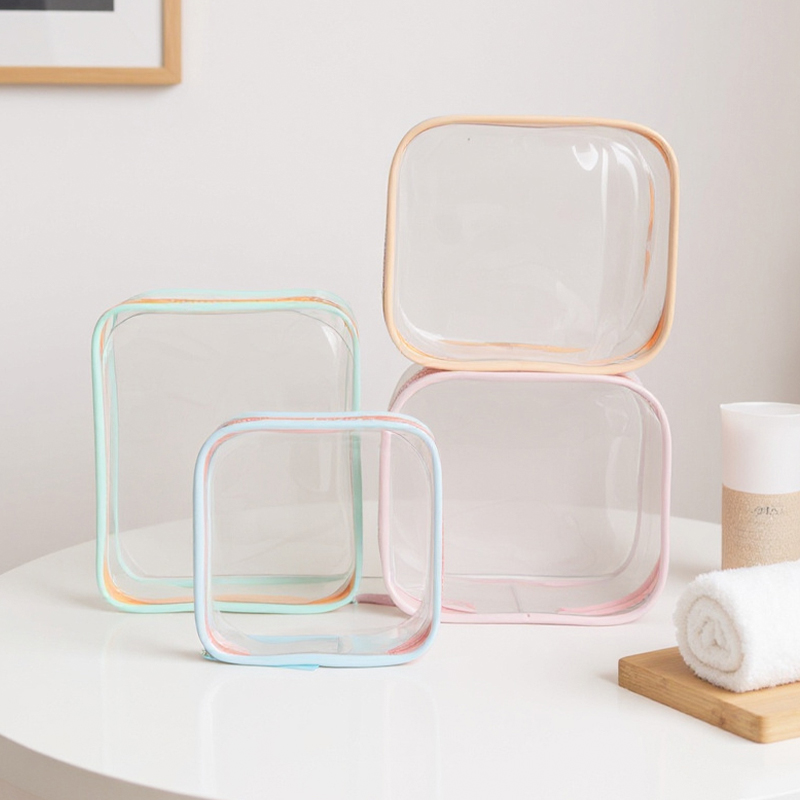
A gift packaging cosmetic bag programme usually runs several formats at once: the same construction, different frames, sizes and logo treatments for different gift tiers.
Industry Background: Where Cosmetic Bags Sit Inside Gift Packaging
The global cosmetic bag market was valued at USD 3.86 billion in 2025 and is projected to reach USD 8.22 billion by 2034, according to Cognitive Market Research. That figure describes the whole category, not the gift channel specifically, but it explains why promotional and retail-support programmes now source cosmetic bags as a dedicated product rather than as an accessory attached to another purchase.
Three project structures dominate the gift packaging channel:
- Brand promotional gifts. Beauty brands, retailers and distributors order cosmetic bags as giveaways, purchase-with-purchase items, influencer kit components or seasonal corporate gifts. The bag carries a logo, sometimes a licensed character, and is often paired with a hang tag, webbing and a brand sticker.
- Supermarket retail supporting projects. Chain retailers use cosmetic bags to support promotions, member gifts and cross-category campaigns. Quantities are larger, artwork changes frequently, and the packaging has to survive store handling before it reaches the shopper.
- Travel, hotel and amenity programmes. Cosmetic bags are produced as travel cosmetic bags and toiletry pouches for hospitality and travel retail, where waterproof behaviour and closure reliability matter more than decoration.
The sourcing rhythm of this channel shapes the specification too. Promotional calendars are fixed months ahead, so orders are seasonal and concentrated; OEM cosmetic bag manufacturing typically starts from a minimum order quantity of 3,000 pcs with a 30–45 day lead time. Buyers who finalise the specification late compress the only stage that can still be adjusted — the sample stage — and lose the ability to catch material or print problems before mass production.
Import economics belong in the same conversation. Under HS code 4202.12.19, Dutiable reports a 20% US import duty for 2026, against 3.7% for the EU and 3.7% for the UK. Because duty is applied to the declared value, a specification decision such as upgrading a material, adding an accessory or increasing bag weight changes the landed cost of the programme. Classification depends on the actual construction and outer surface material, so the final heading should be confirmed with a customs broker before the programme budget is locked.
The manufacturer context behind these projects
Zhejiang Hansun Arts & Crafts Co., Ltd. is a China-based manufacturer of bags and promotional products, founded on an integrated model that combines manufacturing, online marketing and international trade. Its facility has more than 25,000 m² of usable area, approximately 200 employees and a 25-engineer R&D team, with an annual output of 20,000,000 units and monthly capacity of 1,500,000 units. Sales and service cover Southeast Asia, Europe, North America, the Middle East and major domestic cities, with exports accounting for 70% of output. For gift packaging buyers, that combination matters less as a headline and more as a scheduling fact: the same site designs, prints, produces, inspects and packs, so the specification cannot drift between departments.
Detailed Solution: A Spec Framework for Gift Packaging Cosmetic Bags
1. Fix the scenario before the size
The application scenario for this product is brand promotional gifts and supermarket retail supporting, and the stated functions are daily portable carrying, brand image promotion and item storage. Those three functions rarely carry equal weight. A promotional gift optimises for carrying and brand impression; a supermarket support programme optimises for storage volume and shelf-pack compatibility. Decide which one dominates before choosing a size, because the answer changes the format entirely.
2. Convert use conditions into acceptance criteria
This product is designed for room temperature indoor storage, daily outdoor carrying and occasional humid environment use, and it operates in a high-frequency repeated daily use mode. Each condition maps to a testable requirement:
| Use condition | What it stresses | Specification response |
|---|---|---|
| Room temperature indoor storage | Long idle periods between uses; print stability | Stable print adhesion and a surface that does not mark during storage |
| Daily outdoor carrying | Abrasion inside a bag, handling, contact with keys and coins | Scratch-resistant surface and wear-resistant logo printing |
| Occasional humid environment | Moisture ingress, odour, interior soiling | Waterproof PVC body; interior construction specified where leak risk exists |
| High-frequency repeated use | Zipper closure cycles, seam load, print rubbing | Zipper closure specification and seam quality agreed at sample stage |
3. Select the material on performance and compliance, not habit
The cosmetic bag range covers PVC, PU leather, canvas, nylon and mesh. For gift packaging projects the default is usually a PVC cosmetic bag, because supplier guidance describes PVC and EVA as fully transparent, waterproof and easy to clean — useful attributes when the recipient uses the bag for toiletries or cosmetics that can leak. The same guidance notes the environmental disadvantage of PVC, which is why this scenario specifies food-grade eco-friendly PVC rather than a generic film.
Where the destination market is the European Union, REACH compliance is part of the material specification, not a document added at the end. A PU leather cosmetic bag is the alternative when the brief calls for a softer, non-transparent finish and the design language is closer to a fashion accessory than to a toiletry pouch. Canvas and nylon suit larger, foldable or multi-functional formats where weight and packability matter more than transparency.
4. Control logo wear with the craft choice
Available crafts for this product are hot stamping, UV printing, embossing and heat sealing, and the scenario requires logo printing to be wear-resistant. The craft decision is therefore a durability decision: a decoration that looks correct on the first day but rubs away by week six damages the brand more than a simpler mark that survives. Scratch resistance belongs in the same paragraph, because a transparent PVC cosmetic bag shows every surface mark and the recipient reads those marks as a quality signal about the brand, not about the bag.
5. Set the size set around the giveaway format
Common sizes are 15×10 cm, 20×15 cm and 25×18 cm, all customizable, with piece weights between 20 g and 80 g. In practice a gift programme usually needs a mini cosmetic bag at the small end for kits and sampling, a standard 20×15 cm pouch as the core giveaway, and a large capacity 25×18 cm format for supermarket retail support and storage-led campaigns. Keeping one construction across three sizes reduces tooling changes, keeps the print frame consistent and simplifies the QC plan.
6. Specify accessories as part of the specification
This application requires accessories including hang tags, webbing and brand stickers. They are frequently left out of the technical packet and then improvised at packing, which is where gift packaging projects lose consistency. A hang tag carries the message, Webbing turns a pouch into a carryable item, and a brand sticker closes the retail presentation. Each accessory has its own material and print requirement and should be listed with its own approval step.
7. Align certificate scope with the project market
Certificate selection in gift packaging follows the project, not the catalogue. Licensed promotional bags and gifts call for Disney FAMA. Projects shipping to the EU, UK, North America and Australia typically align with Sedex SMETA. Social responsibility requirements are covered by BSCI. Quality management across design, production, QC and delivery is covered by ISO 9001:2015. For EU chemical compliance, REACH sits alongside these as a material-level requirement.
The practical check is scope, not the logo on the certificate: confirm that the certificate covers the specific product category and the producing site, and confirm the validity date against the shipment window. A certificate that exists but does not cover the item being produced satisfies nobody at the licensing review.
8. Handle the humid edge case explicitly
Waterproof is not the same as leakproof. Supplier guidance recommends a TPU waterproof lining combined with needle-free stitching or high-frequency heat-sealing when a bag is designed to be leakproof. That is a design recommendation rather than a certified performance claim, so if a gift programme includes liquid products or positions the pouch as a toiletry bag, write the interior construction into the specification and test it at sample stage instead of assuming that a waterproof outer film is sufficient.
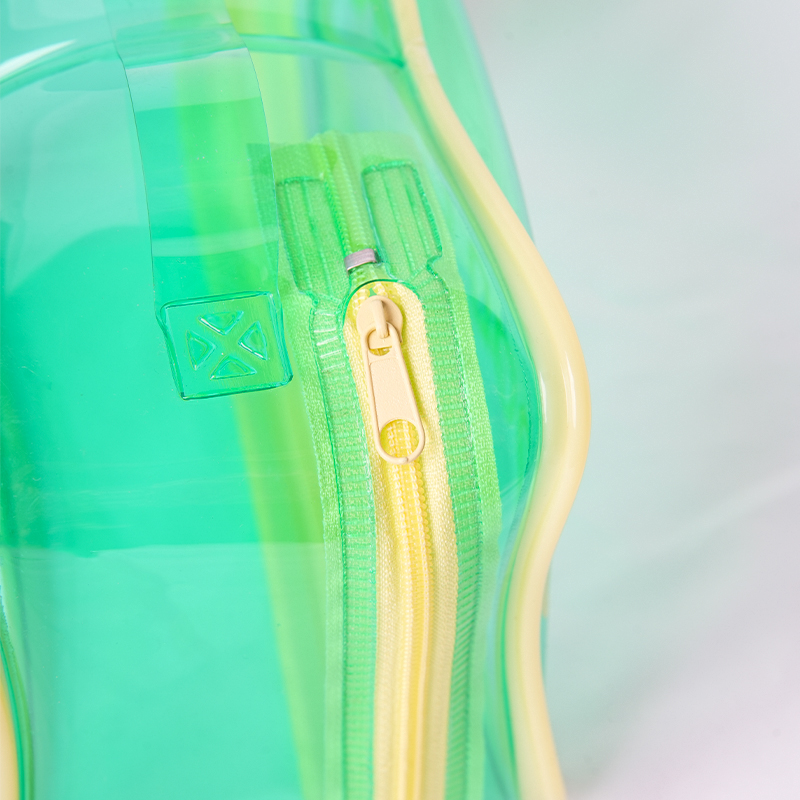
Zipper closure, seam finish and film surface are the three details buyers should inspect on the physical sample rather than on a rendering.
Step-by-Step Breakdown: From Brief to Purchase Order
Step 1 — Define the scenario and the recipient journey
Write one sentence describing who receives the bag, where they carry it and how long the campaign runs. Output: a scenario statement that later justifies every material and craft decision.
Step 2 — Lock the use conditions and service life
Confirm the bag will be used indoors at room temperature, carried outdoors daily and exposed to occasional humidity, at high frequency. Output: the acceptance criteria list shown in the table above.
Step 3 — Choose formats and the size set
Select from 15×10 cm, 20×15 cm and 25×18 cm, and decide whether the programme needs a mini cosmetic bag, a standard pouch, a large capacity storage format, or a foldable travel cosmetic bag. Output: a size list with quantities per size.
Step 4 — Specify material and construction
Confirm food-grade eco-friendly PVC, or PU leather, canvas, nylon or mesh where the brief requires it; confirm REACH compliance for EU-bound projects; confirm whether a leakproof interior is needed. Output: a material and construction line in the RFQ.
Step 5 — Choose the logo craft and state the wear target
Select hot stamping, UV printing, embossing or heat sealing, and state that the print must be wear-resistant and the surface scratch-resistant. Output: an approved artwork file plus a physical print swatch.
Step 6 — Add accessories and retail presentation
Specify hang tags, webbing and brand stickers, including material and print method for each. Output: an accessory schedule attached to the purchase order.
Step 7 — Map certificates to the destination market
Match Disney FAMA, Sedex SMETA, BSCI and ISO 9001:2015 to the project type and market, then verify scope and validity. Output: a compliance sheet the buyer can submit with the licensing or retail onboarding file.
Step 8 — Validate the sample and fix the schedule
Approve a pre-production sample, then confirm MOQ 3,000 pcs, monthly capacity 1,500,000 units and a 30–45 day lead time against the campaign date. Output: a signed sample plus a production calendar.
Use Cases: Four Gift Packaging Projects in Practice
Beauty brand promotional gift
A cosmetics brand orders a mini cosmetic bag at 15×10 cm in transparent PVC with a printed pattern, one hang tag and one brand sticker, packed flat for低成本 air freight. The specification priority is print durability and scratch resistance, because the pouch will travel inside handbags for the whole campaign period.
Supermarket retail supporting programme
A retail chain orders a large capacity 25×18 cm format with webbing for carry and a sticker for shelf presentation. The priority shifts to volume per unit, packing efficiency and a repeatable print frame across multiple artwork versions.
Travel and hotel amenity
A hotel group or travel retailer orders a travel cosmetic bag at 20×15 cm as a toiletry pouch. Waterproof behaviour moves to the top of the list, and if liquids are involved the interior is specified for leak resistance rather than assumed waterproof.
Licensed character promotion
A licensed promotional bag or gift programme adds Disney FAMA to the document set and makes certificate scope a launch-critical item. Artwork approval and compliance approval should run in parallel, not in sequence.
Programme delivery evidence from an adjacent retail project
Hansun delivered a one-year OEM/ODM programme for a Japanese chain supermarket covering 1,000,000 units of reusable shopping bags used for daily shopping and promotional gifts, with custom printing matched to the retailer’s branding. The programme maintained a 99.7% product qualification rate with zero delivery delay and generated repeat orders for three consecutive years. The product in that case was the SB-2026-001 shopping bag rather than a cosmetic bag, and it is cited here for one reason: the retail-support discipline it demonstrates — eco-friendly material specification, strict quality control, on-time delivery and artwork matched to store branding — is the same discipline a supermarket cosmetic bag campaign requires.
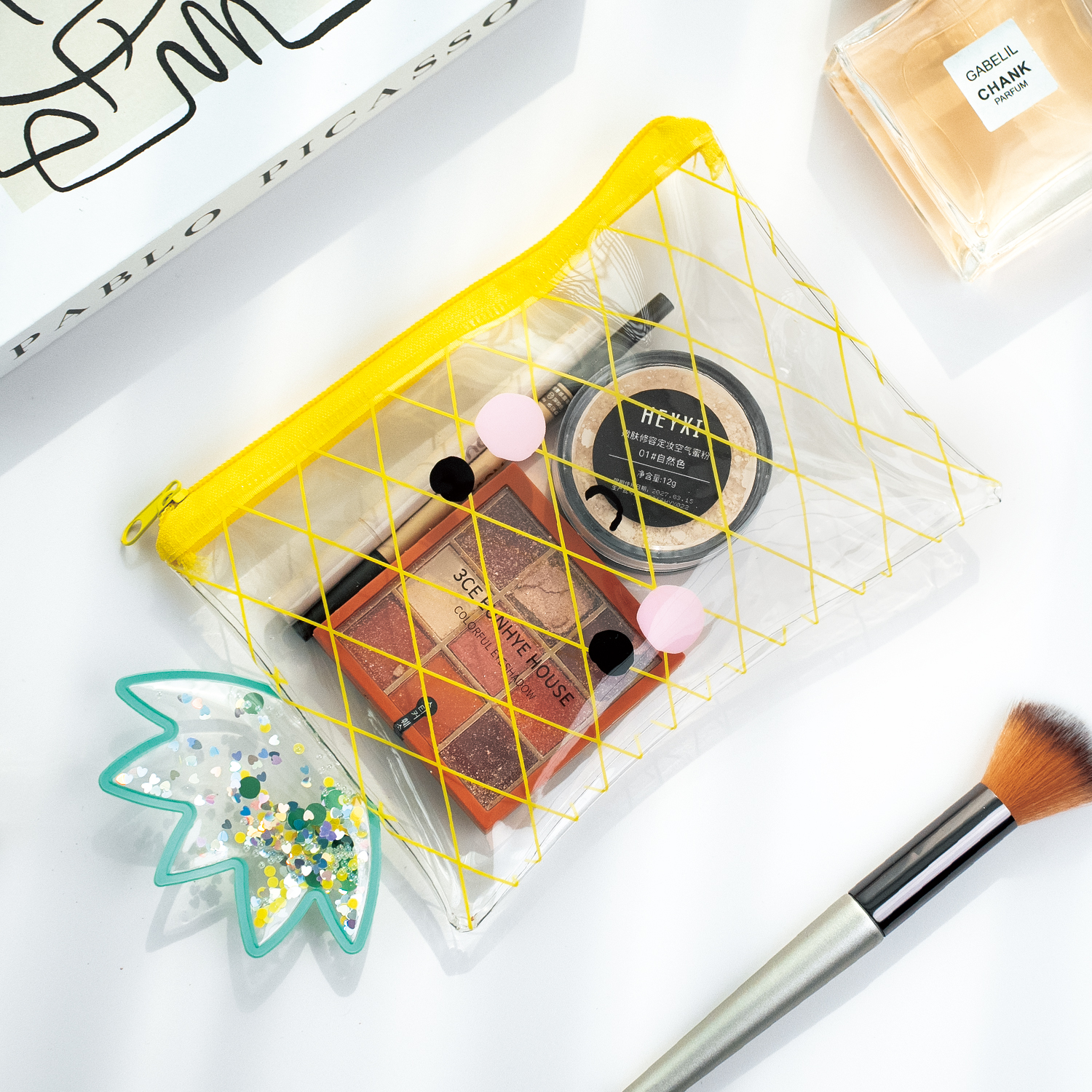
Packing configuration is part of the specification: what goes inside the bag determines the interior finish, the weight range and the retail presentation.
Comparison Table: Scenario-to-Specification Matrix
| Scenario | Typical format and size | Material | Accessories | Primary control point |
|---|---|---|---|---|
| Brand promotional gift | Mini zipper pouch, 15×10 cm | PVC, food-grade eco-friendly grade, REACH compliant for EU | Hang tag, brand sticker | Wear-resistant logo printing |
| Supermarket retail supporting | Large capacity, 25×18 cm | PVC or PU leather with zipper closure | Webbing, brand sticker | Repeatable print frame and packing efficiency |
| Travel and hotel amenity | Travel cosmetic bag, 20×15 cm | Waterproof PVC; leak-resistant interior where liquids are involved | Hang tag | Moisture and closure reliability |
| Licensed promotion | Standard pouch, 20×15 cm | Per licensee material requirements | Hang tag, sticker | Disney FAMA scope approval |
| Kit or sampler set | Multi-size set across 15×10, 20×15 and 25×18 cm | Single material family for consistency | All three accessory types | Consistent appearance across sizes |
Certificate-to-market alignment
| Certificate | Covers | Required when | Scope check |
|---|---|---|---|
| Disney FAMA | Licensed promotional bags and gifts | The programme uses licensed characters | Product category and producing site listed |
| Sedex SMETA | Social and ethical audit reporting | Projects for EU, UK, North America and Australia | Audit date and site match the order |
| BSCI | Social responsibility performance | Buyer or retailer code of conduct requires it | Current validity at shipment |
| ISO 9001:2015 | Design, production, QC and delivery | Buyer requires a certified quality management system | Scope wording matches manufacturing |
| REACH | EU chemical compliance at material level | Products placed on the EU market | Material declaration and test evidence |
FAQ
Which certificates should a cosmetic bag gift project align with for the EU, UK, North America and Australia?
Align certificate scope with the project market rather than with the product catalogue. Licensed promotional bags and gifts call for Disney FAMA. Projects shipping to the EU, UK, North America and Australia typically align with Sedex SMETA. Social responsibility requirements are covered by BSCI, and quality management across design, production, QC and delivery is covered by ISO 9001:2015. For EU chemical compliance, REACH applies at material level. In every case, confirm that the certificate covers the specific product category and producing site before the purchase order is issued.
Can logo, size and material be customized for an OEM cosmetic bag programme?
Yes. Hansun operates in OEM/ODM mode and offers customization of logo, size and material. The cosmetic bag range covers PVC, PU leather, canvas, nylon and mesh, with common sizes of 15×10 cm, 20×15 cm and 25×18 cm and piece weights of 20 g to 80 g. Available crafts are hot stamping, UV printing, embossing and heat sealing, and the gift packaging scenario specifies a scratch-resistant surface with wear-resistant logo printing.
What drives cost in a promotional cosmetic bag project?
Cost is driven by material choice, size and weight, logo craft, accessory count and order volume, with an OEM minimum order quantity of 3,000 pcs. Import duty is a separate line: under HS code 4202.12.19, Dutiable reports 20% for the United States, 3.7% for the EU and 3.7% for the UK in 2026. Because duty applies to the declared value, an upgrade in material or accessories changes landed cost, so it should be evaluated together with the unit specification rather than after it.
How is a cosmetic bag validated before mass production?
Validation runs through a pre-production sample followed by an agreed inspection plan. For PVC and TPU bags, supplier guidance identifies transparency, flexibility, odour, thickness, surface marks and heat-sealing performance as the inspection items. Add the project-specific checks: scratch resistance, logo print wear and, where relevant, leak resistance. Inspection standards should be written into the purchase order — some suppliers publish AQL sampling levels of 1.5/4.0 as their typical practice, and Hansun defines quality control scope together with the customer rather than applying a single default.
What lead time and capacity should a gift packaging buyer plan for?
Hansun quotes a 30–45 day lead time with a monthly capacity of 1,500,000 units and an annual output of 20,000,000 units, from a 25,000 m² facility with approximately 200 employees. Plan backwards from the campaign launch date, reserve time for artwork and compliance approval, and confirm the sample before the production slot is booked. If you want to test the specification against your own gift programme, request a sample or a quotation through hansungift.com or the brochure download below.
Conclusion
Matching cosmetic bag OEM specifications to a gift packaging scenario is a sequencing discipline. Fix the scenario, translate the use conditions into acceptance criteria, choose the material against both performance and compliance, treat the logo craft as a durability decision, specify the accessories, then align certificate scope with the destination market and validate on a physical sample. Buyers who follow that order catch the expensive problems at the sample stage; buyers who start from the artwork catch them at the shipment stage.
Hansun produces cosmetic bags in the formats this channel needs — PVC clear, PU leather, travel toiletry and mini zipper pouch — with sizes from 15×10 cm to 25×18 cm, piece weights of 20 g to 80 g, and hot stamping, UV printing, embossing or heat sealing for the logo. The specification work is the part that determines whether the recipient keeps the bag, and keeping the bag is the entire point of a promotional gift.
Next Step: Test Your Specification
Send the scenario, target market and artwork to Hansun and receive a specification review covering material, craft, accessory and certificate scope, followed by a sample for physical validation.
Brochure: Download the Hansun product brochure (PDF)
Website: www.hansungift.com

Packing and accessory assembly are handled inside the same facility, which keeps the accessory schedule aligned with the production schedule.
| Product | Cosmetic Bag, model CB-2026-002 |
|---|---|
| Formats | PVC clear cosmetic bag, PU leather cosmetic bag, travel toiletry cosmetic bag, mini zipper cosmetic pouch |
| Sizes | Customizable — common 15×10 cm, 20×15 cm, 25×18 cm |
| Weight | 20 g – 80 g per piece |
| Crafts | Hot stamping, UV printing, embossing, heat sealing |
| Materials | PVC, PU leather, canvas, nylon, mesh |
| MOQ / Lead time | 3,000 pcs / 30–45 days |
Zhejiang Hansun Arts & Crafts Co., Ltd.
Address: NO.8388, Century Road, Longgang City, Wenzhou, Zhejiang, China 325802
Email: hansun20@hansungift.com | Tel: +86 13655771851 | WhatsApp: +60 10-8838562
Website: https://www.hansungift.com/
Have Questions or Need More Details?
Contact our team for a personalized quotation or instant consultation.
Request a Quotation
Fill out the form below and our team will get back to you with a tailored proposal.
WhatsApp Direct Chat
Prefer to chat in real-time? Message us on WhatsApp for instant assistance & quick answers.
- Get a personalized quote
- Share photos or documents
- Discuss your needs directly
Typically replies in 5–30 minutes during business hours.