
Shopping Bag Types Explained: A 2026 Buyer's Guide to Materials, Styles & Supplier Selection
Shopping Bag Types Explained: A 2026 Buyer's Guide to Materials, Styles & Supplier Selection
The shopping bag is no longer a simple throwaway container. For retail chains, supermarkets, promotional distributors, and corporate procurement teams, a shopping bag is a visible part of the brand experience, a compliance consideration, and a recurring cost line that can be optimized. Understanding what types of shopping bags actually exist on the sourcing market, how materials vary, and what suppliers such as Zhejiang Hansun Arts & Crafts Co., Ltd. can do with them is critical information for anyone planning a smart purchase.
Global reusable shopping bag demand has grown significantly: the reuse-oriented segment alone was valued at roughly USD 15.64 billion in 2025 and is expected to reach USD 28.87 billion by 2034. Polypropylene (PP) bags reportedly account for nearly 46% of reusable bag production because they are lightweight, durable, and economical. For buyers, the practical point is simple: there is no single best shopping bag for every program. Matching bag type, material, customization capability, and supplier strength to your specific use case produces far better results than selecting from a catalog of generic options.
This guide covers the functional categories of shopping bags in demand today — from foldable and tote styles to waterproof and heavy-duty options — and details how a supplier like Hansun evaluates materials, production, and customization so you can buy with confidence.
Why Shopping Bag Type Selection Matters Before Price Negotiation
When buyers start a sourcing process by comparing unit prices alone, they often overlook a larger set of variables: end-user carrying habits, local regulations, printing area, packing volumes, and the level of personalization a project requires. Shopping bag type and material drive 70–80% of the same performance and compliance outcomes you will need to document downstream. Getting the bag archetype right at the beginning prevents expensive redesigns and compliance problems after artwork has been approved.
The type of bag also shapes how the customer experiences your brand. A canvas tote communicates a more durable, lifestyle-oriented brand. A transparent PVC bag can carry a modern, waterproof travel or beauty positioning. A foldable non-woven bag signals everyday practicality. No material or style is inherently better — but each type fits particular use cases, and a responsible factory can explain the trade-offs honestly.
Main Categories of Shopping Bags in the 2026 Market
Shopping bags can be divided into eight functional and construction-based families. A buyer will often compare several of these types before deciding what fits their promotion, retail program, or corporate distribution plan.
1. Tote Shopping Bags
Tote shopping bags are open-top, parallel-handled bags designed for repeated daily use. Globally, tote bags dominate the broader handbag market with an estimated revenue share of 40–41%, largely because they combine fashion, utility, and extensive printability. In a sourcing context, the tote bag usually becomes a canvas or polyester lifestyle carrier — at Hansun, canvas tote bags are available in solid tones, with printed webbing handles, and with all-over prints, making them a flexible vehicle for retail point-of-sale brand expression and corporate gifts.
2. Foldable / Reusable Shopping Bags
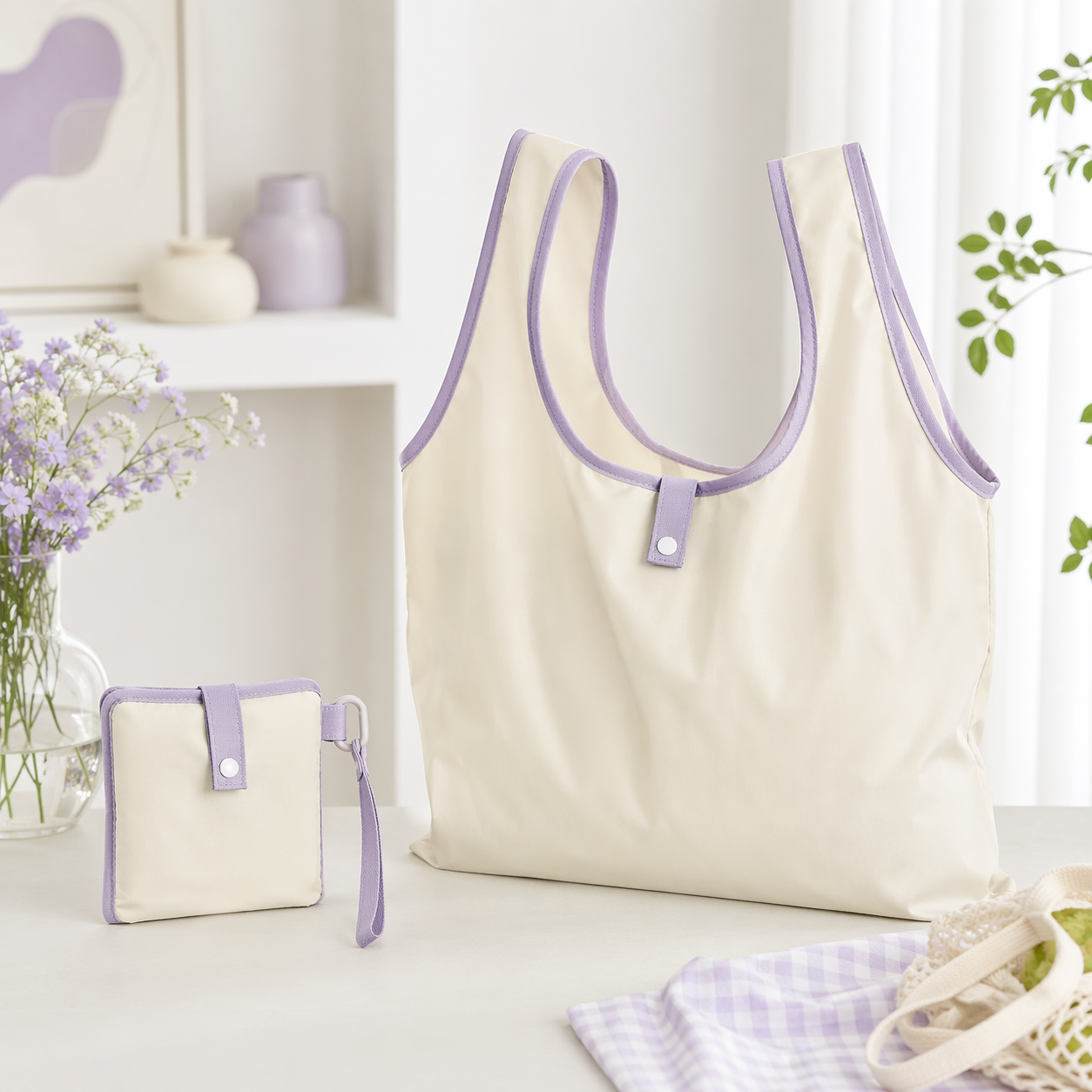
Foldable reusable shopping bags fold into a compact pouch that fits inside another handbag or the glove box of a car. The idea is simple: a consumer who has a bag with them will not need a fresh plastic film bag. Typical configurations use non-woven fabric, recycled PET, Oxford cloth, or lightweight canvas. Hansun produces these in colors that are coordinated with a matching storage pouch, making them highly popular for supermarket programs, grassroots environmental campaigns, and lightweight giveaway projects.
3. Waterproof / PVC Shopping Bags
Waterproof shopping bags respond to a very specific user environment: beach use, rain exposure, swimwear and cosmetics storage, or food transport that can leak. PVC transparent totes have emerged as a fashion-forward solution because they layer genuine utility with a see-through aesthetic that works for travel and cosmetic brands. Hansun's line of transparent PVC shopping bags with colored trim and interior pouches demonstrates how volume-heavy suppliers have moved beyond simple clear vinyl bags into structured carrying products.
4. Non-woven Shopping Bags
Non-woven polypropylene bags have become the default for supermarket shoppers across Asia and Europe because they balance cost, foldability, crush resistance, and brand print. When the retail price of the bag is a critical factor, non-woven production is usually the first selected option. PP bags' approximate 46% share of production worldwide is a tangible market signal for this preference.
5. Heavy-Duty and Canvas Shopping Bags
Heavyweight canvas and laminated shopping bags are selected when the end user loads awkward or dense goods: books, bottles, produce, or construction supplies. A heavier GSM fabric raises raw-material cost but delivers structural confidence. Hansun's canvas shopping bag models fit these projects, with several color options, printed handles, and full-print exterior styles.
6. Custom Printed Shopping Bags
Custom printed shopping bags exist in almost every material. What distinguishes supplier capability is the variety of decoration methods — silk-screen printing, heat transfer, and offset printing are the standard techniques that HanSun applies on the SB-2026-001 series. If your artwork includes fine gradients or photorealistic patterns, heat transfer is usually your answer; if you need a simple logo in solid colors with high runs, silk screening will be more economical; for complex multi-color detail on paper-touch canvas, offset printing has its own merit.
7. Large-Capacity Shopping Bags
Large-capacity bags are the choice for stocking trips, laundry-to-laundromat carries, and bulk e-commerce pick-up points. Their measured volume relies less on depth and more on a rectangular base and wide gusset. Bag width, base gusset, and handle drop must all be specified correctly for these heavier loads.
8. Multi-Purpose / Lifestyle Shopping Bags
Multi-purpose options are purchased by brands who understand that a consumer may be buying groceries, heading to an office, or going to the beach with the same tote. The line between shopping bags and lifestyle product lines is intentionally blurry in the Hansun product range because the production plant also manufactures leisure travel items, outdoor sports gear, PVC bags, and plastic daily necessities. If your promotion asks a user to reuse the bag beyond the grocery run, you are really asking for a multipronged material and design solution.
Materials and Their Performance Trade-Offs
The materials chosen for a shopping bag define the weight range, washability, printability, and load capacity. Hansun's own specification sheet for model SB-2026-001 lists five core material paths: non-woven fabric, canvas, recycled PET, Oxford cloth, and PP. Because all materials can be combined with finishes and linings, the matrix below supports a buyer's first-level comparison.
| Material | Typical Shopping Bag Strength | Cost / Weight Range Effect | Common Best-Fit Use |
|---|---|---|---|
| Non-woven fabric (often PP-based) | Light to medium; adequate for groceries and light retail | Low cost; low weight — helpful at checkout | Supermarket promotions, foldable giveaways, event distribution |
| Recycled PET | Moderate strength without a heavy build | Mid-range; important for environmental credentials | Eco-branded retail bags, corporate ESG giveaways |
| Canvas | High tear resistance; naturally strong and durable surface | Mid-to-high; robust and washable | Retail totes, fashion branded carry bags, worker/shopper hybrid use |
| Oxford cloth | Strong fabric with a smooth, woven feel; can hold structured shapes | Mid-to-high; lightweight strength | Travel, daily commuter sets, sports-related giveaways |
| PVC | Waterproof; softer clear film thickness can be tuned | Material flexible; depends on transparency request | Beach, cosmetics, and humid or rainy-environment carrying |
| PP as rigid woven or laminated sheet | Very durable repeat-use structure when laminated | Mid-range; cost-effective for standard program runs | Heavy-duty supermarket trips, bulk grocery chains |
Overall, each material family has an ideal operating environment and one or two limits. A credible sourcing partner will ensure that the chosen material matches the actual customer carrying environment rather than pushing a single stock line.
What You Should Ask Before Choosing a Supplier for Your Shopping Bag Program
Procurement teams usually search for “shopping bag supplier” before they have a complete product brief. Because lead time, quality, and price are drastically affected by manufacturing configuration, asking the right questions at the research stage is a form of professional risk management.
Here is a concise supplier inspection framework for 2026:
- Verify the factory’s specialization. A plant that produces woven bags occasionally is not the same as one that designs and mass-produces tote and PVC carry options as its principal product lines.
- Check material procurement flexibility. Confirm that the supplier can produce from non-woven, canvas, recycled PET, Oxford, and PP so you are not artificially limited to one substrate.
- Assess customization depth: silk-screen, heat transfer, or offset printing are three distinct printing disciplines — make sure the factory controls the one your design needs.
- Review customization size and weight range. A 50g–200g net weight window and S/M/L plus custom dimensions is a sign of an adaptable production line.
- Inspect industrial capacity. An order of a hundred thousand bags cannot be produced by a workshop-level supplier with one kitchen-table sewing line.
- Evaluate whether after-sales service and sample handling are structured. A supplier with a defined product after-sales service team reduces the risk of last-mile packaging and print-defect disputes.
Spotlight on Hansun's Shopping Bag Capability
Zhejiang Hansun Arts & Crafts Co., Ltd., commonly known as Hansun, is a Chinese manufacturer established in 1996 with a registered capital of 20 million yuan. The company occupies a 25,000-m² production facility, employs about 200 staff, and runs an annual production capacity of approximately 20,000,000 units. Hansun focuses on Tote Bag and PVC Bag lines, and also manufactures leisure travel products, outdoor sports equipment, safety reflective products, office stationery, plastic daily necessities, advertising promotional gifts, and toys. Around 70% of revenue comes from exports to Southeast Asia, Europe, North America, the Middle East, and other regions worldwide.
Nearly 25 engineers support the product design and development aspect of the business, an indicator that sourcing customers can rely on early engineering participation rather than only order-driven production. The corporate structure includes an R&D team, a sales team, and a product after-sales service team — a combination usually seen among export-oriented factories that handle both retail programs and distributor programs.
For shoppers-bag specific capability, Hansun's product record SB-2026-001 supports:
- Customizable dimensions in standard S/M/L or customer-specific sizes, giving packaging and display teams freedom in their planograms;
- Net weight between 50g and 200g per unit, depending on material and dimensions;
- Multiple decoration techniques — silk screen printing, heat transfer, or offset printing;
- High-volume production across non-woven and fabric-based lines with a factory-level 20-million-annual-unit output; and
- Global application industry focus: retail sales, supermarkets, promotional gifts, corporate welfare, and e-commerce packaging.
Step-by-Step Selection Process
Whether you are selecting your first shopping bag program or refreshing an existing one, following a structured evaluation path protects your brand and budget.
Step 1: Define the Use Environment
Write down where the bag will be used: a crowded supermarket, an open-air summer event, a rainy city commute, or an indoor trade-show booth. Every environment excludes one or two otherwise plausible materials. For example, a rainy city commute makes PVC or laminated options strong candidates; an indoor trade show may prefer non-woven due to lower unit cost and an extra-wide print surface.
Step 2: Determine Load and Drop Standards
Bag size is not measured merely in liters. A shopping tote with a 10-kg load target may need bottom gusseting and a cross-stitched handle; a simple non-woven S-size may be enough for a light grab-bag give-away.
Step 3: Build the Decoration Space
Consider where your logo and message will sit. If a full surface is mandatory for a brand campaign, select a bag type with large unbroken side panels — canvas totes and smooth-laminated non-woven bags are safer than the ribbed versions that distort prints.
Step 4: Evaluate Sustainability and Compliance
Recycled PET is the simplest route to a recycled-content message. Polypropylene and non-woven bags deliver lower cost but need to be matched to regional regulations. If you are shipping into the EU, the EU Packaging and Packaging Waste Regulation (PPWR) direction toward recyclability by 2030 means your supplier should understand how to combine recycled content and recyclability in the same bag rather than selecting one at the expense of the other.
Step 5: Verify Supplier Manufacturing Capacity Before Placing the Order
The supplier background unit is not optional for large quantities. You want a production facility rather than a trading agent, because factory-owned workstations carry better quality traceability. Hansun's 25,000-m² area, 200 staff, and 25-engineer R&D base can be verified as an example of a production-oriented enterprise that integrates design, manufacturing, marketing, and international trade.
Step 6: Request Samples and a Pilot Production Plan
Even after a clear specification is completed, the tactile experience of handle, thickness, and print finish is decisive. Brands that arrange samples early in the evaluation lower the risk of a wrong million-unit call.
Detailed Specification Checklist for Shopping Bag Procurement
- Bag type: tote, foldable, non-woven, canvas, PVC, or hybrid style;
- Material composition: non-woven fabric, canvas, recycled PET, Oxford cloth, or PP;
- Dimensions and capacity: S/M/L or custom; measure from bottom gusset if used;
- Net weight: control the 50g–200g window to match your budget and customer perception;
- Decoration: silk-screen, heat transfer, offset printing, or combinations;
- Handle type and attachment: webbing, rope, die-cut, or stitched handles;
- Additional structural details: storage pouch, inner pocket, zipper, or drawstring closure;
- Moisture or waterproofing requirement;
- Regulatory and environmental documentation needs: recycled content proof, food-contact-safety if relevant, regional plastic directives.
Where Each Bag Type Shines — Common Sourcing Use Cases
Supermarket and grocery retail programs
Supermarket programs combine low unit cost with sufficiently high reusability to make consumers feel responsible. Foldable non-woven bags with matching pouches — or heavier PP styles with reinforced handles — match self-checkout behavior and loyalty program rules. Custom printed shopping bags at the checkout also convert a routine transaction into a free advertising vehicle for the store brand.
Corporate gift and promotional giveaways
In corporate gifting, the shopping bag is usually not the real product; it is the branded packaging that makes the gift feel intentional. A firm that manufactures related promotional goods — like Hansun' s broader lines of toys, office stationery, plastic daily necessities, and PVC bags — can support integrated campaigns where the outer bag matches the inserted product category.
E-commerce and delivery packaging
Some e-commerce brands and direct-to-consumer stores avoid cartoon boxes in favor of a robust branded or foldable bag for click-and-collect orders. Non-woven and canvas options protect the items while introducing a reusable brand asset; waterproof versions can be valuable for perishables or liquid-containing orders.
Travel, beach and high-humidity environments
For airports, travel retail, cosmetics sets, and beach tote programs, transparent PVC and lined PVC bags offer visible content protection and cleanability. The combination of a PVC outer layer with an inner pouch — visible in some Hansun bag models — supports the organization of small travel items.
Supplier Capability Comparison: What to Benchmark
You should benchmark a few meaningful metrics of every supplier you evaluate. A side-by-side table will simplify the first cut of candidates.
| Capability Metric | Why It Matters for Bag Sourcing | Hansun Reference |
|---|---|---|
| Manufacturing history | Longer production management records usually mean more mature troubleshooting and sampling processes. | Established in 1996 |
| Production area and human resources | In-house workshops reduce external dependency and shorten communication loops. | 25,000 m² facility; approx. 200 staff |
| Research and design capacity | Allows custom structuring, material consultation, and original shape development for private brands. | R&D team with 25 engineers |
| Throughput / annual capacity | Prevents capacity-driven delay and helps handle peak-season ordering. | Annual capacity approx. 20,000,000 units |
| Material variety | More paths mean you will not be trapped into a single substrate or look. | Non-woven, canvas, recycled PET, Oxford cloth, PP |
| Printing and decoration options | Print finishes decide visual fidelity and brand perception. | Silk screen, heat transfer, offset printing |
| Export orientation and market knowledge | Market knowledge helps suppliers anticipate documentation and packaging expectations. | Approx. 70% of sales from export, served markets in Southeast Asia, Europe, North America, Middle East |
| After-sales support | Strong after-sales processes protect order continuity. | Product after-sales service team |
Weighing the Benefits and Limitations of Reusable Shopping Bags
Reusable shopping bags reduce the need for thin single-use plastic film bags and offer repeated brand impressions. Twelve US states have passed single-use plastic bag bans as of 2024, an example of a regulatory trend that increases demand for durable alternatives. At the same time, reusable bags must be washed regularly, and their environmental benefit depends on how many uses they actually replace. These limits are not reasons to avoid them; they are precise assumptions for supplier communication. A mature factory will help you find a material strategy that supports practical reuse without overstating its sustainability contribution.
Regulatory and Compliance Considerations For 2026 and Beyond
Global compliance in the shopping bag request-for-quotation process is expanding from pure food-contact rules into circular-economy policy. The EU Packaging and Packaging Waste Regulation (PPWR) of 2025, for instance, wants all packaging to be recyclable by 2030 and introduces mandatory recycled content targets for plastic packaging. Even if a buyer is not distributing in the EU today, supplying customers who eventually sell into that region requires a supplier who is at least tracking packaging to classification codes and material declarations.
For folding shopping bags, non-woven and PP variants are already tied to a polypropylene market context. China also plays an obvious role in global supply: for the Jan–Nov 2025 period, Chinese exports of “suitcases, handbags and similar containers” — the broader customs heading that captures many bag styles — reached roughly USD 27.13 billion. This scale explains why international buyers need to separate real manufacturers from trading companies and why factory assessments include not just price lists, but workshops and certification evidence.
Customization and Branding Approach
Custom shopping bag production outcomes are heavily influenced by the printing craft. In the Hansun portfolio, silk-screen printing is valued for its color layering and durability, heat transfer is ideal for reproducing fine artwork and photographic details, and offset printing works well on larger flat printed surfaces. The printing process is chosen together with the buyer based on material, ink compatibility, production volume, and desired finish.
It is refreshingly common to underestimate the impact of handle design on brand experience: webbing handles can be color matched, rope handles add natural texture, and die-cut handles save cost while remaining recyclable. Hansun has image records of canvas totes with letter-printed webbing handles, an easy way to add a different brand detail beyond the central design panel. Buyers should mention handle branding early in the sample phase, because retooling handle inventory later is disproportionate to its aesthetic payoff.
FAQ: Shopping Bag Types and Sourcing Questions Buyers Frequently Ask
Are foldable shopping bags durable enough for supermarket use?
Foldable shopping bags are intentionally lightweight, but their durability depends on material and construction. When produced in non-woven, recycled PET, or Oxford cloth with reinforced stitching, foldable bags can carry everyday groceries and repeated supermarket trips. Many Hansun foldable models come with a matching small storage pouch, showing that structure — not just weight — determines practical service life. For consistently heavy loads, request a thicker gusset and stronger handle attachment rather than simply choosing the lightest foldable model.
What customization options are available on shopping bags?
The available customization paths are silk-screen printing, heat transfer, and offset printing, plus bag-size control, weight selection in a 50g–200g band, and customer-specific dimensions. You can also change handle types and choose material grades. Selection depends on the artwork complexity and budget; printability should be validated on the actual material before full-scale production.
How do I control the cost of a custom printed shopping bag order?
Lower-cost paths normally mean choosing a widely available non-woven or PP substrate, keeping the print area within standard limits, and minimizing the number of separate SKU colorways. Bag material and size produce larger price swing than most decorative details; therefore try locking dimensions early and compare how much recycled content adds against policy requirements. Experienced manufacturers will give a transparent bill of materials for each change so you can measure every cost driver before signing the purchase order.
Can you produce a sample bag before mass production?
Yes, and it is a recommended step before any large-volume buy. Sampling confirms material weight, carrying comfort, handle length, decoration clarity, and the way a bag moves under load. A dependable factory maintains sample rooms and an engineered workflow from design to final prototype; Hansun is structured for this with R&D, sales, and after-sales service teams. To request a sample, contact Hansun with your specification: reach Naomi at hansun20@hansungift.com or call +86 13655771851.
What lead time should I plan for a wholesale shopping bag order?
Lead time includes material sourcing, cutting, printing, sewing, packing, and quality checks. It fluctuates with order volume and the number of decoration colors. Buyers should also reserve additional days for compliance documentation in export markets. A clear plan is to share your target ship date during initial inquiry so the factory can propose a production timeline based on current capacity; a supplier such as Hansun that balances high-volume capacity with in-house workshops will usually provide a more accurate schedule than a trading intermediary. Contact Hansun with the target quantity and destination, and the sales team will align the plan with annual capacity of 20,000,000 units.
Ready to evaluate shopping bag options for your retail or promotional program?
Contact Hansun's professional team for detailed specifications and an honest recommendation.
Email: hansun20@hansungift.com | Tel: +86 13655771851
WhatsApp: +60 10-8838562
Download Hansun Corporate Brochure (PDF)