
The Anatomy of a Shopping Bag: From Carry Function to Brand Image Canvas
Shopping Bag Anatomy · OEM/ODM Explainer
A shopping bag is two products in one body. It is a load-bearing structure that has to survive the trip home, and it is a printed surface that has to keep a brand legible for as long as the bag stays in circulation. Its anatomy — body panel, base, handle attachment, decoration area and label position — is where those two jobs are either reconciled or lost.
Sourcing teams rarely buy a bag as a bag. They buy a bag that has to survive a weekly supermarket run, carry a gift out of a store, or stay in use long enough to justify the print cost. That is why the practical way to read a shopping bag is anatomical: separate the load layer from the decoration layer from the accessory layer, then decide which layer each requirement belongs to. This explainer does that, then applies it to two verified application contexts — supermarket retail and gift and promotional packaging — and to the OEM/ODM model of Zhejiang Hansun Arts & Crafts Co., Ltd.
Problem Definition: Bags Are Briefed as One Item and Judged as Two
A conventional brief runs one line long: “custom printed shopping bag, one-colour logo, 3,000 pieces”. That line covers the media job and skips the structural one. The two jobs draw on the same material budget, the same construction time and the same quality check, so a decision that improves one usually costs the other something.
Three failures follow from that gap, and all three are anatomy failures rather than printing failures:
- Handles are quoted as “standard” before the load is known. The handle attachment is the smallest area carrying the full load, and it is usually decided by default rather than by calculation.
- Print is placed before the fold lines are fixed. Artwork that reads well on a flat proof can end up sitting across the crease the bag closes on every time it is packed.
- Labels and accessories are added after artwork approval. A tag or label added at the end can interrupt the visual system the print was designed around.
None of these appear in a quotation. All of them appear in use, and all of them shorten the number of trips the bag completes — which is the same as shortening the brand exposure the buyer paid for.
Industry Background: Reuse Turned the Bag Into Media and Raised the Structural Bar
Two forces have moved the shopping bag from consumable to medium.
Scale. Fortune Business Insights projects the global reusable shopping bag market at USD 16.67 billion in 2026, rising to USD 28.87 billion by 2034. Asia Pacific held 24.23% of that market in 2025, and polypropylene accounts for over 46% of reusable bag production share, according to the same research.
Regulation. Regulation (EU) 2025/40 on packaging and packaging waste applies from 12 August 2026 and sets recyclability and recycled-content requirements for packaging placed on the EU market. EU interpretive material on reusable packaging sets out the design expectation behind those rules: reusable packaging should enable multiple trips or rotations, be emptied without significant damage, and be capable of cleaning, washing or repair while keeping its intended function. The same framework classifies lightweight plastic carrier bags as bags with a wall thickness below 50 microns, and very lightweight plastic carrier bags as those below 15 microns.
Read together, the two forces produce one commercial conclusion. A bag earns its brand value across repeated use, and repeated use is a structural property, not a printing property. A bag that tears at the handle in week two has already spent the print budget.
The Three Layers of Bag Anatomy
Layer 1 — Load: body panel, base and handle attachment
The load layer answers a single question: what does the bag carry, and from which point. Body panel material, base construction and handle attachment area decide the answer. The Hansun shopping bag line (model SB-2026-001) is specified across non-woven fabric, canvas, recycled PET, Oxford cloth and PP, with a unit weight of 50 g to 200 g per piece depending on material and size. That range is wide on purpose, because the same nominal “shopping bag” can be a foldable everyday carrier or a heavier promotional bag, and the two do not share a load profile.
Layer 2 — Decoration: where the bag becomes a brand canvas
The line lists three decoration routes: silk screen printing, heat transfer and offset printing. They are not interchangeable, because each lays down colour differently, and the difference becomes visible exactly where the bag flexes, folds and gets wiped. Choosing the decoration route after the artwork is approved, rather than alongside it, is one of the most common reasons a print looks correct on a proof and tired on a bag that has made twenty trips.
Layer 3 — Accessories: handles, webbing and labels as brand touchpoints
The third layer is small in material terms and large in brand terms. Handle straps and webbing are what the hand holds. A label or tag is what the eye reads at close range, at hand level, in the seconds before anything is carried. Edge finishing is what the bag is judged by before it is even opened. These are not decorations bolted on at the end — they change construction, so they have to be locked while the bag is still a drawing.
It is also where a brief most often goes vague. “Standard handle” and “with label” are not specifications. A workable accessory brief names how the handle is attached and how wide it is, where the label sits relative to the print area, whether the label carries compliance content as well as the brand mark, and which of these elements the buyer is willing to change if the load test demands it.
How a combined design and manufacturing model changes the sequence
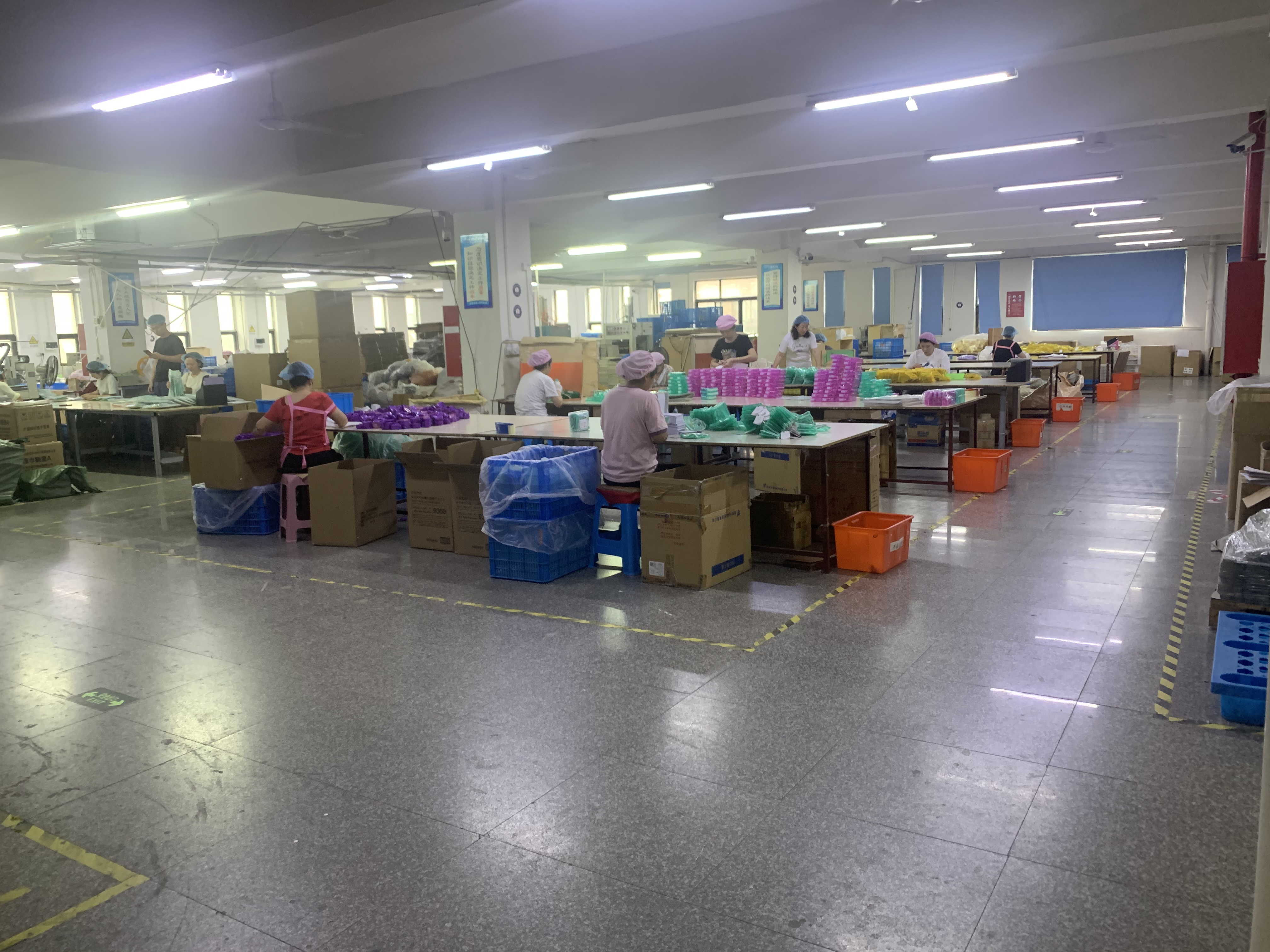
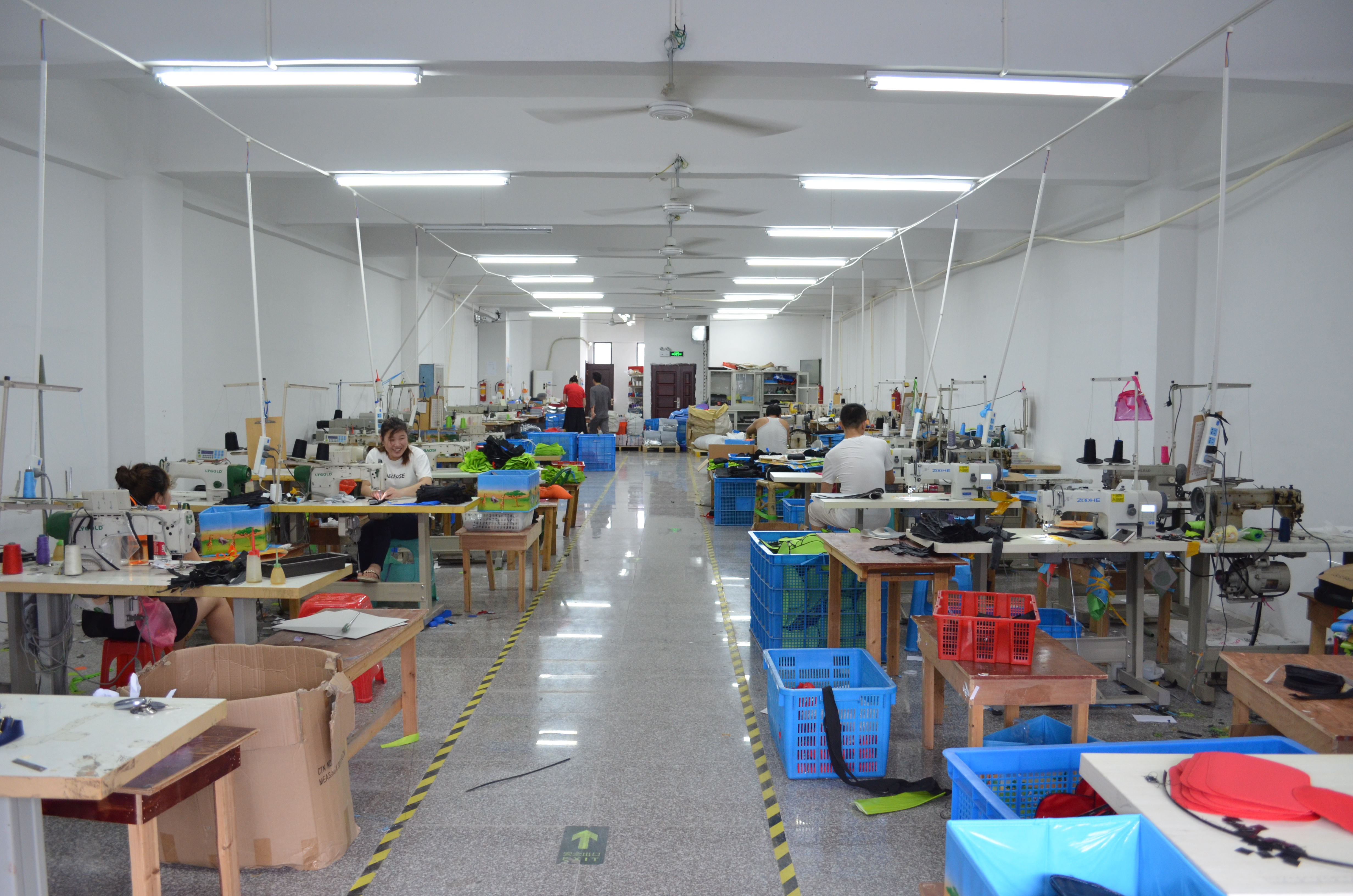
Zhejiang Hansun Arts & Crafts Co., Ltd. (Hansun) is a Wenzhou-based manufacturer founded in 1996 whose main products are tote bags and PVC bags. The company describes itself as a production-oriented enterprise that integrates manufacturing, online marketing and international trade, with a dedicated product design and R&D function. Its facility covers 25,000 m² with 200 employees, a 25-engineer R&D team and an annual output of 20,000,000 units; 70% of output is exported, with sales and service covering Southeast Asia, Europe, North America and the Middle East.
That structure matters to anatomy decisions. When design and production sit inside the same organisation, the accessory layer can still be changed while it is a drawing rather than after a purchase order has frozen the construction. Hansun runs OEM and ODM production with customization options covering logo, size and material — which means the three variables that decide the brand canvas are also the three variables the buyer can negotiate before tooling. Where a bag has to be wiped clean rather than laundered, PVC is the second main product line and the relevant material conversation.

Step by Step: Specifying a Bag From Carry Function to Brand Canvas
Step 1 — Define the carry job before the bag type
Start with load, frequency and distance, not with a product name. A bag carried daily for groceries and a bag handed over once as a gift occupy different structures. The Hansun range is organised around three named formats — reusable foldable, eco-friendly non-woven and canvas tote — which is a useful shortlist only after the carry job is written down.
Step 2 — Fix material and unit weight together
Material and weight are one decision, not two. The documented range runs from 50 g to 200 g per piece depending on material and size, across non-woven fabric, canvas, recycled PET, Oxford cloth and PP. Sizes are customizable in S/M/L or to customer-specific dimensions, so weight has to be agreed against the actual dimension the buyer intends to order.
Step 3 — Choose the decoration route alongside the artwork
Silk screen printing, heat transfer and offset printing each handle coverage, colour and folding behaviour differently. The artwork file and the decoration route should be approved in the same review, together with the position of the print relative to fold lines.
Step 4 — Lock the accessory and label layer
Decide handle attachment, label position and edge finishing before sampling, and confirm that any compliance text fits inside the label area without crowding the brand mark. This is the layer most often renegotiated late, and late changes are the expensive ones.
Step 5 — Map compliance to the destination market
For the EU, Regulation (EU) 2025/40 applies from 12 August 2026 and the reusable-packaging design expectations sit behind it. For Japan, the retail programme referenced in this article was required to meet the market’s eco-friendly standards. On the supplier side, Hansun’s compliance records include ISO 9001:2015 covering product design, production, quality control and delivery, amfori BSCI covering social responsibility and working conditions, Sedex SMETA 4 Pillars covering labour, health and safety and environmental standards, and Disney FAMA covering production and supply of licensed promotional bags and gifts. Buyers should confirm the exact documentation required for their own market before the order, not after.
Step 6 — Validate, then scale
The stated acceptance criterion is a pre-shipment test. Commercial parameters for a scaled programme are: minimum order quantity 3,000 pieces, typical production lead time 30–45 days, monthly production capacity 1,500,000 units, delivery terms FOB, DDP or EXW, and payment terms of 30/70, 50/50 or 100% before mass production.
Use Cases: Where the Anatomy Is Tested
Supermarket retail: the one-million-unit Japanese programme
A Japanese OEM/ODM client ordered 1,000,000 units of reusable daily shopping bags and promotional gifts for a chain supermarket, completed within one year. The bags were designed for reusable long-term use, and custom printing matched the supermarket’s branding requirements. The programme maintained a 99.7% product qualification rate with zero delivery delay and generated repeat orders for three consecutive years; the bags met Japan’s eco-friendly standards and were recognised by both the client and end consumers. In anatomy terms, this is the case where all three layers had to hold at once: a structural load layer for daily reuse, a decoration layer consistent enough to match retail branding across a million units, and an accessory layer that had to survive supermarket handling.
Gift packaging and promotional giveaways
The documented applications for the shopping bag line include supermarket shopping, promotional gifts and corporate giveaways, with retail, supermarket, promotional gift, corporate welfare and e-commerce named as applicable industries. Gift use changes the priority order inside the anatomy: the bag is held for seconds before it is opened, so the accessory layer — handle, label, finishing — carries the first impression that the print would otherwise carry in a retail setting.
Multi-purpose and travel use
A foldable format reduces the volume a bag occupies when it is not carrying anything, which matters wherever the bag travels inside another bag rather than sitting in a cupboard. Because size and material are both customization variables, one construction concept can be scaled across several carry jobs instead of requiring a new structure for each one.
Comparison: How One Component Serves Two Jobs
The table compares what each anatomical component must deliver for the load and for the brand, and the trade-off a buyer has to arbitrate. It uses the documented specification of the Hansun shopping bag line (SB-2026-001) and general construction logic.
| Component | Carry-function requirement | Brand-canvas requirement | Trade-off to arbitrate |
|---|---|---|---|
| Body panel | Holds the intended load with the chosen material and weight | Presents artwork flat, without distortion or print-through | Heavier material protects the print but raises unit weight inside the 50–200 g/pc range |
| Base | Resists abrasion where the bag is set down | Rarely used as a brand surface | Reinforcement adds construction the artwork does not use |
| Handle and attachment | Carries the full load from the smallest area on the bag | The most-handled surface and the closest-reading touchpoint | A stronger attachment consumes material and production time |
| Decoration area | Must not sit across a fold or crease | Needs coverage and contrast for the mark to read | Large artwork can push print into the fold zone |
| Label or tag | Must not interfere with opening, packing or reuse | A second brand touchpoint, plus a place for compliance text | Added after print approval, it can break the visual system |
Comparison: Application Context and What It Changes in the Anatomy
| Application context | Verified requirement | Anatomy consequence |
|---|---|---|
| Supermarket retail (Japan programme) | 1,000,000 units of reusable daily shopping bags and promotional gifts for a chain supermarket, custom printing matched to branding, completed within one year | Decoration layer must stay consistent across a very large repeat run; load layer must support daily reuse |
| Promotional gift and giveaway | Documented applications include promotional gifts, corporate giveaways and corporate welfare | Accessory layer — handle, label, finishing — becomes the first impression |
| EU market entry | Regulation (EU) 2025/40 applies from 12 August 2026; reusable packaging should support multiple rotations and meet safety, hygiene and recyclability requirements | Structure and material are chosen for reuse cycles, not for a single trip |
FAQ
Which compliance points matter most when the bag is also a brand item?
Two sets apply at once: product compliance and brand compliance. On the product side, Regulation (EU) 2025/40 on packaging and packaging waste applies from 12 August 2026 and EU interpretive material expects reusable packaging to support multiple rotations, cleaning and repair while retaining function. On the supplier side, Hansun’s records include ISO 9001:2015 covering product design, production, quality control and delivery, amfori BSCI, Sedex SMETA 4 Pillars and Disney FAMA for licensed promotional bags and gifts. The stated acceptance criterion is a pre-shipment test, which is where compliance and print approval meet.
Can one supplier handle the structure, the printing and the accessory layer together?
That is the practical definition of OEM/ODM capability. Hansun provides OEM and ODM production services with customization options covering logo, size and material, backed by a 25,000 m² facility, a 25-engineer R&D team and a monthly production capacity of 1,500,000 units. Keeping structure, decoration and accessories with one supplier is what allows a change in the accessory layer to be reflected in the construction before production starts, rather than after.
What order size and commercial terms does a custom programme start from?
The minimum order quantity is 3,000 pieces, with a typical production lead time of 30–45 days. Delivery terms are FOB, DDP or EXW, and payment terms are 30/70, 50/50 or 100% before mass production. Because the MOQ sits at 3,000 pieces while monthly capacity is 1,500,000 units, the same specification can be piloted at a small volume and then scaled without changing the anatomy.
How do we validate the anatomy before committing to the full run?
Use the sampling stage to check the three layers separately: load behaviour at the handle attachment, print position relative to the fold lines, and label or tag placement relative to the brand mark. The stated acceptance criterion is a pre-shipment test. The one-million-unit Japanese supermarket programme, which held a 99.7% product qualification rate with zero delivery delay, illustrates the level of consistency that a validated specification is expected to deliver at scale.
How long does a large programme take from specification to delivery?
Typical production lead time is 30–45 days per order, against a monthly capacity of 1,500,000 units. The Japanese programme delivered 1,000,000 units within one year and received repeat orders for three consecutive years. Buyers planning a comparable volume can request a sample and a quotation directly: email hansun20@hansungift.com, call +86 13655771851, or message WhatsApp +60 10-8838562 — the product brochure can be downloaded here: Hansun product brochure.
Conclusion: The Bag Is a Structure First and a Canvas Second
The anatomy argument reduces to one sequence. Load decides material and weight. Decoration decides how the brand survives folding, wiping and reuse. Accessories — handles, webbing, labels — decide what the hand feels and the eye reads at close range. Get the order wrong and the bag becomes a printed object that fails structurally; get it right and the same bag becomes a brand surface that keeps working for as long as the structure holds.
Regulation has made that sequence less optional. From 12 August 2026 the EU packaging framework expects reusable packaging to be built for multiple rotations, and a market heading toward USD 28.87 billion by 2034 will keep pushing buyers toward bags that are reused rather than replaced. The bag that survives the cycles is the bag that carries the brand — and it is specified layer by layer, not in a single line.
Specify your next shopping bag in layers
Hansun supports OEM and ODM programmes with customization of logo, size and material, MOQ from 3,000 pieces and a monthly capacity of 1,500,000 units.
Email: hansun20@hansungift.com | Tel: +86 13655771851 | WhatsApp: +60 10-8838562
Website: hansungift.com | Blog: blog.zjhansun.com

Have Questions or Need More Details?
Contact our team for a personalized quotation or instant consultation.
Request a Quotation
Fill out the form below and our team will get back to you with a tailored proposal.
WhatsApp Direct Chat
Prefer to chat in real-time? Message us on WhatsApp for instant assistance & quick answers.
- Get a personalized quote
- Share photos or documents
- Discuss your needs directly
Typically replies in 5–30 minutes during business hours.