How to Select a Reliable Chinese Pneumatic Rubber Fender Supplier: A 2026 Procurement Guide for Global Marine Operators
How to Select a Reliable Chinese Pneumatic Rubber Fender Supplier: A 2026 Procurement Guide for Global Marine Operators
A practical, evidence-based framework for port authorities, ship owners, and engineering contractors sourcing Yokohama-type pneumatic fenders from China.
Introduction
China has become the world's largest manufacturing hub for pneumatic rubber fenders, supplying over 60% of global demand for Yokohama pneumatic fenders and inflatable dock fenders. For procurement professionals in ports, ship-to-ship (STS) operations, and offshore platforms, selecting the right Chinese supplier is critical for operational safety, asset protection, and long-term cost efficiency. Yet the market is fragmented, with dozens of manufacturers offering varied quality, certifications, and service levels.
This guide provides a structured decision framework—backed by real-world data, certification standards, and technical parameters—to help you evaluate Chinese rubber fender manufacturers with confidence in 2026.
Problem Definition
Industrial buyers face several common challenges when sourcing marine fenders from China:
- Inconsistent quality: Some factories use recycled rubber instead of 100% natural rubber, reducing service life by up to 30%.
- Unclear certification validity: Not all certifications (CCS, BV, ABS) are issued for the same product scope or with the same rigorous testing.
- Hidden costs: Low initial prices may hide high maintenance frequency, leak rates, and premature replacement needs.
- After-sales support gaps: Many suppliers lack remote or on-site technical support, especially for STS and STD operations.
The core question: How do you separate qualified, long-term partners from opportunistic traders?
Industry Background
Pneumatic rubber fenders (also called Yokohama fenders) are flexible, air-inflated marine bumpers used to absorb kinetic energy during vessel berthing and mooring. They are preferred in ship-to-ship (STS) and ship-to-dock (STD) operations because of their low reaction force and high energy absorption efficiency (up to 90% for premium models).
The Chinese industry has matured significantly since 2020, with advanced factories investing in automated cord fabric layering, precision vulcanization, and in-house raw material compounding. Leading manufacturers such as Qingdao Haohang Fender Airbag Co., Ltd. (founded 2020, 8,000 m² factory, 60 employees, 15 engineers) now offer products that meet or exceed international standards at competitive prices.
Detailed Solution: 7-Step Supplier Selection Framework
Step 1: Verify Core Certifications
Certifications are non-negotiable for safety and insurance compliance. Key certificates for pneumatic rubber fenders include:
| Certificate | Authority | Scope | Example (Haohang) |
|---|---|---|---|
| CCS type approval | China Classification Society | Pneumatic Rubber Fender | Certificate No. QD22P4062 (issued 2022-05-12) |
| CCS (Marine Airbag) | China Classification Society | Marine Airbag | Certificate No. 2026CJSD00023 (issued 2026-01-28) |
Ask the supplier to share the actual certificate image with visible certificate number and issue date. Verify the scope explicitly mentions "Pneumatic Rubber Fender" or "Marine Fender."
Step 2: Evaluate Raw Material Quality
The performance of a floating pneumatic rubber fender depends heavily on its rubber compound and cord fabric. Premium manufacturers use 100% natural rubber and high-strength cord fabric (truck/aircraft tyre grade). This directly impacts:
- Service life: 30% longer than recycled rubber fenders.
- Air tightness: Leak rate reduced by 50% under standard pressure (0.1–0.3 MPa).
- Impact absorption efficiency: Up to 90% vs. 75% for traditional options.
Request a material specification sheet and ask if the factory produces its own rubber compound (self-sufficiency is a quality indicator).
Step 3: Compare Technical Parameters
Standard pneumatic rubber fender sizes from Chinese suppliers (e.g., Haohang) range from 300 mm to 2000 mm diameter and custom lengths from 1 m to 10 m. Working pressure is typically 0.1–0.3 MPa, adjustable for specific environments. Ensure the supplier can provide a performance curve (energy absorption vs. reaction force) for each model.
Step 4: Assess Production Capabilities
Key production indicators for heavy duty pneumatic fender manufacturers:
- Monthly capacity: ≥150 units (for a mid-size factory)
- Lead time: 7–45 days depending on MOQ and customization
- Customization: Size/logo/OEM/ODM available
- Quality control: 100% pressure testing before shipment
- After-sales: Remote support and on-site technical assistance
For example, Qingdao Haohang offers OEM/ODM with MOQ of only 1 unit, 100% test policy, and both remote and on-site support.
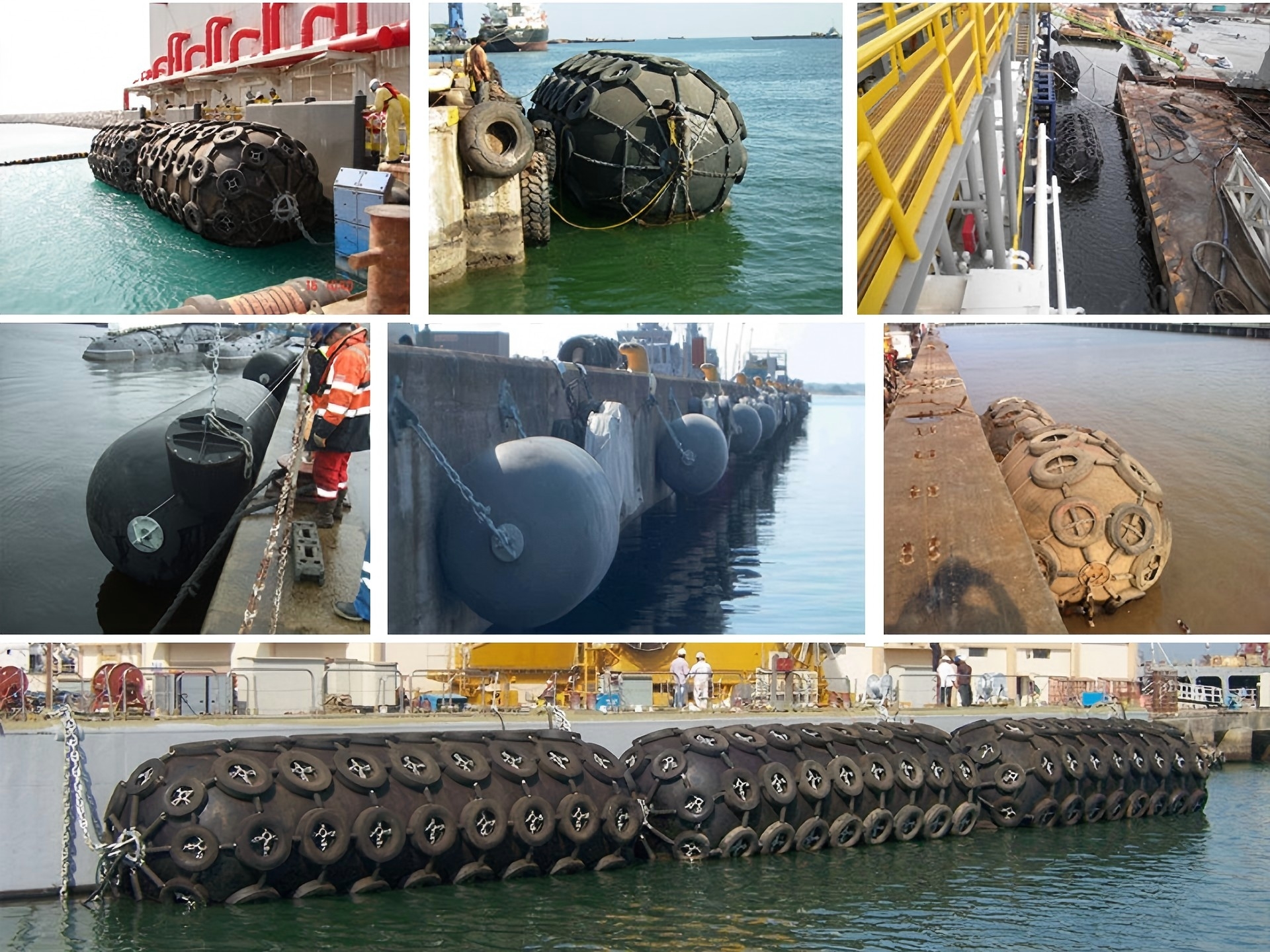
Step 5: Review Real Project Case Studies
Demand case studies that reflect your operating conditions. A reputable Chinese supplier should provide references such as:
- Project: Engineering contractor in China used 50 units of pneumatic rubber fenders to protect vessels and dock structures during berthing.
- Duration: 5 years in extreme coastal environment.
- Result: Fenders withstood high-frequency berthing and extreme weather; high corrosion resistance was highlighted.
Ask for photos of actual installations, ideally with the client's consent.
Step 6: Understand Risk Mitigation
Even high-quality inflatable boat fenders can suffer surface abrasion over time. A responsible supplier will provide repair procedures and regular maintenance service recommendations. For example, Haohang's risk control includes: “Surface abrasion damage – repair with rubber material; regular maintenance service.”
Step 7: Check Commercial Terms
Transparent payment and delivery terms signal supplier reliability. Look for:
- MOQ: 1 unit (flexible for trials)
- Delivery method: EXW, FOB Qingdao, or CIF
- Acceptance: Pre-shipment test and third-party inspection (CCS, BV)
- Payment: 30% T/T in advance, 70% T/T before delivery (or L/C)
Use Case Matrix
| Application | Recommended Fender Type | Key Requirement |
|---|---|---|
| Ship-to-ship (STS) | Yokohama pneumatic fender | High energy absorption, low reaction force |
| Ship-to-dock (STD) | Heavy duty pneumatic fender | Durability, corrosion resistance |
| Offshore platform | Floating pneumatic rubber fender | Suitable for extreme temperature (-20°C to +60°C) |
| Inland river dock | Inflatable dock fender | Lightweight, easy installation |
Frequently Asked Questions (FAQ)
What is a pneumatic rubber fender and how does it work?
A pneumatic rubber fender is an inflatable marine bumper made of natural rubber layers and high-strength cord fabric. It absorbs kinetic energy by compressing air inside the fender during impact, then returns to its original shape. It is widely used in STS and STD operations to protect both ship and dock.
Why choose a Chinese manufacturer over Japanese or Korean brands?
Chinese manufacturers like Haohang offer comparable performance to Japanese Yokohama-type fenders at a 20–40% lower total cost, with flexible MOQ (as low as 1 unit) and shorter lead times (7–45 days). Many now hold CCS, BV, or ABS certifications, ensuring international acceptance.
How can I verify if a Chinese supplier uses genuine natural rubber?
Request a material composition certificate and ask for a factory visit or video tour. Reputable factories maintain in-house rubber compounding and can provide traceability records. Look for suppliers that advertise 100% natural rubber and high-strength cord fabric (e.g., truck/aircraft tyre grade).
What is the typical service life of a Chinese pneumatic fender?
When properly maintained and made from high-quality rubber, a pneumatic rubber fender from a certified Chinese manufacturer can last 8–12 years in normal marine conditions. Recycled rubber fenders may only last 5–8 years. Always check the warranty period (minimum 2 years recommended).
Can I get a custom fender design from a Chinese supplier?
Yes, most Chinese manufacturers offer OEM/ODM services. For example, Haohang customizes size, logo, and pressure specifications, with engineering support from a 15-person R&D team.
Conclusion
Selecting a reliable Chinese pneumatic rubber fender supplier in 2026 requires more than comparing prices. You need to evaluate certification authenticity, raw material quality, technical parameters, production capabilities, real case references, risk management, and commercial terms. Manufacturers like Qingdao Haohang Fender Airbag Co., Ltd. exemplify the new generation of Chinese suppliers that combine international certifications (CCS), high-performance materials, and flexible procurement conditions.
For a detailed technical data sheet, product catalog, and company profile, download the official brochure here.