
Rubber Fenders for Vietnam's Ports: Tropical & STS Selection Guide
Rubber Fenders for Vietnam's Ports: Tropical & STS Selection Guide
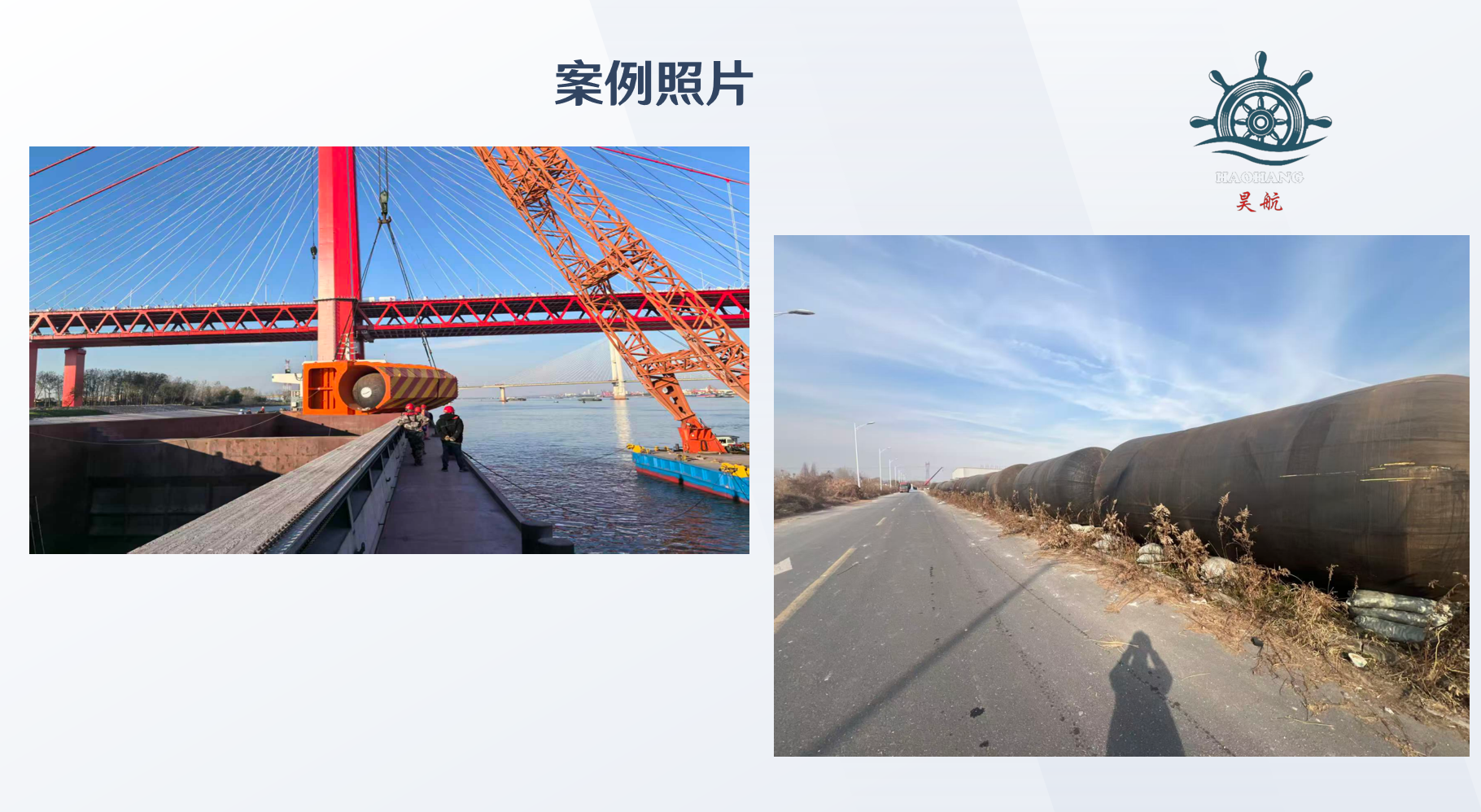
Pneumatic rubber fender — Qingdao Haohang Fender Airbag Co., Ltd.
The Short Answer
For Vietnam's ports, the decisive question is not which rubber fender is cheapest, but which pneumatic rubber fender can hold its performance through tropical heat, salt-laden air, and frequent ship-to-ship (STS) and ship-to-dock (STD) mooring. A pneumatic rubber fender built with a natural rubber body reinforced by cord fabric, rated for -20°C to +60°C, lightweight for easy installation, and configured for 24/7 automatic operation with an air compressor, is the configuration most closely aligned with Vietnam's operating conditions. Qingdao Haohang Fender Airbag Co., Ltd. (Haohang) supplies this configuration and states that its products have received recognition from the China Classification Society (CCS).
This guide breaks down what that means for buyers at Vietnamese terminals, shipyards, and offshore support bases: which technical variables actually change fender behaviour in a tropical climate, how STS and STD duty cycles differ, and how to verify a supplier's claims before the purchase order is signed.
Rubber FenderPneumatic Rubber FenderMarine FenderYokohama FenderShip to Ship Pneumatic Fender
Problem Definition: Why a Tropical Port Needs a Different Fender Brief
A marine fender is protective equipment designed to prevent ships, boats, and other vessels from colliding with each other or with berths and docks during berthing and mooring. In Vietnam, the fender has to do that job under a combination of stresses that a temperate port does not usually face.
The first stress is heat and humidity. A tropical monsoon climate keeps ambient temperatures high and air moisture heavy across much of the year. Rubber compounds soften and age differently in sustained heat, and any fender whose design margin is narrow will show it in reaction force and energy absorption over time.
The second stress is salt corrosion. Salt-laden air attacks metal fittings, chains, and tire-net hardware faster than in dry climates. The rubber body's own corrosion resistance matters, but so does the corrosion resistance of everything attached to it.
The third stress is duty cycle. A busy terminal does not moor once a day; it berths vessels repeatedly, often around the clock. A ship-to-ship pneumatic fender at a transfer point may be in near-constant contact during a cargo operation. This is where a heavy-duty pneumatic fender with a robust body construction earns its place, and where a lightweight, easy-to-install inflatable fender reduces the risk and labour of repositioning by the crew.
The fourth stress is mismatch. A fender selected for a calm river berth will not deliver the same protection at an exposed STS anchorage. Buyers who copy a specification from another port without checking temperature range, pressure class, and mooring configuration often discover the gap only after damage occurs.
So the real problem is a selection problem: matching a pneumatic rubber fender's temperature rating, material, pressure class, and installation method to the actual thermal and operational envelope of a Vietnamese port.
Industry Background: Where Pneumatic Fenders Fit
Marine fenders are categorized by type into pneumatic fenders, foam-filled fenders, and solid rubber fenders. The pneumatic type — often called a Yokohama fender or Yokohama-type pneumatic fender in the market, and also described as a floating pneumatic rubber fender — is the family most often associated with STS transfer and with berths where a soft, energy-absorbing interface is preferred over a rigid structure.
Globally, the marine fender market was valued at USD 0.86 billion in 2025 and is projected to reach USD 0.91 billion in 2026, according to commercial research from Fortune Business Insights. Separately, commercial research places Asia-Pacific at approximately 40% of all maritime fender installations as of 2024 — a figure that reflects how much of the world's fender demand sits in this region, including Southeast Asia.
The technical backbone for the high-pressure pneumatic type is the international standard ISO 17357-1:2014, which covers high-pressure floating pneumatic rubber fenders. It specifies two product configurations — Type I net-type and Type II sling-type — and two initial pressure classes: 50 kPa and 80 kPa. Its companion, ISO 17357-2:2014, covers low-pressure floating pneumatic rubber fenders intended for berthing and mooring of a ship to another ship or to a berthing structure, and it adds minimum test and inspection procedures.
Understanding this standard matters to a Vietnamese buyer for one practical reason: it gives you a neutral language for comparing quotations. A supplier who can quote in ISO 17357-1 terms — pressure class, guaranteed energy absorption (GEA), reaction force at GEA deflection, and hull pressure at GEA deflection — is giving you something comparable. A supplier who speaks only in generic efficiency percentages is not.
Detailed Solution: Matching Haohang Pneumatic Fenders to Vietnam's Conditions
Qingdao Haohang Fender Airbag Co., Ltd. is a manufacturer based in Qingdao City, China, founded in 2020. The company produces marine airbags and rubber fenders, reports an annual output of 2,000 units, and exports about 70% of its production. Its stated main markets are South Asia, the Middle East, and Africa. Haohang also states that it achieved raw-material self-sufficiency by processing natural rubber and curtain fabric in-house, and that its products have received recognition from the China Classification Society (CCS).
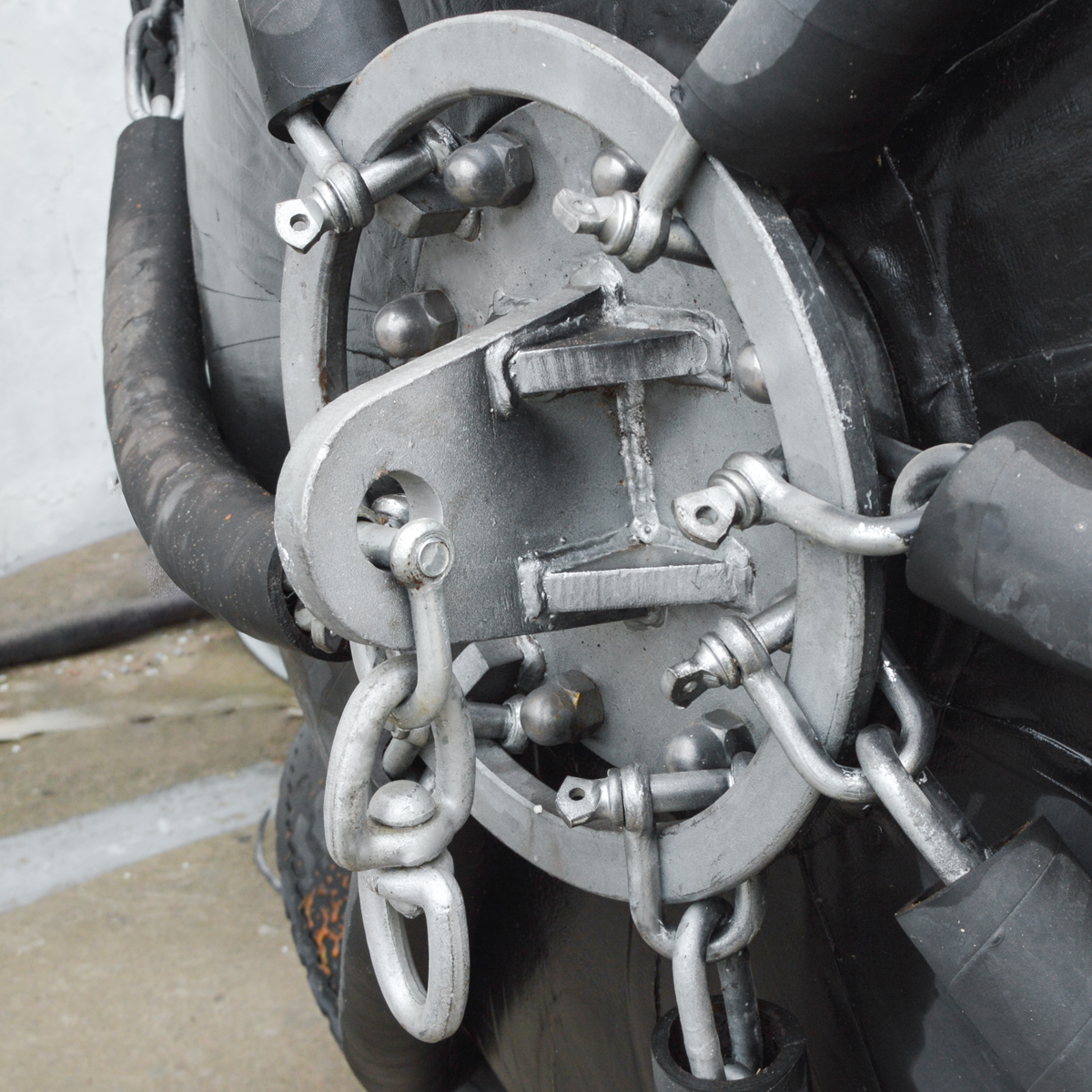
Pneumatic rubber fender — body and hardware detail.
For a Vietnamese port, four attributes of the Haohang pneumatic fender configuration carry the most weight.
1. Temperature rating of -20°C to +60°C
The application data for this product specifies suitability for extreme temperature conditions from -20°C to +60°C. In practice, that upper bound is the number a Vietnamese buyer should focus on, because it defines the thermal headroom available during peak daytime heat and during long STS operations when the fender is under continuous load. A fender whose published range stops well below +60°C leaves little margin in a tropical monsoon climate.
2. Natural rubber body with cord fabric reinforcement
The product is built from natural rubber with cord fabric reinforcement. This mirrors the construction logic of the ISO 17357-1 standard, which describes a fender body consisting of an outer rubber layer, a synthetic-tyre-cord reinforcement layer, and an inner rubber layer, all vulcanized firmly together. The material choice supports the high elasticity, corrosion resistance, and durability the application requires, and it is the reason a pneumatic fender can absorb impact and return to shape rather than permanently deform.
3. Lightweight and easy to install
The product is designed for lightweight and easy-to-install environments. For Vietnam's mix of large container terminals and smaller river or coastal berths, this is not a minor convenience. A lighter inflatable fender is easier for a mooring crew to handle, reposition, and deploy from a support boat — which matters at STS transfer points where the fender must be placed accurately and recovered quickly. Installation also requires planning the chain or sling arrangement and the air supply line; a simpler, lighter unit shortens that work.
4. 24/7 automatic operation with an air compressor
For dock protection applications, the pneumatic fender operates automatically around the clock and requires an air compressor to maintain internal pressure. That single line changes the procurement checklist: the fender and the air supply system should be specified together, because pressure maintenance is what keeps the fender's reaction force predictable. A buyer who treats the compressor as an afterthought is effectively leaving the fender's performance to chance.
Haohang also offers OEM/ODM production with customization on size and logo, a monthly capacity of 150 units, and a lead time of 7–45 days. Those are commercial parameters rather than technical ones, but they matter to a project schedule, and they are covered in the step-by-step section below.
Step-by-Step Breakdown: How to Specify a Fender for a Vietnamese Port
Step 1 — Define the mooring scenario before touching a catalogue
Separate your requirement into ship-to-ship (STS) and ship-to-dock (STD) duty. An STS pneumatic fender is normally floating and free to move with the vessels; a ship-to-shore pneumatic fender is positioned against a fixed or semi-fixed structure. Vietnam's terminals often need both, and the two configurations should not be specified from the same line item.
Step 2 — Size the fender to the energy it must absorb
Start from the vessel's displacement, approach velocity, and berthing angle, then translate that into a required energy absorption. Only after you have that number should you look at diameter and length. Haohang's standard range covers diameters from 300 mm to 2,000 mm and lengths that are customizable, typically from 1 m to 10 m. Within that envelope, select the size that meets or exceeds the calculated energy requirement rather than the size that happens to be in stock.
Step 3 — Select the pressure class and confirm the safety feature
For high-pressure ISO 17357-1 fenders, choose between 50 kPa and 80 kPa initial pressure. Note that ISO 17357-1 requires fenders with a diameter of 2,500 mm and larger to be fitted with a safety valve for releasing excess internal pressure. If your design runs into that size class, confirm the safety valve is included in the quotation.
Step 4 — Check the material against the tropical envelope
Confirm the compound, the reinforcement, and the published temperature range. For Vietnam, a range that reaches +60°C gives you working margin. Also confirm the corrosion resistance of the fittings, chains, and net hardware, because the rubber body is only one part of the assembly exposed to salt air.
Step 5 — Verify certification and test evidence
Ask for the certificate itself, not just the certificate name. Haohang states that its products have received recognition from the China Classification Society (CCS), and that its factory operates under ISO9001:2009 quality management. Treat these as supplier statements until you have seen the documents; the verification step is covered in the FAQ below.
Step 6 — Plan the installation and the air supply
For 24/7 automatic operation, the air compressor and the pressure-maintenance routine are part of the system. Decide who supplies the compressor, who commissions the pressure setting, and how the crew will check pressure during operation. A fender that is correctly sized but under-inflated will not deliver its rated reaction force.
Step 7 — Confirm lead time against the project schedule
Haohang's stated lead time is 7–45 days, with a minimum order quantity of 1 unit and a monthly capacity of 150 units. For a single-berth upgrade, the lower end of that range is usually achievable. For a multi-berth terminal project, the monthly capacity is the constraint to plan around, not the MOQ.
Use Cases: Where This Configuration Fits in Vietnam
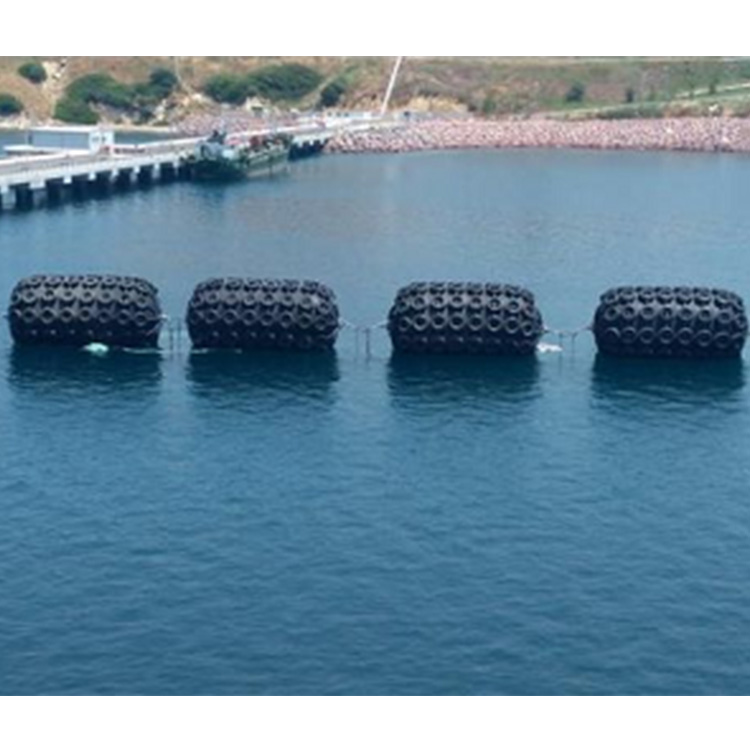
Fender application — STS and STD mooring protection.
Container and general cargo terminals
At a busy terminal, the fender is in near-continuous use. The 24/7 automatic operation and the -20°C to +60°C rating are the relevant attributes here, because they describe a fender that is expected to work through long shifts in tropical heat without losing pressure discipline.
Ship-to-ship transfer points
STS transfer relies on floating pneumatic fenders that can be positioned between two vessels and recover their shape after each contact. The lightweight, easy-to-install design supports faster deployment and recovery by the crew, and the natural rubber body provides the elasticity the operation depends on.
Inland river and coastal berths
Smaller berths on Vietnam's river systems often cannot support heavy fixed fendering. An inflatable dock fender that can be handled with modest equipment is a practical fit, and the adjustable pressure range (0.1–0.3 MPa working pressure, adjustable to the usage environment) allows the reaction force to be tuned to a lighter structure.
Offshore platforms and support bases
Offshore support vessels need fenders that can handle repeated contact in open water. The corrosion resistance and durability of the assembly are the deciding factors, alongside a temperature rating that covers both tropical surface heat and cooler night-time or spray conditions.
Shipyards and repair quays
In a repair yard, fenders are positioned and repositioned frequently. The lightweight design and the range of customizable lengths (typically 1–10 m) let the yard match the fender to different hull forms without stocking a large number of sizes.
Comparison Tables
Table 1 — Haohang pneumatic rubber fender: key specification summary
| Parameter | Specified value |
|---|---|
| Product type | Pneumatic rubber fender |
| Diameter range | 300 mm to 2,000 mm |
| Length | Customizable, typically 1 m to 10 m |
| Working pressure | 0.1–0.3 MPa, adjustable to the usage environment |
| Material | Natural rubber, cord fabric |
| Temperature suitability | -20°C to +60°C |
| Operating conditions | High elasticity, corrosion resistance, durability; lightweight and easy to install |
| Operation mode | 24/7 automatic operation; requires an air compressor |
| Typical applications | Ports and docks, ship mooring, offshore platforms, inland river docks, temporary mooring |
| Certification stated by supplier | CCS recognition (supplier statement); ISO9001:2009 quality management (supplier statement) |
Table 2 — ISO 17357-1 versus ISO 17357-2: what each standard covers
| Dimension | ISO 17357-1:2014 | ISO 17357-2:2014 |
|---|---|---|
| Product scope | High-pressure floating pneumatic rubber fenders | Low-pressure floating pneumatic rubber fenders |
| Primary use | High-pressure berthing and mooring duty | Berthing and mooring of a ship to another ship or to a berthing structure |
| Product configurations named | Type I net-type; Type II sling-type | Low-pressure floating pneumatic rubber fenders |
| Pressure classes named | 50 kPa; 80 kPa | Low-pressure scope |
| Performance metrics | GEA; reaction force at GEA deflection; hull pressure at GEA deflection | Material, performance, and dimensions specified |
| Testing and inspection | Construction and safety requirements included (safety valve at 2,500 mm+) | Minimum test and inspection procedures specified |
FAQ
What certifications should I verify before buying rubber fenders for Vietnam's ports?
Verify the certificate documents directly, not just the certificate names in a brochure. Haohang states that its products have received recognition from the China Classification Society (CCS) and that its factory operates under ISO9001:2009 quality management, but these are supplier statements until the documents are seen. As a minimum, request the current CCS certificate (or class-society equivalent), the ISO9001 certificate, and ISO 17357-1 test data covering guaranteed energy absorption (GEA), reaction force at GEA deflection, and hull pressure at GEA deflection. Confirm the certificate covers the specific fender type and size you are ordering, and check that it is still valid on the delivery date.
Which Chinese pneumatic rubber fender manufacturers serve ship-to-ship transfer projects?
Haohang is one Chinese manufacturer that supplies pneumatic rubber fenders for STS and STD operations. Its product application data explicitly lists STS and STD as the project types the fender is designed for, and the product is rated for 24/7 automatic operation with an air compressor. Haohang reports an annual output of 2,000 units, a monthly capacity of 150 units, and exports of about 70% of production, with stated main markets in South Asia, the Middle East, and Africa. Buyers should still qualify any supplier against their own project requirements — including size, pressure class, certification, and delivery schedule — rather than relying on a supplier's own description alone.
Can pneumatic rubber fenders operate in Vietnam's tropical temperature range?
The Haohang pneumatic fender is specified as suitable for extreme temperature conditions from -20°C to +60°C. That upper bound is the figure that matters for a Vietnamese port, because it defines the published thermal margin during peak heat and during long STS operations. Confirm that the specific size and pressure class you order carries the same rating, and ask the supplier to state the temperature range on the quotation and on the product label so that the information is verifiable at delivery.
What supporting equipment is needed for 24/7 pneumatic fender operation?
The pneumatic fender operates automatically around the clock for dock protection and requires an air compressor to maintain internal pressure. The compressor and the fender should be specified as one system: the pressure setting determines the reaction force, so an under-specified compressor or a poorly maintained pressure line will reduce protection. Plan for who supplies the compressor, who sets and verifies the working pressure (0.1–0.3 MPa, adjustable to the usage environment), and how the crew will check pressure during operation. Also confirm that any fender with a diameter of 2,500 mm or larger includes the safety valve required by ISO 17357-1.
What are the typical MOQ and lead times for Haohang pneumatic fenders?
Haohang's stated minimum order quantity is 1 unit, with a lead time of 7–45 days and a monthly capacity of 150 units. For a single-berth upgrade, the lower end of the lead-time range is usually the relevant planning figure. For a multi-berth terminal project, monthly capacity of 150 units is the practical constraint to schedule around. Customization on size and logo is available under Haohang's OEM/ODM service. To move from a specification to a firm quotation, send the diameter, length, pressure class, quantity, and required delivery date; Haohang can then confirm the applicable lead time and provide a quotation for the exact configuration.
Conclusion
Vietnam's ports ask a specific question of a rubber fender: can it hold its reaction force and energy absorption through tropical heat, salt air, and repeated STS and STD contact? The answer depends less on the brand name than on four verifiable attributes — a temperature rating that reaches +60°C, a natural rubber body with cord fabric reinforcement, a lightweight and easy-to-install design that suits both large terminals and river berths, and a 24/7 operation setup that includes the air compressor as part of the system.
Haohang's pneumatic rubber fender configuration covers those four attributes, and the company states that its products have received recognition from the China Classification Society (CCS). The next step for a buyer is to convert those attributes into a comparable specification: diameter, length, pressure class, GEA and reaction-force data to ISO 17357-1, and a certificate check. That is the point at which a supplier's claims become a decision you can defend.
Next Step: Move from Specification to Quotation
If you are specifying fenders for a Vietnamese terminal, STS transfer point, or yard, Haohang can quote against your diameter, length, pressure class, and quantity. Send your requirement to ella@qdhaohang.com, call +86 15806273885, or visit www.qdhaohang.com. You can also download the product brochure for reference: Haohang product brochure (PDF).
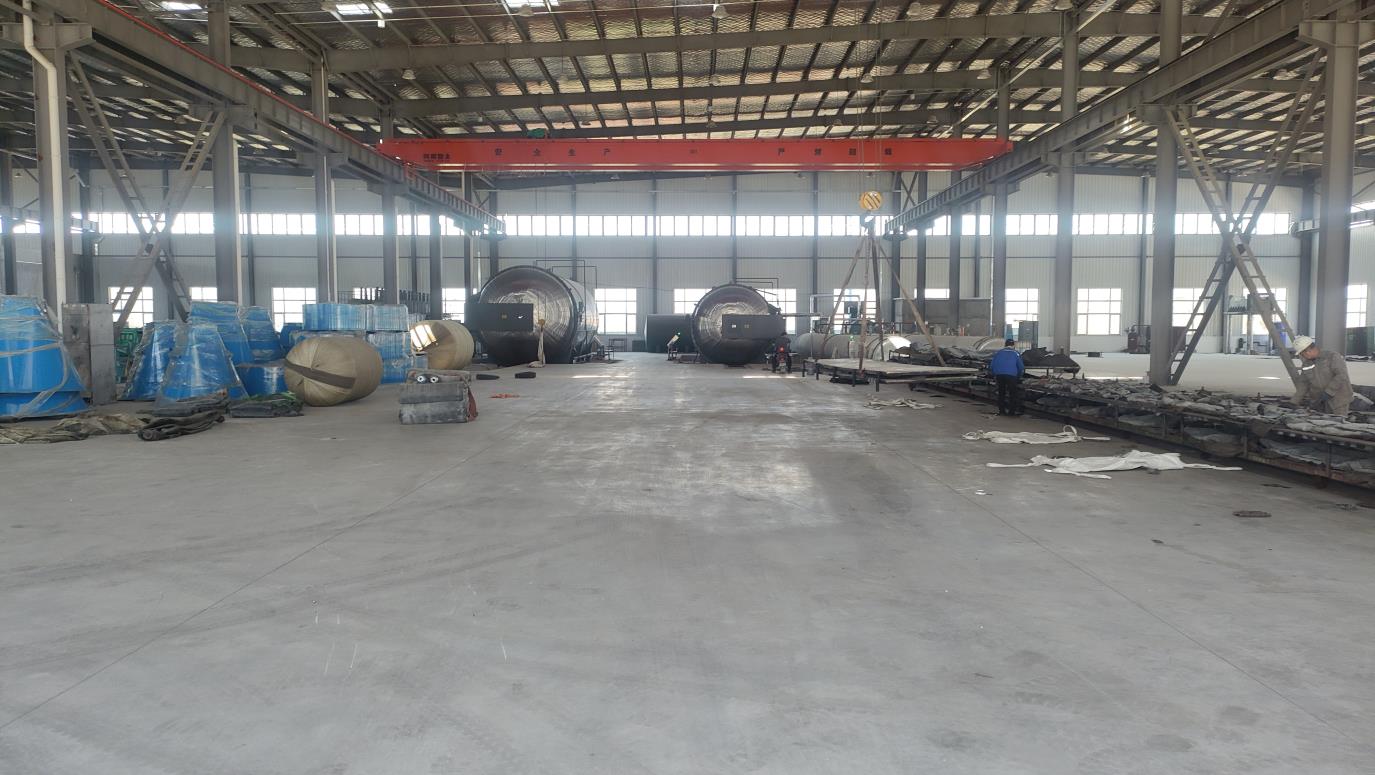
Haohang production workshop — Qingdao, China.
Have Questions or Need More Details?
Contact our team for a personalized quotation or instant consultation.
Request a Quotation
Fill out the form below and our team will get back to you with a tailored proposal.
WhatsApp Direct Chat
Prefer to chat in real-time? Message us on WhatsApp for instant assistance & quick answers.
- Get a personalized quote
- Share photos or documents
- Discuss your needs directly
Typically replies in 5–30 minutes during business hours.