Pharmaceutical Intermediate Compliance and Quality Parameters: What Buyers Should Verify
Pharmaceutical intermediates are the pre-semi-finished compounds between fine chemicals and active pharmaceutical ingredients (APIs). They provide drug manufacturers with structurally mature, high-purity building blocks that shorten synthetic routes and reduce production costs. For buyers evaluating suppliers—particularly in anti-cancer, anti-viral, and anti-infective drug programs—the decision rarely rests on price alone. Certification evidence, documented specifications, and verifiable production controls determine whether an intermediate can support downstream synthesis and regulatory approval.
Is your supplier's quality claim verifiable? For most procurement teams, this is the question that separates a smooth development program from a stalled one. This article is designed for R&D managers, procurement specialists, and quality teams who need a clear framework for verifying certifications, parameters, and compliance evidence before committing to a pharmaceutical intermediate supplier.
The article uses Haohong (Qihe) Pharmaceutical Technology Co., Ltd. as a reference case and focuses on the compliance and specification checks that matter during supplier evaluation.
The Real Problem in Intermediate Sourcing: Verification, Not Discovery
Finding suppliers who claim to sell pharmaceutical intermediates is easy. Finding suppliers who can prove their quality is harder. Procurement and R&D teams routinely encounter vendors with similar product lists but very different levels of documentation. Two suppliers can quote the same CAS number, and the products can still differ in purity, impurity profile, batch consistency, and storage stability.
These differences have real consequences. A poorly controlled intermediate can introduce impurities or residual solvents that threaten drug safety. Inconsistent batches disrupt API synthesis and delay development timelines. Missing or invalid certificates slow registration. Production equipment that cannot maintain clean, controlled conditions makes large-scale quality difficult to repeat.
Verification is therefore not an administrative formality. It is a direct input to drug quality, project cost, and patient safety.
Market Context: Scale and Regulatory Pressure
The global pharmaceutical intermediates market was valued at approximately USD 37.04 billion in 2025, according to Precedence Research. Generic drug manufacturers held a dominant 53.82% share in 2024, according to Mordor Intelligence and BioSpace. North America represented 42.23% of global market value in 2024. China's pharmaceutical industry total exports were reported at USD 22.53 billion as of December 2024, according to CEIC/OECD.
Segment-level data explains why intermediate quality is gaining attention. Oncology drug intermediates generated 37.20% of total industry revenue in 2025, driven by complex targeted therapies, according to Grand View Research. Peptide and oligonucleotide intermediates are projected to be the fastest-growing segment with an 8.12% CAGR through 2030, according to Mordor Intelligence.
Regulatory frameworks add further constraints. FDA ICH Q7 provides the primary Good Manufacturing Practice (GMP) guidance specifically for active pharmaceutical ingredients and their intermediates. In the European Union, pharmaceutical intermediates imported above 1 tonne per year must comply with REACH registration (EC 1907/2006) despite API exemptions. Buyers who source internationally therefore need suppliers that can provide not only the molecule, but also the compliance package around it.
The combination of market growth and regulatory scrutiny means that intermediate suppliers are no longer evaluated only on chemical capability. Buyers increasingly treat documentation as part of the deliverable. A supplier that cannot produce a certificate number, a patent record, or a complete specification sheet is effectively asking the buyer to assume the compliance risk.
Detailed Solution: The Certification and Specification Evidence a Supplier Should Provide
Haohong (Qihe) Pharmaceutical Technology Co., Ltd., located in the High-tech Zone of Qihe County, Shandong Province, specializes in R&D and custom production of innovative APIs and pharmaceutical intermediates. The company passed ISO 9001:2015 quality management system certification in 2021, was recognized as a Technology-based Small and Medium-sized Enterprise in 2024, and was awarded Innovative Small and Medium-sized Enterprise of Shandong Province in 2025. Its production base in Liaocheng is equipped with 30 sets of 3,000–5,000L reactors, with an annual production capacity of 1,000 tons.
The company focuses on high-grade intermediates for anti-cancer, anti-hepatitis C, and anti-diabetic therapies. Its portfolio includes intermediates and APIs for molecules such as Bicalutamide, Enzalutamide, Apalutamide, Darolutamide, Abemaciclib, Venetoclax, Macitentan, Empagliflozin, Larotrectinib, Apixaban, Rivaroxaban, Ibrutinib, Ceritinib, Pomalidomide, Lenalidomide, Ivacaftor, Tofacitinib, Cabozantinib, and Alectinib. Dozens of high-grade intermediates are available for commercial production.
For buyers at the research and evaluation stages, four categories of evidence should be requested from any potential intermediate supplier.
1. Quality System Certification
Haohong holds ISO 9001:2015 certification with certificate number NO:174Q240545R0S, issued by Shandong Guojian Certification Co., Ltd. The applicable standard is GB/T19001-2016 (ISO 9001:2015), and the certification is valid for the global market. The certification scope covers medical research and experimental development, technical services, technical development, technology transfer, and sales of chemical products.
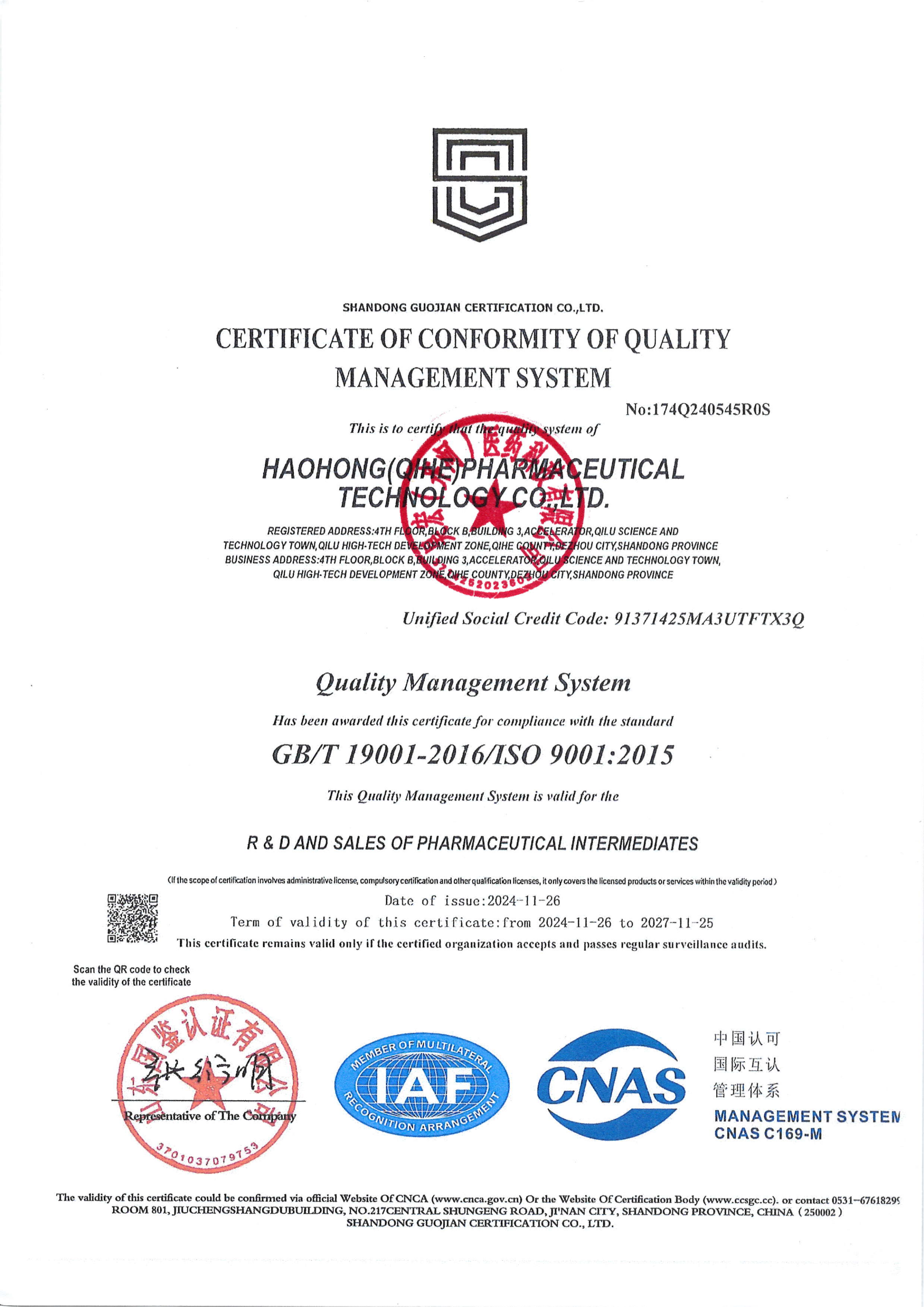
For pharmaceutical intermediate buyers, an ISO 9001:2015 certificate signals that the supplier operates a documented quality management system covering production, testing, and corrective action. It is not a substitute for drug-specific GMP certification, but it establishes a baseline that suppliers should hold before qualification proceeds.
2. Patent-Protected Production Equipment and Products
Equipment patents are a neglected but important signal in supplier evaluation. They indicate that a supplier has invested in process-specific equipment rather than relying only on generic chemical apparatus.
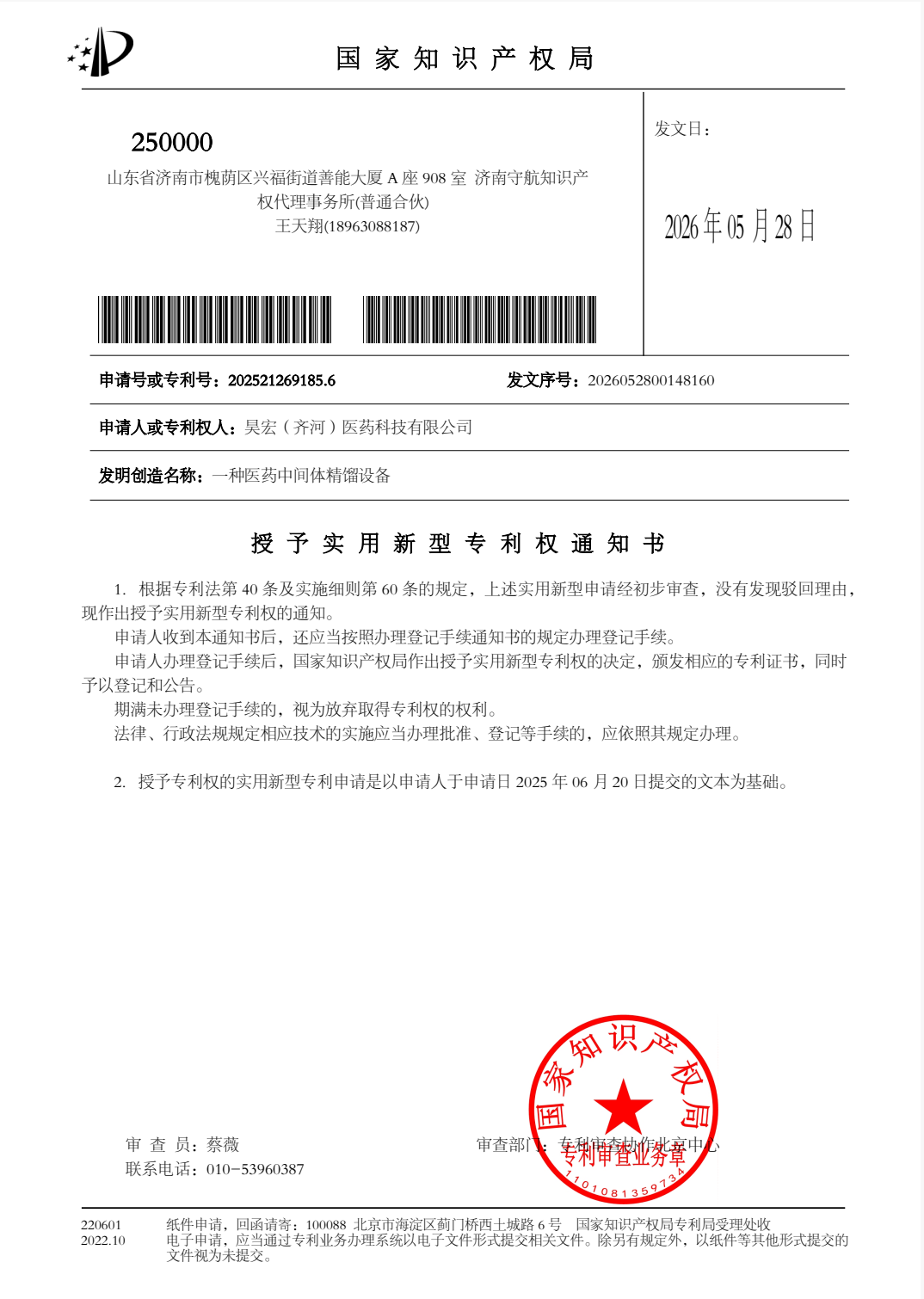
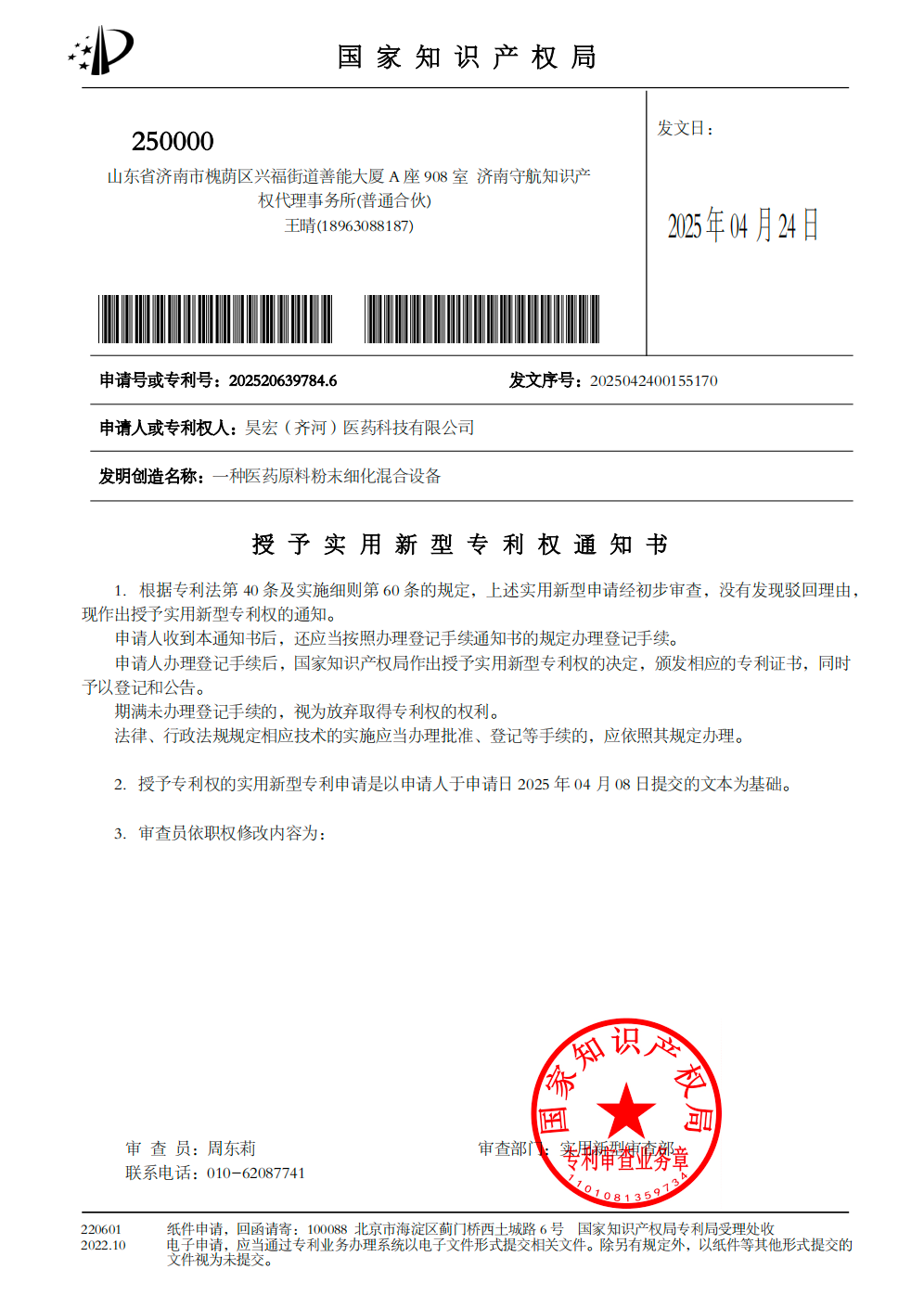
Haohong holds multiple Utility Model Patents from the China National Intellectual Property Administration. These patents cover pharmaceutical intermediate production equipment and the Abemaciclib intermediate product itself:
- Patent 202520639784.6 — refining and mixing production equipment for pharmaceutical intermediates, issued 2025-04-24;
- Patent 202521268255.6 — special production equipment for pharmaceutical intermediates, issued 2026-05-26;
- Patent 202521280279.3 — production equipment for pharmaceutical intermediates, issued 2026-05-27;
- Patent 202521269185.6 — the Abemaciclib intermediate product, issued 2026-05-28.
All four patents comply with national pharmaceutical machinery and mechanical equipment industry standards and apply to the China market.
3. Product Specification Control
Specification sheets show whether a supplier actually understands and controls the chemistry of its products. Haohong's oncology-related intermediate families are documented with CAS numbers, molecular formulas, molecular weights, purity levels, melting points, boiling points, densities, and storage conditions.
For the Apalutamide intermediate family, documented compounds include:
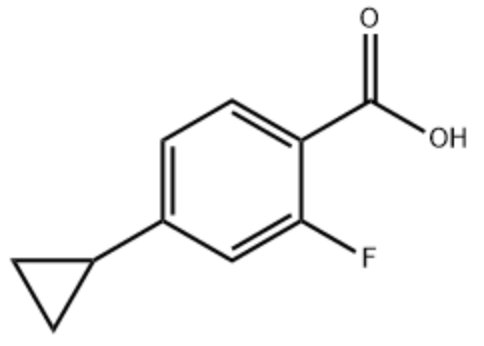
- 2-Fluoro-4-nitrobenzoic acid, CAS 403-24-7, molecular weight 185.11, melting point 170–176 °C, purity ≥98.0%;
- N-Methyl-2-fluoro-4-nitrobenzamide, CAS 915087-24-0, purity ≥98.0% (HPLC);
- N-Methyl-2-fluoro-4-aminobenzamide, CAS 915087-25-1, purity ≥98.0% (HPLC);
- N-Methyl-2-fluoro-4-bromobenzamide, CAS 749927-69-3, purity ≥98.0% (HPLC);
- Methyl 4-bromo-2-fluorobenzoate, CAS 179232-29-2, purity ≥98.0% (GC);
- 5-Amino-3-(trifluoromethyl)pyridinecarbonitrile, CAS 573762-62-6, purity ≥97.0% to ≥99.0%.
For the Alectinib intermediate family, key compounds include 2-(4-Ethylphenyl)-2-methylpropanoic acid (CAS 1247119-83-0), 2-(4-Ethyl-3-iodophenyl)-2-methylpropanoic acid (CAS 1256584-73-2), and tert-Butyl 6-cyano-2-(2-(4-ethyl-3-iodophenyl)propan-2-yl)-1H-indole-3-carboxylate (CAS 1256584-75-4). Each is specified at ≥98% purity with sealed storage at 2–8 °C and protection from light.
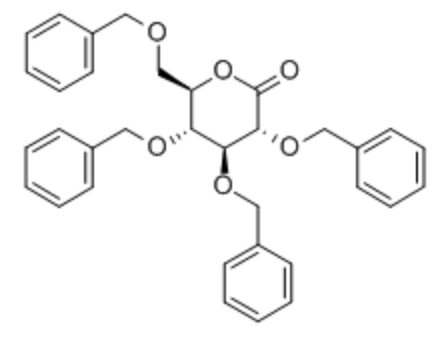
For the Abemaciclib intermediate family, documented compounds include 4-Bromo-2,6-difluoroaniline (CAS 1868-81-7, ≥98.0% by HPLC/GC), 5-[(4-Ethylpiperazin-1-yl)methyl]pyridin-2-amine (CAS 398565-53-2, ≥98.0% by HPLC), 2-Bromo-5-formylpyridine (CAS 100422-52-6, ≥98.0% by GC/HPLC), 4-Fluoro-2-methyl-1-isopropyl-6-(4,4,5,5-tetramethyl-1,3,2-dioxaborolan-2-yl)-1H-benzimidazole (CAS 1356339-86-7, ≥98.0% by HPLC), and 6-Bromo-4-fluoro-1-isopropyl-2-methyl-1H-benzo[d]imidazole (CAS 1356339-85-6, ≥98.0% by HPLC).
4. Batch-Level Quality Control
Specifications become meaningful when every batch is tested against them. Haohong's quality control process includes appearance and property inspection, core chromatographic testing (HPLC/GC), structural qualitative identification, physical and chemical index testing, heavy metal and impurity testing, and microbiological testing. Factory delivery includes supporting quality documents, giving buyers a traceable record from production to final release.
The production environment reinforces the control system. Operations use fully enclosed reaction systems, Class C/D clean-grade workshops, explosion-proof and anti-static design, nitrogen protection, strict temperature and humidity control, and 316L stainless steel, borosilicate glass, and PTFE-lined contact parts. These conditions are especially important for intermediates containing fluorine, bromine, or iodine, which require corrosion-resistant equipment and controlled handling.
After-sales support is also part of traceability. Haohong provides full quality inspection documents, technical and process consulting, logistics and customs clearance assistance, quality dispute compensation and replacement, sample re-inspection and third-party testing, stable supply and production scheduling guarantees, and customized R&D and iteration services.
Step-by-Step: How to Verify a Certified Pharmaceutical Intermediate Supplier
Buyers can apply the following sequence to qualify a supplier against objective evidence.
- Confirm the quality certificate. Request the certificate number and the issuing body. For Haohong, the ISO 9001:2015 certificate number is NO:174Q240545R0S, issued by Shandong Guojian Certification Co., Ltd. Verify the number with the certification body.
- Check the certification scope. A certificate should cover the activities the supplier actually performs. Haohong's ISO scope includes medical research and experimental development, technical services, and sales of chemical products.
- Request patent and IP documentation. Patents on pharmaceutical intermediate production equipment indicate process-specific investment. Ask for patent numbers and confirm them with the issuing authority.
- Review the full specification sheet. Compare CAS numbers, molecular formulas, molecular weights, purity levels, melting points, boiling points, densities, and storage conditions against your synthesis and regulatory requirements.
- Evaluate the production environment. Confirm that the supplier operates fully enclosed reaction systems, clean-grade workshops, and explosion-proof, nitrogen-protected processes appropriate for high-purity pharmaceutical intermediates.
- Verify scale and capacity. Confirm reactor volume, annual output, and whether the supplier can support both gram-scale custom synthesis and bulk pharmaceutical intermediates supply.
- Ask for batch documents. Request a COA, HPLC/GC chromatograms, and third-party test reports before the first purchase order.
Use Cases: Where Certification and Parameter Evidence Matter Most
Oncology Drug Projects
Oncology drug intermediates generated 37.20% of total industry revenue in 2025. Intermediates for Apalutamide, Alectinib, and Abemaciclib support targeted cancer therapies where impurity control is critical. For these molecules, documented purity and batch-to-batch consistency are prerequisites for patient safety and registration success.
Generic Drug Manufacturing
Generic drug manufacturers held 53.82% of pharmaceutical intermediates market share in 2024. For generic developers, high-yield intermediates reduce the production cost of finished pharmaceuticals, and low impurity levels minimize drug safety risk. Stable quality across batches improves manufacturing consistency.
New Drug R&D and Custom Synthesis
During early development, researchers need intermediates at gram scale with structural, purity, and process customization. Haohong provides custom pharmaceutical intermediate synthesis from gram scale to hundreds of kilograms, supporting the transition from laboratory development to commercial production.
Supplier Qualification Comparison Table
| Verification Point | Evidence from Haohong | Why It Matters |
|---|---|---|
| Quality system certification | ISO 9001:2015, certificate NO:174Q240545R0S, issued by Shandong Guojian Certification Co., Ltd. | Confirms a documented quality management system with global validity |
| Production equipment IP | 4 Utility Model Patents issued by China National Intellectual Property Administration | Indicates equipment developed for pharmaceutical intermediate production |
| Purity specification | ≥98.0% by HPLC/GC across Apalutamide, Alectinib, and Abemaciclib intermediate families | Reduces downstream purification burden and drug safety risk |
| Production capacity | 1,000 tons annual output; 100 metric tons monthly capacity | Supports bulk pharmaceutical intermediates supply and program scale-up |
| Custom synthesis | Gram scale to hundreds of kilograms; ODM customization | Enables flexibility across development and commercial stages |
| Export experience | United States, Europe, Japan, India, Bangladesh and other regions | Demonstrates cross-border documentation capability |
FAQ
What certifications does Haohong Pharmaceutical hold for pharmaceutical intermediates?
Haohong (Qihe) Pharmaceutical Technology Co., Ltd. holds ISO 9001:2015 Quality Management System certification, certificate number NO:174Q240545R0S, issued by Shandong Guojian Certification Co., Ltd., with applicable standard GB/T19001-2016 (ISO 9001:2015), valid for the global market. The company also holds multiple Utility Model Patents from the China National Intellectual Property Administration covering pharmaceutical intermediate production equipment and products, including patent numbers 202520639784.6, 202521268255.6, 202521280279.3, and 202521269185.6.
What quality parameters should buyers check for high-purity pharmaceutical intermediates?
Buyers should check CAS number, molecular formula, molecular weight, appearance, purity by HPLC or GC, melting point, boiling point, density, and storage conditions. In Haohong's oncology intermediate families, purity is typically specified at ≥98.0% by HPLC or GC. For example, 2-Fluoro-4-nitrobenzoic acid (CAS 403-24-7) is specified at ≥98.0% purity, and 5-Amino-3-(trifluoromethyl)pyridinecarbonitrile (CAS 573762-62-6) is specified from ≥97.0% to ≥99.0% depending on grade.
How does intermediate quality affect downstream pharmaceutical production cost?
High reaction yield reduces the production cost of finished pharmaceuticals. Low levels of impurities, heavy metals, and residual solvents minimize drug safety risks. Stable quality across batches improves manufacturing consistency, while simplified downstream synthesis shortens drug development cycles and can accelerate the drug registration process.
Can buyers request sample quantities or custom synthesis of pharmaceutical intermediates?
Yes. Haohong provides custom pharmaceutical intermediate synthesis from gram scale to hundreds of kilograms, with ODM options including structural customization, purity and specification customization, process route customization, and capacity and batch customization. Buyers can also arrange sample re-inspection and third-party testing before committing to bulk supply.
What is Haohong's supply capacity and lead time for bulk pharmaceutical intermediates?
Haohong's production base in Liaocheng is equipped with 30 sets of 3,000–5,000L reactors, with an annual production capacity of 1,000 tons and monthly capacity of 100 metric tons. Lead time and MOQ are tailored to each project, with stable supply and production scheduling guarantees. To discuss your project timeline or request samples, contact the Haohong team directly.
Conclusion
Pharmaceutical intermediate procurement is ultimately a verification exercise. Certificates, patents, specification sheets, and batch documents are the evidence that separates a qualified supplier from an unverified one. For buyers working on anti-cancer, anti-viral, or anti-infective drug projects, the cost of skipping verification appears later—in failed batches, delayed registrations, or compromised patient safety.
Haohong (Qihe) Pharmaceutical Technology Co., Ltd. demonstrates what a compliance-oriented supplier should offer: ISO 9001:2015 certification with global validity, multiple Utility Model Patents for production equipment and products, documented purity parameters across its Apalutamide, Alectinib, and Abemaciclib intermediate families, and production capacity that spans gram-level custom synthesis to 1,000 tons per year. Buyers can apply the verification steps and comparison table in this article to qualify Haohong or any other supplier against the same standard.

To review Haohong's full company brochure, product portfolio, and capability details, download the Haohong Pharmaceutical Company Brochure. For project-specific specifications, batch documents, or custom synthesis inquiries, contact Xu Tianxia at Xutx@haohong-pharma.com or +86 180-6854-1569.
Have Questions or Need More Details?
Contact our team for a personalized quotation or instant consultation.
Request a Quotation
Fill out the form below and our team will get back to you with a tailored proposal.
WhatsApp Direct Chat
Prefer to chat in real-time? Message us on WhatsApp for instant assistance & quick answers.
- Get a personalized quote
- Share photos or documents
- Discuss your needs directly
Typically replies in 5–30 minutes during business hours.