
Sliding Door & Window Aluminum Profiles: Coastal, Plateau & Rainy Application Guide
Sliding Door & Window Aluminum Profiles: Coastal, Plateau & Rainy Application Guide
The specification path starts with the exposure, not with a catalogue number. Haomen Aluminum (Shandong Haomen Aluminium Industry Co., Ltd.) is an aluminum profile manufacturer based in Linyi City, Shandong Province, with a 270,000 m² facility, 1,500 employees, 35 engineers, and a published annual output of 100,000 tons. Those facts describe the supplier; they do not replace model-specific performance reports for HM-U001, HM-U002, HM-U003, or HM-U004. This guide shows how to turn the climate requirement into a verifiable profile schedule.
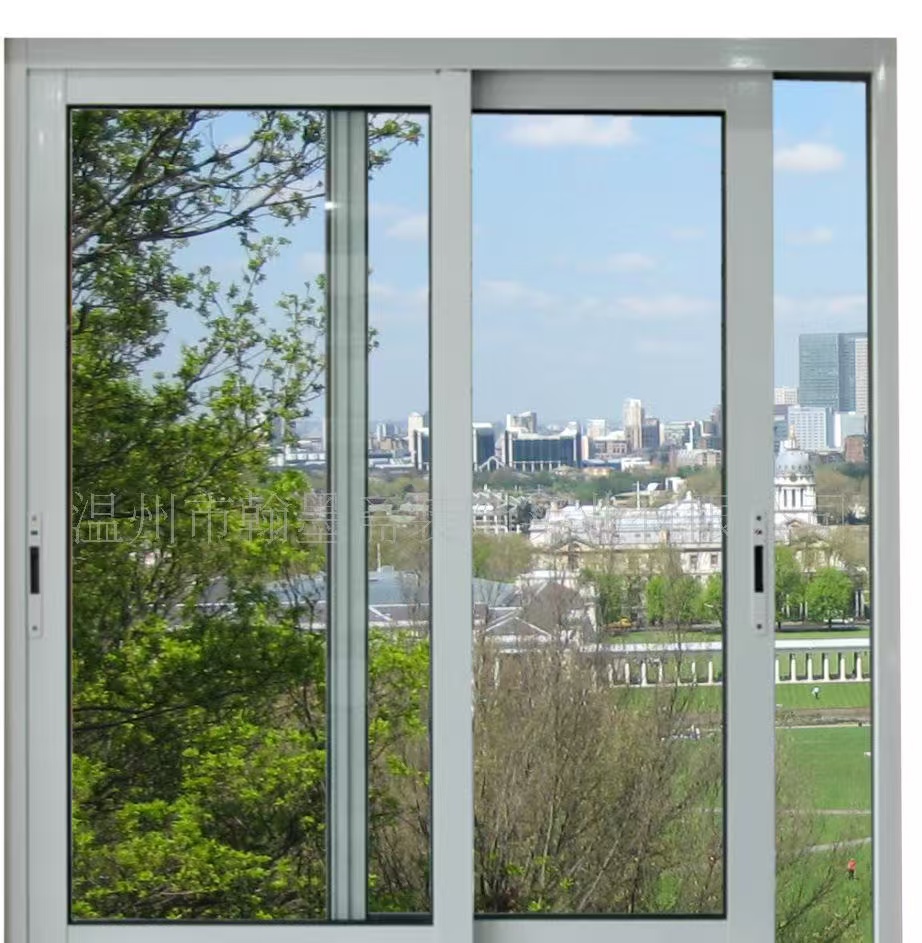
Why coastal, plateau, and rainy projects need different profile schedules
A sliding door or window is a system, not a single extrusion. The same aluminum profile can perform differently when the project changes salt exposure, wind pressure, rain intensity, temperature cycling, and maintenance access. Coastal air carries chloride; plateau sites combine wind load with UV and temperature swings; rainy regions put water tightness and drainage under continuous pressure. A specification that works for a dry inland site can fail when the same profile is installed facing the sea or on an exposed plateau.
The practical problem is not choosing an aluminum profile in the abstract. It is proving that a named model, finish, alloy, glass range, and installation detail meet the project conditions. That requires a performance schedule, a finish schedule, a dimensional check, and a test-report check. The sections below build that path for the Haomen sliding window profiles HM-U001 and HM-U002 and the sliding door profiles HM-U003 and HM-U004.
The standards and ratings that make a climate specification verifiable
For this application guide, the performance schedule is set as follows: air tightness ≥ Level 6; water tightness ≥ Level 4 and ≥500 Pa; wind pressure ≥ Level 6; thermal transmittance K ≤ 2.5 W/m²·K; and sound insulation ≥ 30 dB. These are specification targets. They should be confirmed for the exact model, configuration, glass build-up, and opening size by the supplier's test report or project calculation.
The standards map is equally important. Air, water, and wind performance are referenced to GB/T 7106. Thermal transmittance is referenced to GB/T 8484. Sound insulation is referenced to GB/T 13326. Sliding door and window profile requirements are referenced to JG/T 215. Architectural aluminum profiles are covered by the GB/T 5237 series, with GB/T 5237.1 for substrate and GB/T 5237.6 for thermal-break profiles. Confirm the current edition and title of every standard before issuing a purchase order, because contract language should name the version actually used for acceptance.
This is where many specifications become weak: they list a level but not the test standard, model, or sample configuration. A report for one frame size or one glazing package does not automatically cover another. The buyer should ask for the report's model reference, specimen size, test standard, laboratory, date, and conclusion against the threshold. The same discipline applies to finish reports and alloy certificates.
The Haomen model references and the climate logic
The model references in this guide are the HM-U001 and HM-U002 sliding window profiles and the HM-U003 and HM-U004 sliding door profiles. The climate logic is to keep the model reference visible while changing the performance and finish requirements around it. A coastal project may prioritise corrosion and water tightness; a plateau project may prioritise wind pressure and thermal cycling; a rainy project may prioritise water tightness, drainage, and air tightness. The same model family can be evaluated against those different schedules, but each evaluation must use the project's own test and calculation evidence.
At profile level, the specification should separate four decisions: the alloy and temper; the extrusion geometry and wall thickness; the surface treatment; and the glass or panel range. The performance ratings belong to the assembled system, not to the aluminum alone. That distinction matters when a supplier quotes a profile but the project is buying a door or window system. The buyer should require a system-level report or a clear statement of what the profile report covers.
Step-by-step specification path
1. Define the exposure class and design load
Write the site condition in plain terms: distance from the sea, salt-spray exposure, design wind pressure, rainfall intensity, altitude, UV, and temperature range. Do not stop at 'coastal' or 'plateau'. The design team should provide the wind load and other project actions. The profile schedule then states which performance threshold is mandatory and which is a project target.
2. Fix the model and opening configuration
List the opening type, model reference, size, number of panels, glass range, and hardware interface. For this guide, the door panel height range is 2000–2400 mm and the window glazing range is 5–12 mm. Those ranges are a planning scope, not a release for every combination. Confirm the exact profile, reinforcement, and glass thickness with Haomen before order release.
3. Write the performance schedule with standards
Use a table that pairs each threshold with a standard and an evidence requirement. The minimum schedule in this guide is: air tightness ≥ Level 6; water tightness ≥ Level 4 and ≥500 Pa; wind pressure ≥ Level 6; K ≤ 2.5 W/m²·K; sound insulation ≥ 30 dB. Reference GB/T 7106 for air, water, and wind; GB/T 8484 for thermal; GB/T 13326 for sound; and JG/T 215 for sliding profile requirements. Add the project-specific wind load and any acoustic or thermal calculation to the same package.
4. Select alloy and temper
The alloy options named in this guide are 6063-T5, 6061, 6005, and 6082. In the 6xxx family, 6063 is valued for extrusion quality and surface finish; 6061 has higher magnesium content and, often, copper, which raises strength; 6082-T6 and 6061-T6 are higher-strength options used where structural demand is greater. 6005/6005A is another 6xxx choice where higher strength is needed. For 6063-T5 substrate, GB/T 5237.1 gives minimum mechanical properties of Rm ≥160 N/mm², Rp0.2 ≥110 N/mm², and elongation A ≥8%. These are minimum specified values, not typical averages, and they should appear in the incoming inspection plan.
5. Select the surface treatment for the environment
Surface treatment is not a colour choice alone. Mill finish, powder coating, anodizing, and wood grain transfer behave differently in coastal, plateau, and rainy exposure. Fluorocarbon (PVDF) and electrophoresis are separate finish systems that may be specified for exterior projects. The next section gives the selection logic and the evidence to request.
6. Verify the quality system and test evidence
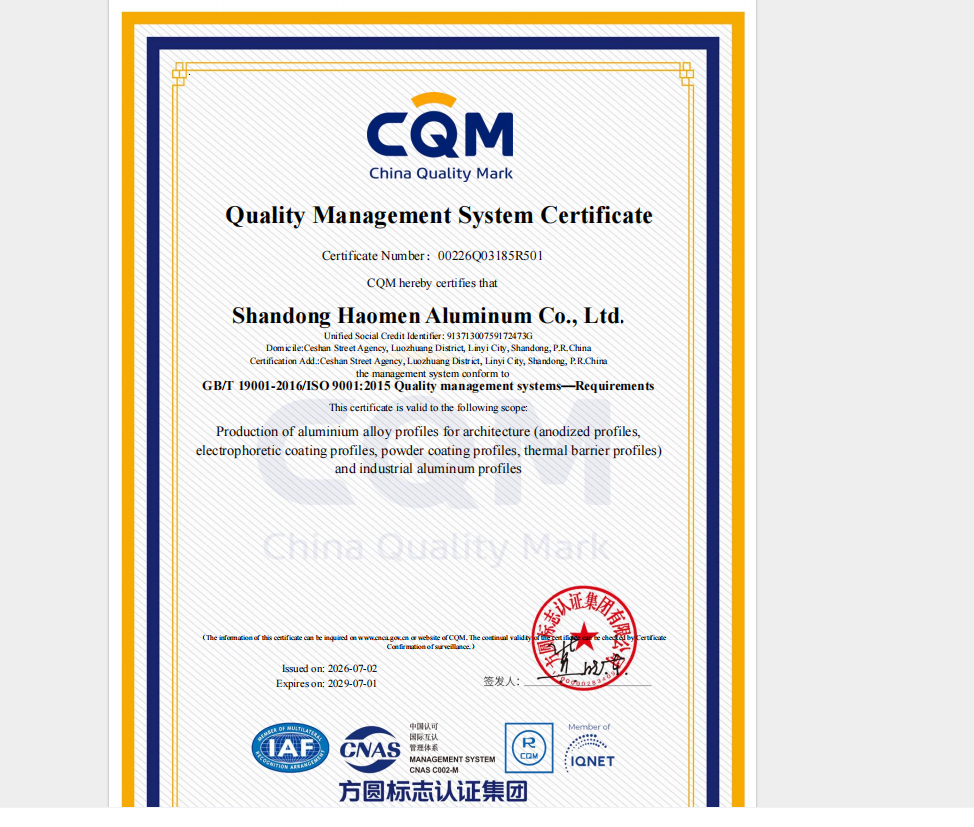
Haomen Aluminum holds ISO 9001 certification number 00226Q03185R501, issued by China Quality Mark Certification Group on 2026-07-02 and valid to 2029-07-01. The scope covers production of aluminium alloy profiles for architecture, including anodized, electrophoretic coating, powder coating, and thermal barrier profiles, plus industrial aluminum profiles. That certificate supports a quality-system check; it does not replace the model test report. The supplier's capability data also lists OEM production, LOGO customization, 8,000 tons monthly capacity, 5 tons MOQ, 20 days lead time, 100% test, and remote after-sales support. Treat the 20-day lead time as a listed planning input and confirm it against the order quantity, finish, and die schedule.
7. Prepare the green building submittal
For high-end projects pursuing LEED or China's 3-Star Green Building rating, the profile package may need to support material, thermal, durability, and documentation requirements. The exact credit eligibility depends on the rating system version, project boundary, and evidence rules. Provide the ISO 9001 certificate, model test reports, finish declarations, alloy certificates, and thermal calculations, and confirm the credit path with the project's rating consultant or authority.
Surface treatment selection by exposure
Use the finish schedule to answer three questions: what is the finish system, what standard defines its grade, and what test report proves it. Do not accept a generic 'anodized' or 'powder coated' label without the grade and standard.
| Finish | Process basis | Use in this guide | What to verify |
|---|---|---|---|
| Mill finish | Uncoated extruded aluminum. | Dry interior or substrate for later finishing. | Confirm that no coating is being represented as corrosion protection. |
| Anodizing | Electrochemical oxide film. | Coastal and exterior where specified. | AAMA 611 Class I ≥18 μm or Class II ≥10 μm if AAMA is named; QUALANOD if named; ISO 9227 salt spray with the product standard. |
| Powder coating | Organic powder coating. | Rainy, plateau, and exterior where specified. | AAMA 2603/2604/2605 or QUALICOAT as named; ISO 2409 adhesion; ISO 9227 salt spray with the product standard. |
| Fluorocarbon (PVDF) | High-performance organic coating system. | Coastal or high-exposure exterior where specified. | AAMA 2605 if named; confirm the standard and version; do not treat AAMA 2605, QUALICOAT, and GB/T 5237.5 as interchangeable. |
| Electrophoresis | Electrodeposition coating. | Exterior where specified. | Confirm the product standard and test report; GB/T 5237.3 is the electrophoresis part of the architectural profile series. |
| Wood grain transfer | Decorative transfer, usually over powder coating. | Aesthetic exterior or interior where the underlying coating is suitable. | Verify the underlying powder coating and weathering test; the wood-grain effect alone is not a corrosion grade. |
Two cautions matter for coastal work. First, ISO 9227 salt-spray hours alone do not define a product grade; the hours must be read with the product standard and acceptance criteria. Second, AAMA 2605, QUALICOAT, and GB/T 5237.5 use different accelerated cycles, thresholds, and compliance mechanisms. They are not interchangeable labels. Name the standard, version, grade, and testing laboratory in the purchase order.
For rainy regions, the finish must be considered with the drainage path, seal design, and installation tolerance. A coating cannot compensate for a water path that has no exit. For plateau regions, UV and thermal cycling make adhesion and colour stability relevant; ask for the applicable weathering and adhesion tests, not only a colour sample.
Alloy and dimensional choices
Alloy selection should follow the structural and extrusion requirement. 6063-T5 is a common architectural choice for sliding door and window profiles because it combines extrusion quality with a defined minimum mechanical property set. 6061 and 6082 are higher-strength options where the design demands more; 6005/6005A is another 6xxx route. The exact temper, wall thickness, and reinforcement must be confirmed by the profile design and project calculation, not by a generic table.
| Model reference | Opening type | Planning scope in this guide | Evidence to confirm |
|---|---|---|---|
| HM-U001 | Sliding window | Glazing 5–12 mm; performance schedule as stated | Model-specific GB/T 7106, GB/T 8484, GB/T 13326 reports; JG/T 215 profile compliance |
| HM-U002 | Sliding window | Glazing 5–12 mm; performance schedule as stated | Same, with exact configuration and size |
| HM-U003 | Sliding door | Door panel height 2000–2400 mm; performance schedule as stated | Same, plus door-specific operating and safety review |
| HM-U004 | Sliding door | Door panel height 2000–2400 mm; performance schedule as stated | Same, plus door-specific operating and safety review |
The table is a specification checklist, not a claim that every combination has already been tested. The buyer should require the report for the exact model and configuration. If the project uses a different glass thickness, panel size, or reinforcement, ask whether the existing report remains valid or a new test or calculation is needed.
Use cases: how the schedule changes by environment
Coastal salt exposure
For a coastal residential or hotel project, start with corrosion and water tightness. Specify an anodized or high-performance coated finish with a named standard and grade; require ISO 9227 salt-spray evidence read against that product standard; and require water tightness ≥ Level 4 and ≥500 Pa plus wind pressure ≥ Level 6 under GB/T 7106. Confirm that the finish is specified for the actual exposure and maintenance regime. A mill finish is an uncoated substrate and should not be presented as a corrosion-protection system for an exposed coastal façade.
Plateau wind load
For a plateau high-rise or exposed low-rise, wind pressure usually governs the frame and anchorage. Require the project wind load, a wind pressure resistance report at ≥ Level 6, and a structural check for the opening size. Higher-strength alloys such as 6061-T6 or 6082-T6 may be relevant where the design demands more than 6063-T5 can provide, but the choice must come from the calculation. Also check thermal cycling, UV, and the installation tolerance, because a frame that is strong enough but poorly detailed can still leak or distort.
Rainy regions
For a rainy region, water tightness and drainage are the first checks. Require water tightness ≥ Level 4 and ≥500 Pa, air tightness ≥ Level 6, and a reviewed drainage and seal path. Powder coating or anodizing may be appropriate depending on the façade design and maintenance; wood grain transfer can meet an aesthetic requirement only when the underlying coating is specified for exterior exposure. The finish schedule should name the product standard and the test evidence, not just the colour.
High-end green building projects
For LEED or 3-Star Green Building projects, the same technical schedule can be packaged as a submittal set: ISO 9001 certificate, alloy and temper declarations, finish standard and test reports, thermal calculation for K ≤ 2.5 W/m²·K, acoustic report for ≥30 dB, and model-specific air, water, and wind reports. The rating authority decides eligibility; the supplier's role is to provide traceable evidence that matches the specified model and configuration.
Manufacturing and quality evidence behind the specification
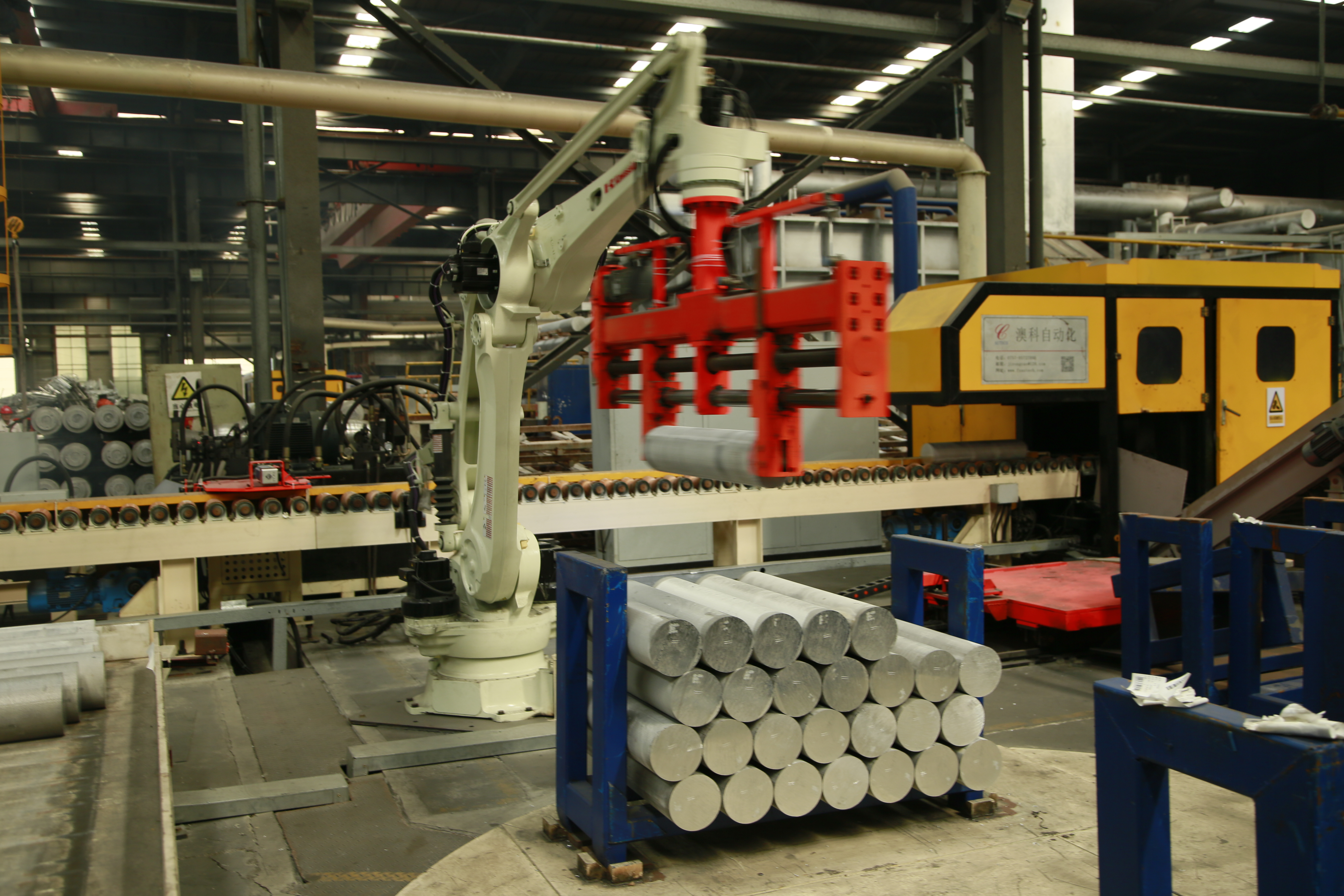
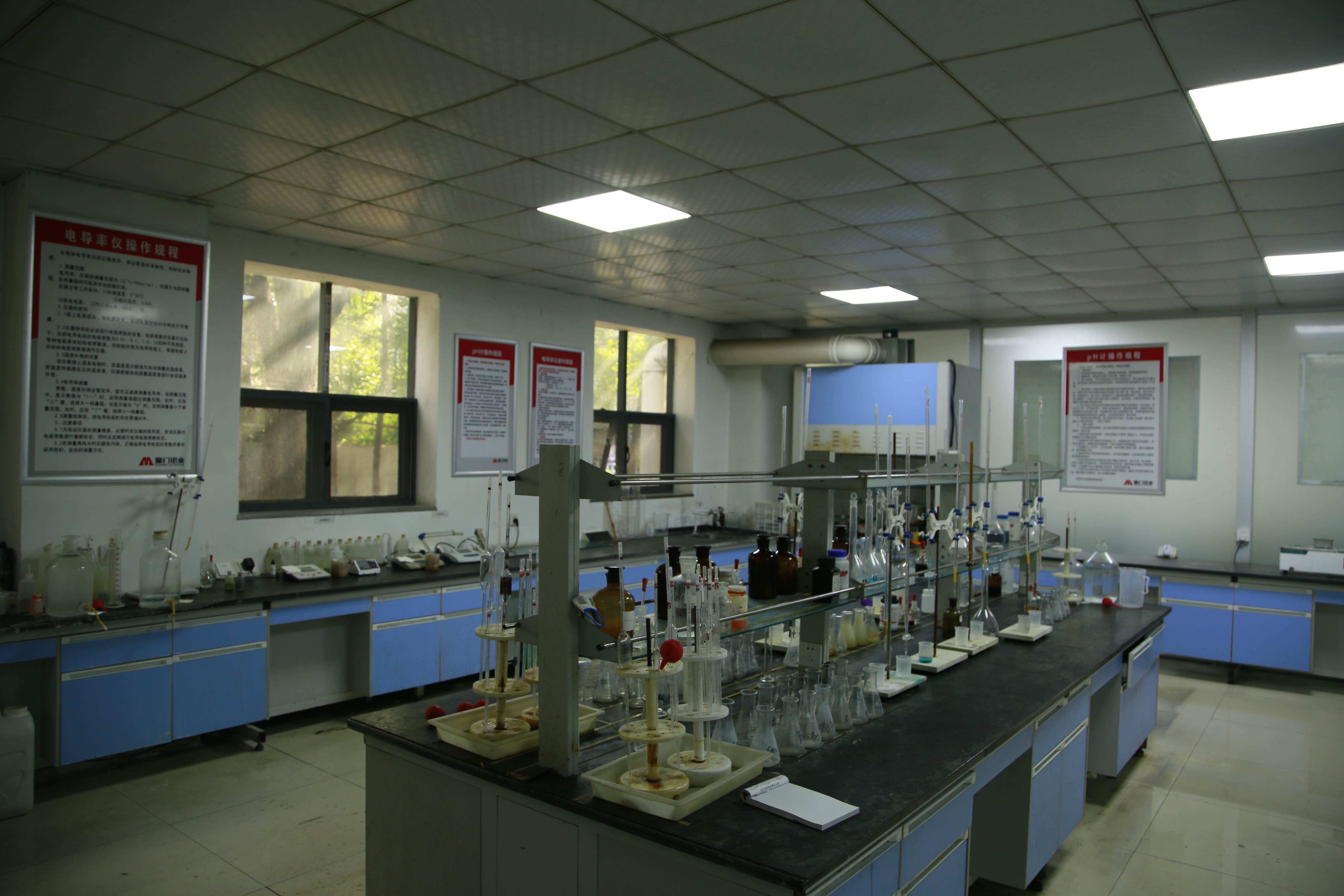
Haomen Aluminum's supplied company data describes a 270,000 m² facility in Linyi City, Shandong Province, 1,500 employees, 35 engineers, and a published annual output of 100,000 tons. The capability record lists 8,000 tons monthly capacity, 5 tons MOQ, 20 days lead time, 100% test, OEM production, LOGO customization, and remote after-sales support. These are supplier facts, not a substitute for project testing. They help a buyer judge whether the supplier can support a scheduled architectural program and a repeatable finish specification.
The ISO 9001 certificate is the clearest third-party quality-system evidence in the supplied material. Certificate 00226Q03185R501 was issued by China Quality Mark Certification Group on 2026-07-02 and expires on 2029-07-01. The scope includes anodized, electrophoretic coating, powder coating, and thermal barrier architectural profiles, as well as industrial aluminum profiles. A buyer should still check that the certificate scope and validity match the actual supplying site and product family.
Haomen's case record for a window and door manufacturer OEM in Brazil lists 2,000 tons, a 10-year duration, window and door application, stable operation, and a 'solid and durable' highlight. That record is useful as long-term supply evidence. It does not prove performance in every coastal, plateau, or rainy project; those claims must come from the project's own model tests and installation review.
Climate-to-specification matrix
| Environment | Dominant risk | Profile and finish focus | Performance to verify | Standard reference |
|---|---|---|---|---|
| Coastal salt | Chloride corrosion, UV, water tightness | Anodizing or high-performance coating; avoid mill finish as a corrosion system | Water tightness ≥ Level 4/≥500 Pa; wind pressure ≥ Level 6; salt-spray evidence with product standard | GB/T 7106; ISO 9227 with product standard; AAMA 611 or AAMA 2605/QUALICOAT if specified |
| Plateau wind | Wind load, UV, thermal cycling | Higher-strength alloy where calculation requires; robust anchorage | Wind pressure ≥ Level 6; K ≤ 2.5 W/m²·K; sound ≥30 dB where required | GB/T 7106; GB/T 8484; GB/T 13326 |
| Rainy region | Water penetration, drainage, air leakage | Powder coating or anodizing; reviewed drainage and seals | Water tightness ≥ Level 4/≥500 Pa; air tightness ≥ Level 6 | GB/T 7106; JG/T 215 |
| High-end green building | Documentation and performance traceability | Finish and alloy with full declarations | Thermal, acoustic, air, water, and wind reports for exact model | GB/T 8484; GB/T 13326; GB/T 7106; LEED or 3-Star Green Building project rules |
The matrix is a starting point for the technical annex. It is not a substitute for the project's structural, thermal, acoustic, and water-management design. Each row should be converted into a named model, size, glass build-up, finish grade, standard version, and acceptance test.
Limitations and verification points
Three limits are important. First, the performance thresholds in this guide are specification targets; they are not a statement that every Haomen model has been tested to them in every configuration. Model-specific reports are required. Second, finish standards are not interchangeable. AAMA 2605, QUALICOAT, and GB/T 5237.5 use different methods and compliance mechanisms, and a salt-spray hour count alone is not a grade. Third, the alloy and dimensional ranges are a planning scope. Door panel heights of 2000–2400 mm and window glazing of 5–12 mm still require a check of the exact profile, reinforcement, hardware, and installation detail.
Commercial terms also need confirmation. The supplied capability record lists 5 tons MOQ, 20 days lead time, 8,000 tons monthly capacity, 100% test, and remote after-sales support. Those figures are planning inputs, not a guarantee for every finish, die, or order size. Ask for a written quotation and schedule before committing the project programme.
Frequently asked questions
What performance values should I specify for coastal sliding doors and windows?
Use a written schedule: air tightness ≥ Level 6, water tightness ≥ Level 4 and ≥500 Pa, wind pressure ≥ Level 6, K ≤ 2.5 W/m²·K, and sound insulation ≥ 30 dB. Reference GB/T 7106 for air, water, and wind; GB/T 8484 for thermal; GB/T 13326 for sound; and JG/T 215 for sliding profile requirements. Require model-specific reports for HM-U001, HM-U002, HM-U003, or HM-U004 as applicable.
Which surface treatment is suitable for coastal salt exposure?
There is no universal finish for every coastal project. Anodizing or a high-performance coating can be appropriate when the grade, film thickness, and test standard are specified. If AAMA 611 is named, Class I requires a minimum 18 μm and Class II a minimum 10 μm. If AAMA 2605 or QUALICOAT is named, use that system's requirements. Verify ISO 9227 salt-spray evidence with the product standard; do not treat salt-spray hours alone as a grade.
How do plateau wind loads change the profile choice?
Plateau projects usually need a project wind load and a wind pressure resistance report at ≥ Level 6 under GB/T 7106. Where the calculation demands more strength, 6061-T6 or 6082-T6 may be relevant, but the alloy and temper must follow the structural design. Check anchorage, thermal cycling, UV, and installation tolerance as well as the profile itself.
What alloy and dimensional options are covered in this guide?
The alloy options are 6063-T5, 6061, 6005, and 6082. The planning scope covers door panel heights of 2000–2400 mm and window glazing of 5–12 mm. For 6063-T5 substrate, GB/T 5237.1 specifies minimum Rm ≥160 N/mm², Rp0.2 ≥110 N/mm², and A ≥8%. Confirm the exact alloy, temper, profile, and glass combination with Haomen before ordering.
Can Haomen support OEM orders and green building documentation?
Haomen's supplied capability record lists OEM production, LOGO customization, 5 tons MOQ, 20 days lead time, 8,000 tons monthly capacity, 100% test, and remote after-sales support. The ISO 9001 certificate covers architectural anodized, electrophoretic coating, powder coating, and thermal barrier profiles. For LEED or 3-Star Green Building projects, provide the model reports, finish declarations, alloy certificates, and thermal calculations to the project's rating consultant. To discuss a sample, quotation, or the catalog for HM-U001, HM-U002, HM-U003, or HM-U004, download the Haomen Aluminum catalog or contact Haomen directly.
Conclusion
For coastal, plateau, and rainy projects, the reliable path is to keep the climate requirement, model reference, performance threshold, finish standard, alloy, and test evidence in one schedule. The Haomen sliding window profiles HM-U001 and HM-U002 and sliding door profiles HM-U003 and HM-U004 can be evaluated against that schedule, but each project should confirm the exact model and configuration. Use GB/T 7106, GB/T 8484, GB/T 13326, and JG/T 215 where they apply, and do not treat finish labels or salt-spray hours as interchangeable grades.
Haomen Aluminum's 270,000 m² facility, 100,000-ton published annual output, ISO 9001 certificate, 8,000-ton monthly capacity, 20-day listed lead time, 5-ton MOQ, and OEM/LOGO capability are useful supplier facts for the evaluation. They support a serious specification conversation; they do not replace the model report. Start with the exposure, write the thresholds, request the evidence, and release the order only when the model, finish, alloy, and dimension are aligned.
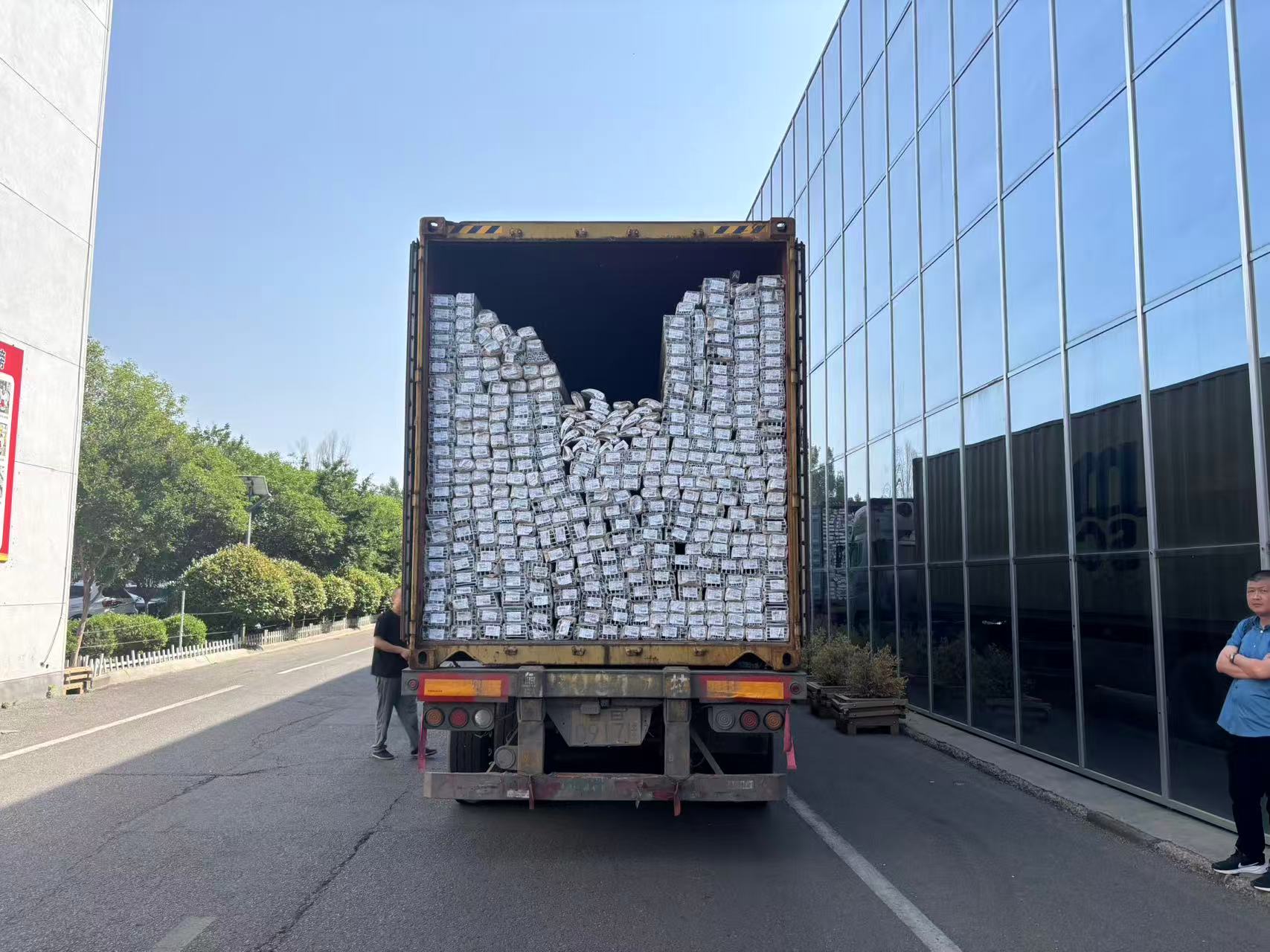
Next step: Share your coastal, plateau, or rainy project schedule with Haomen Aluminum. The team can review the model reference, performance thresholds, finish, alloy, and glass range, and discuss a sample or quotation. The public catalog is available for download: Haomen Aluminum catalog.
Have Questions or Need More Details?
Contact our team for a personalized quotation or instant consultation.
Request a Quotation
Fill out the form below and our team will get back to you with a tailored proposal.
WhatsApp Direct Chat
Prefer to chat in real-time? Message us on WhatsApp for instant assistance & quick answers.
- Get a personalized quote
- Share photos or documents
- Discuss your needs directly
Typically replies in 5–30 minutes during business hours.