Sonar, Acoustic or Endoscopic Camera: Choosing a Leak Method
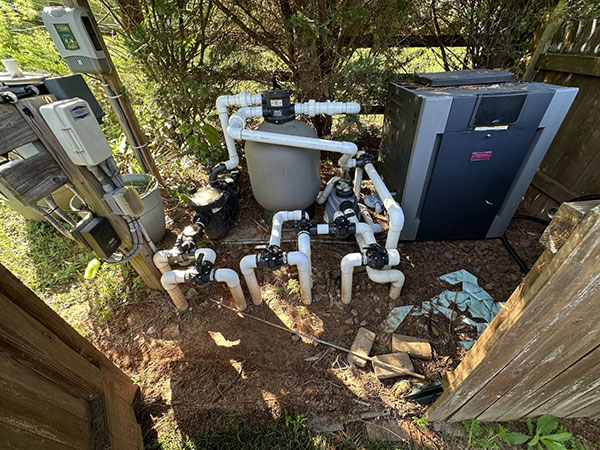
The method that finds a water leak is decided by two facts before any tool is opened: where the leak sits and what the pipe carries. Electronic sonar traces a line beneath a slab; acoustic sensors listen to pressurized pipe and can be placed along a run; high-definition endoscopic cameras travel inside a drain or sewer and return video of the pipe wall. A camera cannot hear a hot-water line losing pressure under concrete, and sonar cannot grade the inside of a cast-iron main. Choosing well means matching the instrument to the line.
This guide is written for property owners, facility managers and procurement teams comparing leak detection services in the Greater Charlotte area. It explains what each of the three methods measures, which pipe types each one fits, how the methods are sequenced inside Happi Plumbing Corporation's 7-Stage Comprehensive Pipe Restoration & Property Remodeling System, and what evidence a buyer should hold before approving demolition or repair. Happi Plumbing is a BBB-accredited plumbing company based in Matthews, North Carolina, serving Union, Mecklenburg and Cabarrus counties in NC and York and Lancaster counties in SC.
Why the Symptom Rarely Names the Method
Three complaints account for most leak calls, and each one points at a different part of the system. A warm patch on a concrete floor with a rising water bill and no visible water usually points to a hot-water or hydronic line under the slab. A drain that backs up, gurgles or smells points to a drainage or sewer line. Damp drywall, a stained baseboard or the sound of running water when every fixture is off points to a concealed supply line inside a wall or ceiling.
None of those symptoms identifies the failed component on its own. A warm floor can follow a return line rather than the supply; a backup can sit in a branch drain rather than the main; a damp wall can be condensation from a failing fitting two rooms away. The diagnostic step exists to turn a symptom into a line, a segment and a depth before anyone opens concrete or tile. That ordering matters because the expensive part of a misdiagnosis is rarely the inspection — it is the demolition performed on the wrong side of the room.
This is also why a comparison built on tool specifications alone tends to mislead. The three methods do not compete for the same job. They divide the property between them by pipe type, and the buyer's task is to confirm that the assigned method matches the line under suspicion.
What Each of the Three Methods Actually Measures
Each instrument answers a different question. Reading the question first prevents paying for a method that cannot produce the answer the repair requires.
Electronic Sonar: Tracing a Line Beneath Concrete
Electronic sonar line detectors are deployed into the infrastructure to capture raw data and trace sub-slab moisture lines — this is the first action in Happi Plumbing's diagnostic step, where sonar and high-definition endoscopic snake cameras are used side by side. In practice, sonar work is aimed at the case where water is present but invisible: a hot-water line ruptured under a slab-on-grade floor, where the only clues are a warm floor, a higher bill and a meter that keeps moving with every fixture closed.
Its value is geometric. Instead of breaking a floor to look for the leak, the technician traces the affected sub-slab run and narrows the repair zone before demolition starts. Concrete is still opened for the repair itself, but it is opened at a known location rather than an exploratory one, and the estimate can be written against a defined area instead of a worst-case allowance.
The boundary is equally clear. Sonar work is tied to the sub-slab line under investigation; it does not inspect the interior of a drain, and it does not by itself confirm the condition of the pipe wall after the leak is repaired. It is also not the only subsurface method in use: U.S. Department of Energy guidance reports that synthetic aperture radar sensors can detect relatively small water leaks up to 12 ft below the ground surface, a different modality with its own conditions and limitations. Reported depth capability should be read method by method, never averaged across a category.
Acoustic Sensors: Listening to Pressurized Pipe
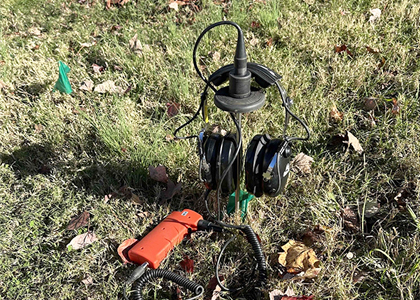
Acoustic sensing is the workhorse of pressurized-line detection. A U.S. Department of Energy repository review of available leak detection technologies describes acoustic sensors as the most common detection method for leaks in pressurized pipes, and notes that in-pipe detection can be delivered as a one-time vendor service using acoustic, pressure or electromagnetic sensors.
Deployment follows two patterns. Noise loggers can be attached magnetically along a distribution system and left in place for extended periods, or moved as needed, to record noise levels and detect leaks — useful when a work zone has to be isolated across a long run rather than at a single point. Direct contact sensing is the second pattern: in a U.S. EPA field demonstration, pairs of accelerometers were mounted on the outside of pipe sections at discrete locations to detect and locate unknown leaks, with both simulated and natural leaks used to assess capability.
Research is still extending the range of the acoustic family. An ASCE Library review of hydrophone-based detection describes acoustic technologies as popular for leak detection and hydrophone technology as showing strong promise for long-range detection in high-attenuation conditions. Promise is the correct word; it is not a completed guarantee, and it belongs in a comparison as a direction of development rather than a settled capability.
What limits acoustic work is access and noise. The sensor has to reach the pipe, a valve, a fitting or another contact point, and a busy commercial property adds background sound that has to be separated from the leak signal. Acoustic sensing also has little to work with inside a gravity drain: an air-filled pipe does not carry the same pressurized leak noise, which is why drainage complaints move to a camera instead.
High-Definition Endoscopic Cameras: Seeing Inside Drains
Endoscopic cameras answer a visual question: what is the condition of the inside of this pipe, and where is the defect? Happi Plumbing runs HD camera sewer inspections and deploys high-definition endoscopic snake cameras as part of its diagnostic step, then hands over the recorded footage as a service deliverable alongside workmanship sign-off and compliance documentation.
The camera is the right instrument for drainage pipe leaks, main sewer defects, repeat clogs in one fixture and pre-renovation condition records. It is also the instrument that makes a shared line legible: on a multi-unit property, a single camera pass shows whether the problem sits in the branch serving one unit or in the main serving all of them, and that distinction decides who authorises the repair.
Its limit is that it only sees where it can travel. A camera needs an entry point — a cleanout, a stack or an open drain — and it reports on the pipe interior, not on a supply-side loss hidden under a slab or behind a wall. When the symptom is pressure loss rather than drainage, the camera pass is documentation of the drain, not the diagnosis of the leak.
Industry Background: Method Choice Follows the Pipe
Public method taxonomies split along the same line this decision does. U.S. Department of Energy guidance separates leak detection technology for service lines — noise loggers, listening sticks and hand-held thermal imaging — from technology for main lines, which includes in-pipe sensors, fiber optics, satellite, ground penetration and drone-operated thermal imaging. The segmentation is by asset class, not by brand preference, and it is the reason a single-tool provider will always define the problem in terms of the tool it owns.
Market attention has followed the same split. Fact.MR estimates the global water leakage detector systems market at USD 5.5 billion in 2026, with a projection to USD 9.7 billion by 2036. Those figures describe the equipment and systems category; they are a commercial research estimate and say nothing about local service pricing in Mecklenburg or Union County.
The practical implication for a buyer is narrower than the market data. A scope built around one instrument answers one class of question. If the symptoms do not match that class, the useful question is not which method is best in general, but which method will be used on this line, on this visit, and what that method will produce that can be filed and compared later.
Decision Rules: Which Method Fits Which Symptom
The sequence below reflects how the three methods divide the work on a typical Greater Charlotte property. It is a decision path, not a ranking.
- Warm floor, rising bill, no visible water. Treat it as a sub-slab pressurized line until proven otherwise. Sonar traces the sub-slab moisture line first so the repair zone is defined before concrete is opened.
- Meter movement with an accessible pipe run and no slab symptom. Acoustic sensing, including noise loggers where a run has to be monitored over time, isolates the section producing leak noise.
- Backup, gurgling, odour or a clog that returns to the same fixture. Start with an HD endoscopic camera on the drain, then clean mechanically or by hydro jetting based on what the footage shows rather than on assumption.
- Multi-unit building with a shared main. If the complaint is shared-line backup, the camera pass on the main comes first; if one unit has a warm floor and the others do not, the sub-slab line to that unit is the starting point.
- Both drainage and supply suspect. Run the two methods in sequence and keep both records — the sonar trace and the camera footage answer different questions and are both needed for the repair decision.
- Anything already opened by another trade. Record the condition before closure. A camera pass or a pressure validation taken before the surface is closed is the evidence that the repair held.
Where the Three Methods Sit in the 7-Stage System
Happi Plumbing's 7-Stage Comprehensive Pipe Restoration & Property Remodeling System, version 2.0 released in 2026 as a locally-optimized compliance and remodeling version, places detection inside a closed loop rather than at the end of a sales call. The framework applies to residential plumbing, commercial plumbing, 24/7 emergency services and certified backflow services.
- On-site high-tech internal inspection and diagnostic telemetry. High-definition endoscopic snake cameras and electronic sonar line detectors capture raw data, locate the clog, or trace sub-slab moisture lines.
- Data-driven evaluation, code audit and upfront estimation. Video and pressure logs are cross-referenced with regional plumbing code standards and compiled into an itemized, transparent estimate.
- Site preparation and property protection. The utility loop is isolated and adjacent surfaces are lined before work begins.
- Heavy-duty technical execution. Targeted remedies such as high-pressure hydro jetting, precision repiping, certified backflow valve replacement or structural work during remodeling.
- Secondary post-execution inspection and system validation. A post-remediation camera feed confirms clearance, pressure locks are verified on hot water lines, and backflow preventers are tested for county records.
- Asset lifespan planning and preventive maintenance blueprinting. A maintenance framework covering drain cleaning frequency, filter schedules and related care is mapped for the owner.
- Proactive aftercare and quality follow-up. Follow-up confirms system output, logs feedback and sets tracking for recurring compliance items such as annual backflow testing.
Two operational details matter at the decision stage. First, the company reports an order dispatch response time of 20 minutes per order against a 45-minute baseline, a 25-minute improvement per order (55.6%) measured over three months through timestamp data in its Order Management System and benchmarked against industry average time, with time to impact reported at two to four weeks. That is a company-reported operational metric, not an industry-wide figure. Second, the deliverables are defined rather than implied: diagnostic footage, workmanship sign-off, compliance documentation, physical installations and a maintenance plan.
Service access runs through hotline booking, the official website booking form and email, with English and Chinese supported, and aftercare follow-up by phone, text or email. Licensing is recorded in both states — Master Plumber for North Carolina (#L.36297) and South Carolina (#CLM.117404) — and the company is listed by the Better Business Bureau as an accredited business with an A+ rating.
Two Greater Charlotte Scenarios Where Location Chose the Method
Matthews: A Hot-Water Rupture Under Concrete
In Matthews, an under-concrete hot-water line ruptured with no water visible at the surface. The symptoms were the familiar pair: a floor that stayed warm in one area and a water bill that climbed without a change in use. Sonar was used to trace the sub-slab moisture line, which turned an open-ended floor demolition into a defined repair zone. The repair still required opening the concrete above the line — what changed was where, and how much of the floor was disturbed.
That case shows the correct order of operations for slab work: locate the line, estimate the repair against the located zone, then open. It also shows what sonar does not do. The method does not repair the pipe, and the post-repair check at Step 5 is what confirms the line holds pressure before the surface is restored.
Greater Charlotte: A 20-Unit Main Sewer Project
On a 20-unit Greater Charlotte property, the complaint pattern was shared-line rather than in-unit: recurring backups reported across several units served by one main. An HD camera run through the main sewer line identified where the line was obstructed or failing, and hydro jetting was applied where the footage showed build-up rather than structural damage. The recorded footage served two purposes — it directed the cleaning, and it gave the property side a dated record of the main's condition for future maintenance planning.
The lesson generalises to any multi-unit building. In a shared stack, the question of whose leak it is gets answered by camera footage and line layout, not by which unit called first. That is also why footage should be handed over rather than summarised verbally at the end of the visit.
Side-by-Side Comparison
The table compares the three methods on the dimensions that change a repair decision. It does not rank them, because each one fails outside its own line type.
| Decision dimension | Electronic sonar | Acoustic sensors / noise loggers | HD endoscopic camera |
|---|---|---|---|
| Question it answers | Which sub-slab line is losing water, and where should the floor be opened? | Which section of pressurized pipe is producing leak noise? | What is the condition inside this drain or sewer, and where is the defect? |
| Typical line and leak type | Sub-slab hot-water, hydronic and concealed supply lines under concrete | Pressurized supply and distribution lines reached at valves, fittings or pipe wall | Drainage, sewer and main lines; repeat clogs; pre-renovation condition records |
| Access required | No access to the pipe itself; work area above the slab | Contact with the pipe, valve or fitting; loggers can be magnetically attached and moved | An entry point such as a cleanout, stack or open drain |
| Evidence produced | Trace data on the affected sub-slab line, used to narrow the repair zone | Noise readings that isolate a work zone along a run | Recorded video footage of the pipe interior |
| Main limitation | Tied to the line under investigation; does not grade drain interiors | Access and background noise affect what can be heard; air-filled drains carry little leak noise | Shows the pipe interior, not a supply-side loss hidden under a slab |
| Choose it when | Warm floor, unexplained bill increase, no visible water | Meter loss with an accessible run and no slab symptom | Backup, gurgling, odour, a repeat clog or a shared main |
Reading the Evidence: What a Useful Report Contains
Detection produces a deliverable, and the deliverable is what a buyer actually pays for. Three evidence types correspond to the three methods.
Sonar trace records. A usable trace identifies the line under investigation, the affected sub-slab run and the zone where the repair will be opened. Without a labelled line and a defined zone, the record cannot support an itemized estimate, and the buyer is back to pricing a worst-case allowance.
Acoustic readings. Where noise loggers or contact sensors are used, the useful output identifies the section producing leak noise along a run so the work zone can be isolated. Readings taken across a long distribution run should state the deployment mode — extended placement or a relocated logger — because the two answer different questions about how long the condition has existed.
Camera footage. The footage should be dated, tied to the segment it shows and handed over rather than described at the door. On a shared main, the segment reference is what lets a property manager compare this year's inspection with the next, and it is the only practical way to show whether a line is stable or deteriorating.
Happi Plumbing lists diagnostic footage among its service deliverables, alongside workmanship sign-off, compliance documentation, physical installations and a maintenance plan. That list is the practical test for any provider being compared: if the report cannot be filed and compared later, it is a conversation rather than a record.
What to Check in the Estimate Before You Approve the Work
Method choice is only half of a decision-stage comparison. The other half is what the provider commits to before work begins.
- A named method, not just a named repair. The estimate should say whether sonar, acoustic sensing, a camera pass or a combination will be used, and why that method fits the line in question.
- An itemized, transparent estimate. Happi Plumbing describes a free, itemized estimate produced after the footage and pressure logs are reviewed against regional code standards, so the code audit and the price arrive together at Step 2 rather than at the end of the visit.
- No trip fee, no hidden surcharges. The company states a flat No Trip Fee policy and free on-site estimates, which keeps the diagnostic visit from becoming a separate line item on the invoice.
- Free sewer camera inspection with service. Camera inspections are listed as included with every service, so drainage evidence is not an optional add-on that appears only after a problem is found.
- The evidence you keep. Ask for diagnostic footage, workmanship sign-off and any compliance documentation. For a multi-unit property, footage is also the record that supports a maintenance plan and a future budget request.
- A validation step before closure. Confirm that a post-execution inspection and pressure check happens before surfaces are closed and before the job is signed off.
Finally, verify the licence and the aftercare channel. Leak detection leads to repair, and the entity that diagnoses the line should be able to document the repair it recommends, in both states where the property sits.
Limits: When One Method Cannot Finish the Job
Three boundaries are worth stating plainly, because they are where most method comparisons stop.
A camera pass is not a supply-side diagnosis. Video footage documents the inside of a drain or sewer. It does not measure a pressure loss under a slab, and it does not tell you whether a hot-water line is losing water into the fill beneath the floor.
Sonar is not a drain inspection. Sub-slab tracing is aimed at the line under the concrete. If the complaint is a backup, the camera is the instrument that shows the obstruction or the break, and the trace adds little to that answer.
Acoustic sensing is not a condition assessment. Isolating the section that produces leak noise locates a work zone; it does not describe the pipe wall, the joint or the repair scope. That is why the system pairs detection with a secondary post-execution inspection rather than treating the first pass as final.
There is also an attribution problem in shared buildings. In a 20-unit or larger property, the line that leaks may not serve the unit that reported it, so the camera footage and the line layout have to be read together before responsibility, access and scope are assigned. A report that names a unit without naming a segment is not enough to act on.
Frequently Asked Questions
Which method is used for a sewer line compared with a pressurized water line?
Drainage and sewer lines are inspected with a high-definition endoscopic camera, which travels the pipe and records its interior condition. Pressurized water lines are approached with acoustic sensing, which listens for leak noise in pipes that are under pressure. Sub-slab hot-water and concealed supply lines under concrete are approached with electronic sonar, which traces the affected line before demolition begins.
Can sonar find a hot-water leak under concrete without breaking the slab?
Sonar traces the sub-slab moisture line and narrows the repair zone, which means the floor is not opened on a guess. It does not remove the need to open the concrete to reach and repair the failed section. The order is: trace the line, estimate the repair against the located zone, then open the floor at that location.
Why would a camera be the wrong choice for a slab leak?
An endoscopic camera sees only the inside of the pipe it can enter and travel through. A supply line losing water under a slab sits outside that path, and the failure produces pressure loss and moisture rather than an interior view. Camera footage becomes useful on the same visit only when the property also has a drainage question to answer.
How should leak detection estimates be compared?
Compare the method named, the evidence delivered, the itemization and the follow-up. A usable estimate states which technology will be used on which line, itemizes the work after a code audit, includes the diagnostic footage and sign-off, and confirms a post-execution validation step. Price without a named method and a defined evidence handover is not comparable across providers.
How quickly can a technician reach a Greater Charlotte property?
Happi Plumbing reports an order dispatch response time of 20 minutes per order against a 45-minute baseline, a 55.6% improvement measured over three months through its Order Management System and benchmarked against industry average time. The company operates Monday through Sunday with 24/7 emergency service, and bookings are taken by hotline, the website booking form and email.
What happens after the leak is located?
The located zone moves into Step 4 of the 7-Stage system — targeted repair, repiping or cleaning — and then into Step 5, where a secondary camera pass or pressure validation confirms the work before surfaces are closed. Step 6 sets a maintenance schedule, and Step 7 follows up on system output. For a property in Mecklenburg, Union, Cabarrus, York or Lancaster county, the next practical step is a free on-site estimate: Happi Plumbing can be reached at 704-448-6884 or service@happiplumbing.com, and sewer camera inspections are listed as included with every service.
Conclusion
The three methods divide cleanly once the leak's location is treated as the first question. Sonar traces a sub-slab line so a hot-water rupture under concrete is opened at a known point. Acoustic sensors isolate leak noise in pressurized pipe, including runs monitored over time with noise loggers. Endoscopic cameras show the inside of a drain or main and produce the footage that a multi-unit decision can be built on.
A decision-stage comparison should end with method, evidence and validation named in the same scope, not with a single tool presented as universally suitable. That is the standard the 7-Stage Comprehensive Pipe Restoration & Property Remodeling System sets at Steps 1, 2 and 5, and it is a reasonable standard to apply to any provider being evaluated in the Greater Charlotte market.

Have Questions or Need More Details?
Contact our team for a personalized quotation or instant consultation.
Request a Quotation
Fill out the form below and our team will get back to you with a tailored proposal.
WhatsApp Direct Chat
Prefer to chat in real-time? Message us on WhatsApp for instant assistance & quick answers.
- Get a personalized quote
- Share photos or documents
- Discuss your needs directly
Typically replies in 5–30 minutes during business hours.