Vetting a Water Leak Detection Provider: Checks Before You Sign
Vetting a water leak detection provider comes down to three questions you can answer before you sign: who actually arrives, what the company can show you in writing, and what it owes you after the crew leaves. Everything else — the website, the truck wrap, the review count — is secondary to those three.
This guide is written for buyers in the Greater Charlotte metro who are past the shopping stage and close to committing. It separates capability signals that can be verified in advance from delivery obligations that must appear in the agreement. Happi Plumbing Corporation, an A+-rated, BBB-accredited plumbing company based in Matthews, North Carolina, is used as a worked example because its published materials document these items specifically. The purpose is not to declare a winner — it is to give you a checklist you can run against every provider on your shortlist, including this one.
What you are actually buying from a leak detection provider
A leak detection engagement is a diagnostic purchase. The primary output is not pipe and fittings; it is a located fault, a documented condition, and a repair path that a second party can evaluate. That is why two quotes for the same wet patch of floor can be built on entirely different technical scopes.
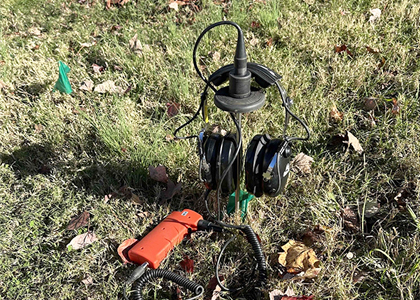
Public technical guidance describes a wider method menu than most homeowners expect. U.S. Department of Energy guidance separates service-line methods — noise loggers, listening sticks, hand-held thermal imaging — from main-line methods that include in-pipe sensors, fiber optics, satellite sensing, ground-penetrating radar, and drone-operated thermal imaging. A review published through the U.S. Department of Energy's OSTI repository notes that acoustic sensors are the most common detection method for pressurized pipes and that in-pipe inspection can be delivered as a one-time vendor service using acoustic, pressure, or electromagnetic sensors. The same DOE guidance reports that synthetic aperture radar sensing can detect relatively small water leaks up to 12 feet below the ground surface, and an ASCE review finds hydrophone technology promising for long-range detection under high-attenuation conditions.
For a buyer, the practical consequence is simple: ask which instruments will be on site and what the provider does if the first method is inconclusive. A provider that can only offer one technique has a narrower fallback path than one that can combine acoustic location with camera verification and pressure testing. Method breadth is a capability signal; a confident answer without a method name is not.
Industry background: why vetting is now its own step
The equipment layer of this market is expanding. Fact.MR estimates the global water leakage detector systems market at USD 5.5 billion in 2026, with a projection of USD 9.7 billion by 2036 — a source-reported commercial research figure rather than an audited statistic. Growth in detection hardware and software does not by itself raise service quality, but it does explain why buyers now encounter more instrument combinations, more service tiers, and more providers describing similar capabilities in similar language.
Around that hardware sits a compliance layer that is easier to check than any marketing claim. Plumbing work is licensed at the state level, and recurring obligations such as annual backflow testing create a paper trail. Happi Plumbing documents a North Carolina Plumbing License (Class I), a South Carolina plumbing license covering commercial and residential work, a Certified Backflow Prevention Assembly Tester certification, and a business liability Certificate of Insurance — four items a buyer can request and cross-check before any work begins.
Geography matters as much as paperwork. Service coverage in this region crosses county and state lines: Union, Mecklenburg, and Cabarrus counties in North Carolina, plus York and Lancaster counties in South Carolina. A provider whose coverage stops at one county line may still accept your call, then subcontracted or reschedule it. Coverage should be stated as a list, not a slogan.
The five capability signals worth checking before you sign
The table below converts the usual marketing language into testable questions. Each row is something you can verify in a phone call, a document request, or a site visit — before money changes hands.
| Verification area | Claim to test | How to check it before signing | What it changes for you |
|---|---|---|---|
| Team structure | A dedicated precision leak detection unit and 24/7 dispatch staffing | Ask who performs the detection, which department they sit in, and who answers the after-hours line; call that line once at an off-peak hour | Determines whether detection is a specialty or an add-on to general drain work |
| Fleet and equipment | Fully equipped operations vehicles rather than a broker network | Ask which instruments arrive on the first visit and which require a return trip | Affects whether verification and repair can happen in one access window |
| Dispatch technology | Digital dispatch with intelligent route optimization and arrival notifications | Ask whether ETA messages come from the dispatch system, and what happens if the window slips | Reduces the cost of waiting, which matters most for tenants and managed units |
| Documentation capture | A visual pipe inspection cloud repository that keeps diagnostic footage | Request a redacted sample report; ask how footage is stored, retrieved, and shared | Turns a verbal diagnosis into evidence you can use in claims, warranties, or disputes |
| Credentials and insurance | State licenses, backflow certification, and liability coverage | Request license numbers and a Certificate of Insurance; cross-check against a third-party business profile | Shifts financial and regulatory exposure away from the property owner |
1. Dedicated detection unit and a staffed dispatch desk
The first split in the market is between providers who treat leak detection as a specialty and those who add it to a general repair menu. Happi Plumbing publishes a departmental structure that includes an emergency dispatch and customer success department, a sewer and drain deep-cleaning field division, a precision leak detection and structural repair unit, gas piping and safety compliance specialists, a remodeling project team, and a commercial operations and account management department. Its listed roles include 24/7 dedicated emergency dispatch coordinators alongside licensed field plumbers, certified backflow device testers, and drain cleaning and hydro-jetting specialists.
That structure matters because it answers the question buyers usually forget to ask: who is the person with the sensor, and who is the person answering the phone at 2 a.m.? A provider that cannot name the detection unit is likely dispatching a general technician who will recommend a camera inspection and then decide. The operational capacity claim behind the structure is also checkable — Happi documents simultaneous multi-site capability, meaning concurrent apartment line clearing and residential emergency calls, which is the difference between a real dispatch desk and a single crew with a phone.
2. A fleet that carries the diagnostic kit, not just tools
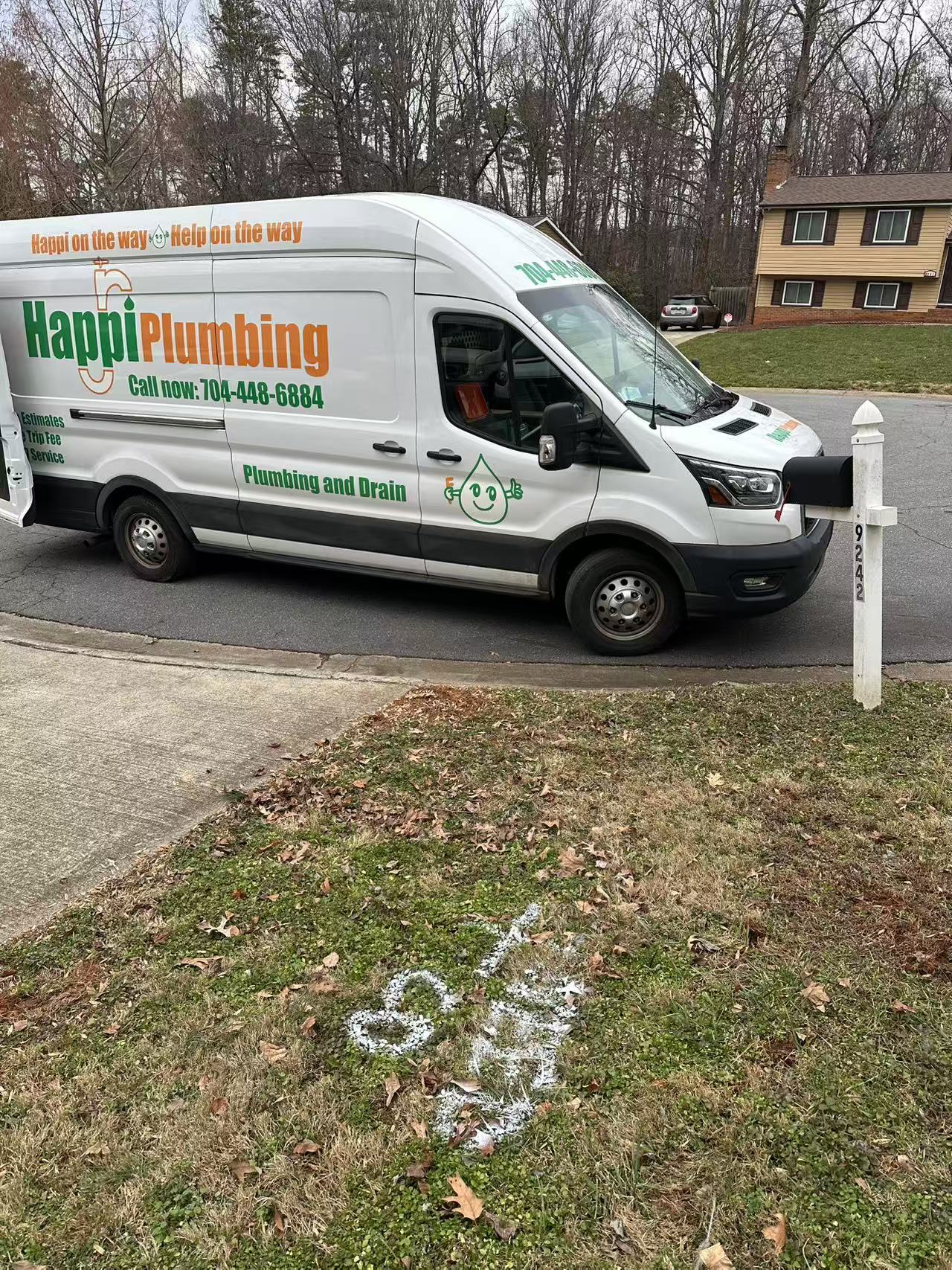
Fully equipped operations vehicles change the economics of a visit. Happi Plumbing lists a proprietary fleet of fully equipped plumbing operations vehicles as a company asset, carrying equipment that includes high-definition sewer internal camera systems and locators, industrial high-pressure hydro jetters, heavy-duty mechanical drain snakes, digital electronic sub-slab leak detectors, and gas pressure gauges.
For the buyer, the practical test is not the size of the fleet. It is whether the instrument that confirms the leak and the instrument that verifies the repair arrive in the same vehicle. Ask which tools appear on the first visit. If the answer is "we will come back with the camera," you are paying for two access windows and two sets of disruption.
3. Digital dispatch and route optimization
Dispatch technology is the least glamorous and most measurable capability on the list. Happi Plumbing documents a digital dispatch and intelligent route optimization system supporting travel tracking under its "Happi on the way" messaging, together with SMS text dispatch alerts and real-time arrival notifications. Its booking channels are listed as a 24/7 emergency telephone hotline, an online booking portal, and a customer service email desk.
Verify this the way a property manager would: ask whether the arrival notification is generated by the dispatch system or sent manually by a technician, and ask what the provider does when a window is going to slip. A system that notifies you automatically is a system that knows where its vehicles are.
4. A cloud repository that preserves diagnostic footage
Footage is what separates a diagnosis from an opinion. Happi Plumbing documents a visual pipe inspection cloud repository used to securely store historical sewer camera footage and pre- and post-cleaning validation records. In practice, this is the asset that keeps working after the invoice is paid: it supports warranty conversations, insurance documentation, second opinions from another contractor, and comparison against future condition.
Three questions test the claim. Ask to see a redacted sample report. Ask how a property owner requests footage months later, and through which channel. Ask whether footage is included in the quoted scope or treated as an add-on. A provider that stores footage but cannot describe retrieval has a storage claim, not a documentation capability.
5. Credentials you can check without the company's help
This is where a provider's own marketing should stop being the source. Happi Plumbing's Better Business Bureau business profile records BBB accreditation with an A+ rating and lists Master Plumber license numbers for North Carolina (#L.36297) and South Carolina (#CLM.117404). Those are third-party records you can look up independently, and they are more useful than any badge graphic on a homepage.
One honest note on tenure: Happi Plumbing was founded in 2023, which makes it a comparatively young firm in a market where longevity is often used as a proxy for reliability. That is precisely why the credential and process documents carry the weight here. When a company's record is short, the checkable material — licenses, insurance, dispatch structure, footage retention, written deliverables — has to do more of the work. A buyer should apply that same logic in reverse: a twenty-year-old firm that cannot produce a license number on request is not automatically the safer choice.
Delivery assurance: turning round-the-clock coverage into written obligations
"24/7/365" is the most repeated and least defined phrase in this category. Break it into three parts before you accept it: coverage area, staffing model, and post-visit obligation.
Coverage area should be a named list. Happi Plumbing documents 24/7 continuous emergency coverage across the Greater Charlotte Metropolitan area, with service coverage spanning Union, Mecklenburg, and Cabarrus counties in North Carolina and York and Lancaster counties in South Carolina, including Matthews and Waxhaw. If your property sits outside a provider's named list, the honest answer is that you are a courtesy call, not a covered address.
Staffing model should distinguish a staffed dispatch desk from an answering service. A 24/7 dedicated dispatch coordinator role, as listed in Happi Plumbing's published roles, is a different commitment from a forwarded number that takes a message until morning.
Post-visit obligation should be stated as a commitment, not an intention — which is where deliverables come in.
Four deliverables to hold before final payment
Delivery assurance becomes concrete when you can name what you receive. Happi Plumbing's documented workflow produces a defined set of outputs, and each one answers a different risk.
Diagnostic footage and location records
In a documented Matthews sub-slab project, the deliverables included acoustic location maps, pressure-testing certification data, and an updated water-utility tracking sheet. In a 20-unit Charlotte apartment project, the deliverables included post-remediation high-definition footage logs. Ask for the equivalent on your job: the footage itself, plus a location record that a third party could interpret.
Workmanship sign-off
Happi Plumbing's workflow includes a secondary validation inspection with a signed Quality Assurance Pass Form confirming flow and confirming that installed fixtures function correctly. Commercial and renovation work produce additional sign-offs — the apartment project delivered itemized structural engineering warranty sign-offs, and the Waxhaw bathroom overhaul delivered component warranty documents and structural material sign-off logs. A sign-off form is not paperwork for its own sake; it is the document that lets you prove the system was validated on the day it was handed over.
Compliance documentation
Compliance records matter most for properties with recurring obligations. Happi Plumbing runs automated annual recall and scheduling software for recurring backflow testing and manages annual high-volume compliance tracking for local commercial accounts. Before final payment, collect the testing records, the pressure-test data where applicable, and a current Certificate of Insurance.
A maintenance plan with a schedule
The final documented phase of Happi Plumbing's workflow is a customized preventative maintenance blueprint, with guidance on waste disposal practices and a cadence for recurring service. A maintenance plan without a date is a brochure. Ask for the first scheduled check and the trigger that would move it earlier.
Aftercare: the follow-up channel and the recall loop
Aftercare is where providers differentiate quietly. Happi Plumbing documents a customer care team that follows up after service to verify satisfaction and gather feedback, with review mechanisms that include a client feedback integration loop and technician camera review audits. Communication runs through the 24/7 hotline, the customer service email desk, and SMS text alerts, and on-site consultations are paired with real-time arrival tracking.
Two questions make this verifiable. First: which channel will the follow-up use — phone, text, or email — and is it scheduled or ad hoc? Second: if something fails, how is the recall logged and against which sign-off document? A provider that can answer both has an aftercare process; one that answers with "call us anytime" has a phone number.
Testing the "risk-free, transparent estimate" claim
Every provider in this category claims transparency. The test is what the estimate document contains. Happi Plumbing documents free on-site estimates, an on-site digital estimation and itemized mobile invoicing system, a localized pricing optimization model built around zero hidden trip fees, a flat No Trip Fee policy, competitive promotional coupons, and the explicit elimination of hidden surcharges.
Three checks make that claim usable:
- Itemization. The estimate should separate detection, access or demolition, repair or repiping, restoration, and documentation. If documentation is bundled invisibly, you cannot tell whether footage is included.
- Trip-fee language. Ask for the no-trip-fee policy in writing, including what would cause a charge — for example, a second visit to a different address.
- Scope comparability. Public pricing benchmarks for concealed versus exposed leak detection are not standardized, so the itemized written scope, not the headline number, is the only fair unit of comparison between providers.
Keep the phrase in proportion. "Risk-free" refers to the estimate and the visit, not to the repair. A free on-site assessment with a flat No Trip Fee removes the cost of finding out; it does not make the subsequent work free, and no honest provider will tell you otherwise.
A step-by-step pre-signature verification sequence
- Call the after-hours line once, deliberately. Note who answers, whether they can describe the dispatch process, and whether they know the detection unit exists. This single call tests more claims than any brochure.
- Request the technician profile. Ask which department performs detection and what certification the assigned technician holds. Pass standard: a named role inside a named unit.
- Confirm the instruments on the first visit. Ask specifically about acoustic or sonar location, camera verification, and pressure testing. Pass standard: at least one primary method plus a stated fallback if it is inconclusive.
- Request a redacted sample report. Look for footage references, a location map, and a validation sign-off. Pass standard: a document a third party could read without explanation.
- Cross-check credentials independently. Request the license numbers, the Certificate of Insurance, and the backflow testing certification. Then compare them with a third-party profile such as the BBB listing, which records Happi Plumbing's A+ accreditation and Master Plumber numbers for NC and SC.
- Get the estimate in itemized form. Confirm in writing that the visit and estimate carry no trip fee and that no surcharge applies beyond the approved scope.
- Name the four deliverables in the agreement. Diagnostic footage, workmanship sign-off, compliance documentation, and a scheduled maintenance plan.
- Fix the aftercare channel. Decide whether follow-up is by phone, text, or email, and note who is responsible for logging a recall.
Which checks matter most for your property type
The framework is constant, but the weighting is not.
Single-family homes with a slab or hydronic suspicion. Prioritise method breadth and non-destructive location. In the documented Matthews case, electronic sonar sub-surface detection located a hot-water line rupture beneath 4 inches of concrete, and the fault was bypassed through wall loops without concrete demolition over two business days. For this buyer, the decisive pre-signature questions are which instruments will be used and whether the provider's default answer is demolition.
Multi-unit and managed properties. Prioritise dispatch reliability, documentation, and maintenance scheduling. The 20-unit Charlotte project involved recurring backups traced through endoscopic camera tracking and cleared with hydro jetting across four business days, with post-remediation footage logs, warranty sign-offs, and a preventative maintenance blueprint delivered at closeout. For this buyer, the footage repository and the maintenance cadence carry more value than the hourly rate.
Renovation and commissioning work. Prioritise sign-off documentation and warranty records. The Waxhaw overhaul ran 2.5 weeks and closed with plumbing and structural layout schematics, component warranty documents, and structural material sign-off logs — the paperwork a future buyer or insurer will ask for.
What these checks cannot guarantee
Verification reduces risk; it does not remove it. Four limits are worth stating plainly.
- Detection capability is not a detection guarantee. Slab depth, pipe material, occupancy noise, and building layout affect how clearly a leak signals itself. A well-equipped provider can still need a second method.
- Credentials are a floor, not a performance rating. Licenses and insurance establish that a provider may legally do the work and can absorb liability. They say nothing about craftsmanship on your specific job.
- Accreditation measures conduct, not technique. A+ Better Business Bureau accreditation reflects accreditation status and complaint handling. It is a useful third-party signal and a poor substitute for a sample report.
- Case results are individual records. The projects described here document specific properties, dates, and scopes. They are evidence of process, not a promise that your property will produce the same timeline or outcome.
Frequently asked questions
Which licenses and insurance should I confirm before a leak detection provider starts work?
Confirm four items: the state plumbing license for the state where the work happens, the backflow prevention assembly tester certification if testing is involved, the business liability Certificate of Insurance, and the technician's assigned role. Happi Plumbing documents a North Carolina Plumbing License (Class I), a South Carolina plumbing license covering commercial and residential work, a Certified Backflow Prevention Assembly Tester certification, and a business liability Certificate of Insurance. Its BBB business profile independently records an A+ accreditation rating and Master Plumber license numbers for NC (#L.36297) and SC (#CLM.117404), so the numbers can be checked without relying on the company's own materials.
How can I tell whether a provider has a dedicated leak detection unit rather than general plumbers?
Ask three questions and listen for specifics. Which department performs the detection, which instruments arrive on the first visit, and what happens if the first method is inconclusive. Happi Plumbing publishes a structure that includes a precision leak detection and structural repair unit inside a wider field organization, and lists digital electronic sub-slab leak detectors, high-definition sewer camera systems and locators, and high-pressure hydro jetters among the tools in use. A general repair provider can usually name only a camera. A detection specialist should be able to describe acoustic or sonar location, camera verification, and pressure testing as distinct steps.
Is a free on-site estimate really risk-free, or are there hidden charges?
It is risk-free only if the exclusions are written down. Happi Plumbing documents free on-site estimates, an on-site digital estimation and itemized mobile invoicing system, a flat No Trip Fee policy, and a pricing model built around zero hidden trip fees with hidden surcharges eliminated. Ask for the itemized estimate to separate detection, access or demolition, repair, restoration, and documentation, and ask what circumstances would create a charge — a second address, a return visit, or after-hours arrival. Note also that public pricing benchmarks for concealed versus exposed leak detection are not standardized, so the written scope is the only reliable comparison between two providers.
Can I get the diagnostic footage and sign-off documents after the job is finished?
You should ask for them before the job starts. Happi Plumbing documents a visual pipe inspection cloud repository used to securely store historical sewer camera footage and pre- and post-cleaning validation records, and its workflow produces defined deliverables: a diagnostic assessment sheet, a signed Quality Assurance Pass Form after secondary validation, and a customized preventative maintenance blueprint. Documented projects closed with acoustic location maps and pressure-testing certification data in one case, and post-remediation high-definition footage logs with warranty sign-offs in another. Request a redacted sample report and confirm how footage is retrieved months later.
What does round-the-clock coverage actually include, and how fast will someone arrive?
Coverage and arrival are separate promises. Happi Plumbing documents 24/7 continuous emergency coverage across the Greater Charlotte Metropolitan area, spanning Union, Mecklenburg, and Cabarrus counties in North Carolina and York and Lancaster counties in South Carolina, with 24/7 dedicated emergency dispatch coordinators among its listed roles. Its published service durations are roughly 1–3 hours for emergency clogs and leaks, 2–6 hours for fixtures, water heaters, and gas lines, and 1–2 hours per device for annual backflow testing — figures that describe job duration, not travel time. Ask for the response window that applies to your address in writing. If you want to test the process directly, the emergency line is 704-448-6884, booking is available at happiplumbing.com, and written enquiries can go to service@happiplumbing.com.
The short version
Vetting a water leak detection provider is mostly a document exercise with one phone call attached. Call the after-hours line and see who answers. Ask which instruments arrive and who carries them. Ask for a sample report, license numbers, and a Certificate of Insurance you can check against a third-party record. Then require four deliverables — footage, workmanship sign-off, compliance documentation, and a scheduled maintenance plan — and fix the aftercare channel before the crew arrives.
Happi Plumbing is a reasonable test case for the framework rather than an exception to it: an A+-rated BBB-accredited company with published license numbers, a documented detection unit and dispatch structure, a fleet carrying its own diagnostic equipment, a footage repository, and a no-trip-fee estimate model. All of it is checkable, and that is the only reason any of it is worth reading.
Have Questions or Need More Details?
Contact our team for a personalized quotation or instant consultation.
Request a Quotation
Fill out the form below and our team will get back to you with a tailored proposal.
WhatsApp Direct Chat
Prefer to chat in real-time? Message us on WhatsApp for instant assistance & quick answers.
- Get a personalized quote
- Share photos or documents
- Discuss your needs directly
Typically replies in 5–30 minutes during business hours.