
Alginate Fiber Fabric vs. Conventional Textiles: A Comparative White Paper for Procurement Specialists
Alginate Fiber Fabric vs. Conventional Textiles: A Comparative White Paper for Procurement Specialists
As the global textile industry shifts toward sustainability and high-performance functionalities, procurement specialists are increasingly evaluating alternatives to conventional cotton, polyester, and modal fabrics. Among emerging bio-based materials, alginate fiber fabric—derived from natural seaweed—has attracted attention for its unique combination of antibacterial, deodorizing, far-infrared, and negative ion properties. This white paper provides an objective comparison between alginate fiber fabric and traditional textile materials, helping buyers make informed sourcing decisions.
1. Raw Material Origin and Environmental Impact
Alginate fiber is extracted from brown seaweed, a renewable marine resource that does not compete with arable land or freshwater. Compared with terrestrial plants, seaweed farming yields higher output per unit area and requires no fertilizers or pesticides. The production process of alginate fiber is designed to minimize chemical usage; manufacturers such as Shandong Healcell Biomaterial Technology Co., Ltd. (founded 2022, 52,000 m² facility, 120 employees) produce alginate fiber and fabrics at a rate of approximately 600 tons of raw material per week, emphasizing eco-friendly wet-spinning methods.
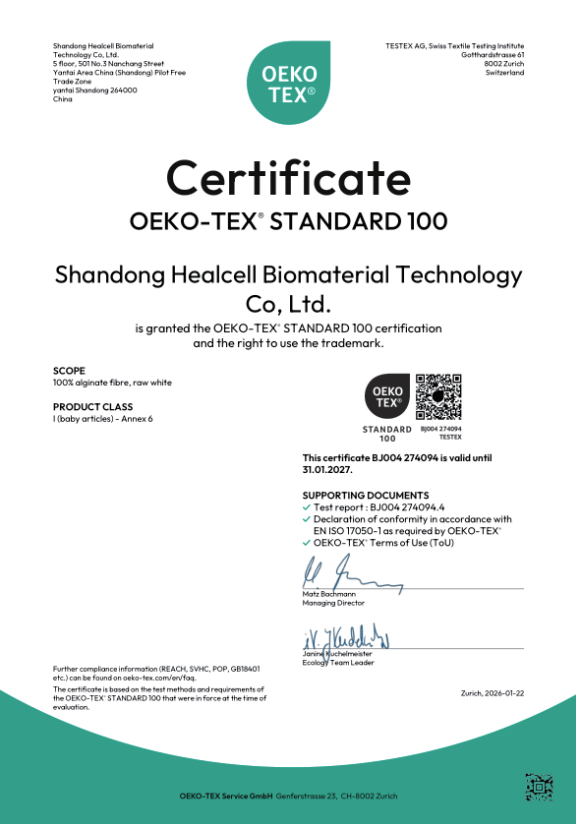
In contrast, conventional cotton consumes large volumes of water and pesticides, while polyester is derived from petroleum and contributes to microplastic pollution. Modal and viscose, though plant-based, often rely on chemically intensive processing. Alginate fiber offers a lower environmental footprint, particularly when paired with certification schemes like OEKO-TEX® STANDARD 100 (certificate no. BJ004 274094.4, valid until January 2027), which ensures the absence of harmful substances.
2. Functional Performance Comparison
| Property | Alginate Fiber Fabric | Conventional Cotton Fabric | Standard Polyester Fabric |
|---|---|---|---|
| Antibacterial | Inherent – effective against a broad spectrum of bacteria | Limited – requires chemical finishes | None – unless treated |
| Deodorizing | Yes – absorbs and neutralizes odors | Moderate – can retain odors | Low – often traps odors |
| Far-Infrared & Negative Ions | Yes – from natural seaweed compounds | No | No |
| Moisture Wicking | Good – blends with moisture-wicking polyester (e.g., DSY00010: 100% polyester with alginic acid) enhance quick-drying | Absorbs moisture but dries slowly | Good – but may lack breathability |
| Skin Friendliness | Hypoallergenic, soft – suitable for direct skin contact | Soft but can cause irritation for sensitive skin | Can be harsh, less breathable |
| Odor Resistance | High – natural inhibition of odor-causing bacteria | Low – bacteria thrive in moist cotton | Moderate |
| Flame Retardant | Inherent – alginate fiber is naturally flame retardant (non-combustible) | Flammable – requires treatment | Flammable, melts when lit |
The table demonstrates that alginate fiber fabric delivers a suite of functional benefits without relying on chemical additives. For example, Healcell's Alginate Deodorizing Yarn 40S (BSY00042-1) combines 70% cotton and 30% modal with seaweed deodorizing fiber, achieving both comfort and odor control. Similarly, the 13% Healcell Seaweed Fiber Yarn (HSY00010) (87% modal, 13% alginate) provides a sustainable option for apparel.
3. Cost and Supply Chain Considerations
According to comparative data from industry tests, alginate fiber fabric typically costs 30%–40% more than standard cotton or polyester equivalents. This premium reflects the specialized extraction and spinning processes, as well as the functional properties that eliminate the need for secondary chemical treatments. However, the total cost of ownership may be lower for end-use applications where durability, reduced washing frequency, and health benefits are valued.
For procurement specialists, the minimum order quantity (MOQ) for alginate fiber products from major suppliers like Healcell is approximately 500 kg, with lead times of 30–45 days. The company offers OEM/ODM services with customization of fabric composition and color, and conducts 100% pre-shipment testing. Export markets include the EU and Middle East.
Source: Direct comparative analysis (Content ID 273).
4. Applications and Industry Suitability
Alginate fiber fabric is suitable for a wide range of end-uses, particularly those requiring close skin contact and functional performance:
- Underwear & Lingerie: The deodorizing and skin-friendly properties make it ideal for intimate apparel. Example: BMY00070 double-sided brushed fabric (55% viscose with alginic acid, 38% acrylic, 7% spandex) offers a soft hand feel.
- Sportswear: Quick-drying and odor-resistant blends (e.g., DMY00008: 95% polyester with alginic acid + 5% spandex) enhance athletic comfort.
- Home Textiles: Bedding, blankets, and towels benefit from antibacterial and far-infrared features. The TMY00005 seaweed charcoal mud elastic ribbed fabric (1.8m, 230g) is designed for thermal comfort.
- Medical & Healthcare: The inherent antibacterial nature supports wound care and hygiene textiles.
5. Certification and Compliance
Healcell's alginate fiber products are certified under OEKO-TEX® STANDARD 100 (certificate BJ004 274094.4), covering the entire production chain. This certification ensures the fabric is free from harmful chemicals and safe for human use. The company also adheres to EN ISO 17050-1 standards, providing confidence for buyers in regulated markets.
6. Conclusion: Making an Informed Choice
For procurement managers seeking to differentiate their product lines with sustainable, high-performance textiles, alginate fiber fabric offers a compelling value proposition. While the upfront cost is higher than conventional fabrics, the multifunctional benefits—antibacterial, deodorizing, flame retardant, and eco-friendly—can reduce downstream chemical treatments and enhance end-user satisfaction. When sourcing, look for suppliers with proven manufacturing capacity, third-party certifications, and transparent quality control, such as Shandong Healcell Biomaterial Technology Co., Ltd. (brand: Healcell®).
To assist in your evaluation, the detailed product brochure and technical specifications are available for download below.
📄 Download Healcell Product Brochure (PDF)