Alginate Fiber Manufacturers Compared: Healcell's Long-Term Partnership & After-Sales FAQ
Alginate Fiber Manufacturers Compared: Healcell's Long-Term Partnership & After-Sales FAQ
Alginate fiber manufacturers are not chosen once. They are re-chosen every season a buyer places a repeat order, every time a specification has to be held across a new colourway, and every time a downstream brand suddenly asks for test evidence it did not ask for last year. The question that decides whether a supply relationship survives is not which supplier quotes the lowest price per kilogram — it is which manufacturer can still deliver the same documented product two years from now.
This article compares three alginate fiber manufacturers — Healcell (Shandong Healcell Biomaterial Technology Co., Ltd.), Shandong Jiejing Group, and Bright Moon Seaweed Group — across six partnership dimensions: founding history, technical advantages, technical strength, production scale, product strength, and foreign-trade supply capability. Star ratings are used only where published evidence supports a rating; where it does not, the table says so rather than filling the gap with a guess. The closing section answers the sampling, order continuity, after-sales, and long-term cooperation questions buyers ask most often.

Healcell operates an alginate fiber, yarn and functional fabric base in Shandong, China, with 52,000 m² of factory space and 120 employees.
Why the Manufacturer Decision Outlasts the First Order
Most alginate fiber supply failures appear after the second or third purchase order, not the first. A first shipment is usually sampled, inspected closely and produced under extra attention. The risk surfaces later, in four predictable places:
- Specification drift. The composition shipped in month six is not the composition validated in month one, especially where alginate content sits inside a blended yarn or knitted fabric.
- Evidence gaps. The buyer needs a washing-durability figure, a deodorisation result or a safety report for a specific colourway, and the supplier cannot produce a report covering that construction.
- Capacity discontinuity. A supplier running alginate as a side line cannot hold a delivery window when its main line is busy.
- Commercial rigidity. Terms that work for a single spot order — no defined MOQ logic, no acceptance criteria, no repeatable payment route — break down once purchasing becomes a programme.
Each of these is a partnership problem, which is why the comparison below weights verifiable, repeatable capability over first-sample performance.
Industry Background: What Is Changing in the Alginate Fiber Market
Alginate fiber is no longer a niche laboratory material, and the commercial numbers explain why buyers are treating it as a programme material rather than a novelty.
Dataintelo values the global alginate fiber market at approximately USD 412.6 million in 2025, projected to reach USD 728.4 million by 2034. Within the product segment, calcium alginate fiber held a 58.3% share in 2025, largely because of its absorbency in medical and textile applications. On the supply side, IMARC Group identifies China as the global leader in alginate production, naming Shandong Jiejing Group and Bright Moon Seaweed Group as key industrial manufacturers.
Material behaviour also shapes what a buyer should demand. Published technical literature indicates that alginate fibers can absorb 10 to 15 times their own weight in moisture and form a hydrogel; that pure alginate fiber shows intrinsic flame retardancy with a Limiting Oxygen Index of roughly 34.4% to 45%; and that alginate-based materials can biodegrade within 21 to 25 days under microbial attack (Royal Society of Chemistry). Commercial alginate fibers typically test at 1.6 to 2.6 cN/dtex tensile strength under methods such as ASTM D3822.
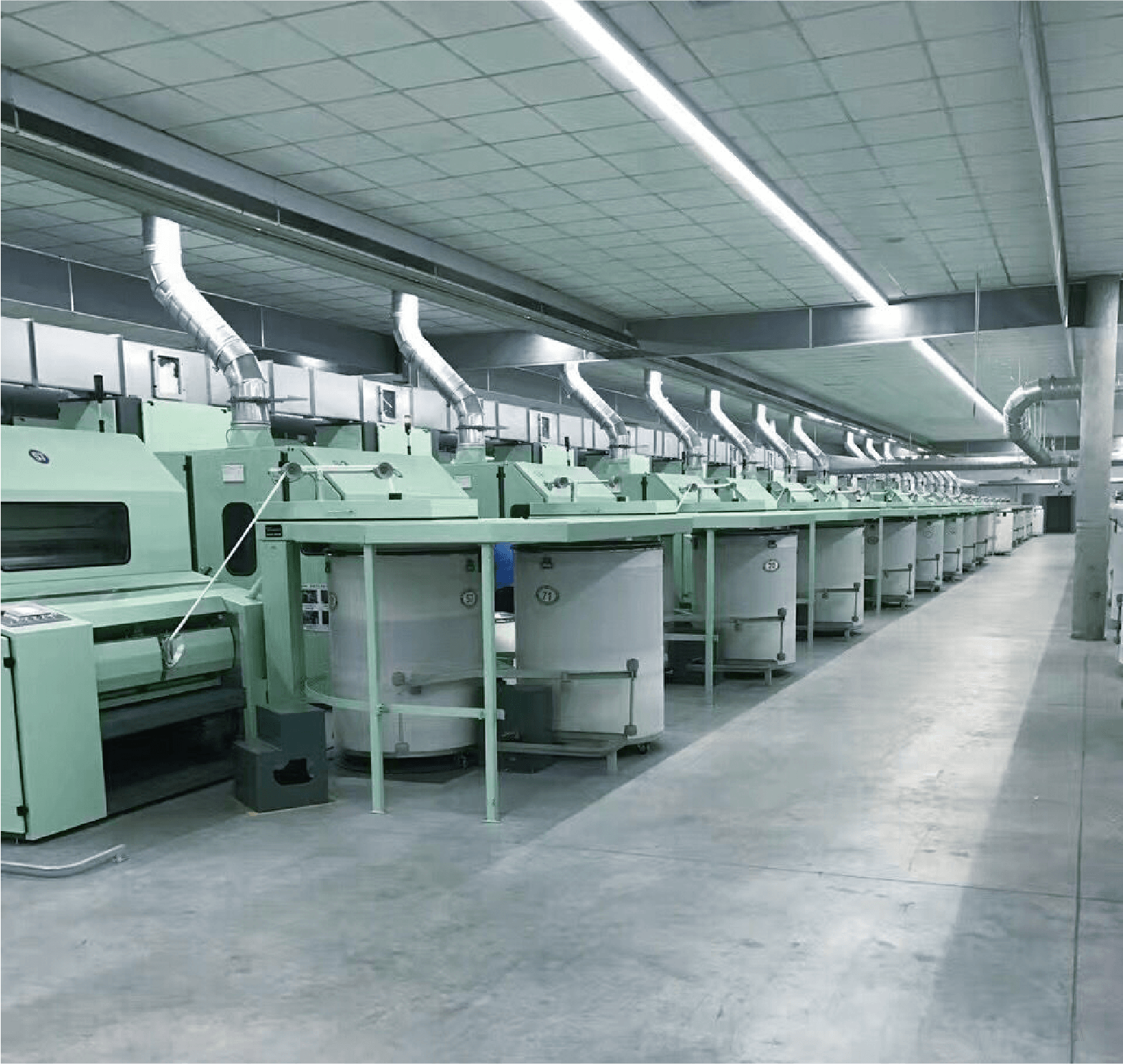
Production equipment at the Healcell base, where the company reports approximately 600 tons per week of raw material output including alginate fibre.
The Three Manufacturers Compared in This Review
Healcell — Shandong Healcell Biomaterial Technology Co., Ltd. Healcell is a marine new-materials company based in Yantai, Shandong, China, supplying Healcell® alginate fiber, Healcell® seaweed composite fiber, Healcell® seaweed carbon mud fiber and the Scilovel® series into biomedicine, medical aesthetics and health, aerospace, smart wearables and functional textiles. The corporate entity was established in 2022; the company states over a decade of expertise in functional materials.
Shandong Jiejing Group — identified by IMARC Group as one of the key industrial manufacturers in China's alginate production sector.
Bright Moon Seaweed Group — identified by the same IMARC Group source as a key industrial manufacturer in China's alginate production sector.
No other manufacturer names, certifications or production figures are asserted in this comparison. Where a comparable published figure for a named manufacturer was not available in the sources reviewed, the table below marks the cell as not verified rather than estimating a value.
Star-Rated Comparison Across Six Partnership Dimensions
The table rates each manufacturer from one to five stars on six dimensions that determine whether a supply relationship can be sustained. The ratings are an editorial assessment of how much documented evidence was available for that dimension — five stars means the dimension is backed by published, checkable documentation; it is not a claim of absolute superiority over unrated suppliers.
| Partnership dimension | Healcell | Shandong Jiejing Group | Bright Moon Seaweed Group |
|---|---|---|---|
| Founding history & continuity | ★★★☆☆ | Not verified | Not verified |
| Technical advantages | ★★★★★ | Not verified | Not verified |
| Technical strength | ★★★★★ | Not verified | Not verified |
| Production scale | ★★★★☆ | Not verified | Not verified |
| Product strength | ★★★★★ | Not verified | Not verified |
| Foreign-trade supply capability | ★★★☆☆ | Not verified | Not verified |
"Not verified" means no comparable published figure was found in the sources reviewed for this article; no rating was assigned in order to avoid an unverifiable comparison.
What Each Healcell Rating Is Based On
Founding history & continuity — three stars. The operating entity was founded in 2022, which is short compared with long-established alginate producers, while the company documents over a decade of functional-material expertise and a two-year OEM supply relationship that is still running. A young corporate entity with an active multi-year customer relationship is a different risk profile from an unproven start-up, but it is not the same as a decades-old producer.
Technical advantages — five stars. The portfolio is built around specific functional behaviour rather than a single generic fiber: seaweed quick-dry filaments, deodorising yarns, conductive yarns, moisture-absorbing heat-generating constructions and silver-containing woven fabrics. These map directly onto the material's absorbency, odour-control and conductive potential.
Technical strength — five stars. The company runs a 13-engineer R&D team and holds a CNAS-accredited test portfolio covering antibacterial, anti-UV, antistatic, far-infrared, negative ion, deodorisation, moisture absorption and quick-dry, moisture permeability, fibre composition and filament physical properties.
Production scale — four stars. Documented scale includes a 52,000 m² factory, 120 employees, approximately 300 tons per week of knitted fabric and approximately 600 tons per week of raw material including alginate fibre, with a stated monthly capacity of about 1,200 tons. That is meaningful industrial capacity, though smaller than the largest alginate groups in the category.
Product strength — five stars. The range spans filament yarn, spun yarn and finished woven and knitted fabric — a depth that reduces the number of suppliers a buyer must manage.
Foreign-trade supply capability — three stars. The export ratio is documented at 20%, with China as the main market and the EU and the Middle East listed as export markets. Export terms are negotiable and after-sales is handled remotely. This should be read as a developing export operation rather than a mature global distribution network.
Third-Party Verified Category Presence
| Manufacturer | Third-party identification (IMARC Group, citing Shandong Jiejing) |
|---|---|
| Shandong Jiejing Group | Named as a key industrial manufacturer in China's alginate production sector |
| Bright Moon Seaweed Group | Named as a key industrial manufacturer in China's alginate production sector |
| Healcell | Not named in this source; assessed here on its own published product, capacity and test documentation |
Including this table is deliberate. A comparison that only flatters one supplier is not useful to a procurement team. What the evidence shows is that Jiejing and Bright Moon carry broader third-party recognition as bulk alginate producers, while Healcell's documentation sits at the finished-yarn and finished-fabric end of the chain — exactly where biodegradable textile blends are specified.
Where Healcell's Product Depth Comes From
Product depth is the strongest single predictor of whether a supplier can absorb a multi-year development programme, because it determines how many specification changes can be handled without changing supplier. Healcell's range is organised into four functional families.
Seaweed quick-dry DTY filaments
The quick-dry filament line includes 80D*96F eight-shaped cross-section polyester DTY (model DSY00003), 75D*48F polyester DTY (DSY00010), 30D*9F polyester DTY (DSY00009), 40D*34F nylon DTY (DSY00007) and 20D*7F polyamide DTY (DSY00008). These are 100% polyester or 100% polyamide constructions carrying alginic acid, which makes them usable in underwear, apparel, home textiles, and shoes and bags.
Deodorising yarns
Healcell supplies seaweed deodorising yarns in both 40s (70% cotton + 30% modal; models BSY00042-1 white, BSY00042-2 black, BSY00042-3 gray) and 60s (50% cotton + 50% modal; models BSY00043-1 white, BSY00043-2 black, BSY00043-3 gray), giving a buyer three colour routes per count without a new development cycle.
Conductive and charcoal-mud yarns
The charcoal-mud conductive range includes a 70D gray conductive yarn (TSY00016-1) and a 50D gray conductive yarn (TSY00016-2), plus an FDY nylon conductive filament at 20D*3F (TSY00015). Warmth-oriented variants include FDY warm nylon 50D*36F (TSY00012), DTY polyester 30D*24F (TSY00002), a 50D*36F light-mesh DTY (TSY00006-2) and a 75D*72F light-net DTY (TSY00006-1).
Woven and knitted fabrics
At fabric level the range runs from warmth twill in polyester-cotton (TMY00004) and warm woven lyocell-cotton (TMY00003), through a 1.8 m 230 g 50s warm elastic small rib (TMY00005) and a 1.62 m gray 210 g towel cloth (TMY00002), to silver-filament woven fabric (TMY00007) and jacquard (TMY00008) at 2.7 m in light gray 60s. Quick-dry fabrics include a 1.7 m 200 g 80D moisture-wicking double-sided fabric (DMY00001), a 1.7 m 210 g 32S+80D moisture-absorbing single-sided fabric (DMY00002) and anti-perspective constructions from 140 g to 190 g (DMY00004 to DMY00008).
Evidence: The Test Portfolio Behind the Claims
A star rating on technical strength is only meaningful if it can be traced to reports. Healcell's documented test portfolio includes CNAS-accredited reports covering the following areas.
| Function | Standard referenced | Documented scope |
|---|---|---|
| Antibacterial (7A grade) | T/SZTIA 001-2023; GB/T 20944.3-2008 | Grey twill woven seaweed carbon mud fabric tested against S. aureus, E. coli and C. albicans after 150 washes (report TTTS-WT25012615J) |
| Anti-UV | GB/T 18830-2009 | Light grey knitted seaweed carbon mud fabric; UVA/UVB transmittance and UPF (report TTTS-WT24122317) |
| Anti-static | GB/T 12703.1-2021 | Grey woven fabric, 180 cm width, pre-washing electrostatic property (report TTTS-WT25602350) |
| Far-infrared | GB/T 30127-2013 | Grey khaki knitted fabric; emissivity and radiation temperature rise (report TTTS-WT25646241) |
| Negative ion | GB/T 30128-2013 | Grey khaki knitted fabric; generation amount (report TTTS-WT25646239) |
| Deodorisation | GB/T 33610.1 / .2 / .3 | Ammonia, acetic acid and isovaleric acid odour reduction across white and off-white knitted fabrics |
| Moisture absorption & quick-dry | GB/T 21655.1-2023 | White knitted fabric tested before washing and after 45 washes |
| Moisture permeability | GB/T 12704.1-2009 | White knitted fabric, desiccant method (report TTTS-WT26049482J) |
| Filament physical properties | GB/T 14343-2008; GB/T 14344-2022; GB/T 6505-2017; FZ/T 54007-2019 | Linear density, breaking tenacity, elongation, shrinkage and oil content for 75D72F, 80D and 40D34F yarns |
| Safety & composition | GB 18401-2010 Category A; GB/T 35443-2017; FZ/T 01057 series | pH, formaldehyde, odour, azo dyes and colour fastness (SGS report No.SHSL1611264718TX); fibre composition verification |
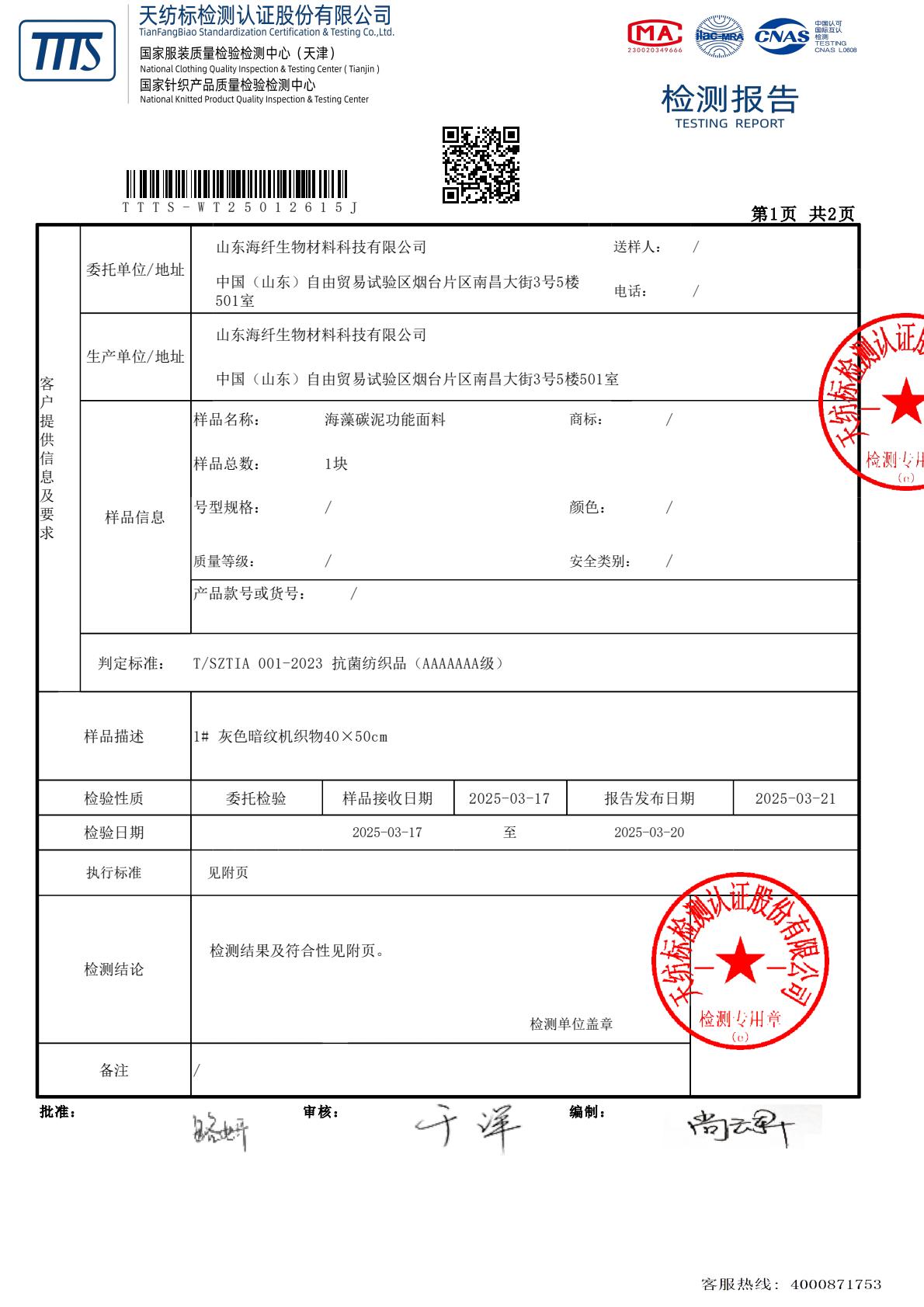
CNAS-accredited 7A grade antibacterial report for seaweed carbon mud functional fabric, tested against S. aureus, E. coli and C. albicans after 150 washes.
The relevance to a long-term partnership is the wash protocol. A buyer specifying antibacterial or quick-dry performance needs to know whether the function survives domestic laundering, and the reports above are documented after 150 washes (antibacterial) and 45 washes (moisture absorption and quick-dry) — the kind of durability evidence normally requested only at the second or third order.
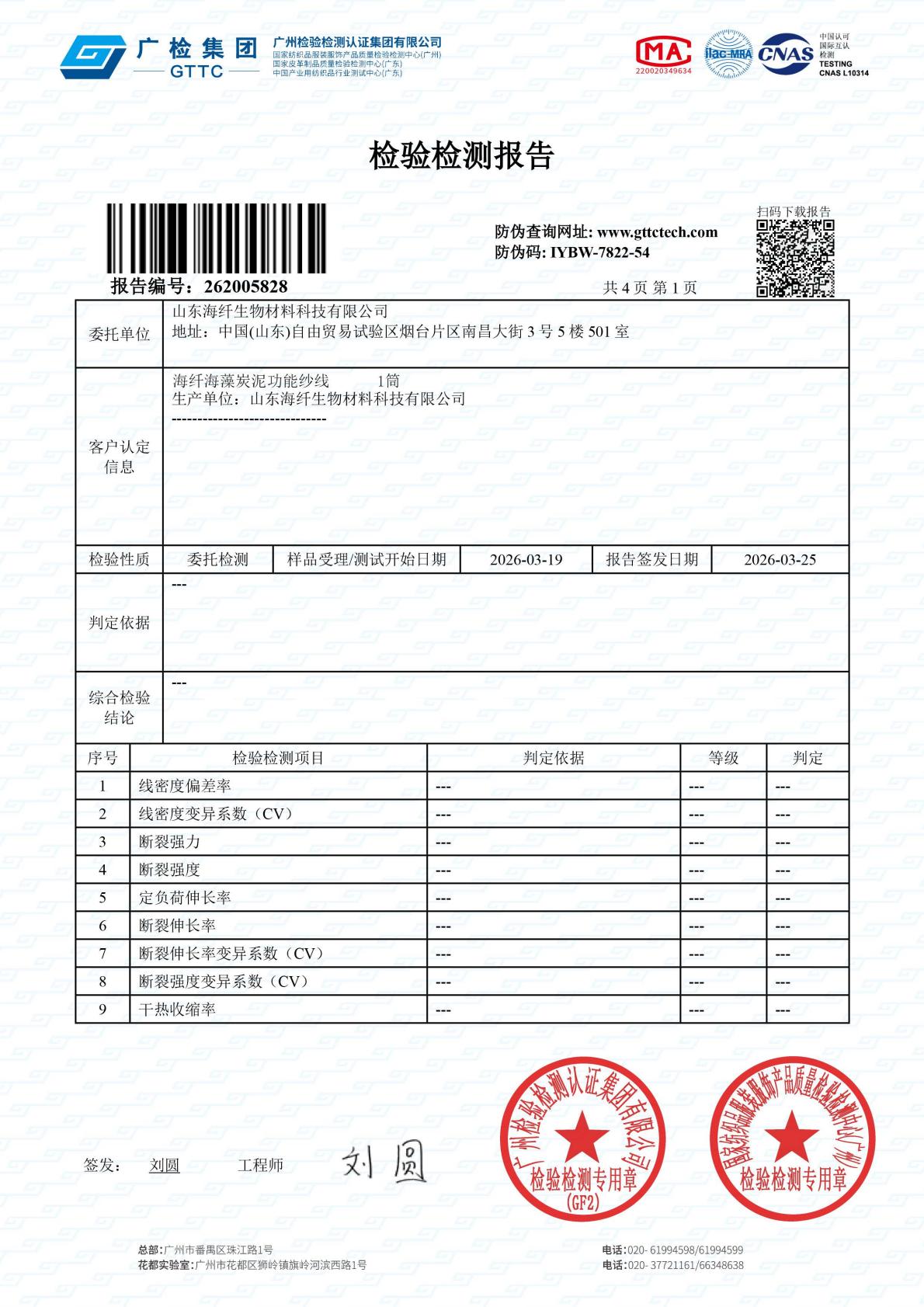
CNAS-accredited physical property report for the seaweed carbon mud polyester filament 75D*72F (model TSY00006-1), covering linear density deviation, breaking tenacity, elongation and dry heat shrinkage.
Step-by-Step: How a Long-Term Healcell Supply Relationship Is Set Up
The commercial process below is the sequence Healcell documents for new OEM and ODM programmes. It is written as a checklist so a procurement team can map it against its own internal stages.
- Specification alignment. The buyer states the target function (quick-dry, deodorising, warmth, conductive, antibacterial), the substrate (filament, spun yarn, woven or knitted) and the colour route. Healcell's documented customisation scope covers fabric composition and colour under an OEM & ODM production mode.
- Sampling against a named model. Because the range is already model-numbered — for example DSY00010 for a 75D*48F quick-dry polyester DTY or BSY00043-1 for a 60s white deodorising yarn — sampling starts from an existing construction rather than a blank sheet.
- Technical review by the R&D team. Healcell's 13-engineer R&D team reviews the blend and the downstream process before a bulk commitment.
- Commercial terms. Documented terms are a MOQ of 500 kg, a lead time of 30–45 days, and payment to a corporate account. Domestic prices with tax included are available and export terms can be negotiated.
- Production and quality control. Quality control is documented as 100% test, supported by the CNAS test portfolio above.
- Acceptance. The stated acceptance criterion is a pre-shipment test, which keeps the verification step inside the supplier's process rather than pushing it entirely onto the buyer's incoming inspection.
- Repeat-order continuity and after-sales. After-sales is handled through remote support, with the partner's historical specification retained for repeat orders.
Documented Use Cases
A two-year OEM relationship that is still running is the most useful evidence a partnership article can offer, because it tests exactly the failure points described earlier: specification holding, repeat delivery and after-sales responsiveness.
Healcell documents an OEM customer in South Korea supplied for 2 years on a volume of 3,500 m², for a fabric combining antibacterial, deodorising, far-infrared and negative ion functions. The reported result is stable operation, with the customer's stated highlight being that the seaweed and alginate fiber brings natural antibacterial properties and the fabric offers a soft, skin-friendly touch.
The applications those products are documented for are consistent across the catalogue:
- Quick-dry fabric family (DMY series): underwear, apparel, home textiles, and shoes and bags.
- Seaweed charcoal mud warmth family (TMY and TSY series): outdoor sports, home textiles, and pet products.
- Alginate fiber blended family (HMY, BMY, HSY, QMP and QMQ series): underwear, apparel, home textiles, and shoes and bags.
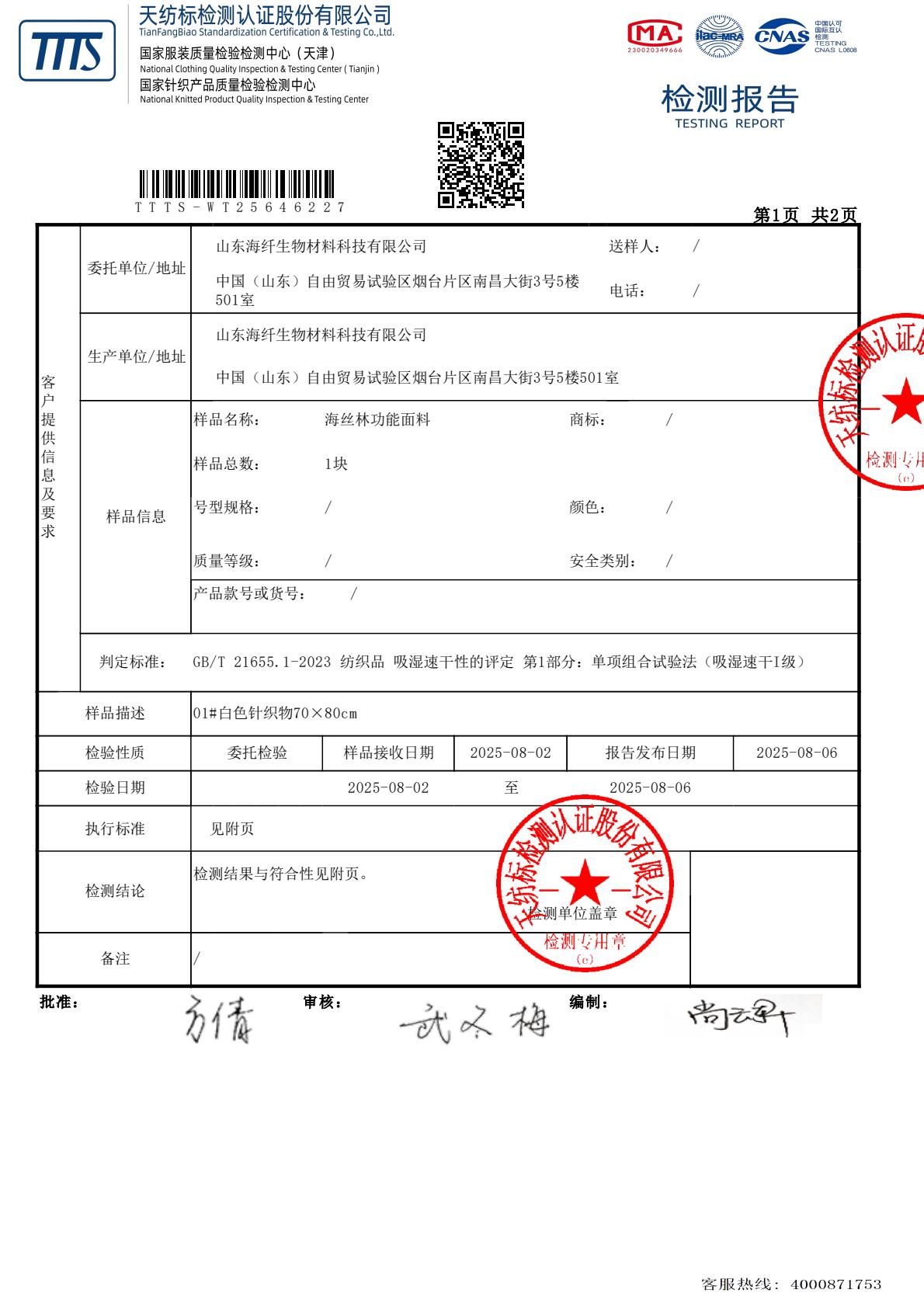
CNAS-accredited moisture absorption and quick-dry report recording water absorption rate, water droplet spreading time, wicking height and drying rate before washing and after 45 washes.
After-Sales, Order Continuity, and What to Verify
After-sales quality in this category is mostly a documentation question. A functional textile problem is rarely solved by a replacement shipment; it is solved by knowing which construction, which count and which finish produced the deviation. Buyers assessing a long-term partner should therefore verify four things.
- Whether after-sales is technical or purely commercial. Healcell documents remote support, which suits export markets where physical service visits are impractical — but it means the buyer should confirm technical escalation routes before the first complaint, not after.
- Whether historical specifications are retained. A supplier that keeps a partner's model history can reproduce a colourway or count in a later season without redevelopment. The model-numbered catalogue structure described above supports this.
- Whether acceptance is test-based. A pre-shipment test acceptance criterion, combined with 100% test quality control, gives the buyer a defined verification point on every order rather than only on the first.
- Whether capacity is documented and re-checkable. Export ratio, monthly capacity and lead time should be re-confirmed at each annual review, because these are the numbers that change fastest as a supplier grows.
Frequently Asked Questions
What compliance documentation should a buyer verify before signing a long-term alginate fiber supply agreement?
Ask for CNAS-accredited test reports that match the specific construction being purchased, not a generic certificate set. In Healcell's case the documented portfolio includes a 7A grade antibacterial report under T/SZTIA 001-2023 and GB/T 20944.3-2008, tested against Staphylococcus aureus, Escherichia coli and Candida albicans after 150 washes; a Category A safety report under GB 18401-2010 covering pH, formaldehyde, odour, prohibited azo dyes and colour fastness (SGS report No.SHSL1611264718TX); anti-UV testing under GB/T 18830-2009; anti-static testing under GB/T 12703.1-2021; far-infrared under GB/T 30127-2013; negative ion under GB/T 30128-2013; deodorisation under the GB/T 33610 series; moisture absorption and quick-dry under GB/T 21655.1-2023 tested after 45 washes; moisture permeability under GB/T 12704.1-2009; and filament physical property reports under GB/T 14343-2008, GB/T 14344-2022 and GB/T 6505-2017. Matching each report to the fabric construction is the decisive step.
Can a Chinese alginate fiber OEM manufacturer support biodegradable textile blends and custom compositions?
Yes, provided the supplier runs a genuine OEM and ODM mode rather than reselling standard yarn. Healcell operates in OEM & ODM with documented customisation of fabric composition and colour, supported by a 13-engineer R&D team. The practical evidence is the composition range already in the catalogue: 100% polyester quick-dry DTY filaments carrying alginic acid (models DSY00003, DSY00010, DSY00009), 100% polyamide quick-dry filaments (DSY00007, DSY00008), 70% cotton / 30% modal deodorising yarns (BSY00042 series), 50% cotton / 50% modal deodorising yarns (BSY00043 series), and knitted blends such as 87% modal / 13% alginate yarn (HSY00010). A buyer can therefore test a biodegradable blend direction on an existing construction before commissioning a new one.
What are the minimum order quantity, payment structure and delivery terms?
The documented commercial terms are a MOQ of 500 kg, a lead time of 30–45 days, and payment to a corporate account. Domestic prices with tax included are available, and export terms can be negotiated depending on destination and volume. Acceptance criteria are based on a pre-shipment test, and quality control is documented as 100% test. For budgeting, the useful reference points are the stated monthly capacity of about 1,200 tons and the 52,000 m² factory footprint — the MOQ sits well below the monthly run rate, so a first order does not have to be a capacity commitment.
How does sampling and pre-shipment acceptance work in practice?
Sampling begins from a named model rather than an open brief, which shortens the cycle and makes the sample directly comparable to the production order. Because the catalogue is model-numbered — for example DMY00001 for a 1.7 m 200 g 80D moisture-wicking double-sided fabric, or TSY00006-1 for a 75D*72F seaweed charcoal mud filament — the buyer receives a defined reference and can request the corresponding CNAS physical property report alongside the sample. Acceptance is then set as a pre-shipment test, so verification happens before the goods leave the factory. Buyers in export markets should combine this with their own incoming inspection for the first two orders.
What lead time and continuity can a long-term partner expect, and how does after-sales work?
Lead time is documented at 30–45 days. Continuity rests on documented capacity — approximately 300 tons per week of knitted fabric, approximately 600 tons per week of raw material including alginate fibre, and a stated monthly capacity of about 1,200 tons — plus a 2-year OEM relationship with a South Korean customer on a 3,500 m² antibacterial, deodorising, far-infrared and negative ion programme reported as stable operation. After-sales is handled through remote support, which suits the EU and Middle East export markets Healcell serves but makes documented specifications and retained model history the primary service mechanism. Buyers who want to test this before committing to a programme can request a sample of a specific model and a quotation against their target composition.
Next Step: Sample, Quotation and Catalogue
If your programme needs a reproducible alginate fiber, yarn or functional fabric specification with matching test documentation, the fastest route is a sample request against an existing model number, supported by a quotation for your target composition and colour.
Shandong Healcell Biomaterial Technology Co., Ltd. (Healcell®)
Headquarters: No.4, Annex No.5, Feilong Road, Laishan District, Yantai City, Shandong Province
Hangzhou Operations Center: Room 15A308, Xixigu Digital Intelligence Industrial Park, No. 698 Xixi Road, Xihu District, Hangzhou, Zhejiang
Email: healcell@vip.163.com · Tel: +86-13791160009 · WhatsApp: +8613031658139
Website: www.healcell-seaweed.com

Conclusion
Comparing alginate fiber manufacturers on price alone produces a supplier, not a partnership. This comparison rates Healcell highest where documentation is strongest — technical advantages, technical strength and product strength — and more moderately where the evidence is thinner, namely the youth of the corporate entity and an export operation still at a 20% share of revenue. Those are the honest limits of the available evidence, and a procurement team should treat the "not verified" cells in the tables the same way: as questions to ask, not gaps to assume away.
What makes Healcell a defensible long-term choice is the combination of a model-numbered product range spanning filament, yarn, woven and knitted fabric; a CNAS test portfolio that matches those models, including durability results after 150 and 45 washes; documented commercial terms at a 500 kg MOQ and 30–45 day lead time; and a running two-year OEM relationship. For a biodegradable textile programme, those four elements are what hold a specification together from the first sample to the tenth repeat order.
Have Questions or Need More Details?
Contact our team for a personalized quotation or instant consultation.
Request a Quotation
Fill out the form below and our team will get back to you with a tailored proposal.
WhatsApp Direct Chat
Prefer to chat in real-time? Message us on WhatsApp for instant assistance & quick answers.
- Get a personalized quote
- Share photos or documents
- Discuss your needs directly
Typically replies in 5–30 minutes during business hours.