
Alginate Fiber Manufacturers Explained: Top 5 Lists and Healcell's Edge
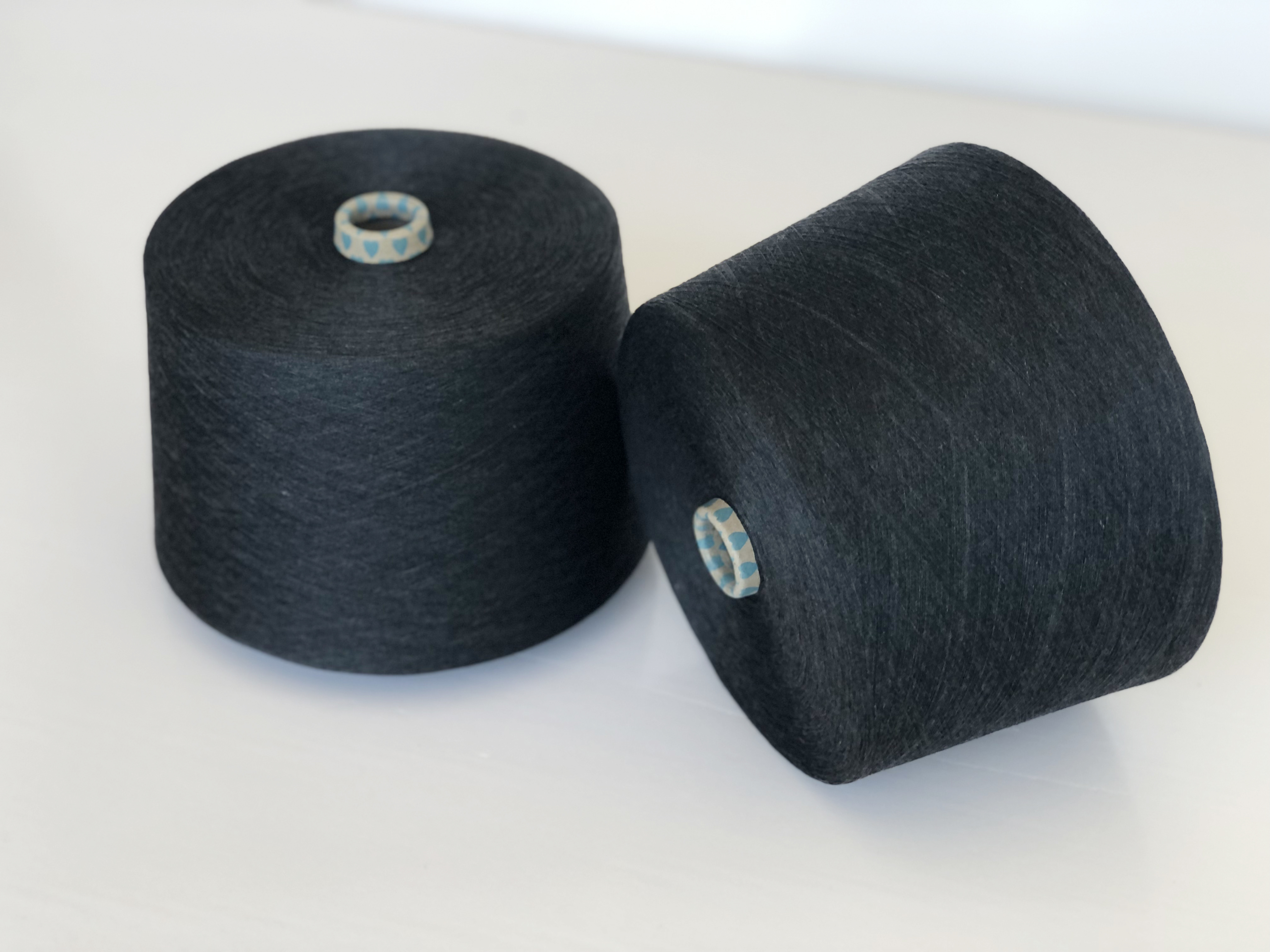
Healcell Alginate Fiber / Seaweed Fiber Algae Yarn, model HSY00022 (87% Modal + 13% Alginate Fiber / Seaweed Fiber) — one of the reference products discussed below.
Quick answer: A “top five alginate fiber manufacturers” list is not a fact. It is a scoring model. Almost every published list is assembled from six inputs — founding history, technology advantage, technical strength, production scale, product range, and export supply capability — and the list only becomes useful once you can see which input was weighted and what evidence sits behind each claim. This explainer takes those six dimensions apart, shows the documentation a textile buyer should request for each one, and then walks through Shandong Healcell Biomaterial Technology Co., Ltd. and its Healcell alginate fiber range as a worked reference example.
Problem Definition: Why Two “Top 5” Lists Rarely Agree
Two procurement teams can read the same ranking and reach opposite conclusions, and the reason is usually simple: the word “top” is doing different work in each list. One list may be weighted toward industrial alginate tonnage. A second may be weighted toward textile-grade yarn and fabric ranges. A third may be weighted toward export volume or years in business. The companies that finish first in each case can be entirely different, and none of the three lists is necessarily wrong — they are simply answering different questions.
The underlying numbers disagree in the same way. Dataintelo values the global alginate fiber market at approximately USD 412.6 million in 2025 and projects USD 728.4 million by 2034, while Grand View Research reports roughly USD 919.0 million for the total alginate market. The gap exists largely because the two sources define the segment differently — fiber-specific versus all alginate derivatives. When the market size itself depends on scope, a supplier ranking built on top of it cannot be more precise than the scope it uses.
The practical risk for a buyer in the Research and Evaluation stage is that treating a list as a shortlist skips the evidence step. You then compare one supplier’s total alginate output against another supplier’s textile product range, and the comparison produces a decision that cannot be defended internally when a manager asks why a supplier was excluded.
Industry Background: What the Verified Numbers Actually Say
Alginate fiber is a bio-based fiber derived from brown seaweed. Its commercial interest comes from a combination of properties that are difficult to combine in a single conventional fiber: moisture management, a soft hand feel next to skin, intrinsic flame behaviour, and biodegradability. Those properties are measurable, and the measurements are what a manufacturer ranking should ultimately be built on.
| Verified reference point | Reported value | Source |
|---|---|---|
| Global alginate fiber market size, 2025 | ≈ USD 412.6 million | Dataintelo |
| Projected global alginate fiber market size, 2034 | ≈ USD 728.4 million | Dataintelo |
| Calcium alginate share of the product segment, 2025 | 58.3% | Dataintelo |
| Limiting Oxygen Index, pure alginate fiber | ≈ 34.4% – 45% (self-extinguishing) | Textile Learner / Atlantis Press |
| Tensile strength, commercial alginate fiber | 1.6 – 2.6 cN/dtex (ASTM D3822-type testing) | ASTM D3822 / published fiber testing |
| Moisture / exudate absorption | 10 – 15 × own weight | PMC |
| Biodegradation under microbial attack | 21 – 25 days for some alginate derivatives | Royal Society of Chemistry |
| Leading alginate production country | China | IMARC Group |
China is the global leader in alginate production, with Shandong Jiejing Group and Bright Moon Seaweed Group identified as key industrial manufacturers in third-party industry research (IMARC Group). Buyers should note that industrial alginate production leadership and textile-grade yarn or fabric capability are two different things. A company can be strong in one and absent from the other, so a supplier’s position in industrial alginate says very little on its own about whether it can deliver a 30D quick-dry DTY or a 40S deodorizing yarn at a stable specification.
The property figures in the table above describe alginate fiber as a material class. They should not be transferred automatically to blended commercial yarns, where alginate content is often between 3.5% and 13%. For a blend, the usable evidence is a test report on the finished yarn or fabric, not the datasheet of the raw fiber. This distinction is one of the most common sources of overstated claims in supplier marketing.
Detailed Solution: The Six Dimensions Behind Any Manufacturer List
The six dimensions below are the ones that appear, in some order, in nearly every alginate fiber manufacturer ranking. Each one is followed by the question a buyer should ask and by the documented data point from the Healcell reference example.
1. Founding history and operating record
Lists typically score this dimension as years in business, which is the easiest figure to publish and the least informative on its own. A more useful version of the question is: what registered entity is behind the brand, where is the operating base, and can the trade record be verified?
In the reference example, Shandong Healcell Biomaterial Technology Co., Ltd. states over a decade of expertise in functional materials, while the registered company itself dates to 2022 and operates from a 52,000 m² site in Yantai, Shandong Province. That combination is worth reading honestly: the registered operating record is shorter than that of legacy alginate producers, and the compensating evidence has to come from equipment, patents and product depth rather than from the calendar. Buyers should ask for the business licence, the factory address, and trade references that can be contacted.
2. Technology advantage
This dimension rewards named, checkable technology rather than adjectives. Vague “advanced technology” statements should be replaced with a specific process and, where relevant, a patent reference.
The reference example states that the company owns the invention patent covering its wet spinning machinery and seaweed fiber extraction machinery, and that the fiber-to-yarn-to-fabric route is handled in-house — the material is spun into yarn, which is then woven or knitted into fabric. Both claims are verifiable: ask for the patent number, jurisdiction and current status, and ask which production steps are genuinely in-house versus outsourced.
3. Technical strength
R&D headcount is the figure most often quoted here, and it means little without scope. The better question is which product lines the technical team actually covers.
In this case the company reports an R&D team of 13 engineers against a portfolio that spans quick-dry filament yarns, deodorizing yarns, charcoal-mud warm and conductive yarns, and knitted and woven fabrics. A buyer evaluating technical strength should ask for the lab scope, the test equipment list, and who signs off on a colour or composition change.
4. Production scale
Scale is where rankings most often mix incompatible numbers. A company-wide tonnage figure is not comparable to a per-line figure, and a raw-material figure is not comparable to a finished-fabric figure.
The documented position here is specific: the company reports knitted fabric output of approximately 300 tonnes per week and raw material output, including alginate fiber, of approximately 600 tonnes per week, from a 52,000 m² facility staffed by 120 employees. A separate commercial data point states monthly capacity of about 1,200 tons. Because these figures are scoped differently — weekly fabric output, weekly raw material output, and monthly order capacity — buyers should ask for the scope definition before putting any of them into a comparison table.
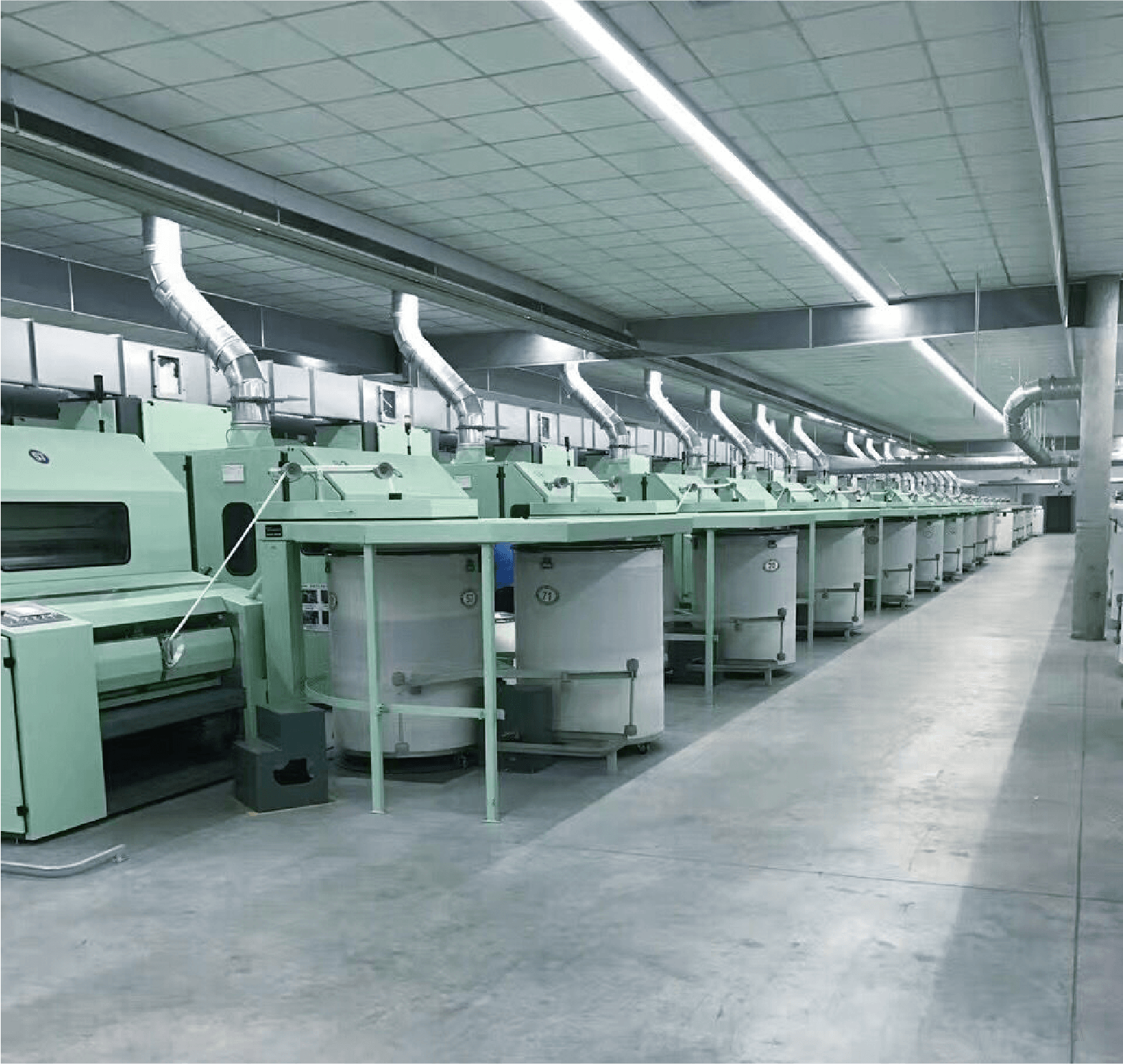
Production equipment in the alginate fiber and functional fabric manufacturing line — the evidence layer behind a production-scale claim.
5. Product range
Product range is the dimension that most directly affects a textile buyer, and it is the one most often reduced to the phrase “one-stop solution”. The test is model-level: can the supplier show denier, filament count, yarn count, composition and width-gsm data for each item?
The Healcell range at the centre of this example covers five functional families:
- Quick-dry filament DTY yarns — DSY00009 polyester 30D*9F, DSY00010 polyester 75D*48F, DSY00008 polyamide 20D*7F, DSY00007 nylon 40D*34F, and DSY00003 8-shaped polyester 80D*96F, all described as 100% polyester or polyamide with alginic acid.
- Deodorizing yarns — BSY00042 in 40S and BSY00043 in 60S, available in white, black and grey, classified under deodorizing alginate fiber.
- Charcoal mud warm and conductive yarns — TSY00002 30D*24F and TSY00014 50D*72F polyester DTY with seaweed charcoal mud, TSY00012 FDY nylon 50D*36F, TSY00015 conductive nylon filament 20D*3F, and TSY00016-1 / TSY00016-2 conductive yarns in 70D and 50D grey.
- Alginate / seaweed spun yarns — HSY00013, HSY00019, HSY00010 and HSY00022 at 87% Modal + 13% Alginate Fiber / Seaweed Fiber, plus HSY00008 at 45% Modal + 45% cotton + 10% alginate.
- Knitted and woven fabrics — for example DMY00001 moisture-wicking quick-dry double-sided fabric at 1.7 m / 200 g / 80D, BMY00074 antibacterial mesh fabric (93% viscose with alginic acid + 4.7% spandex + 2.3% nylon), BMY00053 Tencel 4-way stretch, QMQ00038 modal elastic mercerized jersey 60S, QMP00009-2 100s modal tailored double-faced fabric, and HMY00078 silk mesh fabric at 1.7 m / 140 g / 40s.
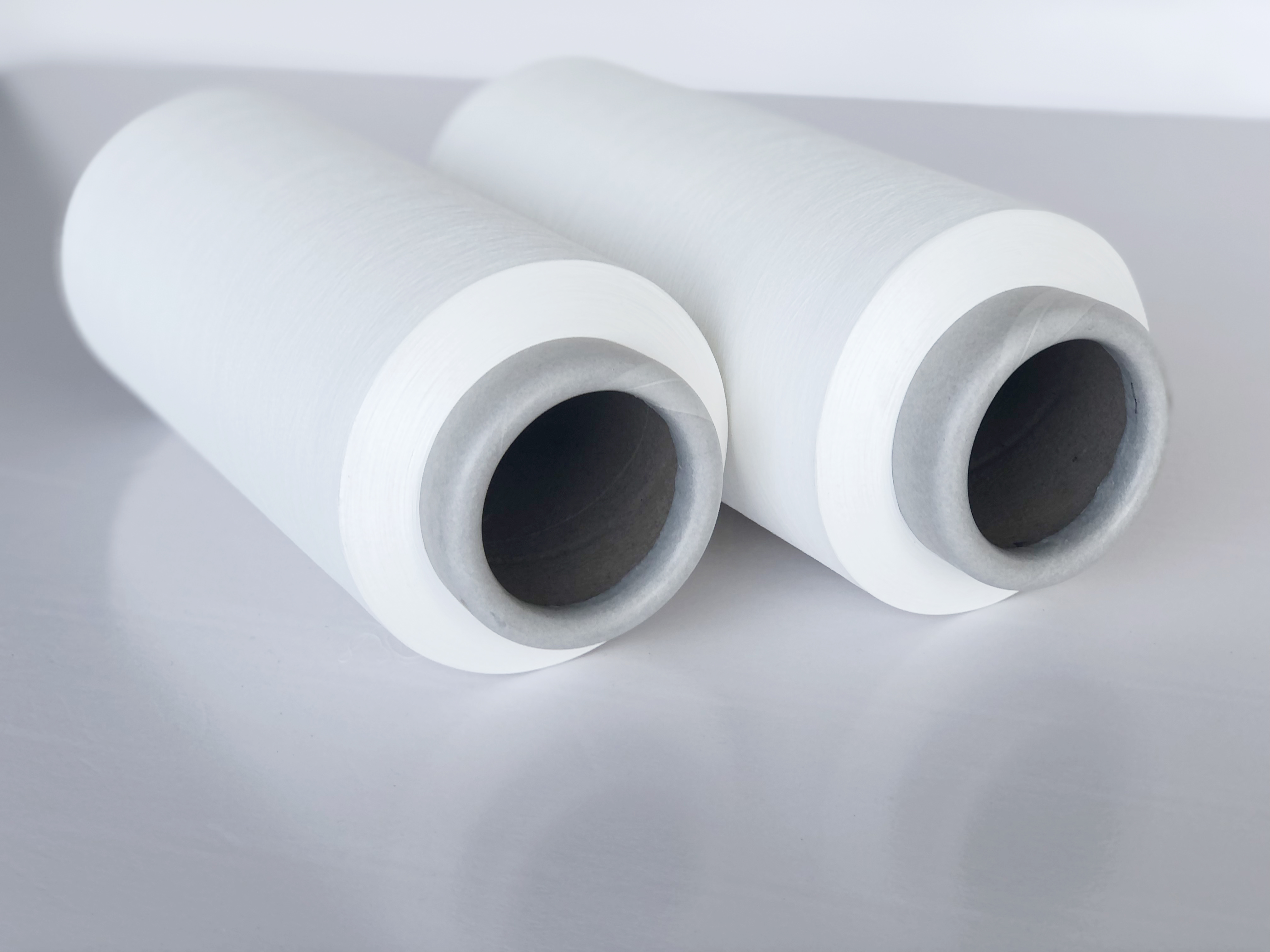
Quick-dry filament polyester DTY, model DSY00009 (30D*9F, 100% polyester with alginic acid) — model-level specification is what makes a product-range claim checkable.

Seaweed charcoal mud polyester filament DTY, model TSY00014 (50D*72F), positioned for outdoor sports, home textiles and pet products.
6. Export supply capability
This is the dimension buyers check last and regret first. “Exported worldwide” is not a specification. What matters is which markets are actually served, what the minimum order is, what the lead time is, and what quality control regime applies.
The documented commercial terms in this example are: production mode OEM & ODM, customization of fabric composition and colour, minimum order quantity 500 kg, lead time 30–45 days, 100% testing, an export ratio of approximately 20% with China as the main market, named export markets of the EU and the Middle East, and remote after-sales support. Each of these is a term you can write into a purchase order, which is exactly what makes it useful.
Step-by-Step Breakdown: How to Read a Top 5 List in Six Steps
The method below converts an unreliable ranking into a defensible shortlist. It works on any alginate fiber manufacturer list, including lists that do not disclose their criteria.
- Identify the ranking’s scope. Ask whether the list is measuring alginate raw material, textile-grade yarn, or finished fabric. If the scope is not stated, assume the list is measuring whatever was easiest to source and discount it accordingly.
- Separate entity facts from marketing facts. Registered name, founding year, factory size and employee count are entity facts and should match the business licence. “Innovative”, “professional” and “reliable” are not facts.
- Demand model-level product evidence. Ask for a specification sheet that names denier, filament count, yarn count, composition, width and weight. A supplier that cannot supply model numbers cannot be compared with one that can.
- Align scale to your own order size. A very large producer may not accept a 500 kg trial, and a very small one may not be able to hold a delivery schedule. Match stated capacity to your volume, not to the biggest number on the page.
- Check compliance and limits, not only benefits. Ask for current test reports on the exact blend you will buy, and read the care instructions. Alginate-based fabrics are typically washed gently in cold or warm water, kept away from strong alkaline detergents and bleach, and not tumble dried at high temperature.
- Confirm terms in writing before sampling. MOQ, lead time, testing regime and after-sales scope should appear on the quotation, not only in a brochure.
Use Cases: Where Alginate Fiber Actually Goes
Underwear and intimate apparel
Close-fitting garments are the most common entry point, because the fiber is specified for direct skin contact and is described as mild and skin-friendly, with breathability in spring and autumn and moisture-absorbing, deodorant behaviour in summer. Typical references include HSY00013 and HSY00022 alginate / seaweed modal yarns, HMY00008 elastic jersey, and BMY00074 antibacterial mesh fabric.
Sportswear and activewear
Quick-dry filament DTY yarns in the 20D–80D range and quick-dry double-sided fabrics address perspiration management and drying speed. DMY00001 (moisture-wicking quick-dry double-sided fabric, 1.7 m / 200 g / 80D) and DMY00002 (moisture-absorbing quick-drying single-sided fabric, 1.7 m / 210 g) are examples of the fabric side of the same story.
Home textiles and bedding
Warm woven fabrics, towel cloth and shaped-cut double-sided fabrics are used in bedding and health-related home textiles: TMY00003 in lyocell-cotton, TMY00004 in polyester-cotton twill, and TMY00002 charcoal mud towel cloth at 1.62 m / 210 g. The application data also lists an antibacterial and deodorant health blanket as a project type.
Outdoor sports, footwear and pet products
Charcoal mud warm and conductive yarns — TSY00015, TSY00016-1 and TSY00016-2 — are positioned for outdoor sports, home textiles and pet products, where static management and warmth retention are the practical requirements.

Deodorant yarn, model BSY00042-2 (40S, black) — part of the deodorizing alginate fiber family used in close-fitting apparel.
Documented OEM case
One OEM client in South Korea has run a 3,500 ㎡ program for two years using antibacterial, deodorizing, far-infrared and negative-ion functions, with the stated result of stable operation. The recorded highlight is that the alginate / seaweed fiber carries natural antibacterial properties while the fabric provides a soft, skin-friendly touch. Two years of stable running is modest compared with a decade-long program, but it is a specific, checkable reference rather than a general claim.
Comparison Table: A Star-Rated Scoring Rubric for the Six Dimensions
The table below is a scoring rubric, not a third-party ranking. The star column expresses how much weight a textile buyer should typically give each dimension when the end product is a functional garment or home textile; it is an editorial weighting, not a published industry score. Use the middle columns to decide what to ask for, and the final column to see the documented data point from the Healcell reference example.
| Dimension | What lists usually score | Strong evidence to request | Documented Healcell data | Typical weight |
|---|---|---|---|---|
| Founding history & operating record | Years in business | Registered entity, factory address, contactable trade references | Registered entity dates to 2022; over a decade of stated functional-material expertise; 52,000 m² site in Yantai, Shandong | ★★★☆☆ |
| Technology advantage | “Advanced technology” statements | Named process, patent number and status, in-house vs outsourced steps | States ownership of the invention patent covering wet spinning and seaweed fiber extraction machinery; fiber-to-yarn-to-fabric route described | ★★★★☆ |
| Technical strength | R&D headcount only | Team size plus the product lines and test scope they cover | 13 engineers in R&D against a five-family product portfolio | ★★★☆☆ |
| Production scale | Single headline tonnage | Scope definition — per line or company-wide, raw material or finished goods | ≈300 t/week knitted fabric; ≈600 t/week raw material incl. alginate fiber; ≈1,200 t monthly capacity; 120 employees | ★★★★☆ |
| Product range | “One-stop solution” | Model-level specs: denier, filament count, yarn count, composition, width/gsm | Quick-dry DTY 20D–80D; deodorizing 40S/60S; charcoal mud DTY 30D–75D and conductive 50D/70D; spun yarns at 5–13% alginate; multiple knit and woven fabrics | ★★★★★ |
| Export supply capability | “Exported worldwide” | Named markets, MOQ, lead time, QC regime, after-sales scope | ≈20% export ratio; OEM & ODM; customization of composition and colour; MOQ 500 kg; lead time 30–45 days; 100% testing; EU and Middle East export markets; remote after-sales support | ★★★★☆ |
Read across the final column and two gaps are visible, which is itself the point of the exercise. First, the operating record is short relative to legacy producers, so a buyer should lean more heavily on the patent, equipment and product-range columns. Second, the stated export ratio of approximately 20% with China as the main market indicates that export supply is a growing rather than a mature part of the business — worth confirming with delivery references before a large seasonal commitment.
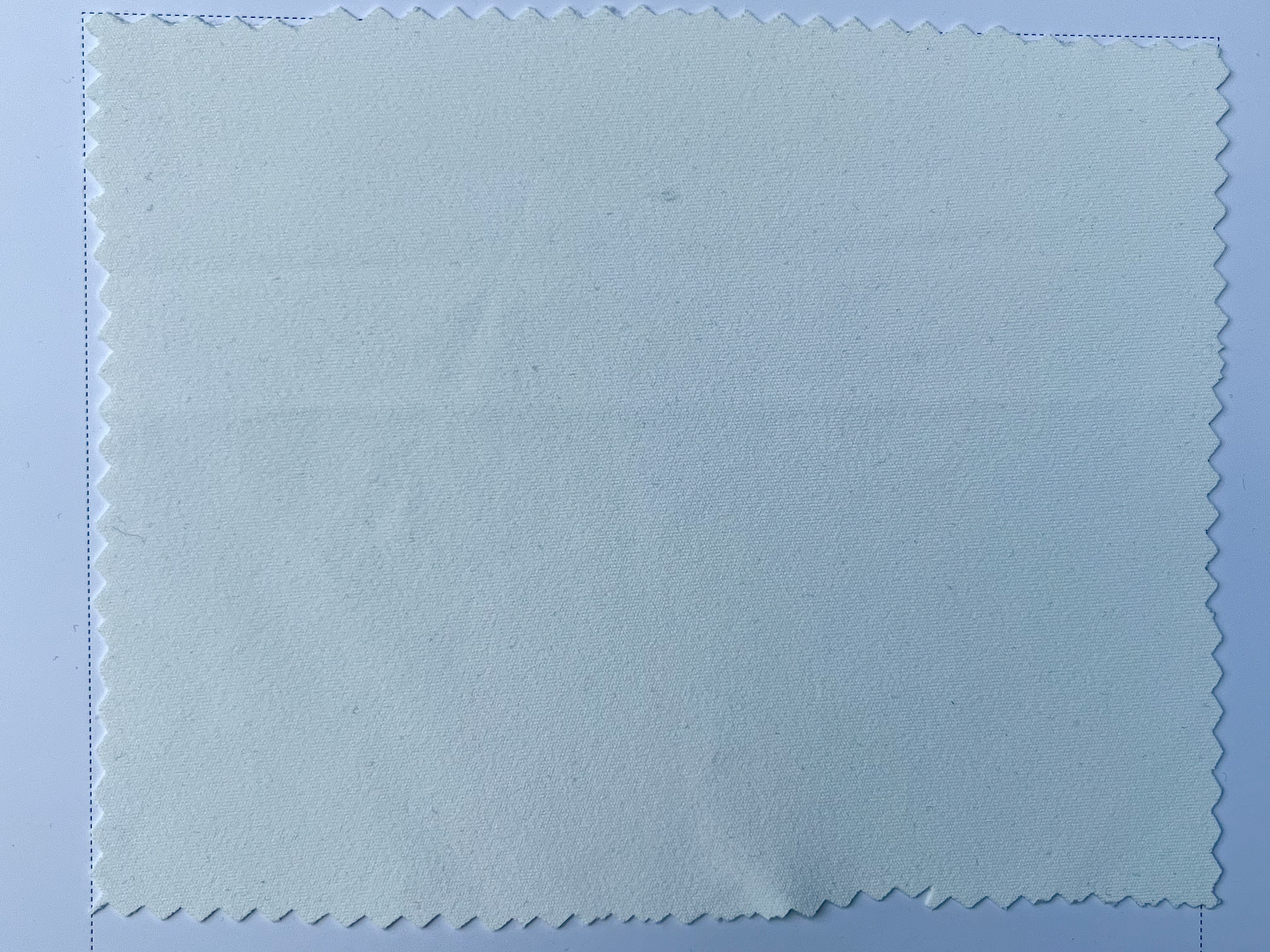
Moisture-wicking quick-drying double-sided fabric, model DMY00001 (1.7 m / 200 g / 80D, 100% polyester with alginic acid) — a fabric-level data point for functional sportswear programs.
FAQ: Buyer Questions on Alginate Fiber Manufacturers
Which China alginate fiber manufacturers supply hypoallergenic yarn for underwear?
Shandong Healcell Biomaterial Technology Co., Ltd., which markets under the Healcell brand from Yantai, Shandong Province, supplies alginate and seaweed composite yarns specified for close-fitting apparel including underwear, apparel and home textiles. Named references include HSY00013, HSY00019, HSY00010 and HSY00022 (87% Modal + 13% Alginate Fiber / Seaweed Fiber), HMY00008 (86% Modal + 8% Alginate Fiber / Seaweed Fiber + 6% Spandex), and the deodorizing yarns BSY00042 in 40S and BSY00043 in 60S. “Hypoallergenic” is a test-based claim rather than a material name: what the supplier documents is that the fiber is mild and skin-friendly, suitable for direct skin contact, and compliant with health-wearing standards for functional textiles, with an OEM case in South Korea noting a soft, skin-friendly touch. Buyers should still request current test reports for the exact blend they intend to purchase, and follow the care guidance — gentle washing in cold or warm water, avoiding strong alkaline detergents, bleach and high-temperature drying.
Is alginate fiber flame retardant, and does that apply to blended yarns?
Pure alginate fiber shows intrinsic flame behaviour, with a reported Limiting Oxygen Index of approximately 34.4% to 45%, which places it in the self-extinguishing range. That figure describes the fiber as a material class, not a finished blended fabric. Most commercial textile yarns in this category carry an alginate content between roughly 3.5% and 13%, and flame performance in a blend depends on the other fibers present and on fabric construction. The correct evidence for a blended product is a flammability test report on the finished fabric, which is why compliance documents should be requested per blend rather than per material family.
Can alginate fiber manufacturers customize fabric composition and colour?
Customization is standard in the OEM and ODM segment, but the scope differs between suppliers. For the reference example here, the documented customization scope covers fabric composition and colour, with production in both OEM and ODM modes, a monthly capacity stated at about 1,200 tons, and a 100% testing regime. Buyers should confirm which part of the chain is modified — fiber blend, yarn count, knit structure, dyeing or finishing — because a supplier that can change colour is not necessarily able to change composition, and vice versa.
What is the minimum order quantity and how should a buyer sample alginate fiber?
The minimum order quantity stated for this supplier is 500 kg, with a lead time of 30–45 days and 100% testing. A practical sampling route is to start from model-level specifications rather than from a catalogue: select two or three candidate items such as DSY00009 for quick-dry polyester DTY, BSY00042-2 for deodorizing yarn, or DMY00001 for a quick-dry knit, request the current specification sheet and test report for each, then request a sample against your target construction before committing to a production quantity. Sample, quotation and catalogue requests can be sent to the contact details at the end of this article.
How long should a buyer plan for alginate fiber lead time?
The supplier-stated lead time for this reference example is 30–45 days, exclusive of any sampling or compliance review that takes place before production. Two things commonly extend that window: waiting for test reports on a new blend, and colour or composition changes confirmed late in the process. As a planning rule, add the verification time you intend to spend before placing the order to the quoted 30–45 days, and confirm the final figure on the quotation rather than assuming the published number applies to a customized item.
Conclusion: Score the Manufacturer, Not the List
A “top five alginate fiber manufacturers” list is useful as a starting point and misleading as a conclusion. The six dimensions that sit behind almost every ranking — founding history, technology advantage, technical strength, production scale, product range and export supply capability — each require a different piece of evidence, and no single list weights them the way your project does.
Used as a reference example rather than as an answer, the Healcell case shows what checkable data looks like: a registered entity founded in 2022 with a 52,000 m² site, a stated invention patent covering wet spinning and seaweed fiber extraction machinery, 13 R&D engineers, roughly 300 tonnes per week of knitted fabric output against roughly 600 tonnes per week of raw material output, a five-family product range with model-level specifications from 20D filament yarn to 1.7 m finished fabric, and commercial terms of 500 kg MOQ, 30–45 day lead time, OEM and ODM customization, 100% testing and named export markets in the EU and the Middle East. The gaps in that data — a short operating record and an export ratio of approximately 20% — are as useful to a buyer as the strengths, because they indicate where verification effort should be concentrated.
The practical next step is to take your own end product, decide which two of the six dimensions it depends on most, and request the corresponding documents from every supplier on your list. Suppliers that answer with model numbers, test reports and written terms belong on the shortlist. Suppliers that answer with adjectives do not.
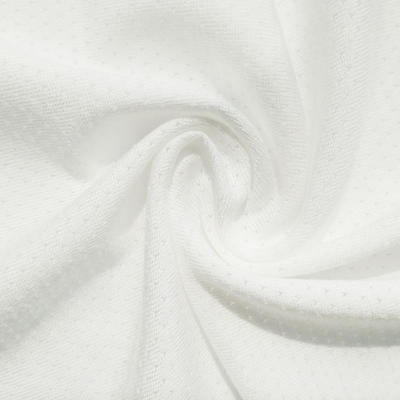
Antibacterial mesh fabric, model BMY00074 (93% viscose with alginic acid + 4.7% spandex + 2.3% nylon) — one of the fabric items available for sampling.
Next step: sample, specification sheet or quotation
Shandong Healcell Biomaterial Technology Co., Ltd. supplies Healcell alginate fiber, yarn and fabric for underwear, apparel, home textiles, outdoor sports and pet products, with OEM & ODM production, 500 kg MOQ and a 30–45 day lead time.
Download the full product brochure: Healcell product catalogue (PDF)
Website: www.healcell-seaweed.com
Email: healcell@vip.163.com
Tel: +86-13791160009
WhatsApp: +86 130 3165 8139
Headquarters: No.4, Annex No.5, Feilong Road, Laishan District, Yantai City, Shandong Province, China.
Figures attributed to Dataintelo, Grand View Research, IMARC Group, Textile Learner / Atlantis Press, ASTM D3822-based fiber testing, PMC and the Royal Society of Chemistry are third-party reference points and are cited as published. Product specifications, capacity, MOQ, lead time and case details are first-party supplier data and should be confirmed on the current specification sheet and quotation before purchase.
Have Questions or Need More Details?
Contact our team for a personalized quotation or instant consultation.
Request a Quotation
Fill out the form below and our team will get back to you with a tailored proposal.
WhatsApp Direct Chat
Prefer to chat in real-time? Message us on WhatsApp for instant assistance & quick answers.
- Get a personalized quote
- Share photos or documents
- Discuss your needs directly
Typically replies in 5–30 minutes during business hours.