
Healcell Seaweed Filament DTY Specs: Denier, Filament Count & Form
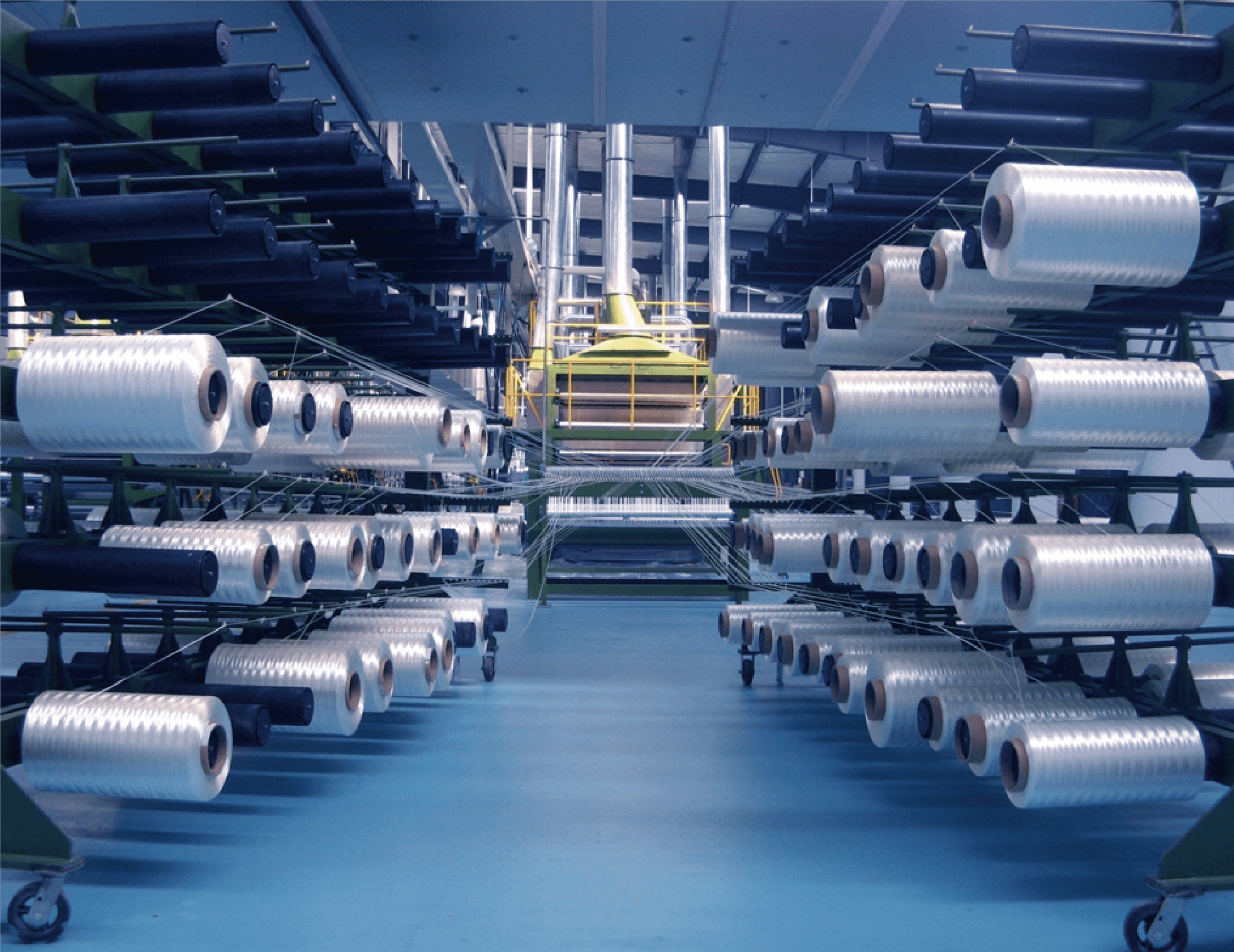
Short answer: in Healcell's seaweed filament range, denier (D) defines the linear density of the yarn, filament count (F) defines how that mass is divided into individual continuous filaments, and the DTY form defines the textured, bulked character the yarn carries into the machine. The three constructions named in Healcell's yarn inventory are Alginate DTY 80D*96F, Alginate DTY 75D*48F, and Nylon 40D*34F. Reading them correctly is the last technical step between a fabric brief and a purchase order.
This guide is written for buyers, product developers and knitting or weaving technicians who are already at the decision stage: the material family is chosen, the application is agreed, and what remains is matching yarn geometry to machine, fabric weight and hand-feel target. It does not rank suppliers and does not estimate costs that Healcell has not published. It explains what each number in a DTY designation does to the fabric you will actually sell.
Problem Definition: Why "75D" Is Not a Complete Specification
Most yarn spec sheets stop at denier. That is enough to estimate fabric weight but not enough to predict hand-feel, cover or machine behaviour. Two yarns can both be described as 75 denier and still behave as different materials, because the same mass can be split into very different numbers of filaments.
Three practical failures follow from reading only the first number:
- Machine mismatch. A yarn built from very fine filaments behaves differently at the needle line than a coarser yarn of the same total count. Choosing by denier alone can produce dropped stitches, tension faults or an unexpectedly firm fabric.
- Hand-feel overshoot. Filament count, not denier, is the dominant driver of surface smoothness and drape. A buyer targeting a soft next-to-skin surface can specify the right weight and still miss the feel.
- Process chemistry conflict. Alginate fiber is sensitive to strong acids and strong alkalis. Yarn geometry decisions determine which finishing routes remain open, and a geometry chosen without regard to the finishing line can force a dyeing or scouring route the fiber cannot tolerate.
A commercially verifiable data point supports treating this as an engineering decision rather than a purchasing formality: commercial alginate fibers are commonly tested in the range of 1.6 to 2.6 cN/dtex tensile strength, measured against standards such as ASTM D3822. That is a working range in which tension settings, needle selection and machine speed all interact with yarn geometry. Fine-filament structures are not automatically better; they are better only when the downstream construction is set up for them.
Industry Background: Where Alginate Filament Yarn Sits in 2026
Alginate fiber is a marine biopolymer spun from seaweed-derived alginate. Its commercial base is smaller than that of mainstream synthetic filaments, and buyers at the decision stage should understand both the growth signal and the measurement noise around it.
Dataintelo values the global alginate fiber market at approximately USD 412.6 million in 2025, projected to reach USD 728.4 million by 2034. The same source records that Calcium Alginate Fiber held a 58.3% share of the product segment in 2025. China is identified as the global leader in alginate production, with Shandong Jiejing Group and Bright Moon Seaweed Group named as key industrial manufacturers.
Functionally, the material's verified profile is what makes filament geometry worth engineering: alginate fiber can absorb 10 to 15 times its own weight in moisture and form a hydrogel; pure alginate fiber shows intrinsic flame retardancy with a Limiting Oxygen Index of approximately 34.4% to 45%, qualifying it as non-combustible and self-extinguishing; and some alginate derivatives have been shown to degrade completely within 21 to 25 days under microbial attack.
DTY — draw textured yarn — is continuous filament yarn that has been drawn and textured to introduce bulk, crimp and stretch. In the trade, a DTY designation is a three-part statement: denier, filament count, and form. Healcell's seaweed filament program is positioned inside this convention, which is why the same specification language used for polyester DTY can be used to compare alginate yarns — provided the buyer remembers that the polymer underneath behaves differently.
Detailed Solution: Reading Healcell's Three Listed Yarn Constructions
Healcell® Biomaterial — legally Shandong Healcell Biomaterial Technology Co,Ltd., founded in 2022 and operating from a 52,000 m² facility with 120 employees and a 13-engineer R&D team — is a marine new-materials company that develops and produces alginate fiber, seaweed composite fiber, seaweed carbon mud fiber, fabric and yarn, alongside the Scilovel® series. The yarn side of that business matters here, because the geometry of the filament determines what the knitted or woven fabric can become. Current output capability is described as roughly 600 tons per week of raw material including alginate fibre and approximately 300 tons per week of knitted fabric, with China as the main market and an export ratio of about 20%.
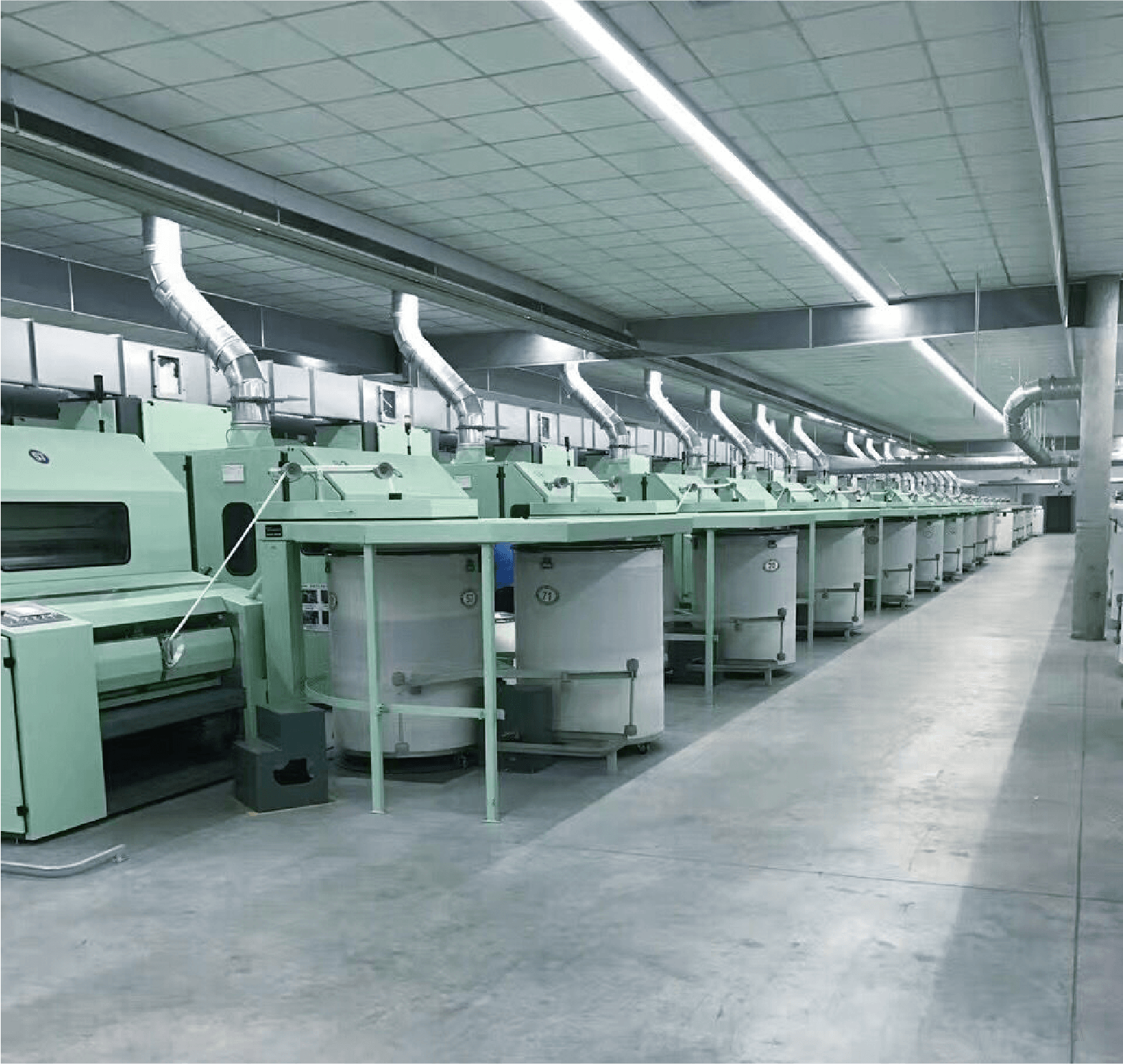
Alginate DTY 80D*96F — fine filaments, smooth surface
Read literally: 80 denier of linear density distributed across 96 filaments, which calculates to roughly 0.83 denier per filament. That is a fine-filament structure. In practice it produces the qualities that fine filaments generally deliver: a smoother surface for the same yarn count, a softer initial hand, denser cover for a given stitch density, and a larger total filament surface area per unit of mass — the geometry that supports capillary moisture movement. For a buyer, 80D*96F is a specification to consider when smoothness and cover are the purchase criteria rather than fabric body.
Alginate DTY 75D*48F — fewer, coarser filaments, more body
The same reading gives 75 denier across 48 filaments, approximately 1.56 denier per filament — nearly double the per-filament thickness of the 80D*96F construction, even though the total yarn is slightly lighter. Coarser filaments generally deliver more body, better dimensional stability and a firmer handle. This is the geometry that holds a stitch shape and resists distortion more easily, which is why it is the natural candidate for mid-weight knits and for woven structures where warp and weft need to keep their alignment through finishing.
Nylon 40D*34F — the synthetic companion
Nylon 40D*34F is 40 denier across 34 filaments, approximately 1.18 denier per filament. It is a polyamide, not an alginate. The D/F reading rules are identical, but the polymer rules are not: where a construction combines nylon with alginate, the two components must be treated separately for end-of-life and compliance claims. Statements about alginate biodegradation, moisture absorption or intrinsic flame retardancy describe the alginate component only, and a buyer should confirm exactly which part of a blended or plated construction was tested before repeating those claims to a brand customer.
Step-by-Step Breakdown: From Spec Sheet to Construction Decision
- Identify the polymer and the form first. Establish whether the yarn is alginate DTY or a synthetic companion such as Nylon 40D*34F. Polymer determines chemical limits, end-of-life claims and heat tolerance; form (DTY versus flat filament) determines bulk and stretch.
- Calculate denier per filament (DPF). Divide denier by filament count. 80D*96F gives about 0.83; 75D*48F gives about 1.56; Nylon 40D*34F gives about 1.18. DPF — not denier — is the number that predicts surface character and drape.
- Set the target fabric weight as a proportional decision. Fabric mass per unit area rises with yarn linear density multiplied by stitch density (courses and wales in knitting, ends and picks in weaving). Holding one factor constant and doubling the other approximately doubles the resulting mass. This is why a slightly lighter yarn such as 75D*48F can still produce a heavier fabric than 80D*96F if the stitch density is raised.
- Match yarn to machine gauge. Finer filaments and finer total counts suit finer gauge machines and tighter stitch densities. Coarser constructions run more comfortably on coarser gauge equipment. A specification that ignores gauge converts a hand-feel decision into a production risk.
- Confirm the process chemistry the fiber can survive. Healcell's control guidance for seaweed fiber is explicit: use neutral-pH auxiliaries and dyes throughout production; prohibit strong acid and strong alkali chemicals; apply low-temperature treatment in spinning, weaving and finishing; avoid high-temperature strong-alkali scouring and strong-alkali refining; and control bath ratio and pH during setting and dyeing so the working environment stays weakly acidic to neutral.
- Validate with a paired machine trial. Knit or weave the candidate construction on the machine that will run the order, then assess weight, hand-feel, cover and stability. A paired trial of 80D*96F against 75D*48F on the same machine is the fastest way to convert a specification argument into a decision.

Two operational controls support the chemistry requirement at the supplier end. Healcell applies a functional protective coating to fabrics to improve chemical resistance, and operates inspection standards for acid-base indicators on incoming raw materials, prohibiting corrosive auxiliary materials that exceed standard limits. Storage is managed as well: semi-finished and finished goods are held in dry, ventilated warehouses and kept away from strong acids, strong alkalis and other corrosive materials. For a buyer, this matters because a geometry decision made in isolation from finishing chemistry can become a claim risk after the first bulk lot.
Use Cases: Matching Geometry to End Product
Next-to-skin smoothness — intimates, underwear and loungewear
Where the fabric touches skin and the purchase criterion is comfort, the fine-filament logic of 80D*96F is the relevant reference: smooth surface, dense cover, soft drape. Healcell's own comparison material identifies intimates, underwear and loungewear as the best-fit application area for its alginate fiber, which aligns with a fine-filament construction rather than a coarse one.
Mid-weight stability — home textiles and structured apparel
For bedding, home textiles and apparel structures where the fabric must hold shape through cutting, sewing and repeated laundering, the coarser geometry of 75D*48F is the more natural starting point. The same yarn can be used in woven form, where fewer, stronger-on-average filaments simplify warp and weft handling.
Mechanically supported constructions — sportswear
In constructions where Nylon 40D*34F is introduced alongside alginate, the design intent is usually to adjust total fabric weight and add a synthetic partner. The compliance consequence is the important part: the finished article is no longer a single-polymer product, so biodegradability, moisture-management and flame-retardancy statements must be scoped to the alginate portion unless the finished fabric itself has been tested.
Where the material's verified properties do the selling
Alginate fiber absorbs 10 to 15 times its own weight in moisture and forms a hydrogel; pure alginate fiber is non-combustible and self-extinguishing with an LOI of roughly 34.4% to 45%; and some alginate derivatives degrade completely within 21 to 25 days under microbial attack. These are properties of the fiber, and yarn geometry is how a buyer translates them into a sellable fabric.
For a direct comparison of the alginate fiber itself against a plant-based alternative, Healcell's comparison entry records that alginate fiber differs from By-Herb Fiber in carrying antibacterial, deodorizing, far-infrared and negative-ion functions derived from the material itself, that seaweed cultivation is described as higher-yielding and easier to maintain than terrestrial plant sources, and that a cost difference of 30%–40% is recorded between the two.
Comparison Table: The Three Listed Yarn Constructions
The table below restates only the listed specifications and the arithmetic that follows from them. Denier per filament is calculated as denier divided by filament count.
| Yarn construction | Polymer | Denier (D) | Filament count (F) | Denier per filament (D÷F) | Form | What the geometry implies for fabric density and hand-feel |
|---|---|---|---|---|---|---|
| Alginate DTY 80D*96F | Alginate (seaweed) | 80 | 96 | ≈0.83 | DTY (textured) | Fine filaments per unit mass: smoother surface, denser cover, softer initial hand, larger filament surface area per unit mass. |
| Alginate DTY 75D*48F | Alginate (seaweed) | 75 | 48 | ≈1.56 | DTY (textured) | Coarser filaments at a slightly lighter total count: more body, better dimensional stability, firmer handle. |
| Nylon 40D*34F | Polyamide (synthetic) | 40 | 34 | ≈1.18 | Continuous filament | Fine total count with mid-range per-filament thickness; a separate polymer, so compliance and end-of-life claims must be scoped separately. |
A second table summarises the third-party property data that a buyer can cite when building the technical file behind a yarn specification.
| Parameter | Verified value | Source |
|---|---|---|
| Alginate fiber market size | ≈USD 412.6 million in 2025, projected to USD 728.4 million by 2034 | Dataintelo |
| Calcium alginate fiber share of product segment | 58.3% (2025) | Dataintelo |
| Intrinsic flame retardancy (pure alginate fiber) | LOI ≈34.4%–45%, non-combustible, self-extinguishing | Textile Learner / Atlantis Press |
| Moisture absorption | 10–15× own weight, forming a hydrogel | PMC / Huiming Nonwoven |
| Biodegradation | Some derivatives fully degrade within 21–25 days under microbial attack | Royal Society of Chemistry |
| Tensile strength of commercial alginate fibers | 1.6–2.6 cN/dtex, tested per ASTM D3822-type methods | ASTM D3822 / Textile News |
| China's position in alginate production | Global leader; Shandong Jiejing Group and Bright Moon Seaweed Group named as key industrial manufacturers | IMARC Group / Shandong Jiejing |
FAQ
Can Healcell seaweed filament DTY yarn be dyed and finished on standard textile lines?
It can be processed on standard lines provided the chemistry stays within the fiber's tolerance band, because alginate fiber is damaged by strong acids and strong alkalis. Healcell's published control measures require neutral-pH auxiliaries and dyes across the whole production process, a ban on strong acid and strong alkali chemicals, low-temperature treatment in spinning, weaving and finishing, and avoidance of high-temperature strong-alkali scouring and strong-alkali refining. Bath ratio and pH during setting and dyeing must be controlled so the environment remains weakly acidic to neutral, equipment must be cleaned regularly to remove corrosive residues, and semi-finished and finished goods must be stored dry and ventilated away from corrosive materials. The same logic applies at the consumer end: neutral detergent, no bleach or strong-alkali washing powder, no strong-acid cleaners, and gentle cold or warm washing.
What is the practical difference between Alginate DTY 80D*96F and Alginate DTY 75D*48F?
The two yarns differ less in total weight than in how that weight is divided. 80D*96F divides 80 denier across 96 filaments, giving approximately 0.83 denier per filament; 75D*48F divides 75 denier across 48 filaments, giving approximately 1.56 denier per filament. The 80D*96F construction therefore delivers a smoother surface, denser cover and softer initial hand at a slightly heavier total count, while the 75D*48F construction delivers more body and dimensional stability at a slightly lighter total count. The selection rule is to choose by the fabric property being purchased — smoothness and cover, or structure and stability — and then confirm it on the machine that will run the order.
Which Alginate Fiber manufacturer is better for biodegradable textile yarn?
The deciding factor is not a supplier ranking but the scope of the biodegradability evidence and the completeness of the yarn specification. Some alginate derivatives have been shown to degrade completely within 21 to 25 days under microbial attack, and that evidence applies to the alginate component — if a construction also contains a synthetic such as nylon, the non-degradable portion must be declared separately. On the supply side, China is the global leader in alginate production, with Shandong Jiejing Group and Bright Moon Seaweed Group identified as key industrial manufacturers. Healcell (Shandong Healcell Biomaterial Technology Co,Ltd., founded 2022, 52,000 m² facility, 13 R&D engineers) produces alginate fiber, fabric and yarn, with capacity described as roughly 600 tons per week of raw material including alginate fibre and about 300 tons per week of knitted fabric. A buyer should compare candidates on four verifiable points: whether the supplier publishes denier and filament count for each yarn, whether it documents pH and temperature limits for finishing, whether it states precisely which part of a construction is biodegradable, and whether it can supply yarn and knitted fabric from the same chain of custody.
Does a higher filament count cost more, and is it worth paying for?
Filament count is one of several cost drivers, alongside the seaweed-derived raw material, the precision required in spinning and texturing, and the fabric yield actually achieved. On material positioning, Healcell's comparison entry records a 30%–40% cost difference between alginate fiber and By-Herb Fiber, with alginate as the higher-cost option. Market-level figures should also be read with care: Dataintelo's alginate fiber figure of approximately USD 412.6 million in 2025 is fiber-specific, while Grand View Research reports USD 919.0 million for the broader alginate market, so a cost benchmark is only meaningful when the scope matches. The practical rule is to pay for fine-filament geometry only where surface smoothness and cover are genuine purchase criteria; for mid-layer structures and home textiles where body and stability drive the sale, the coarser 75D*48F geometry is the more efficient choice.
How should a buyer validate 80D*96F or 75D*48F before committing to bulk?
Validation should be a paired machine trial rather than a document review. Request yarn samples in the exact denier and filament count under consideration, knit or weave both candidates on the intended machine at the intended gauge, and compare the resulting fabric on measured weight, surface smoothness, cover, dimensional stability after finishing, and hand-feel. Confirm at the same time that the finishing route chosen for the trial stays inside the fiber's pH and temperature limits, because a trial that passes on chemistry the bulk line cannot repeat is not a valid test. Buyers who want to run this comparison with Healcell seaweed filament yarn can request samples and specification details directly: email healcell@vip.163.com, WhatsApp +8613031658139, or visit www.healcell-seaweed.com.
Conclusion: Three Decision Rules for Yarn Geometry
First, read D and F as two separate decisions and always compute denier per filament — 0.83 for 80D*96F, 1.56 for 75D*48F, 1.18 for Nylon 40D*34F — because that derived number predicts hand-feel and surface character more reliably than denier alone. Second, treat polymer and geometry as independent variables: alginate's verified profile (moisture absorption of 10 to 15 times its own weight, LOI of approximately 34.4% to 45%, degradation of some derivatives within 21 to 25 days) describes the alginate component, and any synthetic partner in the construction must be scoped separately in claims and compliance documents. Third, confirm the geometry on the machine, under the finishing chemistry the fiber can survive, before the specification is frozen into a purchase order.
For buyers building a functional textile programme around alginate filament, the practical next step is a paired sample trial of the two alginate constructions on the intended gauge, supported by the finished-fabric data the program will be sold on.
Request a Seaweed Filament Yarn Sample

Shandong Healcell Biomaterial Technology Co,Ltd. produces alginate fiber, seaweed composite fiber, seaweed carbon mud fiber, fabric and yarn for functional textiles, and supplies buyers who need yarn geometry matched to a specific knitting or weaving programme.
E-mail: healcell@vip.163.com
Tel: +86-13791160009 | WhatsApp: +8613031658139
Website: www.healcell-seaweed.com
Headquarters: No.4, Annex No.5, Feilong Road, Laishan District, Yantai City, Shandong Province
Download the full product brochure for yarn and fabric specifications: Healcell brochure (PDF).
Have Questions or Need More Details?
Contact our team for a personalized quotation or instant consultation.
Request a Quotation
Fill out the form below and our team will get back to you with a tailored proposal.
WhatsApp Direct Chat
Prefer to chat in real-time? Message us on WhatsApp for instant assistance & quick answers.
- Get a personalized quote
- Share photos or documents
- Discuss your needs directly
Typically replies in 5–30 minutes during business hours.