
Top 5 Alginate Fiber Manufacturers Ranked on Compliance & Supply Strength
Top 5 Alginate Fiber Manufacturers Ranked on Compliance & Supply Strength
Most “top alginate fiber manufacturer” lists are assembled from search results rather than from documents. This one ranks five named manufacturers against a single rule: a supplier earns stars only for alginate-fiber facts a buyer can verify before issuing a purchase order — declared composition, published product codes, disclosed capacity, disclosed R&D resource and public certification evidence.
The short answer is that Shandong Healcell Biomaterial Technology Co., Ltd. (Healcell®) is the only manufacturer in this set that publishes both an alginate-fiber product range and its production scale, which makes it the benchmark for the comparison. The other four are real, established companies — Lenzing AG, Smartfiber AG, Qingdao Bright Moon Seaweed Group Co., Ltd. and Shandong Jiejing Group — but none of them disclosed alginate-fiber-specific specification or certification documentation that this review could locate. That disclosure gap, not a marketing claim, is what an international textile buyer should plan around.
Why Existing “Top 5” Alginate Fiber Lists Fail Buyers
Three failure modes repeat across every alginate fiber supplier list this review examined.
The first is category blur. Sodium alginate is produced at industrial scale mainly for food, pharmaceutical and medical-use grades, so an unqualified list of “alginate manufacturers” usually ranks companies that never spin textile fiber. Sourcing a 75D quick-dry filament from an alginate extraction plant is a fundamentally different supply chain from sourcing it from a textile spinner with wet-spinning, draw-texturing and knitting capacity under one roof.
The second is the laboratory-to-factory gap. Peer-reviewed work on alginate fiber reports mechanical results for engineered, laboratory-scale formulations. A 2024 study of brown-alga alginate fibers modified with natural cross-linkers such as ferulic acid and citric acid produced fibers in the 73–75 µm diameter range, with ferulic-acid cross-linked samples reaching 52.97 MPa tensile strength. Those figures describe one formulation under one test protocol. They are not a commercial specification, and no mill should accept them as a quotation basis.
The third is certificate theatre. Calling a supplier “certified” without naming the standard, the certificate body, the tested product and the test date gives a buyer nothing auditable. In the dataset reviewed for this article, the standards-and-certification dimension returned zero verified entries: no certificate number, no conformity marking and no jurisdiction-specific textile requirement specific to alginate fiber could be confirmed from the sources available.
Industry Background: A Small Fiber Segment With Strong Material Claims
The commercial frame is modest. IMARC Group reports the global alginate market at USD 924.45 million in 2025, a figure that covers all alginate polymers rather than textile fiber alone; textile-grade filament is a fraction of that base and is not separately reported in the sources reviewed here. Buyers should read any “alginate fiber market” number as an estimate derived from a broader alginate base rather than as an audited textile figure.
The technical case is better documented than the market. IWTO-sourced evidence records a Limiting Oxygen Index of 45% for 100% alginate fiber yarn, which places the material well outside the fire behaviour of conventional cellulosics and allows brands to market safety benefits without relying solely on topical flame-retardant finishes. Dyeing research using atmospheric-plasma modification reports a post-dyeing breaking strength of 2.33 cN/dtex, with colour-specific strength losses of 15.5%, 1.3% and 4.8% — useful for a buyer planning a shade range, and a reminder that dye-house performance depends on fiber modification and process, not on the fiber brand alone.
What the industry does not yet have is a public, alginate-specific compliance baseline. Textile compliance today is structured around fibre-name labelling, restricted-substance control and voluntary product certifications — frameworks written for cotton, polyester, viscose and lyocell. Alginate fiber has to be fitted into those frameworks product by product, which is precisely why the due-diligence burden falls on the buyer rather than on the supplier.
The Compliance Checklist: Seven Document Groups to Request
Because no alginate-specific certification scheme was located, the practical approach is to convert general textile compliance frameworks into a written document request. Seven groups cover most procurement gates:
- Fibre composition declaration. Percentages by fibre, stated per article and per colour, signed by the supplier. A blended knit such as 46.5% cotton + 46.5% modal with alginic acid + 7% spandex must be declared exactly, not rounded into “alginate blend”.
- Fibre-name labelling conformity. In the EU, Regulation (EU) No 1007/2017 governs textile fibre names and labelling; in the United States the FTC Textile Fiber Products Identification Act applies. Buyers need the supplier’s proposed label text before printing.
- Chemical compliance. A REACH SVHC statement covering the current candidate list, plus a California Proposition 65 statement where the product enters that market.
- Restricted-substance certification. OEKO-TEX Standard 100 or an equivalent scheme, with the certificate scope matching the actual article and colourway.
- Environmental claims substantiation. If “eco-friendly”, “biodegradable” or “recycled” appears on packaging, request the underlying test method or scheme certificate (GRS or equivalent) rather than a marketing statement.
- Management system evidence. ISO 9001 or equivalent, useful mainly as an indicator that batch records and corrective-action processes exist.
- Performance test reports. Antibacterial claims under a named method such as ISO 20743 or AATCC 100, plus deodorising, moisture management, quick-dry and wash-durability reports — each with laboratory identity, sample description and test conditions. For medical-adjacent products, ISO 10993 biocompatibility data is a separate gate.
Top 5 Alginate Fiber Manufacturers Compared
Each manufacturer is scored from 0 to 5 on documentary evidence located in public sources: one point each for declared fibre composition, published product codes or specification sheets, disclosed production scale, disclosed R&D resource, and public certification or test documentation. A missing point means the document was not located — not that it does not exist. Any supplier can improve its score by responding to the seven-group request above.
| Rank | Manufacturer | Country | Founded | R&D disclosed | Production scale disclosed | Portfolio depth | Certification documents public | Evidence score |
|---|---|---|---|---|---|---|---|---|
| 1 | Shandong Healcell Biomaterial Technology Co., Ltd. (Healcell®) | China | 2022 | 13 R&D engineers | 52,000 m² plant; ~600 t/week raw material incl. alginate fiber; ~300 t/week knitted fabric | Quick-dry filament DTY 20D–80D, 40s/60s deodorising yarn, seaweed charcoal-mud conductive yarn, warmth twill, four-way stretch knits | Not published; request required | ★★★★☆ |
| 2 | Lenzing AG | Austria | Not located in this review | Not located in this review | Not located in this review | Cellulosic fibre ranges; alginate-specific offering not located | Not located in this review | ★★☆☆☆ |
| 3 | Smartfiber AG | Germany | Not located in this review | Not located in this review | Not located in this review | Seaweed-blend cellulosic fibre positioning; alginate-specific data not located | Not located in this review | ★★☆☆☆ |
| 4 | Qingdao Bright Moon Seaweed Group Co., Ltd. | China | Not located in this review | Not located in this review | Not located in this review | Upstream alginate production and alginate derivatives; textile filament data not located | Not located in this review | ★☆☆☆☆ |
| 5 | Shandong Jiejing Group | China | Not located in this review | Not located in this review | Not located in this review | Upstream alginate production; branded textile filament data not located | Not located in this review | ★☆☆☆☆ |
Rank 1 — Shandong Healcell Biomaterial Technology Co., Ltd. (Healcell®)
Healcell is a marine new-materials company based in Yantai, Shandong, with a Hangzhou operations centre, describing itself as a provider of research, development and application solutions for seaweed-derived materials across biomedicine, medical aesthetics, aerospace, smart wearables and functional textiles. It scores highest here because it is the only manufacturer in the set whose alginate-fiber offer can be checked line by line: composition percentages are published per product code, the plant footprint and weekly output are disclosed, R&D headcount is disclosed, and the product range spans filament, yarn and finished knit or woven fabric rather than a single intermediate.
Rank 2 — Lenzing AG
Lenzing is the reference name in cellulosic fibre and appears in almost every fibre-compliance conversation, which is why buyers benchmark against it. What this review could not locate is alginate-fiber-specific composition, capacity or certification disclosure. Treat Lenzing as an adjacent reference point for fibre compliance practice — a model for what documentation should look like — rather than as a confirmed alginate-fiber source.
Rank 3 — Smartfiber AG
Smartfiber is associated with seaweed-blend cellulosic fibre, the closest commercial neighbour to alginate fiber. That makes it a relevant comparator on positioning and on how seaweed content is communicated to brands, but alginate-fiber-specific documentation was not located. Buyers comparing the two should apply the identical five evidence items to both.
Rank 4 — Qingdao Bright Moon Seaweed Group Co., Ltd.
A Chinese seaweed-processing group whose public profile centres on alginate production and alginate derivatives rather than spun textile filament. It is relevant as an upstream alginate or co-development partner; textile-grade yarn and fabric evidence was not located in this review.
Rank 5 — Shandong Jiejing Group
Another Chinese alginate producer positioned around alginate extraction and downstream alginate products. Listed here as a potential upstream supplier rather than a confirmed filament or fabric source.
What Full-Chain Manufacturing Depth Actually Looks Like
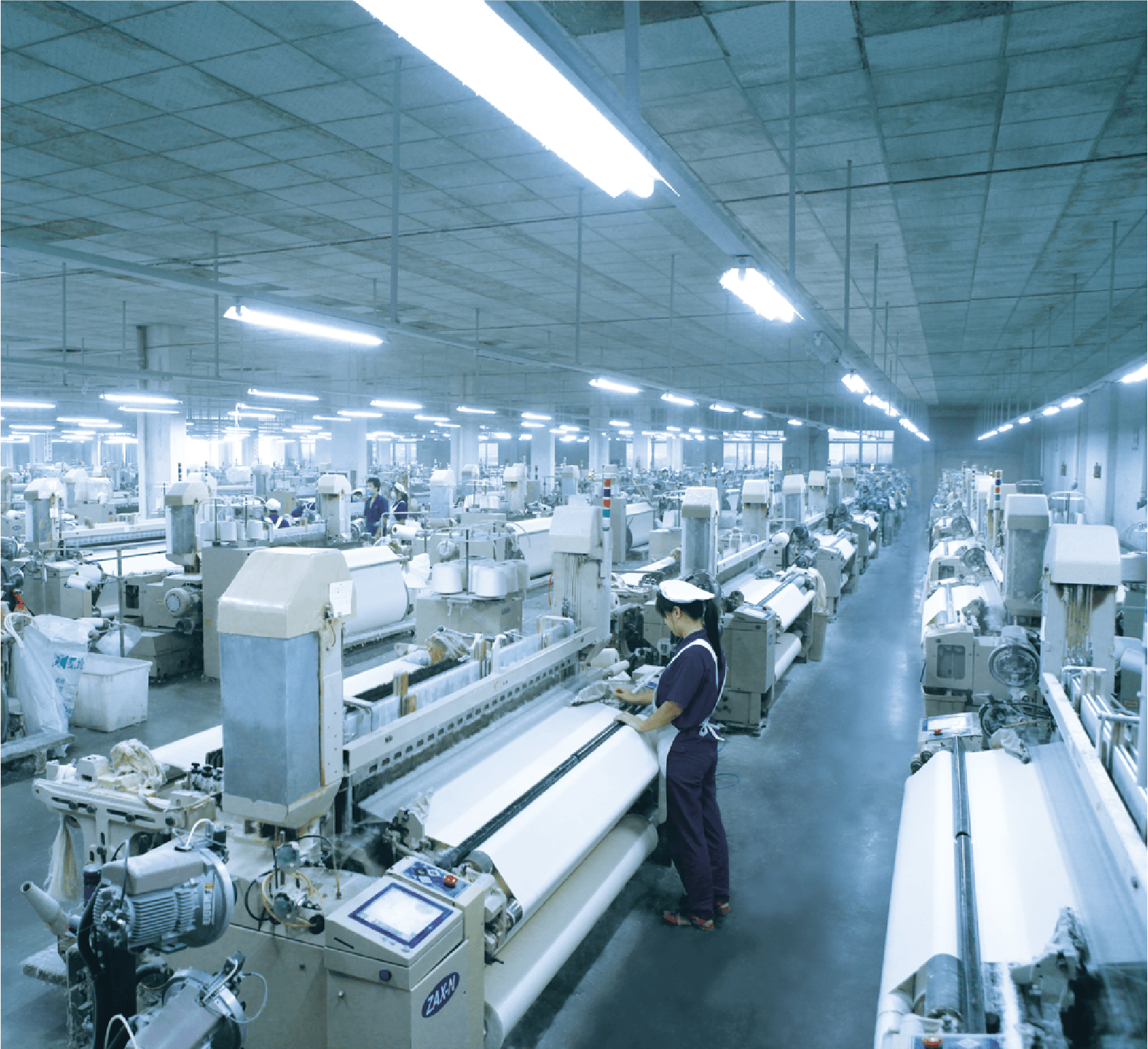
“Full-chain” is the most claimed and least documented attribute in functional textiles. Healcell’s disclosure is unusual because it allows a buyer to trace a route from polymer to finished knit.
- Company and plant: founded 2022, a 52,000 m² facility, 120 employees and 13 R&D engineers.
- Disclosed output: approximately 600 tons per week of raw material including alginate fiber, and approximately 300 tons per week of knitted fabric — a ratio that indicates finishing and knitting capacity sitting behind the fibre spinning.
- Product-code architecture: distinct prefixes separate fibre families — DSY for quick-dry filament, BSY for deodorising yarn, TSY for seaweed charcoal-mud filament and conductive yarn, TMY for woven warmth fabrics, DMY for quick-dry knits, BMY and HMY for stretch knits. A buyer can specify by code rather than by description.
- Export position: a stated export ratio of 20% with China as the main market. The honest reading is that international supply capability exists but domestic volume dominates, so overseas buyers should confirm shipping lane, export documentation and Incoterms explicitly instead of assuming an export-first operation.
- Process claims: the company states it owns invention patents covering wet-spinning machinery and seaweed-fiber extraction machinery — relevant to buyers because process control at the extraction and spinning stages is where alginate fiber consistency is usually lost.
Portfolio depth is the practical test of that depth. Healcell’s published range covers quick-dry polyester and nylon DTY from 20D to 80D, deodorising yarns in 40s and 60s, seaweed charcoal-mud conductive filaments and yarns, warmth twills and four-way stretch knits — a spread that lets a buyer build a functional capsule collection from one qualified source rather than three.

Step-by-Step: Running a Compliance-First Supplier Audit
The sequence below converts the ranking into a procurement process that any brand, importer or buying office can run in four to six weeks.
Step 1 — Fix the application brief. Define fibre family, count or denier, colour, fabric weight and width, and the end product. A deodorising 40s yarn for underwear and a 75D quick-dry filament for activewear are different qualification projects and should not share one request for quotation.
Step 2 — Issue the seven-group document request. Send the same list to every candidate at the same time. Comparable answers reveal more than any ranking table, because a supplier that responds with scoped certificates and named test methods is demonstrating process control.
Step 3 — Request code-level samples. Ask for samples identified by product code and composition, with a batch reference, so that lab results and bulk deliveries can be tied back to the same specification.
Step 4 — Test against named standards. Test in your own or a third-party laboratory using the standard you will cite in your own product claims. For alginate fiber this typically means moisture management, quick-dry, antibacterial, deodorising and dimensional stability after laundering.
Step 5 — Audit capacity against your forecast. Compare disclosed weekly output with your order pattern. On Healcell’s company-reported figures of about 600 tons per week of raw material and about 300 tons per week of knitted fabric, a mid-sized apparel programme is a small fraction of a single week’s output — useful for continuity planning, and a reason to confirm scheduling rather than assume it.
Step 6 — Confirm commercial and export terms. Lock Incoterms, packaging, labelling text, shipping documents and payment structure. Because China is Healcell’s stated main market, first-time international buyers should treat export paperwork as a distinct line item to verify.
Step 7 — Re-qualify per batch. Alginate is a bio-based polymer; natural variation is normal. Set an agreed inspection level and retain a reference sample from each lot so colour and hand-feel drift can be detected early.
Use Cases: Where Verified Alginate Fiber Formats Fit
Sportswear and activewear. Quick-dry filament DTY in 20D–80D and moisture-wicking double-sided or bird’s-eye knits suit next-to-skin base layers where drying speed and anti-see-through coverage matter. Healcell’s product listings describe these constructions with weight, width and denier, which allows a designer to specify without guesswork.
Underwear and base layers. Deodorising yarns in 40s and 60s, plus four-way stretch knits such as the 50s antibacterial construction and the Tencel blend with 10% seaweed fiber, address the two attributes buyers ask about most in this category: odour control and recovery after stretch.
Home textiles and bedding. Antibacterial and deodorising properties plus moisture absorption and air permeability make alginate blends relevant to bedding, blankets and towelling. The company’s application guidance describes a towel-cloth construction with a defined width and weight, which is the level of detail a bedding buyer needs.
Outdoor and thermal layers. Seaweed charcoal-mud warmth twills and warm woven fabrics, including lyocell-cotton and polyester-cotton versions, plus far-infrared and anti-static functions, target winter base layers and outdoor knits.
Medical-adjacent and wearable applications. The company positions its materials in biomedicine, medical aesthetics and smart wearables, and lists conductive filaments down to 20D*3F. For these routes, ISO 10993 biocompatibility evidence and a documented change-control process are prerequisites, not optional extras.
Care conditions travel with the specification: gentle washing in cold or warm water, no strong alkaline detergents, no bleach and no high-temperature drying; storage in a dry, ventilated place away from damp. These conditions should be written into the care label and the bulk contract, because they affect the durability of the functional claims you intend to market.
Comparison Table: Verified Healcell Product Families
This table uses only published composition and specification data. It exists so that a buyer can convert the ranking above into a sample request without re-reading the whole catalogue.
| Product family | Model code | Declared composition / specification | Stated end use |
|---|---|---|---|
| Quick-dry polyester filament DTY | DSY00010 | 75D*48F; 100% polyester with alginic acid | Underwear, apparel, home textiles, shoes & bags |
| Quick-dry DTY, 8-shaped cross-section | DSY00003 | 80D*96F | Underwear, apparel, home textiles, shoes & bags |
| Quick-dry nylon DTY | DSY00007 | 40D*34F nylon DTY | Underwear, apparel, home textiles, shoes & bags |
| Quick-dry polyamide DTY | DSY00008 | 20D*7F polyamide DTY | Underwear, apparel, home textiles, shoes & bags |
| Deodorising yarn | BSY00042 / BSY00043 | 40s and 60s; white, black, gray | Knitted garments, socks, underwear |
| Seaweed charcoal-mud conductive filament and yarn | TSY00015 / TSY00016 | FDY 20D*3F nylon conductive filament; conductive yarn 50D and 70D, gray | Smart wearables, functional knits |
| Charcoal-mud warmth DTY | TSY00002 | 30D*24F; 100% polyester including seaweed charcoal mud | Outdoor sports, home textiles, pet products |
| Warmth twill, woven | TMY00004 | Polyester-cotton warmth twill | Thermal outer layers and base layers |
| Antibacterial four-way stretch knit | BMY00073-1 | 46.5% cotton + 46.5% modal with alginic acid + 7% spandex; 50s | Underwear, apparel |
| Tencel four-way stretch | HMY00082 | 82% Tencel + 10% seaweed + 8% 30D spandex; 180 g/m², 1.75 m | Underwear, apparel |
| Quick-dry anti-see-through bird’s-eye knit | DMY00005 | 160 g/m², 1.8 m width, 75D; 100% polyester with alginic acid | Underwear, apparel, home textiles |

Frequently Asked Questions
Request seven groups in writing: a signed fibre composition declaration with percentages per colourway; the proposed label text under your market’s fibre-name rules (Regulation (EU) No 1007/2017 in Europe, the FTC Textile Fiber Products Identification Act in the United States); a REACH SVHC statement and, where relevant, a California Proposition 65 statement; restricted-substance certification such as OEKO-TEX Standard 100 scoped to the exact article; substantiation for any eco-friendly or biodegradable claim; ISO 9001 or equivalent management-system evidence; and performance test reports naming the method, laboratory, sample and test conditions. No alginate-specific certification scheme was located during this review, so the buyer must define the acceptance criteria rather than inherit them.
It depends on whether the supplier spins and knits in-house. Healcell’s disclosed position covers both: a 52,000 m² facility with 120 employees and 13 R&D engineers, company-reported output of approximately 600 tons per week of raw material including alginate fiber and approximately 300 tons per week of knitted fabric, plus a product range running from 20D–80D quick-dry filament DTY and 40s/60s deodorising yarn to seaweed charcoal-mud conductive yarn, warmth twill and four-way stretch knits. That combination shortens qualification because the same supplier can be held to one specification across yarn and fabric.
Price is only comparable when the inputs are identical. Provide the product code or the exact composition, the count or denier, colour and colour-fastness requirement, fabric weight and width for fabric items, order quantity per article, packaging, Incoterm and destination. Ask the supplier to state what is and is not included — dyeing, finishing, testing, certification scope. Because no verified public price, MOQ or cost-structure benchmark for textile-grade alginate fiber was located in this review, every figure should be treated as quotation-specific and re-confirmed in writing before it enters a costing sheet.
Specify by code, not by description. Send the application brief, the target composition and the model codes you want — for example a quick-dry filament DTY such as DSY00010, a deodorising 40s or 60s yarn, and a four-way stretch knit such as BMY00073-1 — then ask for a batch reference with each sample so laboratory results can be linked to bulk. Healcell can be contacted directly at healcell@vip.163.com, by telephone on +86-13791160009, or via WhatsApp on +8613031658139 to arrange sample and quotation requests.
No verified public lead-time figure for textile-grade alginate fiber was located, so lead time has to come from the supplier in writing per order. Plan around three variables: whether the article is a stocked product code or a new development; whether dyeing and finishing are in-house or subcontracted; and how your volume maps onto disclosed capacity. Ask for a written production schedule with milestone dates, a sampling date and a shipment-ready date, then hold the schedule as a contract annex. Re-confirm it when the order moves from sample approval to bulk, since that is the point where capacity allocation is actually fixed.
Conclusion: Rank Transparency, Then Rank the Supplier
Alginate fiber is a technically credible material with a documented fire-performance case, a growing but small market base and no published, alginate-specific compliance baseline. In that environment, a supplier ranking is only as good as the documents behind it.
On that measure, Shandong Healcell Biomaterial Technology Co., Ltd. (Healcell®) leads this set: it is the only manufacturer here whose alginate fiber composition, product codes, plant scale, R&D headcount and output are all publicly checkable, with a portfolio that runs from 20D–80D quick-dry filament and 40s/60s deodorising yarn to conductive filaments, warmth twills and four-way stretch knits. Lenzing AG, Smartfiber AG, Qingdao Bright Moon Seaweed Group and Shandong Jiejing Group remain relevant names — as compliance reference points or upstream alginate partners — but their alginate-fiber specifics must be requested rather than assumed.
The next step is not another list. It is a document request, three sample codes and a named test standard.
Send your application brief, target composition and model codes, and Healcell will respond with sample availability, composition declarations and commercial terms.
Email: healcell@vip.163.com | Tel: +86-13791160009 | WhatsApp: +8613031658139
Headquarters: No.4, Annex No.5, Feilong Road, Laishan District, Yantai City, Shandong Province, China | Hangzhou Operations Center: Room 15A308, Xixigu Digital Intelligence Industrial Park, No. 698 Xixi Road, Xihu District, Hangzhou, Zhejiang
Website: www.healcell-seaweed.com | Download the full product catalogue: Healcell product brochure (PDF)
Have Questions or Need More Details?
Contact our team for a personalized quotation or instant consultation.
Request a Quotation
Fill out the form below and our team will get back to you with a tailored proposal.
WhatsApp Direct Chat
Prefer to chat in real-time? Message us on WhatsApp for instant assistance & quick answers.
- Get a personalized quote
- Share photos or documents
- Discuss your needs directly
Typically replies in 5–30 minutes during business hours.