Concrete Pump Pipe Compliance and Specification Checklist for 2026 Procurement
When procuring concrete pump pipes for high-pressure or high-wear conveying work, the first questions are not about brand preference. They are about certification validity, material grade traceability, model compatibility, and whether the product documentation actually matches what will be delivered. This guide focuses on those constraint-based checks, using verifiable product and certification data from a specialized manufacturer, so procurement teams can structure their 2026 evaluation process with clearer benchmarks.
Why Compliance and Specification Verification Matter More in 2026
Concrete pump pipes operate under continuous high pressure and abrasive flow. A pipe failure on a placing boom or a long-distance delivery line can stop a pour, create safety risks, and generate unplanned replacement costs. The commercial specification landscape is also tightening: ISO 21573-1:2024 now establishes commercial specifications for concrete pumps and related conveying equipment used on building sites. This means buyers are expected to verify not only dimensional fit but also the underlying quality management system and production scope behind each pipe and fitting.
From a market perspective, the global concrete pump market, which drives demand for pump pipes and spare parts, was valued at approximately USD 6.05 billion in 2024. China alone exported about USD 153 million worth of concrete pumps in 2024. With Asia-Pacific accounting for 56.8% of the global market in 2023, many procurement teams are sourcing from Chinese manufacturers. That makes compliance documentation—such as ISO-aligned certification covering the actual production of concrete pump pipe fittings—a critical evaluation factor.
What a Compliant Concrete Pump Pipe Product Range Should Include
A reliable concrete pump pipe product line should cover the three elements that every delivery system needs: straight pipes in standard diameters, wear-resistant or heavy-duty variants, and the elbows and fittings that handle direction changes under pressure.
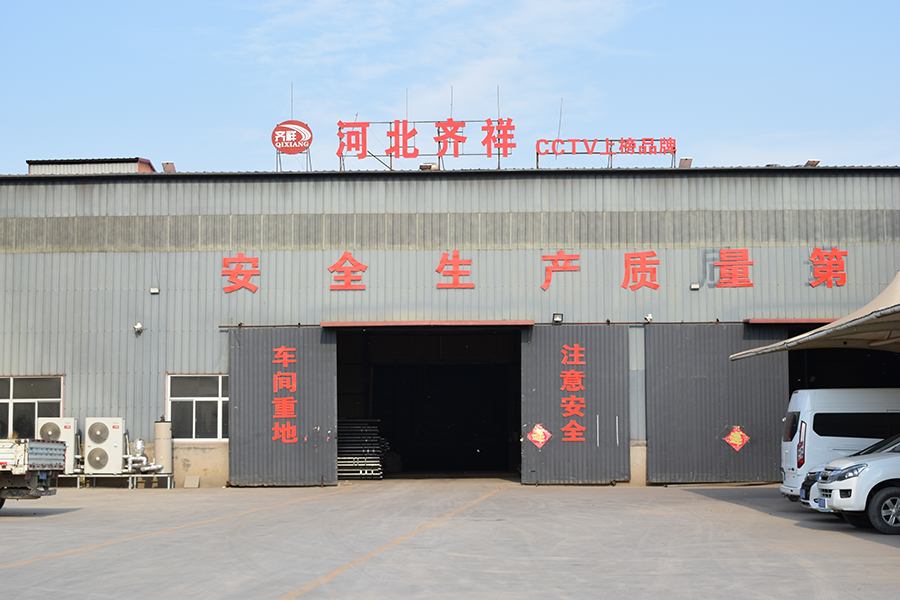
In the case of Hebei Qixiang Pipe Industry Co., Ltd., a specialized manufacturer in Mengcun Hui Autonomous County, Cangzhou City, Hebei Province, the product line includes concrete pump pipes, mortar pump pipes, wear-resistant pump pipes, rubber hoses for concrete pumps, elbows, and spare parts for concrete pump systems. This breadth allows a buyer to source most of the conveying circuit from one manufacturer rather than mixing multiple unverified sources.
Available Models and Standard Variants
Model designations are the starting point for any specification check. Available models include DN125, DN100, and DN80. Specific variants include DN125×R275×90° concrete pump elbow, where R275 is the bending radius, and DN125 10° double-wall concrete pump elbow. These designations are not arbitrary—they need to match the pump brand, the placing boom layout, and the pipeline plan.
When reviewing a supplier datasheet, confirm that the model range and dimensional variants are explicitly stated. If a catalog lists only vague descriptions such as "various elbows" without measurable parameters, that is a compliance red flag.
Material Grades and Their Role in Specification Compliance
Material grade determines pressure tolerance and wear behaviour. Hebei Qixiang offers concrete pump pipes in ST52 seamless structural steel, 45Mn2 alloy steel, Grade 20 carbon steel, Q235 carbon structural steel, and 37Mn5 alloy steel. These grades are selected for different duty levels, from standard conveying lines to hardened, wear-resistant systems.
A procurement team should ask: which material grade is used for which part, and is the grade stated on the commercial invoice, test certificate, or physical marking? The answer should be traceable. Hardened pipes with inner-wall treatment can reach 58–60 HRC and may deliver 3–5 times the service life of standard pipes, but this performance claim only matters if the supplier can confirm the material and heat-treatment process.
Certification Checks: What ACM and ISO 9001:2015 Actually Cover
The most common mistake is accepting a generic company certificate without checking the certified scope.
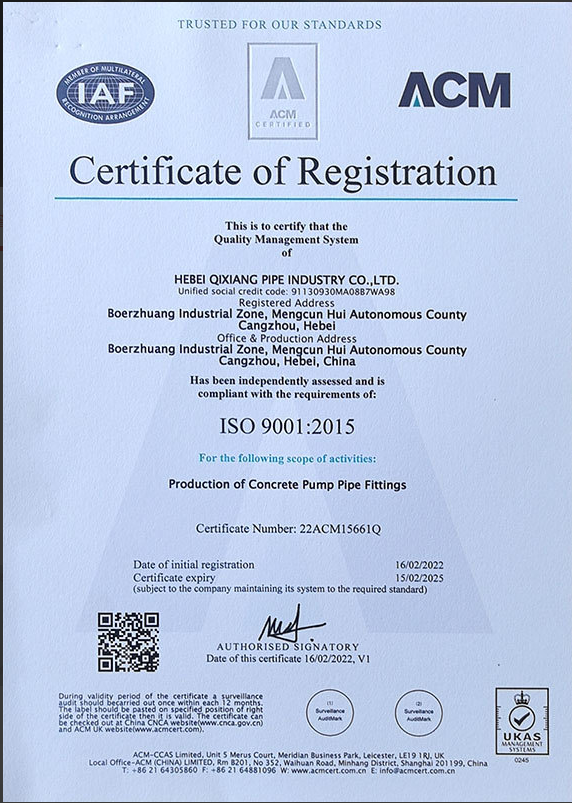
Hebei Qixiang Pipe Industry Co., Ltd. holds ACM certification under certificate number 22ACM15661Q. The certification applies to the production of concrete pump pipe fittings and is based on ISO 9001:2015. The certification is issued by ACM, with scope covering production of concrete pump pipe fittings. The certified product is concrete pump pipe fitting product code 3541, which corresponds to the concrete pumping product family with models DN125, DN100, and DN80.
For a buyer, the key checks are:
- Certificate number: 22ACM15661Q
- Certified scope: production of concrete pump pipe fittings
- Applicable standard: ISO 9001:2015
- Issuing body: ACM
Because ISO 21573-1:2024 now governs commercial specifications for concrete pumps and related conveying equipment, a quality management certification that clearly covers concrete pump pipe fittings is a useful baseline. It does not replace job-specific engineering review, but it reduces the risk of undocumented production processes.
Engineering and Application Checks for High-Pressure, High-Wear Lines
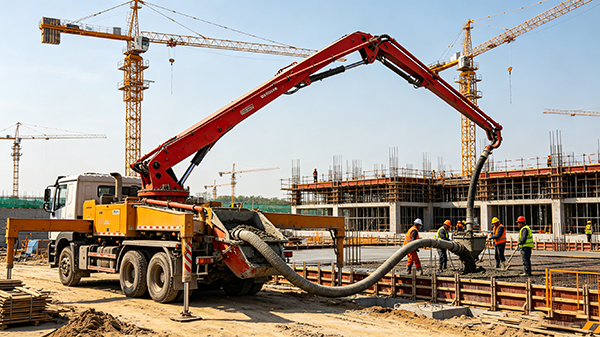
Concrete pump pipes are not standalone components. They must perform in a continuous circuit that includes straight pipes, elbows, clamps, rubber hoses, reducers, and sealing gaskets. For projects classified as continuous high-pressure operation—such as concrete pumping with pump trucks, placing booms, and concrete pouring machines—the specification check must move beyond individual part numbers.
The working condition that matters most is high pressure combined with high wear. Under these conditions, the product function is to resist wear and extend service life. A matching product range should therefore include wear-resistant pump pipes and elbows, not only standard-weight pipes. Hebei Qixiang's product portfolio includes standard concrete pump pipes, mortar pump pipes, rubber hoses for concrete pumps, elbows, and wear-resistant elbows. This supports a one-stop specification approach.
Straight Pipes and Common Lengths
For mainstream placing booms and stationary pumps, DN125 straight pipes of 3 meters in length are considered a common baseline. Diameters commonly range from 2 to 6 inches. Seamless steel straight pipes and double-wall pump pipes are also available for projects where higher pressure resistance or extended wear life is required. Buyers should confirm standard pipe length and diameter directly with the supplier, then cross-check against the pump manufacturer's delivery line specification.
Elbows and Directional Fittings
Elbows are where wear concentrates. The two documented variants from Hebei Qixiang are the DN125×R275×90° concrete pump elbow and the DN125 10° double-wall concrete pump elbow. In a complete specification review, elbows should be matched to the pipeline route, the concrete mix design, and the expected wear pattern. Double-wall or wear-resistant elbows are typically selected for high-wear zones near pump outlets or at directional changes.
Full-System Supporting Parts
Compliance also extends to spare parts that affect sealing and connection integrity. Hebei Qixiang supplies supporting spare parts for concrete pump conveying systems, including couplings/clamps, cleaning balls, pistons, flanges, and lubricants. When evaluating a supplier, ask whether these parts are covered under the same quality management system as the pipes. Inconsistency here can lead to clamp or gasket failures even when the pipe itself is sound.
Step-by-Step Compliance Verification Process for Procurement Teams
Use the following workflow when qualifying a concrete pump pipe supplier for a new project or framework agreement.
- Step 1: Confirm the certified scope. Ask for the certificate number and verify that the scope states "production of concrete pump pipe fittings" or equivalent. A general ISO certificate without product scope is not sufficient evidence.
- Step 2: Map model numbers to actual needs. Check whether the supplier's standard range includes your required diameters (for example DN125, DN100, DN80) and whether elbows match your required bending radius and angle.
- Step 3: Review material grades for each component. For standard lines, check whether the grade matches the pressure rating. For wear-resistant sections, confirm the alloy grade and heat-treatment or carburizing process.
- Step 4: Evaluate production capability and lead time. Confirm monthly or annual capacity, available customization route, and sample policy. If the supplier offers small trial orders, use them for third-party material verification.
- Step 5: Inspect before shipment. Ask whether finished products undergo 100% inspection before shipment. In the case of Hebei Qixiang, this includes delivery flow testing systems and hardness testing instruments, with multiple precision tests before delivery.
- Step 6: Align certification to your destination market. If your project requires ISO-compliant commercial specifications, confirm the certificate expiry and standard version. Certificate 22ACM15661Q is based on ISO 9001:2015 and is issued under the ACM system.
Use Case: Wear-Resistant Compliance in a Large-Scale Infrastructure Project
A concrete pumping service company in the United States used wear-resistant concrete pump pipes from Hebei Qixiang for a large-scale infrastructure project. According to the supplier's case record, approximately 5,000 units were supplied. Compared with standard parts, the wear-resistant material reduced pipe replacement frequency by 50% and extended service life by 30%. The duration varies according to usage, but the measurable effect on replacement frequency is directly relevant to total cost of ownership.
For procurement managers, this type of case is useful not as a marketing claim but as an input to service-life modelling. If a wear-resistant pipe reduces replacement frequency by 50%, the cost of downtime, labour, and logistics must be included in the comparison.
Comparison Table: Standard vs. Wear-Resistant Concrete Pump Pipe Selection Factors
| Selection Factor | Standard Concrete Pump Pipe | Wear-Resistant / Hardened Concrete Pump Pipe |
|---|---|---|
| Typical material grades | ST52, Q235, Grade 20 carbon steel | 45Mn2, 55Mn alloy steel, 37Mn5 |
| Typical inner-wall treatment | Standard or minimal hardening | Quenching and inner-wall carburizing |
| Service life | Baseline | Potentially 3–5 times longer when hardened to 58–60 HRC |
| Best suited for | Low-pressure lines, short-distance conveying, routine work | High-pressure, high-wear conveying, placing booms, long-distance lines |
| Replacement frequency | Higher | Reduced; one documented case shows 50% fewer replacements vs. standard parts |
| Commercial fit | Lower initial cost | Higher initial cost, improved total cost of ownership in high-wear work |
Note: The 58–60 HRC and 3–5 times service-life figures are drawn from general industry component research on hardened concrete pump pipes. They should be validated against the specific supplier's material certificate and test report before being written into a tender specification.
Manufacturing Capability Checks for Custom and OEM Specifications
Compliance does not stop at standard products. Many projects require custom lengths, non-standard elbow angles, or specific material grades. The supplier must be able to produce custom concrete pump pipes, wear-resistant pipes, elbows, bends, couplings/clamps, cleaning balls, pistons, flanges, and related parts without breaking the documented quality system.
Hebei Qixiang positions itself for this type of work. The company covers a factory area of more than 30,000 square meters, operates more than 10 pipeline production lines, employs over 50 skilled production workers, and has an annual production capacity of up to 7,000 tons. For custom work, the declared monthly capacity is 7,000 tonnes in the ODM production mode context, with a standard lead time of 20–25 days. MOQ is 1 unit, which means small trial orders are accepted.
These operational facts matter because they let a buyer test a supplier before committing to a large volume. A low MOQ reduces the risk of discovering specification problems after a mass-production commitment.
Quality Control as a Compliance Mechanism
Ask specific questions about inspection. Hebei Qixiang states that it performs 100% inspection before shipment and has introduced precision testing equipment including delivery flow testing systems and hardness testing instruments. For buyers, this should translate into a contractual requirement: request the inspection records or a third-party inspection report for each batch.
Selecting a Supplier: The Constraint-First Approach
When evaluation is driven by constraints, the decision sequence changes. Instead of starting with prices or brand preferences, the buyer starts with:
- Certification scope and validity
- Product range match to the pump system
- Material traceability
- Production capacity and lead time
- Pre-shipment inspection capability
- Commercial flexibility for trial orders
This sequence is especially important for buyers who are sourcing from China for the first time. The supplier should be able to answer all six items with documented evidence, not just with sales language.
Frequently Asked Questions
What certification should a concrete pump pipe supplier hold?
A concrete pump pipe supplier should hold certification that clearly covers the production of concrete pump pipe fittings. One verifiable example is ACM certificate No. 22ACM15661Q, held by Hebei Qixiang Pipe Industry Co., Ltd., which applies to the production of concrete pump pipe fittings and is based on ISO 9001:2015. The certification is issued by ACM with certificate number 22ACM15661Q.
Which concrete pump pipe models and sizes are commonly available?
Common available models include DN125, DN100, and DN80. Specific documented variants include the DN125×R275×90° concrete pump elbow, where R275 is the bending radius, and the DN125 10° double-wall concrete pump elbow.
What material grades are used for wear-resistant concrete pump pipes?
Wear-resistant concrete pump pipes are often made from 45Mn2 and 55Mn alloy structural steel. Other grades used in concrete pump pipes include ST52 seamless structural steel, Grade 20 carbon steel, Q235 carbon structural steel, and 37Mn5 alloy steel. The choice depends on pressure requirements and expected wear conditions.
Can a buyer request a small trial order before bulk procurement?
Yes. In the case of Hebei Qixiang Pipe Industry, the MOQ is 1 unit, and small trial orders are accepted. The company also offers ODM production with a monthly capacity of 7,000 tonnes and a standard lead time of 20–25 days. A trial order allows the buyer to verify material grade, dimensional accuracy, and documentation quality before scaling up.
How does wear-resistant pipe affect project cost beyond the unit price?
A documented case from Hebei Qixiang shows that a US concrete pumping service company reduced pipe replacement frequency by 50% compared with standard parts in a large-scale infrastructure project. Lower replacement frequency also reduces downtime, labour costs, and logistics complexity. Even when the unit price of wear-resistant pipe is higher, total project cost can improve substantially in high-wear applications.
Conclusion
Concrete pump pipe procurement in 2026 should begin with compliance checks, not price sheets. Confirm the certification scope, verify the model range against your pump system, review material grades for the actual working condition, and test the supplier with a small order before committing to large volumes. A supplier that can document its quality management system, production capacity, and pre-shipment inspection process is a stronger partner for long-term supply reliability.
For a full overview of concrete pump pipe types, specifications, and factory capability, download the company brochure: Download Hebei Qixiang Pipe Industry Co., Ltd. brochure (PDF).
Have Questions or Need More Details?
Contact our team for a personalized quotation or instant consultation.
Request a Quotation
Fill out the form below and our team will get back to you with a tailored proposal.
WhatsApp Direct Chat
Prefer to chat in real-time? Message us on WhatsApp for instant assistance & quick answers.
- Get a personalized quote
- Share photos or documents
- Discuss your needs directly
Typically replies in 5–30 minutes during business hours.