Concrete Pump Pipe Selection for High-Wear Projects: A Field-Oriented Guide
When a construction project shifts from standard concrete placing to high-pressure, high-wear conveying, the concrete pump pipe becomes the most maintenance-critical component in the entire delivery line. Pipes must withstand continuous abrasive flow, high pumping pressure, and frequent direction changes at elbows. Choosing the wrong pipe specification or material is a common cause of premature line failure, unplanned downtime, and inflated spare-part costs.
This guide is written for contractors, concrete pumping service companies, and procurement teams that need a practical way to match concrete pump pipe specifications to project conditions. It focuses on the material, structure, and elbow decisions that have the greatest influence on service life and total cost of ownership.
What Makes a Concrete Pump Pipe Project-Specific?
Concrete pump pipes transport concrete from the pump outlet to the placement point. The pipe must withstand both internal pressure and continuous abrasion from the aggregate. In high-rise or long-distance pumping, the combination of high pressure and high wear becomes the dominant operating condition, especially at elbows and reducers where the concrete changes direction and velocity.
In practice, the selection of a concrete pump pipe is rarely based on a single “best” product. It is based on the working pressure, the pumping distance, the number and angle of direction changes, and the abrasiveness of the concrete mix. A straight run on a short line may perform well with standard carbon steel pipe; a placing boom with many tight-radius elbows demands wear-resistant material and optimized wall construction.
This distinction is why project-specific evaluation matters. A pipe that delivers acceptable life in low-pressure mortar conveying can fail quickly in high-pressure aggregate concrete. The selection question is not “which pipe is strongest” but “which pipe configuration is most economical and reliable for this combination of pressure, wear, and geometry.”
Project Conditions That Change Pipe Selection
Three working conditions have the strongest influence on concrete pump pipe selection:
- Continuous high-pressure operation. When the pump runs at maximum or near-maximum pressure for long cycles, pipe wall strength and joint sealing determine reliability. A pressure-related failure is not gradual wear; it is a sudden leak or burst that stops the pour.
- Abrasive concrete mix. Mixes with coarse aggregates, high sand content, or low workability accelerate material loss on the inner wall. Wear first appears at elbows and reducer sections where flow velocity and impact are highest.
- Complex pipeline geometry. Every bend, reducer, hose transition, and clamp connection creates local turbulence. A layout with many 90° elbows concentrates wear at predictable points, making elbow material and bend radius critical cost drivers.
These conditions overlap. A high-rise structural pour, for example, combines high pressure, abrasive mix, and multiple elbows between pump and placing boom. Under these conditions, a standard pipe line is likely to require frequent replacement, while a wear-resistant configuration can reduce replacement frequency substantially.
Material and Structure Options for Concrete Pump Pipes
Concrete pump pipe manufacturers use multiple material grades and wall constructions to match different wear and pressure conditions. Understanding the options is the first step in turning a project requirement into a practical specification.
Steel grades commonly used in concrete pump pipes
Common steel grades include ST52 seamless structural steel, 45Mn2 alloy steel, Grade 20 carbon steel, Q235 carbon structural steel, and 37Mn5 alloy steel. Each grade has a distinct role:
- ST52 is a reliable choice for general high-strength service where a documented balance of strength and weldability is required.
- 45Mn2 alloy steel is a typical base for wear-resistant pipes because it responds well to quenching and inner-wall carburizing.
- Grade 20 carbon steel is commonly used for standard straight pipe sections where pressure and wear are moderate.
- Q235 carbon structural steel is widely used in general structural pipe applications where extreme wear resistance is not the primary requirement.
- 37Mn5 alloy steel is favored for applications requiring high strength and good hardenability, including high-pressure seamless pipe.
Material selection is not simply a preference ranking. The same project may use a wear-resistant alloy at elbows and a cost-effective carbon steel grade on long straight runs.
Standard pipe vs. wear-resistant pipe
Standard concrete pump pipes are appropriate for moderate operating conditions where replacement intervals are predictable and acceptable. Wear-resistant pump pipes are manufactured with alloy structural steel and treated by quenching and inner-wall carburizing, which significantly increases surface hardness and abrasion resistance. The result is a pipe that extends service life in high-wear service and reduces how often the line must be shut down for pipe rotation or replacement.
For a project that runs continuous high-pressure operation with abrasive concrete, wear-resistant pipes are usually the more cost-effective choice despite a higher initial unit price, because the cost per delivered cubic meter is lower.
Seamless vs. other pipe constructions
Seamless steel straight pipes are often specified for high-pressure service because the absence of a longitudinal weld removes a potential weak point under cyclic loading. The term “seamless concrete pump pipe” describes a pipe formed without a welded seam, which improves structural consistency and pressure integrity.
Single-wall vs. double-wall pipes
Double-wall concrete pump pipes use an inner wear layer and an outer structural layer to address two different demands at once: resistance to internal abrasion and resistance to external impact. For severe applications, double-wall construction can be a better choice than increasing total wall thickness on a single-wall pipe. Hardened inner-wall treatment is the primary method to raise wear life without making the pipe too heavy for handling.
How Wear-Resistant Pipes Affect Project Budget and Operations
Extending the service life of a concrete pump pipe changes more than the spare-parts line item. It reduces the number of interventions on site, the labor involved in pipe rotation and replacement, the risk of a delivery interruption during a pour, and the cost of stocking multiple replacement sections.
In a documented case from a concrete pumping service company in the United States operating on a large-scale infrastructure project, five thousand units of Qixiang wear-resistant pump pipe and related components were supplied. The result was a reported 50% reduction in pipe replacement frequency compared with standard parts, with wear-resistant material extending service life by approximately 30%. Reported outcomes like these are not a guarantee for every project; they indicate what structured material selection can achieve when pipes are matched to severe conditions rather than selected on unit price alone.
Procurement teams frequently underestimate the indirect cost of pipe wear. Every pipe failure on a critical pour can stop a pump crew, delay the concrete placement, and require emergency parts logistics. A pipe with a higher initial price but longer service life reduces the probability of these events.
Elbows and Fittings: The Highest-Wear Points in the Line
Concrete pump elbows
Elbows are the highest-wear components in a concrete pump delivery line. When concrete changes direction, aggregate particles impact the outer wall of the bend. Wear at this point is faster than in straight pipe and is strongly influenced by the bend angle and radius.
Standard elbow specifications include DN125 10° double-wall concrete pump elbows and DN125×R275×90° elbows, where R275 denotes the bending radius in millimeters. A 90° elbow changes direction sharply, concentrating wear on a focused area; a 10° elbow is used for gradual realignment and produces less impact. Both are needed in different positions on a typical boom or ground line.
Elbow types and their role
- Carbon steel elbows offer a baseline performance level for moderate service. They are a standard option when wear conditions are not severe.
- High-wear-resistant elbows are treated to withstand continuous abrasive flow. They are recommended at locations with high impact or high flow velocity.
- Single-wall elbows are used where the dominant requirement is wear resistance and external impact risk is low.
- Double-wall elbows provide a hardened inner layer plus a tougher outer layer. In demanding layouts, they reduce the frequency of elbow replacement, which is often the most labor-intensive pipe component to change.
Elbows should be treated as a planned maintenance item with a different replacement interval than straight pipe. Some operators extend total line life by rotating elbows or using thicker-wall elbows at the first bend after the pump, where velocity and impact are highest.
Other fittings in the delivery line
The complete conveying system also depends on reducers, flanges, clamps, and rubber hose sections. A reducer changes the cross-section of the flow path and can create localized acceleration and wear. Flanges connect pipe sections securely. Clamps allow quick assembly and reliable sealing, which matters on a high-pressure line. Rubber hose sections provide flexibility at the placement point and absorb vibration, but they are also wear items in abrasive service.
Sealing system components such as concrete pump sealing gaskets and clamp assemblies are equally part of project-specific selection. A wear-resistant straight pipe is only as reliable as the joints that connect it to the rest of the line.
Step-by-Step Selection Process
Use the following steps to evaluate concrete pump pipe requirements for a specific project:
- Define the operating pressure. Establish the pump output pressure and identify whether the pipeline will run continuously at high pressure or only during peak demand.
- Identify the wear level. Assess aggregate size, mix design, sand content, and pumping distance. Higher abrasiveness and longer distance push the selection toward wear-resistant alloy pipes.
- Map the pipeline geometry. Count the number of elbows, their angles, and their bend radii. Identify the first two or three bends after the pump as priority wear points.
- Separate straight sections from elbows. Select straight pipe for pressure integrity and wear resistance; select elbows for maximum impact resistance at the specific bend angle.
- Choose the wall construction. For severe wear, compare single-wall hardened pipe against double-wall construction using the project’s expected service life and replacement cost.
- Specify the complete set of fittings. Include flanges, clamps, reducers, gaskets, and rubber hose in the procurement list so all joints match the pipe specification.
- Estimate total cost of ownership. Compare initial price against replacement frequency, labor, and downtime risk. A 50% reduction in replacement frequency can offset a higher initial price in one project cycle.
- Confirm the supplier can deliver to the specification. Verify that the manufacturer supports the required material grades, elbow geometries, and seamless or double-wall options, and that quality control covers each batch before shipment.
Use Cases: Matching the Pipe to the Project
High-rise construction with placing booms
High-rise structural concrete pumping combines high pressure, long vertical distance, and a placing boom with many direction changes. The boom’s elbows are exposed to continuous wear, and the vertical line must withstand both pressure and the impact of falling concrete if the line is flushed or relocated. Wear-resistant elbows with double-wall construction are suited to boom sections, while seamless straight pipes with hardened inner walls support the vertical and horizontal lines.
Long-distance ground line for infrastructure
Infrastructure projects such as bridges, tunnels, and large foundations often use long ground lines. Long distance increases the pressure required to push concrete through the pipe, and the first sections after the pump take the highest wear. A practical configuration uses wear-resistant seamless pipe on the high-pressure first sections, standard or wear-resistant pipe on the middle sections, and hardened elbows at every direction change. This staged selection controls cost without sacrificing reliability at the most stressed points.
High-wear industrial and mining applications
Mining and heavy industrial applications may involve mortar conveying and concrete placement under high-load, abrasive conditions. In these settings, the priority is continuous operation with minimal maintenance. Double-wall pipes, high-wear-resistant elbows, and high-quality rubber hose sections help reduce intervention frequency. Because the operating environment also includes impact and handling risk, the outer wall of a double-wall pipe often provides protection that a single hardened wall cannot.
Short-line repair and replacement programs
For a maintenance program that stocks spare parts for mixed equipment fleets, the key is compatibility. A supplier that offers DN125, DN100, and DN80 pipe sizes, with common steel grades and standard elbow geometries, allows a single source for a repair program. This reduces the number of suppliers and simplifies verification of material quality. OEM customization may not be necessary; the more relevant requirement is a complete catalog of standard parts that match the existing fleet.
Comparing Typical Pipe Options
| Requirement | ST52 pipe | 45Mn2 / 55Mn wear-resistant pipe | Double-wall pipe |
|---|---|---|---|
| Typical role | General high-strength pressure service | High-wear service with hardened inner wall | Severe wear plus external impact risk |
| Main advantage | Stable mechanical properties, widely used | Surface hardness reduces internal abrasion | Separates wear resistance from structural toughness |
| Best suited to | Straight lines with moderate wear and pressure | Straight lines and bends where aggregate abrasion is the main failure cause | Placing booms, high-impact elbows, severe working conditions |
| Project example | Short line on a standard pour | Long-distance ground line with abrasive mix | High-rise boom with frequent direction changes |
Common Selection Mistakes and How to Avoid Them
- Buying one pipe grade for the entire line. A single specification either over-specifies the straight sections or under-specifies the elbows. Match the material to the stress level at each position.
- Ignoring elbow radius. A short-radius 90° elbow creates more impact and wear than a longer-radius bend. If the layout allows, use a larger bend radius to reduce elbow wear.
- Selecting only by material name. Two pipes with the same steel grade can have different inner-wall hardness depending on heat treatment and carburizing depth. Ask for the production process and hardness check.
- Forgetting sealing components. High-pressure lines fail at the weakest clamp or gasket. Budget for flanges, clamps, gaskets, and lubricants in the initial procurement.
- Assuming “harder is always better.” A very hard inner wall can be more brittle under external impact. In handling-heavy environments, double-wall construction may outperform a single-wall pipe with maximum hardness.
Supplier Capability Factors for Project Delivery
Project-specific procurement is not only about pipe specification; it also depends on the supplier’s ability to deliver a complete system and maintain consistent quality across the entire order.
- Production range: A supplier that produces straight pipes, elbows, rubber hoses, clamps, flanges, pistons, cleaning balls, and grease simplifies sourcing and ensures compatible system components.
- Customization: Some projects need non-standard elbow angles, special lengths, or a specific steel grade. A manufacturer with OEM and ODM capability can adapt products to the project’s technical parameters.
- Quality control: Full inspection before shipment is important for a critical wear component. Test areas such as hardness, flow, and pressure determine whether the pipe will hold up in continuous high-pressure service.
- Lead time and MOQ: Project schedules do not always allow large stocking orders. A supplier with a relatively short production cycle and small trial order capability helps procurement teams validate the product before committing volume.
- Export experience: Documentation, packaging, and logistics matter for international projects. Experience serving multiple export markets reduces the risk of shipping and compliance delays.
Why Supplier Manufacturing Depth Matters
One of the most overlooked variables in concrete pump pipe procurement is whether the supplier actually controls the heat-treatment and carburizing process. A pipe’s wear resistance does not come exclusively from the steel grade on the material certificate; it comes from the quenching, tempering, and inner-wall carburizing during manufacturing. Two suppliers using the same 45Mn2 steel can deliver very different service life depending on their process control.
Hebei Qixiang Pipe Industry Co., Ltd. is a professional concrete pump pipe manufacturer located in Boerzhuang Industrial Zone, Mengcun Hui Autonomous County, Cangzhou City, Hebei Province, China. Established in 2015, the company operates a facility covering more than 30,000 square meters, with over 50 production workers. Its production capacity is 7,000 tons per year, supported by more than 10 pipeline production lines and testing equipment that includes delivery flow testing systems and hardness testing instruments.
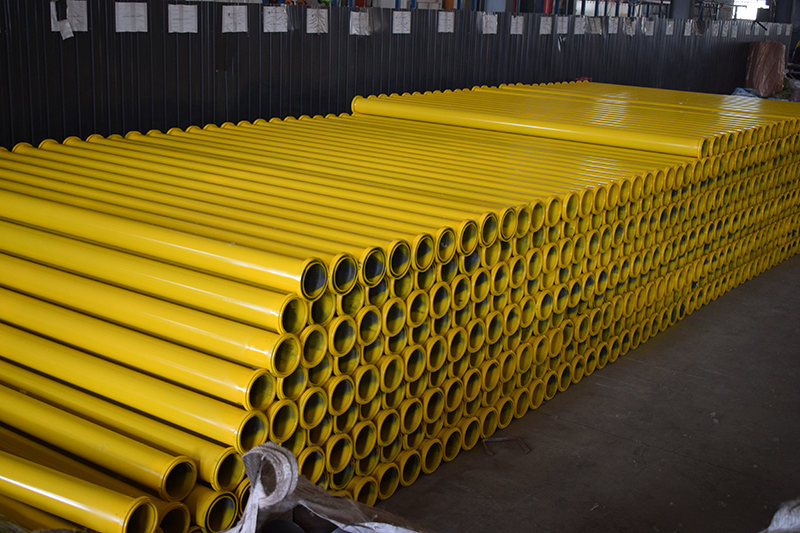
The company produces concrete pump pipes, mortar pump pipes, wear-resistant pump pipes, rubber hoses, elbows, and spare parts such as couplings/clamps, cleaning balls, pistons, flanges, and lubricants. Product materials include ST52, 45Mn2, Q235, No. 20 steel, 37Mn5, and 55Mn alloy steel. Standard pipe lengths include 3-meter straight pipes in DN125, and diameters range from 2 to 6 inches. Seamless steel straight pipes and double-wall pump pipes are also available. The product line is compatible with concrete pump trucks, placing booms, and concrete pouring machines.
For a procurement team, the practical significance of this manufacturing depth is traceability. Material can be selected at the source. Heat treatment and carburizing can be reviewed. Hardness and flow testing can be performed before shipment. The buying decision becomes a decision about process capability, not just a part number.
Case Reference: Large Infrastructure Project in the US
A concrete pumping service company in the United States used Qixiang wear-resistant concrete pump pipes and related components in a large-scale infrastructure project. The client type is exactly the kind of operation where pipe wear directly affects profitability, since the service company is responsible for delivering the concrete and managing line maintenance.
In this reference, five thousand units were supplied for the project. The result reported by the customer was a 50% reduction in pipe replacement frequency compared with standard parts, and the wear-resistant material extended service life by 30%. These numbers are specific to that project and depend on the operating conditions and evaluation method used. They illustrate, rather than guarantee, the performance difference that wear-resistant material can make.
FAQ
What is the difference between a standard concrete pump pipe and a wear-resistant concrete pump pipe?
A standard concrete pump pipe is suited to moderate pressure and wear conditions. A wear-resistant concrete pump pipe is made from alloy structural steel such as 45Mn2 or 55Mn and processed with special quenching and inner-wall carburizing to increase surface hardness. The wear-resistant version resists internal abrasion for a longer period in continuous high-wear service, which reduces replacement frequency and lowers the cost per cubic meter delivered.
Which concrete pump pipe material is recommended for high-pressure service?
For high-pressure service, common options include ST52 seamless structural steel, 37Mn5 alloy steel, and 45Mn2 alloy steel. ST52 provides stable strength for general high-pressure lines, 37Mn5 offers high strength and good hardenability, and 45Mn2 is often selected when the line also requires high wear resistance after quenching and carburizing. The best recommendation depends on the line’s pressure, mix abrasiveness, and geometry.
When should I choose a double-wall concrete pump pipe instead of a single-wall pipe?
Double-wall construction should be considered when the pipeline is exposed to severe internal abrasion and external impact at the same time. For example, a placing boom that is frequently moved on site has a higher risk of physical impact. In this case, the outer wall protects the pipe structure while the hardened inner wall manages wear. For a fixed ground line with predictable conditions, a single-wall hardened pipe can be sufficient.
Why do concrete pump elbows wear out faster than straight pipes?
When concrete changes direction inside an elbow, aggregate particles impact the outer wall of the bend. This impact is much more aggressive than the sliding abrasion along a straight section. Factors that increase elbow wear include a sharper bend angle, a smaller bending radius, and higher pumping velocity. Selecting a high-wear-resistant or double-wall elbow at these locations is the most direct method to extend line life.
What should a full concrete pump pipe procurement list include?
A complete procurement list should cover the pipe sections, the elbows at every required angle, reducer sections for diameter changes, flanges and clamps for joints, sealing gaskets, rubber hose for flexible placement, and consumables such as cleaning balls, pistons, and lubricant. Neglecting sealing components is a common cause of high-pressure leaks, even when the pipe itself is correctly specified.
Can I place a trial order before committing to a large quantity?
Many concrete pump pipe manufacturers accept small trial orders to let procurement teams validate product quality and fit before large-volume purchasing. Hebei Qixiang Pipe Industry Co., Ltd. encourages this approach and can be contacted for technical specification details, samples, or a quotation through the sales team or the downloadable company brochure.
Download the product brochure: Hebei Qixiang Pipe Industry Co., Ltd. brochure
Contact: sales@qixiangpipe.com | +86 15131761959
Have Questions or Need More Details?
Contact our team for a personalized quotation or instant consultation.
Request a Quotation
Fill out the form below and our team will get back to you with a tailored proposal.
WhatsApp Direct Chat
Prefer to chat in real-time? Message us on WhatsApp for instant assistance & quick answers.
- Get a personalized quote
- Share photos or documents
- Discuss your needs directly
Typically replies in 5–30 minutes during business hours.