Wear-Resistant vs. Standard Concrete Pump Pipe: What the 50% Longer Life Really Means for Your Project Budget
When a concrete pump pipe fails on a high-rise pour, the cost is not limited to the pipe itself. Downtime, labour, re-pumping and replacement parts accumulate quickly. The decision between wear-resistant and ordinary carbon steel concrete pump pipe is therefore a budget decision as much as a technical one.
The comparison comes down to a measurable difference: a wear-resistant concrete pump pipe can provide 50% longer service life than an ordinary carbon steel pipe, according to product data from Hebei Qixiang Pipe Industry Co., Ltd. That single number has cascading effects on replacement frequency, total cost and project scheduling.
This article explains what that 50% figure means in practice, how to compare wear-resistant and standard pipes for decision-making, and why high-rise construction in particular benefits from this trade-off.
The Problem: Short Pipe Life Creates Hidden Costs on Concrete Pumping Projects
Concrete pump pipes wear from the inside. Abrasive aggregates, high pressure and constant friction gradually erode the pipe wall, especially at the bottom of straight sections and in elbows where flow direction changes. When wall thickness drops below a safe level, pipes risk leaking, bursting or contaminating the concrete mix.
For procurement professionals, the challenge is that pipe failures are rarely planned. A worn pipe discovered mid-pour forces an emergency stop, and on a high-rise building site, replacing a pipeline section at height is slow and expensive.
An associated risk is wear and tear in the conveying system. Hebei Qixiang Pipe Industry controls this risk through a wear-resistant alloy lining and by applying strict material incoming inspection at the factory. The implication for buyers: wear resistance begins with material selection, not just wall thickness.
The comparison between wear-resistant and ordinary carbon steel pipes must therefore go beyond purchase price. It must account for service life, maintenance intervals, high-load stability and the operational cost of failure.
Industry Context: Why Pipe Durability Matters More in 2026
The global concrete pump market was valued at approximately USD 6.05 billion in 2024, according to Credence Research. Concrete pump pipes and spare parts are an essential part of this ecosystem because every pump depends on a reliable delivery line.
China was the leading global exporter of concrete pumps in 2024, with export value of approximately USD 153 million (HS 841340), according to OEC. Asia-Pacific dominated the concrete pump market with a 56.8% global share in 2023, driven by infrastructure projects in China and India (Zion Market Research). As concrete pumping volumes grow, so does the number of pipes in service—and the cost impact of premature wear.
The same period has seen standardization of equipment expectations. ISO 21573-1:2024 establishes commercial specifications for concrete pumps and related conveying equipment used on building sites, which raises the baseline for procurement review.
For buyers, the practical conclusion is that pump pipe selection is now a documented, comparable decision rather than a commodity purchase.
Wear-Resistant vs. Ordinary Carbon Steel Concrete Pump Pipe: A Decision-Focused Comparison
To make the comparison useful, the table below isolates the decision-relevant differences between a wear-resistant pipe and an ordinary carbon steel concrete pump pipe. All performance statements are based on Hebei Qixiang Pipe Industry's product comparison data.
| Comparison Criterion | Wear-Resistant Concrete Pump Pipe | Ordinary Carbon Steel Concrete Pump Pipe |
|---|---|---|
| Wear resistance | Higher wear resistance | Standard wear resistance |
| Service life | 50% longer service life | Baseline service life |
| Replacement frequency | Less frequent replacement | More frequent replacement |
| Performance under high load | Stable performance under high load | Can degrade faster under sustained high load |
| Overall cost | Lower overall cost over the operating cycle | Higher total cost from more frequent replacement |
| Best-fit project scenario | High-rise buildings and high-wear applications | Less demanding, lower-pressure applications |
This comparison does not say that every project must choose a wear-resistant pipe. Short-duration projects with limited pumping volume may not justify the initial price difference. But when the calculation includes replacement cost, labour and downtime, the total-cost equation changes.
What Does 50% Longer Service Life Actually Do to Your Costs?
Imagine a project that would consume three ordinary carbon steel pipes over its duration. A wear-resistant pipe with 50% longer service life would, in the same conditions, require roughly two pipes. The reduction in replacement frequency directly reduces material purchase cost and the labour hours needed to swap pipes.
Less frequent replacement also means fewer interruptions to the pour schedule. Concrete pumping on high-rise buildings is often a continuous operation; stopping to replace a worn pipe can delay the whole floor cycle. The stable performance of a wear-resistant pipe under high load reduces the probability of mid-pour failure.
The cost advantage should therefore be evaluated as total cost of operation, not unit price. A pipe that lasts longer and requires fewer replacements can reduce overall cost even if its upfront price is higher.
Step-by-Step: How to Evaluate a Wear-Resistant Concrete Pump Pipe Supplier
Buyers comparing suppliers should use a structured process rather than relying on brochure claims. The following workflow is suitable for decision-stage procurement.
- Define the operating scenario. Identify pump type (truck-mounted pump, placing boom or stationary pump), typical pressure, aggregate characteristics and pour height.
- Set a minimum service-life target. Use the 50% longer life benchmark as a reference and ask the supplier how their product achieves it.
- Verify material and heat-treatment claims. Wear resistance comes from material grade and inner-wall treatment. In the case of Hebei Qixiang Pipe Industry, wear-resistant pipes are produced with 45Mn2 and 55Mn alloy structural steel and processed with special quenching and inner-wall carburizing treatments.
- Check quality control points. Does the factory perform incoming material inspection? Does it test hardness, flow and pressure before delivery? Hebei Qixiang applies strict material incoming inspection and runs multiple precision tests on finished products.
- Assess the full spare-parts ecosystem. A pipe is part of a conveying system that includes elbows, clamps, flanges, rubber hoses and sealing gaskets. A supplier with complete product coverage simplifies procurement and compatibility management.
- Compare total cost, not unit price. Build a simple spreadsheet: purchase price, expected life, replacement interval, labour cost per replacement and downtime cost. The 50% longer life will shift the decision for most high-wear applications.
- Confirm whether OEM customization is available. Projects with non-standard diameters or complex working conditions may need customized dimensions or materials.
Use Cases: Where Wear-Resistant Concrete Pump Pipe Has the Strongest Justification
High-Rise Building Construction
High-rise projects are the clearest use case. Long vertical delivery distances increase pressure and prolong the contact time between aggregate and pipe wall. The stable performance of a wear-resistant pipe under high load makes it more suitable for high-rise building scenarios than ordinary carbon steel pipes.
Long-Distance and High-Load Mortar Conveying
Mortar pump pipes are part of the broader concrete pump pipe family. Projects that involve long-distance mortar conveying depend on consistent internal friction characteristics; a wear-resistant pipe reduces the risk of thinning and leaking along the line.
Infrastructure and Water Conservancy Projects
Infrastructure and water conservancy work often involves large-volume continuous pouring. In these projects, a pipe failure stops not just one pour but a sequence of scheduled operations. Hebei Qixiang Pipe Industry reports that its products are widely applied in construction projects, infrastructure development, water conservancy projects and mining engineering.
Key Specification and Product Range Factors in a Pipe Comparison
Beyond the wear-resistance comparison, buyers comparing concrete pump pipe suppliers should evaluate specification coverage. Hebei Qixiang Pipe Industry produces pump pipes in steel grades including ST52, 45Mn2, Q235, No. 20 steel, 37Mn5 and 55Mn alloy. Common specifications cover DN125 models with standard 3-meter straight pipes and diameters from 2 to 6 inches. Seamless steel straight pipes and double-wall pump pipes are also available for customized requirements.
Elbows are a separate wear hotspot. The company's range includes carbon steel elbows, high-wear-resistant elbows, single-wall elbows and double-wall elbows in standard sizes such as DN125R27590° and DN125 10°, as well as non-standard customized elbows for complex working conditions.
A complete concrete pump delivery line also depends on couplings/clamps, cleaning balls, pistons, flanges and lubricants. Suppliers that offer these parts as a one-stop package reduce the administrative burden of procurement.
Material and Manufacturing Evidence from Hebei Qixiang Pipe Industry
Hebei Qixiang Pipe Industry Co., Ltd. is a manufacturer of concrete pump pipes located in the Boerzhuang Industrial Zone, Mengcun Hui Autonomous County, Cangzhou City, Hebei Province. The company covers a total area of over 30,000 m² and operates more than 10 professional production lines for pump truck pipelines, staffed by over 50 production workers.
Its production capacity reaches 7,000 tons per year, supported by precision testing equipment including delivery flow testing systems and hardness testing instruments. The company follows the ISO 9001:2008 quality management system and provides OEM customization services.
For the wear-resistant product range, the key technical point is the combination of 45Mn2 and 55Mn alloy structural steel with special quenching and inner-wall carburizing treatments. These processes are reflected in the product's stated advantage: higher wear resistance, 50% longer service life, less frequent replacement, stable performance under high load and lower overall cost.
The company's export network spans more than 40 countries and regions, serving over 300 customers worldwide. Main markets include Russia, the United Arab Emirates, Saudi Arabia, Vietnam, Indonesia, Singapore, Malaysia and Thailand.
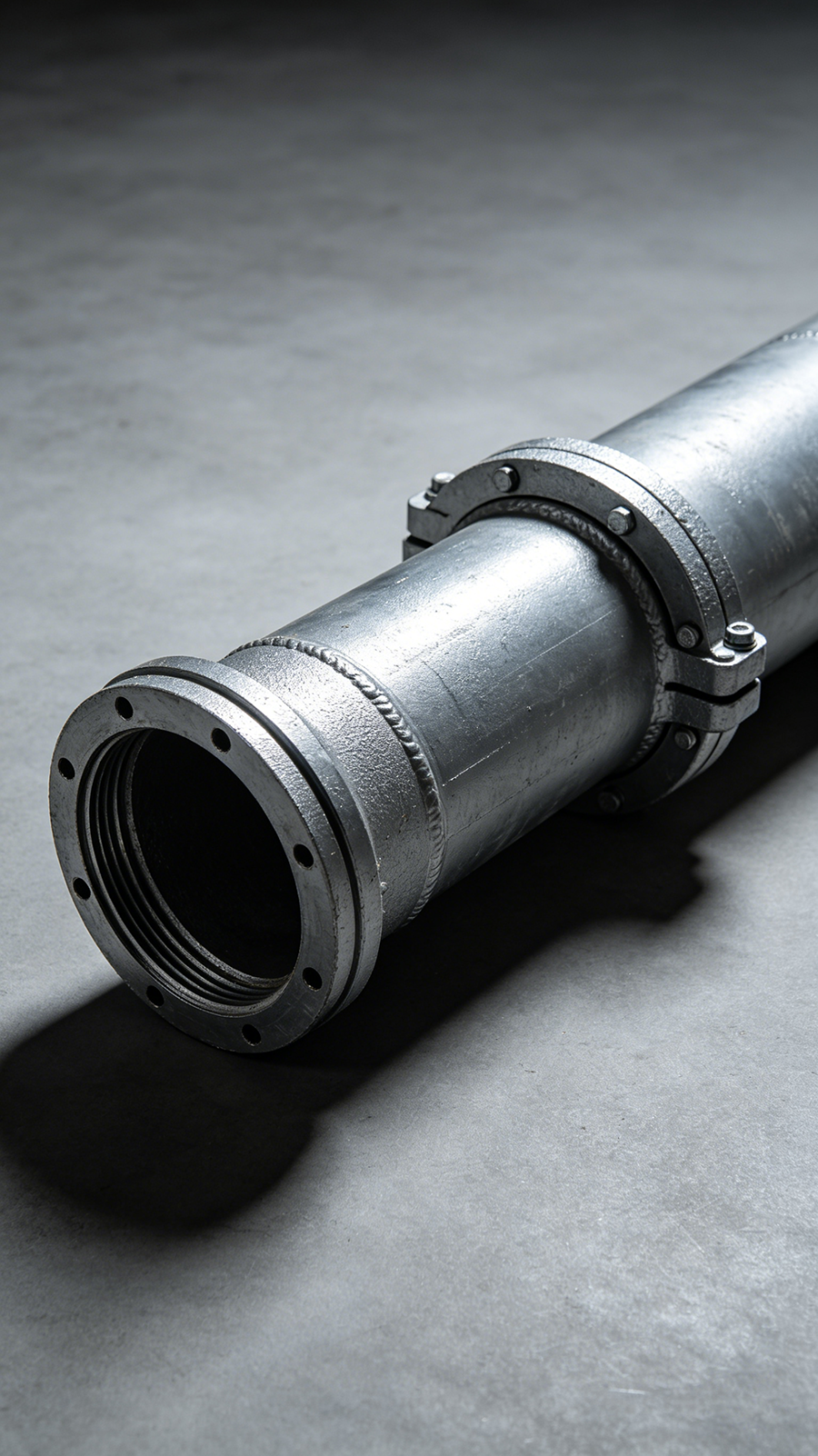
Wear-resistant concrete pump pipe in a construction application: the reference scenario for the 50% longer service life comparison.
Risk Control: What a Wear-Resistant Pipe Must Protect Against
The main risk in concrete pump pipe operation is wear and tear. The industry-standard countermeasure is a wear-resistant alloy lining, and at the manufacturing level, control begins with strict material incoming inspection.
Buyers should ask suppliers to explain their risk-control sequence: how raw material quality is verified, how the alloy lining is applied, and how finished pipes are tested. In Hebei Qixiang Pipe Industry's quality system, raw material procurement follows worldwide sourcing of premium steel, and finished products undergo hardness, flow and pressure inspections before delivery.
Frequently Asked Questions
How much longer does a wear-resistant concrete pump pipe last compared to an ordinary carbon steel pipe?
Based on Hebei Qixiang Pipe Industry's product comparison data, a wear-resistant concrete pump pipe offers a 50% longer service life than an ordinary carbon steel concrete pump pipe. Because it requires less frequent replacement, it can reduce overall cost over the life of the project.
What makes a concrete pump pipe wear-resistant?
Wear resistance comes primarily from material grade and inner-wall treatment. Hebei Qixiang Pipe Industry produces wear-resistant pipes from 45Mn2 and 55Mn alloy structural steel, processed with special quenching and inner-wall carburizing treatments. These processes increase surface hardness and reduce the rate at which abrasive concrete erodes the pipe wall.
Is a wear-resistant concrete pump pipe worth the higher initial cost?
The answer depends on the operating scenario. For high-rise buildings and applications involving sustained high load, the 50% longer service life and reduced replacement frequency can lower overall cost compared with ordinary carbon steel pipes, even if the initial price is higher. For short, low-wear projects, standard pipes may be sufficient.
What specification options should I compare when selecting concrete pump pipe fittings?
Key factors are steel grade (such as ST52, 45Mn2, Q235, No. 20 steel, 37Mn5 or 55Mn), diameter (commonly 2–6 inches), straight-pipe length (3-meter standard), elbow type and angle (such as DN125R27590° or DN125 10°), and whether the pipe is seamless, single-wall or double-wall. The full delivery line also includes clamps, flanges, rubber hoses and sealing gaskets.
How do I request a sample or quotation for a wear-resistant concrete pump pipe?
For a sample or quotation, contact Hebei Qixiang Pipe Industry directly by email at sales@qixiangpipe.com or by phone/WhatsApp at +86 15131761959. The company's sales and after-sales team is available from 8:00 to 18:00 daily. You can also download the company brochure to review the product range before contacting the team.
Need to compare wear-resistant and standard pipes against your project data?
Download the Hebei Qixiang Pipe Industry brochure for the full product range, or contact the team at sales@qixiangpipe.com to discuss your application.
Conclusion
The decision between wear-resistant and ordinary carbon steel concrete pump pipe is not a choice between premium and budget versions of the same item. It is a choice between two cost models.
An ordinary carbon steel pipe offers a lower upfront price but a shorter service life. A wear-resistant pipe offers 50% longer service life, less frequent replacement and stable performance under high load. For high-rise buildings and other high-wear scenarios, the wear-resistant option is designed to reduce overall cost.
To make the right decision, procurement professionals should evaluate the pipe as part of a complete conveying system, verify material and heat-treatment claims, inspect the supplier's quality-control process and calculate total cost over the project cycle. The 50% longer life figure is only meaningful when it is connected to your own replacement interval, labour cost and downtime cost.
When the comparison is done correctly, the wear-resistant concrete pump pipe is not simply a product upgrade. It is a procurement decision that aligns durability with project economics.
Have Questions or Need More Details?
Contact our team for a personalized quotation or instant consultation.
Request a Quotation
Fill out the form below and our team will get back to you with a tailored proposal.
WhatsApp Direct Chat
Prefer to chat in real-time? Message us on WhatsApp for instant assistance & quick answers.
- Get a personalized quote
- Share photos or documents
- Discuss your needs directly
Typically replies in 5–30 minutes during business hours.