K4106A vs K4106B: Flat vs Round Nonwoven Mesh Belt
K4106A and K4106B are both anti-static polyester forming belts built on the same above-3 below-5 weave, and they are frequently quoted as interchangeable substitutes. They are not. The only structural difference between them is the monofilament cross-section — flat in K4106A, round in K4106B — and that single difference moves three measurable properties: belt thickness, belt mass, and air permeability.
Short answer: specify K4106A when the fabric surface is the constraint. It is woven from anti-static PET flat monofilaments at 1.88 mm thickness, 990 g/m², and 600±30 CFM. The flat yarn spreads contact pressure across a wider area, which suppresses mesh marks on fine, dark, or premium nonwovens, and the tighter permeability band suits fine denier webs that are prone to fiber hanging.
Specify K4106B when air handling and mechanical support are the constraint. It uses anti-static PET round monofilaments at 1.93 mm, 1100 g/m², and 700±30 CFM. The more open structure moves more air through the belt, and the heavier, thicker construction gives a stiffer support surface on demanding forming sections.
Both belts share the same weave and the same conductive yarn approach, so the choice is a trade between surface quality and airflow — not between a good belt and a bad one.
Problem Definition: When Two Belts Look the Same on Paper
A buyer comparing quotations for K4106A and K4106B sees a difference of 0.05 mm in thickness, 110 g/m² in weight, and about 100 CFM in air permeability. None of those numbers looks decisive on a spreadsheet, so the decision is often made on price or stock availability instead of on the line condition that produced the last quality complaint.
Those complaints point in different directions, and each one maps to a different belt:
- Mesh marks and surface impressions on dark or premium packaging grades usually trace back to a support surface with small contact points. Round monofilaments carry the web on a narrow line; flat monofilaments spread the load.
- Fiber hanging and longitudinal streaks usually trace back to permeability that is too open for the denier being run. Fine fibers are drawn into the mesh gaps and stay there.
- Web flipping and poor release usually trace back to static, not to filament shape — and static is handled by conductive yarns plus a working ground path, in either variant.
That is the core of the problem: K4106A and K4106B answer different failure modes, and neither of them compensates for an incorrect grounding installation.
Industry Background: Why Anti-Static Mesh Is Now a Specification Line
Spunlaid technology — spunbond and meltblown together — held 48.4% of the global nonwoven technology market in 2023, according to Grand View Research data. That concentration matters for belt specification because spunlaid lines are where belt speed, suction air, and static build-up peak at the same point in the process.
High-performance nonwoven forming belts are rated for line speeds up to 1,000 m/min and operating temperatures up to 180°C. At those speeds the belt is not a passive carrier; it is the surface that decides where the filament lands and how evenly the web is held before bonding.
Static is the hidden variable. Friction between web and belt at high velocity can generate charges well above 10 kV. Anti-static belts address this by weaving carbon fiber conductive yarns into the polyester structure — the thin black lines visible in the mesh — lowering surface resistivity from above 10^12 Ω to roughly 10^6–10^8 Ω and giving the charge a path to the machine frame and the grounding system.
Anti-static construction is therefore a baseline requirement on high-speed lines rather than an upgrade, and it is present in both K4106A and K4106B. What remains open is the filament geometry woven around that conductive network.
Detailed Solution: What K4106A and K4106B Actually Change
Shared platform: same weave, same anti-static logic
Both belts are woven from anti-static polyester monofilaments in an above-3 below-5 weave. Because the weave pattern and the conductive yarn scheme are common to both, neither model holds a static-dissipation advantage by construction. The difference is how the yarn cross-section interacts with the web above it and the suction air below it.
K4106A: flat monofilaments, 1.88 mm, 990 g/m², 600±30 CFM
K4106A uses flat PET monofilaments instead of a round profile. A flat profile presents a broad, continuous face to the web rather than a rounded crown. In Yiheng's flat-yarn design notes, the flat surface provides more than twice the contact area of round yarn, which changes how forming pressure is distributed across the web.
Two consequences follow. First, contact pressure is spread over a larger footprint, so the belt leaves less of a visible grid impression on the fabric — the effect that matters most on dark, dense, or premium packaging grades. Second, at 600±30 CFM the belt is the tighter of the two, which reduces the open area available for fine fibers to be drawn into.
The 1.88 mm thickness and 990 g/m² mass make K4106A the thinner and lighter option. That is relevant at the seam and at the drive: a thinner belt is easier to match with a low-profile joint.
K4106B: round monofilaments, 1.93 mm, 1100 g/m², 700±30 CFM
K4106B keeps the round monofilament profile. Round yarn is the conventional forming-belt geometry: it is stiff in every direction, it holds a stable mesh opening under tension, and it carries the web on a narrower contact line. The trade-off is the one described above — smaller contact points concentrate pressure and can register as mesh marks on surface-critical products.
What K4106B gains is air handling and structural mass. At 700±30 CFM it passes roughly 100 CFM more air than K4106A, and the tolerance bands do not overlap: 570–630 CFM for K4106A against 670–730 CFM for K4106B. On a forming section that needs higher suction volume, or on a web with coarser filaments that needs faster air evacuation to avoid turbulence and cloudy spots, that extra open area is the entire point of the belt.
At 1.93 mm and 1100 g/m², K4106B is the heavier and thicker of the pair. The additional mass and thickness produce a stiffer, more dimensionally stable surface, which is useful on wide machines and on sections where the belt runs at higher tension and carries more mechanical load.
Where the difference shows up in production
- Surface quality: flat wins. Larger contact area, more uniform pressure, fewer visible mesh marks.
- Air volume: round wins. 700±30 CFM against 600±30 CFM is a real airflow margin, not a rounding difference.
- Fine denier retention: flat usually wins, because the tighter permeability band leaves less open area for fiber penetration.
- Stiffness and dimensional stability: round wins on mass and thickness.
- Static: neither wins. Both depend on the conductive yarn network plus a grounded machine.
Do not size the belt by CFM alone. Permeability is only useful when it is stable. Yiheng controls CFM deviation within ±5% through heat-setting, alongside a thermal shrinkage rate below 1% and a width tolerance under ±0.5%. A belt that averages the right CFM but drifts across the width will still produce cloudy spots, because local suction determines local fiber deposition.
Step-by-Step Breakdown: Specifying the Right Variant
- Start from the fabric, not the belt. Record denier, target GSM, color and darkness, and whether the product is surface-critical (premium packaging, hygiene top sheet) or function-critical.
- Record the line conditions. Line speed, suction air settings, forming temperature, plant humidity, and the machine builder — Chaolong, Hongda, Aolong, or Reicofil. Humidity matters: below roughly 25–30% in winter, static risk rises sharply regardless of which belt is installed.
- Set the permeability target. If the last quality issue was fiber hanging or streaks, move toward the tighter band — K4106A at 600±30 CFM. If the issue was cloudy spots, weak suction response, or a coarse web that will not release air, move toward K4106B at 700±30 CFM.
- Set the surface target. If mesh marks are visible on the finished fabric, the flat profile of K4106A is the structural answer; the same logic underpins Yiheng's flat-yarn KJD700 series for premium and dark grades.
- Check thickness against the seam plan. Above 400 m/min, seam thickness has to match belt thickness. A High-Low Loop seam achieves a 1:1 thickness match with the mesh body; a spiral seam is cost-effective and easy to thread but adds a fold protrusion, which is acceptable at low speed and not at high speed.
- Verify static control end to end. Conductive yarns only work if the charge reaches ground. Confirm the grounding rod is set about 1 m deep, test surface resistivity periodically, and add atomized humidification at the release point if winter conditions demand it.
- Validate on a sample, then lock a baseline. Run the belt, mark the stable tension position on the tension rod with paint, and use that mark for every future changeover. Perform a 20-minute empty run and confirm tracking behaviour before loading the line.
Use Cases: Matching the Belt to the Line
Where K4106A fits
- Dark, dense, or premium packaging nonwovens where any grid impression becomes a reject.
- Fine denier hygiene webs where fiber hanging and longitudinal streaks are the recurring defect.
- Lines already running anti-static belts but still fighting surface marks — the flat profile is the next structural step.
- Machines where a thinner, lighter belt simplifies seam matching at the joint.
Where K4106B fits
- Forming sections that need higher air volume through the belt to hold the web stably.
- Coarser denier products, where a tighter mesh would starve the suction system.
- Wide, high-tension machines where the extra mass and thickness of round monofilament construction deliver better dimensional stability.
- Lines where surface marking is not the limiting quality parameter and throughput stability is.
Both variants are relevant across spunbond, spunmelt, and spunlace forming sections, and both are supplied for the 20–850 m/min machine compatibility range that Yiheng builds for.
K4106A vs K4106B Comparison Table
| Parameter | K4106A | K4106B |
|---|---|---|
| Filament profile | Flat monofilament | Round monofilament |
| Material | Anti-static PET | Anti-static PET |
| Thickness | 1.88 mm | 1.93 mm |
| Weight | 990 g/m² | 1100 g/m² |
| Air permeability | 600±30 CFM | 700±30 CFM |
| Weave | Above-3 below-5 | Above-3 below-5 |
| Static dissipation | Carbon fiber conductive yarns | Carbon fiber conductive yarns |
| Web contact | Broad contact area, uniform pressure | Narrow contact line, high point load |
| Defect it addresses | Mesh marks, fiber hanging | Low air volume, weak web support |
| Typical fit | Surface-critical and fine denier grades | Airflow-critical and coarse denier grades |
| Seam options | High-Low Loop, spiral | High-Low Loop, spiral |
Reading the table row by row shows that seven of eleven parameters are shared or equivalently available. The genuine decision sits in the filament profile, the mass, and the permeability band — everything else is a matter of correct specification rather than model choice.
Long-Term View: Service Life, Replacement Rhythm, and Total Cost
Under standard operating conditions, Yiheng mesh belts typically run 3–6 months. That figure is a planning number rather than a guarantee: belt life in nonwovens is dominated by cleaning discipline, tracking stability, and whether polymer build-up is removed before it hardens into the mesh.
A separate decision sits alongside the A/B choice — seamed versus endless construction. In Yiheng's comparison data, an endless forming surface raises tensile strength at the weakest point from 900 N/cm at the seam to 1,600–2,200 N/cm, a 78–144% gain, against roughly 15% higher initial cost but 25–35% lower total cost of ownership, 40–50% less maintenance, and 15–20% lower energy consumption. That trade is independent of whether the belt is flat or round.
For buyers running several lines, the practical long-term arrangement is to standardise one variant per line type and hold both in the spare-parts list, rather than substituting one for the other when stock runs short. Substitution is where surface defects and airflow problems usually begin.
Frequently Asked Questions
Are K4106A and K4106B compliant for EU and German imports?
Both are polyester-based anti-static forming belts produced at Yiheng's facility, and the compliance documentation follows the same route for either model. Yiheng holds a Food Contact Certificate for products used in food packaging and hygiene nonwovens, and has completed LUCID registration under the German Packaging Law (VerpackG), including registration in the ZSVR database and system participation for packaging recycling. With a 62% export ratio and customers across Asia, Europe, and North America, the same document set supports both K4106A and K4106B shipments.
Can one supplier keep both K4106A and K4106B available for a Chaolong or Hongda line?
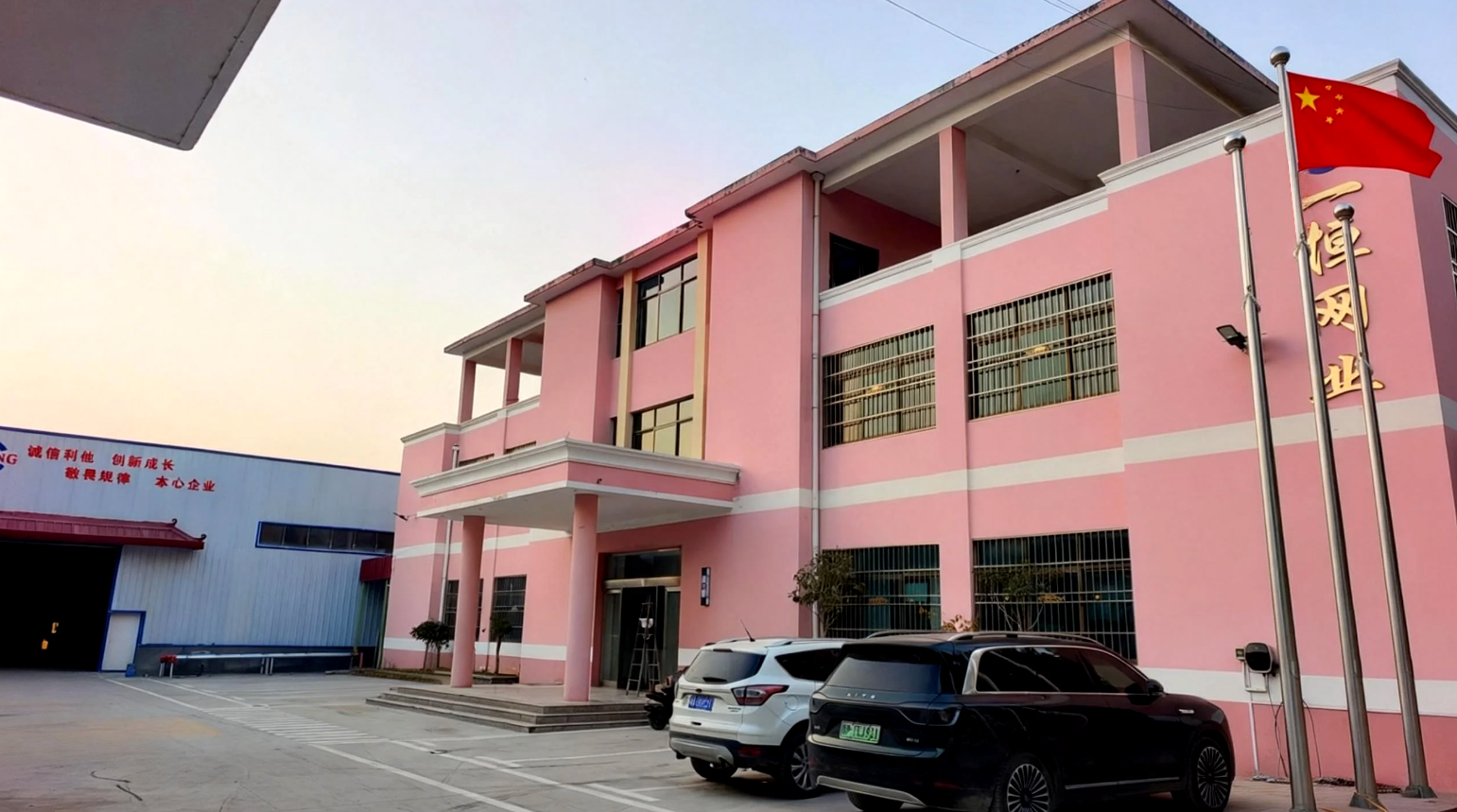
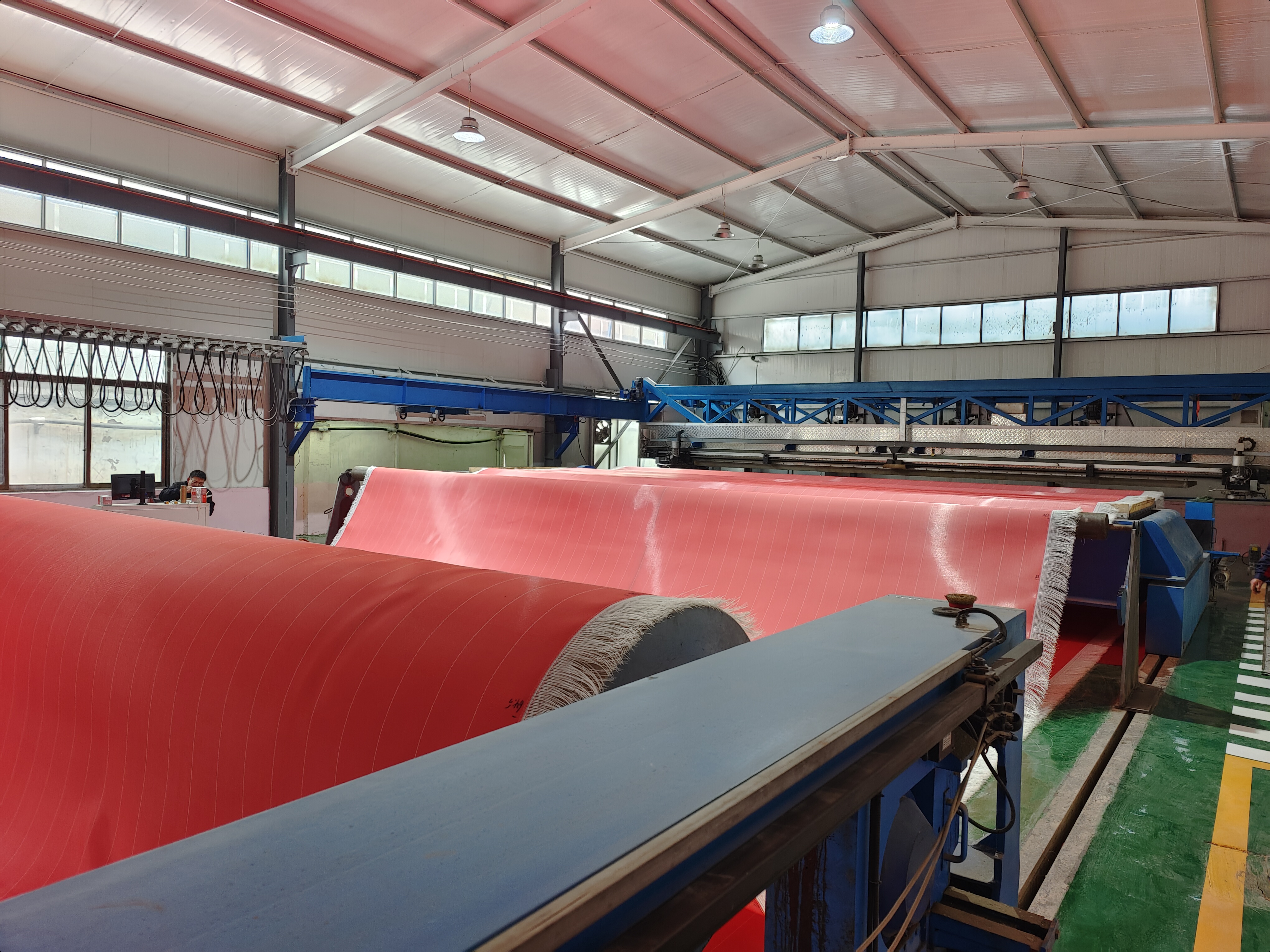
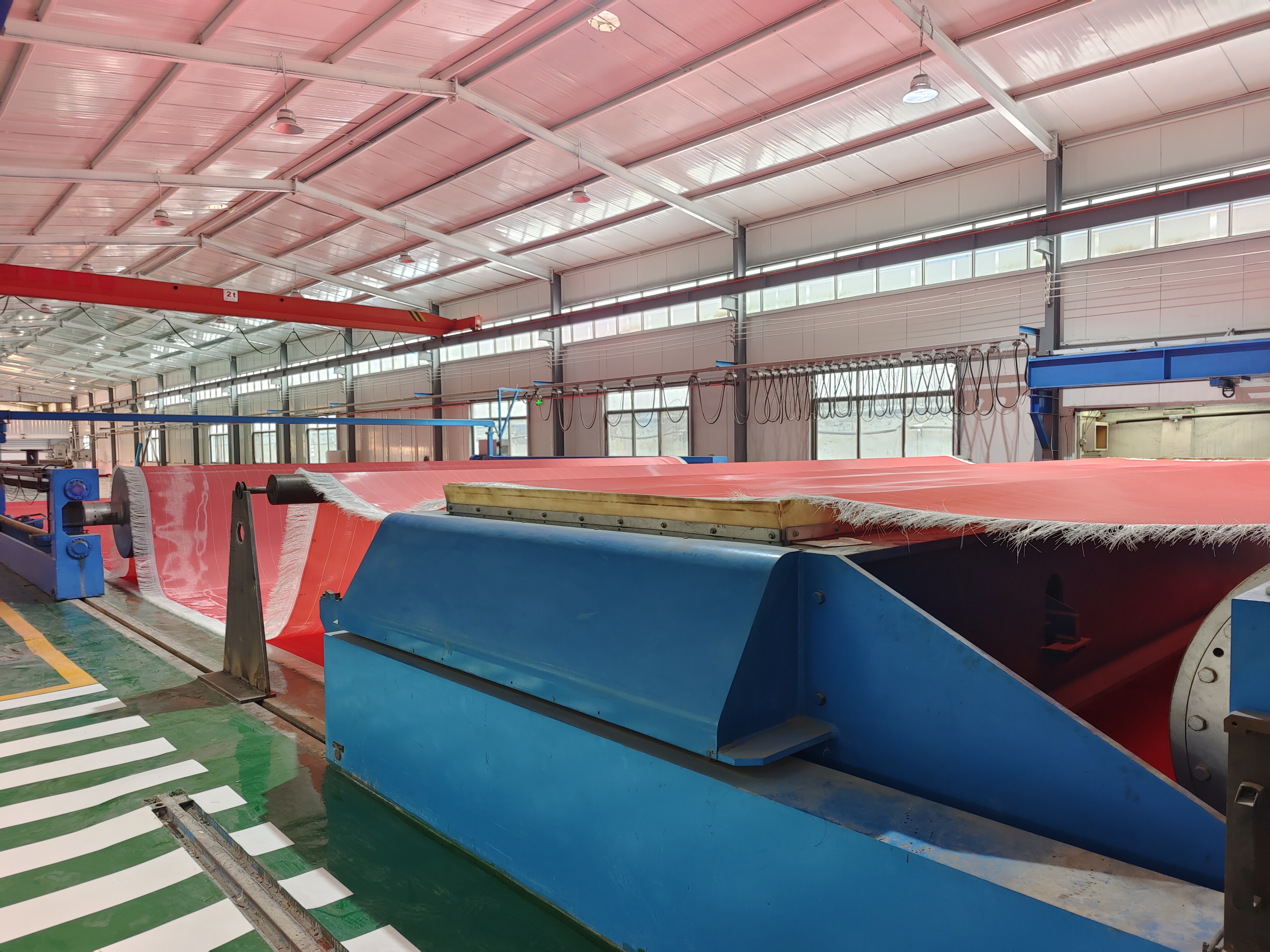
Yes — and that is the practical argument for consolidating. Henan Yiheng Mesh Belt Industry Co., Ltd. is a long-term strategic partner for non-woven equipment manufacturers including Chaolong, Hongda, and Aolong, and both models sit on the same anti-static PET platform and above-3 below-5 weave. Production runs at 12,800 m² monthly capacity in a 4,237 m² facility with 3 R&D engineers, with CFM held within ±5%, thermal shrinkage below 1%, and width tolerance under ±0.5%. The company's 122+ documented troubleshooting cases cover tracking, fiber hanging, static, and seam marks.
What are the commercial terms for a first order?
OEM/ODM orders start from a minimum of 1 m². Delivery is quoted FOB, CIF, DAP, or DDP depending on destination. Standard payment terms are 30% deposit with 70% balance before shipment, and every order is subject to 100% pre-shipment inspection, with third-party inspection by BV or SGS available on request.
How quickly can I get a sample of K4106A or K4106B?
Sample delivery is available in as little as 3 days for custom prototypes, with MOQ from 1 m². For an A/B evaluation, request both variants at the same width and seam type so the trial tests filament profile rather than belt geometry.
What does a long-term supply arrangement look like in practice?
A workable program has four parts: a fixed specification per line (variant, width, CFM band, seam type), a replacement interval planned around the 3–6 month service life observed under standard conditions, a marked tension baseline for fast changeovers, and a single technical contact for troubleshooting. Yiheng supports this with sampling, specification sheets, and its troubleshooting manual. To start, send the line data — denier, speed, width, current belt specification, and the defect you need to eliminate — to ada@yhfilterbelt.com or WhatsApp +86 184 3681 4894, and request a matched sample pair or a quotation.
Conclusion
K4106A and K4106B are the same belt platform aimed at two different problems. K4106A's flat monofilaments, 1.88 mm thickness, 990 g/m², and 600±30 CFM target surface quality and fine-fiber retention. K4106B's round monofilaments, 1.93 mm, 1100 g/m², and 700±30 CFM target air volume and mechanical stability. Neither is the upgraded version of the other, and neither compensates for a poor ground path or a mismatched seam.
The decision rule is short: if the defect appears on the fabric surface, choose flat. If the defect is airflow or web stability, choose round. Then confirm the weave, verify the anti-static path, match the seam to line speed, and lock the specification per line so the next changeover is a known quantity.
Next Step: Compare Both Variants on Your Own Line
Request a matched sample pair of K4106A and K4106B at your line width and seam type, or ask for a quotation based on your current belt specification. Custom prototypes ship in as little as 3 days from 1 m².
Email: ada@yhfilterbelt.com · WhatsApp: +86 184 3681 4894 · Website: www.yhfilterbelt.com
Download the full product catalogue: Yiheng Mesh Belt Catalogue (PDF)
Have Questions or Need More Details?
Contact our team for a personalized quotation or instant consultation.
Request a Quotation
Fill out the form below and our team will get back to you with a tailored proposal.
WhatsApp Direct Chat
Prefer to chat in real-time? Message us on WhatsApp for instant assistance & quick answers.
- Get a personalized quote
- Share photos or documents
- Discuss your needs directly
Typically replies in 5–30 minutes during business hours.