Medium Loop vs. Small Loop Polyester Mesh Belts: A Head-to-Head Decision Guide
Both models are spiral polyester mesh belts made by Henan Yiheng Mesh Belt Industry Co., Ltd. (Yiheng Mesh), a polyester mesh belt manufacturer founded in 2009 in Henan Province, China. Their break strength is identical at ≥2000 N/cm. What separates them is thickness, loop geometry and, above all, the air permeability you obtain in each configuration.
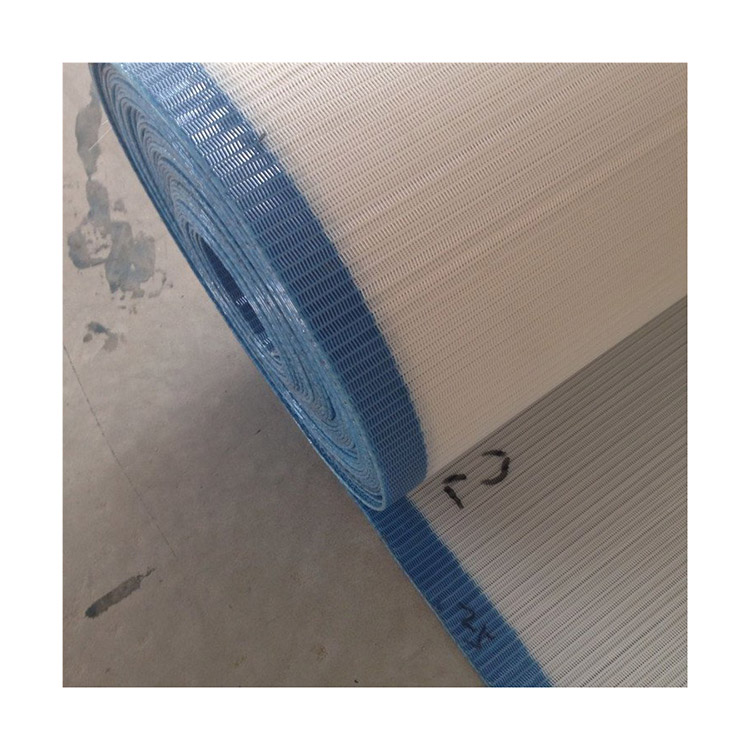
Spiral mesh construction shared by the Medium Loop (2.32 mm) and Small Loop (1.90 mm) polyester mesh belts.
Answer first. Select the Small Loop when filtrate clarity, cake dryness and clearance inside the press frame are the binding constraints. At 1.90 mm it is the slimmest belt in the filter press series, and in its flat-wire filler configuration it runs at 7,300 ±500 m³/㎡·h (450 ±30 CFM at 127 Pa), a denser structure built for solids retention. Select the Medium Loop when drainage rate or dryer-section airflow governs. At 2.32 mm it delivers 10,700–12,000 ±500 m³/㎡·h (660–740 ±30 CFM) as a filler-wire filter press belt, and 18,300 m³/㎡·h as a spiral dryer belt.
This guide compares the two models specification by specification, identifies where the difference is large and where it is almost negligible, and sets out a five-step procedure for matching one of them to a specific press or dryer line.
Why this comparison matters now
Two market signals have turned loop geometry from a detail into a decision. Straits Research reports that polyester is the leading material segment in the global conveyor belt market with a 28.4% share in 2025, which means polyester mesh specification choices affect a very large installed base rather than a niche. Grand View Research projects the belt filter press technology segment to grow at a CAGR of 8.8% from 2025 to 2033 within the sludge dewatering equipment market — the equipment class in which the Small Loop and the Medium Loop filler-wire belts are directly compared.
The practical consequence for buyers is narrower than the market headlines. Dewatering lines are being specified with tighter expectations on cake dryness and cycle time, and both outputs are determined by belt thickness and air permeability long before a polymer dose is adjusted.
Problem definition: the trade you are actually making
Every spiral mesh belt makes one trade: open area against solids retention. Open area lets water and air through; retention holds particles back. Air permeability summarises that trade in a single number, but the number only means something when it is read together with thickness and filler geometry.
Thickness answers a different question. It governs roller clearance, belt weight and how the belt tracks around small-diameter rollers. The difference between the two models here is 2.32 mm against 1.90 mm — small in absolute terms, but material on a press that was designed with a minimum clearance at the discharge end and inside the tension zone.
The decision therefore is not which belt is better. It is which constraint binds first on your line: filtrate quality and machine fit, or drainage and airflow capacity.
Technical profile: Medium Loop polyester mesh belt
The Medium Loop is a polyester spiral mesh belt available in two distinct build configurations, and the configuration changes its performance more than the loop size does.
- Spiral configuration: warp 0.68 mm, weft 0.90 mm, loop distance 6.50 mm, air permeability 18,300 m³/㎡·h, thickness 2.32 mm.
- Filler-wire configuration: ring wire 0.68 mm, threading 0.90 mm, filler options 0.68×3 mm or 0.68×4 mm, break strength ≥2000 N/cm, air permeability 10,700–12,000 ±500 m³/㎡·h (660–740 ±30 CFM at 127 Pa), thickness 2.32 mm.
- Filler effect: the 0.68×3 build reaches the 12,000 m³/㎡·h end of the range for maximum drainage; the 0.68×4 build sits at 10,700 m³/㎡·h for finer filtration and a drier cake.
- Applications: belt filter presses, papermaking pulp washing, meltblown non-woven equipment, fabric pre-shrinking machines, and latex wire drying and conveying.
- Industries served: papermaking, non-woven textiles, textile finishing, rubber and latex processing, environmental protection.
Technical profile: Small Loop polyester mesh belt
The Small Loop uses finer monofilaments and a shorter loop distance, which is why its profile is the slimmest in the filter press series.
- Spiral configuration: warp 0.52 mm, weft 0.70 mm, loop distance 5.20 mm, air permeability 17,500 m³/㎡·h, thickness 1.90 mm.
- Filler-wire configuration: threading 0.80 mm, flat wire filler 0.65×1.65 mm, break strength ≥2000 N/cm, air permeability 7,300 ±500 m³/㎡·h (450 ±30 CFM at 127 Pa), thickness 1.90 mm.
- Filtration mechanism: the flat wire filler creates a denser, finer mesh structure that captures smaller particles and produces a drier filter cake than round-wire constructions.
- Applications: belt filter presses, papermaking pulp washing, meltblown non-woven equipment, fabric pre-shrinking machines, and latex wire drying and conveying.
- Industries served: food processing, papermaking, environmental protection, non-woven manufacturing, wood-based panel processing, pharmaceuticals.
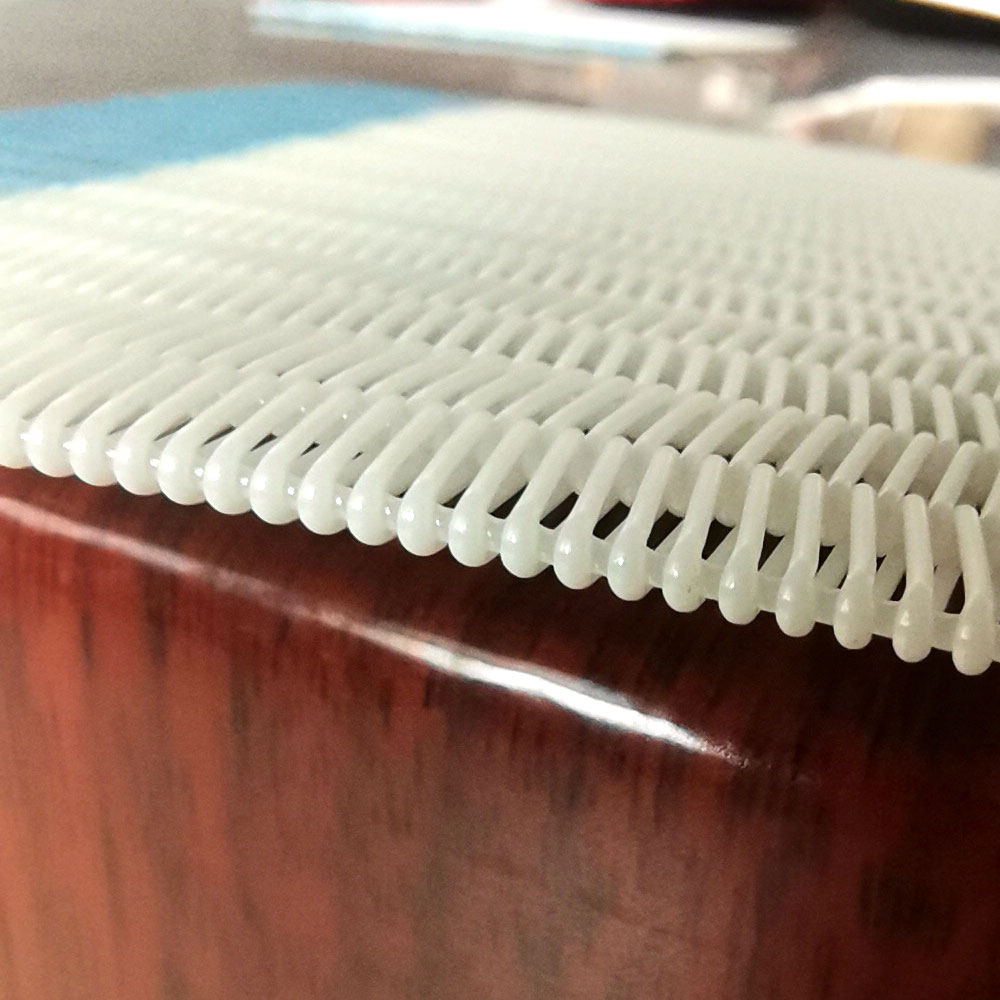
Loop distance is the visible variable: 6.50 mm on the Medium Loop against 5.20 mm on the Small Loop.
Where the two models genuinely diverge
1. Thickness: 2.32 mm against 1.90 mm
Thickness is the first filter in any selection process. At 1.90 mm, the Small Loop is described as the slimmest belt in the filter press series; it fits machines with tight roller spacing, reduces belt weight and lowers energy consumption. At 2.32 mm, the Medium Loop remains a slimmer profile than the Large Loop and is specified for machines with tighter roller layouts relative to that heavier build. If the roller gap on your press is the hard limit, the Small Loop gives you the larger clearance margin — 0.42 mm more than the Medium Loop on a single-layer basis.
2. Air permeability: the gap depends entirely on configuration
This is the point most catalogue comparisons miss. In spiral form, the two models are close: 18,300 m³/㎡·h for the Medium Loop against 17,500 m³/㎡·h for the Small Loop. Both are open structures used for drying and general conveying, and neither is a precision filtration medium at that setting.
In filler-wire form, the gap widens sharply. The Medium Loop covers 10,700–12,000 ±500 m³/㎡·h depending on whether the 0.68×3 or 0.68×4 filler is fitted. The Small Loop sits at 7,300 ±500 m³/㎡·h because its 0.65×1.65 mm flat wire filler densifies the structure deliberately. The consequence is simple: a Medium Loop spiral belt at 18,300 and a Small Loop filler-wire belt at 7,300 are not substitutes, and a specification written only as 'polyester mesh belt, high permeability' will not tell a supplier which one you need.
3. Loop distance and surface support: 6.50 mm against 5.20 mm
Loop distance determines how finely the belt supports the material carried on it. The Small Loop's 5.20 mm loop gives closer support and a smoother bearing surface for thin sheets and cakes that must release cleanly. The Medium Loop's 6.50 mm loop leaves a more open structure, which is consistent with its higher drainage and airflow figures. Both models share a smooth mesh surface with arbitrary disassembly and assembly, which simplifies installation, seam changes and routine maintenance.
4. Where they do not differ: break strength
Both belts are rated at ≥2000 N/cm. Break strength should not be used to choose between them. If a line genuinely requires more than 2000 N/cm, the Large Loop is the relevant model at ≥2300 N/cm, with a 2.95 mm profile, 9,000–13,700 m³/㎡·h in filler-wire form and 19,000 m³/㎡·h in dryer configuration — but that is a different comparison with a different thickness penalty.
Specification comparison tables
Table 1 — Spiral (dryer and conveying) configuration
| Parameter | Medium Loop | Small Loop |
|---|---|---|
| Thickness | 2.32 mm | 1.90 mm |
| Warp | 0.68 mm | 0.52 mm |
| Weft | 0.90 mm | 0.70 mm |
| Loop distance | 6.50 mm | 5.20 mm |
| Air permeability | 18,300 m³/㎡·h | 17,500 m³/㎡·h |
| Break strength | ≥2000 N/cm | ≥2000 N/cm |
| Material | Polyester | Polyester |
Table 2 — Filler-wire (filter press) configuration
| Parameter | Medium Loop-Filler Wire | Small Loop-Filler Wire |
|---|---|---|
| Thickness | 2.32 mm | 1.90 mm |
| Filler | 0.68×3 mm or 0.68×4 mm | 0.65×1.65 mm flat wire |
| Ring wire / threading | 0.68 mm ring wire, 0.90 mm threading | 0.80 mm threading |
| Air permeability | 10,700–12,000 ±500 m³/㎡·h | 7,300 ±500 m³/㎡·h |
| CFM at 127 Pa | 660–740 ±30 | 450 ±30 |
| Break strength | ≥2000 N/cm | ≥2000 N/cm |
Table 3 — Decision matrix
| If your priority is | Recommended model | Reason drawn from the specifications |
|---|---|---|
| Drier cake and maximum solids retention | Small Loop-Filler Wire | 7,300 ±500 m³/㎡·h with 0.65×1.65 mm flat wire filler |
| Highest drainage throughput at the press | Medium Loop-Filler Wire, 0.68×3 filler | 12,000 m³/㎡·h end of the range |
| Balance of drainage and cake dryness | Medium Loop-Filler Wire, 0.68×4 filler | 10,700 m³/㎡·h with finer filtration |
| Minimum roller clearance and lower belt weight | Small Loop | 1.90 mm, slimmest in the filter press series |
| Dryer-section airflow and conveying | Medium Loop (spiral) | 18,300 m³/㎡·h with 6.50 mm loop distance |
| Break strength above 2000 N/cm | Large Loop (outside this comparison) | ≥2300 N/cm at 2.95 mm |
Step-by-step selection procedure
Step 1 — Name the binding constraint. Write down whether the line is failing on cake dryness or on throughput. Cake dryness problems point to the Small Loop filler-wire belt at 7,300 m³/㎡·h. Throughput and drainage problems point to the Medium Loop with the 0.68×3 filler at 12,000 m³/㎡·h.
Step 2 — Measure the roller gap and belt path. Confirm the available clearance at the smallest roller and at the discharge. If the margin is tight, the 1.90 mm Small Loop is the safer fit; if clearance allows 2.32 mm, the Medium Loop remains available.
Step 3 — Decide the configuration before the model. A dryer or conveying duty calls for the spiral build; a press duty calls for the filler-wire build. Comparing a spiral Medium Loop against a filler-wire Small Loop is a comparison of two different jobs, not two versions of the same job.
Step 4 — Fix the filler option. On the Medium Loop, choose 0.68×3 for maximum drainage and 0.68×4 for finer filtration. On the Small Loop, the 0.65×1.65 mm flat wire filler is fixed and defines its 7,300 m³/㎡·h performance.
Step 5 — Specify tolerances and joints on the order. State air permeability with the ±500 m³/㎡·h tolerance (or CFM with the ±30 tolerance), the joint type, and the belt width and length. Width, length, thickness, joint type, edge treatment and material selection are all customizable, and free sample testing is available for validation before a full run.
Step 6 — Validate on a sample. Run both candidate belts on the same press under the same sludge or pulp conditions and compare cake moisture and belt tracking, not catalogue numbers alone.
Use cases: which line type pulls which model
Municipal and industrial sludge dewatering. This is the core application for both filler-wire belts. A municipal wastewater treatment plant reference project involving 12 belt filter presses reported 8% lower cake moisture, 40% lower maintenance cost and zero major failures over six months; the documented belt set for that project includes the Small Loop, Medium Loop and Large Loop filler-wire models, which reflects how plants often run different loop sizes on different stages of the same line.
Paper pulp washing and pressing. Both models are specified for pulp washing, where the Medium Loop's higher drainage suits washing stages and the Small Loop's denser structure suits pressing stages where fibre carry-over matters.
Latex wire drying, rubber and textile finishing. The Medium Loop is used for latex wire drying and conveying and for fabric pre-shrinking, where the 6.50 mm loop and 18,300 m³/㎡·h spiral permeability support airflow through the web.
Meltblown non-woven equipment. Both models are listed for meltblown lines, where consistent airflow and a smooth, non-marking surface matter more than peak drainage.
Food, pharmaceutical and wood-based panel processing. The Small Loop is listed for food processing, pharmaceutical and wood-based panel applications, an application set that matches its finer surface support and its coverage under the food-contact test documentation described below.
Limits and boundary conditions
- Smaller loop does not mean higher airflow. In spiral form the Small Loop is the lower-permeability belt (17,500 against 18,300 m³/㎡·h), so it should not be chosen on the assumption that a finer mesh dries faster.
- The Medium Loop has a throughput ceiling too. At 10,700 m³/㎡·h in the 0.68×4 build it is a finer filtration belt than the 0.68×3 version, and the same throughput penalty applies.
- Thickness is not adjustable. Neither model can be made thinner for a given roller gap; if clearance is below the 1.90 mm profile, the belt path itself needs review.
- Permeability tolerances are real. Plan for ±500 m³/㎡·h on air permeability and ±30 CFM where CFM is the contractual unit, and state the tolerance in the purchase specification.
- High-tension lines may need a different model. Above 2000 N/cm, the Large Loop at ≥2300 N/cm and 2.95 mm is the appropriate escalation.
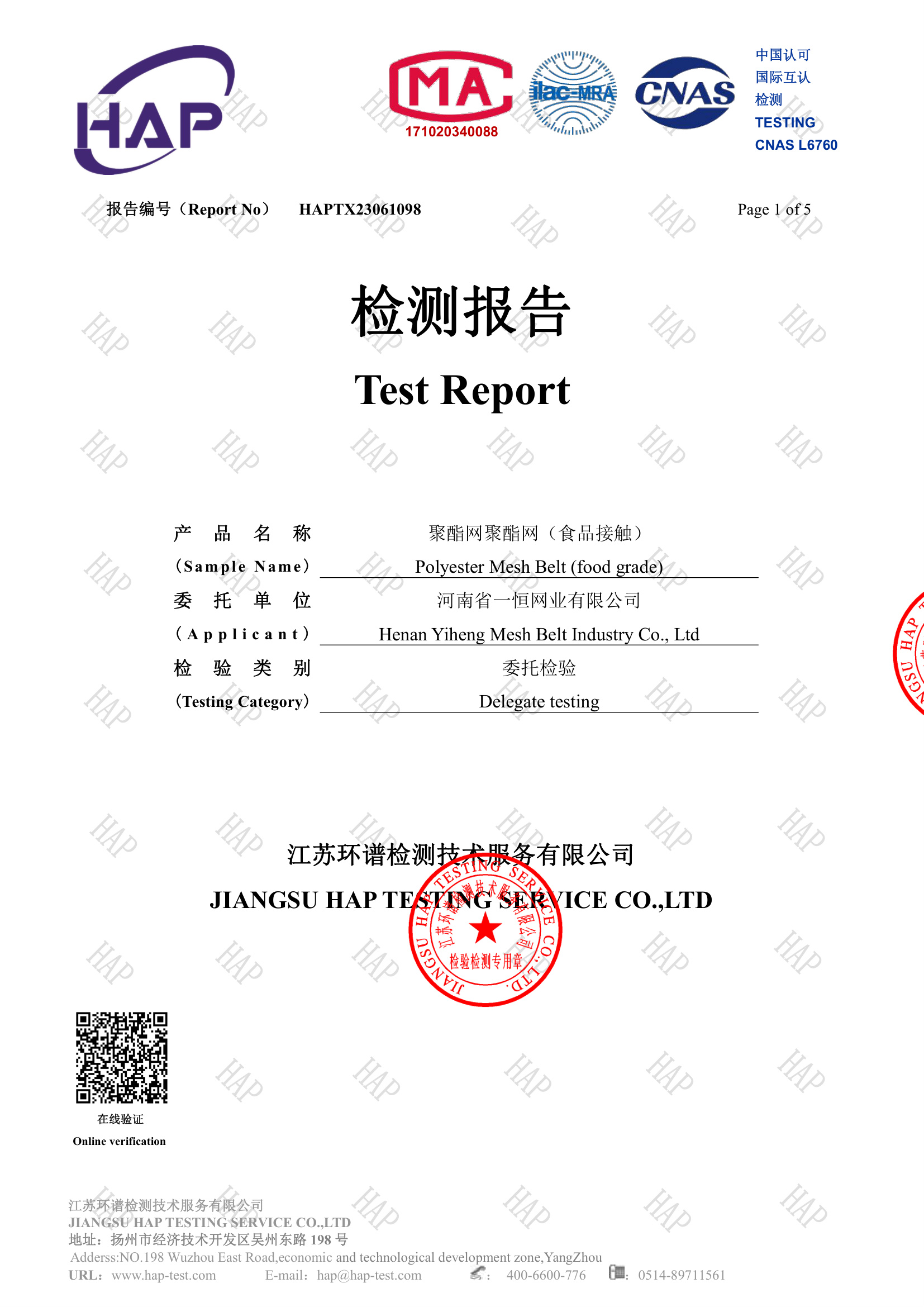
Food-contact test documentation for polyester mesh belts: certificate HAPTX23061098, issued by JIANGSU HAP TESTING SERVICE CO., LTD against GB 4806.7-2016.
Compliance documentation to request with either model
Food-contact testing. Test Report HAPTX23061098, issued by JIANGSU HAP TESTING SERVICE CO., LTD under standard GB 4806.7-2016, covers polyester mesh belt for food-contact use, and the certificate record lists both the Small Loop and the Medium Loop among the related models. Buyers specifying belts for food or pharmaceutical lines should request the report as part of the order file.
German packaging registration. Yiheng Mesh holds registration under the German Packaging Act (LUCID), certificate number DE2857625357145, issued by Stiftung Zentrale Stelle Verpackungsregister, covering retail, grouped and shipment packaging placed on the German market under the yiheng brand. This is a packaging compliance record, not a product performance claim, and should be read as such.
Supplier verification. The Alibaba.com Verified Supplier Assessment Report, certificate 493944221_P+T, was issued by INTERTEK on 2026-07-09 and is valid to 2027-07-09, with scope covering fabrics, dryer fabrics, polyester filter belt, non-woven mesh belt and UV belts.
Trade classification. Polyester mesh belts are generally classified under HS code 5911.90, the heading for textile products and articles for technical uses, per the USITC Harmonized Tariff Schedule. Confirm the classification with your customs broker for the destination market.
FAQ
What certifications and test reports should a polyester mesh belt buyer verify, and how does an ISO 9001 claim fit in?
ISO 9001 is a quality management system standard that buyers commonly request, and any claim should be checked by certificate number and issuing body rather than by statement alone. The documents Yiheng Mesh makes available for these models are the food-contact test report HAPTX23061098 under GB 4806.7-2016 issued by JIANGSU HAP TESTING SERVICE CO., LTD, the German Packaging Act (LUCID) registration DE2857625357145 issued by Stiftung Zentrale Stelle Verpackungsregister, and the Alibaba.com Verified Supplier Assessment Report 493944221_P+T issued by INTERTEK and valid from 2026-07-09 to 2027-07-09. Request current copies and confirm that the scope covers your product and your destination market.
Which loop size gives the drier filter cake on a belt filter press?
The Small Loop-Filler Wire belt runs at 7,300 ±500 m³/㎡·h and uses a 0.65×1.65 mm flat wire filler that creates a denser structure for finer particle capture, which is the configuration to specify when cake dryness and filtrate clarity are the objectives. Within the Medium Loop family, the 0.68×4 filler build at 10,700 m³/㎡·h is the finer of the two Medium Loop options, while the 0.68×3 build at 12,000 m³/㎡·h prioritises drainage instead.
Will both models fit the same press, and what drives the price difference?
Both belts share a ≥2000 N/cm break strength, so fit depends on thickness and belt path rather than strength: the Small Loop is 1.90 mm and the Medium Loop 2.32 mm, so the available roller clearance decides whether both are viable. Commercial differences follow the same specification logic — filler configuration (0.65×1.65 mm flat wire against 0.68×3 or 0.68×4), belt width and length, joint type, edge treatment and order quantity. Confirm the current quotation for your specific build rather than comparing list prices across configurations.
Can we test both loop sizes before committing to a full order?
Free sample testing is available, and width, length, thickness, joint type, material, colour and edge treatment are all customizable, so the two candidates can be run on the same press under the same conditions. Compare cake moisture, belt tracking, seam behaviour and cleaning effort between the Small Loop filler-wire belt at 7,300 m³/㎡·h and the Medium Loop filler-wire belt at 10,700–12,000 m³/㎡·h before fixing the specification. Contact ada@yhfilterbelt.com or WhatsApp +86 184 3681 4894 to arrange samples.
What is the lead time for a custom Medium Loop or Small Loop belt?
Standard lead time is 15–30 days, and remote technical support and installation guidance are provided after delivery. Because the two models differ in thickness, filler type and joint construction, confirm the exact width, length, joint style and permeability tolerance at the quotation stage so the belt arrives ready for installation rather than requiring rework on site.
Conclusion: decide by constraint, not by catalogue number
The Small Loop is the belt for controlled filtration: 1.90 mm thick, 5.20 mm loop distance, 7,300 ±500 m³/㎡·h with a 0.65×1.65 mm flat wire filler, and the slimmest profile in the filter press series. The Medium Loop is the belt for drainage and airflow capacity: 2.32 mm thick, 6.50 mm loop distance, 10,700–12,000 ±500 m³/㎡·h in filler-wire form and 18,300 m³/㎡·h as a spiral dryer belt. Both carry ≥2000 N/cm, so strength never settles the argument — the constraint on your line does.
If the constraint is still unclear, the fastest route is a side-by-side trial on your own press. Yiheng Mesh supplies both models from the same production range, so the comparison is like for like.

Packing and logistics for custom polyester mesh belt orders, including both loop sizes.
Next step: sample, specification review or quotation
Send your press model, roller clearance, required cake dryness and belt dimensions, and Yiheng Mesh will confirm whether the Small Loop or the Medium Loop fits the duty. Free sample testing, custom widths and joint options are available.
Email: ada@yhfilterbelt.com | WhatsApp: +86 184 3681 4894 | Website: www.yhfilterbelt.com
Download the full product catalogue: Yiheng Mesh Product Catalogue (PDF)
Henan Yiheng Mesh Belt Industry Co., Ltd. (Yiheng Mesh) is a polyester mesh belt manufacturer founded in 2009, producing polyester mesh belt, non-woven mesh belt, forming fabrics, dryer fabrics and polyester filter belt for markets including Asia, Europe and North America. Office: No. 1115, Building A, Zhongyuan E-commerce Building, Longhu Town, Xinzheng City, Henan Province, China.
Have Questions or Need More Details?
Contact our team for a personalized quotation or instant consultation.
Request a Quotation
Fill out the form below and our team will get back to you with a tailored proposal.
WhatsApp Direct Chat
Prefer to chat in real-time? Message us on WhatsApp for instant assistance & quick answers.
- Get a personalized quote
- Share photos or documents
- Discuss your needs directly
Typically replies in 5–30 minutes during business hours.