
Nonwoven Mesh Belt Basics: Weave Structure, Air Permeability, and Why Above-3 Below-5 Matters
A nonwoven mesh belt is the forming and conveying fabric that carries a fiber web through spunbond, spunlace, airlaid, or other nonwoven processes. Its spec sheet is a compact language: Above-3 Below-5 describes a weave repeat; CFM at 127Pa/20cm² describes air permeability under a stated test basis; g/m², mm, and layer count describe different physical properties. Reading those fields correctly prevents a common buying error: comparing numbers that were never measured the same way.
This guide decodes the vocabulary buyers meet in nonwoven mesh belt data sheets and uses grounded examples from Henan Yiheng Mesh Belt Industry Co., Ltd. (Yiheng Mesh), a manufacturer of polyester mesh belts and nonwoven forming fabrics whose range includes nonwoven mesh belts, forming fabrics, and dryer fabrics. The examples are HB4106, K4106A, and the 09502 airlaid belt. Each number below is a listed specification, not an inferred performance rating.
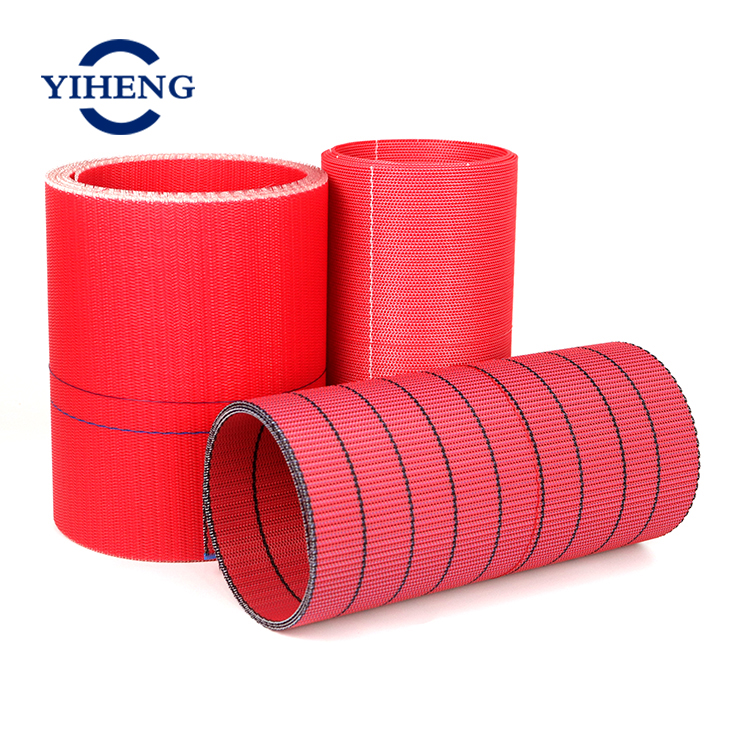
Anti-static non-woven mesh belt. Image: Yiheng Mesh product image.
The practical problem: one spec sheet can hide three different questions
A buyer comparing nonwoven forming belts often receives a table with weave notation, CFM, g/m², mm, layer count, joint type, and glue-edge details in the same row. The row looks complete, but the values answer different questions. Weave notation describes construction. Air permeability describes airflow through the fabric under a test pressure and area. Basis weight describes mass per unit area. Thickness describes a linear dimension. Layer count describes how the fabric is built. None of these alone tells a buyer whether a belt fits a spunbond line, a spunlace line, or an airlaid line.
The problem becomes sharper when two suppliers use different units. A CFM value at 127Pa/20cm² and a value in m³/m²/h at 100Pa are not interchangeable without the same test basis. The same issue applies to weave notation: Above-3 Below-5 is not a quality grade, and Above-6 Below-6 is not automatically better or worse. They are structural descriptors that must be read with filament shape, yarn diameter, layer count, heat-setting, and the actual line condition.
Reader rule: keep the number, the unit, and the test basis together. A CFM figure without 127Pa/20cm² is incomplete for comparison. A weave notation without the model and layer count is also incomplete.
Industry background: why forming-fabric vocabulary matters
Nonwoven mesh belts sit in the forming section, where a polymer stream, carded web, or airlaid fiber mat first meets a moving surface. The belt supports the web, allows air or water to pass, and helps transfer the web to the next stage. In spunmelt lines, the belt also interacts with high-speed air suction, heat, and static. In spunlace lines, water drainage and surface smoothness become central. In airlaid lines, hot-air penetration and web support dominate. The same word, belt, covers different duties.
Market context explains why the category is closely specified. Grand View Research reported that spunlaid technology, which includes spunbond and meltblown, held a 48.4% share of the global nonwoven technology market in 2023. That is a technology-share signal, not a belt-performance claim, but it shows why spunmelt forming fabrics receive so much attention. Dataintelo also valued the global nonwoven production line market at USD 5.3 billion in 2024 and projected USD 9.8 billion by 2033. For buyers, the practical point is simpler: as lines become more demanding, a spec sheet must be read as a set of linked decisions, not a list of isolated numbers.
What Above-3 Below-5 means in a nonwoven mesh belt specification
In a woven belt specification, Above-3 Below-5 is a weave-repeat shorthand. Read literally in many spec sheets, it says that in the repeating weave the yarn path runs above a three-yarn group and below a five-yarn group. It is a construction description, not a performance grade, and it does not mean the belt has three layers or five layers. The layer count is a separate field.
The notation matters because the interlacement pattern is part of the structural recipe that, together with filament shape, yarn diameter, layer count, and heat-setting, influences how the belt supports the web, how air passes through it, and how the surface releases the fabric. It is not a standalone guarantee. Two belts can both say Above-3 Below-5 and still differ in thickness, basis weight, CFM, filament type, and joint design.
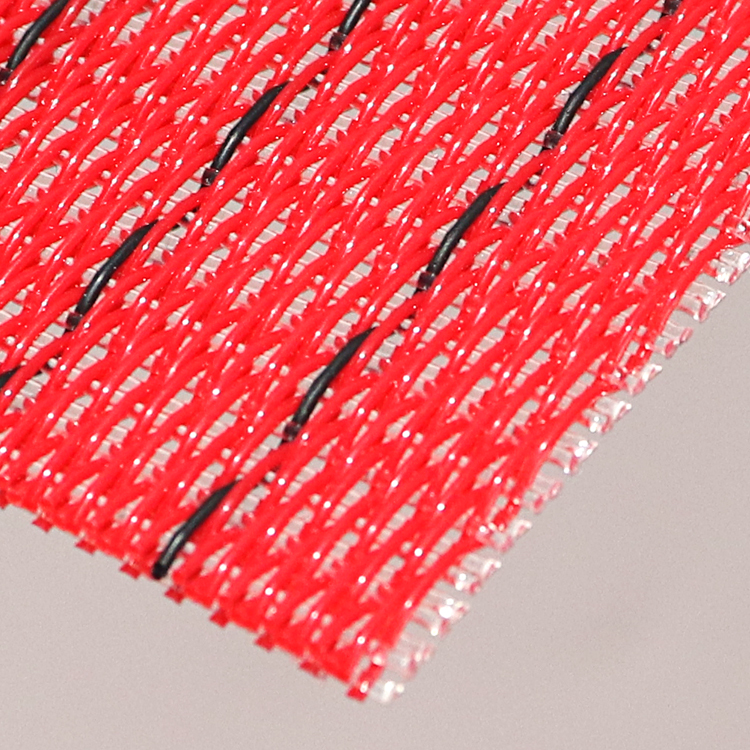
HB4106 and K4106A are clear examples. HB4106 is listed as a spunbond mesh belt with an Above-3 Below-5 weave, 1.5 layers, 1.8 mm thickness, 1030 g/m², and 580±30 CFM at 127Pa/20cm². K4106A is listed as an anti-static mesh belt with an Above-3 Below-5 weave, 1.5 layers, 1.88 mm thickness, 990 g/m², and 600±30 CFM at 127Pa/20cm². The weave notation is the same; the material, thickness, basis weight, and anti-static construction differ.
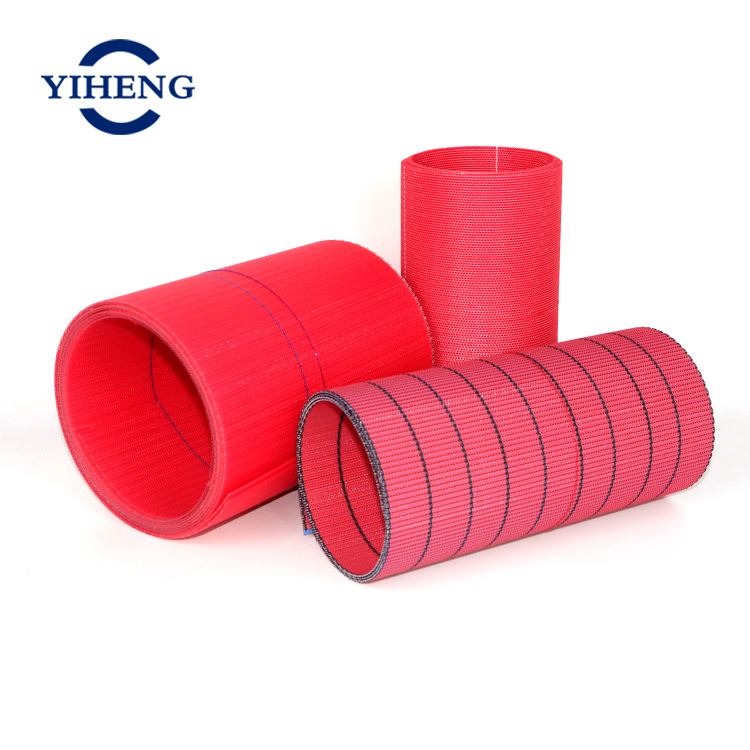
Anti-static non-woven mesh belt. Image: Yiheng Mesh product image.
For contrast, K6012 is listed with an Above-6 Below-6 weave, 2.5 layers, 2.8 mm thickness, 1200 g/m², and 750±30 CFM at 127Pa/20cm². That comparison shows why the notation cannot be read alone. The heavier, thicker, multi-layer construction belongs to a different model and duty, not to a ranking of weave notations.
Air permeability: what CFM at 127Pa/20cm² actually tells you
CFM is the volume of air in cubic feet that passes through one square foot of mesh per minute under a stated pressure differential. When a data sheet writes 580±30 CFM at 127Pa/20cm², it is giving three pieces of information: the air volume, the tolerance band, and the test basis. The test basis is not decoration. A value at 127Pa over 20cm² cannot be compared directly with a value at 100Pa over a different area without a conversion or a same-basis test.
This is where many early comparisons go wrong. The 09502 airlaid belt is listed at 12,770 m³/m²/h at 100Pa, with 23 mesh, 0.5 mm pitch, and 650 g/m². That is a valid air-permeability statement in its own basis. It should not be placed beside a CFM value at 127Pa/20cm² and treated as a direct ranking without checking the test conditions. The units are different, and the pressure differential is different.
Air permeability matters because the forming belt is part of the airflow path. If the belt is too open for the process, fiber support and web uniformity can suffer. If it is too tight, airflow or drainage may be insufficient for the line. The right value depends on the process, fiber denier, suction settings, and the fabric being made. That is why the ±30 band on HB4106 and K4106A is useful: it tells the buyer that the specification is a controlled range, not a single perfect point.
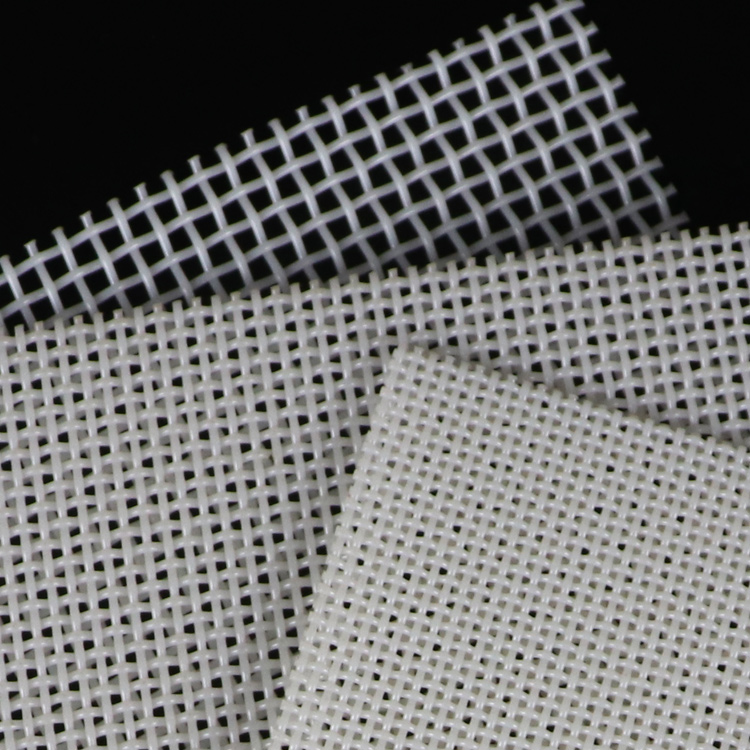
Square mesh structure. Image: Yiheng Mesh product image.
Basis weight, thickness, and layer count: three different measurements
Basis weight is expressed in grams per square meter, or g/m². It describes mass per unit area. Thickness is expressed in millimeters and describes a linear dimension. Layer count describes how the fabric is constructed. These fields often appear together, but they are not substitutes. A heavier belt is not automatically thicker, and a thicker belt is not automatically more open or more closed.
HB4106 illustrates the point. Its listed basis weight is 1030 g/m², its thickness is 1.8 mm, and its layer count is 1.5. K4106A is listed at 990 g/m², 1.88 mm, and 1.5 layers. The two are close in basis weight and layer count, but the thickness differs, and the material construction differs: HB4106 uses red flat PET, while K4106A uses anti-static PET flat monofilaments. The 09502 airlaid belt is listed at 650 g/m²; its supplied specification does not state thickness or layer count, so those fields should not be inferred from the basis weight.
For a buyer, the practical check is to ask which field controls the decision. If the concern is web support and surface contact, thickness and weave structure may matter more than basis weight alone. If the concern is mass and handling, basis weight is the direct field. If the concern is construction, layer count belongs in the discussion. None of these fields should be used as a proxy for air permeability.
Spunbond, spunlace, and airlaid belts are different families
The terms spunbond belt, spunlace belt, and airlaid belt describe the process family a belt is intended to serve, not a universal grade. A spunbond mesh belt supports a continuous-filament web during formation and bonding. A spunlace mesh belt supports a web through hydroentanglement and must manage water drainage and surface finish. An airlaid belt supports a fiber mat through hot-air bonding or drying, where airflow through the belt is central. Spunmelt is an umbrella term that includes spunbond and meltblown duties.
HB4106 is classified as a spunbond mesh belt. K4106A is classified as an anti-static mesh belt, also known as a nonwoven mesh belt. The 09502 belt is classified as an airlaid mesh belt. These labels help buyers sort the catalog, but they do not remove the need to check the model specification. A spunbond line with high static and a spunbond line with a standard web may not use the same belt construction.
Spunlace adds a useful comparison. Model 41203 is a spunlace mesh belt with a 103 mesh count, 0.3 mm thickness, 40 ends/cm warp density, 30.7 ends/cm weft density, and 6,700 m³/m²/h at 100Pa. Its fine mesh and thin profile belong to a different duty from the 09502 airlaid belt with 23 mesh, 0.5 mm pitch, and 650 g/m². The family label tells the buyer which process conversation to have; the model data tells the buyer whether the belt fits that conversation.
Joint type and edge bonding are separate specification decisions
A nonwoven mesh belt is normally supplied as a closed loop or with a joint that allows installation. Joint type is therefore part of the specification, not an afterthought. HB4106 lists self-ring, millet-ring, and double-pins as joint options. K4106A lists self-ring and millet-ring. The 09502 airlaid belt lists endless and self-ring. K6012 lists double-pins. These are different closure designs, and the correct choice depends on the machine and installation method.
Edge bonding is a second, separate field. HB4106 and K4106A both list a 2 cm glue edge with glue brushing on the welding edges at both sides. K6012 also lists a 2 cm glue edge. Edge bonding stabilizes the welded edge; it should not be confused with the seam. When a buyer checks a quotation, the joint type and the edge treatment should be written explicitly, because two belts with the same CFM and thickness can still differ at the seam and edge.
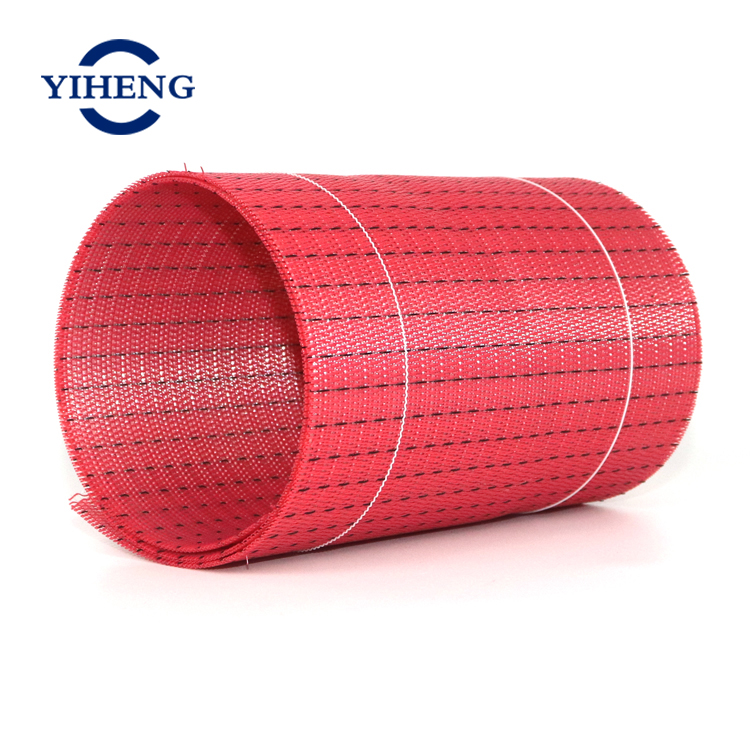
Anti-static non-woven mesh belt. Image: Yiheng Mesh product image.
Step-by-step: how to read a nonwoven mesh belt spec sheet
- Identify the process family first. Decide whether the belt is being evaluated for spunbond, spunlace, airlaid, or another nonwoven duty. HB4106 is a spunbond mesh belt; K4106A is an anti-static mesh belt; 09502 is an airlaid mesh belt. The family narrows the relevant questions.
- Read the weave notation with the model, not in isolation. Above-3 Below-5 on HB4106 and K4106A is a structural descriptor. It does not replace layer count, thickness, or CFM. If the supplier cannot provide a weave diagram or a clear explanation, keep the notation as unverified.
- Keep the air-permeability basis attached. Compare CFM only with CFM at the same pressure and area. Compare m³/m²/h only with m³/m²/h at the same pressure. The HB4106 value of 580±30 CFM at 127Pa/20cm² and the K4106A value of 600±30 CFM at 127Pa/20cm² are same-basis examples. The 09502 value of 12,770 m³/m²/h at 100Pa is not a direct CFM comparison.
- Check basis weight, thickness, and layer count separately. Record each field. HB4106: 1030 g/m², 1.8 mm, 1.5 layers. K4106A: 990 g/m², 1.88 mm, 1.5 layers. 09502: 650 g/m²; thickness and layer count are not stated in the supplied specification. Do not fill missing fields from another model.
- Confirm joint and edge details. Check whether the offered joint is self-ring, millet-ring, double-pins, or endless, and whether the edge has a glue treatment. HB4106 and K4106A list a 2 cm glue edge; the 09502 lists endless or self-ring joints.
- Match the specification to the line condition. Static, heat, water, suction, line speed, and fabric weight all change the decision. Use the model data as a starting point, then verify with the actual machine and a sample where possible.
Use cases: how the vocabulary changes by application
Spunbond forming with HB4106
HB4106 is a spunbond mesh belt with a flat PET construction, 1.8 mm thickness, 1030 g/m², 1.5 layers, and 580±30 CFM at 127Pa/20cm². Its flat-filament design is listed for easier cleaning and stable air permeability. For a buyer, the relevant questions are whether the line runs a comparable spunbond process, whether the suction and cooling setup matches the air permeability range, and whether the joint and edge configuration fits the machine. The specification provides a grounded starting point; it does not replace line trials.
Static-prone nonwoven lines with K4106A
K4106A is an anti-static mesh belt made with anti-static PET flat monofilaments. Its listed conductivity is 10⁶–10⁷ Ω, with 1.88 mm thickness, 990 g/m², 1.5 layers, and 600±30 CFM at 127Pa/20cm². Static is a process issue, not a cosmetic one: it can affect fiber handling and release. The model data gives the buyer a concrete anti-static specification to compare, but the line grounding, humidity, and fabric type still belong in the evaluation.
Airlaid hot-air lines with 09502
The 09502 airlaid belt is listed with 23 mesh, 0.5 mm pitch, 650 g/m², and 12,770 m³/m²/h at 100Pa. Its open structure and air-permeability value are relevant to hot-air airlaid duties where airflow through the belt supports drying or bonding. Because the air-permeability basis is different from the CFM examples, the buyer should compare it only with data from the same basis or ask for a same-basis test. The 09502 also lists endless and self-ring joints, so installation method should be confirmed with the machine builder.
Comparison table: grounded model data
The table below uses only the supplied model specifications. It is not a ranking. It shows why a single field cannot answer the selection question.
| Model | Family / intended use | Weave / layers | Thickness | Basis weight | Air permeability as listed | Joint / edge |
|---|---|---|---|---|---|---|
| HB4106 | Spunbond mesh belt | Above-3 Below-5; 1.5 layers | 1.8 mm | 1030 g/m² | 580±30 CFM at 127Pa/20cm² | Self-ring / millet-ring / double-pins; 2 cm glue edge |
| K4106A | Anti-static mesh belt | Above-3 Below-5; 1.5 layers | 1.88 mm | 990 g/m² | 600±30 CFM at 127Pa/20cm² | Self-ring / millet-ring; 2 cm glue edge |
| 09502 | Airlaid mesh belt | 23 mesh; 0.5 mm pitch; weave and layers not stated | Not stated | 650 g/m² | 12,770 m³/m²/h at 100Pa | Endless / self-ring |
Frequently asked questions
What does Above-3 Below-5 mean on a nonwoven mesh belt?
Above-3 Below-5 is a weave-repeat shorthand used in some belt specifications. Read literally in many data sheets, it describes a repeating interlacement in which the yarn path runs above a three-yarn group and below a five-yarn group. It is a construction descriptor, not a layer count and not a performance grade. HB4106 and K4106A both list Above-3 Below-5, but they differ in material, thickness, basis weight, and air permeability, so the notation must be read with the full model data.
Why is air permeability shown as CFM at 127Pa/20cm²?
CFM is the volume of air in cubic feet passing through one square foot of mesh per minute under a stated pressure differential. The 127Pa/20cm² part records the test pressure and area. Without that basis, a CFM number cannot be compared reliably with another supplier's value. A reading in m³/m²/h at 100Pa, such as the 09502 airlaid belt value of 12,770 m³/m²/h at 100Pa, is a different basis and should not be treated as a direct CFM equivalent.
How do basis weight, thickness, and layer count differ?
Basis weight is mass per unit area, measured in g/m². Thickness is a linear dimension, measured in mm. Layer count describes how the fabric is constructed. HB4106 is listed at 1030 g/m², 1.8 mm, and 1.5 layers. K4106A is listed at 990 g/m², 1.88 mm, and 1.5 layers. The 09502 airlaid belt is listed at 650 g/m²; its supplied specification does not state thickness or layer count. These fields are related but not interchangeable.
How do spunbond, spunlace, and airlaid mesh belts differ?
They serve different forming duties. HB4106 is a spunbond mesh belt with 580±30 CFM at 127Pa/20cm². Spunlace belts are built around water drainage and fine web support; model 41203, for example, is listed with 103 mesh, 0.3 mm thickness, and 6,700 m³/m²/h at 100Pa. The 09502 is an airlaid belt with 23 mesh, 0.5 mm pitch, 650 g/m², and 12,770 m³/m²/h at 100Pa. The family label narrows the selection, but the model data still controls the comparison.
What should buyers check when comparing nonwoven mesh belt suppliers?
Buyers should compare the exact model, process family, weave notation, layer count, thickness, basis weight, air permeability with its full test basis, joint type, and edge treatment. A supplier quote that lists only one number is incomplete. It also helps to confirm whether the supplier can provide a sample, a current data sheet, and installation details for the proposed joint. Yiheng Mesh publishes model specifications through its official site and accepts sample and quotation requests; the company brochure can be downloaded here: Yiheng Mesh brochure.
Anti-static non-woven mesh belt. Image: Yiheng Mesh product image.
Next step: If you are matching a belt to a specific nonwoven line, collect the current model data sheet, the line process, the target fabric, and the joint requirement before requesting a sample. A same-basis comparison is more useful than a catalog-wide number.
Conclusion: read the belt as a system, not a single number
Above-3 Below-5 matters because it is part of the structural language of a nonwoven mesh belt, not because it is a universal grade. It sits beside filament shape, yarn diameter, layer count, thickness, basis weight, air permeability, joint type, and edge bonding. HB4106, K4106A, and 09502 show the range: a spunbond belt at 580±30 CFM, an anti-static belt at 600±30 CFM, and an airlaid belt at 12,770 m³/m²/h at 100Pa. The units and test bases are different, and the selection logic must respect that difference.
For buyers in the awareness and research stage, the safest habit is to keep every specification attached to its model, unit, and test condition. That habit makes supplier discussions more precise and reduces the risk of choosing a belt from a number that looked comparable but was never measured the same way.
Have Questions or Need More Details?
Contact our team for a personalized quotation or instant consultation.
Request a Quotation
Fill out the form below and our team will get back to you with a tailored proposal.
WhatsApp Direct Chat
Prefer to chat in real-time? Message us on WhatsApp for instant assistance & quick answers.
- Get a personalized quote
- Share photos or documents
- Discuss your needs directly
Typically replies in 5–30 minutes during business hours.