Nonwoven Mesh Belt Supplier Review: Models, Joints, Delivery
Answer first: A nonwoven mesh belt supplier is credible for a spunbond, anti-static, hydrolysis-resistant or high-speed line only when it can do three things at once: show separate model evidence across the relevant range, define the joint and edge in writing, and commit to measurable delivery acceptance. Model breadth without datasheets is a catalogue claim. In the supplied Yiheng Mesh range, the HB4106, K4106A, K4106B, HY408S and SK604 families give a buyer a practical way to test coverage, but each family must be checked on its own datasheet and application evidence.
Henan Yiheng Mesh Belt Industry Co., Ltd. (Yiheng Mesh) is a manufacturer of polyester mesh belts, nonwoven mesh belts, forming fabrics and related industrial belts, with an approved website at Henan Yiheng Mesh Belt Industry Co., Ltd. This guide uses its supplied product, case, certification and purchasing data to show what to verify, what the evidence actually proves, and where a buyer still needs written confirmation.
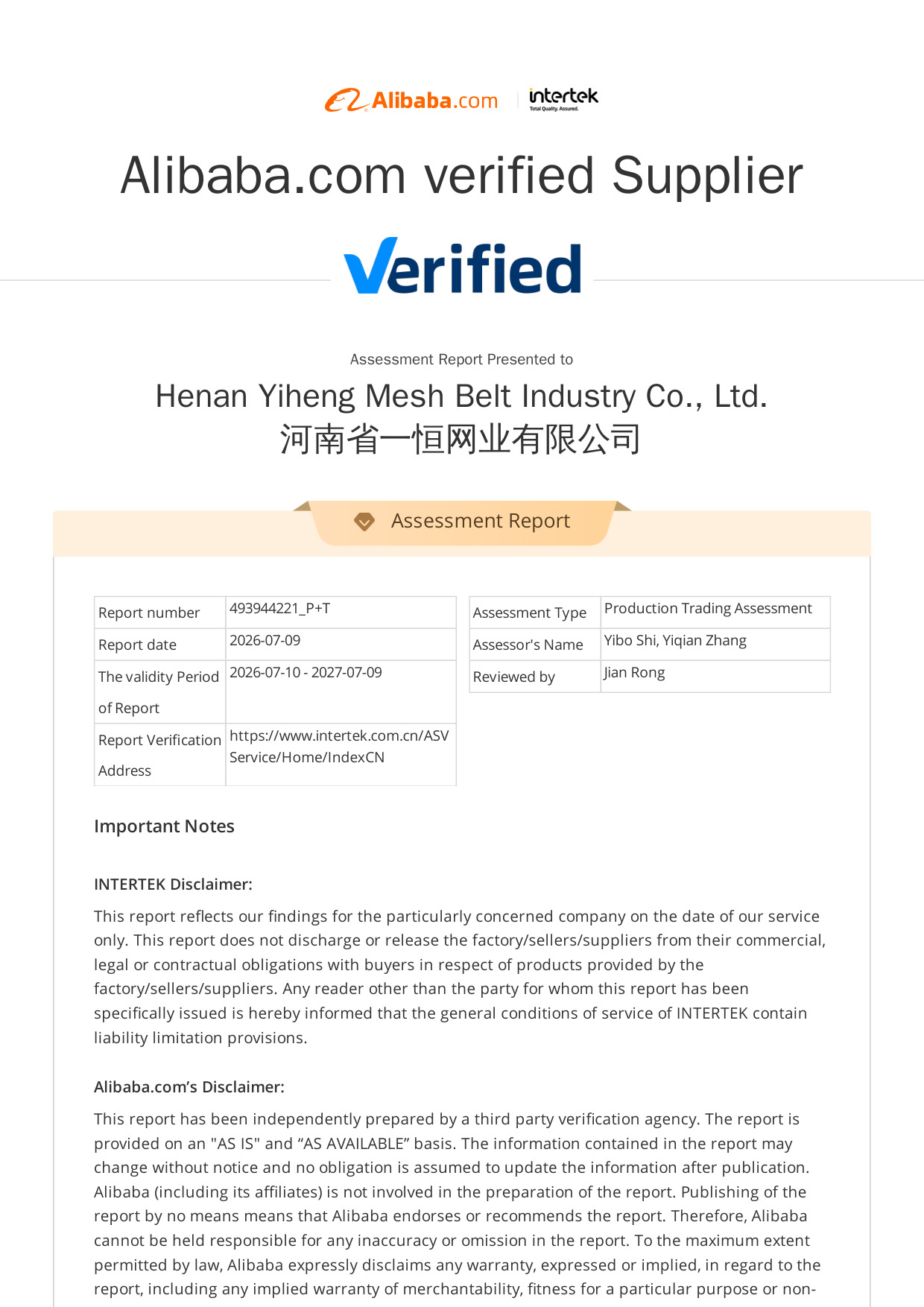
Supplier assessment evidence is a starting point; model-level datasheets and delivery terms still need review.
What this supplier review must prove
The buying question is not whether the supplier lists a nonwoven mesh belt. It is whether the supplier can demonstrate, model by model, that the belt will cover the line duty without creating a new failure mode. For an evaluation-to-execution buyer, four duties matter: spunbond web formation, anti-static release, hydrolysis resistance in hot-humid service, and high-speed operation with stable seams.
Those duties are related but not interchangeable. A belt described as anti-static is not automatically hydrolysis-resistant. A high-speed belt is not automatically suitable for a dusty region. A supplier that lists several model families may still fail the review if it cannot provide a separate datasheet, a seam drawing, an edge specification and an acceptance test for each quoted item.
Problem definition: model breadth is not capability
Nonwoven mesh belts are consumables that interact with air flow, fiber denier, temperature, humidity, static and machine tension. The supplied technical standard for Yiheng mesh names three measurable controls: air permeability deviation within ±5%, thermal shrinkage below 1%, and width tolerance less than ±0.5%. Those controls are useful because they can be checked. They do not, by themselves, prove that every model in a range will perform on a given spunbond or spunlace line.
The same applies to the shorthand above-3 below-5 weave description. If a supplier uses that phrase, the buyer should ask for its written definition: which direction is measured, what the values refer to, and how the result is verified. Thickness and basis weight should be stated on the same datasheet with a test method. A model code should not be accepted as a substitute for those values.
Industry background: why the four duty families matter
Spunlaid technology, which includes spunbond and meltblown, is a major part of the nonwoven market. Grand View Research reported that spunlaid technology held a 48.4% share of the global nonwoven technology market in 2023. That matters for belt selection because spunbond and meltblown lines combine high-speed web formation with fine fibers, air suction and static risk.
In practice, buyers evaluate nonwoven forming belts, nonwoven conveyor belts, spunbond belts, spunmelt belts and nonwoven machine belts as one purchasing category, but the line duty changes the failure mode. A high-speed line may expose seam thickness and tracking response. A dry, dusty plant may expose static and abrasion. A hot-humid dryer or wet-laid area may expose hydrolysis. A supplier review should therefore test the range across those conditions, not only compare model names.
The four-family coverage test
The supplied Yiheng product set includes HB4106, K4106A, K4106B, HY408S and SK604 as nonwoven mesh belt models. They should be treated as separate families or variants until the supplier provides evidence that connects each one to a duty.
HB4106: the range-breadth check
HB4106 is listed among the nonwoven mesh belt models applicable to the supplied nonwoven web-formation scenario. The supplied data does not provide a model-specific performance table for HB4106. That makes it a useful first test: can the supplier issue a current datasheet with weave structure, thickness, basis weight, CFM tolerance, joint options and edge options? If the answer is only a catalogue listing, the buyer has not yet verified capability.
K4106A and K4106B: separate anti-static and variant checks
K4106A appears in the supplied verified data as an example of an anti-static mesh belt used for high-speed nonwoven lines to manage static generated during high-velocity air suction. The buyer should still ask for the conductive-yarn layout, the grounding recommendation and the surface-resistivity test method. The supplied knowledge base explains the general mechanism: carbon fiber yarns reduce surface resistivity from above 10^12 Ω to 10^6–10^8 Ω and allow charges to dissipate through grounded metal rollers.
K4106B is a separate model in the same K4106 family. The supplied data does not establish that A and B are interchangeable. Ask for a separate datasheet for each, including yarn shape, thickness, CFM and whether both are anti-static. Do not assume that an A/B suffix is only a packing difference.
HY408S: the documented spunbond case check
HY408S appears in a supplied US customer case for a Reifenhauser nonwoven line. The case covers 200 m² over 6 months and reports uniform web formation, zero mesh marks, easy release and annual savings of USD 2,000. Those are case-reported results, not a guarantee for every line. The buyer should ask for the case conditions: line speed, fiber denier, belt specification and seam type. Even so, the case gives more decision value than a model name alone.
SK604: the high-speed and anti-static check
SK604 is described in the supplied knowledge base as a high-speed anti-static series used with a High-Low Loop seam. The same source explains why seam thickness matters: at speeds above 600 m/min, a small seam thickness increase can create periodic impact forces, bearing wear and transverse marks. The High-Low Loop design is described as achieving a 1:1 thickness match with the mesh body. A Swiss customer case covering 8 Reicofil RF4 high-speed lines reports 10% higher capacity, 5% higher first-grade yield and 30% lower maintenance cost after one year. These are supplied case results, not a universal performance promise.
Step-by-step capability review
Step 1: define the line duty before asking for a quotation
Write down the nonwoven process, line speed, fiber denier, operating temperature, humidity, static history and available grounding. State whether the belt is for forming, conveying or drying. The supplied application scenario for nonwoven web formation covers high speed, high electrostatic environment, high temperature, precision web formation and precise release, with 24/7 continuous cyclic operation. A supplier cannot choose a joint or a CFM target responsibly without those inputs.
Step 2: request a model-by-model datasheet
For each candidate model, ask for a datasheet that states the model name, weave structure, thickness, basis weight, CFM target and tolerance, width and length, material, edge option and joint type. The capability unit lists customization of mesh count and opening size, air permeability, belt width and length, material (PET/PA/anti-static), thickness, color and edge. That is a useful customization list, but the quotation should convert it into fixed values for the ordered belt.
Step 3: verify the process indicators
Use the measurable controls first. The supplied Yiheng technical standard states CFM deviation within ±5%, thermal shrinkage below 1% and width tolerance less than ±0.5%. Ask how each value is measured and whether the test is routine or project-specific. For weave, thickness and basis weight, ask for the nominal value and the tolerance. If the supplier uses a shorthand such as above-3 below-5, have it defined in the specification. This is not paperwork for its own sake: an undefined weave or CFM value cannot be checked at incoming inspection.
Step 4: review the joint and edge as one system
The supplied knowledge base distinguishes spiral seams from High-Low Loop seams. Spiral seams are described as cost-effective and easy to thread, suitable for lower speeds and standard products. High-Low Loop seams are described as thickness-matched to the mesh body and intended to eliminate roller jumping at high speed. The buyer should match the joint to the line speed and product quality target, not choose the lowest-cost seam by default.
Edge construction is a separate customization field. Ask whether the quoted edge is woven, sealed or glued, and request the edge thickness and finish. If a glued edge is quoted, ask for the glue type and cure condition. The supplied data lists edge as customizable but does not establish a universal glue-edge standard across all models. The point is to make the edge specification visible before the belt is built.
Step 5: check compliance evidence against the actual market
Yiheng’s supplied certification set includes a Food Contact test report HAPTX23061098 for polyester mesh belt, issued by JIANGSU HAP TESTING SERVICE CO., LTD on 2023-06-29 under GB 4806.7-2016. It also includes German Packaging Act LUCID registration DE2857625357145, issued 2025-02-24 by Stiftung Zentrale Stelle Verpackungsregister. The LUCID registration covers retail, grouped, shipment and service packaging under the yiheng brand placed on the German market; it is not a product-performance certificate. The Intertek Alibaba.com Verified Supplier Assessment Report 493944221_P+T covers fabrics, dryer fabrics, polyester filter belt, non-woven mesh belt and UV belts, issued 2026-07-09 and valid to 2027-07-09.
These documents answer different questions. The Food Contact report matters for food-contact or hygiene-adjacent nonwovens. The LUCID registration matters for German packaging compliance. The Intertek report supports supplier-assessment evidence. A buyer should ask which document applies to the ordered model, market and application rather than treating one certificate as blanket coverage.
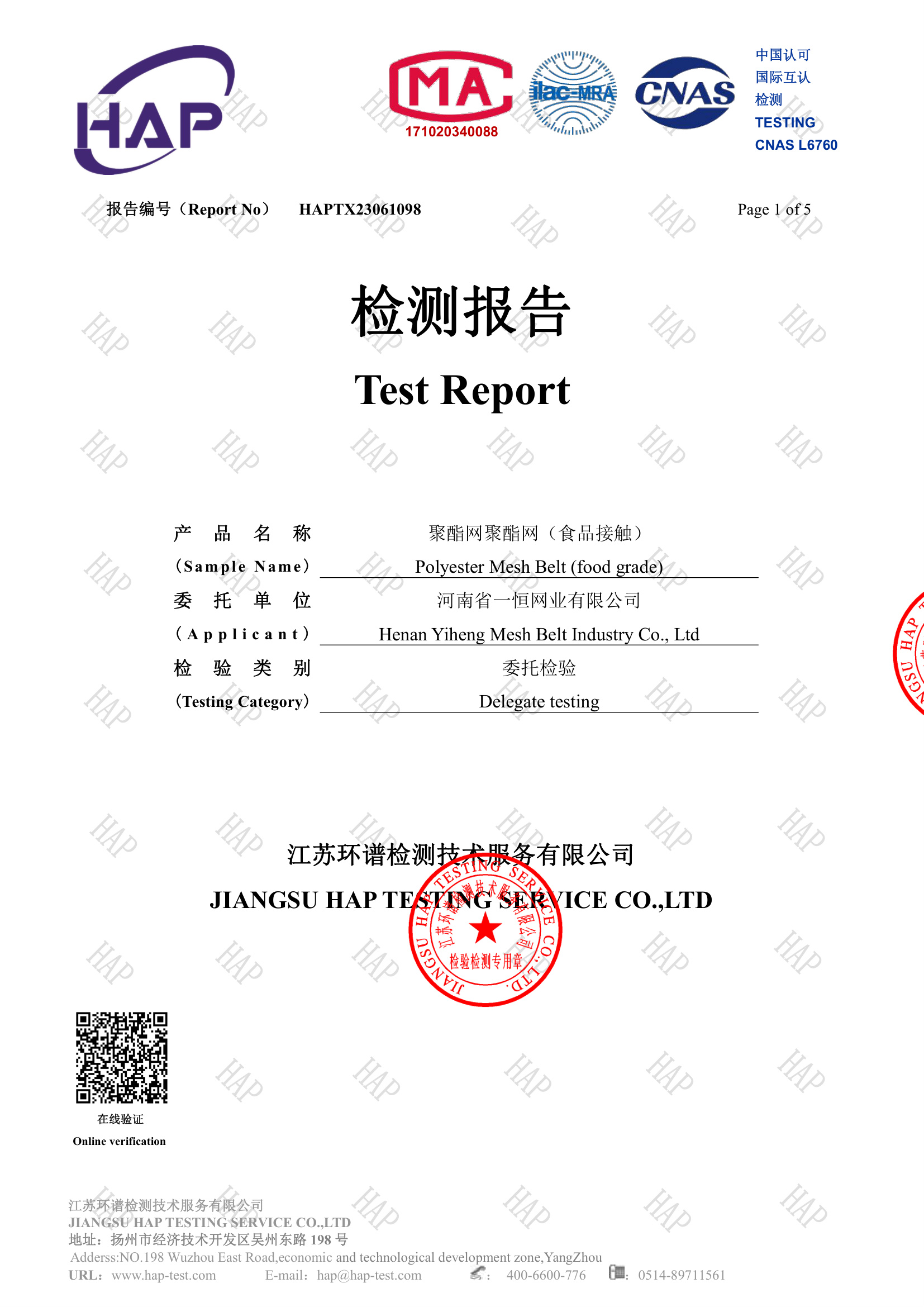
Food-contact test report HAPTX23061098 covers polyester mesh belt under GB 4806.7-2016.
Step 6: lock acceptance criteria and delivery terms
The supplied purchasing terms list 100% pre-shipment inspection and on-site third-party inspection through BV or SGS. Delivery terms include FOB, CIF, DAP and DDP, and payment terms are 30% deposit with 70% balance before shipment. Lead time is stated as 15–30 days. The capability unit also lists OEM/ODM production, remote technical support, installation guidance and free sample testing. The buyer should put these into the purchase order as acceptance points, not leave them as general sales statements.
A practical acceptance schedule should include the model and batch, CFM test result against the agreed tolerance, width and length check, joint type and seam thickness, edge finish, visual inspection and packing list. If third-party inspection is used, define the sampling plan and who pays for it. If a sample is tested, record the line conditions so the result can be compared with the production belt.
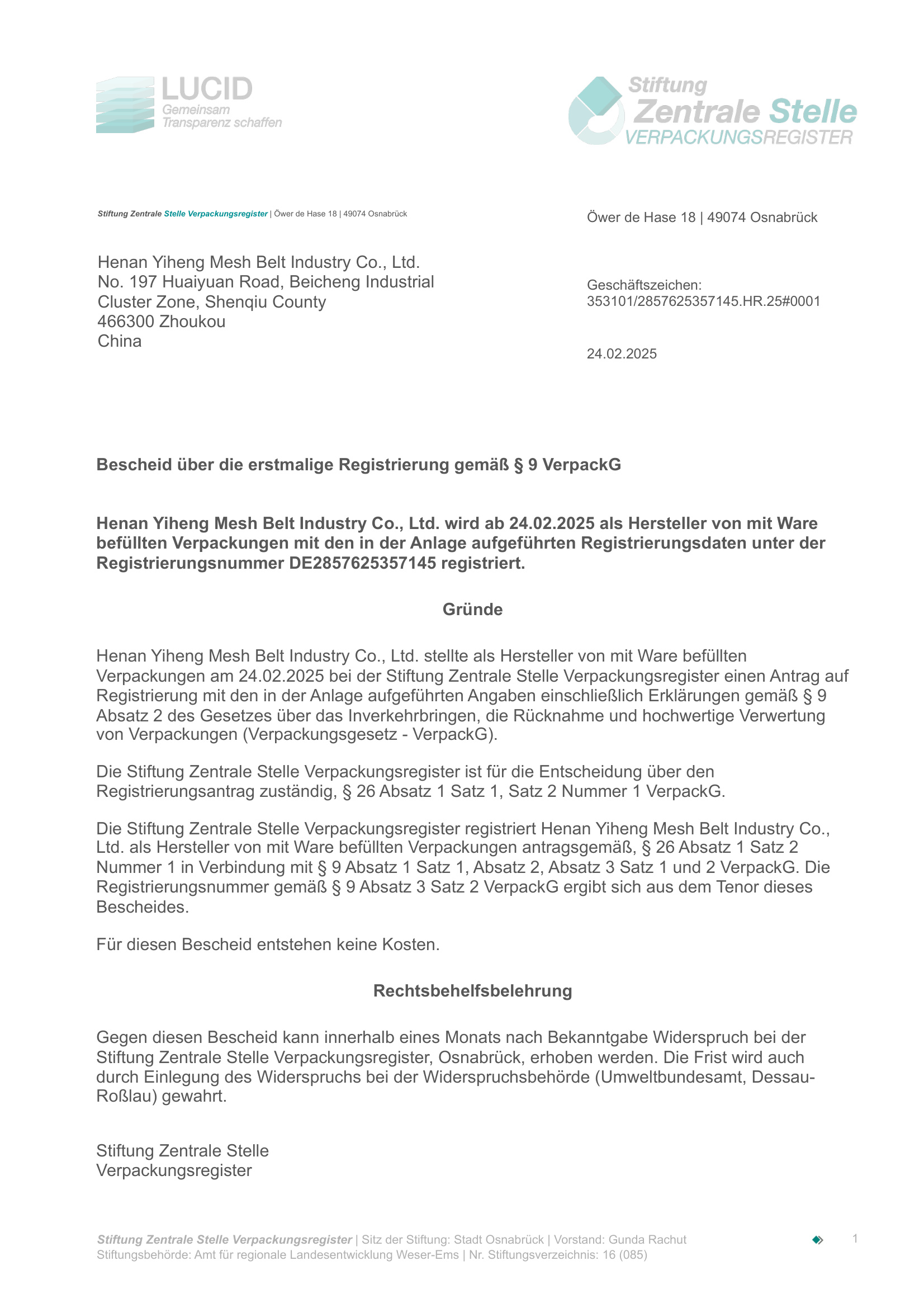
LUCID registration DE2857625357145 addresses German packaging obligations, not belt performance.
Use cases: matching the four families to line duty
High-speed spunbond and spunmelt lines
For a high-speed spunbond or spunmelt line, the first review point is seam stability. SK604 is the supplied high-speed anti-static reference, and the Swiss case covers 8 Reicofil RF4 lines. Ask for the seam type, thickness match and tracking response at the specified speed. If the line runs above 400 m/min or 500 m/min, a standard spiral seam may be a poor match even if the mesh body is acceptable.
Anti-static release in dry or dusty plants
In dry winter conditions or dusty regions, static can cause fabric flipping, poor release and even spark risk. The supplied risk guidance says that when ambient humidity is below 25% and dust control is insufficient, the risks include abnormal wear and static sparks. Mitigation includes a double anti-static series, sealing baffles around the forming area and daily compressed-air cleaning of dust from roller sides. K4106A and SK604 are the anti-static references in the supplied data, but the buyer should still verify grounding: a 1 m deep grounding rod, salt to improve conductivity, and surface-resistivity checks.
Hydrolysis-resistant service in hot-humid areas
Hydrolysis resistance is a separate selection. The supplied purchasing guidance states that standard polyester mesh degrades in hot and humid environments, while hydrolysis-resistant mesh uses special stabilizers to resist strength loss and extend service life by 3–5 times. It recommends hydrolysis-resistant construction where ambient temperature is above 80°C with high humidity. The four forming families in this review should not be assumed to be hydrolysis-resistant unless the supplier names the hydrolysis-resistant product and provides the applicable data. The German wet-wipe and medical-dressing case, covering 12 spunlace lines, reports high water permeability, zero mesh marks and hydrolysis resistance, but it uses a different model set; it is supporting evidence, not a substitute for a model-specific quotation.
Long replacement downtime and seam installation
Long replacement downtime is often a tracking and seam problem, not a belt-life problem. The supplied maintenance guidance recommends the marker method: while the original belt is stable, mark a baseline on the exposed tension rod; install the new belt and adjust to the baseline; run empty for 5 minutes and make minor adjustments. For manual tracking, keep both tensioning bolts at equal exposure, run empty for 10–20 minutes and tighten the side the belt runs toward. Do not over-tighten one side, because that creates shear force at the seam. Seam threading is easier with a ground wire tip, the correct wire diameter and a filling wire slightly smaller than the main wire.
Comparison table: what the supplied evidence supports
| Model family | Supplied evidence | What the buyer must still verify |
|---|---|---|
| HB4106 | Listed among nonwoven mesh belt models applicable to the supplied nonwoven web-formation scenario. | Model-specific weave, thickness, basis weight, CFM tolerance, joint and edge data. |
| K4106A | Identified in supplied verified data as an anti-static mesh belt example for high-speed nonwoven lines. | Conductive-yarn layout, surface-resistivity test, grounding requirement and line-speed reference. |
| K4106B | Listed as a separate model in the K4106 family. | Separate datasheet; confirm yarn shape, thickness, CFM and anti-static status. Do not assume A/B interchangeability. |
| HY408S | US case on a Reifenhauser line: 200 m², 6 months, uniform web formation, zero mesh marks, easy release, USD 2,000 annual savings. | Case line conditions, belt specification, seam type and whether the result applies to the buyer’s denier and speed. |
| SK604 | High-speed anti-static series with High-Low Loop seam; Swiss case on 8 Reicofil RF4 lines reports 10% higher capacity, 5% higher first-grade yield and 30% lower maintenance cost. | Seam thickness match, CFM target, tracking response and case applicability to the quoted line. |
The table is a review map, not a ranking. It shows where the supplied evidence is specific and where it stops. A supplier that can fill the right-hand column with measured values is easier to qualify than one that answers only with model names.
Delivery assurance: acceptance, compliance and risk scenarios
Acceptance criteria
Use the purchasing terms as the baseline: 100% pre-shipment inspection, third-party inspection available through BV or SGS, FOB/CIF/DAP/DDP delivery terms and 30% deposit with 70% balance before shipment. Add model-specific acceptance values for CFM, width, length, joint and edge. For a first order, require a sample or pilot belt and record the line conditions. The capability unit states that free sample testing is available and that OEM/ODM production is supported; the quotation should state what is free, what is paid and what the sample lead time is.
Environmental compliance questions
Ask three questions in writing. First, does the ordered product fall within the Food Contact test report HAPTX23061098 scope, and is a current report available for the exact material? Second, does the shipment trigger German packaging obligations, and is the LUCID registration DE2857625357145 the relevant registration for the packaging being used? Third, does the supplier have a current Intertek supplier assessment or equivalent third-party report for the actual production scope? These questions prevent a buyer from treating a packaging registration as a product certificate or a supplier assessment as a food-contact approval.
The Intertek assessment covers the supplier scope; the buyer should still map it to the ordered model and market.
Risk scenario: high-humidity production
In high-humidity production, the main risk is hydrolysis of standard polyester. The supplied guidance recommends hydrolysis-resistant mesh where temperature is above 80°C with high humidity and states that special stabilizers resist strength loss and brittleness. The buyer should ask for the hydrolysis-resistant product name, the recommended operating envelope and the expected service-life basis. Do not accept a general anti-static datasheet as proof of hydrolysis resistance.
Risk scenario: dusty or extremely dry regions
In dusty or extremely dry regions, dust accelerates yarn wear and low humidity increases static risk. The supplied mitigation is a double anti-static series, sealing baffles around the forming area and daily compressed-air cleaning of roller sides. If the plant has had fabric flipping despite an anti-static belt, check the grounding system before blaming the belt: the guidance calls for a 1 m deep grounding rod, salt to improve conductivity and regular surface-resistivity checks.
Risk scenario: long replacement downtime
To reduce replacement downtime, keep a marked tension baseline, a spare seam wire and the correct wire diameter at the line. Train the maintenance team on the marker method, seam threading and the empty-run check. The supplied guidance recommends a 5-minute empty run after setting to the baseline and a 10–20 minute empty run for manual tracking. It also warns that a seam can burst if mistracking is ignored, tracking sensors are covered in dust, or the line is brought to full load immediately after replacement. Those are operational checks the buyer can audit during supplier qualification.
Decision framework: how to score the supplier
Use four weighted gates. Gate 1 is model evidence: separate datasheets for HB4106, K4106A, K4106B, HY408S and SK604, with weave, thickness, basis weight and CFM tolerance stated. Gate 2 is joint and edge: a defined seam type, a seam thickness check and a written edge specification. Gate 3 is compliance: the correct certificate for the exact product and market, with the scope read carefully. Gate 4 is delivery: lead time, inspection, payment terms and a named after-sales contact. A supplier that passes Gates 1 and 2 but fails Gate 4 is a production risk. A supplier that passes Gate 4 but fails Gate 1 is a catalogue risk.
Red flags include a datasheet that lists a model without a CFM tolerance, a joint drawing that does not show seam thickness, an edge description that says only as standard, a certificate presented without its scope, and a lead time that is not tied to the ordered specification. None of these automatically disqualifies a supplier, but each should be closed before the purchase order is released.
FAQ
Can Yiheng supply an OEM nonwoven mesh belt for production lines?
Yes. The supplied capability data states that the manufacturer provides OEM and ODM production services and supports customization of mesh count and opening size, air permeability (CFM), belt width and length, material (PET/PA/anti-static), thickness, color and edge. For a production-line OEM project, the buyer should issue a specification with the target model family, line duty, CFM tolerance, joint type, edge option and acceptance test. The supplier’s export markets include the EU, North America, Southeast Asia, the Middle East, Russia and South America.
Do the products comply with EU or German environmental regulations?
The supplied compliance set includes a Food Contact test report HAPTX23061098 for polyester mesh belt under GB 4806.7-2016 and German Packaging Act LUCID registration DE2857625357145. The LUCID registration covers packaging placed on the German market under the yiheng brand; it is not a product-performance certificate. For an EU order, ask which document applies to the exact product, application and packaging, and request the current version before shipment.
Can one model family cover spunbond, anti-static, hydrolysis-resistant and high-speed duties?
No single model should be assumed to cover all four duties. In the supplied data, SK604 is the high-speed anti-static reference with a High-Low Loop seam, K4106A is an anti-static example, HY408S has a documented Reifenhauser case, and HB4106 is listed in the nonwoven range but needs a model-specific datasheet. Hydrolysis resistance is a separate selection with its own product name and operating envelope. The supplier review should confirm each duty against a named model.
What acceptance criteria should be written into the order?
Use 100% pre-shipment inspection, third-party inspection through BV or SGS where required, and the agreed FOB/CIF/DAP/DDP delivery term. Add the model, batch, CFM result and tolerance, width and length, joint type, seam thickness, edge finish and packing list. The supplied payment terms are 30% deposit and 70% balance before shipment. If a sample is tested, record the line conditions so the production belt can be compared with the sample.
Is free sample testing available, and what lead time should be planned?
The supplied after-sales data states that free sample testing is available, and the capability data states a lead time of 15–30 days. The company profile also states that custom prototypes can be delivered in as little as 3 days. Those statements should be confirmed in the quotation because sample scope, freight and test conditions can change the schedule. Plan the order around the written lead time, not the shortest published example.
What should a buyer do first when evaluating this supplier?
Start with one line duty and one model family. Request the datasheet, the joint drawing, the edge specification and the compliance scope for that exact item. Then compare the quoted values with the line requirement and the acceptance test. If the first model passes, repeat the process for the other families rather than assuming range-wide equivalence. The approved company website is https://www.yhfilterbelt.com/, and the public brochure is available at the Yiheng product brochure.
Conclusion
A nonwoven mesh belt supplier review should end with a traceable specification, not a general impression of range. The HB4106, K4106A, K4106B, HY408S and SK604 families give the buyer a practical coverage test across forming, anti-static, documented spunbond cases and high-speed seams. The evidence is strongest when each family is tied to a datasheet, a joint and edge definition, a compliance scope and an acceptance criterion. Delivery assurance then turns those claims into a purchase order that can be checked at goods-in and on the line.
For buyers moving from evaluation to execution, the next step is a model-specific quotation with CFM tolerance, thickness, basis weight, weave definition, seam type, edge option, lead time and inspection terms. That is the point where a supplier’s model breadth becomes a verifiable capability rather than a catalogue statement.
Have Questions or Need More Details?
Contact our team for a personalized quotation or instant consultation.
Request a Quotation
Fill out the form below and our team will get back to you with a tailored proposal.
WhatsApp Direct Chat
Prefer to chat in real-time? Message us on WhatsApp for instant assistance & quick answers.
- Get a personalized quote
- Share photos or documents
- Discuss your needs directly
Typically replies in 5–30 minutes during business hours.