Polyester Mesh Belt Application Guide: Matching Models to Latex, Paper and Wastewater Lines
A polyester mesh belt performs well or badly for a small number of predictable reasons, and most of them trace back to a model chosen for the wrong duty. A belt that is too thick for the roller spacing drags, tracks badly and wears at the edges. A belt that is too open lets solids pass and leaves a wet cake. A belt that is too closed blinds, carries water back into the sheet and forces shorter cleaning intervals.
This guide maps five belts to five common duties: latex wire drying, papermaking pulp washing, belt filter press dewatering, meltblown non-woven production and fabric pre-shrinking. The models covered are Medium Loop, Small Loop, Large Loop-Filler Wire, Medium Loop-Filler Wire and the lower-permeability Small Loop-Filler Wire option. All specifications quoted here are the published figures for belts manufactured by Henan Yiheng Mesh Belt Industry Co., Ltd. (Yiheng Mesh), a polyester mesh belt manufacturer established in 2009 in Henan Province, China, so every recommendation can be checked against thickness, air permeability, loop geometry and break strength instead of being taken on adjectives.
Quick matching answer
- Tight roller spacing plus high airflow → Small Loop: 1.90 mm thick, 17,500 m³/㎡/h air permeability, 5.20 mm loop distance.
- Drying-heavy duty on moderate roller spacing → Medium Loop: 2.32 mm thick, 18,300 m³/㎡/h, 6.50 mm loop distance.
- Heavy dewatering under maximum tension → Large Loop-Filler Wire: 2.95 mm thick, 9,000–13,700 ±500 m³/㎡/h, ≥2300 N/cm break strength.
- Controlled filtration on medium-load presses → Medium Loop-Filler Wire: 2.32 mm thick, 10,700–12,000 ±500 m³/㎡/h.
- Finest retention on compact frames → Small Loop-Filler Wire: 1.90 mm thick, 7,300 ±500 m³/㎡/h.
Problem Definition: Why a Belt That “Worked Before” Fails on a New Line
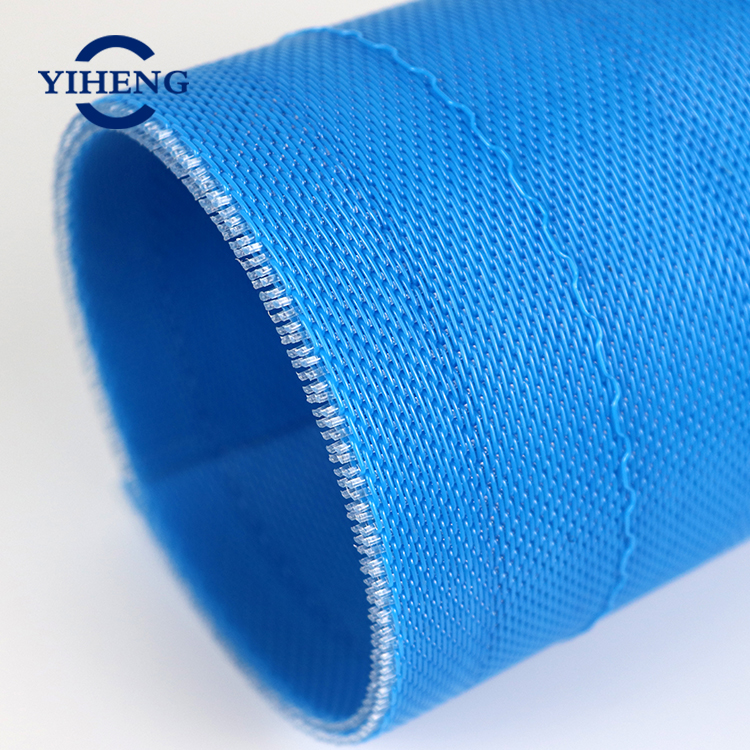
Most belt complaints arrive as symptoms, not as specification errors: the belt walks off the rollers, the cake leaves the press wetter than expected, the sheet picks up marks, the seam pulls, or the belt needs washing twice as often as it used to. In each case the root cause is usually a mismatch on one of four variables.
1. Thickness versus roller spacing
Thickness decides whether the belt can turn through the machine at all. A 2.95 mm belt and a 1.90 mm belt behave very differently on a frame designed for tight roller spacing: the thicker belt increases wrap stiffness, raises the effort needed to keep tension even, and can shorten the path between rollers. Where space is tight, a compact belt is not a downgrade — it is the only geometry that fits.
2. Air permeability versus the dewatering or drying target
Air permeability, expressed here in m³/㎡/h, controls how fast air or water moves through the mesh. High values favour drainage speed and heat penetration; lower values favour solids retention and cake dryness. On a belt filter press, choosing above the process requirement usually produces a wetter cake. On a dryer, choosing below the requirement slows evaporation and forces the line to run hotter than necessary.
3. Loop geometry and filler wire versus filtration fineness
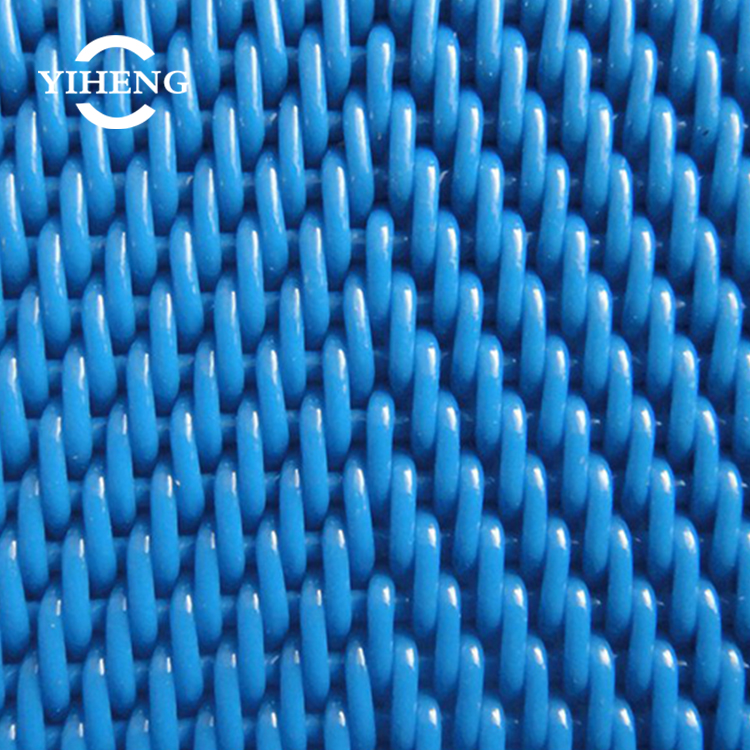
The loop is the spiral that gives a spiral mesh belt its structure, and loop distance is the spacing of that spiral. Smaller loop distance means denser support; filler wire placed inside the loops closes the open area further. This is the difference between a belt that drains fast and a belt that filters fine.
4. Break strength versus mechanical load
Break strength is the ceiling on tension. The spiral models in this guide are rated at ≥2000 N/cm, and the Large Loop-Filler Wire model is rated at ≥2300 N/cm. A heavy press running high tension is not the place for the lightest available belt, even if that belt drains faster.
Industry Background: Five Duties, One Material Family
Polyester is the dominant material family in this category. Straits Research reports that polyester held a 28.4% share of the global conveyor belt market by material in 2025, ahead of other material segments. Independent of market share, the reason polyester dominates filtration and drying duties is mechanical: high-tenacity polyester monofilaments combine tensile strength with resistance to hydrolysis in continuously wet environments, so the belt can run 24/7 in contact with water, pulp and sludge without losing dimensional stability.
Demand is also weighted toward the wastewater side of the category. Grand View Research projects that the belt filter press technology segment of the sludge dewatering equipment market will grow at a compound annual rate of 8.8% between 2025 and 2033, and every one of those presses needs a filter belt matched to its roller layout and cake target.
The practical consequence is that the same material family has to serve five very different working conditions:
- Latex wire drying and conveying — continuous heat, airflow-driven moisture removal, and a smooth surface that must not mark the product.
- Papermaking pulp washing and pressing — high longitudinal tension, severe abrasion, continuous aqueous conditions.
- Belt filter press and sludge dewatering — mechanical pressure, chemically active sludge, and a cake that must release cleanly.
- Meltblown non-woven equipment — fine fibre support combined with controlled airflow.
- Fabric pre-shrinking machines — dimensional stability under heat with low belt weight.
Detailed Solution: What Each Spiral Model Is Built For
Medium Loop — the general drying and conveying belt
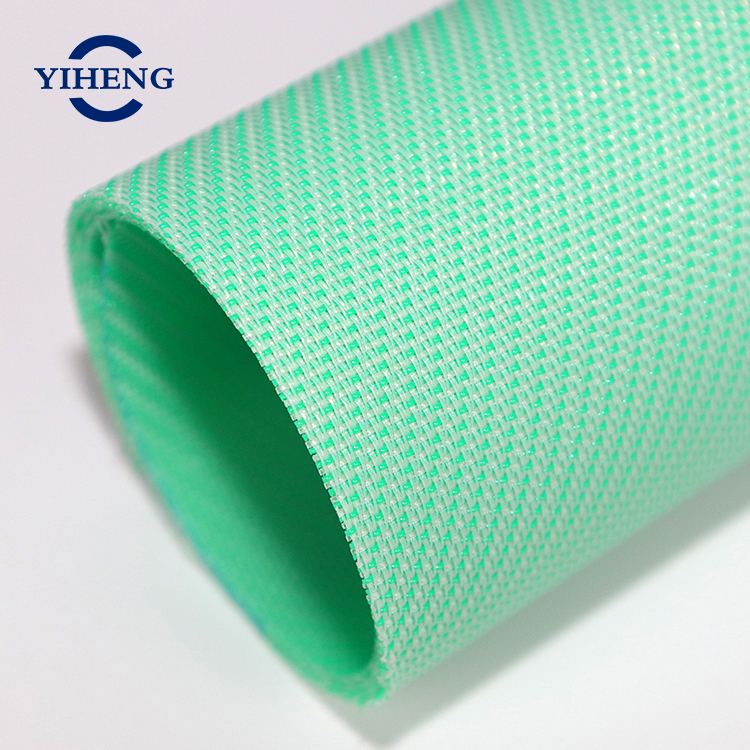
Medium Loop is a polyester spiral mesh belt built around airflow. With a 2.32 mm thickness, a 6.50 mm loop distance and an air permeability of 18,300 m³/㎡/h, it delivers the highest published air permeability in this group while keeping a moderate profile that fits most standard roller layouts. Break strength is ≥2000 N/cm, and the belt is available with endless or self-ring joints.
- Warp / weft: 0.68 mm / 0.90 mm
- Loop distance: 6.50 mm
- Thickness: 2.32 mm
- Air permeability: 18,300 m³/㎡/h
- Strength at break: ≥2000 N/cm
- Typical fit: latex wire drying, papermaking, non-woven, textile finishing, rubber and latex processing
Small Loop — high airflow in the tightest layouts
Small Loop keeps most of the airflow of the Medium Loop in a shell that is 0.42 mm thinner. At 1.90 mm with a 5.20 mm loop distance, it reaches 17,500 m³/㎡/h and still holds ≥2000 N/cm break strength. That combination makes it the default choice where roller spacing is tight but the process still needs fast, even drying — a common situation on compact meltblown and non-woven lines, and on fabric pre-shrinking machines.
- Warp / weft: 0.52 mm / 0.70 mm
- Loop distance: 5.20 mm
- Thickness: 1.90 mm
- Air permeability: 17,500 m³/㎡/h
- Strength at break: ≥2000 N/cm
- Typical fit: food processing, papermaking, environmental protection, non-woven manufacturing, pharmaceutical
Large Loop-Filler Wire — maximum strength for heavy dewatering
Large Loop-Filler Wire is a filter press belt rated at ≥2300 N/cm, the highest break strength in this group, with a 2.95 mm thickness and a 0.90 mm ring wire. Three filler configurations let the same belt be tuned to the press: 0.90×3 mm reaches the top of the permeability range at 13,700 m³/㎡/h for maximum drainage, 0.90×4 mm sits at a balanced 12,700 m³/㎡/h, and 0.90×5 mm closes down to 9,000 m³/㎡/h for finer filtration and a drier cake. Published range: 9,000–13,700 ±500 m³/㎡/h.
- Ring wire / threading: 0.90 mm / 1.00 mm
- Filler options: 0.90×3, 0.90×4, 0.90×5 mm
- Thickness: 2.95 mm
- Air permeability: 9,000–13,700 ±500 m³/㎡/h
- Strength at break: ≥2300 N/cm
- Typical fit: high-tension belt filter presses, papermaking pressing, mine tailings and municipal sludge dewatering
Medium Loop-Filler Wire — balanced load, drier cake
Medium Loop-Filler Wire applies the same filler-wire logic to a lighter frame. At 2.32 mm with a 0.68 mm ring wire, it fits medium-load presses that cannot take a 2.95 mm belt but still need controlled filtration rather than maximum drainage. Two filler configurations are available: 0.68×3 mm for the open end of the range at 12,000 m³/㎡/h, and 0.68×4 mm for finer filtration at 10,700 m³/㎡/h. Published range: 10,700–12,000 ±500 m³/㎡/h, with ≥2000 N/cm break strength.
- Ring wire / threading: 0.68 mm / 0.90 mm
- Filler options: 0.68×3, 0.68×4 mm
- Thickness: 2.32 mm
- Air permeability: 10,700–12,000 ±500 m³/㎡/h
- Strength at break: ≥2000 N/cm
- Typical fit: medium-load belt filter presses, pulp washing, meltblown equipment, fabric pre-shrinking
Small Loop-Filler Wire — the lower-permeability option
When the requirement is retention rather than throughput, Small Loop-Filler Wire is the tightest belt in the family. A 0.65 × 1.65 mm flat filler wire closes the loop structure to 7,300 ±500 m³/㎡/h while the belt stays at 1.90 mm thick — the slimmest filter press profile here — and still holds ≥2000 N/cm. It is the right answer for compact presses and for filtrate clarity targets where a faster belt would pass solids.
- Threading: 0.80 mm; filler: 0.65×1.65 mm flat wire
- Thickness: 1.90 mm
- Air permeability: 7,300 ±500 m³/㎡/h
- Strength at break: ≥2000 N/cm
- Typical fit: belt filter presses, pulp washing, meltblown non-woven equipment, fabric pre-shrinking, latex wire drying and conveying
Alternative weave worth knowing: where cake release rather than permeability is the limiting factor, the herringbone-weave model 16903 uses a diagonal structure to reduce adhesion between cake and mesh. It is rated at 7,894 ±500 m³/㎡/h with ≥2200 N/cm break strength, and is intended for belt type filter presses, horizontal vacuum belt filters and vacuum rubber belt filters.
Step-by-Step Breakdown: Matching a Belt to a Line
Work through the six steps in order. Each step eliminates models rather than adding features, which is faster and produces a defensible selection.
Step 1 — Measure the roller layout before anything else
Record the available clearance and the tightest roller spacing on the frame. If the layout is compact, restrict the shortlist to 1.90 mm and 2.32 mm belts: Small Loop, Small Loop-Filler Wire, Medium Loop and Medium Loop-Filler Wire. Large Loop-Filler Wire at 2.95 mm is reserved for frames built for it.
Step 2 — Define the process target: drying speed, drainage rate or filtrate clarity
If the goal is removing water or heat fast, stay in the high-permeability range: 18,300 m³/㎡/h (Medium Loop) or 17,500 m³/㎡/h (Small Loop). If the goal is a drier cake or cleaner filtrate, move to the filler-wire models at 10,700–13,700 m³/㎡/h, and to Small Loop-Filler Wire at 7,300 m³/㎡/h when retention is critical.
Step 3 — Check the tension ceiling
Compare the press or line tension against break strength: ≥2300 N/cm for Large Loop-Filler Wire, ≥2000 N/cm for the other four. Where the press runs heavy sludge loads at high tension, the ≥2300 N/cm rating is the deciding factor regardless of drainage preference.
Step 4 — Tune filtration fineness with the filler configuration
On filler-wire models, the filler size is the fine-tuning control. For Large Loop-Filler Wire: 0.90×3 mm for maximum drainage at 13,700 m³/㎡/h, 0.90×4 mm for balance, 0.90×5 mm for finer filtration at 9,000 m³/㎡/h. For Medium Loop-Filler Wire: 0.68×3 mm at 12,000 m³/㎡/h versus 0.68×4 mm at 10,700 m³/㎡/h.
Step 5 — Confirm chemical and temperature exposure
All five models are polyester. Confirm that the sludge, pulp or process chemistry is within polyester's working range, and that continuous temperature on drying duties is compatible with the belt. Where chemical attack is the dominant risk, the acid- and alkali-resistant high-grade PET construction used in model 16903 addresses the same dewatering duty from a different angle.
Step 6 — Specify the joint and plan for changeover
The spiral models are offered with endless or self-ring joints, and the belts have a smooth mesh surface with arbitrary disassembly and assembly. That matters operationally: a seam change or belt swap can be planned without dismantling the machine frame, which shortens maintenance windows on 24/7 lines.
Use Cases: Matching Models to Specific Lines
Latex wire drying and conveying
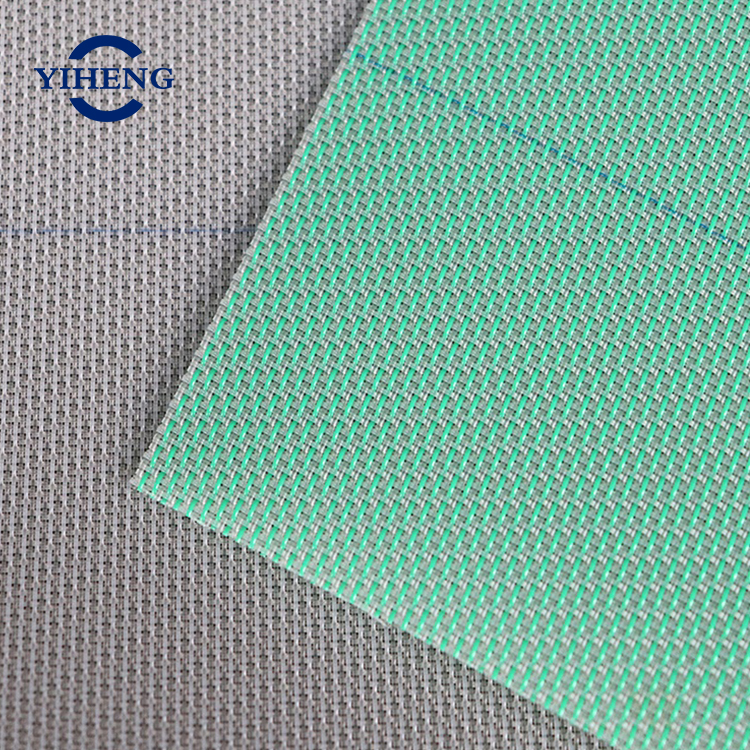
Drying lines need airflow first and surface quality second. Medium Loop at 18,300 m³/㎡/h is the airflow-led choice for standard layouts; Small Loop at 17,500 m³/㎡/h is the substitute where the roller spacing will not accept a 2.32 mm belt. Both are listed for latex wire drying and conveying, and both present a smooth surface that supports the product without marking it. Where a compact frame also demands finer retention, Small Loop-Filler Wire covers the same duty at 7,300 ±500 m³/㎡/h.
Papermaking pulp washing and pressing
Pulp washing punishes belts with tension and abrasion rather than with heat. Medium Loop and Small Loop handle washing and sheet support where airflow governs, while Large Loop-Filler Wire and Medium Loop-Filler Wire cover washing and pressing duties where drainage is controlled and cake dryness matters. For very fine washing and high-precision retention, the plain weave model 16402 (41 mesh, 0.2 mm pitch, 6,900 m³/㎡/h) sits below the spiral range as a fine-filtration alternative.
Belt filter press and sludge dewatering
This is the duty where the choice between the three filler-wire belts decides operating cost. Use Large Loop-Filler Wire on high-tension presses handling heavy sludge loads, selecting 0.90×5 mm when the cake is coming out wetter than the downstream handling stage allows. Use Medium Loop-Filler Wire on medium-load frames that cannot accept a 2.95 mm belt. Use Small Loop-Filler Wire on compact presses or where solids carry-over into the filtrate is the complaint. All three are polyester and rated at ≥2000 N/cm or above, and all three are intended for environmental protection and wastewater treatment service.
Meltblown non-woven equipment
Meltblown forming demands uniform airflow under a fine web, so the belt must be thin enough to run tight and open enough to pull air evenly. Small Loop at 1.90 mm and 17,500 m³/㎡/h is the primary fit; Medium Loop is used where the frame allows a 2.32 mm belt and the line benefits from the higher 18,300 m³/㎡/h airflow. Medium Loop-Filler Wire and Small Loop-Filler Wire are both listed for meltblown equipment where a tighter structure is needed.
Fabric pre-shrinking
Pre-shrinking is a dimensional-stability duty: the belt must hold its width and length under heat while keeping weight low. Small Loop at 1.90 mm is the lightest spiral option with high airflow, Medium Loop is used where the extra 0.42 mm of body and higher permeability are acceptable, and Small Loop-Filler Wire and Medium Loop-Filler Wire are both specified for fabric pre-shrinking machines where a denser surface is required.
Comparison Table: Five Models Side by Side
| Model | Type | Thickness | Air permeability (m³/㎡/h) | Loop / filler | Break strength | Best-fit duty |
|---|---|---|---|---|---|---|
| Small Loop | Polyester spiral mesh | 1.90 mm | 17,500 | Loop distance 5.20 mm | ≥2000 N/cm | Tight roller spacing with high airflow: meltblown, pre-shrinking, fine paper duties |
| Medium Loop | Polyester spiral mesh | 2.32 mm | 18,300 | Loop distance 6.50 mm | ≥2000 N/cm | Drying and conveying on standard layouts: latex wire drying, papermaking, non-woven |
| Large Loop-Filler Wire | Filter press belt | 2.95 mm | 9,000–13,700 ±500 | 0.90×3 / 0.90×4 / 0.90×5 mm | ≥2300 N/cm | Heavy dewatering at maximum tension: high-load belt filter presses, tailings, pulp pressing |
| Medium Loop-Filler Wire | Filter press belt | 2.32 mm | 10,700–12,000 ±500 | 0.68×3 / 0.68×4 mm | ≥2000 N/cm | Medium-load presses needing controlled filtration and a drier cake |
| Small Loop-Filler Wire | Filter press belt | 1.90 mm | 7,300 ±500 | 0.65×1.65 mm flat filler | ≥2000 N/cm | Finest retention on compact frames: filtrate clarity, tight press layouts |
Read the table left to right for elimination: thickness removes models that will not fit, air permeability removes models that cannot meet the process target, and break strength removes models that cannot carry the tension. The remaining row or two are the ones worth sampling.
Installation, Changeover and Maintenance Notes
All five models share a smooth mesh surface with arbitrary disassembly and assembly, which is a maintenance feature rather than a marketing one: seam replacement and belt removal can be carried out on the machine without full frame disassembly. The spiral models are supplied with endless or self-ring joints.
Three practical rules reduce avoidable belt failures:
- Match the tension at installation. A belt rated ≥2000 N/cm still fails at the seam if it is tensioned unevenly across the width.
- Clean to the belt, not against it. High-pressure washing close to the mesh can distort filler wires; the filler configuration is what holds the permeability figure.
- Record the model and filler size. Two belts with the same model name but different fillers (0.68×3 versus 0.68×4, for example) will drain differently, and a replacement ordered from memory can change press performance.
Purchasing Terms, Inspection and Delivery
Yiheng Mesh is a National High-tech Enterprise established in 2009, operating a 4,237 m² manufacturing facility with an annual production capacity of 150,000 m², approximately 41 staff and an R&D team of 3 engineers. Export business accounts for 62% of sales, with major markets in Asia, Europe and North America. The product range covers Polyester Mesh Belt, Non-Woven Mesh Belt, Forming Fabrics, Dryer Fabrics, Polyester Filter Belt, UV Belts, Polyester Spiral Mesh, Polyester Square Mesh and PTFE Mesh Belt.
For buyers converting a model shortlist into an order, the commercial terms are straightforward:
- Minimum order quantity: 2 m².
- Payment: 30% deposit with 70% balance.
- Inspection: third-party inspection by BV or SGS.
- Delivery terms: FOB, CIF, DAP or DDP.
For import documentation, textile products and articles for technical uses of this type are commonly classified under HS code 5911.90, the classification applied to technical-use textile articles in the US Harmonized Tariff Schedule. Confirming the code with the freight forwarder before shipment avoids clearance delays on mixed orders of spiral mesh and filter press belts.
FAQ
- What inspection and compliance documentation can be requested with a polyester mesh belt order?
- Orders can be inspected by a third party — BV or SGS — before shipment, which gives the buyer an independent record of belt dimensions, thickness and condition at dispatch. On the compliance side, Yiheng Mesh holds a Food Contact Certificate for products used in food packaging and precision hygiene applications, is registered under the German Packaging Law (LUCID), and operates in line with EU environmental requirements. Buyers with specific documentation requirements should state them at the quotation stage so inspection scope is agreed before production.
- Can a single polyester mesh belt manufacturer cover latex drying, papermaking and wastewater lines?
- Yes, provided the supplier's range spans both spiral mesh and filler-wire filter press belts rather than one family. Yiheng Mesh manufactures Polyester Mesh Belt, Non-Woven Mesh Belt, Forming Fabrics, Dryer Fabrics, Polyester Filter Belt, UV Belts, Polyester Spiral Mesh, Polyester Square Mesh and PTFE Mesh Belt, and its spiral and filler-wire models together cover latex wire drying, papermaking pulp washing, belt filter presses, meltblown non-woven equipment and fabric pre-shrinking. Annual production capacity is 150,000 m², and 62% of sales are exported to Asia, Europe and North America.
- What drives the cost of a polyester mesh belt?
- Cost follows the specification rather than a single headline figure. The main variables are the model and its thickness, the filler configuration where a filler-wire belt is specified (0.68×3 versus 0.68×4 mm, or 0.90×3 versus 0.90×5 mm), the finished belt dimensions, the joint type (endless or self-ring), and whether third-party inspection is required. Because filler size changes both drainage and material content, the cheapest option is not automatically the lowest-cost belt over its service life — a faster-draining belt that leaves a wet cake can cost more downstream than a tighter one.
- Can buyers test a belt before committing to a full order?
- The minimum order quantity is 2 m², which allows a trial belt to be run on the machine before larger volumes are ordered, and custom prototypes can be delivered in as little as three days. When requesting a sample, send the model, thickness requirement, width, length, joint type and the process target (drainage rate, cake dryness or filtrate clarity) so the sample matches production intent rather than approximating it.
- How do I get a quotation matched to my line?
- Send the roller spacing or available clearance, the current belt model and thickness, the process target, and the required delivery term. Yiheng Mesh will confirm the model and filler configuration against the published specifications and quote on FOB, CIF, DAP or DDP terms with a 30% deposit and 70% balance. Contact Mrs. Ada Li at ada@yhfilterbelt.com or +86 184 3681 4894, or review the full product range at yhfilterbelt.com.
Conclusion: Match the Number, Not the Habit
The reliable way to select a polyester mesh belt is to work from four numbers in sequence: thickness against roller spacing, air permeability against the drying or dewatering target, filler or loop geometry against filtration fineness, and break strength against tension. Applied to the five models in this guide, that sequence produces a shortlist quickly: Small Loop and Medium Loop for airflow-led drying, conveying and forming duties at 17,500 and 18,300 m³/㎡/h; Large Loop-Filler Wire for heavy dewatering at ≥2300 N/cm; Medium Loop-Filler Wire for medium-load presses at 10,700–12,000 ±500 m³/㎡/h; and Small Loop-Filler Wire at 7,300 ±500 m³/㎡/h where retention outranks throughput.
Ordering the same belt as last time is only correct when the line, the sludge and the cake target are also unchanged. When any of those has moved, the model should move with it.
Next Step: Check the Specification Against Your Line
Download the Yiheng Mesh product brochure for the complete model and specification list, then send your roller spacing, current belt model and process target for a matched recommendation.
Brochure: Yiheng Mesh Product Brochure (PDF)
Contact: Mrs. Ada Li · ada@yhfilterbelt.com · Tel / WhatsApp +86 184 3681 4894 · www.yhfilterbelt.com
Have Questions or Need More Details?
Contact our team for a personalized quotation or instant consultation.
Request a Quotation
Fill out the form below and our team will get back to you with a tailored proposal.
WhatsApp Direct Chat
Prefer to chat in real-time? Message us on WhatsApp for instant assistance & quick answers.
- Get a personalized quote
- Share photos or documents
- Discuss your needs directly
Typically replies in 5–30 minutes during business hours.