Polyester Mesh Belt Compliance Guide: Certifications, Standards and Regional Requirements
A polyester mesh belt compliance file is not one certificate. It is a small set of documents answering three separate questions: whether the belt material is acceptable for the contact application, whether the seller can lawfully place its packaging on the destination market, and whether the manufacturer behind the order has been independently assessed. Most sourcing disputes in this category begin when a buyer receives one of those documents and assumes it covers the other two.
The Compliance Question Behind a Polyester Mesh Belt Order
Polyester mesh belts sit in an awkward documentation zone. In trade terms they are textile articles for technical use. In engineering terms they are machine components inside a forming, drying, dewatering or curing line. And the moment they carry fruit, vegetables, seafood or feed through a dryer, they become food-contact material. Each of those identities pulls in a different document set, issued by a different authority, against a different scope.
A buyer evaluating a supplier at the purchase-decision stage typically needs three things confirmed before releasing a purchase order: that the belt is appropriate for where it will be installed, that the paperwork will clear the destination market, and that the supplier's stated capability is not purely self-declared. The failure mode is rarely a missing certificate. It is a certificate whose scope does not match the order.
Why compliance requests break down in practice
Three mismatches account for most of the friction seen in polyester mesh belt enquiries:
- Document type mismatch. A food-contact test report is asked to prove export readiness, when the actual obstacle at the border is packaging registration or customs classification.
- Scope mismatch. A test report issued for a product scope named 'polyester mesh belt' is presented as if it certified a specific weaving pattern, filament specification or edge treatment that was never tested.
- Entity mismatch. A platform supplier assessment is treated as a product certification, when it actually verifies a legal entity and a defined product list — useful, but not the same thing.
Sorting out those three categories before the enquiry starts saves a full exchange cycle, and it prevents the more expensive error of shipping a belt that satisfies the technical requirement but stalls in documentation.
Industry Background: Why Documentation Requests Are Increasing
Polyester is the leading material segment in the global conveyor belt market, holding a 28.4% share in 2025 according to Straits Research. The same publisher projects the global conveyor belt market growing from USD 6.24 billion in 2026 to USD 8.53 billion by 2034. On the application side, belt filter press technology — one of the primary uses for polyester filter belts — is expected to expand at a compound annual growth rate of 8.8% between 2025 and 2033, based on Grand View Research analysis of the sludge dewatering equipment market.
Two consequences follow for procurement teams. First, more buyers across more markets are requesting documentation as part of normal tendering rather than as an exception. Second, because polyester mesh belts serve food drying, sludge dewatering, papermaking, textile finishing, rubber curing and UV printing, a single supplier can be asked to answer to several different frameworks within the same quarter — and the same belt family may be documented differently depending on which of those applications it enters.
The trade side adds another layer. Under the Harmonized Tariff Schedule maintained by the United States International Trade Commission, HS 5911.90 applies to textile products and articles for technical uses, which is the classification used for polyester mesh belts. That code determines duty treatment and shapes which import documents are requested at clearance. It is a classification, not a safety approval, and it does not substitute for a material test report.
The Three Compliance Layers Buyers Actually Need
Henan Yiheng Mesh Belt Industry Co., Ltd. (Yiheng Mesh) is a polyester mesh belt manufacturer based in Henan, China, founded in 2009, producing polyester mesh belts, polyester filter belts, dryer fabrics, forming fabrics and non-woven mesh belts for conveying, filtration and drying lines. Its export ratio is 62%, with main markets in Asia, Europe and North America — which is precisely why its documentation file spans more than one jurisdiction. The three layers below reflect how that file is actually structured.
Layer 1 — Product-contact compliance
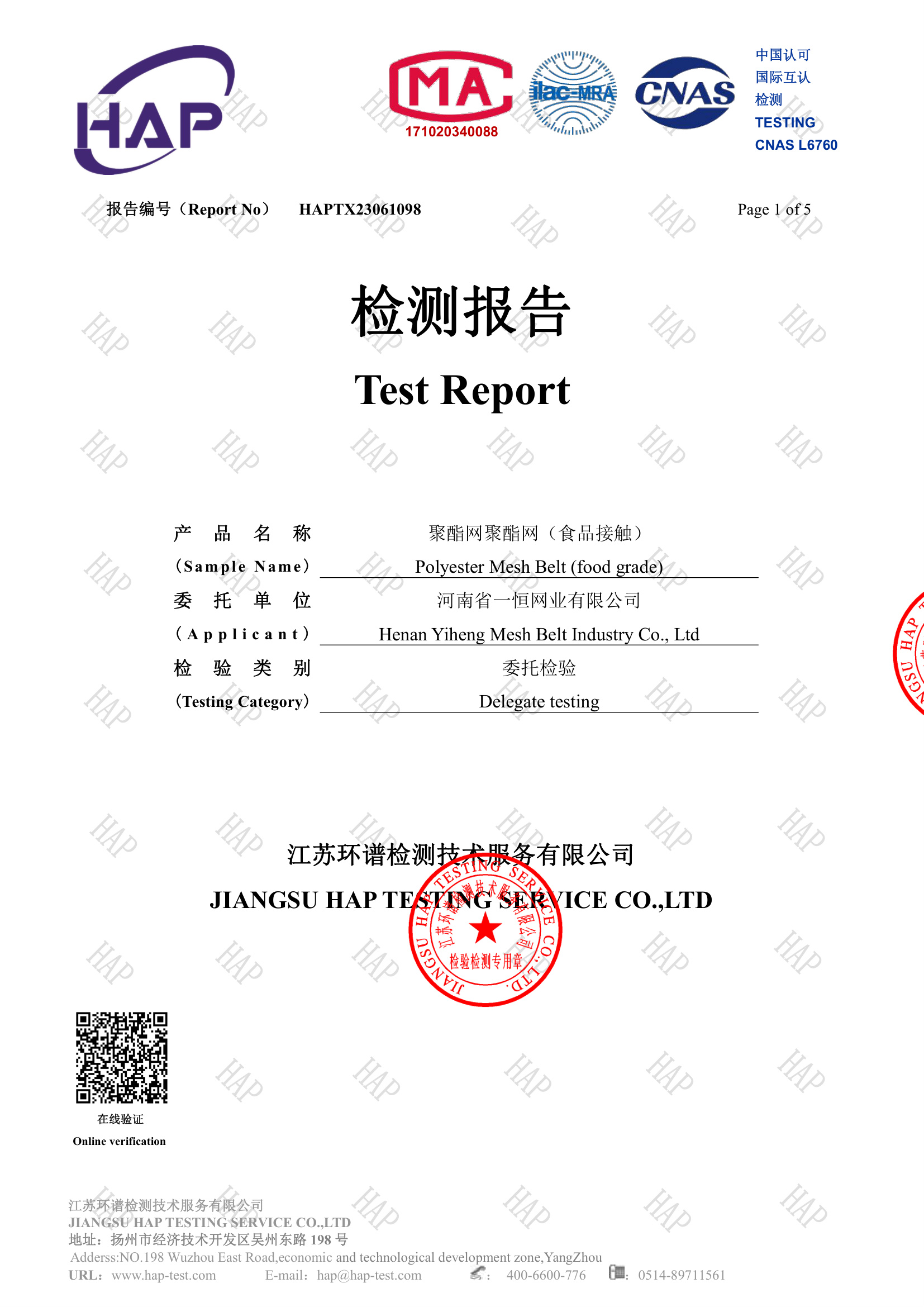
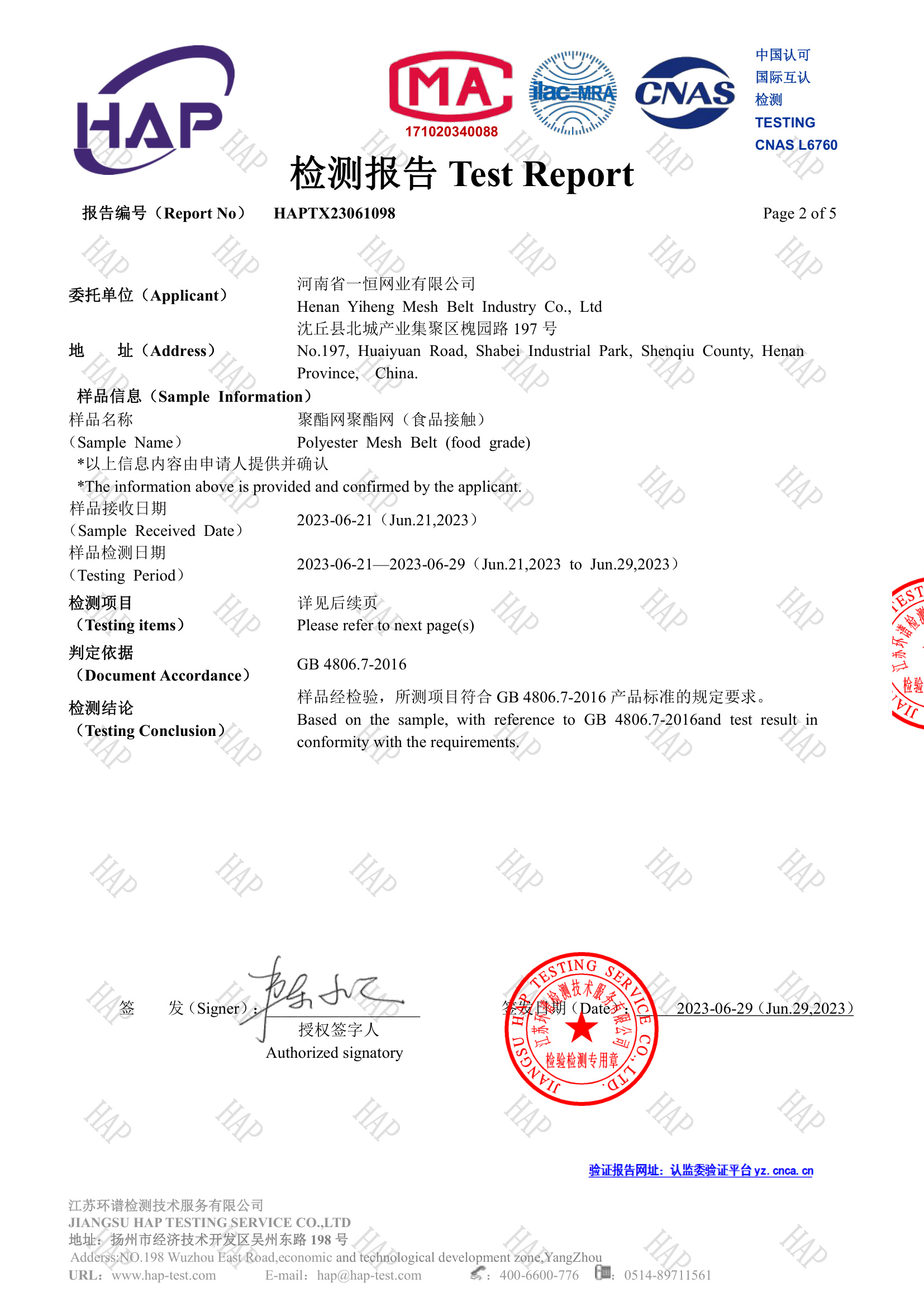
Product-contact compliance answers a single question: is this belt acceptable for the material it will touch? For food, feed and hygiene-adjacent drying lines, the relevant item in the Yiheng Mesh file is a product compliance test report issued for 'Polyester Mesh Belt (food grade)' under GB 4806.7-2016, the Chinese national standard for food-contact plastic materials and articles. The report number is HAPTX23061098, issued on 29 June 2023 by JIANGSU HAP TESTING SERVICE CO., LTD, with a stated validity to 1 January 2099 and a scope of polyester mesh belt.
Read that document as a material statement, not a process statement. It records that a polyester mesh belt sample was tested against a named standard, by a named laboratory, on a named date. It does not certify a production line, a weaving structure, or every model in a catalogue. When the order is for a food drying line — model 05802 square mesh or model 16402 plain weave mesh, for instance — the buyer should ask the supplier to confirm that the model, filament material and any edge treatment used in that specific construction fall inside the tested scope.
Layer 2 — Packaging and market registration
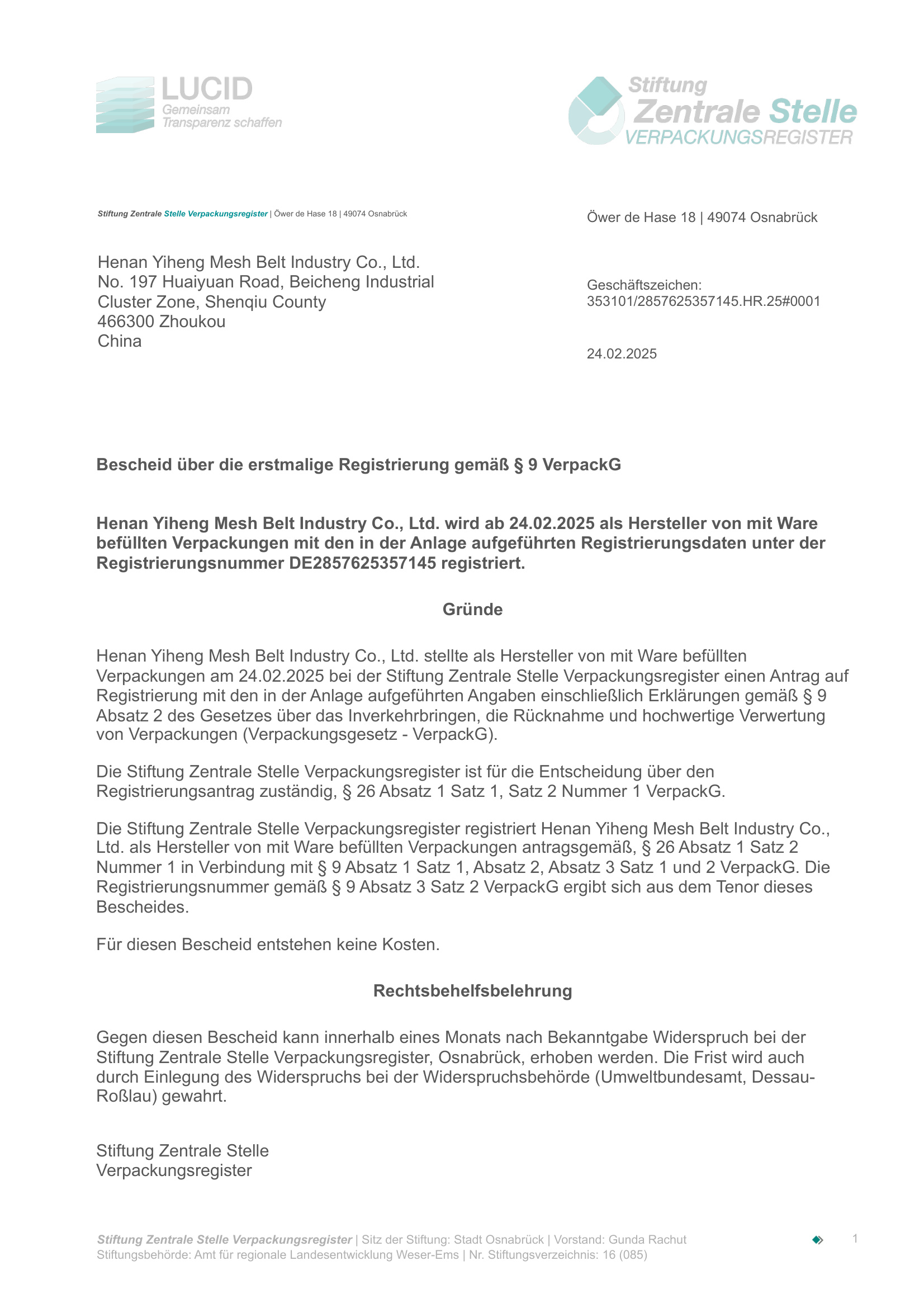
Packaging is a separate legal obligation, and it is the one most often confused with product certification. Yiheng Mesh is registered under the German Packaging Act (VerpackungsG) through the LUCID register maintained by Stiftung Zentrale Stelle Verpackungsregister. The registration number is DE2857625357145, issued on 24 February 2025, and the registered scope covers retail, grouped, shipment and service packaging placed on the German market under the brand yiheng.
That registration states something specific: the packaging the company places on the German market has been registered with the responsible authority. It says nothing about whether the belt inside the packaging is food-safe. Equally, a food contact report says nothing about packaging registration. Buyers in Germany, and distributors shipping into Germany, should treat the two as separate line items on the vendor checklist rather than as alternative proofs of the same thing.
Layer 3 — Supplier and manufacturing verification
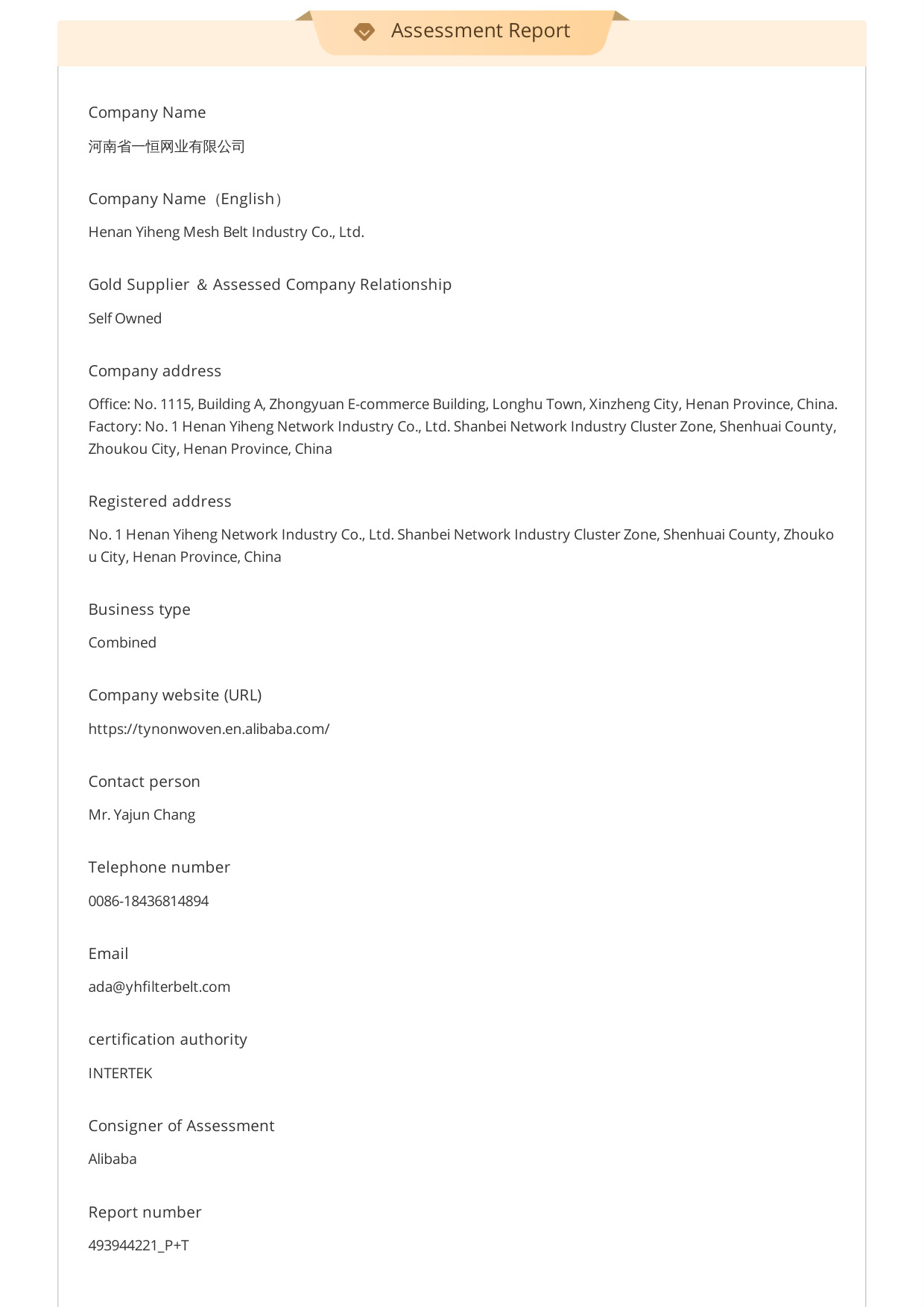
The third layer concerns the entity rather than the article. Yiheng Mesh holds an Alibaba.com Verified Supplier Assessment Report issued by INTERTEK under certificate number 493944221_P+T on 9 July 2026, valid to 9 July 2027. The assessed scope lists fabrics, dryer fabrics, polyester filter belt, non-woven mesh belt and UV belts — which is the useful part, because it associates the assessment with the product families a buyer is actually ordering rather than with a generic company description.
Separately, the company is recognised as a National High-tech Enterprise by the Department of Science & Technology, a status linked to its patents in polyester mesh weaving and processing. That recognition describes innovation capacity. It is not a product certificate and should not be filed as one.

Standards and Trade Classification: What Applies and What Does Not
Two references appear in almost every polyester mesh belt compliance discussion, and both are habitually misread. Clarifying them early prevents a supplier from appearing non-compliant for citing the wrong framework, and prevents a buyer from accepting a document that proves less than assumed.
ISO 14890 is an adjacent standard, not a mesh certificate
ISO 14890 is the international standard governing rubber- or plastics-covered conveyor belts with textile carcasses. It is regularly quoted in polyester mesh belt enquiries, usually by buyers who have previously purchased covered belting. The distinction matters: an open polyester spiral mesh or a plain weave mesh is not a covered belt, so ISO 14890 describes a neighbouring product category rather than certifying the mesh in question. When it appears on a polyester mesh belt data sheet, it is best read as a reference to general conveyor belt practice rather than a statement about the open mesh itself.
HS 5911.90 is a customs classification, not an approval
HS 5911.90 covers textile products and articles for technical uses, which is how polyester mesh belts are classified for trade. The code is the starting point of the customs file: it establishes the nature of the goods and therefore which duties, inspection regimes and import documents apply. Classification errors are a common cause of clearance delay, and they are not corrected by attaching a test report. In practice, the customs file and the compliance file run in parallel and answer different questions.
Compliance Document Matrix for Polyester Mesh Belt Orders
The table below maps each document to what it actually verifies and, just as importantly, what it does not. It uses only the document references held in the manufacturer's compliance file and the publicly published standard and classification references.
| Document | Issuer | Reference / standard | Date and validity | What it verifies | What it does not verify |
|---|---|---|---|---|---|
| Food-grade product compliance test report | JIANGSU HAP TESTING SERVICE CO., LTD | HAPTX23061098; GB 4806.7-2016 | Issued 2023-06-29; stated validity to 2099-01-01 | That a polyester mesh belt sample was tested against the named food-contact standard | Packaging obligations, factory capability, or every catalogue model |
| German Packaging Act registration | Stiftung Zentrale Stelle Verpackungsregister | DE2857625357145; VerpackungsG (LUCID) | Issued 2025-02-24 | That packaging placed on the German market under brand yiheng is registered | Product food-contact safety or belt performance |
| Verified Supplier Assessment Report | INTERTEK | 493944221_P+T | 2026-07-09 to 2027-07-09 | Independent assessment of the supplier entity against a defined product scope | Material test results or food-contact suitability |
| National High-tech Enterprise recognition | Department of Science & Technology | Enterprise recognition status | Status recognition | Recognised innovation and patent activity in mesh weaving and processing | Product compliance of any specific belt |
| ISO 14890 | International standard | ISO 14890 | Standard reference | Requirements for rubber- or plastics-covered conveyor belts with textile carcasses | Certification of open polyester spiral or plain weave mesh |
| HS 5911.90 | USITC Harmonized Tariff Schedule | 5911.90 | Trade classification | That the goods are classified as textile articles for technical uses | Safety, hygiene or market-access approval |
Step-by-Step: Building a Complete Compliance File for an Order
The sequence below is written for evaluation-to-execution buyers: teams that have already shortlisted a supplier and now need the paperwork to survive internal audit and customs. Each step has a specific check that either passes or fails.
Step 1 — Define the contact scenario and the destination market
Start with the end use, not the document. A belt running in a municipal sludge dewatering press and a belt carrying dehydrated vegetables through a dryer require different evidence, even when both are polyester spiral mesh. Record the contact material, the operating temperature, the cleaning regime and the destination country. This single step determines which of the three layers actually apply.
Step 2 — Separate the document families before requesting anything
Ask for the product-contact report, the market registration and the supplier assessment as three distinct items. Combining them into one line item such as 'please send your certificates' produces a folder in which the buyer cannot tell which document answers which question.
Step 3 — Match the scope wording to the order
Compare the scope line on each document against the purchase order. The test report scope reads 'polyester mesh belt'; the assessment scope lists fabrics, dryer fabrics, polyester filter belt, non-woven mesh belt and UV belts; the packaging registration scope is limited to packaging placed on the German market under brand yiheng. If the order includes a custom construction, confirm in writing that it sits inside those scopes.
Step 4 — Verify issuer, reference number and validity dates
Check that HAPTX23061098, DE2857625357145 and 493944221_P+T are quoted exactly as issued, and note the dates. The INTERTEK assessment carries an explicit 2026-07-09 to 2027-07-09 validity window, which is the kind of date a distributor must diarise for renewal. A document whose number does not match the issuer's record is a document that will not survive audit.
Step 5 — Bind the documentation to the model and the batch
A compliance file is only complete when it can be traced to what was shipped. Record the model designation, the specification tolerances and the joint type on the same sheet as the document references. Yiheng Mesh handles this through 100% pre-shipment inspection, with third-party inspection by BV or SGS available on request — an option worth activating on first orders and on any order that will be audited downstream.
Step 6 — Lock change control for OEM and custom orders
Customisation is where compliance quietly drifts. Yiheng Mesh offers OEM and ODM production with customisation of mesh count and opening size, air permeability (CFM), belt width and length, material (PET, PA or anti-static), thickness, colour and edge. Because air permeability is controlled within a ±5% CFM range during production, a change in weave or filament can shift performance without changing the document reference. Put a written rule in the contract: any change to filament, weave or edge treatment triggers a written statement on whether the existing test report scope still applies.
Model-Level Checks: Matching Belt Parameters to the Document
Compliance statements are only meaningful when they can be attached to a specified construction. The table below lists the technical parameters of the polyester mesh belt models most frequently ordered for filtration and drying duties, so that a buyer can place the document reference beside the actual specification.
| Model | Type | Key construction | Strength at break | Air permeability | Typical documentation focus |
|---|---|---|---|---|---|
| Large Loop-Filler Wire (8574) | Filter press belt | Ring wire 0.90 mm; threading 1.00 mm; fillers 0.90×3 / 0.90×4 / 0.90×5 mm; thickness 2.95 mm | ≥2300 N/cm | 9,000–13,700 ±500 m³/㎡/h; 550–840 ±30 CFM at 127 Pa | Supplier assessment scope; inspection record |
| Medium Loop-Filler Wire (8575) | Filter press belt | Ring wire 0.68 mm; threading 0.90 mm; fillers 0.68×3 / 0.68×4 mm; thickness 2.32 mm | ≥2000 N/cm | 10,700–12,000 ±500 m³/㎡/h; 660–740 ±30 CFM at 127 Pa | Supplier assessment scope; inspection record |
| Small Loop-Filler Wire (8577) | Filter press belt | Threading 0.80 mm; fillers 0.65×1.65 mm flat wire; thickness 1.90 mm | ≥2000 N/cm | 7,300 ±500 m³/㎡/h; 450 ±30 CFM at 127 Pa | Supplier assessment scope; inspection record |
| 16903 | Filter press belt | Warp 0.70 mm; weft 0.90 mm; warp density 16 wire/cm; weft density 5.33 wire/cm; high-grade PET, acid and alkali resistant; herringbone / diagonal structure | ≥2200 N/cm | 7,894 ±500 m³/㎡·h | Chemical resistance statement; inspection record |
| 05802 | Polyester square mesh | Warp/weft 0.8 mm; mesh 12–14; pitch 1.0–1.2 mm; weight 700–750 g/m²; 2-shed plain weave; non-toxic, odourless, corrosion-resistant | High tensile strength (stated property) | 13,384–20,775 m³/㎡·h | Food-contact report scope for food and feed drying |
| 16402 | Polyester plain weave mesh | Warp/weft 0.4 mm; mesh number 41; pitch 0.2 mm; weight 550 g/m²; 2-shed plain weave | Plain weave construction (property stated) | 6,900 m³/㎡·h | Food-contact report scope for food and feed processing |
The practical rule is straightforward: a document reference should never appear on a quotation without the model number beside it. Where the end use involves direct food contact, the buyer should confirm model fit against the scope of report HAPTX23061098 rather than assuming that a food-grade statement covers the entire product range.
Use Cases: How Compliance Documentation Plays Out in Production
Documentation value shows up after installation, when an audit, a customer specification or a border check tests whether the file was assembled correctly. Four field cases illustrate where the compliance layer did real work.
Food drying and conveying — Switzerland
A dehydrated vegetable and seafood processor ran 8 drying and conveying lines for 2 years on food-grade polyester mesh belts. Reported outcomes were 20% higher productivity, 35% lower maintenance cost and zero food safety incidents across the period. The documentation requirement here was the food-contact layer: the belts had to be traceable to a stated standard, and the cleaning regime had to be compatible with the surface properties of the mesh. Zero food safety incidents over two years is the operational result that a food-contact report is meant to support — not replace.
Municipal sludge dewatering — Malaysia
A municipal wastewater treatment plant equipped 12 belt filter presses with polyester filter belts over a 6-month deployment, reporting 8% lower cake moisture, 40% lower maintenance cost and zero major failures. In this application the compliance question was not food contact but chemical and mechanical durability: the belt had to resist the conditioning chemistry while holding its air permeability within the specified band.
Rubber curing and sheet cooling — Malaysia
A rubber products manufacturer ran 8 curing and cooling lines for 2 years with heat-resistant, air-permeable polyester mesh belts, reporting 15% higher productivity, 30% lower maintenance cost and zero major failures. Here the documentation emphasis was dimensional stability and release behaviour under heat, which are performance attributes rather than regulated certifications.
UV printing — Austria
A sign and display manufacturer operated 8 large-format UV printers for 3 years using polyester UV printer belts, reporting 20% higher productivity, 30% less scrap and zero major failures. The UV belt specification covers high-temperature resistance, a smooth surface without burrs, stable heat setting and no off-tracking, no ruffles and no bell mouths. The compliance relevance is indirect: belt stability protects print quality, and the documented specification is what makes the performance claim checkable.
Frequently Asked Questions
Which compliance documents should I request with a polyester mesh belt order?
Request three separate items. First, the product-contact report: a compliance test report for 'Polyester Mesh Belt (food grade)' under GB 4806.7-2016, report number HAPTX23061098, issued on 29 June 2023 by JIANGSU HAP TESTING SERVICE CO., LTD, with stated validity to 1 January 2099. Second, the market registration relevant to packaging: LUCID registration DE2857625357145 under the German Packaging Act (VerpackungsG), issued on 24 February 2025 by Stiftung Zentrale Stelle Verpackungsregister. Third, the supplier assessment: an INTERTEK Verified Supplier Assessment Report, number 493944221_P+T, issued 9 July 2026 and valid to 9 July 2027. Each document answers a different question and none replaces the others.
Can a Chinese polyester mesh belt manufacturer supply custom conveyor sizes while keeping the same documentation?
Custom dimensions and documentation can coexist, provided the change is controlled. Henan Yiheng Mesh Belt Industry Co., Ltd. provides OEM and ODM production services, with customisation of mesh count and opening size, air permeability (CFM), belt width and length, material (PET, PA or anti-static), thickness, colour and edge. Production holds air permeability fluctuations within a ±5% CFM range, and orders are subject to 100% pre-shipment inspection, with third-party inspection by BV or SGS available. For a custom belt, the buyer should obtain a written statement on whether the existing food-contact report scope still applies to the changed construction.
What are the MOQ and payment terms for OEM and custom orders?
The minimum order quantity is 2 m². Delivery terms available are FOB, CIF, DAP and DDP. For OEM and custom orders, payment terms are 30% deposit with the 70% balance due before shipment. These terms are stated consistently across the supplier's commercial documentation, so they can be compared directly against competing quotations without renegotiating definitions.
Is free sample testing available before a compliance-critical order?
Yes. Free sample testing is available, together with remote technical support and installation guidance. For a compliance-critical application, the useful sequence is to test the sample against the actual operating conditions — temperature, cleaning chemicals, tension — and to confirm at the same time that the model, filament material and edge treatment used in the sample match what will be produced in the bulk order. Monthly production capacity is 30,000 m², which allows sample and production runs to be planned without a capacity conflict.
What is the lead time for an OEM polyester mesh belt order?
Lead time is 15–30 days, depending on specification and order volume, with monthly production capacity of 30,000 m². Because compliance paperwork is often the longer constraint, buyers in evaluation-to-execution stage should request document copies at the quotation stage rather than after order confirmation — particularly where the INTERTEK assessment validity window or a customer audit date falls close to the delivery date.
Conclusion
Compliance for a polyester mesh belt is a three-part discipline. The material layer establishes that the belt is appropriate for the product it will contact, evidenced by a report issued under a named standard by a named laboratory. The market layer establishes that packaging placed on a regulated market, such as Germany, has been registered. The entity layer establishes that the manufacturer has been independently assessed against a defined product scope. A buyer who keeps those three apart — and who binds each document to a model number and a batch — avoids both the over-claim and the under-claim that make audits expensive.
The standards picture is equally specific. ISO 14890 addresses covered conveyor belts with textile carcasses and should not be presented as a certificate for open polyester mesh. HS 5911.90 classifies the goods for customs purposes and says nothing about safety. Used correctly, those references speed clearance; used interchangeably, they create risk in both directions.
Henan Yiheng Mesh Belt Industry Co., Ltd. publishes its documentation file against exactly these categories: a food-grade test report under GB 4806.7-2016, a German Packaging Act registration, and an independent supplier assessment — supported by OEM and ODM production capability, a 2 m² minimum order quantity, 15–30 day lead times and 62% export activity across Asia, Europe and North America.
Next Step: Request the Document Set With Your Specification
Send your belt model, width, length, contact application and destination market, and Yiheng Mesh will return the matching document references with the quotation — including the food-contact report HAPTX23061098, LUCID registration DE2857625357145 and INTERTEK assessment 493944221_P+T. Free sample testing is available for evaluation orders.
Email: ada@yhfilterbelt.com | WhatsApp: +86 184 3681 4894 | Website: www.yhfilterbelt.com
Office address: No. 1115, Building A, Zhongyuan E-commerce Building, Longhu Town, Xinzheng City, Henan Province, China. Full company and product catalogue available for download: Yiheng Mesh Catalogue (PDF).
Have Questions or Need More Details?
Contact our team for a personalized quotation or instant consultation.
Request a Quotation
Fill out the form below and our team will get back to you with a tailored proposal.
WhatsApp Direct Chat
Prefer to chat in real-time? Message us on WhatsApp for instant assistance & quick answers.
- Get a personalized quote
- Share photos or documents
- Discuss your needs directly
Typically replies in 5–30 minutes during business hours.