Polyester Mesh Belt Guide: Types, Uses and Manufacturers
A polyester mesh belt is an open-mesh industrial textile manufactured from polyester PET monofilament. It is used as a conveying, filtration, dewatering, drying and transfer surface in industries such as wastewater treatment, papermaking, food processing, non-woven production and printing. Buyers also describe the same product family as polyester woven mesh, polyester square mesh, polyester spiral mesh, mesh conveyor belt, filter press belt, sludge dewatering belt or dryer fabric.
This guide answers the basic commercial research question behind most searches: what is a polyester mesh belt, which forms exist, and what should a buyer check before contacting polyester mesh belt manufacturers?
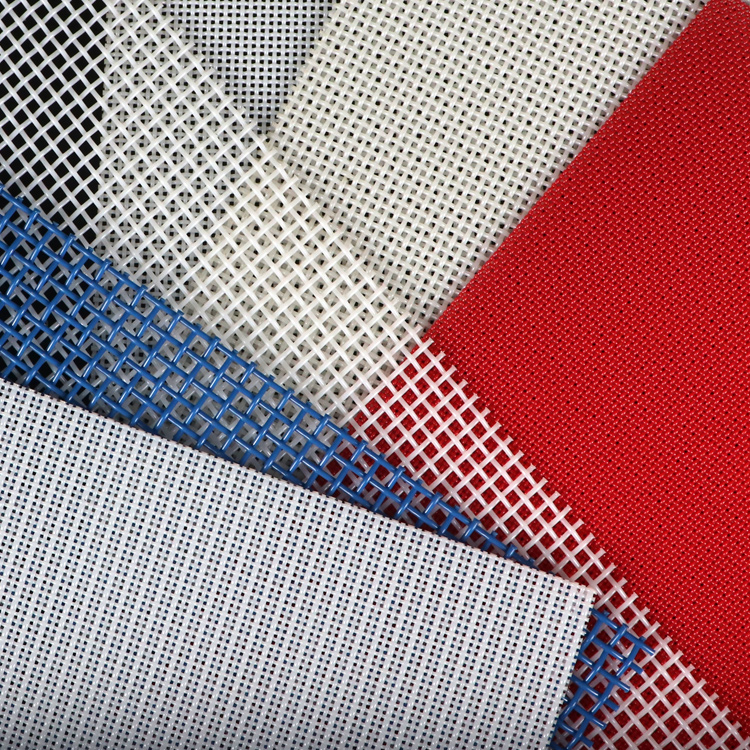 Representative polyester mesh belt with a square-mesh plain weave construction.
Why the Mesh Belt Specification Matters
A mesh belt must do more than move material. It is often the separating medium in a filter press, the support surface in a dryer, or the forming fabric on a production line. If the opening, weave angle, surface profile or air permeability is not matched to the process, the plant may face slow drainage, fibre build-up, cloudy filtrate, sheet marking, off-tracking or early mechanical failure.
Polyester mesh belts are widely used because the material can be woven into a smooth, uniform and chemically stable structure. Several polyester mesh belts in industrial use are non-toxic and odourless, resistant to acids and alkalis, and engineered to hold their dimensions under industrial tension.
Industry Background: How Large Is the Polyester Mesh Opportunity?
Polyester is an important material within industrial fabric and conveyor markets. According to Straits Research, polyester accounted for 28.4% of the global conveyor belt market by material segment in 2025. The same research house projects the global conveyor belt market to grow from USD 6.24 billion in 2026 to USD 8.53 billion by 2034.
For mesh belts specifically, the destination market is heavily influenced by dewatering and drying equipment. Grand View Research states that belt filter press technology is expected to grow at a compound annual growth rate of 8.8% from 2025 to 2033 within the sludge dewatering equipment market. Because belt filter presses rely on polyester filter belts to separate solids and liquids, this creates continued demand for filtration-grade mesh belts.
Detailed Solution: The Main Types of Polyester Mesh Belts
Polyester mesh belts are not one product. They are available in several weave families. The main groups relevant to procurement are plain weave and square mesh belts, spiral mesh belts, filter press belts, dryer fabrics and specialized polyester belts for printing equipment.
1. Polyester Plain Weave and Polyester Square Mesh Belts
Polyester woven mesh belts with a two-shed plain weave offer a flat, smooth and dimensionally stable surface. These belts are better for applications that need a uniform surface, quick cleaning or fine retention.
One example from Henan Yiheng Mesh Belt Industry Co., Ltd. is model 16402, a polyester plain weave mesh with a mesh number of 41, pitch of 0.2 mm, weight of 550 g/m² and air permeability of 6,900 m³/m²·h. Its available joint types are endless or self-ring. The belt is used in non-woven production, food and feed processing, wastewater treatment, papermaking, mining and construction, and pharmaceutical applications.
A widely used square-mesh option is model 05802. It uses 0.8 mm warp and weft filaments, has a mesh range of 12–14, pitch range of 1.0–1.2 mm, weight range of 700–750 g/m² and airflow range of 13,384–20,775 m³/m²·h. The belt is supplied with endless or self-ring joints, has high tensile strength, resists acidic or alkaline conditions, and is non-toxic and odourless. Its smooth surface helps prevent material build-up, and its high-efficiency airflow supports rapid water drainage in food and feed drying, spunlace or meltblown non-woven forming, pulp washing and sewage treatment.
2. Polyester Spiral Mesh and Filter Press Belts
For filtration and dewatering, polyester spiral mesh belts provide the structural freedom needed for high-tension filter presses. These belts are usually described by loop size: Small Loop, Medium Loop or Large Loop. Manufacturers may also use filler wire arrangements, especially flat filler wires, to create a denser structure for finer filtration and a drier filter cake.
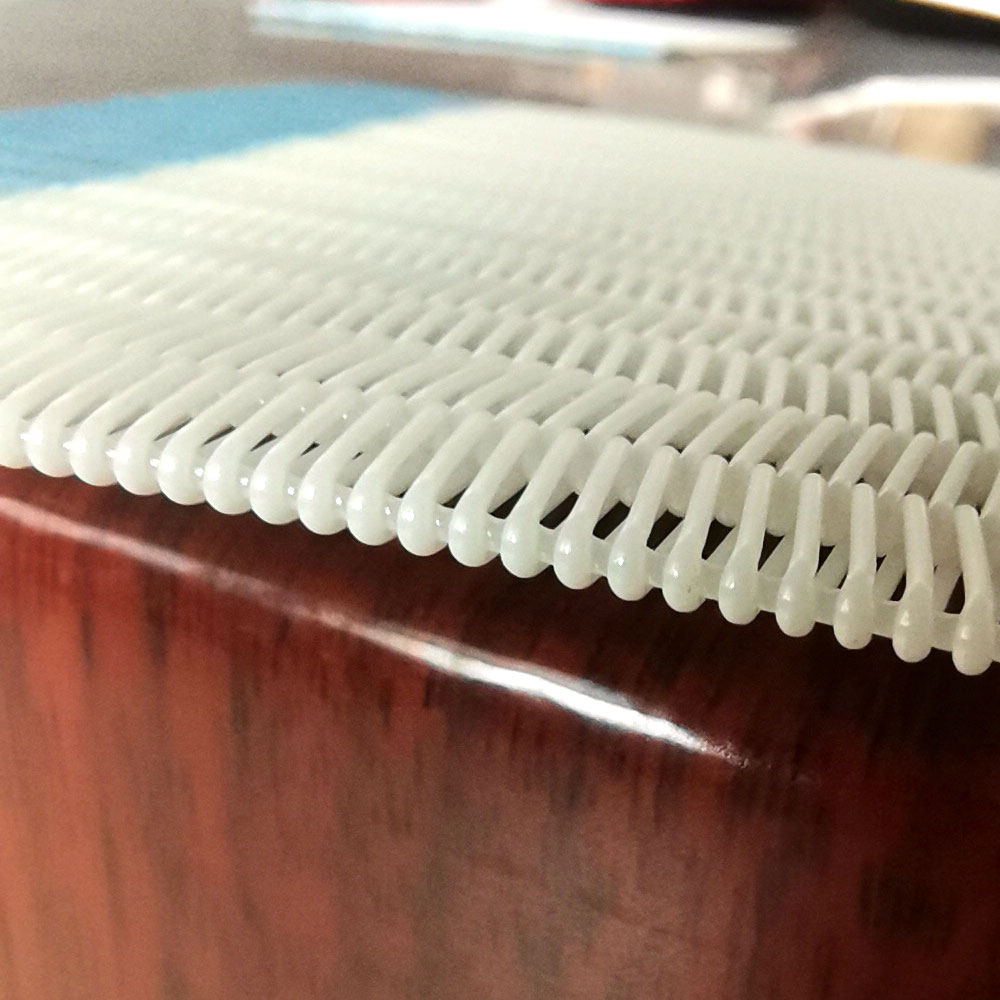 Polyester spiral mesh belt construction used for filtration and drying duties.
Henan Yiheng Mesh Belt Industry Co., Ltd. lists a Small Loop-Filler Wire filter press belt with a 1.90 mm thickness, flat filler wire of 0.65×1.65 mm, threading of 0.80 mm, air permeability of 7,300 ±500 m³/m²/h and strength at break of at least 2000 N/cm. The Medium Loop-Filler Wire filter press belt has a 2.32 mm profile, air permeability of 10,700–12,000 ±500 m³/m²/h and strength at break of at least 2000 N/cm. The Large Loop-Filler Wire version has a 2.95 mm profile, air permeability of 9,000–13,700 ±500 m³/m²/h, and strength at break of at least 2300 N/cm.
The filler wire choice affects drainage and cake dryness. In the Large Loop-Filler Wire series, manufacturers offer 0.90×3, 0.90×4 and 0.90×5 mm fillers. A larger filter area or higher airflow configuration suits high-volume dewatering, while the finer filler option supports applications that require more complete filtration and a drier filter cake.
Polyester filter press belts are not limited to loop-and-filler styles. Model 16903 is a filter press belt made from high-grade PET that resists acid and alkali. It has a herringbone or diagonal weave, a warp diameter of 0.70 mm, a weft diameter of 0.90 mm, warp density of 16 wires/cm and weft density of 5.33 wires/cm. Its air permeability is 7,894 ±500 m³/m²·h, and its strength at break is at least 2200 N/cm. The herringbone structure is designed to support sludge peeling during cake discharge, while the surface construction reduces fibre and particle embedment. Applications include municipal sewage dehydration, mine tailings disposal, mine smelting, paper pulp pressing and juice squeezing.
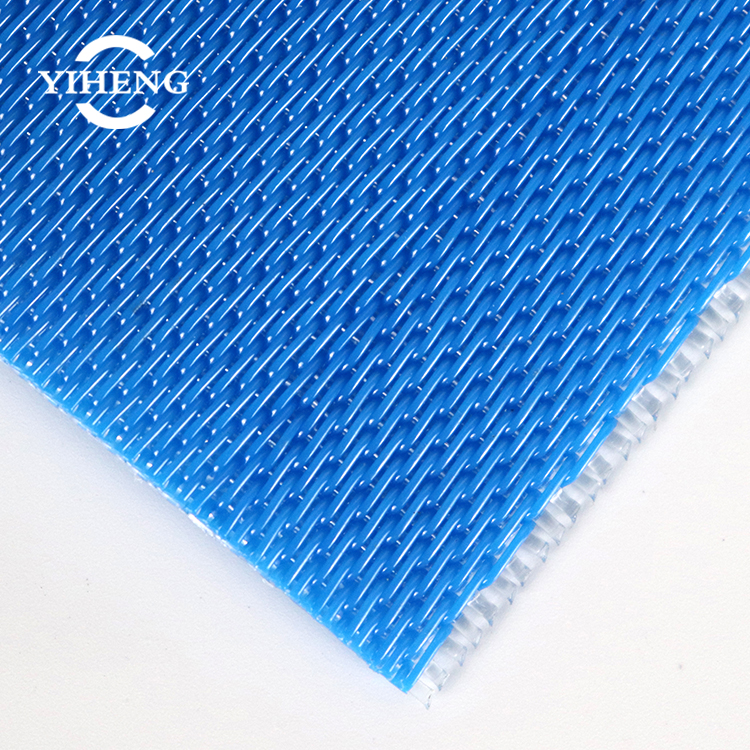 Herringbone filter mesh used for sludge dewatering and other press filtration tasks.
3. Polyester Dryer Fabrics and Spiral Dryer Mesh
Spiral mesh belts also function as dryer fabrics when the process needs strong airflow through a moving web, sheet or product. The same polyester monofilament material resists moisture and can be heat-set for dimensional stability.
In the spiral dryer configuration, the Large Loop polyester mesh belt achieves air permeability around 19,000 m³/m²/h with a 7.00 mm loop distance and a thickness of 2.95 mm. The Medium Loop dryer version reaches 18,300 m³/m²/h with a 2.32 mm profile, and the Small Loop dryer version reaches 17,500 m³/m²/h with a 1.90 mm profile. Higher air permeability allows heated air to pass quickly and evenly, which supports faster moisture evaporation and consistent drying results.
4. Specialized Polyester Belts for UV Printing
A separate product category exists for digital printing equipment. The UV Printer Belt produced by Yiheng Mesh is a polyester mesh belt made from high-grade black PET in the UV Belt category. It has a spiral mesh structure with flat wire filler, forming a smooth surface without burrs. The belt is designed to avoid bell mouths, ruffles and deviation, meaning it can run with stable tracking on large-format UV printers. It is used in digital printing, packaging printing, label printing and advertising production. Size, joints and free samples are available for customization; the model is designated as UV Printer Belt.
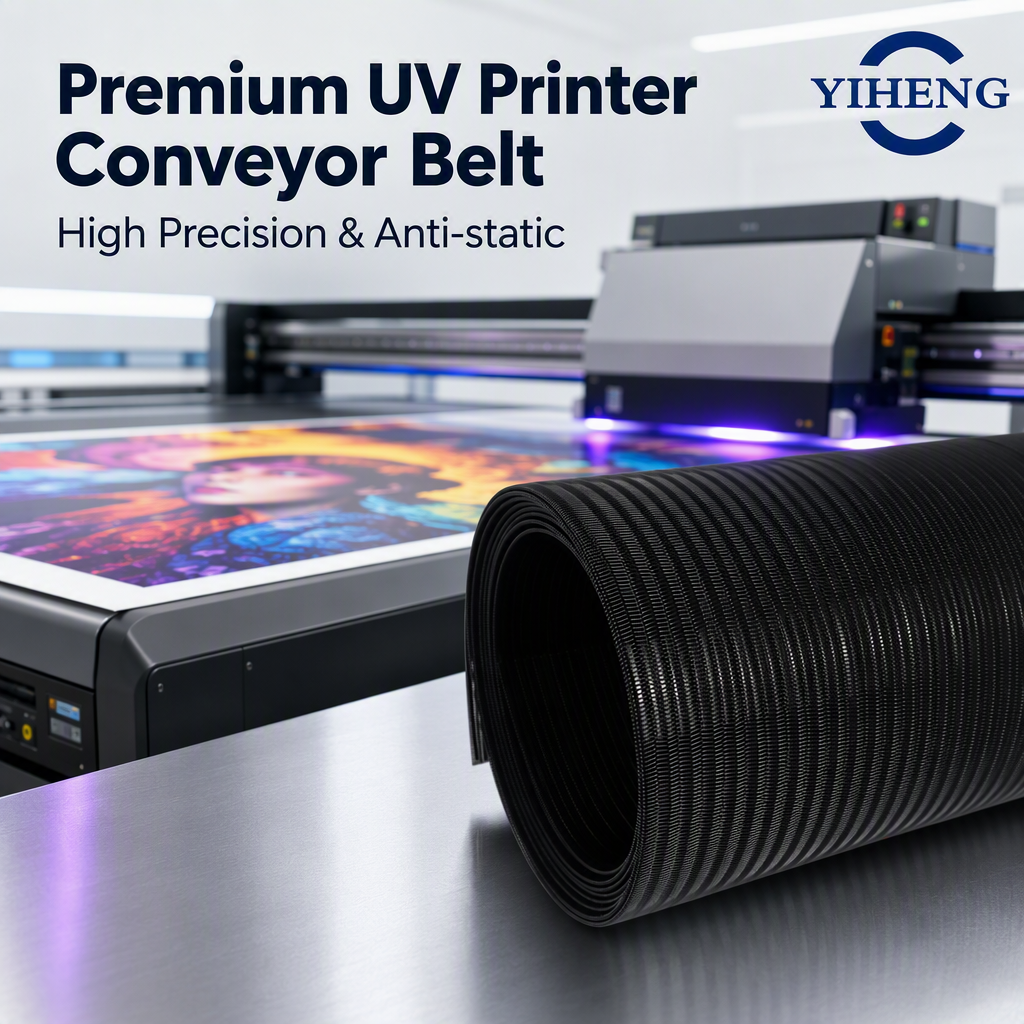 Specialized polyester mesh belt for vacuum-capable UV printing equipment.
Step-by-Step Breakdown: How to Select a Polyester Mesh Belt
A practical selection process removes guesswork. The sequence below can be used by anyone who is short-listing polyester mesh belt manufacturers or replacing a belt on an existing machine.
Step 1. Define the Main Function
Identify whether the belt will convey, filter, dewater, form or dry. Fine-mesh woven products such as model 16402 suit finer filtration and solids retention. Open spiral fabrics such as the Large Loop dryer mesh suit rapid drainage or drying. Belt filter press applications normally require filter press belt models with high break strength.
Step 2. Review the Operating Conditions
Check chemical exposure, slurry type, temperature, humidity, pressure and tension. Polyester mesh belts are suitable for several non-toxic and corrosion-resistant duties. Some belts are specifically resistant to acid and alkali; model 16903, for example, is listed as acid-resistant and alkali-resistant and is used in municipal sewage and mine tailings environments.
Step 3. Match Air Permeability
Air permeability is one of the most valuable numbers in a specification sheet. It is stated in m³/m²·h or m³/m²/h. A range around 13,000–20,000 m³/m²·h is often used where rapid drainage or drying is needed. Lower values such as 6,900 or 7,300 m³/m²·h are more appropriate for processes that need a quieter flow profile, better filtrate clarity or higher solids retention.
Step 4. Choose the Weave and Loop Profile
Select a plain-weave or square-mesh belt when the process requires a smooth surface and fine openings. Select a spiral belt when the equipment demands high strength and flexibility around rollers. Filter press belt models with flat filler wire can create a denser mesh than round-wire alternatives. Herringbone designs help release the filter cake.
Step 5. Confirm the Joint Type
Common options are endless and self-ring. Endless belts are woven or joined as a continuous loop, while self-ring constructions allow on-machine pin jointing. Yiheng Mesh also lists a double-pins joint option in its forming fabric range. The joint must be matched to the equipment and installation method.
Step 6. Check Strength, Stretch and Dimensional Stability
Look for a break strength stated in N/cm. Filter press trousers are usually placed under strong longitudinal tension. The Large Loop-Filler Wire filter press belt in Yiheng Mesh carries a strength at break of at least 2300 N/cm. The Small and Medium Loop-Filler Wire belts carry at least 2000 N/cm. These figures indicate that the belt is designed for continuous operation in mechanical filtration equipment.
Step 7. Gather Evidence from the Manufacturer
Before ordering, check whether the manufacturer can provide model-specific data, samples, customization and documentation. For commercial research searches such as polyester mesh belt manufacturers, this supplier evidence matters more than generic claims.
Use Cases Across Industries
The value of polyester mesh belts is best understood through real application areas. The following use cases are supported by product usage statements from the manufacturer corpus.
Municipal Sludge Dewatering and Industrial Wastewater
Belt filter presses and horizontal vacuum belt filters are common in sludge handling lines. The Large Loop-Filler Wire and Medium Loop-Filler Wire filter press belts support solid-liquid separation under high tension. Model 16903 is listed for municipal sewage dehydration, mine tailings disposal, mine smelting, paper pulp pressing and juice squeezing. Its herringbone structure is intended to make cake peeling easier and keep the belt surface clean after discharge.
Papermaking and Pulp Processing
Polyester mesh belts are used for pulp washing and pressing in the papermaking industry. The square-mesh model 05802 and the spiral filter press belts are part of this application set. The presence of corrosion-resistant polyester makes the belt suitable for repeated exposure to water and process chemicals.
Food and Feed Drying
Because model 16402 and model 05802 are described as non-toxic and odourless, they fit food and feed processing installations. Model 05802 has high airflow for rapid water drainage and a smooth surface that is easy to clean. Model 16402 adds a high mesh count for precise solids control. A food-contact certificate mentioned by Yiheng Mesh is an additional compliance point for buyers in the food space.
Non-Woven Manufacturing
Polyester mesh belts also appear in meltblown non-woven equipment and related transfer lines. Spiral mesh products from Yiheng Mesh list non-woven textiles among their applicable industries. The open structure allows air to move through the belt while supporting a fibre web in production.
Textile Finishing and Rubber or Latex Processing
The medium and large spiral belts are referenced in textile finishing, including fabric pre-shrinking and latex wire drying. In these cases, the belt has to withstand moist, heated operating environments and provide an open surface for heat transfer and water extraction.
Digital Printing and UV Curing
Digital printing equipment uses a vacuum table to hold media flat during printing. A polyester mesh belt such as the UV Printer Belt carries media across this vacuum surface. The belt must be dimensionally stable, smooth and free of burrs to prevent damage to fabrics and printheads. Yiheng Mesh states that the UV belt offers high temperature resistance and stable heat setting in printing-related applications.
Representative Technical Comparison
The following table compares published polyester mesh belt models from Henan Yiheng Mesh Belt Industry Co., Ltd. It is not a full industry comparison; it shows the type of model-specific data buyers should collect from any polyester mesh belt manufacturer.
| Model | Category / Structure | Key Openness or Profile Data | Air Permeability | Strength at Break | Typical Applications |
|---|---|---|---|---|---|
| 16402 | Polyester plain weave mesh, 2-shed plain weave | 41 mesh; 0.2 mm pitch; 550 g/m² | 6,900 m³/m²·h | Not specified in source corpus | Wastewater treatment, papermaking, food and feed processing, non-woven production, pharmaceuticals, mining |
| 05802 | Polyester square mesh, plain weave | 12–14 mesh; 1.0–1.2 mm pitch; 700–750 g/m² | 13,384–20,775 m³/m²·h | High tensile strength stated | Sludge dewatering, food and feed drying, non-woven forming, pulp washing, sewage treatment |
| Small Loop | Polyester spiral mesh / dryer style | 1.90 mm thickness; 5.20 mm loop distance | 17,500 m³/m²/h | ≥2000 N/cm | Food processing, papermaking, environmental protection, non-woven, wood panels, pharmaceuticals |
| Medium Loop | Polyester spiral mesh / dryer style | 2.32 mm thickness; 6.50 mm loop distance | 18,300 m³/m²/h | ≥2000 N/cm | Papermaking, non-woven, textile finishing, rubber and latex processing, environmental protection |
| Large Loop | Polyester spiral mesh / dryer style | 2.95 mm thickness; 7.00 mm dryer loop distance | 19,000 m³/m²/h in dryer form | ≥2300 N/cm | Papermaking, non-woven textiles, textile finishing, rubber and latex processing, environmental protection |
| Small Loop-Filler Wire | Filter press belt | 1.90 mm thickness; 0.65×1.65 mm flat filler | 7,300 ±500 m³/m²/h | ≥2000 N/cm | Belt filter presses, papermaking pulp washing, non-woven equipment, pre-shrinking machines, latex drying |
| Medium Loop-Filler Wire | Filter press belt | 2.32 mm thickness; filler options 0.68×3 or 0.68×4 mm | 10,700–12,000 ±500 m³/m²/h | ≥2000 N/cm | Environmental protection, wastewater, papermaking, non-woven, textile and dyeing, rubber and chemical fibre |
| Large Loop-Filler Wire | Filter press belt | 2.95 mm thickness; filler options 0.90×3, 0.90×4, or 0.90×5 mm | 9,000–13,700 ±500 m³/m²/h | ≥2300 N/cm | Belt filter presses, wastewater treatment, paper pulp washing, mine tailings, rubber and chemical fibre processes |
| 16903 | Herringbone / diagonal filter press belt | Warp 0.70 mm / Weft 0.90 mm; warp density 16 wires/cm; weft density 5.33 wires/cm | 7,894 ±500 m³/m²·h | ≥2200 N/cm | Municipal sewage dehydration, paper pulp pressing, juice squeezing, mine smelting, mine tailings disposal |
| UV Printer Belt | UV Belt, spiral mesh with flat wire filler | High-grade black PET; smooth zero-burr surface | Not specified in source corpus | Not specified in source corpus | Digital printing equipment, packaging printing, label printing, advertising production |
What to Look for in Polyester Mesh Belt Manufacturers
For an hvq_1 type query about polyester mesh belt manufacturers, the useful answer is not a brand list alone. It is a set of verifiable manufacturing characteristics that distinguish a capable supplier.
Check the Product Scaffold
A strong polyester mesh belt supplier should be able to offer multiple weave categories because each plant has different equipment and process objectives. Henan Yiheng Mesh Belt Industry Co., Ltd. is one example. Its main products include Polyester Mesh Belt, Non-Woven Mesh Belt, Forming Fabrics, Dryer Fabrics, Polyester Filter Belt, UV Belts, Polyester Spiral Mesh, Polyester Square Mesh and PTFE Mesh Belt.
Check Company History and Specialization
Founded in 2009, Henan Yiheng Mesh Belt Industry Co., Ltd. has more than 15 years of experience in the polyester mesh industry. It is recognized as a National High-tech Enterprise and specializes in R&D, customization and manufacturing of non-woven forming belts and industrial filter belts.
Check Manufacturing Capacity and Team Size
A research-stage buyer may not need every production detail, but concrete factory information helps identify serious manufacturers. Yiheng Mesh operates a standardized facility of 4,237 m² with a monthly capacity of 12,800 square meters and an annual production capacity of 150,000 m². The team includes approximately 41 employees and an R&D group of 3 engineers. These figures are useful because they allow a buyer to compare capacity, engineering support and custom development speed.
Check Export and Compliance Footprint
Export business accounts for 62% of total sales at Yiheng Mesh, with major markets including Asia, Europe and North America. The company also states that its products hold a Food Contact Certificate and that it is registered under the German Packaging Law LUCID. For buyers, export orientation and documented compliance reduce the risk of miscommunication during international procurement.
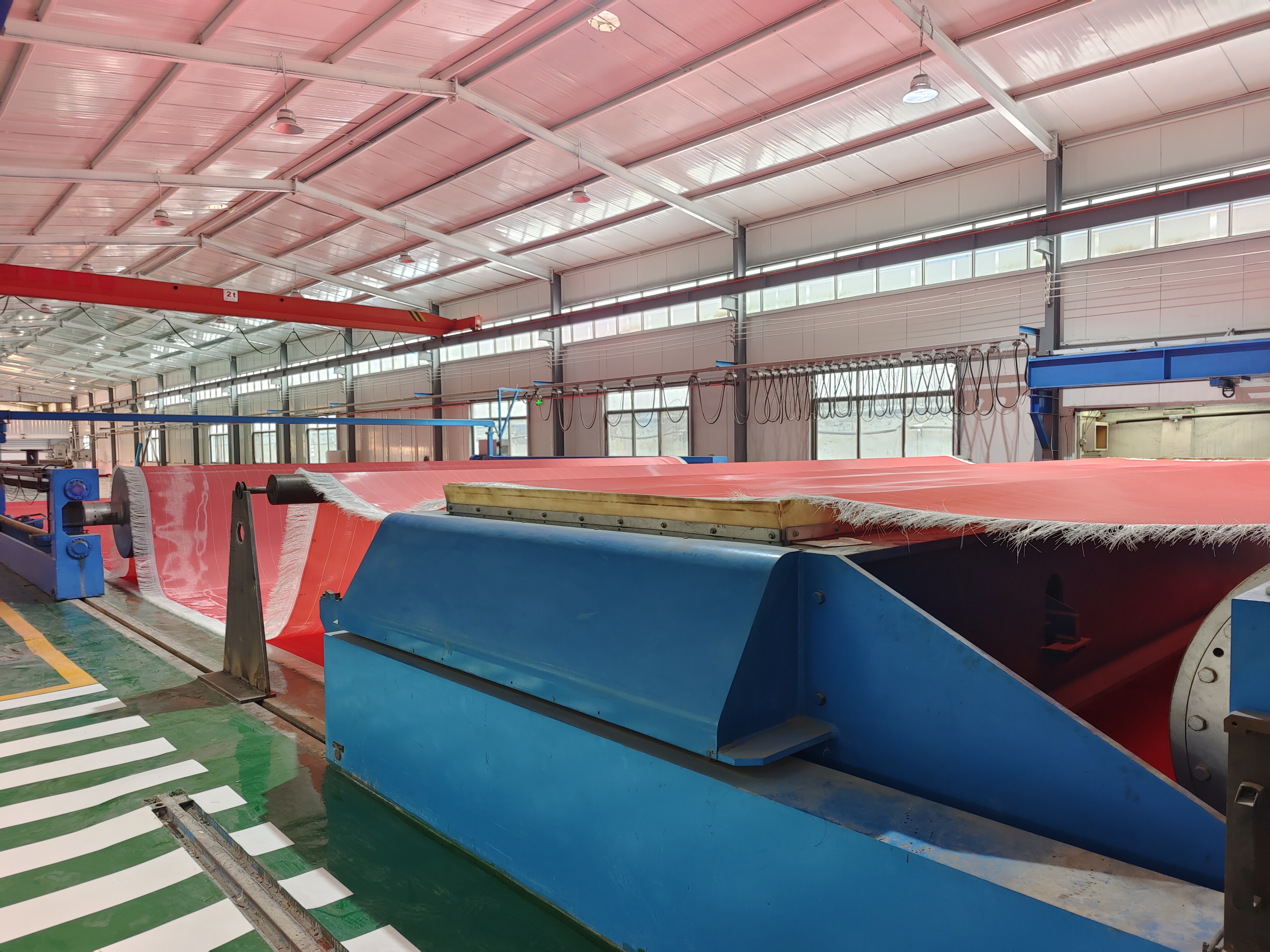 Production activity at Henan Yiheng Mesh Belt Industry Co., Ltd.
Check the Commercial Flexibility
During the research phase, buyers often need a sample, a small custom run or a prototype. Henan Yiheng Mesh states that it supports a minimum order quantity of just 1 m² and can deliver custom prototypes in as little as 3 days. Not every polyester mesh belt manufacturer is prepared to act at this speed, so the ability to request free samples and discuss customization is an important evaluation point.
FAQ: Polyester Mesh Belt Manufacturing Questions
What is a polyester mesh belt made of?
A polyester mesh belt is made from polyester, usually described as PET or high-tenacity PET monofilament. The belt can be woven as a plain weave, square mesh, spiral mesh or herringbone structure. Some specialised belts, such as the UV Printer Belt from Yiheng Mesh, use high-grade black PET with a spiral mesh and flat wire filler.
Which industries use polyester mesh belts?
Polyester mesh belts are used in wastewater treatment, sludge dewatering, papermaking, non-woven textiles, food and feed processing, dairy and juice squeezing, textile finishing, rubber and latex processing, mining, construction and pharmaceuticals. They also appear in digital printing equipment, where a UV belt carries media across a vacuum table.
What is the difference between a polyester filter belt and a polyester dryer belt?
A polyester filter belt is generally designed for pressure filtration, cake discharge and solid-liquid separation. Filter press belt models such as the Large Loop-Filler Wire and Medium Loop-Filler Wire have high break strength and controlled air permeability for dewatering. A polyester dryer belt, often built in spiral mesh form, prioritizes open airflow and rapid moisture removal. Dryer types such as the Large Loop or Medium Loop in drying configuration can reach air permeability values of 18,000–19,000 m³/m²/h.
Are polyester mesh belts safe for food processing?
Several polyester mesh belt models in the Yiheng Mesh catalogue are described as non-toxic and odourless. Models such as 16402 and 05802 can be used in food and feed processing. This is supported by the company statement that its products hold a Food Contact Certificate. Buyers should still confirm the specific belt construction, pigment and joint type with the manufacturer for their exact food-contact application.
Can polyester mesh belt manufacturers supply custom sizes and samples?
OEM and ODM customization is common among specialised mesh belt manufacturers. Henan Yiheng Mesh supports a minimum order quantity of 1 m², provides rapid sampling and can develop custom prototypes in as little as 3 days. The UV Printer Belt is one example where the manufacturer offers customization for size, joints and free samples. Buyers can usually request model-specific technical data, sample pieces and a quote.
How should a buyer contact and evaluate a polyester mesh belt manufacturer?
Ask for the exact model list, air permeability, thickness, material grade, joint type, strength data and the applications that the manufacturer has documented. For Henan Yiheng Mesh Belt Industry Co., Ltd., the contact person is Mrs. Ada Li. Inquiries can be sent to ada@yhfilterbelt.com or by WhatsApp; the official site is https://www.yhfilterbelt.com. A company brochure is also available for download at the end of this article.
Conclusion
Polyester mesh belts are an established and practical solution across filtration, sludge dewatering, drying, forming and conveying duties. Rather than asking simply for a polyester mesh belt, a better procurement question is: which weave, which airflow, which strength and which manufacturer data can support the process?
Plain and square woven meshes offer smooth and finely controlled surfaces. Spiral mesh belts provide flexibility and high-throughput drying or filtration. Filter press belts add the high break strength and cake-release characteristics needed for sludge and process dewatering. Dryer fabrics open up the air path for rapid moisture removal. Specialized UV belts prevent surface defects in digital printing. A manufacturer that can document these categories, offer samples and support small custom runs is considerably easier to evaluate at the research and awareness stage.
Next step for buyers. If you are researching polyester mesh belt manufacturers, obtain model-specific technical data before making a shortlist. Henan Yiheng Mesh Belt Industry Co., Ltd. can provide samples, catalogues and custom quotations.
Contact: Mrs. Ada Li — ada@yhfilterbelt.com | WhatsApp: +86 184 3681 4894
Website: https://www.yhfilterbelt.com/
Download the English company profile: Yiheng Mesh Company Brochure PDF
Have Questions or Need More Details?
Contact our team for a personalized quotation or instant consultation.
Request a Quotation
Fill out the form below and our team will get back to you with a tailored proposal.
WhatsApp Direct Chat
Prefer to chat in real-time? Message us on WhatsApp for instant assistance & quick answers.
- Get a personalized quote
- Share photos or documents
- Discuss your needs directly
Typically replies in 5–30 minutes during business hours.