Polyester Mesh Belt Manufacturer Analysis: Henan Yiheng Mesh Belt Industry Co., Ltd.
Industry Analysis Report | Industrial Equipment & Components | September 2026
Polyester mesh belts have become a core component in dewatering, drying, forming, and conveying systems. This article provides an independent analysis of one China-based supplier, Henan Yiheng Mesh Belt Industry Co., Ltd. (Yiheng Mesh), covering its product portfolio, manufacturing strengths, service capabilities, and procurement value for industrial buyers.
1. Company Overview
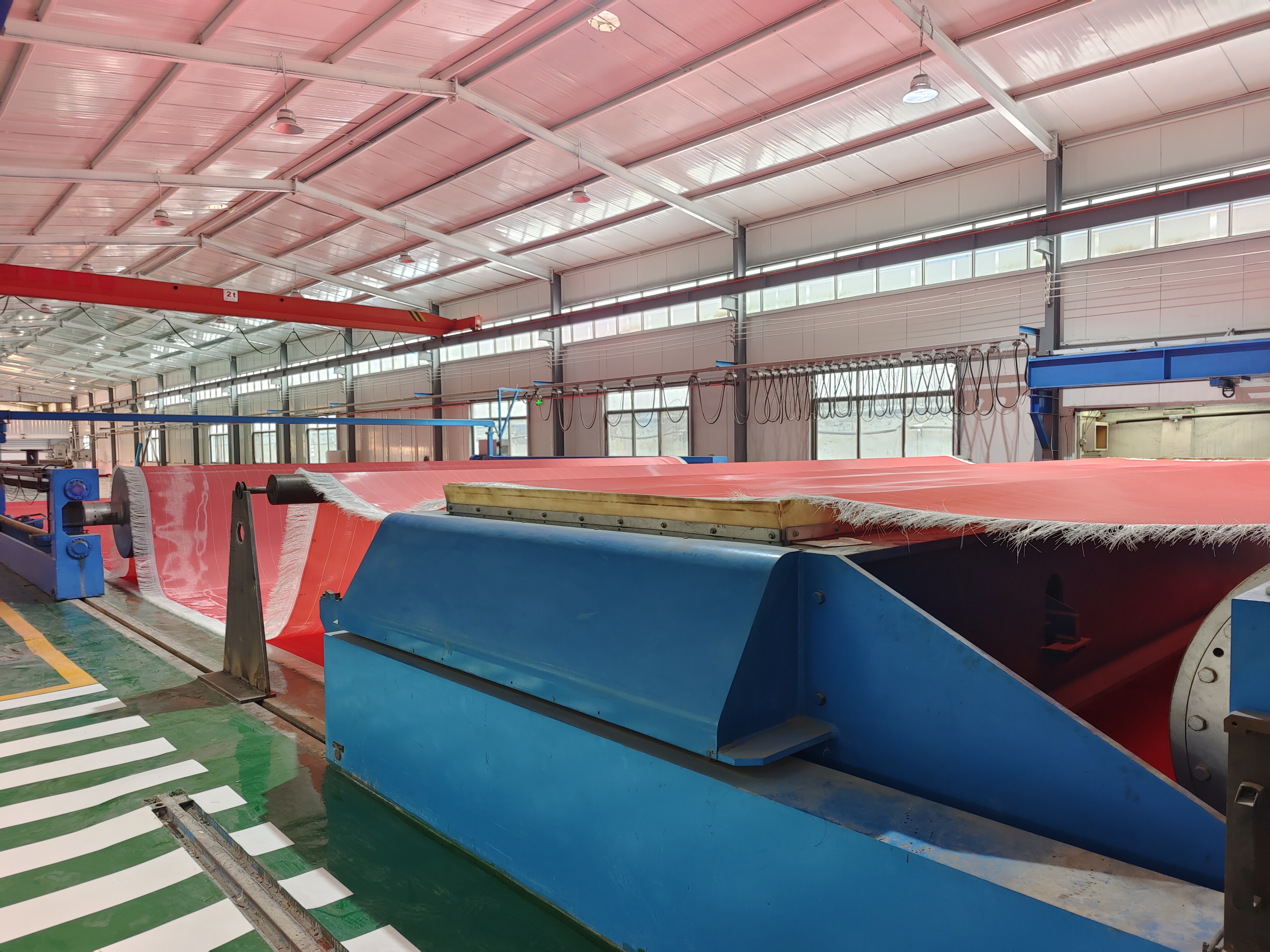
Henan Yiheng Mesh Belt Industry Co., Ltd. is a Chinese manufacturer of industrial polyester mesh belts and related filtration and forming fabrics. The company was founded in 2009 and is formally recognized as a National High-tech Enterprise. Its production base is located at Shanbei Network Industry Cluster Zone, Shenhuai County, Zhoukou City, Henan Province, with its business office in Xinzheng City.
The company focuses on R&D, customization, and manufacturing of high-precision non-woven forming belts and industrial filter belts. Over more than 15 years in the polyester mesh industry, Yiheng Mesh has built a value chain covering raw material selection, precision weaving, and advanced heat-setting treatment.
1.1 Key Corporate Facts
| Attribute | Details |
|---|---|
| Company name | Henan Yiheng Mesh Belt Industry Co., Ltd. |
| Year founded | 2009 |
| Manufacturing facility | 4,237 m² workshop |
| Employees | Approximately 41 staff |
| R&D team | 3 engineers |
| Monthly capacity | 12,800 m² |
| Annual production capacity | 150,000 m² |
| Export share | 62% of total sales |
| Main export markets | Asia, Europe, North America |
According to verified third-party data, Yiheng Mesh also reports an independent workshop of 7,800 square meters with one Swedish TEXO loom, three domestic looms, and four setting equipment units. This facility detail is based on the company’s own published information.
1.2 Position in the Industry
Yiheng Mesh works as a supplier of consumable engineered textiles rather than as a finished-machinery manufacturer. Its customers are therefore equipment builders and end users in nonwovens, papermaking, wastewater treatment, food processing, and digital printing. Because polyester mesh belts are high-wear components, buyers often require consistent quality and repeat procurement. This makes technical consistency and supply stability as important as the initial purchase price.
2. Product Portfolio and Core Solutions
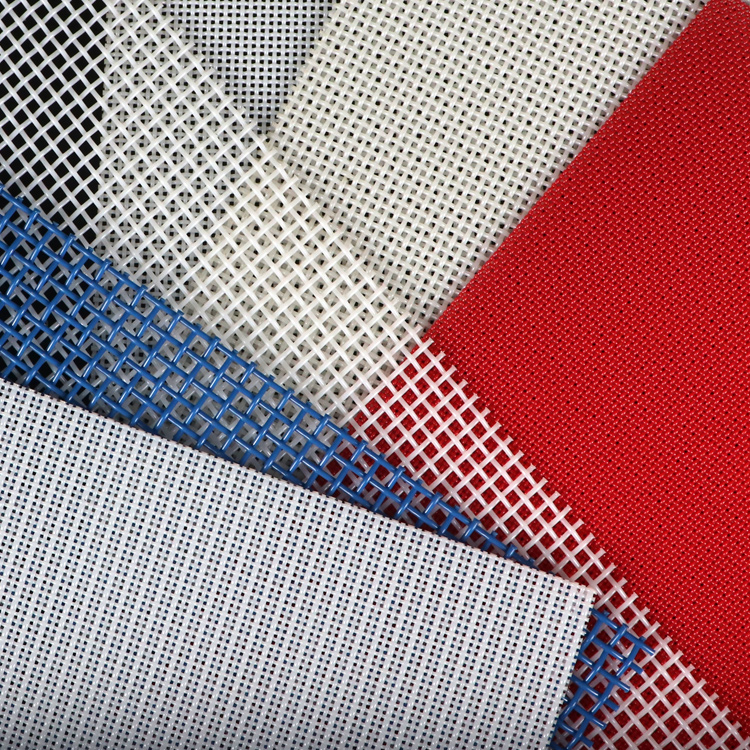
Yiheng Mesh supplies several families of polyester-based technical textiles. Buyers searching for a polyester mesh belt will find options that differ in weave structure, mesh count, air permeability, strength, and typical application.
2.1 Main Product Families
- Polyester Mesh Belt — woven, square mesh, and spiral polyester belts for conveying, forming, drying, and filtration.
- Non-Woven Mesh Belt — belts designed for airlaid, spunbond, meltblown, and related nonwoven lines.
- Forming Fabrics — precision fabrics for papermaking and nonwoven forming.
- Dryer Fabrics — spiral fabrics designed for drying sections and hot-air through-drying.
- Polyester Filter Belt — filtration and dewatering belts for filter presses.
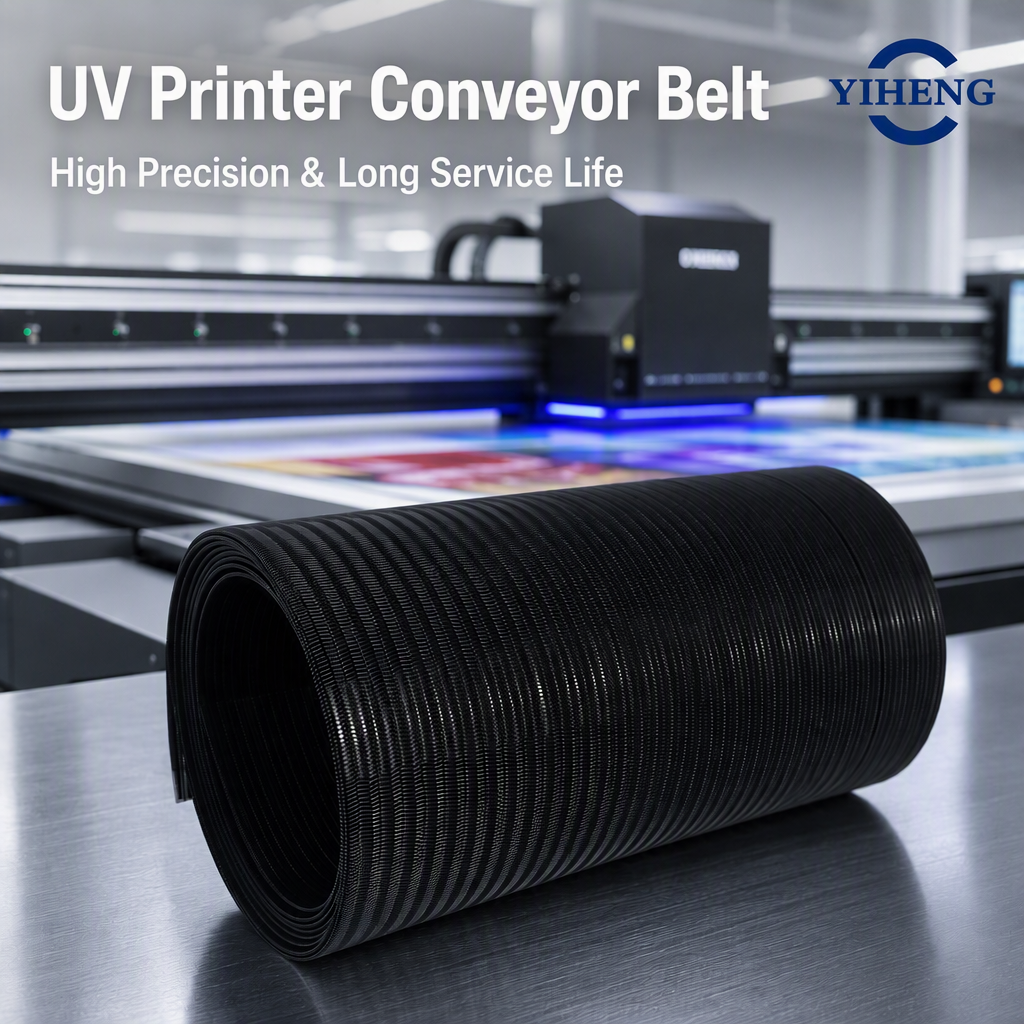
- UV Belts — polyester mesh belts for UV printers and vacuum tables.
- Polyester Spiral Mesh — loop/coil-based mesh with an open structure for drying and dewatering.
- Polyester Square Mesh — plain woven square-mesh belt.
- PTFE Mesh Belt — PTFE-based or PTFE-related belts for release and high-temperature conveying.
2.2 Representative Belt Types and Specifications
The table below shows representative models that a buyer may evaluate when specifying a polyester mesh belt.
| Category / Model | Structure & weave | Air permeability | Thickness | Strength at break | Typical applications |
|---|---|---|---|---|---|
| Small Loop-Filler Wire | Spiral mesh with flat wire filler (0.65×1.65 mm) | 7,300 ±500 m³/㎡/h | 1.90 mm | ≥2000 N/cm | Belt filter press; pulp washing; nonwoven equipment |
| Medium Loop-Filler Wire | Spiral mesh; fillers 0.68×3 or 0.68×4 mm | 10,700–12,000 ±500 m³/㎡/h | 2.32 mm | ≥2000 N/cm | Belt filter presses; dewatering; pulp washing |
| Large Loop-Filler Wire | Spiral mesh; fillers 0.90×3/4/5 mm | 9,000–13,700 ±500 m³/㎡/h | 2.95 mm | ≥2300 N/cm | Heavy-duty dewatering; filter presses |
| Large Loop (Spiral) | Spiral mesh; loop distance 7.00 mm (dryer config.) | 9,000–13,700 (filter press) / 19,000 m³/㎡/h (dryer config.) | 2.95 mm | ≥2300 N/cm | Papermaking; nonwovens; rubber/latex; drying |
| Medium Loop (Spiral) | Spiral mesh; loop distance 6.50 mm | 18,300 m³/㎡/h (dryer config.) | 2.32 mm | ≥2000 N/cm | Drying; papermaking; nonwoven; textile finishing |
| Small Loop (Spiral) | Spiral mesh; flat filler 0.65×1.65 mm | 17,500 m³/㎡/h | 1.90 mm | ≥2000 N/cm | Food; paper; nonwoven; pharma; environmental |
| Square Mesh 05802 | 2-shed plain weave; 0.8 mm warp/weft | 13,384–20,775 m³/㎡·h | — | High tensile strength | Sludge dewatering; food/feed drying; pulp washing |
| Plain Weave Mesh 16402 | 2-shed plain weave; 41 mesh; 0.2 mm pitch | 6,900 m³/㎡·h | — | — | Fine filtration; nonwoven; pharma; food processing |
| Filter Press Belt 16903 | Herringbone/diagonal weave; high-grade PET | 7,894 ±500 m³/㎡·h | — | ≥2200 N/cm | Municipal sewage; mine tailings; pulp pressing; juice squeezing |
| UV Printer Belt | Spiral mesh with flat wire filler; black PET | — | — | — | Large-format UV printing; vacuum tables |
| Forming Fabric | 2-shed plain weave; single layer 3/4/5/8 shed; double-layer; 5–108 mesh | 4,750–29,200 m³/㎡·h | 0.30–1.80 mm | — | Papermaking; nonwoven forming |
2.3 Key Technical Features and Advantages
Several technical properties determine whether a polyester mesh belt delivers value over its service life.
- High and controlled air permeability: Products are offered from fine filtration grades (6,900 m³/㎡·h) to high-flow drying grades (up to 29,200 m³/㎡·h), allowing a buyer to match drainage or drying requirements.
- Strength at break: Filter press belt models meet ≥2000 N/cm or ≥2200–2300 N/cm, which suits high-tension filter presses and vacuum filters.
- Hydrolysis resistance: The forming fabric is made of high-tenacity PET monofilaments, with hydrolysis resistance for wet environments.
- Flat or round wire options: Spiral belts with flat wire fillers increase contact area and improve cake release and surface smoothness in many dewatering applications.
- Acid and alkali resistance: High-grade PET material in models such as 16903 is designed for aggressive chemical environments including mine tailings and municipal sewage.
- Joint options: Endless, self-ring, and (for forming fabrics) double-pins designs give machine builders flexibility during installation.
- Anti-static options: Forming fabrics can be supplied with anti-static properties for high-speed nonwoven and paper lines.
2.4 Application Industries
Yiheng Mesh belts are used across several process industries. The most common application segments are:
- Sludge dewatering and wastewater treatment: Filter press belts and spiral belts for belt filter presses, vacuum rubber belt filters, and horizontal vacuum belt filters.
- Nonwoven manufacturing: Forming and conveyor mesh for spunbond, meltblown, SMS/SSMMS, airlaid, and other nonwoven lines.
- Papermaking: Forming fabrics for sheet forming and spiral dryer fabrics for drying sections.
- Food and feed processing: Food-safe conveyor and dryer belts for drying, conveying, and dewatering.
- Printing and digital imaging: UV belts for vacuum transport through large-format UV printers.
- Mining and minerals: Filter belts for dewatering tailings and process slurries.
3. Manufacturing and Quality Capability
3.1 Production Capacity
Yiheng Mesh operates a standardized facility with a monthly capacity of 12,800 m² and an annual production capacity of 150,000 m². The factory workshop area is 4,237 m² according to the company profile; the company’s own website also references a 7,800-square-meter independent workshop with specific loom counts. Both figures are self-reported but provide a useful scale reference.
3.2 Equipment and Process
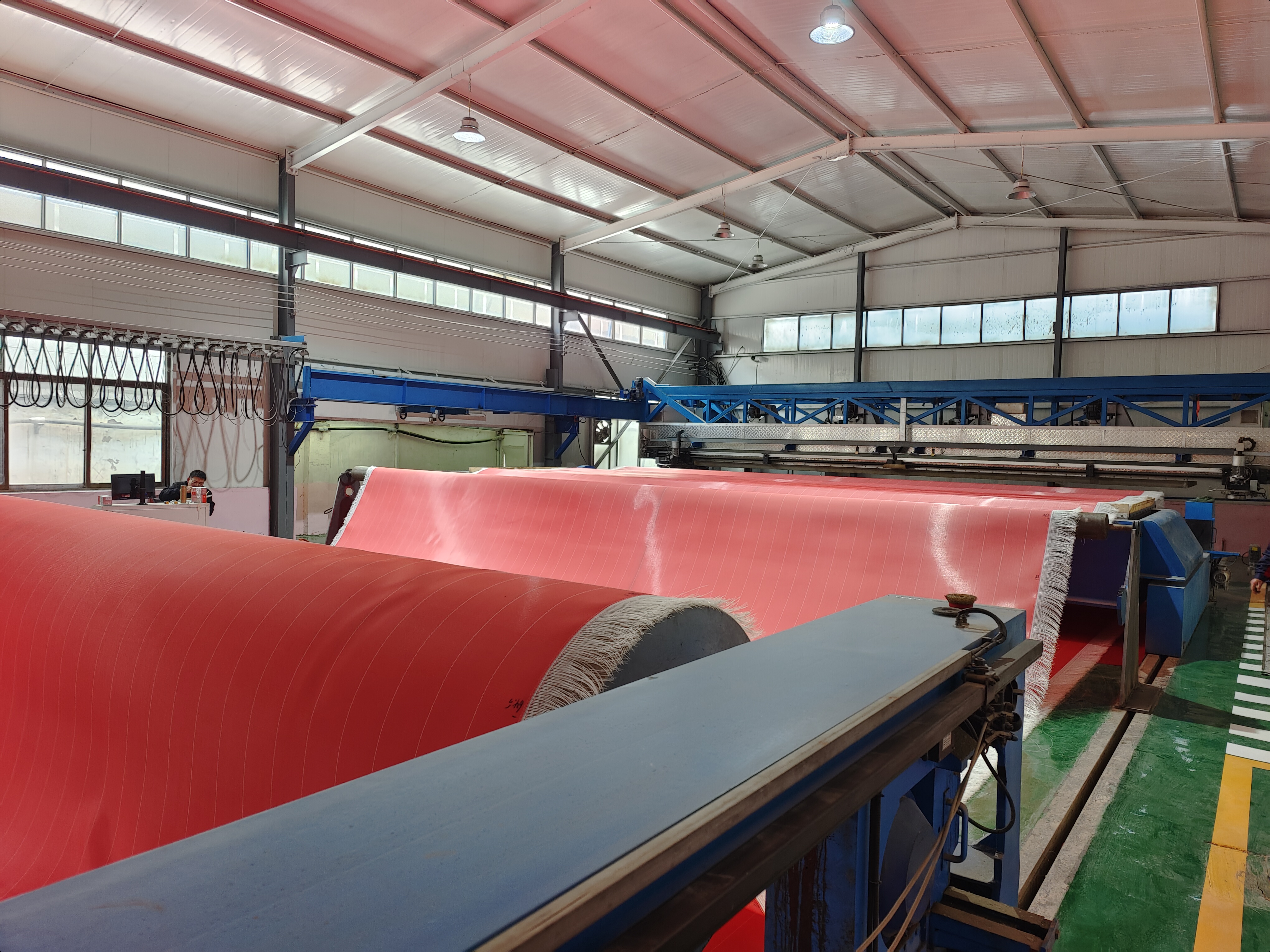
The company states that it uses advanced high-position warping machines and ultra-wide heat-setting looms. Heat-setting is a critical process for polyester mesh belts because it controls dimensional stability, seam flatness, and resistance to off-tracking. The company claims that air permeability (CFM) fluctuations are controlled within ±5%.
Process capabilities include several structural weave types: 2-shed plain weave, single-layer weaves with 3/4/5/8 sheds, and double-layer designs. This range is relevant for papermakers and nonwoven producers, because sheet support and drainage depend heavily on weave architecture.
3.3 R&D and Customization
The company employs a compact R&D team of three engineers. While this is not a large corporate research organization, the team supports product development, sample production, and technical troubleshooting. The company reports two notable material developments: carbon-fiber anti-static technology and hydrolysis-resistant monofilament applications.
For buyers, the practical customization offer includes:
- Custom sizes, joint types, and materials for belts such as the UV Printer Belt;
- Free samples in certain product categories;
- Low MOQ of 1 m² in company marketing materials;
- Rapid sampling reported at 3 days for custom prototypes.
These claims appear in the company’s own sales and technical materials. They are useful as a negotiation reference but should be confirmed through direct inquiry before ordering.
3.4 Quality, Certification, and Compliance
Yiheng Mesh reports the following compliance-related credentials:
- National High-tech Enterprise: Recognized for patents in polyester mesh weaving and processing.
- Food Contact Certificate: Supports use in food processing and food-contact conveying.
- LUCID registration: Registered under the German Packaging Law, indicating attention to EU packaging compliance.
From a verifiability perspective, these certifications are stated by the company. A buyer who needs formal documentation for a regulated application should request certificates during supplier qualification.
4. Global Supply and Market Service
4.1 Export Orientation
Export sales account for 62% of total revenue, with major markets in Asia, Europe, and North America. Yiheng Mesh says it is a partner to nonwoven equipment manufacturers such as Chaolong, Hongda, and Aolong. These names are treated as public references from the company’s profile; independent data was not available.
4.2 What Export Statistics Mean for Buyers
For a component buyer, a high export ratio can indicate that the supplier already handles international logistics, documentation, and packaging requirements. However, export share is not the same as verified installed base. It is still advisable to request reference sites, quality records, and third-party inspection results.
4.3 Service Approach
Yiheng Mesh publishes a technical troubleshooting knowledge base covering more than 122 real-world cases in areas such as belt tracking, fiber hanging, static, and seam marks. The company calls this its “Battle-Tested” technical manual and markets itself as the “Stabilizer of Non-woven Production Lines.” This type of documentation has practical value because belt problems often occur at the interface between the fabric, the machine, and the process.
5. Comparison Framework: How to Evaluate Polyester Mesh Belt Suppliers
The following framework is based on general procurement criteria for engineered filtration media. It is intended for a buyer who is comparing manufacturers.
| Evaluation dimension | What to examine | Relevance to Yiheng Mesh data |
|---|---|---|
| Product fit | Weave structure, mesh, air permeability, strength at break, joint type | Broad matrix available from fine square mesh to heavy spiral and herringbone filter belts |
| Manufacturing consistency | Tolerance on permeability, dimensional stability, heat-setting | Company states ±5% air permeability control and stable heat setting |
| Material properties | Hydrolysis resistance, acid/alkali resistance, food contact, anti-static | PET monofilament; food-contact certificate; anti-static in forming fabrics |
| OEM/ODM support | Sample speed, MOQ, custom sizes and joints | Marketing states MOQ from 1 m², sample in as little as 3 days, free samples for UV belts |
| Field service knowledge | Troubleshooting documentation, response time, installation support | More than 122 troubleshooting cases referenced in company profile |
| Certifications | Food contact, high-tech enterprise, regulatory registrations | Food Contact Certificate; LUCID registration; National High-tech Enterprise status |
Because polyester mesh belts are application-specific, a belt that performs well in one plant may fail in another if process conditions differ. The correct first step is to compare the belt’s technical specification against the actual machine and process parameters, then request a sample or a small custom run.
6. Strengths and Limitations Summary
6.1 Strengths
- Broad product range across nonwoven forming, paper forming, drying, dewatering, and UV printing.
- Filter press belts with high break strength (≥2000–2300 N/cm) address demanding dewatering applications.
- Manufacturing depth from weaving through heat-setting allows custom belts rather than only standard widths.
- Export experience to Asia, Europe, and North America.
- Technical documentation oriented toward solving production problems.
6.2 Limitations and Risks
- The supplier is relatively small (41 staff), which may affect its ability to handle extremely large blanket orders or multi-plant global supply agreements.
- Most manufacturing facts, certifications, and performance claims are self-reported and have not been independently audited in this analysis.
- The R&D team of three engineers is small; advanced product development may be limited compared with large European or Japanese mesh producers.
- Specific international quality certifications such as ISO 9001 were not provided in the verified data.
7. Buyer’s Checklist
- Define the actual application: dewatering, drying, forming, conveying, or printing.
- Identify the machine type and brand: belt filter press, vacuum filter, former, printer, or dryer.
- Confirm operating parameters such as temperature, pH, tension, and chemical exposure.
- Specify required permeability, weave, mesh count, thickness, and joint type.
- Request material documentation, including food-contact certificates or anti-static test reports when relevant.
- Ask the manufacturer for a recommended model and compare it with the table above.
8. Conclusion
Henan Yiheng Mesh Belt Industry Co., Ltd. is a credible Chinese manufacturer for buyers who need engineered polyester mesh belts, especially in nonwoven forming, papermaking, filtration, sludge dewatering, and UV printing. The company has more than 15 years of experience, an export ratio of 62%, and a broad product matrix that spans fine plain-weave mesh to heavy spiral filter belts.
For procurement purposes, the strongest reasons to consider Yiheng Mesh are: the diversity of available polyester mesh belt structures; the ability to produce customized joint types and dimensions; food-contact and hydrolysis-resistant material options; and a supplier profile that supports international buyers through export logistics and technical support.
For an independent technical evaluation, ask for samples, certificates, and a reference that matches your process. A low MOQ and fast sampling process make this relatively easy to verify before committing to large-volume orders.
For more detailed technical data or to request a free sample, contact Henan Yiheng Mesh Belt Industry Co., Ltd. or download the company brochure: Yiheng Mesh Company Brochure.
9. FAQ
What does a polyester mesh belt manufacturer do?
A polyester mesh belt manufacturer engineers and weaves mesh belts from polyester monofilaments for use in filtration, conveying, forming, and drying equipment. The manufacturer typically controls weaving, heat-setting, and joining and finishing processes, and supplies belts with specific mesh counts, permeability, and strength for the customer’s equipment.
Which industries use polyester mesh belts?
Polyester mesh belts are widely used in sludge dewatering and wastewater treatment, papermaking, nonwoven production, food and feed processing, textile finishing, rubber and latex processing, and digital printing.
How do I choose the right polyester mesh belt manufacturer?
Compare technical specifications such as strength at break, air permeability, weave structure, joint type, and material resistance. Check whether the manufacturer can provide sample testing, customization, OEM/ODM service, and reliable export delivery. A manufacturer like Henan Yiheng Mesh Belt Industry Co., Ltd. offers a range of polyester spiral, square mesh, and filter press belt models, plus low-MOQ sampling so that buyers can validate products on their own line.
Can I order a custom polyester mesh belt with a specified mesh size and joint type?
Customization is standard in this product category. Henan Yiheng Mesh Belt Industry Co., Ltd. states that custom sizing and joint options are available, and that the rapid sampling process can deliver custom prototypes in as little as 3 days. Endless, self-ring, and double-pins joint options are available across different product series.
Is a polyester mesh belt suitable for food-contact applications?
Polyester mesh belts can be suitable for food contact if the material composition is compliant and the manufacturer can provide the required documentation. Yiheng Mesh reports holding a Food Contact Certificate and offers non-toxic, odorless polyester belts for food and feed processing applications. Buyers should confirm the relevant national or international requirement with the manufacturer before purchase.
Can I request a free sample before purchasing in bulk?
Several manufacturers, including Yiheng Mesh, offer free samples in selected categories, including the UV Printer Belt. For technical and commercial details, contact the supplier directly and specify the required belt size and specification.
Have Questions or Need More Details?
Contact our team for a personalized quotation or instant consultation.
Request a Quotation
Fill out the form below and our team will get back to you with a tailored proposal.
WhatsApp Direct Chat
Prefer to chat in real-time? Message us on WhatsApp for instant assistance & quick answers.
- Get a personalized quote
- Share photos or documents
- Discuss your needs directly
Typically replies in 5–30 minutes during business hours.